


Trying to build a product without an experienced UX pro is like setting sail without a map. You’ll definitely move, but you're probably heading for choppy waters, wasting precious cash, and leaving a trail of frustrated customers. A consultant UX design expert is your navigator, ensuring every dollar you spend on development is a direct investment in keeping and converting users. For lean, ambitious startups, that distinction is everything.
Why a Fractional UX Leader is Your Startup's Secret Weapon
In the frantic race to launch, it's dangerously easy to ignore the tiny friction points that trip up users. A confusing signup flow, a clunky feature, an illogical menu—each one seems minor on its own. But stacked together, they create a bad experience that sends people running for the exit, killing your growth before it even starts. This is where a strategic fractional UX leader becomes one of the smartest investments you can make.

Connecting UX Directly to Startup Metrics
Thinking of UX as just "making things pretty" is a classic, and very expensive, mistake. A seasoned fractional consultant ties every design decision directly back to the metrics that matter to your business.
- User Retention: An expert digs into why users are leaving and designs practical solutions to keep them around, directly boosting your customer lifetime value (LTV).
- Conversion Rates: They obsess over your most critical funnels—from onboarding to checkout—systematically removing roadblocks to make it simple for users to take action.
- Competitive Edge: A seamless, intuitive product isn't a nice-to-have anymore. It's a massive differentiator that builds real brand loyalty and carves out your spot in the market.
This intense focus on business outcomes is exactly why the global User Experience (UX) Design Services market has exploded. It jumped from $11,728.6 million in 2021 and is projected to smash $38,448.2 million by 2033. That incredible growth, tracked by firms like Cognitive Market Research, highlights just how critical strategic UX has become.
The Fractional Advantage for Lean Companies
For most startups, bringing on a full-time, senior-level Head of UX just isn't in the cards. The hefty salary and long-term commitment are huge hurdles. This is precisely where the fractional leadership model is a game-changer.
Imagine hiring a world-class chef to design your restaurant's menu and train your kitchen staff for just 10 hours a week. You get elite-level expertise shaping your core offering without the cost of a full-time executive chef. That's fractional leadership.
A fractional consultant provides the high-level strategic thinking of a seasoned executive without the full-time price tag. They bring a valuable outside perspective, untangled from internal politics, and are laser-focused on solving your most urgent user challenges. This setup is the perfect growth lever, giving you access to elite talent on a flexible basis.
Defining What You Really Need from a UX Consultant
Hiring a UX consultant without a clear problem is like going to the doctor and just saying, "I feel weird." To get the right prescription, you have to point to where it hurts.
Are users constantly abandoning their shopping carts? Is that shiny new feature you just shipped getting zero love?
Before you even think about writing a job post, you have to diagnose your specific challenge. A top-tier consultant isn't a jack-of-all-trades; they're a specialist you bring in to solve a very precise business problem.
Matching Your Challenge to the Right Engagement
The specific pain points you're feeling will map directly to different kinds of consulting engagements. Each one calls for a unique approach, which is why it's so critical to get this right from the start.
- Strategic Audit: For when you feel your product could be better but don’t know where to start. An expert will dive into your user journeys and analytics to hand you back a prioritized roadmap of opportunities.
- Feature Design and Validation: For when you need to build a new feature or overhaul an existing one. A consultant will take it from user research and wireframing to high-fidelity prototypes and usability testing.
- Rapid Research Sprint: For when you have a single, burning question about your users that’s holding everything up. A consultant can design and run a focused research sprint to get you actionable answers in just a few weeks.
One of the most common mistakes is hiring a hands-on designer when what you really need is a high-level strategist—or vice-versa. Defining the engagement type upfront saves you a ton of time and money.
Crafting a Job Description That Attracts the Best
Once you know what you need, communicate it with absolute clarity. A vague job description attracts vague talent. A precise one acts as a filter, pulling in the exact experts who specialize in solving your kind of problem.
Think of your job description as a concise project brief, not a generic HR template. Clearly lay out the problem, the project goals, key responsibilities, and—this is the most important part—what success actually looks like.
For instance, don't just say "improve user engagement." Get specific. Say something like, "Increase the weekly active user rate for our core reporting feature by 15% within three months." That kind of language speaks directly to results-driven professionals and signals that you're a serious, organized client.
Where to Find and How to Vet Top UX Talent
Once you’ve figured out what you need, the next challenge is finding the right consultant. You could spend weeks sifting through generic freelance sites hoping to get lucky, but that's more like playing the lottery than a sound hiring strategy. Your goal is to find a channel that minimizes your risk and connects you with a true strategic partner.
Comparing Channels for Hiring a UX Consultant
There's a huge difference between a broad marketplace and a highly specialized, curated network. While generic sites offer a massive pool of talent, the entire burden of vetting falls on you. A vetted talent marketplace, on the other hand, does that heavy lifting for you, presenting a pre-qualified shortlist of pros who match your needs.
Here’s a breakdown of the most common channels:
| Hiring Channel | Time to Hire | Cost | Talent Quality and Vetting | Best For |
|---|---|---|---|---|
| Vetted Talent Networks (like Shiny) | 1-3 weeks | Moderate to High (Retainer) | High (Pre-vetted, curated matches) | Startups needing senior, strategic talent quickly without the hiring overhead. |
| General Freelance Marketplaces | 4-8 weeks+ | Low to High (Hourly/Project) | Variable (Requires extensive self-vetting) | Small, well-defined projects where you have the time to screen many candidates. |
| Personal & Professional Networks | 2-6 weeks | Low (No platform fees) | High (Based on trusted referrals) | Tapping into known talent, but the pool is limited and depends on who you know. |
| Specialized Design Agencies | 4-6 weeks+ | High (Project-based or Retainer) | High (Managed team) | Large-scale projects requiring a full team, but less flexible and more expensive. |
| LinkedIn & Job Boards | 6-12 weeks+ | Moderate (Ad spend, recruiter fees) | Variable (Requires full hiring process) | Finding full-time hires or contractors when you have a dedicated internal recruiting function. |
For most early-stage companies, a vetted network offers the most efficient path to high-quality leadership. This decision tree helps visualize how to match your core business goal with the right hiring approach.
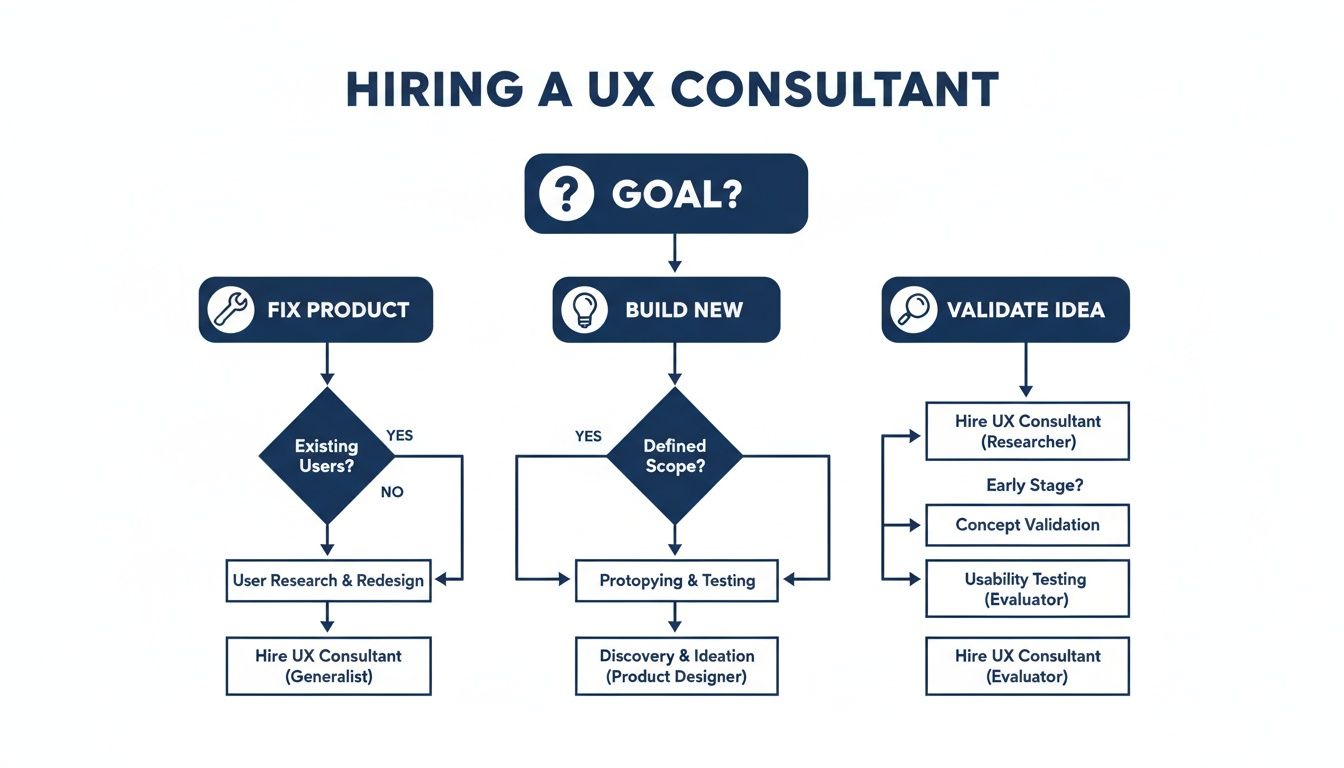

As the flowchart shows, starting with a clear objective is the most critical first step. It clarifies everything that follows.
Moving Beyond the Portfolio
A slick portfolio is table stakes. It proves a designer has taste and technical skill, but it tells you almost nothing about their strategic thinking. To vet top talent, you have to dig into how they think. The best interviews feel less like an interrogation and more like a collaborative problem-solving session.
Here are a few questions to get past the surface-level polish:
- Tell me about a time you used user data to pivot a design decision that the team initially disagreed with. What was the outcome? This gets at their ability to champion user needs with hard evidence.
- How do you ensure your UX recommendations tie back to the company's bigger goals, like increasing revenue? This separates a designer from a true business partner.
- Walk me through your process for handing off designs to engineering. How do you handle technical constraints that pop up? This reveals their collaboration skills and real-world experience.
These questions force candidates to share stories that reveal how they handle conflict, think strategically, and work with a team. For a deeper dive, check out our complete guide on recruiting best practices.
The Soaring Demand for Strategic UX
The need for strategic UX leadership is exploding. UX design consulting is the main driver in a market expected to grow from $8.8 billion in 2026 to an incredible $77.18 billion by 2034. That's a massive 31.20% compound annual growth rate. This means the competition for elite UX leaders is fierce, making fractional engagements an increasingly smart move.
A great consultant doesn't just deliver mockups; they deliver clarity. They challenge your assumptions, ask tough questions, and bring a data-informed perspective that forces the entire team to level up its thinking. Finding this kind of leader isn’t a luxury; it’s a strategic imperative.
Understanding Fractional Models and Pricing
Hiring a top-tier UX design consultant isn't like buying something off the shelf. The pricing and structure depend on what you’re trying to accomplish. Understanding the different fractional models is your key to landing executive-level talent without the hefty full-time price tag.
Think of it like hiring a personal trainer. Do you need someone for a few hours to map out a workout plan (a project)? Or do you need someone in your corner every week, tracking your progress (a retainer)? Each model serves a different purpose.
The Most Common Fractional Engagements
Most consultant gigs fall into one of three buckets. Picking the right one means you're paying for actual progress, not just hours.
- Hourly Rates: Best for small, undefined tasks or grabbing an hour of expert advice. It's flexible but can be tricky to budget.
- Project-Based Fees: Perfect for projects with a clear start and end, like a website redesign. You get a predictable cost for a specific outcome.
- Monthly Retainers: The ideal setup for ongoing strategic guidance. A retainer secures a set number of hours each month, giving you consistent access to an expert who becomes embedded with your team.
We saw a FinTech startup use a 10-hour-per-week retainer to overhaul their onboarding flow. That sustained focus allowed the consultant to iterate based on fresh user feedback, leading to a measurable lift in user activation rates over just two months.
Budgeting for a Fractional UX Consultant
A full-time senior UX consultant can easily command a $140K-$200K annual salary. Fractional engagements, on the other hand, give you access to that same top-tier expertise for a fraction of the cost.
This value proposition is seriously shaking up the market. While design and prototyping still make up 42% of the UX market, the real story is the explosion in UX training, which is growing at an 18.51% CAGR. This shows a huge shift toward building design skills in-house—a process that fractional leaders are perfectly positioned to spearhead. You can read the full research about these UX market trends from Mordor Intelligence.
Fractional hiring lets you bring on an executive-level strategist for a cost often on par with a junior full-time hire. You’re not just saving money; you’re getting a much better return on your talent investment. To learn more about making this model work for you, check out our comprehensive guide to fractional hiring.
Integrating Your New Consultant for Maximum Impact
You’ve signed the contract with a top-tier UX design consultant. Now the real work begins. The difference between a partnership that fizzles out and one that drives incredible results often comes down to the first few weeks. A clumsy onboarding process leaves your new consultant fighting for access and context, burning through your budget just trying to get oriented.
A thoughtful integration process empowers them to start delivering value almost immediately. It’s about strategically embedding them into your team and arming them with everything they need to succeed from day one.

The Day One Onboarding Checklist
Treat your consultant’s first day like you would any new executive hire. The goal is to eliminate friction so they can jump right into solving problems.
- Grant Tool Access Immediately: Get them logins to all critical platforms: Figma, Google Analytics, Mixpanel, Jira, Asana, Slack, or Microsoft Teams.
- Share All Relevant Documentation: Give them access to past user research, product roadmaps, brand guidelines, and existing design files. Don't make them hunt for information.
- Schedule Key Introductions: Book short intro meetings with the Head of Product, lead engineers, and key marketing or sales stakeholders.
A consultant’s greatest asset is their fresh perspective, but that perspective is useless without context. The faster you can immerse them in your business, the faster they can start identifying high-impact opportunities.
Setting the Stage for a Successful Partnership
Beyond setup, establish clear expectations and communication rhythms. A great consultant thrives on clarity and alignment.
Your integration plan also needs to map out how you’ll measure progress. What does a "win" look like? A 10% increase in feature adoption? A measurable drop in support tickets? Setting these benchmarks early ensures everyone is rowing in the same direction and focused on tangible outcomes.
This level of preparation is a hallmark of successful leadership integration. For a deeper dive, check out our guide on modern executive onboarding best practices.
By investing time upfront to create a seamless onboarding experience, you’re not just being a good partner—you’re maximizing the return on your investment.
More Than a Contractor, a Partner in Growth
Bringing on a UX design consultant isn't just about plugging a temporary hole. Think of it as a direct investment in a strategic partner who can genuinely shape the future of your product. If you've followed this guide, you now have the playbook to find, vet, and integrate that person effectively.
The key is to focus on strategic alignment from day one. When you do, their work will deliver real, measurable business outcomes—transforming UX from a simple line item into a powerful engine for sustainable growth.
Got Questions? We've Got Answers
Stepping into the world of UX consulting? It's natural to have questions. Here are a few common ones we hear from founders.
What’s the Real Difference Between a UX Consultant and a UI Designer?
This is a classic. Think of it this way: the UX consultant is your product's architect. They’re obsessed with the strategy, the foundation, and user psychology. They map out user journeys and build wireframes to make sure the entire experience makes sense.
The UI designer, on the other hand, is the interior decorator. They take the architect’s solid blueprint and bring it to life visually with colors, typography, and animations. A brilliant UI can't fix a broken UX, but when it's built on a strong UX foundation, that's when the magic happens.
How Many Hours a Week Do We Actually Need?
That's the beauty of the fractional model. The commitment is based on your startup's current stage and goals.
- An early-stage startup might just need 5-10 hours a week for high-level strategy and research oversight.
- A growing company in the middle of a major redesign might need a more hands-on 15-25 hours a week to drive the project forward.
The point is, you can scale the hours up or down as your needs change, getting senior-level expertise right when you need it.
How Do We Know if a UX Consultant is Actually Doing a Good Job?
A great consultant's impact should never be a mystery; it should be tied to business results. You absolutely must define what success looks like together at the very beginning of the engagement.
Here’s what you should be tracking:
- Quantitative KPIs: Keep a close eye on metrics like conversion rates, task success rates, and your Net Promoter Score (NPS).
- Qualitative Insights: This is the context you get from user interviews, usability testing sessions, and customer support tickets.
Finding the right fractional consultant UX design expert might seem like a huge task, but it doesn't have to be. We specialize in connecting ambitious companies with our curated network of vetted, executive-level talent ready to make a real impact. If you're ready to find a strategic partner to accelerate your growth, we're here to help.
Schedule a consultation today and let's find the perfect strategic partner for your team.