


Traffic is up. Paid spend is up. Your team is shipping landing pages, forms, email flows, and checkout tweaks. But revenue doesn’t move the way it should.
That’s usually the moment founders start asking the wrong question. They ask, “Do we need more traffic?” when the better question is, “Where are we losing the traffic we already paid for?”
That’s the job of conversion optimisation experts. They don’t just make pages prettier. They find where intent dies, where trust drops, where forms create friction, and where messaging breaks between ad click and final action. Done well, CRO is one of the few growth levers that improves performance without forcing you to spend more to acquire the same visitor.
I’ve seen founders delay this hire because it feels secondary to product, sales, or demand gen. It isn’t. If your funnel leaks, every other investment gets less efficient.
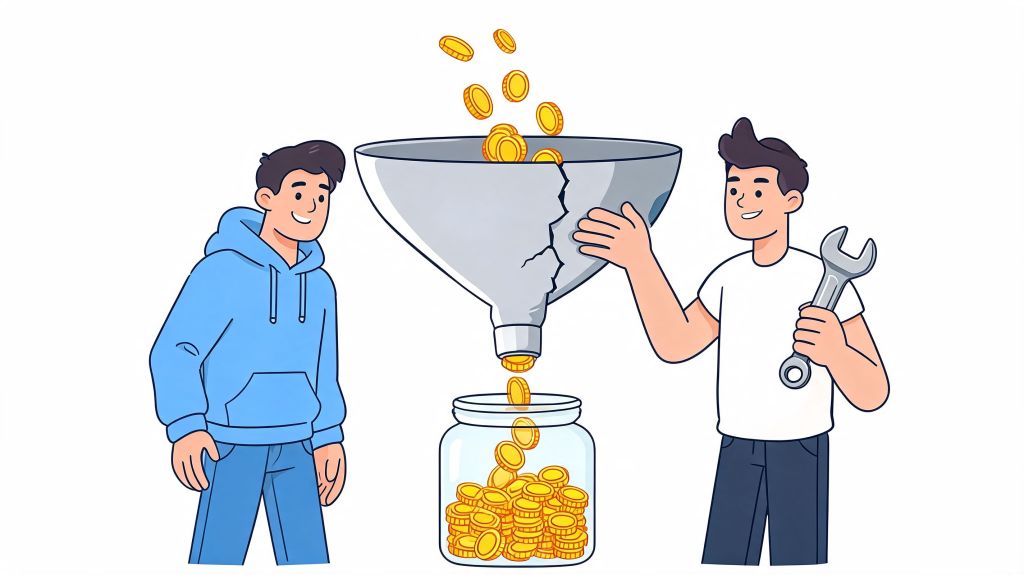
The Leaky Bucket Problem in Your Business
Most businesses don’t have a traffic problem first. They have a traffic-to-revenue translation problem.
Marketing brings people in. Sales asks for better leads. Product wants more activation. Leadership sees dashboards full of activity and still feels that something is off. The missing piece is often simple. Visitors arrive with intent, then hit a confusing page, a weak offer, a clumsy form, or a journey that asks for commitment before trust has been earned.


That’s the leaky bucket. You keep pouring in budget at the top while money escapes through the cracks lower down.
Why CRO deserves executive attention
This isn’t a minor optimisation project for the marketing team. It’s a revenue discipline. According to SQ Magazine’s CRO statistics roundup, businesses using CRO tools see a 223% ROI on average, and even moving from 1% to 3% conversion can triple revenue without increasing traffic acquisition spend.
That’s why serious operators treat CRO as a business system, not a string of random tests.
Practical rule: If you’re spending aggressively to acquire traffic before fixing conversion bottlenecks, you’re paying to scale waste.
What conversion optimisation experts actually fix
A good CRO expert usually starts with questions like these:
- Where does intent break? Is there a mismatch between ad promise and landing page reality?
- Where does trust weaken? Are pricing, proof, or positioning too vague for the buyer to commit?
- Where does friction spike? Are forms, navigation, mobile layout, or checkout steps getting in the way?
- Where are teams guessing? Are decisions driven by opinion instead of funnel data, recordings, surveys, and test results?
The strongest experts don’t obsess over button colors in isolation. They work across messaging, UX, analytics, and prioritisation. They plug the leaks that matter.
Define the Mission Not Just the Job Title
Founders often post for a “CRO expert” as if that title means one clear thing. It doesn’t.
A strong hire starts with the mission. You need to know what outcome this person owns, what kind of funnel they’ll work on, and what kind of constraints they’ll inherit. Otherwise you’ll interview polished generalists who sound capable but aren’t built for your actual problem.
A SaaS funnel is not an ecommerce funnel
A lot of CRO advice still defaults to ecommerce. That’s useful if you’re fixing product pages, cart flow, or checkout abandonment. It’s less useful if you sell software, industrial services, or a high-consideration B2B offer.
As Invesp notes in its guide to effective conversion optimization techniques, content on conversion optimization often fixates on e-commerce tactics, but B2B funnels like demo bookings or trial signups in SaaS have different user journeys and require specialised expertise.
That difference matters in hiring.
A B2B SaaS company might need someone who can improve:
- Demo request quality
- Trial signup flow
- Pricing page clarity
- Sales-assisted funnel handoff
- Lifecycle conversion from trial to paid
An ecommerce brand may need someone better at:
- Product detail page hierarchy
- Cart and checkout flow
- Mobile merchandising
- Offer architecture
- Retention and repeat purchase prompts
Those are different muscles.
Write the mission in plain English
Before you hire, answer these three questions:
What’s broken right now?
Flat trial signups, weak lead quality, low checkout completion, poor mobile conversion, or inconsistent landing page performance all point to different profiles.What are you asking this person to build?
A quick funnel repair project is different from building a durable experimentation program.Where does this person need authority?
If they can’t influence design, copy, analytics, and development prioritisation, they’ll become an advisor with no influence.
Hiring gets easier when you stop describing a person and start describing a problem.
Useful mission statements
These are better than a generic job title:
- Fix our inbound demo funnel and improve visitor-to-meeting conversion
- Build our first serious experimentation program across landing pages and onboarding
- Reduce friction in mobile checkout and improve trust at purchase
- Audit our funnel, identify the highest-value drop-offs, and create a prioritised testing roadmap
A role defined this way filters candidates fast. The right person will respond with process, examples, and trade-offs. The wrong person will answer with buzzwords.
Fractional vs Full-Time The New Leadership Calculus
A lot of founders still assume the serious move is a full-time executive hire. Sometimes it is. Often it isn’t.
For many growth-stage companies, the choice isn’t simply “hire an expert or don’t.” It’s full-time vs fractional. And that decision changes cost, speed, flexibility, and the kind of expertise you gain.


Why the old model breaks for many SMBs
The traditional playbook says to hire a senior leader once the business feels the pain sharply enough. The problem is that many companies between early traction and real scale need senior judgment, but not another full-time executive seat.
That’s exactly where the market gap sits. As Personizely’s analysis of CRO expert hiring points out, most content focuses on full-time hires or agencies, while growth-stage businesses in the $1M to $50M revenue range often can’t justify a $150K+ salary and still need real expertise. It also notes that fractional models of 5 to 25 hours per week fill that gap.
That matches what I’ve seen in practice. A lot of companies don’t need someone sitting in meetings all week. They need a senior operator who can diagnose the funnel, set priorities, build a testing discipline, and keep the team honest.
Side by side decision factors
| Decision area | Full-time CRO leader | Fractional CRO leader |
|---|---|---|
| Cost shape | Fixed salary and ongoing overhead | Flexible retainer or scoped engagement |
| Speed to start | Longer hiring cycle | Usually faster to activate |
| Experience range | Deep in one environment over time | Broad pattern recognition across multiple environments |
| Flexibility | Harder to scale up or down | Easier to match to current need |
| Best use case | Large, mature program with ongoing volume | Growth-stage company needing strategic lift and structure |
What full-time gets right
A full-time leader makes sense when CRO is already a large internal function. If you have steady experiment volume, multiple product surfaces, a healthy analytics stack, and enough design and engineering support, a dedicated leader can compound value over time.
Full-time also helps when the role needs deep internal alignment across product, lifecycle, paid acquisition, and revenue operations.
What fractional gets right
Fractional works best when the company needs senior judgment more than managerial presence.
Consider it hiring a world-class chef for the meals that matter most instead of putting them on payroll before you know how often you’ll use the kitchen. If the funnel needs sharper diagnosis, stronger prioritisation, and a cleaner testing roadmap, fractional is often the smarter buy.
A good fractional CRO leader can:
- Audit your full funnel quickly
- Clarify where effort is being wasted
- Build a realistic test roadmap
- Create accountability without adding executive bloat
- Coach internal marketers, designers, and analysts
The trade-off founders miss
The risk with full-time is overcommitting before the role is fully defined. The risk with fractional is under-scoping the authority needed to make change stick.
If you go fractional, don’t hire for “advice.” Hire for ownership of a specific mission. Give access to analytics, calls, recordings, copy, and decision-makers. Otherwise you’ll get a smart diagnosis and very little movement.
For a broader view of how flexible executive hiring changes the equation, this guide on the fractional C-suite advantage in executive leadership is worth reading.
How to Source and Attract Elite CRO Talent
Sourcing good CRO talent is harder than most founders expect. Plenty of candidates can talk about testing. Far fewer can look at a funnel, spot the actual bottleneck, and explain what they’d do first.
That gap matters because the upside is real. As Matomo’s CRO benchmark analysis shows, top-performing websites convert above 11.45% while the industry average hovers around 2.35%. The spread is so large that the quality of the operator matters far more than a polished resume.
Start with channels, but don’t stop there
You can source through LinkedIn, niche communities, specialist recruiters, and referrals. Those all work. But each one has friction.
LinkedIn gives you volume, not clarity. Recruiters can help, but many don’t know how to vet experimentation depth. Referrals are excellent if you already know experienced operators. Most founders don’t have that network in-house.
That’s why curated talent routes often outperform broad search. They cut out a lot of noise.
For founders hiring adjacent growth leadership roles, this playbook on how to hire a CMO is useful because the evaluation logic is similar. You’re screening for strategic judgment, not just channel vocabulary.
What to look for in the first conversation
A serious candidate should be able to discuss:
Their diagnostic approach
Ask how they decide whether the problem sits in traffic quality, message match, page friction, offer structure, or post-click trust.Their research stack
Look for comfort with tools like GA4, heatmaps, session recordings, funnel reports, on-site surveys, and experiment logs.Their prioritisation logic
Strong candidates don’t jump straight to tactics. They explain why one test should happen before another.Their view on failure
Good experts have run tests that lost. Better experts can explain what those losses taught them.
A candidate who only talks about wins usually hasn’t run enough meaningful experiments.
Interview prompts that reveal the real operator
Use questions that force thinking, not rehearsed answers:
- Walk me through a test that failed and what changed in your process afterward.
- If you inherited our funnel tomorrow, what would you audit first and why?
- How do you decide whether a conversion issue is a traffic problem or a page problem?
- When do you push back on stakeholders who want to test their own ideas first?
- What would make you say we’re not ready for A/B testing yet?
The best candidates usually sound less flashy
Founders sometimes get pulled toward the best storyteller in the room. Be careful. Strong conversion optimisation experts often sound methodical, even cautious. That’s usually a good sign.
You don’t want a hype machine. You want someone who can tell the difference between a nice idea and a test worth running.
Design a Live Test to Reveal True Expertise
Interviews are useful, but they’re not enough. CRO is one of those disciplines where charm can hide shallow thinking.
The best hiring filter I know is a compact live exercise. Not a giant take-home project. Not free consulting. A focused diagnostic task that shows how the candidate thinks under real constraints.

Why a live exercise beats another interview round
A lot of teams still hire CRO people based on personality, screenshots of dashboards, and generic claims about experimentation culture. That’s how you end up with opinion-led testing dressed up as strategy.
A better standard is process. According to Viacon’s review of conversion optimization mistakes and the CRE Methodology™, a rigorous, step-by-step framework avoids random testing, and data-driven prioritization can improve A/B test success rates from a typical 10 to 20% to over 40 to 60%.
That’s exactly what your hiring process should probe. Not whether they know the vocabulary, but whether they can apply disciplined reasoning.
A simple format that works
Give the candidate a narrow brief using real business context. For example:
- A landing page
- A funnel snapshot from GA4
- A few session recordings or summary notes
- Basic context on traffic source and target customer
Ask for three outputs:
- The top issues they see
- One prioritised hypothesis
- How they’d validate it before launching a test
You’re not hiring them to redesign the whole business in a slide deck. You’re checking whether they can separate signal from noise.
What a strong response includes
Look for these traits:
A clear diagnosis
They identify likely friction points instead of listing cosmetic changes.Evidence before opinion
They refer to user behavior, funnel steps, message mismatch, or trust gaps before suggesting fixes.A sharp hypothesis
Not “change the CTA.” More like: if we tighten the value proposition and reduce form friction for high-intent visitors, more of them will complete the next step.Prioritisation
They explain why this test comes first.
Good CRO operators don't just spot problems. They rank them.
Red flags in the exercise
Watch for candidates who:
- Jump straight to design preferences
- Recommend too many tests at once
- Talk about best practices as if they’re universal truths
- Ignore buyer intent and traffic source
- Treat every funnel like ecommerce
A live test usually reveals within minutes whether someone has real operating depth. It’s the fastest way I know to separate a practitioner from a performer.
Set Up for Success Contracting Onboarding and KPIs
Even a strong hire can fail in a weak setup. Founders lose momentum under these circumstances. They spend weeks finding a good person, then hand them partial access, vague goals, and a pile of stakeholder opinions.
That almost guarantees slow progress.

As S2W Media’s CRO guidance notes, 78% of companies are dissatisfied with their conversion rates, often because of poor user research and weak testing rigor. One of the best early KPIs for a new CRO expert is simple: establish a data-backed testing program that moves the team away from gut-feel decisions.
Choose the right contract model
Different scopes need different structures.
| Contract model | Best fit | Watch-out |
|---|---|---|
| Project-based | One audit, one funnel fix, one launch | Can end before internal habits improve |
| Retainer | Ongoing oversight, roadmap management, recurring testing | Needs clear scope and cadence |
| Hourly advisory | Specific expert input for an existing team | Easy to underuse and hard to operationalise |
For most growth-stage companies, a retainer tends to work best because CRO needs continuity. Research, prioritisation, implementation, and review rarely happen cleanly in one short burst.
A practical 30 60 90 day rhythm
First 30 days
Access matters more than action volume in the first month.
- Give full visibility into GA4, ad accounts, landing pages, CRM stages, heatmaps, recordings, and past test history
- Map the funnel from first click to conversion event
- Review sales calls and customer objections if you have them
- Identify obvious blockers that don’t require debate
Next 60 days
Following diagnosis, the expert should move to structured execution.
- Build a prioritised experimentation backlog
- Define hypothesis format and decision criteria
- Launch the first meaningful tests
- Create a reporting rhythm that stakeholders can follow
By 90 days
You should see whether the operating model works.
- A clear testing system
- Shared definitions of success
- Better alignment across marketing, design, product, and sales
- Evidence that decisions are getting sharper, even before all lagging results fully show up
For broader guidance on setting leaders up quickly, this article on executive onboarding best practices for modern leadership success is a useful companion.
KPIs that keep the role honest
Don’t judge the role on one lagging metric alone. Use a mix.
Program health
Is there a real research and testing cadence, or is everything still reactive?Quality of hypotheses
Are tests rooted in observed friction and user behavior?Cross-functional throughput
Can design and development ship what gets prioritised?Business outcomes
Over time, the work should improve conversion efficiency, not just produce a pile of experiments
If your CRO expert can’t get access, buy-in, and implementation support, you don’t have a performance problem. You have an operating problem.
What founders should avoid
The failure modes are predictable:
- Micromanaging test ideas instead of evaluating the process
- Forcing vanity experiments that matter internally but not commercially
- Withholding customer insight from sales, support, or success teams
- Expecting instant miracles before enough research and test cycles exist
- Judging the hire only by presentation quality
The best setups give the expert room to diagnose, enough authority to influence execution, and a scoreboard the whole leadership team understands.
Your Next Hire Can Be Your Biggest Growth Lever
The right CRO hire changes how a business grows. You stop treating conversion problems like isolated page issues and start managing them as a system.
That system starts with a clear mission. Then comes the hiring model that fits your stage. Then a vetting process that tests judgment, not confidence. Then onboarding and KPIs that create real accountability.
For most growth-stage companies, the biggest shift is this: you don’t need to wait until you can justify a permanent executive seat to get senior-level conversion leadership. Fractional access has changed that. It gives founders a way to bring in experienced conversion optimisation experts without locking into the wrong structure too early.
If traffic is already flowing and results still feel thinner than they should, this is often the next highly effective hire. Not because CRO is fashionable. Because fixing leaks beats buying more water.
If you’re exploring a fractional route, Shiny helps growth-stage companies connect with vetted executives for 5 to 25 hours a week, including senior CRO and growth leaders who can diagnose funnel issues, build testing discipline, and drive meaningful improvement without the overhead of a full-time hire. If you want help finding the right fit, it’s a practical place to start a conversation.