


At its core, the customer acquisition cost calculation is pretty straightforward: take your total sales and marketing spend for a period and divide it by the number of new customers you brought in. But don’t let the simple formula fool you. This is the number that tells you exactly what you’re paying to win over each customer.
Getting this calculation right is the first, and most critical, step toward building a business that’s not just growing, but is actually profitable and sustainable for the long haul.
Why Mastering CAC Calculation Is Your Secret Weapon

In today’s market, just knowing your Customer Acquisition Cost (CAC) isn’t going to cut it. It’s a start, but truly mastering the calculation is what separates the businesses that just get by from the ones that dominate their industry. Think of it less like a marketing metric and more like a vital sign for your company’s overall health and direction. A precise CAC informs everything from budget talks to your entire pricing strategy.
This has never been more important. Acquiring customers is getting more expensive by the day. One report found that CAC has shot up by a jaw-dropping 222% since 2013. During that same window, the average loss per new customer went from $9 to $29. This paints a clear picture of just how inefficient many marketing strategies have become.
To really nail this down, you need to be meticulous about what goes into your calculation. It’s more than just ad spend. Here’s a look at the key inputs you should be tracking.
Key Inputs for Your CAC Calculation
| Component | Description | Example |
|---|---|---|
| Marketing Spend | All costs associated with your marketing campaigns and content creation. | Ad spend (Google, Meta), SEO tools, content writers, email marketing software. |
| Sales Team Costs | Salaries, commissions, and bonuses for your sales representatives. | Base salaries for your SDRs, commission payouts on closed deals. |
| Salaries (Marketing) | Compensation for all marketing team members. | Salaries for your CMO, social media manager, content strategist, etc. |
| Overhead | A portion of general business expenses that support sales and marketing. | Rent for office space, utilities, software licenses (e.g., CRM, analytics tools). |
Once you start tracking these components, you move from a fuzzy estimate to a crystal-clear picture of what it truly costs to grow your business.
A Compass for Sustainable Growth
A well-calculated CAC is your business’s North Star. It cuts through the noise and gives you the clarity to make tough financial calls and ensure you’re around for the long term. Without it, you’re flying blind, throwing money at campaigns and just hoping for a decent return.
This metric is so powerful because it creates a direct line between your spending and your results. It helps you finally answer those nagging questions about your business model:
- Are our marketing channels actually working?
- Is our pricing model going to keep us afloat?
- How long will it take to actually make our money back on a new customer?
By regularly running a customer acquisition cost calculation, you turn abstract spending into concrete, actionable data. This data gives you the power to justify budgets, fine-tune campaigns, and build a growth engine that doesn’t just acquire customers—it acquires them profitably.
Ultimately, a deep understanding of your CAC is what lets you build a more predictable, scalable business. You shift from guesswork to a data-driven approach, making sure every dollar you put toward growth is a smart investment, not just another expense. This isn’t just about crunching numbers; it’s about making the strategic decisions that will fuel your company’s future.
Getting the Right Data for an Accurate CAC
Your Customer Acquisition Cost is only as reliable as the data you feed it. Garbage in, garbage out isn’t just a saying—it’s a hard truth that can lead to blown budgets and flawed strategies. To get this right, you have to be meticulous about what you include.
First, let’s round up all the obvious marketing expenses for the time period you’re measuring. This isn’t just your ad spend; it’s everything that goes into your marketing engine.
- Ad Spend: Break this down by channel (Google Ads, LinkedIn, etc.) and date.
- Marketing Team Salaries: Everyone on the marketing payroll for that period.
- Agency Fees: Any costs for outside help on campaigns or creative work.
- Software Subscriptions: Your CRM, email marketing platforms, analytics tools, and so on.
Next up, the sales team. Their costs are a huge piece of the puzzle and can easily make up over 40% of your total CAC. Don’t just look at base salaries; you need to include commissions and any performance bonuses tied to new customer acquisition.
Then there are the less obvious costs that are so easy to forget. Think about overheads like office rent, utilities, and even shared software licenses that support the sales and marketing teams. These might seem small individually, but they can add up to thousands of dollars every month and quietly inflate your true CAC.
Common Pitfalls to Sidestep
One of the most common mistakes I see is teams overlooking departmental overhead. When you leave out general business expenses, your CAC looks artificially low, giving you a false sense of efficiency.
Another classic trap is letting retention costs sneak into your acquisition calculation. The money you spend on customer support, success managers, and churn-prevention campaigns belongs firmly in the retention bucket. Mixing them blurs the line between what it costs to get a customer versus what it costs to keep one.
Also, watch out for how you classify big, one-time expenses. If you lump a major rebranding campaign or a product launch event into a single month’s calculation, it’s going to create a massive spike that makes long-term trend analysis nearly impossible.
Key Insight: The secret is consistency. Allocate your costs the same way every single month. This allows for clean, apples-to-apples comparisons so you can track your CAC without any nasty surprises.
Where to Pull Your Numbers From
The data you need is probably scattered across a few different departments, which is a recipe for errors. Finance, marketing, and sales don’t always speak the same language, and manually pulling numbers from different spreadsheets is a nightmare.
Your best bet is to create a single source of truth. This could be a dedicated CAC tracking spreadsheet or a more advanced reporting dashboard, but the goal is to centralize all your cost inputs.
Here’s where to look:
- Finance Ledger Exports: Your accounting team is your best friend here. They can provide clean exports for salaries, overhead, and general software costs.
- Campaign Cost Reports: Dive into your marketing platforms like Google Analytics or Meta Ads Manager to get granular ad spend data.
- Vendor Invoices: Don’t forget to check the actual invoices from agencies and software providers to validate your subscription fees.
Finally, you need to be absolutely sure about the number of new customers you acquired during the period. Get this number directly from your CRM or billing system. A small mismatch here will throw off the entire CAC formula.
Once you’ve gathered every cost line item, add them all up. Then, divide that total by the number of new customers. This final step is where your raw data transforms into an actionable metric that truly reflects your performance.
I recommend auditing your data sources and your calculation process at least quarterly. It’s a simple habit that prevents small errors from creeping in and keeps your CAC aligned with reality.
Putting the CAC Formula into Practice
Alright, you’ve done the hard work of gathering all your cost data. Now it’s time to actually plug it into the customer acquisition cost calculation and see what story the numbers tell.
The formula itself is refreshingly simple, which is great because it cuts through all the noise to give you one powerful metric.
Total Sales & Marketing Costs / New Customers Acquired = Customer Acquisition Cost (CAC)
Think of this calculation as the bridge connecting what you spend to how you grow. It takes a messy list of expenses and turns it into a single, clean indicator of how efficiently your go-to-market engine is running.
Let’s walk through a real-world scenario to make this concrete.
A Monthly CAC Calculation Example
Imagine you’re running a B2B SaaS startup and want to figure out your CAC for last month—let’s call it May. First, you’ll need to pull together all the relevant costs for that month.
Here’s a plausible breakdown of your expenses:
- Ad Spend: You invested $10,000 across Google Ads and LinkedIn campaigns.
- Salaries: Your two-person marketing team and three sales reps have combined monthly salaries of $35,000.
- Commissions & Bonuses: The sales team crushed it and earned $8,000 in commissions for deals closed in May.
- Tools & Software: Your tech stack—CRM, analytics, marketing automation—cost you $2,000 for the month.
Add it all up, and your total sales and marketing spend for May comes out to $55,000.
Next, you dive into your CRM and billing system. The data shows you brought on 100 new paying customers in May. Perfect. Now you just pop those numbers into the formula.
$55,000 (Total Costs) / 100 (New Customers) = $550 CAC
There it is. For every new customer you signed in May, it cost your business $550. That’s your baseline.
Extending the Calculation to a Full Quarter
Calculating CAC on a monthly basis is fantastic for catching short-term trends, but a quarterly view often tells a more balanced story. Why? Because it smooths out the inevitable bumps in the road, like a single high-spend marketing campaign or a slow holiday month that might otherwise skew a 30-day snapshot.
Let’s stick with our SaaS startup and zoom out to look at the entire second quarter (April, May, and June).
| Expense Category | Total Q2 Costs |
|---|---|
| Ad Spend | $32,000 |
| Salaries | $105,000 |
| Commissions & Bonuses | $25,000 |
| Tools & Software | $6,000 |
| One-Time Event Cost | $10,000 (for a conference) |
| Total Costs | $178,000 |
During this three-month period, the company successfully acquired 325 new customers.
$178,000 / 325 = $547.69 CAC
The quarterly CAC of $547.69 is remarkably close to the May-only result. This consistency is a good sign, suggesting the company’s acquisition machine is running smoothly. If that number had been wildly different, it would be a clear signal to dig in and figure out what changed—for better or worse.
Your CAC is a living, breathing metric. It will naturally fluctuate with seasonality, campaign performance, and strategic pivots. Calculating it over different timeframes is how you get a complete picture of your business’s health.
The image below breaks down the CAC formula into its simplest parts.
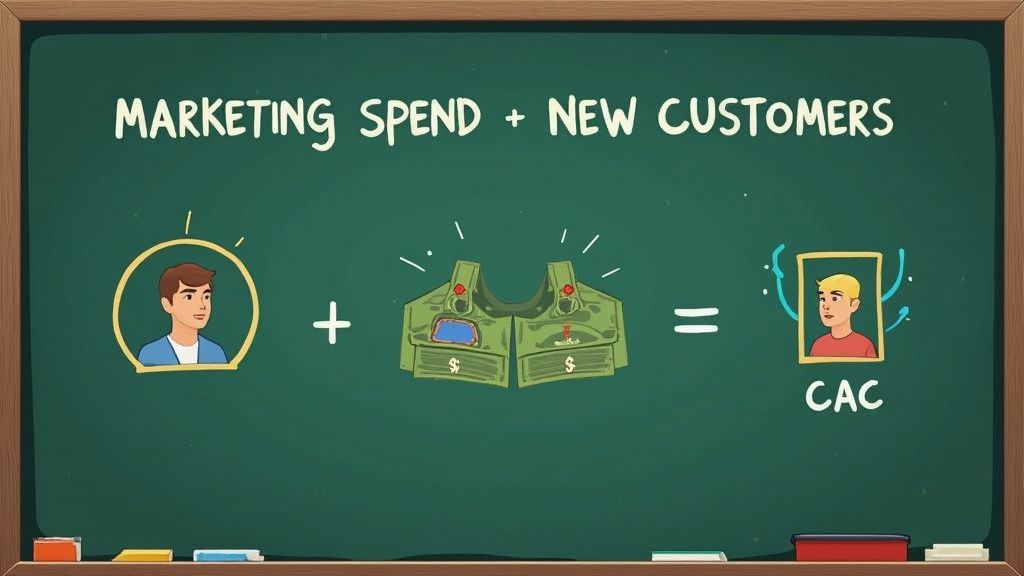
As you can see, it all boils down to two key variables: the comprehensive cost of your go-to-market efforts and the total count of net-new customers you brought in during that same period. Get those right, and you’re golden.
What Your CAC Number Is Really Telling You
Running the customer acquisition cost calculation is a great first step, but the number you get is only half the story. A CAC of $550 might be fantastic for one business and a complete disaster for another. The real magic happens when you start putting that number into context to understand your company’s actual health and long-term viability.
This is where you graduate from simple arithmetic to strategic financial analysis. Your CAC only becomes truly powerful when you pair it with other key business metrics. It helps you answer the most critical question of all: is our growth engine actually sustainable?
The Ultimate Health Metric: The LTV to CAC Ratio
The single most important metric for interpreting your CAC is the Lifetime Value (LTV) to CAC ratio. This simple comparison pits what you spend to get a customer against the total revenue you can expect to earn from them over their entire relationship with your company.
It’s the ultimate test of a sustainable business model.
- LTV: The total revenue a single customer is projected to generate.
- CAC: The total cost to acquire that customer.
Let’s use a real-world example. If your average LTV is $1,800 and your CAC is $550, your LTV:CAC ratio is roughly 3.3:1. This is great news—it means for every dollar you spend acquiring a customer, you get $3.30 back.
Most investors and SaaS experts I talk to agree that a healthy ratio to aim for is 3:1 or higher.
A ratio below 1:1 is a massive red flag. It means you’re actively losing money on every new customer you bring in. A 1:1 ratio isn’t much better; you’re just breaking even on the acquisition, leaving no margin for operational expenses or, you know, profit.
Understanding Your CAC Payback Period
Another critical piece of the puzzle is the CAC payback period. This metric tells you exactly how many months it takes for a new customer to generate enough revenue to cover their own acquisition cost.
Why does this matter so much? Because a shorter payback period means you recoup your investment faster, freeing up precious cash flow to reinvest in more growth.
For subscription businesses, you can figure this out with a pretty simple formula:
CAC / (Average Revenue Per Account x Gross Margin %) = Payback Period in Months
Let’s go back to our example. If your CAC is $550 and a customer pays $100 per month with an 80% gross margin, your payback period is just under seven months ($550 / $80). This timeline is especially vital for startups, where a long payback period can put a serious strain on cash reserves. Honestly, understanding and optimizing this payback timeline is a core function that many businesses rely on fractional CFO firms to manage and optimize.
It’s also crucial to remember that your CAC doesn’t exist in a vacuum. Broader market dynamics heavily influence what’s considered a “good” CAC. For instance, the mobile app space has seen acquisition costs jump by about 60% in the last five years. This surge is driven by stricter privacy rules like Apple’s iOS 14.5 update and the phasing out of third-party cookies, making it way more expensive to reach potential users.
How Your CAC Stacks Up Against Industry Benchmarks

So, you’ve done the work and calculated your Customer Acquisition Cost. You’re left staring at a number. But what does that number actually mean?
A $400 CAC might be a huge win for one company and a five-alarm fire for another. Without context, it’s just a data point. To make it meaningful, you have to see how it compares to the rest of your industry.
Comparing your CAC against industry benchmarks is the best way to get a real-world perspective. It shifts your focus from an internal-only view to one that accounts for the market forces everyone in your sector is facing. Knowing where you stand is the first step to setting realistic growth targets.
Why Do CAC Benchmarks Vary So Much?
As you dig in, you’ll notice that average CACs can be wildly different from one industry to the next. This isn’t random; a few key factors drive these variations, and understanding them will help make sense of your own costs.
- Product Price Point: This one’s pretty straightforward. High-ticket items can justify a higher CAC. A business selling enterprise software for $50,000 a year can afford to spend much more to land a customer than a D2C brand selling $50 t-shirts.
- Sales Cycle Length: The longer it takes to turn a lead into a paying customer, the more your costs pile up. B2B sales cycles, for example, often drag on with multiple touchpoints, demos, and negotiations, which naturally drives up the final acquisition cost.
- Market Maturity: In a crowded, mature market, the competition for customer attention is fierce. This almost always leads to higher ad spend and acquisition expenses across the board as everyone fights for the same eyeballs.
Key Takeaway: Don’t get hung up on a broad, all-industry average. You need to dig into the benchmarks for your specific niche—whether that’s FinTech, HealthTech, or B2B SaaS—to get a comparison that actually means something.
This industry-specific lens is critical. For instance, the complexity of B2B software development leads to a combined average CAC of around $720. Heavy industries like oil and gas see an even higher CAC near $783, while something like legal services can swing anywhere from $584 to $1,245.
To give you a better feel for where things land, here’s a look at some average CAC values across different sectors.
Average Customer Acquisition Cost (CAC) by Industry
This table provides a comparative overview of typical CAC values across different business sectors. Use it to get a rough idea of how your own performance stacks up.
| Industry | Average CAC (Approx.) |
|---|---|
| Travel | $7 |
| Retail | $10 |
| Consumer Goods | $22 |
| Manufacturing | $83 |
| Transportation | $98 |
| Marketing Agency | $141 |
| Financial | $175 |
| Technology (Hardware) | $182 |
| Real Estate | $213 |
| Banking/Insurance | $303 |
| Technology (Software) | $395 |
| Telecom | $315 |
Remember, these are just averages. Your own “good” number will depend on your specific business model, LTV, and growth stage.
Setting Realistic Performance Targets
Once you know your industry’s average CAC, you’re empowered to set goals that are both ambitious and achievable. If your CAC is way higher than the benchmark, that’s a clear signal to start digging into your marketing funnel, channel performance, or sales process to find the leaks.
On the other hand, what if your CAC is well below average? That could mean you’re a top performer, but it could also signal an opportunity to invest more aggressively in your winning channels to really scale growth. This is where a deep understanding of your financial metrics transforms from a reporting task into a true strategic advantage.
For many founders, interpreting these numbers and building a financial strategy around them can be a huge challenge. If you want to go deeper on how high-level financial guidance can shape these exact decisions, it’s worth understanding the meaning and role of a fractional CFO. Their expertise is centered on optimizing these kinds of financial metrics to drive sustainable growth.
Common Questions About CAC Calculation
Once you get your hands dirty with the basic customer acquisition cost calculation, you’ll quickly realize that the real world is a bit messier than the formula suggests. That’s a good thing! It means you’re moving past the textbook definition and into practical application.
Let’s walk through some of the most common questions that pop up. Answering these will help you sharpen your analysis and use CAC to make smarter, more strategic decisions for your business.
How Often Should I Calculate My CAC?
There’s no single magic number here, but I’ve found that a dual cadence of monthly and quarterly calculations works best for most companies.
Monthly calculations are your tactical pulse check. They give you immediate feedback on specific campaigns or shifts in ad spend. Did that new LinkedIn campaign move the needle? Is our cost on Google Ads creeping up? You’ll see it in the monthly numbers.
But looking only at monthly data can be a rollercoaster. A big one-time event, a seasonal slump, or a paid-in-full annual contract can skew the results. That’s where quarterly calculations come in. They smooth out those peaks and valleys, giving you a much more stable, strategic view of your acquisition engine’s health.
Pro Tip: Just launched a major marketing initiative or entered a new market? I’d recommend calculating CAC weekly for the first month. This gives you a rapid feedback loop to make quick adjustments before you pour too much budget into a channel that isn’t delivering.
What’s the Difference Between CAC and CPA?
This is easily one of the most common points of confusion, and it’s critical to get it right. People often use Customer Acquisition Cost (CAC) and Cost Per Action (or Cost Per Acquisition, CPA) interchangeably, but they measure two very different things.
- CPA (Cost Per Action): This is a micro-metric. It measures the cost of a single, specific action you want a user to take. It could be a newsletter sign-up, an ebook download, a lead form submission—anything short of becoming a paying customer. It’s focused on one particular step in your funnel.
- CAC (Customer Acquisition Cost): This is the macro-metric. It’s the big one. It measures the total, all-in cost to acquire an actual paying customer. It includes all the sales and marketing expenses that went into winning that customer, not just the cost of one ad or one lead.
Think of it like this: you might have an excellent CPA of $50 for generating a new lead. But if you know it takes ten of those leads to land one paying customer, and you factor in sales commissions and software costs, your true CAC is going to be well over $500. CPA is a piece of the puzzle; CAC is the whole picture.
How Do I Calculate CAC for Individual Channels?
A blended, company-wide CAC is your starting point, but the real power comes from breaking it down by channel. This is how you discover that your Instagram ads are wildly profitable, while your trade show spending is a money pit. It’s how you find opportunities to reallocate your budget for maximum impact.
To do this, you need to get good at attributing your costs and your new customers back to their original source. For a specific channel like Google Ads, the formula gets a bit more detailed:
Google Ads Spend + A Portion of Team Salaries & Overhead / New Customers from Google Ads = Google Ads CAC
The trickiest part is always allocating those “soft costs” like salaries and overhead. A simple, effective way to start is to divide those costs proportionally. You can base it on the percentage of time your team spends on each channel or the percentage of the budget each channel represents. It won’t be perfect, but an educated estimate is infinitely better than ignoring these costs entirely.
Once you have channel-specific CACs, you can start making much smarter decisions, find ways to reduce your overall customer acquisition cost, and double down on what truly works.
Ready to bring in expert leadership to optimize your marketing spend and supercharge your growth? Shiny connects you with a marketplace of over 650 vetted fractional executives who can help you scale efficiently. Find the perfect part-time leader for your startup at https://useshiny.com.