



Data-driven decision-making means using facts, numbers, and hard data to make strategic business moves, instead of relying on gut feelings alone. It's about swapping guesswork for calculated confidence, which leads to better, more accurate outcomes.
But making this shift is easier said than done. It requires more than just new software; it requires a new mindset, clear processes, and often, expert leadership to guide the way.
Moving Beyond Gut Instinct in Business


Think of a captain navigating stormy seas. One relies on experience and intuition, while another uses GPS, sonar, and real-time weather data. Both might reach their destination, but the second captain avoids unnecessary risks and charts a smarter, more efficient course. That’s the real difference between running a business on instinct versus data-driven decision-making (DDDM).
This isn't to say experience is worthless—far from it. The goal is to pair that hard-won wisdom with objective proof. When you ground your choices in facts, you stop hoping for a good result and start engineering one. This shift isn't a luxury anymore; it’s a necessity for any business that wants to survive and thrive.
Why Data Is Your Most Valuable Asset
Data is everywhere, and the companies that know how to use it are pulling ahead. This isn't just a trend; it's a fundamental change in how modern business operates.
In fact, around 90% of enterprise businesses agree that data is becoming absolutely critical to their operations. On top of that, 44% already rely on data for most of their decision-making. You can explore more statistics on data-driven practices on passivesecrets.com.
When you adopt a data-first approach, you unlock serious advantages:
- You reduce risk and uncertainty. Decisions are based on proven trends, not just a hunch.
- You spot hidden opportunities. Data can reveal new markets or customer behaviors you'd otherwise miss.
- You get everyone on the same page. A single source of truth aligns the entire team toward the same objective goals.
By replacing assumptions with insights, data-driven decision-making empowers leaders to navigate market changes with confidence and precision. It builds a foundation for sustainable growth and operational excellence.
This disciplined approach is key to building a resilient company. When you truly understand the complete decision-making process, you can weave data into every step to get more consistent, successful results. It all starts with valuing evidence over opinion.
The Real World Impact of a Data-First Culture
Let’s cut through the buzzwords. Building a data-first culture isn’t about drowning your team in spreadsheets—it's about making smarter, more precise moves that directly grow your bottom line. When every department from marketing to operations is aligned around objective facts, your entire organization starts working smarter.
The benefits are very real. Research shows that data-driven companies are 23 times more likely to acquire customers, six times more likely to keep them, and an incredible 19 times more likely to be profitable than their less-focused peers. You can dive into these data-driven enterprise findings on mcksey.com.
Pinpoint Your Most Valuable Customers
Guessing who your best customers are is a recipe for wasted marketing spend. A data-driven approach moves you from broad assumptions to surgical precision. By analyzing customer behavior and purchase history, you can identify the specific segments that drive most of your revenue.
For example, a SaaS company might assume all users are equally valuable. After digging into their product data, they discover a small group of “power users” who are far more likely to upgrade. They can then focus their marketing efforts on attracting more of these exact users, boosting customer lifetime value and slashing acquisition costs.
Slash Operational Waste and Boost Efficiency
Inefficiencies love to hide in plain sight, often disguised as "the way we've always done things." Data acts as a spotlight, illuminating broken processes, supply chain bottlenecks, and underperforming assets. It gives you the hard evidence needed to make bold changes.
Consider a manufacturing firm struggling with production delays. Instead of playing the blame game, they analyze machine performance data and find that one piece of equipment is responsible for 40% of all downtime. Armed with this insight, they roll out a targeted maintenance schedule, drastically reducing delays and increasing factory output.
A data-driven culture transforms operations from a cost center into a strategic asset. By optimizing processes with real-world evidence, you unlock hidden capacity and build a more resilient, profitable business.
Dramatically Improve Customer Retention
We all know acquiring a new customer is far more expensive than keeping an existing one. True data-driven decision-making lets you spot customer churn signals before it's too late. By monitoring support tickets, product usage, and feedback, you can identify at-risk customers and step in.
For example, an e-commerce brand might notice a dip in purchase frequency from a previously loyal customer segment. Instead of waiting for them to disappear, they can launch a personalized re-engagement campaign with special offers—winning them back and strengthening the relationship for the long haul.
The evidence is clear: companies that embed data into their daily operations consistently outperform those that rely on guesswork. The improvements aren't just marginal; they're often exponential.
Impact of Data Driven Practices on Business Growth
| Performance Metric | Improvement Multiple |
|---|---|
| Customer Acquisition | 23x more likely |
| Customer Retention | 6x more likely |
| Profitability | 19x more likely |
| Operational Efficiency | Up to 25% cost reduction |
| Revenue Growth | 10% or more above peers |
These figures underscore a simple truth: data isn't just about analytics, it's about building a smarter, faster, and more profitable business.
Your Roadmap to Making Data Driven Decisions
Shifting to a data-driven culture can feel overwhelming, but you don’t need a team of data scientists to get started. The journey begins with a simple, manageable roadmap.
The first step is a crucial one: move from just collecting data to collecting the right data. Many businesses drown in metrics that have little connection to their primary objectives. Instead, define a handful of Key Performance Indicators (KPIs) that directly measure progress toward your most important goals, like customer acquisition cost (CAC) or monthly recurring revenue (MRR).
This disciplined approach ensures your efforts are always tied to what actually moves the needle. You're no longer just tracking numbers for the sake of it; you're building a dashboard that tells a clear story about your company's health.
Connecting Your Data Dots
Once you’ve nailed down your KPIs, the next challenge is pulling together all the information needed to track them. Your business data is likely scattered across different platforms. Your CRM holds customer interactions, Google Analytics tracks website behavior, and your payment processor has the transaction history. The goal is to bring these separate streams together into one cohesive view.
You don’t need a complex, expensive data warehouse to get this done. Modern, user-friendly tools can connect to these sources and pull key metrics into a single, unified dashboard. This integration allows you to see the full customer journey—from their first website visit to their most recent purchase—revealing insights that siloed data sets would completely miss.
Fostering a data-curious culture is the most important step. It’s about empowering your team to ask "why" and giving them the tools and confidence to find the answers in the data.
This infographic shows how a data-first culture creates a positive feedback loop for business growth.
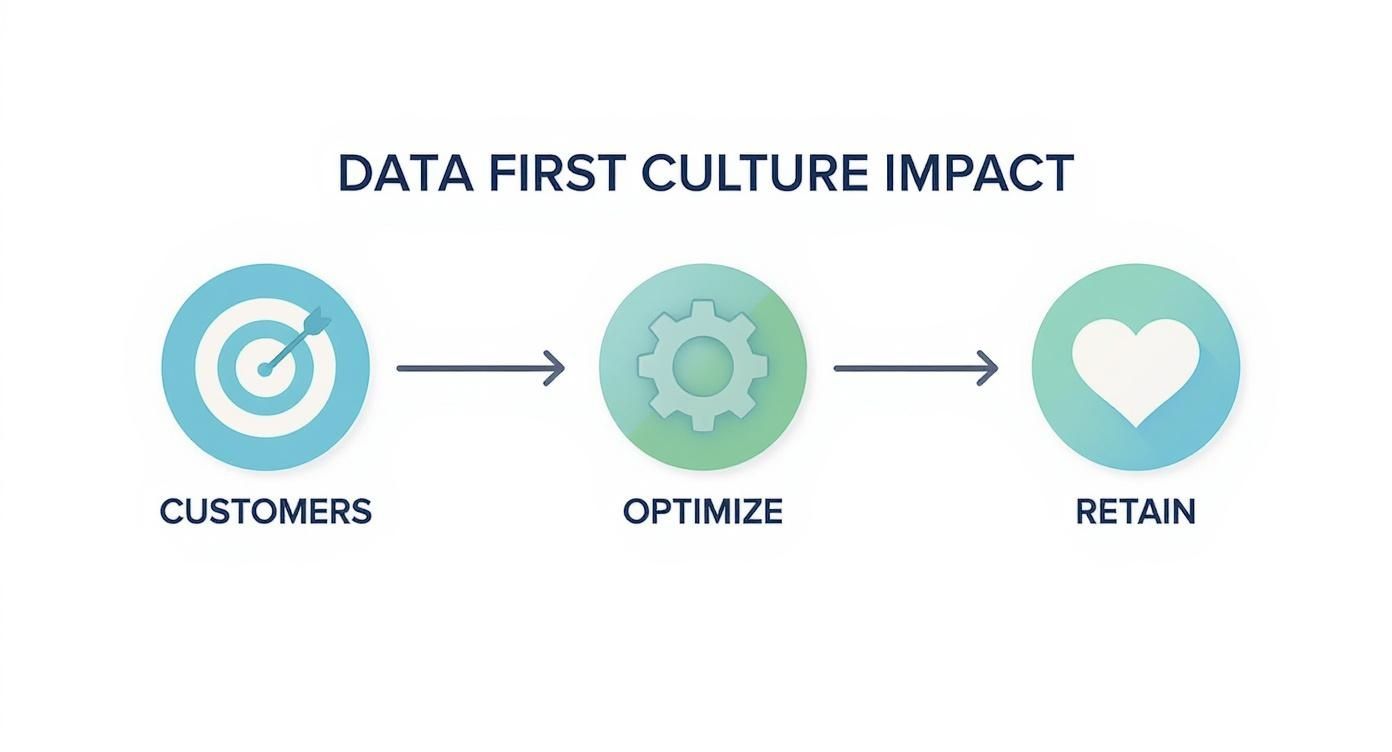

As the visualization highlights, truly understanding your customers with data leads directly to process improvements and much stronger retention.
Building a Foundation of Trust and Curiosity
Data is only useful if your team trusts it and knows how to use it. This is where culture becomes more important than technology. Creating a data-driven organization means encouraging questions and treating data as a shared resource for finding answers, not as a tool for placing blame.
Start by making your data accessible and easy to understand. Simple dashboards will always be more effective than convoluted spreadsheets. From there, you can build a solid foundation by sticking to a few core principles:
- Start with Your Goals: First, define what success looks like for your business. Then identify the metrics that track your progress toward that vision.
- Ensure Data Quality: Establish straightforward rules for data entry and management. Consistent, accurate data is the bedrock of trustworthy insight. Garbage in, garbage out.
- Choose the Right Tools: Select user-friendly analytics tools that your team will actually use. The best tool is the one that gets adopted.
- Foster a Curious Mindset: Actively encourage your team to ask questions and explore the data. Celebrate moments when data reveals an unexpected insight—that’s a sign of a healthy data culture.
This phased approach to data driven decision making makes the transition feel achievable. For a deeper look into structuring your approach, our guide on choosing a strategic decision-making framework can provide valuable context. By focusing on these fundamental steps, you can create a powerful system for growth.
Navigating the Common Roadblocks on Your Data Journey
Going data-driven is a game-changer, but the path is rarely a straight line. Many companies get tripped up by the same predictable hurdles. Knowing these ahead of time is the first step to building a data strategy that actually sticks.
One of the biggest culprits? Data silos. This is what happens when crucial information gets locked away in separate departments. Marketing has its analytics, sales has its CRM data, and finance has its revenue reports. Each team sees only a single piece of the puzzle, making it impossible to see the whole picture.
Then there's the human element: resistance to change. People are creatures of habit. Shifting from trusted gut-feel decisions to a data-first approach can feel uncomfortable or even threatening. Your team might worry that data will be used to micromanage their work instead of empowering it.
Overcoming Data Fragmentation and Skepticism
To knock down data silos, you have to make collaboration non-negotiable. Start by creating a small project team with people from different departments. For instance, pull together folks from marketing, sales, and product to tackle a pilot project, like figuring out where customers drop off in the buyer journey. This forces everyone to share their data to solve a common problem.
And for dealing with the skeptics? Nothing beats a quick win.
Instead of trying to boil the ocean with a massive, company-wide overhaul, start small. Pick a specific business problem and use data to solve it. These early victories build momentum and turn doubters into your biggest champions.
Managing Technical Complexity and Poor Data Quality
Many businesses also get bogged down by technical complexity. The average organization uses 5 to 7 specialized data tools, and a whopping 70% of data leaders admit they struggle with their tech stack. Even with these headaches, the pressure to embed data into every decision isn't going away. You can discover more insights about the data-driven enterprise on mcksey.com.
Finally, there’s the silent killer of all data initiatives: poor data quality. If the data you’re starting with is inconsistent or incomplete, any insights you pull from it will be flawed. It’s the classic "garbage in, garbage out" problem, and it destroys trust faster than anything else.
The fix is to put simple data governance practices in place.
- Establish Clear Ownership: Assign someone to be responsible for the accuracy of key data sets.
- Create Simple Validation Rules: Set up basic checks to ensure data is entered consistently (like standardizing country names in your CRM).
- Regularly Audit Your Data: Schedule quick reviews to catch and fix errors before they snowball.
By getting out in front of these common roadblocks, you can smooth out your transition to a culture of data driven decision making. It’s not about hitting perfection overnight; it’s about making steady progress.
How Fractional Leaders Accelerate Your Data Transformation

Let's be honest: building a data-driven culture is a massive undertaking. It’s far more than buying new software. It requires a clear vision, deep expertise, and a leader to champion the change. For many growing businesses, bringing on a full-time, C-suite executive like a Chief Data Officer (CDO) just isn't in the budget.
This is where a fractional executive becomes your secret weapon. Think of it like hiring an expert guide for a mountain expedition. Instead of fumbling your way through dangerous terrain alone, you bring in someone who’s made the climb dozens of times. They know the shortcuts, the pitfalls to avoid, and the fastest, safest route to the summit.
A fractional leader provides C-suite expertise at a fraction of the cost. They step in, provide immediate direction, and deliver tangible results in months, not years.
Setting the Vision and Building the Roadmap
The first thing an experienced fractional leader brings to the table is clarity. They work with your leadership team to translate vague business goals into a specific, actionable data strategy. They cut through the noise to pinpoint the few critical KPIs that will actually move the needle for your bottom line.
This expert guidance helps you sidestep common mistakes, like splurging on complex tech you don't need or chasing vanity metrics that mean nothing. You get a clear roadmap that's perfectly aligned with your company’s real growth objectives.
A fractional leader’s greatest value is their objective, outside perspective. They aren’t caught up in internal politics, allowing them to focus entirely on building a data framework that drives real business results.
This approach is the heart of effective fractional leadership, where a seasoned expert integrates with your team to deliver high-impact outcomes without the overhead of a full-time hire.
Mentoring Your Team and Championing the Culture
Technology is just one piece of the puzzle. The bigger challenge is shifting the company culture to truly embrace data driven decision making. A fractional leader acts as both a mentor and a champion, guiding your existing team and building their confidence.
They help nurture a culture of curiosity, where data is seen as a tool for empowerment, not micromanagement. By showing the team how to use data to solve real-world problems and celebrating early wins, they build the momentum needed to make the change permanent. This hands-on coaching is invaluable for upskilling your people and creating a sustainable data practice.
A fractional executive accelerates your journey by:
- Selecting the Right Technology: They draw on experience to help you pick cost-effective tools that fit your needs, steering you away from expensive blunders.
- Developing Your Team: They quickly spot skill gaps and provide targeted training, transforming your employees into a capable, data-savvy team.
- Implementing Key Processes: They put simple, effective processes in place for data governance and analysis that your team can easily maintain.
Ultimately, a great fractional executive doesn’t just build systems; they build capability within your own team. They fast-track your transformation by injecting senior-level expertise exactly where and when you need it, ensuring your journey toward data driven decision making is both quick and successful.
Getting Started on Your Data-Driven Future
Gut-feel leadership is a thing of the past. Data-driven decision-making isn’t some far-off trend—it’s the new price of admission for any business that wants to win. We’ve walked through what it takes to shift from intuition to insight, building a team that runs on objective facts, not just subjective feelings.
As technologies like AI and real-time analytics become more accessible, the opportunity to pull ahead of the competition grows. By 2025, global data creation is projected to hit a staggering 180 zettabytes. With self-service analytics empowering employees at every level, you’re not just building dashboards; you’re building a smarter workforce. You can dig deeper into mastering data-driven decision making on sparkco.ai to learn more.
The greatest risk isn’t trying to embrace data and getting it wrong. It’s letting your competitors figure it out first. The time to build your data-driven future is now.
If you’re ready to speed up your progress and sidestep the common pitfalls, expert guidance is a game-changer. Our network of fractional executives provides the seasoned leadership needed to transform your operations and unlock real growth potential.
Common Questions Answered
What's the very first step in data-driven decision-making?
Before you touch a single spreadsheet, get crystal clear on your business goals. What are you actually trying to achieve? Once you know that, then you can figure out the Key Performance Indicators (KPIs) that track your progress. This keeps you from drowning in vanity metrics and helps you focus only on the numbers that matter.
How much data do I really need to get started?
You don't need "big data" to make a big impact. You can start with the information you already have in your CRM, website analytics, or sales reports. The secret isn't quantity; it's the quality and relevance of the data. Small, clean datasets often pack more of a punch than massive, messy ones.
Isn't this kind of thing only for huge companies?
Not at all. While large corporations have entire data science departments, the core ideas of using data to make better choices work for any size business. With so many user-friendly tools available, small and mid-sized companies can absolutely use data to find a competitive edge, optimize their marketing spend, and discover new growth opportunities.
Making decisions based on evidence isn't a matter of company size—it's a matter of mindset. Any organization can benefit from replacing assumptions with objective facts to drive better business outcomes.
Ready to build a culture of data-driven decision making but need the expert leadership to guide you? The right fractional executive can build your roadmap and accelerate your transformation.
Schedule a consultation to find the perfect executive for your team.