


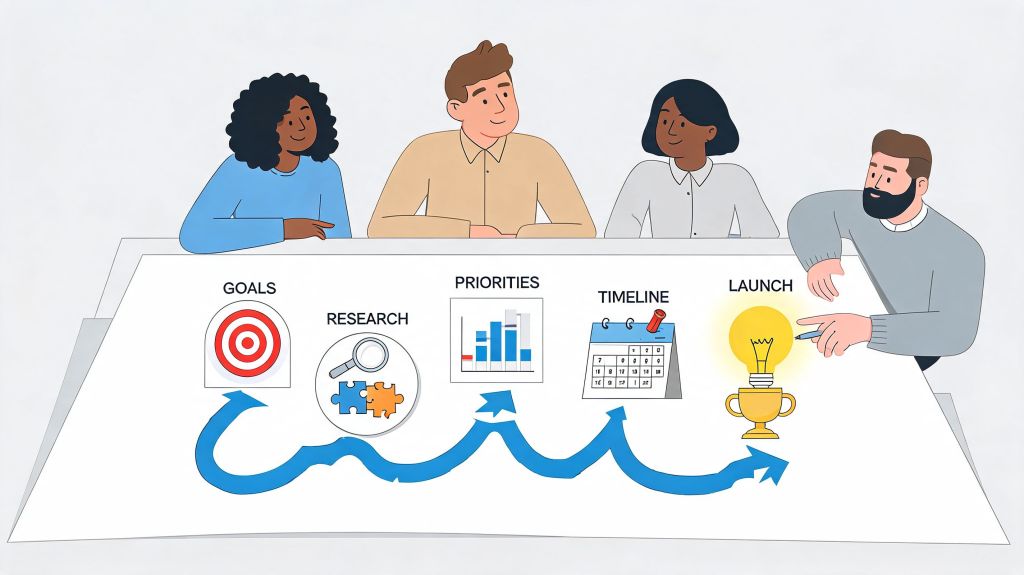
Most founders don’t have a technology problem. They have a sequencing problem.
The team is busy. Engineers are shipping. Sales is asking for integrations. Operations wants better reporting. Finance wants fewer software subscriptions. Everyone has a reasonable request, and the product backlog keeps growing. But when you step back, it’s not obvious whether the company is building toward a clear destination or just reacting faster than last week.
That’s where developing technology roadmap work becomes valuable. Not as a corporate ritual. Not as a giant slide deck. As a practical operating tool that helps a growth-stage company decide what matters, what waits, and what gets cut.
For startups and firms in the $1M to $50M range, this matters even more. You don’t have room for expensive detours. Every hire, migration, integration, and architecture decision competes for the same limited budget and leadership attention. A good roadmap keeps technology tied to business outcomes instead of turning into a pile of disconnected projects.
Why Your Startup Needs More Than Just a To-Do List
A backlog is not a roadmap.
A project plan is not a roadmap either.
A backlog captures requests. A project plan tracks delivery. A technology roadmap connects technology decisions to business priorities over time. It answers a different question: what are we building, changing, or retiring so the business can reach its next stage without chaos?
That distinction gets missed all the time in startups. Teams treat roadmap work like administrative overhead, so they keep everything in Jira, Notion, Trello, or Linear and assume that’s enough. It usually isn’t. Those tools are useful for execution, but they don’t force the harder conversation about trade-offs.
What a roadmap does that a backlog cannot
A real roadmap gives leadership a shared view of:
- Business intent. Why this initiative matters now.
- Timing logic. Why one investment must happen before another.
- Resource reality. Which work the team can support and which work needs help.
- Risk exposure. Where technical debt, vendor lock-in, or security gaps could slow growth.
- Cross-functional alignment. What product, engineering, operations, and finance need to prepare for.
Without that layer, teams often drift into local optimization. Engineering improves infrastructure no one asked for. Product commits features that depend on systems ops can’t support. Revenue teams promise capabilities that require months of backend work.
Practical rule: If your roadmap reads like a feature dump, it isn’t a roadmap yet.
A roadmap doesn’t need enterprise complexity. In an early-stage company, it can be a focused document with major initiatives, expected outcomes, dependencies, and rough time horizons such as Now, Next, and Later. That’s enough to create alignment without pretending you can predict everything.
Why this matters when resources are tight
The value shows up in speed and waste reduction. Organizations with well-structured technology roadmaps report 45% faster time-to-market for new initiatives, according to BETSOL’s technology roadmap guide. For a startup, that isn’t a nice-to-have. Faster execution changes fundraising conversations, sales cycles, hiring plans, and product momentum.
What doesn’t work is building a roadmap as a one-time exercise for the board, then ignoring it. What also doesn’t work is trying to make it perfect before anyone sees it. The strongest roadmaps start simple, force good decisions, and evolve with the business.
That’s why many smaller companies benefit from experienced part-time leadership during roadmap creation. You don’t need a giant PMO. You need someone who can separate strategic work from noise, challenge assumptions, and turn competing requests into a coherent plan.
Aligning Technology with Your Business North Star
Before you inventory tools, debate architecture, or estimate delivery, decide what the business is trying to accomplish.
That sounds obvious, but many roadmap efforts start in the wrong place. Someone lists technical problems first. The team begins discussing cloud costs, data pipelines, ERP replacements, or mobile app rewrites before agreeing on the outcome the company needs.


A useful roadmap starts with the business North Star. If the company wants to expand into a new market, reduce churn, improve gross margin, shorten onboarding, or support a more complex sales motion, technology should serve that destination. If it doesn’t, you’re just funding activity.
Turn broad goals into operating targets
Founders often start with goals that are directionally right but too vague to guide decisions. “Grow faster” won’t help a team choose between rebuilding analytics, improving onboarding, or replacing a brittle integration layer.
Make goals specific enough to shape investment decisions. For example:
- Market expansion might require multilingual product support, regional billing capability, and stronger customer data handling.
- Retention improvement might require product analytics, support tooling, and workflow fixes inside onboarding.
- Operational efficiency might point to ERP cleanup, better reporting, or removal of manual handoffs.
The point isn’t to overformalize. It’s to create criteria. Every technical initiative should be easy to test against a business objective. If no one can explain the connection in plain language, it probably shouldn’t be on the roadmap.
Ask each function the right questions
Roadmaps fail when they’re built from the engineering view alone. Sales, marketing, customer success, finance, and operations see blockers that a technical team won’t always spot.
A short set of leadership interviews usually reveals more than a long workshop deck. Ask questions like:
- What is slowing revenue right now
- Where do customers feel friction most often
- Which manual processes create recurring pain
- What breaks when volume increases
- What capability do we keep promising but struggle to deliver
The answers won’t come in perfect roadmap language. That’s fine. Your job is to translate them into strategic initiatives.
For companies thinking more broadly about sequencing change, a digital transformation roadmap for growing businesses can help frame how technology work ties to operating change across departments.
The best roadmap conversations happen when non-technical leaders describe business pain in their own words, and technical leaders translate that pain into solvable constraints.
Write outcome statements, not just projects
A weak roadmap item says, “Migrate CRM.”
A stronger one says, “Improve lead handoff quality and reporting reliability by replacing fragmented CRM workflows.”
That small difference matters. The first version invites task thinking. The second keeps the team focused on business impact and leaves room to choose the right implementation path.
Use a simple structure for each initiative:
- Business objective
- Problem being solved
- Expected operational or customer outcome
- Constraints or assumptions
- Owner
This gives you a roadmap that leadership can read without needing a translation layer.
Mapping Your Capabilities and Uncovering Gaps
Once the business direction is clear, you need an honest view of current reality. At this stage, many teams get uncomfortable.
Founders often assume they know their stack well enough already. Usually they know the major systems, but not the hidden fragility. They know what the app does, but not which workflows depend on one engineer’s memory, a brittle Zapier setup, an outdated plugin, or a reporting process held together in spreadsheets.

A capability audit surfaces those risks before they become expensive surprises. During initial inventories, 60% of enterprises identify outdated technology stacks that hinder scale, according to ITONICS on technology roadmapping.
Build a lightweight current-state map
You don’t need a consulting-grade architecture review. You need a practical inventory that answers five questions:
- What systems do we rely on
- Who owns them
- What business process do they support
- Where are the known pain points
- What would fail if usage, complexity, or compliance needs increased
Start with categories, not diagrams:
| Capability Area | Current Tooling or Process | Known Pain Point | Business Risk |
|---|---|---|---|
| Lead management | CRM, forms, handoff workflow | Data inconsistency | Sales forecasting issues |
| Billing and payments | Subscription platform, invoicing workflow | Hard to support new pricing | Revenue operations friction |
| Customer onboarding | Product setup, support, docs | Manual steps and delays | Slower activation |
| Reporting | BI tool, spreadsheets, exports | Conflicting metrics | Poor decision-making |
| Security and access | Identity, permissions, audit habits | Inconsistent access control | Governance risk |
That table won’t win design awards. It will expose where the company is vulnerable.
Look for four kinds of gaps
Not every gap is technical debt in the classic sense. In growth-stage firms, I usually see four categories.
System gaps
The tool doesn’t support the next phase of the business.
A SaaS company might have billing software that works for one market and one plan structure, but breaks when the company adds channel partners or international customers. The product still sells, but finance and support absorb the complexity.
Process gaps
The software exists, but the process around it is sloppy or inconsistent.
This happens with CRM stages, incident response, release approvals, customer onboarding, and data definitions. Teams blame the tool when the actual issue is lack of operating discipline.
Skill gaps
The company has systems it can’t fully use because nobody has complete ownership of them.
A startup may have HubSpot, Snowflake, AWS, or Power BI in place but no leader who can decide how those systems should evolve. Work gets outsourced piecemeal, and nobody holds the architecture together.
Dependency gaps
This is the silent killer. A roadmap can look sensible until one initiative depends on data cleanup, access model changes, vendor migration, or a missing integration no one documented.
Don’t confuse familiarity with fitness
A tool that has been around for years often survives on habit, not merit. Teams know its workarounds, so they stop questioning whether it still fits the business.
That’s how companies outgrow systems without admitting it. The stack remains “functional,” but each new request takes longer, costs more, and creates more exceptions.
If a team needs custom workarounds for every new customer, product line, or report, the issue usually isn’t speed. It’s fit.
A useful audit includes both systems and team capability. Ask:
- Which platforms are business-critical but lightly understood
- Where is knowledge concentrated in one person
- Which workflows fail when that person is unavailable
- Which vendors or contractors control important parts of your operating model
Those answers matter as much as the software list itself.
Prioritizing Initiatives That Drive Real Growth
Most roadmap failures don’t come from lack of ideas. They come from poor selection.
By the time you finish the capability audit, you’ll have a long list: platform upgrades, integration fixes, data cleanup, security improvements, hiring needs, product bets, workflow redesigns, reporting changes. The temptation is to label all of them urgent and start several at once.
That usually creates motion without progress.
Analysis shows that up to 70% of technology roadmaps fail to deliver their intended value because they miss key dependencies between initiatives, according to Orbus Software’s roadmapping article. Good prioritization is how you prevent that.


Start with decision criteria, not opinions
Before you score anything, agree on what “important” means for your business. In startups, I usually push teams to judge initiatives against a small set of practical filters:
- Revenue relevance. Does this help win, retain, or expand customers?
- Operational benefit. Does it remove recurring manual work or reduce fragility?
- Strategic enablement. Does it make possible a future capability the company needs?
- Risk reduction. Does it reduce a material exposure that leadership shouldn’t ignore?
- Execution fit. Can this team deliver it with current bandwidth and skills?
If a proposed initiative scores poorly across those filters, it shouldn’t survive just because someone senior requested it.
RICE versus MoSCoW
Two frameworks work especially well for developing technology roadmap decisions in smaller companies. They solve different problems.
RICE helps when you want a more analytical way to rank initiatives that affect users, customers, or business outcomes. It forces discussion around Reach, Impact, Confidence, and Effort.
MoSCoW works better when you need a fast alignment method for scope control. It sorts work into Must-have, Should-have, Could-have, and Won’t-have.
Here’s a practical comparison.
Choosing Your Prioritization Framework
| Framework | Best For | Key Components | Example Use Case |
|---|---|---|---|
| RICE | Product, platform, and growth initiatives where relative impact can be compared | Reach, Impact, Confidence, Effort | Deciding whether to improve onboarding analytics, rebuild reporting, or launch an integration |
| MoSCoW | Scope discussions where multiple stakeholders need a simple decision model | Must-have, Should-have, Could-have, Won’t-have | Defining what belongs in the first release of a customer portal or internal ops upgrade |
When RICE works best
RICE is useful when the team has enough context to compare initiatives with some discipline. It pushes people past vague statements like “this is important.”
For example, if you’re comparing a billing cleanup project with a support tooling upgrade and a data warehouse rebuild, RICE helps the team ask:
- Who is affected?
- How meaningful is the outcome if we get it right?
- How confident are we in the assumptions?
- What’s the delivery burden?
It won’t produce scientific certainty. That’s not the point. It creates a shared logic for ranking options.
When MoSCoW is the better tool
MoSCoW is simpler and often better in messy real-world planning sessions.
If your team is defining the first phase of a roadmap and stakeholders keep adding “one more essential item,” MoSCoW helps separate true requirements from preferences. It’s especially effective when timing matters more than precision.
A practical example:
- Must-have. Identity and access controls for a new admin tool.
- Should-have. Better reporting views for managers.
- Could-have. Custom dashboard themes.
- Won’t-have. Nice-to-have automations that don’t affect launch readiness.
This keeps the roadmap defensible when pressure rises.
A roadmap gets stronger when leadership says no clearly, not when it says yes politely to everything.
Prioritize dependencies before visible output
Founders and boards naturally want visible progress. Customer-facing work is easier to celebrate than plumbing. But some of the most important roadmap items are enabling moves that make later work possible.
That might include:
- Cleaning core data structures before introducing analytics
- Standardizing authentication before adding admin features
- Reworking billing logic before changing pricing
- Clarifying ownership before adding new vendors or contractors
These aren’t glamorous. They’re often the difference between roadmap success and repeated rework.
Where fractional leadership changes the quality of decisions
This is one area where part-time senior leadership has disproportionate value. A seasoned fractional CTO or CIO can moderate prioritization with enough distance to challenge pet projects, enough technical depth to spot hidden dependencies, and enough business context to keep the company from funding work that doesn’t change outcomes.
That matters in startups because the loudest request often wins unless someone experienced reframes the conversation. Good roadmap leadership protects the company from building an expensive list of unrelated “important” things.
Building Your Roadmap and Resourcing for Success
Once priorities are clear, the roadmap needs a form people can use.
That doesn’t mean producing a giant enterprise artifact with dozens of swimlanes and color-coded certainty theater. For most growth-stage companies, a roadmap should be readable in one meeting. If executives, engineering leads, and department heads can’t understand it quickly, it won’t guide decisions.

A practical roadmap combines priorities, timing, ownership, and resource assumptions. It should show what’s happening now, what’s coming next, and what stays on the horizon until the business is ready.
Use a format your team will actually maintain
For startups, my default is a Now, Next, Later view with themes or swimlanes. It’s flexible enough for uncertainty and structured enough for coordination.
Common swimlanes include:
- Product and customer experience
- Core platform and architecture
- Data and reporting
- Security and compliance
- Internal operations and automation
Each initiative should have a short label, an owner, and a plain-English outcome. Avoid overcommitting to exact dates unless the work has fixed timing.
A simple roadmap entry might include:
| Time Horizon | Initiative | Owner | Outcome |
|---|---|---|---|
| Now | Standardize customer data model | Engineering lead | Reduce reporting conflicts and support cleaner integrations |
| Now | Replace manual onboarding handoffs | Operations lead | Shorten setup friction and improve customer launch consistency |
| Next | Rework billing logic for new packaging | Product and finance | Support pricing changes without custom exceptions |
| Later | Consolidate analytics stack | Fractional tech leader | Improve decision quality and reduce reporting sprawl |
That’s enough structure to govern execution without pretending you can forecast every detail.
Resource planning is where many roadmaps become fiction
A roadmap can look smart and still be impossible.
This usually happens when teams plan initiatives without mapping the actual bottlenecks. The work may depend on one senior engineer, a busy founder, a contractor who has limited availability, or a product owner who’s already overloaded.
The resource discussion has to be blunt:
- Who is accountable for each initiative?
- Which specialized skills are missing internally?
- What work must be deferred because the team cannot absorb it?
- Where does outside expertise reduce risk instead of adding coordination overhead?
A lot of founders avoid these questions because they lead directly to a hard truth. The company may need leadership before it needs more execution capacity.
A 2024 CB Insights report found that 68% of startups cite an executive talent gap as a top barrier to strategic planning, as referenced in this roadmapping discussion. That gap shows up in technology planning constantly. Companies have engineers. They may even have product managers. But they lack a senior operator who can turn business goals into sequencing, staffing, and governance.
Where fractional leadership fits
A fractional CTO, CIO, or technology operator is often the practical answer when the company is too complex for ad hoc decision-making but not ready for a full-time executive hire.
That role can help by:
- Clarifying architecture choices so engineering stops revisiting the same debates
- Setting roadmap priorities based on business value rather than internal politics
- Creating execution guardrails for vendors, contractors, and internal teams
- Owning cross-functional translation between founders, product, operations, and finance
- Running roadmap reviews so the document stays alive after creation
This is also where companies benefit from understanding the difference between strategic leadership and pure delivery support. Many firms first explore IT outsourcing and development options when work piles up. Outsourcing can help with implementation, but it doesn’t replace the leadership needed to choose the right work, sequence it properly, and govern outcomes.
Make the roadmap a governance tool
A roadmap should influence weekly and monthly decisions, not just annual planning.
That means assigning a review cadence and using the roadmap to answer real questions:
- Are current initiatives still tied to business priorities?
- Did any dependency change the sequence?
- Are we learning something that should move an item from Later to Next, or out of the plan entirely?
- Do we need different ownership because execution is stuck?
The companies that get value from roadmaps treat them as decision frameworks. The companies that don’t often save them in Google Slides and revisit them only when investors ask.
Keep the artifact honest
The strongest startup roadmaps share a few traits.
They show trade-offs
A roadmap should reveal what the company is not doing. If everything made the list, nobody prioritized.
They separate commitments from options
Some items are approved and staffed. Others are candidate bets that depend on market feedback, hiring, or budget. Label them clearly.
They reflect leadership bandwidth
If a roadmap assumes heavy founder involvement in every initiative, it isn’t scalable. Either delegate more effectively or simplify the plan.
They avoid false precision
Quarter ranges and time horizons are often more useful than exact dates. Precision that isn’t real damages trust.
The roadmap should be detailed enough to guide action and loose enough to survive contact with reality.
A practical build sequence
If you’re creating your first serious roadmap, this sequence works well:
- Set the business targets that technology must support.
- Map current capabilities across systems, processes, and team strengths.
- List major gaps and constraints without trying to solve everything immediately.
- Prioritize initiatives using a framework the leadership team understands.
- Choose a simple roadmap format such as Now, Next, Later with clear owners.
- Stress-test resources before declaring anything committed.
- Establish review cadence so the roadmap becomes part of company operations.
That’s enough to move from reactive decision-making to guided execution.
Governing and Communicating Your Living Roadmap
A roadmap loses value fast when nobody governs it.
The initial workshop might be strong. The priorities may be sensible. Then delivery starts, new information appears, one customer request changes direction, and the roadmap becomes a stale file that no longer reflects the actual plan.
That isn’t a documentation problem. It’s a leadership problem.
According to a 2025 Gartner survey, roadmaps that are user-driven and regularly updated with feedback boost project success rates by 2.5 times compared to static, top-down plans, as cited in Fresh Produce’s technology roadmap discussion. The practical lesson is simple. Teams need a process for learning and adjustment, not just an approved chart.
Build a review rhythm
A good governance cadence is usually lightweight:
- Monthly check-ins for initiative status, blockers, and dependency changes
- Quarterly roadmap reviews for reprioritization and business alignment
- Event-driven updates when major customer, market, hiring, or funding changes occur
The monthly review shouldn’t turn into a giant status meeting. Keep it focused on decisions. What changed? What’s at risk? What needs to move?
Quarterly reviews are where leadership should revisit assumptions. A roadmap that looked right one quarter ago may no longer fit product demand, customer feedback, or operating constraints.
Define what you’ll measure
If roadmap items aren’t connected to outcomes, teams fall back to completion theater. Work gets shipped, but nobody knows whether the business improved.
Use a few initiative-level measures tied to the original objective. Examples include:
- Operational outcomes such as fewer manual handoffs or cleaner reporting workflows
- Customer outcomes such as improved onboarding experience or fewer support escalations
- Execution outcomes such as better release consistency or reduced rework
- Strategic outcomes such as readiness for a new pricing model, market, or compliance requirement
You don’t need a dashboard for every initiative. You do need a clear statement of what success looks like.
Roadmap communication fails when leaders report activity instead of explaining changed capability.
Use one roadmap, tailored for different audiences
Many companies create multiple versions of the roadmap and accidentally create multiple truths. Engineering sees one thing. The board sees another. Sales hears a third version in hallway conversations.
Keep one source of truth. Then adjust the level of detail by audience.
- Board and investors need strategic themes, timing, major dependencies, and business rationale.
- Functional leaders need ownership, constraints, and cross-team impacts.
- Delivery teams need enough detail to sequence work and expose blockers.
- Customer-facing teams need clarity on what is committed, what is directional, and what should never be promised yet.
Many startups regain alignment through this process. The roadmap becomes a communication tool, not just a planning tool.
From Plan to Progress
Developing technology roadmap work is less about producing a polished artifact and more about building decision discipline.
The companies that do this well don’t chase every request. They tie technology to business direction, inspect current capabilities realistically, prioritize with intent, and review the plan often enough to keep it useful. That’s what turns roadmap work from an annual exercise into an operating advantage.
For startups and growth-stage firms, the process should stay lean. You don’t need enterprise bureaucracy. You need clarity, ownership, and enough senior judgment to make hard trade-offs early.
If you’re also refining how you’ll measure progress once the roadmap is in motion, this guide to KPIs for software development is a useful next step.
When the internal team lacks time or senior technology leadership, the right part-time executive can make the difference between a roadmap that sits in a folder and one that drives the business forward.
If you need senior leadership to build or run a roadmap without committing to a full-time hire, Shiny connects startups and growing businesses with experienced fractional executives who can step in quickly and help turn strategy into execution.