



You're probably sitting on a familiar mess right now. The tools are multiplying, the team is improvising around broken workflows, and every urgent meeting ends with the same quiet truth, the company doesn't need another software rollout, it needs someone who can redesign how work gets done.
That's the subject of digital transformation leadership. In growth-stage companies, this is not a tech procurement problem dressed up in strategy language. It's an operating-model problem, and the leader who owns it has to align ambition, people, process, and measurement before the stack starts to matter.
The market has already moved past the idea that transformation is a side project. One 2025 industry compilation says 61% of executives now rank digital transformation as a top business priority, and 94% of large enterprises in the US and UK already run a defined digital transformation strategy. It also reports $2.58 trillion in global digital transformation spending in 2025, with projected growth to $3.9 trillion by 2027 and a 28.5% CAGR from 2025 to 2030 (Yomly digital transformation statistics). That's the backdrop. The job is no longer optional.
What Digital Transformation Leadership Actually Means
A founder I'd trust to be blunt would call it this way. The company has three tools for a job that needs one leader, so the stack gets blamed while the operating model stays untouched. The CTO fixes systems. The CIO stabilizes infrastructure. Digital transformation leadership sits above both and asks a harder question, how should the business change its decisions, workflows, and accountability so the new tools produce better outcomes?
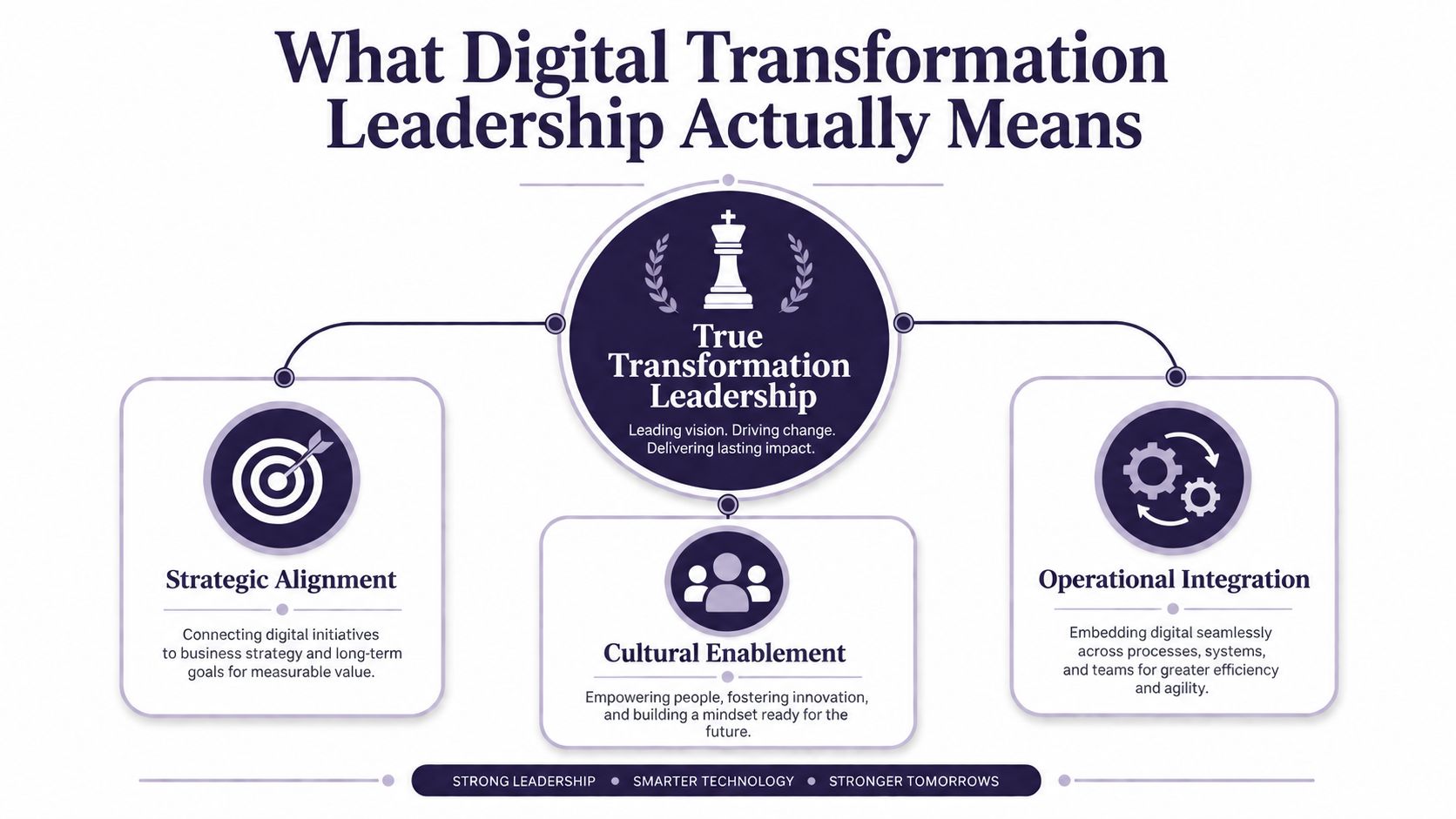

The role is broader than technology
The cleanest definition is simple. A transformation leader sets the digital ambition, rewires the operating model behind it, and gets the organization to adopt the new way of working. That means budgets, governance, cross-functional coordination, and the discipline to track whether people are using the thing that was launched.
Boston Consulting Group's work on transformation success makes the leadership point impossible to ignore. When organizations get six critical success factors right, success odds can rise from 30% to 80%, and only two out of five organizations handled outcome monitoring adequately, compared with 90% of winning programs (BCG). The lesson is blunt. Technology is not the differentiator, leadership quality is.
Practical rule: if the leader cannot explain how the business will work differently after the rollout, the transformation is already drifting into theatre.
Why founders get this wrong
The most expensive mistake is conflating the role with a technical leader. A strong CTO can build the platform. A strong CIO can harden the environment. Neither one is automatically responsible for redesigning the customer journey, training managers to work differently, or forcing the board to stare at adoption metrics instead of launch slides.
That's why this role belongs in the center of the business, not buried in IT. In a real growth company, the right sentence is usually, “We need a leader who can redesign the operating model around digital execution,” not, “We need another person who knows the tools.” Once you say that clearly, the org chart usually looks wrong, because the answer is rarely the box you already have.
The Four Core Competencies a Transformation Leader Must Bring
A good restaurant doesn't fail because the kitchen has knives. It fails when the chef can't decide the menu, the line cooks don't trust the prep system, the service team is misreading the ticket flow, and the owner keeps changing priorities. Digital transformation leadership works the same way. Four capabilities matter, and they matter in this order.
Strategic thinking sets the menu
This is the ability to choose what the company is trying to become. Not every digital idea deserves a budget line, and not every legacy process deserves to survive. A leader with strategic thinking decides where digital work creates advantage, which customer pain is worth solving, and what the company will stop doing to make room.
Digital fluency knows which appliances actually cook
This is not about writing code. It's about understanding enough of the stack to tell useful from useless, automate from decorate, and platform from patch. A leader without digital fluency tends to buy shiny tools because the demo looked elegant. A leader with it can ask the better question, “What will this change in the workflow on Tuesday morning?”
Change leadership retrains the line cooks
People do not resist change because they are irrational. They resist it because the new way threatens speed, competence, or status. A transformation leader has to coach managers, absorb friction, and keep the work moving while habits shift. The SAGE research on digital transformational leadership points to this people-side reality, noting that outcomes are shaped more by collaboration, strategic thinking, leadership, and customer orientation than by pure technical depth (SAGE research).
Stakeholder alignment keeps front-of-house and investors on the same page
The board wants traction, finance wants control, operations wants stability, and sales wants fewer blockers. If those groups are not reading from the same menu, the program fractures. Many smart leaders underperform, because they confuse updates with alignment.
A quick self-check helps:
- Strategic thinking: can you cut three initiatives and explain why?
- Digital fluency: can you describe the workflow impact without jargon?
- Change leadership: can you get managers to adopt the new behavior, not just attend the meeting?
- Stakeholder alignment: can you keep the board, operators, and customers pointed at the same outcome?
The strongest transformation leaders are not the loudest visionaries. They are the ones who can make the next operating decision obvious to everyone who has to live with it.
Governance Models and KPIs That Keep the Program Honest
Competence is personal. Governance is structural. You can hire a strong leader and still fail if the company gives that person no clear authority, no decision rights, and no metrics that expose reality instead of spin. That's why the governance model matters as much as the person.
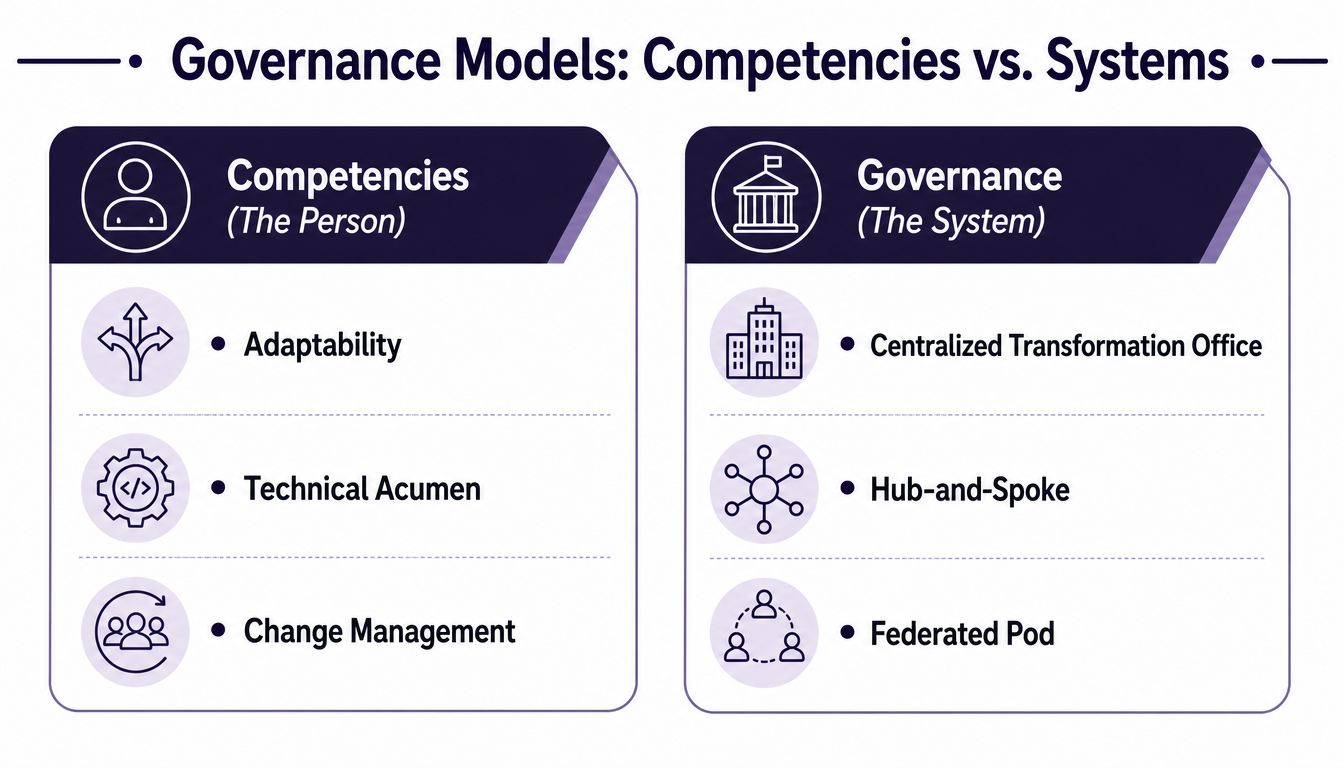

Pick the structure that matches the stage
A centralized transformation office works when the company needs control, consistency, and fast coordination. It's the right shape for early standardization, but it can become a bottleneck if every decision has to climb the same ladder.
A hub-and-spoke model gives the center enough authority to set standards while business units keep ownership of execution. That tends to fit companies that have outgrown ad hoc change but still need local flexibility.
A federated pod model pushes responsibility into the teams closest to the customer. It's fast and adaptive, but it demands maturity, because weak discipline inside the pods turns into chaos quickly.
The simplest rule is this. If your company still needs one throat to choke, centralize. If it needs shared standards with local judgment, go hub-and-spoke. If the teams can already move with discipline, federate.
Track the right numbers, not every number
For a board slide, I'd split the dashboard into three buckets.
- Leading indicators: adoption, employee sentiment, cycle time.
- Lagging indicators: revenue impact, cost-to-serve, retention.
- Guardrails: security, compliance, customer trust.
If you want one operational source of truth to keep the metrics conversation disciplined, data-driven decision-making is the right mental model. The point is not to drown the board in dashboards. The point is to prove whether the new operating model is working.
Clear KPI targets matter too. McKinsey-derived statistics cited by Mooncamp say companies with clear KPI targets are twice as likely to succeed, and embedding KPIs into long-term workflows increases the likelihood of successful transformation by 7 times (Mooncamp digital transformation statistics). Use that insight properly. Pick two numbers you're willing to obsess over, then pick two guardrails you refuse to cross.
The board-ready template
Keep it brutally short:
- Objective: what business outcome is changing?
- Leading KPI: what proves adoption is happening?
- Lagging KPI: what proves business value is landing?
- Guardrail KPI: what must not degrade?
If you can't fit that on one page, the program is too loose.
How a SaaS Scale-Up Led Its Transformation in Six Months
Northstar Analytics, a fictional but representative SaaS scale-up, had the classic growth-stage problem. Sales had promised flexibility, ops had accumulated tools to patch every gap, and customer onboarding was taking too much human effort to scale cleanly. They brought in a fractional Chief Transformation Officer, not to “lead innovation,” but to reset how the business worked.
Month one was diagnosis, not rescue
The first month was interviews, system audits, and customer-journey mapping. No one bought software. No one renamed the initiative. The leader spent time with support, finance, product, and sales because the failure was not hidden in one team, it was distributed across all of them.
By the end of that month, the pattern was obvious. The company had six overlapping tools touching the same handoff points, and nobody owned the end-to-end flow. The leadership decision was to cut, not add.
Months two through six were about sequencing
Month two collapsed the six tools into two. Months three and four redesigned onboarding and instrumented it so the team could see where customers stalled. Months five and six handed the program back to the operating leaders with a 90-day scorecard that kept the work visible after the fractional leader stepped out.
Two failures happened along the way. A CRM migration slipped by six weeks, and a pricing experiment had to be rolled back. That didn't break the program. It made the program credible, because the leader treated failure as part of execution, not as a reason to hide.
Useful test: if the board only sees success stories and never sees the trade-offs, the transformation is probably being managed for optics, not outcomes.
The difference at Northstar was simple. The leader did not try to “own transformation” forever. They made the operating leaders capable of owning it after the initial redesign.
A Practical 90-Day Roadmap for Your First Hundred Days
A transformation program doesn't need a grand launch. It needs a clean start, clear gates, and a bias toward learning before scaling. The safest path is four phases. Each one has a decision point, and each one should answer a different question.
Diagnose
The first two weeks are for listening and instrumenting, not building. Talk to the people who touch the customer, the system, and the handoffs. Find the friction, map the workflows, and identify where the business is already compensating with manual effort.
Design
Weeks three through six are about choosing the operating model and the first three KPIs. The leader decides what gets centralized, what stays local, and what the board will measure. The goal is not elegance. The goal is a structure people can run.
Pilot
Weeks seven through ten should focus on one product surface and one customer segment. That keeps the blast radius small while still proving whether the new workflow works. Pilots only matter if they produce a decision, keep going, adjust, or stop.
Scale
The final stretch is where many programs die. The leader moves on, the operating team inherits half-finished work, and the metrics go quiet. Scaling only works if ownership is transferred deliberately, with enough air cover for managers to run the new system without re-litigating every decision.
For a practical companion to this planning mindset, digital transformation roadmap guidance can help structure the sequence. Keep the investor-facing artifacts tight:
- A one-page operating model
- A live KPI scorecard
- A decision log for what changed and why
If those three documents don't exist by day 90, the program is still a presentation.
Three Common Pitfalls That Quietly Kill the Program
The fastest way to waste money is to treat transformation like a software purchase. A company buys tools, announces a rollout, and assumes the business will adapt around the new logo in the corner of the screen. It won't. If the workflows, incentives, and decision rights stay the same, the stack just becomes a more expensive version of the old mess.
Pitfall one, tech-first thinking
This shows up when leaders start with vendor demos instead of customer pain. The cheapest correction is to map the operational bottleneck before talking to anyone selling a platform. If the problem is handoffs, ownership, or approval delays, software alone won't fix it.
Pitfall two, hiring the wrong seniority
A founder sometimes hires too senior a leader for a company that still needs sleeves-rolled-up execution. The result is predictable. The executive expects a broad mandate, but the business can only support a narrow one. The diagnostic is simple, can this person spend part of the week in the weeds without losing authority? If not, the fit is off.
Pitfall three, treating transformation as a side hustle
This happens when the work sits under a Chief of Staff or a generalist who already has three other jobs. The program loses oxygen. The correction is not more meetings, it's clear ownership with enough time, decision rights, and board visibility to keep the initiative alive.
The common thread is staffing and sequencing, not strategy. Most failures are not because the company lacked ambition. They failed because nobody was given the right shape of responsibility.
Why Fractional Executives Are the Highest-Leverage Answer Right Now
For many growth-stage companies, the best answer is a fractional transformation leader, usually a former CTO, COO, or Chief Digital Officer working five to twenty-five hours a week. That gives you C-suite judgment without the delay, commitment, or full-time overhead of a permanent hire.
Compare the options honestly
Full-time hiring is slow. It also forces you to commit before the operating model is clear. Fractional leadership is faster because the person can start with diagnosis and quickly move into execution design.
It also lowers risk. If the transformation needs to be tested, not just announced, a fractional executive can prove the case for permanence before the company locks itself into a long-term structure. That matters when the board wants momentum but the business still needs flexibility.
If you want a narrower operating lens on this role, fractional Chief Digital Officer is the right concept to study. The point is not to replace full-time leadership forever. The point is to match the seniority and time commitment to the actual problem.
Know when fractional is the wrong answer
If you need a permanent operator on the ground every day, fractional won't be enough. If the board wants a full-time peer sitting in executive meetings every week, the model may also miss the mark. But for CEOs and owners in the $1M to $50M revenue range, the fractional route is often the smartest starting move because it gets the work moving before the company overcommits.
That's the highest-impact part of the model. You don't pay for a permanent seat until the transformation proves it deserves one.
Your First Move This Week
Start with four questions. Which of the four competencies is missing, which governance model fits your stage, which two KPIs belong on the board slide, and are you hiring full-time when a fractional leader would ship the work first?
If you answer those directly, the next move becomes obvious. You stop shopping for a title and start shopping for the right operating shape. That's how real transformation gets traction.
If you're sorting through that decision right now, Shiny connects companies with seasoned fractional executives who can lead this work without the drag of a long search or a full-time hire. If you want a sounding board on whether your next move should be fractional, full-time, or something in between, visit Shiny and schedule a conversation.