


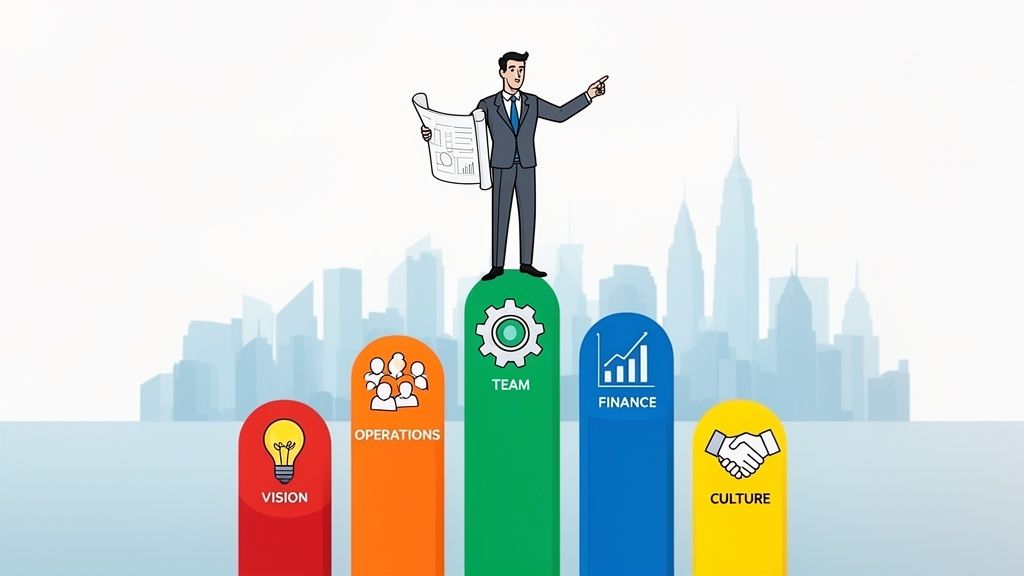
It's easy to get the wrong idea about what a CEO actually does. Forget the stereotype of the corner-office boss barking orders. The reality is far more nuanced, strategic, and demanding.
A CEO’s job isn't to do everything. It's to ensure everything gets done, and done right, by the right people. This critical distinction is where many founders get stuck, drowning in day-to-day tasks instead of steering the ship.
What Are the Real Duties of a Chief Executive Officer?
Think of a CEO as the conductor of an orchestra. They don’t play every instrument, but they are responsible for ensuring the violins, brass, and percussion create a masterpiece together. They set the tempo, cue the entrances, and shape the overall performance. Without them, you just have noise.
This means the duties of a chief executive officer are less about direct execution and more about creating the conditions for success. Whether you're a five-person startup or a 500-person enterprise, these core responsibilities remain the same. Understanding them is the first step to identifying where you're stretched thin and might need expert support.
The Five Core Pillars of CEO Responsibility
A CEO's time is their most precious asset, and it must be invested wisely. Their focus boils down to five critical functions that truly move the needle and determine the company’s future.
- Setting the Vision: Define and relentlessly communicate where the company is going. This "North Star" guides every decision, from product roadmaps to marketing campaigns.
- Building the Team: Attract, hire, and mentor a world-class senior leadership team—the people who will execute the vision. No CEO builds a great company alone.
- Allocating Capital: As the company's chief investor, the CEO decides how to deploy money, time, and resources to drive maximum growth.
- Driving the Culture: Shape the values and behaviors that define how work gets done. Culture isn't a poster on the wall; it's how your team acts when no one is watching.
- Ensuring Alignment: Act as the company's connective tissue, ensuring every department, team, and individual is pulling in the same direction toward shared goals.
The diagram below shows how these five core duties are interconnected, with the CEO at the center.
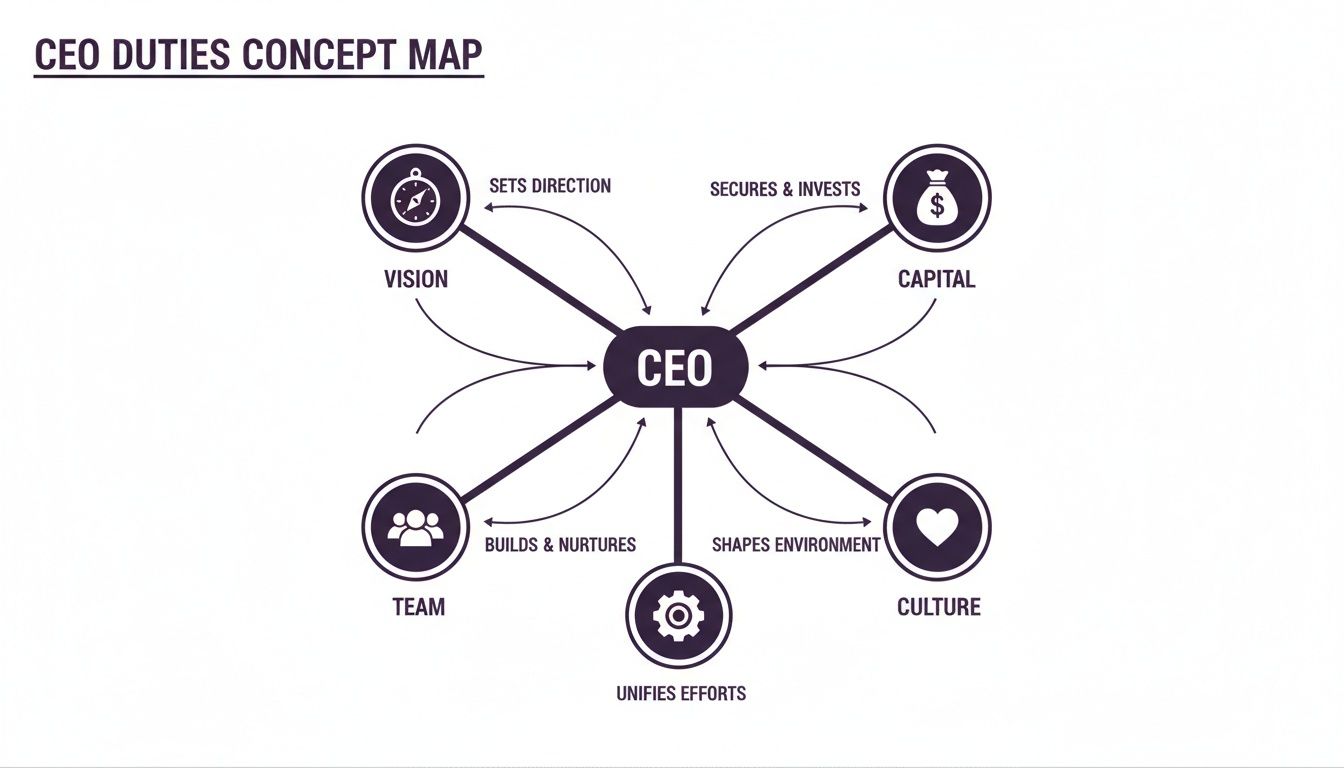

This table offers a quick summary of these essential responsibilities.
The Five Pillars of CEO Responsibilities at a Glance
A summary of the core duties every Chief Executive Officer must manage for sustainable business success.
| Core Duty | Primary Objective | Key Activities |
|---|---|---|
| Set the Vision | Define and articulate the company's long-term direction and purpose. | Strategic planning, goal setting, communicating the mission. |
| Build the Team | Attract, hire, and develop a world-class senior leadership team. | Executive recruiting, mentoring, performance management. |
| Allocate Capital | Deploy financial and human resources to maximize growth and returns. | Budgeting, fundraising, M&A decisions, resource planning. |
| Drive the Culture | Shape the values, beliefs, and behaviors of the organization. | Modeling values, establishing norms, creating a positive work environment. |
| Ensure Alignment | Keep all parts of the organization moving in the same direction. | Internal communication, cross-functional collaboration, performance tracking. |
The CEO role is a constant balancing act between strategy (the vision), people (the team and culture), and resources (capital). Understanding this framework helps founders see where they should be spending their time—and where getting experienced, on-demand help could make all the difference.
Setting the Vision and Driving the Strategy
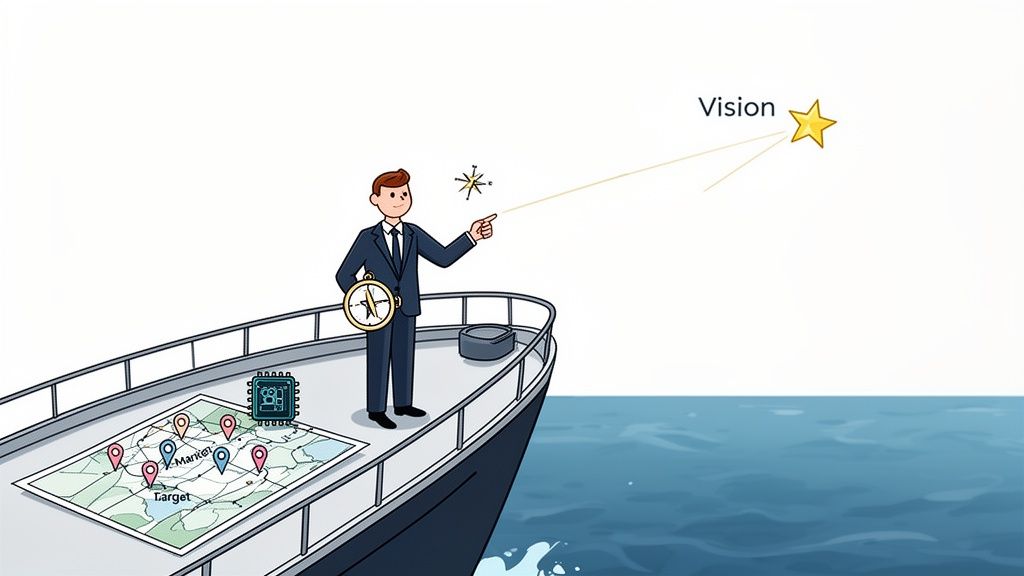
A business without a clear vision is like a ship adrift at sea. The CEO is the captain who doesn't just point to a destination but also charts the course to get there.
This goes beyond a catchy mission statement. It’s about creating and communicating a compelling "why" that energizes everyone, from the board to the newest hire. This vision becomes the ultimate filter for every decision. Does this product feature move us closer to our goal? Does this marketing campaign align with who we are? It keeps the entire organization pointed in the same direction.

From Vision to Actionable Strategy
An inspiring vision is just the start. The real work is translating that big idea into a tangible plan. This means digging into competitive analysis and being brutally honest about where your company can uniquely win.
This strategic work answers a few tough questions:
- Where do we play? Which markets and customer segments are we targeting?
- How do we win? What is our unique value proposition?
- What capabilities do we need? What skills, tech, and processes are essential?
- How will we measure success? What are the key performance indicators (KPIs) that prove our strategy is working?
To build out a framework for this, check out our guide on the strategic planning process steps.
The Bandwidth Challenge of Strategic Leadership
Here's the classic CEO dilemma: you’re constantly pulled between the big-picture thinking that defines the company’s future and the operational demands that keep the lights on.
Every hour spent on a tactical fire is an hour not spent analyzing a new market, meeting a key partner, or refining the five-year vision. Founders often get so buried in the day-to-day that they lose the very perspective they were hired to provide.
The solution involves getting better at delegation and finding the right support. By bringing in experienced leaders—even on a part-time basis—a CEO can buy back the time and mental space to focus on their most vital job: driving the vision. This is where fractional leadership becomes a powerful tool, not just for saving money, but for gaining a strategic edge.
Building and Leading a Winning Executive Team
A CEO’s legacy is forged in the quality of the team they assemble. While setting the vision is mission-critical, putting a world-class executive team in place to execute that vision is a very close second.
Simply put, no CEO ever succeeds alone.
The job is to become a magnet for talent, attracting 'A-players' who take deep, personal ownership over their part of the business. The best CEOs think like the general manager of a pro sports team—always scouting, coaching, and making the team chemistry click.
Defining Roles and Finding the Right Fit
The first step is getting clear on what the business truly needs from its leaders. What specific outcomes must an executive deliver in their first year? What fires do they need to put out?
Great CEOs hunt for traits you won’t find on a resume:
- Ownership Mentality: Do they act like they own the place? A-players take the blame and share the credit.
- Resilience: How do they react when punched in the mouth? The ability to get back up after a setback is non-negotiable.
- Collaborative Spirit: Can they argue passionately for their idea but rally behind the final decision, even if it wasn't theirs?
Finding these people is hard. A bad executive hire can torpedo a company’s progress by months, if not years. For a deeper dive, see our guide on how to build high-performing teams.
The Startup's Dilemma: A Smarter Solution
For growing companies, this is a massive challenge. Founders often lack a deep network of seasoned executives and can't compete with big corporate paychecks. The financial risk is also terrifying; one bad senior hire can be a catastrophic blow to a small company’s budget.
This is where the fractional executive model is a smarter, more nimble approach. Instead of gambling on a massive full-time salary, you can bring in a vetted, battle-tested executive for a fraction of the cost.
This move de-risks the entire process. You get immediate access to top-tier strategic talent to plug a critical gap—like a fractional CMO to build your marketing engine or a fractional CFO to get finances in order—without the crushing long-term financial weight. It's how you get the expertise you need right now.
Mastering Capital Allocation and Financial Health
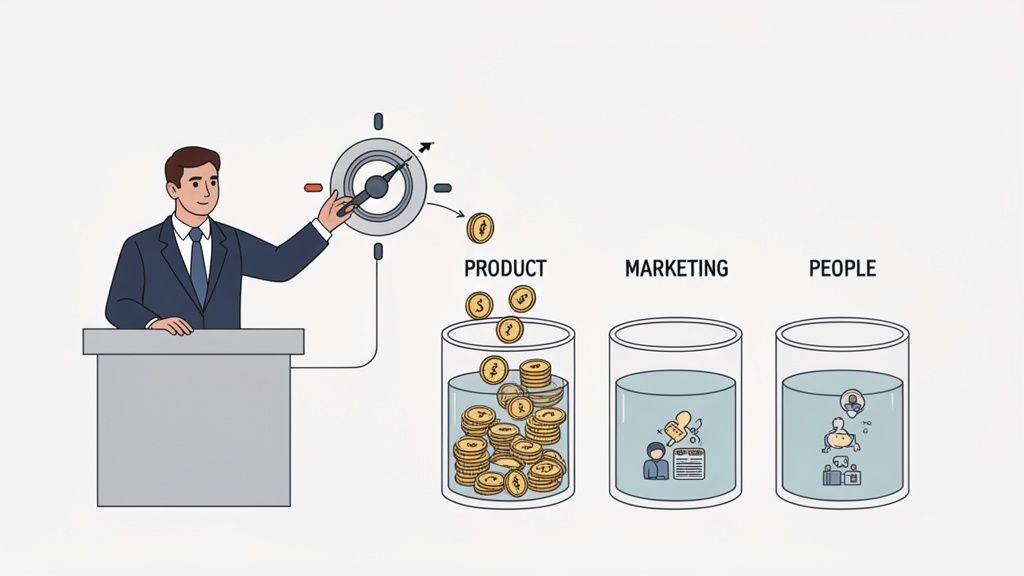
Capital is your company’s lifeblood. As CEO, one of your most critical jobs is to be its primary steward. This is about making smart, strategic calls on where every dollar goes to generate the highest possible return.
Think of yourself as the company’s chief investment officer. Should we put the next $100,000 into engineering to ship a product faster? Or into a marketing campaign to fill the funnel? These high-stakes decisions define your company’s trajectory.
Poor capital allocation can kill even the most brilliant ideas. You must develop a deep understanding of your business’s financial engine.
The CEO as Financial Storyteller
While your CFO lives in the spreadsheets, you own the financial narrative. This is critical during a fundraise. Investors aren’t just buying a product; they’re betting on a leader’s vision and their credible plan for turning capital into enterprise value.
You must fluently articulate your company's financial story, mastering key metrics:
- Burn Rate: How much cash are you burning each month? Justify this spend by connecting it to strategic growth, not just operational costs.
- Runway: How many months can you operate with the cash you have? This number injects urgency into every decision.
- Unit Economics: How profitable is each customer? Metrics like Customer Acquisition Cost (CAC) and Lifetime Value (LTV) prove your business model works.
Communicating these figures clearly to your board, investors, and team is fundamental to building trust.
Managing the Budget and Financial Performance
Beyond fundraising, you are on the hook for the company’s day-to-day financial health. This means overseeing the annual budget—a document that is less a set of rigid rules and more a strategic roadmap expressed in numbers.
This constant financial oversight is one of the most draining parts of being a CEO. For many founders, especially those from a technical background, it can feel overwhelming. The pressure to manage finances perfectly while also leading strategy, sales, and the team is immense.
This is a classic pain point where fractional leadership is a game-changer. Bringing in an experienced, part-time CFO gives you the rigorous financial discipline a growing company desperately needs. They can professionalize your budgeting, sharpen your reporting, and help you craft a fundraising narrative that investors can't ignore—freeing you to focus on the parts of the business only you can drive.
How Fractional Executives Drive Real Growth
After mapping out the sheer scope of a CEO's responsibilities, it's clear one person can't master everything at once. This is where smart companies are finding their edge. Fractional leadership isn't just about saving money; it's a strategic weapon for hitting growth targets without the massive financial risk of a full-time executive hire.
The model is simple: you embed a seasoned, C-suite leader into your team on a part-time basis. You get the exact expertise needed to solve your most pressing challenges, whether for 10, 15, or 20 hours a week.
When Strategic Expertise Is a Must
Think of a fractional executive like a specialist surgeon. You don’t hire one to live in your house just in case you need an operation. You bring them in for a specific, high-stakes procedure. The same logic applies when your business hits a make-or-break moment.
Common scenarios where on-demand expertise is a game-changer:
- Navigating a Fundraise: A fractional CFO can build your financial model, shape your story for investors, and manage the entire due diligence process.
- Expanding into a New Market: A fractional Chief Revenue Officer who has already conquered a specific geography gives you an instant playbook, helping you skip months of costly trial-and-error.
- Professionalizing Operations: A fractional COO can implement the systems and processes needed to scale without everything catching fire, turning startup chaos into a well-oiled machine.
- Building a Marketing Engine: A fractional CMO can lay the foundation for predictable revenue by developing your brand strategy, setting up lead generation, and hiring your first marketers.
You aren't just hiring a consultant who drops off a report. You're embedding a leader who executes alongside your team, transferring their knowledge and building capabilities that last.
A Smarter Way to Fulfill the Duties of a Chief Executive Officer
Ultimately, this model frees up a CEO to focus on their most vital duties—setting the vision and steering the ship—by delegating critical functions to a trusted expert. It plugs leadership gaps almost instantly with vetted talent, letting you sidestep the long, risky, and expensive process of a full-time executive search.
If you want to go deeper on this model, learn more about what a fractional CEO does and how they can support your existing leadership.
The right fractional executive doesn't just fill a gap on an org chart; they become a catalyst for growth. For founders and CEOs, this is about building a more resilient, efficient, and powerful company.
Burning Questions About the CEO Job
Stepping into the CEO role, especially as a founder, is a huge learning curve. It’s natural to have questions. Let's tackle a few common ones we hear from leaders trying to figure it all out.
How does the role change from startup to enterprise?
In the early days, the CEO is the ultimate jack-of-all-trades. You're writing code, closing deals, maybe even packing boxes. You're deep in the trenches, doing the work.
As the company scales, that has to change. Your job shifts from doing the work to building the team that does the work. The focus moves from shipping features to hiring incredible leaders, setting a clear vision, and ensuring the organization is healthy. You stop building the product and start building the company.
What is the biggest mistake new CEOs make?
Without a doubt, it's failing to let go. Many new CEOs, especially founders, can't stop themselves from getting involved in every detail. They struggle to truly delegate and trust their team.
This creates a massive bottleneck. Nothing can move forward without their approval, and they end up completely burned out.
Great leadership is about empowering your executive team to take real ownership. When you do that, you free yourself up to focus on the big-ticket items that only you can handle: strategy, fundraising, and culture.
What is the most effective way for a CEO to manage their time?
Time is the only resource you can't get more of. The best CEOs are ruthless about protecting their calendar. They filter every request through the lens of their five core responsibilities: vision, team, capital, culture, and alignment.
They constantly ask one simple question: "Am I the only person who can do this?"
If the answer is no, it gets delegated. Immediately. This intense focus ensures their energy goes where it will have the highest impact, pushing the business forward instead of just putting out today's fires.
Feeling the weight of all these responsibilities? You don't have to carry it all yourself. Getting the right senior leadership in place—even on a part-time basis—can give you the bandwidth you need to lead effectively. If you're ready to explore how a vetted fractional executive can help you scale faster, let's talk. Schedule a consultation today and find the right leadership partner for your growth journey.