


ERP consulting is no longer a niche technology expense. The global market is projected to reach USD 23.42 billion by 2031, showing that external expertise has become a standard strategic necessity rather than a narrow technical fix.
That growth reflects a familiar situation for owners and CEOs. Your finance team is working around an old accounting system, operations relies on spreadsheets, sales has its own customer records, and nobody trusts the inventory report completely. The business has reached the point where an ERP system could create discipline and visibility, but the internal team doesn't have the capacity to lead a major transformation alone.
The difficulty is not just choosing between NetSuite, Microsoft Dynamics 365 Business Central, SAP Business One, or another platform. The core challenge is deciding how the company should operate, who will make the decisions, how legacy data will be cleaned, and who will own the result after the consultants leave.
The market context is substantial. Mordor Intelligence estimates that global ERP consulting services were worth approximately USD 14.76 billion in 2025 and are projected to reach USD 23.42 billion by 2031, with an estimated compound annual growth rate of 8.35% from 2026 through 2031. North America represented about 38% of revenue in 2025, while Asia-Pacific is forecast to grow at approximately 11.90% annually through 2031.
For an SMB, those figures don't mean you need a larger consultancy. They mean ERP implementation has become a management discipline with specialized skills, recurring obligations, and material financial consequences. The strongest model combines technical ERP consulting services with accountable internal leadership, often through a fractional executive who can translate the consultant's roadmap into operating decisions.
Why Most ERP Projects Fail Before They Start
The failure became obvious on a Monday morning. The new ERP was live, yet the warehouse could not trust its item records, finance was reconciling transactions manually, and managers were approving work by email because the configured workflows did not match daily operations.
The implementation team had completed its contracted tasks. The business still could not run with confidence.
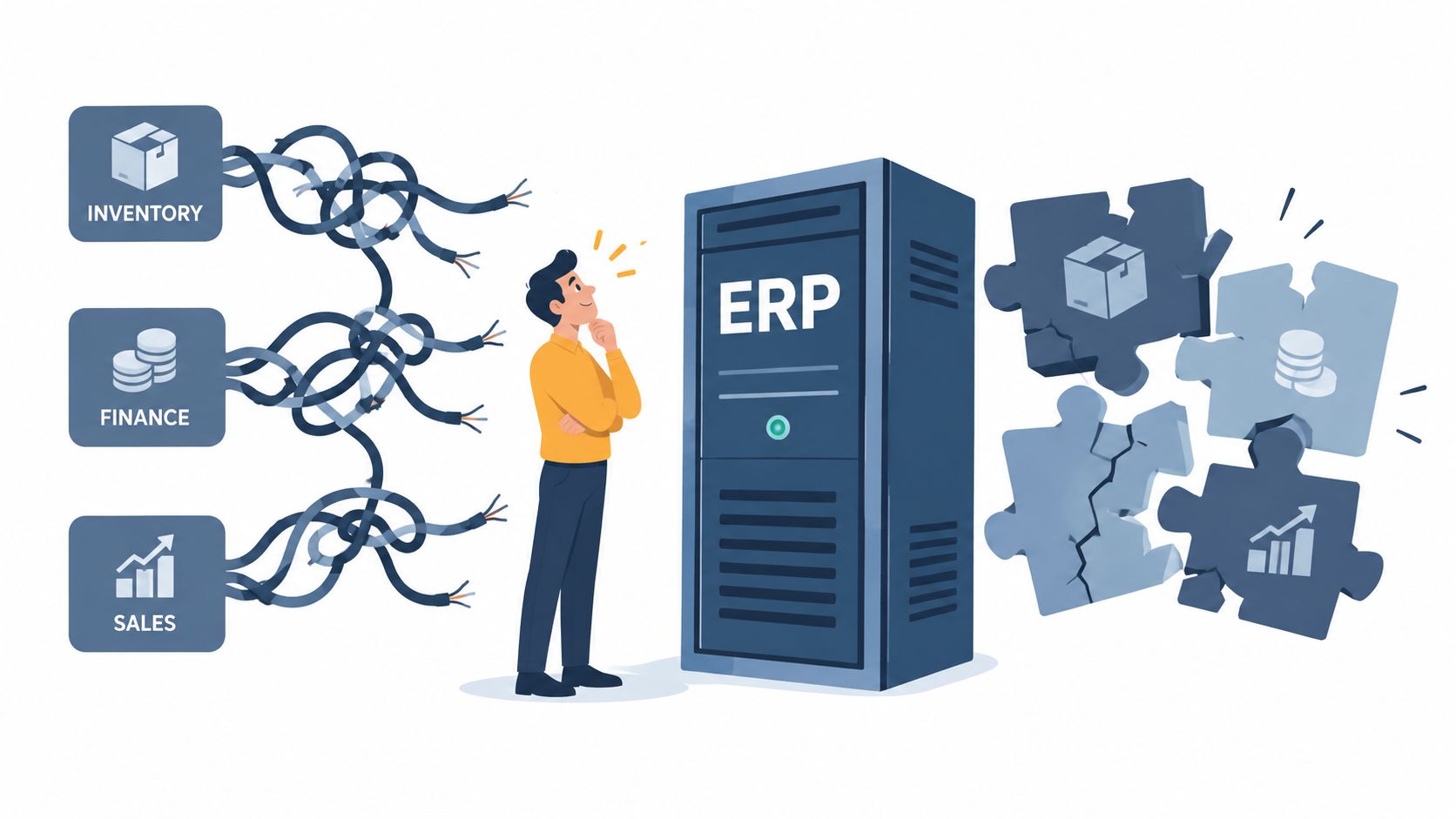
That result usually starts months earlier, when leadership treats ERP as a software refresh rather than a change in the company's cost structure and operating model. A vendor presents polished dashboards, the project team approves a configuration, and executives expect fragmented processes to become orderly after launch. Software can enforce a process. It cannot decide which process the company should use, assign ownership, or persuade employees to abandon familiar workarounds.

The numbers describe a governance problem
Academic and industry literature commonly reports that approximately 40% to 70% of ERP implementations encounter serious failure or underperformance, according to documented ERP implementation research. The same research reports that only 10% of projects finished on schedule and within budget, while 55% finished with a time or cost overrun and 35% were eventually cancelled.
Those outcomes rarely point only to defective code. They expose weak sponsorship, unclear requirements, poor data quality, excessive customization, inadequate training, and resistance to change. A consultant can configure a purchasing workflow, but an internal finance leader must decide who owns approvals, which controls apply, and which exceptions the company will stop tolerating.
A technical roadmap is useful only when someone inside the business converts it into decisions, trade-offs, and accountability. For a company without enough internal capacity, fractional executive expertise can provide that bridge without placing the entire responsibility on a project committee.
What leadership must own
A serious ERP program needs named decision-makers, not a committee that meets only when an issue becomes urgent. Before the first configuration workshop, establish:
- An executive sponsor: This person removes organizational obstacles, resolves competing priorities, and communicates why the change matters.
- Process owners: Finance, operations, sales, purchasing, and warehouse leaders must approve how their functions will work in the new system.
- A decision framework: Someone must determine which requests are required, which can wait, and which would create unnecessary customization.
- A change plan: Employees need role-specific training, time to test realistic scenarios, and a clear route for reporting problems.
Practical rule: If the client team cannot make timely process decisions, the consultant will make assumptions. Those assumptions eventually become configuration, rework, or resistance.
ERP consulting services create value by exposing these decisions while the business can still change course. The right partner makes operational consequences visible, while accountable internal leadership decides what the company is willing to fund, change, and own after implementation.
Understanding ERP Consulting Pricing Models
The cheapest proposal often looks attractive because it prices the visible work and leaves the difficult work undefined. A responsible comparison starts by asking what the fee includes, what assumptions it depends on, and who pays when those assumptions prove wrong.
A fixed-fee engagement can work well for a tightly bounded discovery phase, ERP selection exercise, or high-level process blueprint. It gives the buyer cost predictability and gives the consultant a clear delivery target. It becomes risky when the scope is vague, the data is unexamined, or the business expects the consultant to solve unknown integration and process problems inside the same fee.
Time-and-materials pricing is more adaptable for implementation, migration, integration, and optimization. It allows the team to investigate issues rather than hiding them behind change orders. The trade-off is budget exposure. Without a requirements-to-configuration matrix, weekly cost review, and formal approval for scope changes, an open-ended engagement can absorb decisions that should have been made by the client.
Outcome-based pricing can align the consultant with milestones such as an accepted process design, validated migration, completed user-acceptance testing, or a successful cutover. It sounds appealing, but the outcome must be controllable and measurable. A consultant shouldn't be held solely responsible for adoption if the client doesn't release process owners for testing or provide usable source data.
Compare the risk, not just the fee
| Pricing model | Works best when | Main buyer risk | Control to request |
|---|---|---|---|
| Fixed fee | The deliverable and assumptions are clear | Exclusions and change orders | Signed scope, acceptance criteria, and assumptions |
| Time and materials | Discovery and technical complexity remain uncertain | Uncontrolled effort and budget creep | Weekly burn reporting and change thresholds |
| Outcome based | Milestones can be objectively verified | Disputes over responsibility | Shared measures and client dependencies |
| Hybrid | The project has known and unknown components | Confusion over which work belongs where | Separate phases with distinct commercial rules |
The financial risk isn't theoretical. A worldwide 2026 ERP survey reported that 30.0% of projects exceeded budget. Among over-budget projects, 54.9% cited unexpectedly required technology, 51.0% cited scope expansion, and 43.1% cited technical issues as primary cost drivers.
Those figures make a hybrid structure practical for many SMBs. Use a fixed fee for discovery, process mapping, and a phase-one blueprint. Use time-and-materials pricing for integrations or data remediation where the condition of the legacy environment can't be known in advance. Tie payments to accepted deliverables, not to vague assurances that the project is progressing.
Look beyond the statement of work
Ask whether the proposal includes data cleansing, migration rehearsals, integration monitoring, training materials, testing support, cutover preparation, and post-launch assistance. Also ask what internal labor the consultant expects from your team.
A proposal that assumes unlimited client availability is not cheaper. It has only moved part of the cost into executive time, delayed decisions, employee overtime, and operational disruption.
How to Choose the Right ERP Partner
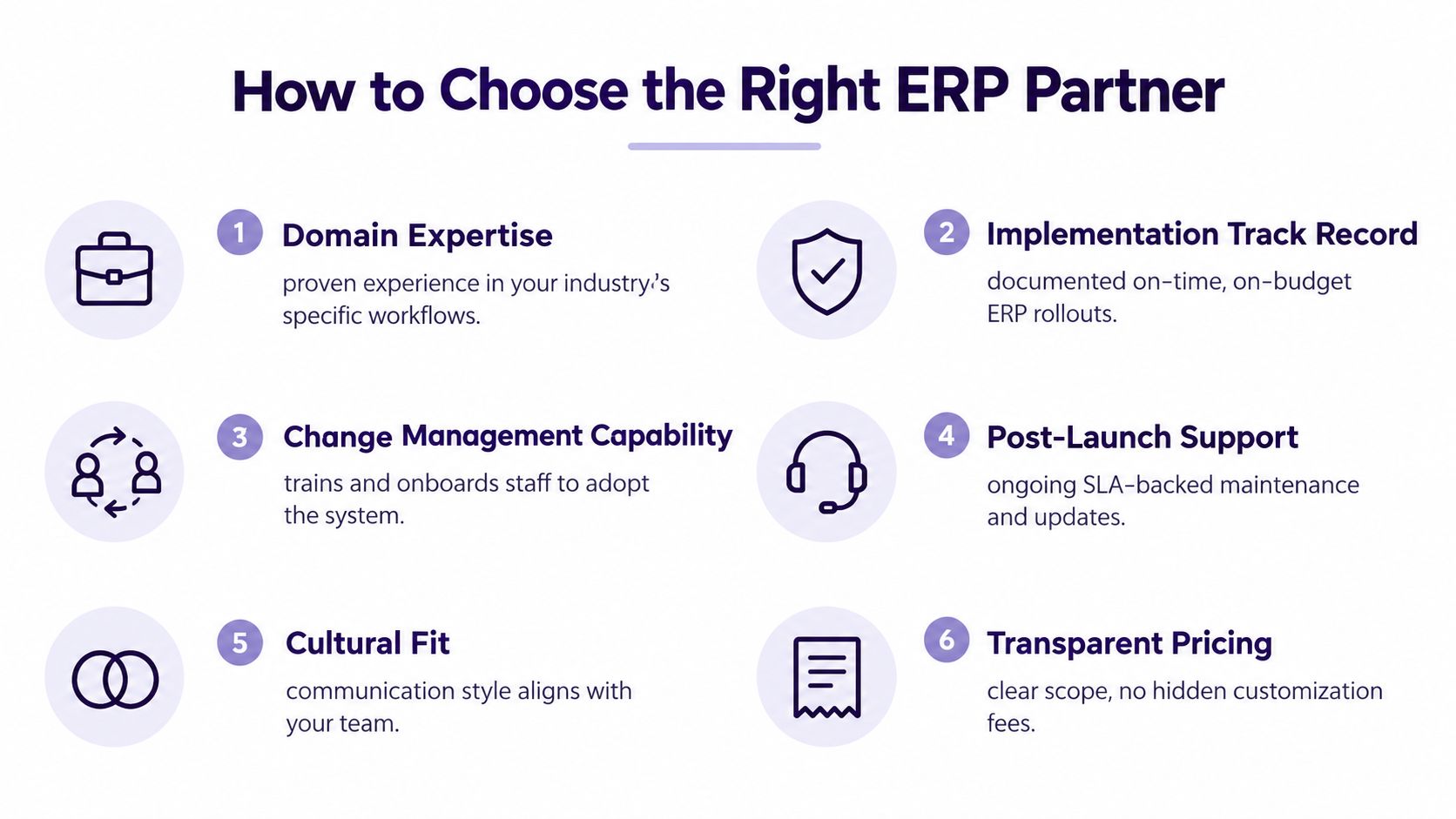
Start with the operating model, not the software demonstration. A partner who asks about your workflows, approval rules, data ownership, and integration dependencies before recommending a configuration is showing the right instinct. A partner who leads with a product feature list may be efficient at selling a platform while missing the conditions that determine whether your people will use it.
The evaluation should be gated. Each gate should produce an artifact you can review before authorizing the next stage.
Gate one establishes accountability
Require the proposed partner to define the executive sponsor, project governance, cross-functional team, business objectives, escalation path, and decision rights. Ask what happens when finance and operations disagree about a process. If the answer is “we'll work it out in the workshops,” governance hasn't been designed yet.
Your objectives should describe business outcomes in operational terms. Examples include a trusted month-end process, consistent purchasing controls, reliable inventory visibility, or a single customer record. Avoid objectives that only describe activity, such as configuring modules or completing training sessions.
Gate two maps the business before configuration
The partner should document current workflows, pain points, exceptions, approvals, inputs, outputs, and system dependencies. Then the team should design the future process before configuring the ERP.
This sequence prevents the company from reproducing every historical workaround in a new platform. Standard functionality should be preferred where it supports the target process. Customization should require a business case, an owner, a support implication, and an explanation of why configuration or process change isn't sufficient.
Gate three makes data a deliverable
Data migration isn't a technical export. It requires business decisions about duplicate customers, inactive products, inconsistent units, missing tax information, obsolete suppliers, and conflicting account structures.
A credible partner should provide:
- A data inventory: Identify source systems, owners, fields, dependencies, and retention requirements.
- Cleansing rules: Define how duplicates, blanks, invalid values, and conflicting records will be handled.
- Reconciliation controls: Compare source totals and record counts with migrated results.
- Acceptance thresholds: Assign named owners who approve the quality of each data set.
Gate four tests real work
Ask for unit, integration, performance, security, and user-acceptance testing. User acceptance should use realistic scenarios, including returns, partial shipments, approval exceptions, month-end activity, and failed integrations.
The partner should also provide role-based training, a cutover rehearsal, a support model, and a hypercare plan. Research on ERP success factors ranks continuous system integration, post-implementation training, and active user participation as the three most important post-implementation success factors.
For broader transformation planning, connect the ERP roadmap to your digital transformation roadmap. The ERP should support the operating model, not become an isolated technology program.
The Hidden Five-Year Cost of ERP Ownership
The implementation quote is only one line in the economic model. Over the ownership period, the company must fund data maintenance, integrations, process changes, user support, reporting improvements, and the temporary productivity loss that comes with learning a new way to work.
A low quote can conceal a high operating burden. For example, a partner might reduce the upfront price by assuming that client employees will clean all legacy data in spare hours, that integrations will remain simple, or that the business won't request changes after launch. Those assumptions rarely survive contact with a growing company.
Industry summaries indicate that 51% of ERP implementations exceeded their original budgets, while technical and data issues were cited by 34% of organizations with overruns, according to an ERP total cost of ownership analysis. The same analysis emphasizes that ownership costs extend beyond licensing and implementation to include data remediation, temporary productivity decline, and recurring support.
Build a five-year capacity model
Your financial model should include more than subscription fees and consultant invoices. List the resources required to make the system work:
- Executive time: Sponsorship, steering decisions, escalation, and benefits reviews.
- Subject-matter experts: Process mapping, requirements decisions, testing, and training.
- Data remediation: Cleansing, deduplication, reconciliation, and repeated maintenance.
- Integration ownership: Monitoring, incident response, vendor coordination, and future changes.
- Productivity disruption: Reduced throughput while employees learn new processes.
- Change requests: Reports, workflows, fields, permissions, and justified enhancements.
- Post-launch support: Hypercare, optimization, release testing, and user assistance.
The dollar value of internal labor belongs in the model even when salaries are already budgeted. Those employees are being diverted from customer delivery, production planning, closing the books, or sales execution. If the project consumes their capacity, the opportunity cost is real.
Customization is a recurring obligation
Customization can solve a genuine competitive requirement, but every custom script, integration, and special workflow creates future testing and maintenance work. It can also make upgrades harder and narrow the pool of people who understand the environment.
The right question isn't whether customization is possible. Ask whether the benefit justifies the permanent ownership burden, whether standard functionality could support the process, and who will maintain the decision after the implementation partner leaves.
A lower implementation fee isn't a saving if it transfers essential work to an already overloaded client team.
A five-year view usually favors a simpler operating model with clear ownership. That may mean accepting a small process change rather than reproducing every legacy preference. It may also mean paying more for migration quality and post-launch support so the company doesn't spend years correcting preventable defects.
The Strategic Case for Fractional Executive Leadership
An ERP program can have a sound technical plan and still lose momentum when nobody on the client side owns the business decisions. The consultant brings platform knowledge, methods, and delivery capacity. The company must still decide which processes matter, protect the work from competing priorities, resolve disputes between functions, and connect the investment to financial results.
Fractional leadership fills that accountability gap without forcing an immediate permanent C-suite appointment. An experienced fractional COO, CFO, CIO, or operations executive owns the business side of the program while the implementation partner handles its delivery responsibilities. The role is to make sure the consultant's work survives contact with daily operations, competing incentives, and difficult trade-offs.
Why a permanent hire may be the wrong first move
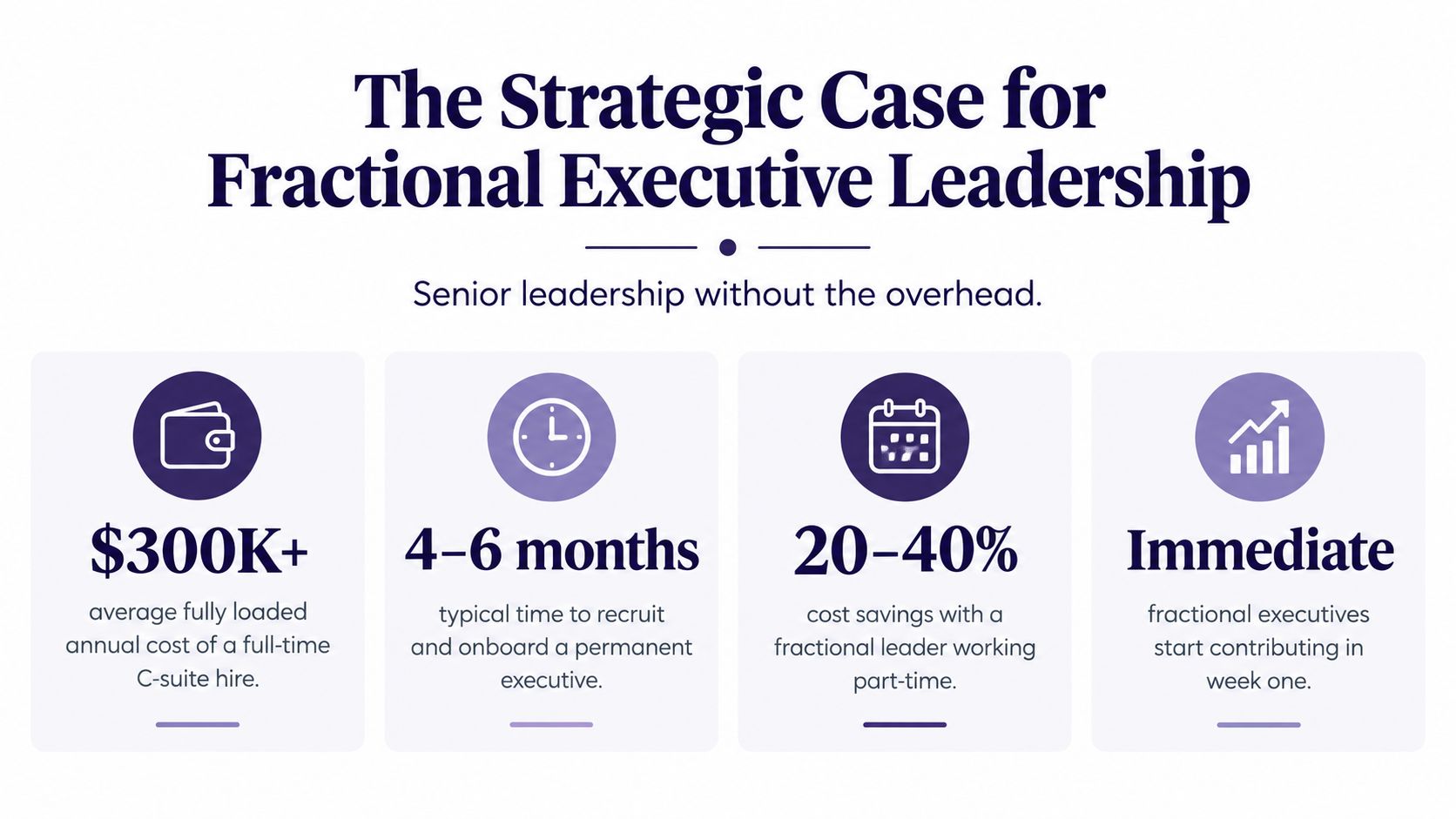
Recruiting a senior leader takes time and creates financial exposure before the company fully understands the role it needs. SHRM benchmark data cited in recruitment reporting places the average cost per executive hire at $35,879. The same reporting says filling a C-suite role averages 7.2 months, with 35% of searches taking longer than nine months.
The recruitment reporting also cites a range of two to five times the executive's annual compensation for a failed senior executive appointment, including replacement costs, lost productivity, disruption, and management time. That exposure matters when the business needs leadership now but has not established whether the lasting position should be a CIO, COO, CFO, or another executive role.
A fractional appointment provides a controlled way to test the mandate. The company can set defined outcomes, observe how the leader works with employees and the consulting partner, and decide later whether the need supports a permanent hire. It also keeps the leadership decision separate from the pressure to fill a title quickly.
What the fractional leader owns
A fractional executive needs a written mandate, authority over defined decisions, and access to the information required to act. The responsibilities may include:
- Business case ownership: Maintain the benefits model and challenge requests that do not support agreed objectives.
- Governance: Run steering meetings, manage escalations, and prevent unresolved decisions from stalling delivery.
- Process alignment: Confirm that the future-state design matches how the company intends to operate.
- Resource protection: Secure time from process owners, testers, trainers, and data stewards.
- Vendor management: Hold the consulting partner accountable for deliverables, assumptions, risks, and handover.
- Adoption leadership: Make managers responsible for training completion, process compliance, and useful feedback.
The leader connects board-level concerns with implementation detail. A consultant may explain why an integration needs redesign. The fractional executive translates that decision into consequences for close timing, customer service, inventory control, staffing, and cash management. That translation is where technical recommendations become operating decisions.
Match the executive to the problem
Define the business problem before hiring an “ERP expert.” A finance-led program may need a fractional CFO who understands controls, reporting, working capital, and close processes. A fragmented operating environment may need a fractional COO who can improve handoffs across purchasing, production, warehouse, and fulfillment. A complex technology estate may need a fractional CIO who can govern integrations, security, vendors, and data ownership.
Fractional CIO leadership can fit a company where technology decisions affect strategy, but a full-time information executive would be premature. The same principle applies to operations and finance. The title matters less than the authority, relevant experience, and measurable mandate attached to the engagement.
Engaging Fractional Talent to Secure ERP Success
A fractional executive should enter the ERP program before the implementation partner begins configuring the system. That timing allows the leader to establish decision rights, review the business case, challenge the scope, and make sure internal capacity matches the delivery plan.
Start with a short mandate document. It should identify the executive sponsor, the business outcomes, the systems in scope, the process owners, the decision rights, the major risks, and the conditions for success. It should also state what the fractional leader can approve independently and what requires the CEO or board.
Create ownership in five stages
First, baseline the business. Document the current process, key performance measures, known workarounds, data problems, integration dependencies, and major sources of operational friction. Without a baseline, the company can't distinguish genuine improvement from a completed project plan.
Second, govern the implementation. Require a decision log, risk register, requirements-to-configuration traceability, data-quality sign-offs, and test evidence. The fractional executive should chair or prepare the governance meetings and escalate unresolved decisions before they become schedule problems.
Third, protect adoption. Training should be role-based and tied to the actual future process. Managers need to reinforce the new workflow, not permit every department to preserve its old spreadsheet. Active users should participate in testing and help colleagues after launch.
Fourth, rehearse cutover. Run the migration, reconciliation, integration checks, user access review, support escalation, and business continuity procedures before the production switch. A rehearsal exposes missing owners while the team can still correct them.
Fifth, operate after go-live. Hypercare is not the operating model. Assign an executive sponsor, process owners, data stewards, integration owners, and a route for prioritizing enhancement requests. Set aside a realistic optimization budget rather than treating every post-launch improvement as an unexpected exception.
Measure value after the launch
A technically successful deployment can still produce weak adoption, inaccurate master data, or a return to manual workarounds. Panorama's 2025 ERP Report indicates that more than three-quarters of organizations completed ERP projects within the expected timeline, with a median project duration of nine months. Timeliness alone doesn't prove that the system is delivering the intended operating benefits.
Review performance at regular intervals after launch. Track whether users follow the designed processes, whether master data meets the agreed quality standard, whether integrations complete reliably, and whether the original business outcomes are emerging. A fractional executive can lead those reviews, reprioritize improvements, and decide when the company needs permanent ownership.
The right engagement may eventually lead to a full-time hire. It may also show that the business needs specialized leadership only during transformation, stabilization, fundraising, rapid growth, or a major operating change. Both outcomes are valid when the decision follows evidence rather than urgency.
Shiny connects growing companies with experienced fractional executives who can provide practical ownership across finance, operations, technology, and other critical functions. Visit Shiny to explore flexible executive support for your ERP program and schedule a consultation around the leadership gap your business needs to close.