



Your demo graph is flat, your sales team keeps asking for a case study you haven't written, and you're still editing nurture emails after midnight. Then the board asks for pipeline coverage by next quarter, while a full-time VP of marketing remains financially out of reach.
That's the founder moment that sends you searching for a fractional VP of marketing. You can over-hire into a full-time executive role, hand the problem to an agency that doesn't own the commercial result, or bring in a senior operator part-time. The right choice depends on the gap you need to close, the authority you'll give the person, and the scorecard you'll use.
I've hired three fractional marketing leaders. One gave us operating discipline and moved pipeline conversations forward. One produced polished strategy documents that never changed what the team did. The difference wasn't the title. It was whether we hired for ownership, execution, and measurable commercial progress.
If your company is at the same crossroads, start by understanding the broader founder problem described in Delegate or Suffocate. Then use this guide to define the role, choose the right engagement, calculate the economics, interview candidates, and set targets that make the hire accountable.
The Founder Moment That Leads Here
The search usually starts with a Monday meeting that feels more uncomfortable than the previous one. Sales says the lead quality is poor. Product says marketing keeps requesting features without explaining the buyer. The founder sees activity everywhere, but no clear line from that activity to qualified pipeline.
Meanwhile, the founder is still acting as the head of marketing by default. They approve landing pages, rewrite positioning, brief freelancers, review ad copy, and answer questions about the CRM. Those tasks don't just consume time. They force every marketing decision through one person who should be focused on company direction, customers, fundraising, and hiring.
A full-time VP might solve the leadership gap, but the commitment can arrive before the business is ready to support it. An agency may launch campaigns quickly, but many agencies own deliverables rather than the entire marketing operating system. A fractional leader sits between those options, provided you give them enough authority to make decisions.
The model has moved well beyond a novelty. The global market for part-time senior leadership is reported at more than $5.7 billion, with growth of about 14% annually, while North America represents about $4.1 billion, according to an independent 2026 fractional executive market summary. The broader fractional CMO services market is projected to grow from USD 2.11 billion in 2025 to USD 2.28 billion in 2026, then reach USD 3.51 billion by 2031, implying a 9.01% CAGR from 2026 to 2031 in Research and Markets' outlook.
Those figures matter for one reason: other companies are already buying part-time senior marketing judgment. You don't need to treat the model as an experiment, but you do need to define it precisely.
Founder rule: Don't hire a fractional VP to make marketing look organized. Hire one to make the company's pipeline decisions better and faster.
The rest comes down to practical questions. What should this executive own? How much time belongs to strategy versus execution? What should the first ninety days produce? Which interview answers indicate a real operator, and which ones signal another slide-deck consultant?
What a Fractional VP of Marketing Actually Does
A fractional VP of marketing is a senior marketing operator who takes responsibility for the function on a part-time basis. In a typical startup engagement, that means roughly 8 to 20 hours per week, with the exact commitment shaped by the team, pipeline complexity, and immediate priorities.
The role sets direction, creates the operating rhythm, manages internal and external contributors, and connects marketing work to pipeline outcomes. They might define the ideal customer profile, select the channel mix, hire a demand generation contractor, repair lifecycle reporting, or challenge a sales forecast that depends on unqualified leads.
A full-time VP of marketing carries a broader embedded obligation. They own culture, hiring capacity, executive relationships, and often board reporting as a permanent member of the leadership team. A fractional VP can own the same functional decisions within a smaller time commitment, but you must agree on decision rights before the engagement starts.
A fractional CMO often works at a more strategic altitude. That person may lead positioning, go-to-market design, executive alignment, and board preparation, then delegate daily management to someone else. The titles overlap in the market, so don't rely on the label. Ask who will run the weekly meeting, approve the campaign brief, manage the agency, and answer for the pipeline number.
The simplest analogy is sports. A fractional VP is the part-time head coach who runs practice, calls the plays, evaluates the roster, and changes the game plan. A fractional CMO is closer to the owner who sets the philosophy, reviews the season, and decides where the franchise should go.
| Dimension | Fractional VP of Marketing | Full-Time VP of Marketing | Fractional CMO |
|---|---|---|---|
| Primary focus | Strategy plus operational execution | Embedded functional leadership | Executive strategy and growth direction |
| Team involvement | Directs marketers, contractors, and agencies | Builds culture, hires, and manages the permanent team | Often delegates delivery |
| Time model | Part-time, agreed weekly commitment | Full-time | Part-time, usually senior advisory and executive work |
| Typical outputs | Priorities, campaigns, dashboards, pipeline reviews | Function design, hiring, culture, board reporting | Positioning, GTM strategy, executive alignment |
| Accountability | Owns marketing operations and pipeline math | Owns the full marketing function | Owns strategic marketing outcomes |
The core distinction is blunt: a fractional VP owns pipeline math, not just strategy decks. If the candidate can't explain what they'll stop, who they'll manage, how they'll measure progress, and what decisions they'll make in the first month, you're interviewing an advisor, not an operator. The difference between fractional marketing roles is also explained in this guide to fractional marketing.
Core Responsibilities and Day-to-Day Scope
The role becomes useful when you translate the title into four operating responsibilities. If you can't identify who owns each one, marketing will keep drifting between the founder, sales, contractors, and agencies.
Strategy and planning
The fractional VP turns company goals into a focused marketing plan. That usually includes positioning, ICP definition, channel selection, campaign sequencing, and quarterly OKRs tied to pipeline. They should be able to explain why a channel deserves investment, what evidence would change the decision, and which activities the team will stop.
Strategy isn't a document delivered once. It's a set of choices revisited as sales conversations, win-loss feedback, and channel performance reveal what the market is responding to.
Team and execution
The executive manages the people who do the work. That may include a marketing coordinator, content writer, demand generation manager, designer, freelancers, and agencies. Their job is to turn disconnected contributors into one system, remove the founder from routine approvals, and make sure every deliverable serves a commercial priority.
They don't need to write every asset. They do need to recognize weak work, give a useful brief, protect the team from random requests, and intervene when a channel or vendor underperforms.
Budget and tooling
A capable operator allocates resources across paid acquisition, content, lifecycle marketing, events, analytics, and the marketing technology stack. They review spend against qualified opportunities rather than rewarding activity because a campaign is busy.
That includes deciding whether a tool such as HubSpot, Salesforce, Google Analytics, or a paid media platform is producing trustworthy information. Poor data makes good judgment look bad, so instrumentation belongs in the scope.
Reporting and accountability
The CEO should receive a direct readout, not a collection of channel updates. A practical scorecard can include 5 to 7 metrics total, with 1 to 2 business outcomes, 2 to 3 leading indicators, and 1 to 2 operating metrics, reviewed monthly and recalibrated quarterly, according to Webtonic's measurement framework.
| Bucket | Weekly Hours (Typical) | Example Activities |
|---|---|---|
| Strategy and planning | 2 to 4 | ICP refinement, positioning, channel decisions, OKRs |
| Team and execution | 3 to 8 | 1:1s, briefs, vendor management, approval removal |
| Budget and tooling | 1 to 3 | Spend reviews, attribution checks, CRM and automation decisions |
| Reporting and accountability | 1 to 3 | Pipeline dashboard, CEO update, sales alignment, forecast review |
A realistic cadence might include a Monday strategy session, midweek 1:1s and asynchronous reviews, and a Friday pipeline review. Quarterly planning can take the form of an off-site or focused operating session. The exact calendar matters less than the operating seat: the fractional VP should direct the work, not merely comment on it.
Fractional vs Full-Time vs Agency
Founders often compare these options as if one is universally superior. It isn't. The decision is a trade-off between monthly cost, ownership of pipeline outcomes, and flexibility to change the commitment.
A full-time VP wins when the business needs permanent culture-building, extensive hiring, and constant executive presence. An agency wins when the strategy already works and you need specialized production, such as paid search, design, video, or marketing automation. The fractional VP wins when the company needs one accountable leader but doesn't yet need a permanent executive infrastructure.
For a growth-stage startup, that distinction is material. You're not buying the prestige of a title. You're buying a person who can make prioritization decisions, manage contributors, and connect spend to commercial performance without locking the company into a full-time structure.
| Dimension | Fractional VP of Marketing | Full-Time VP of Marketing | Marketing Agency |
|---|---|---|---|
| Cost structure | Part-time retainer | Salary, benefits, equity, and recruiting commitment | Monthly or project fee |
| Pipeline accountability | Direct, if written into scope | Direct | Often limited to contracted deliverables |
| Flexibility | Hours can scale with needs | Low after hiring | Scope changes require a new agreement |
| Team leadership | Yes, when authority is explicit | Yes | Usually manages its own team |
| Best use | Ownership gap and growth-stage complexity | Permanent embedded leadership | Overflow execution and specialist capacity |
| Main risk | Ambiguous scope or insufficient hours | Expensive mismatch | Activity without cross-functional ownership |
The fractional model is particularly useful when you need leadership now but want to preserve the option to hire full-time later. It also provides a cleaner exit if the role, person, or growth plan proves wrong. That flexibility only works if the contract defines notice, access, decision rights, deliverables, and success measures.
Two caveats matter. A full-time VP is the better choice when you have strong product-market fit, a large permanent team to build, and a business that needs embedded leadership. An agency is the better choice for overflow execution after someone internal already owns strategy.
Decision rule: If you need someone to own the marketing function and can't yet justify a permanent executive, hire fractional. If you only need tasks completed, hire an agency.
When It Is the Right Time to Hire
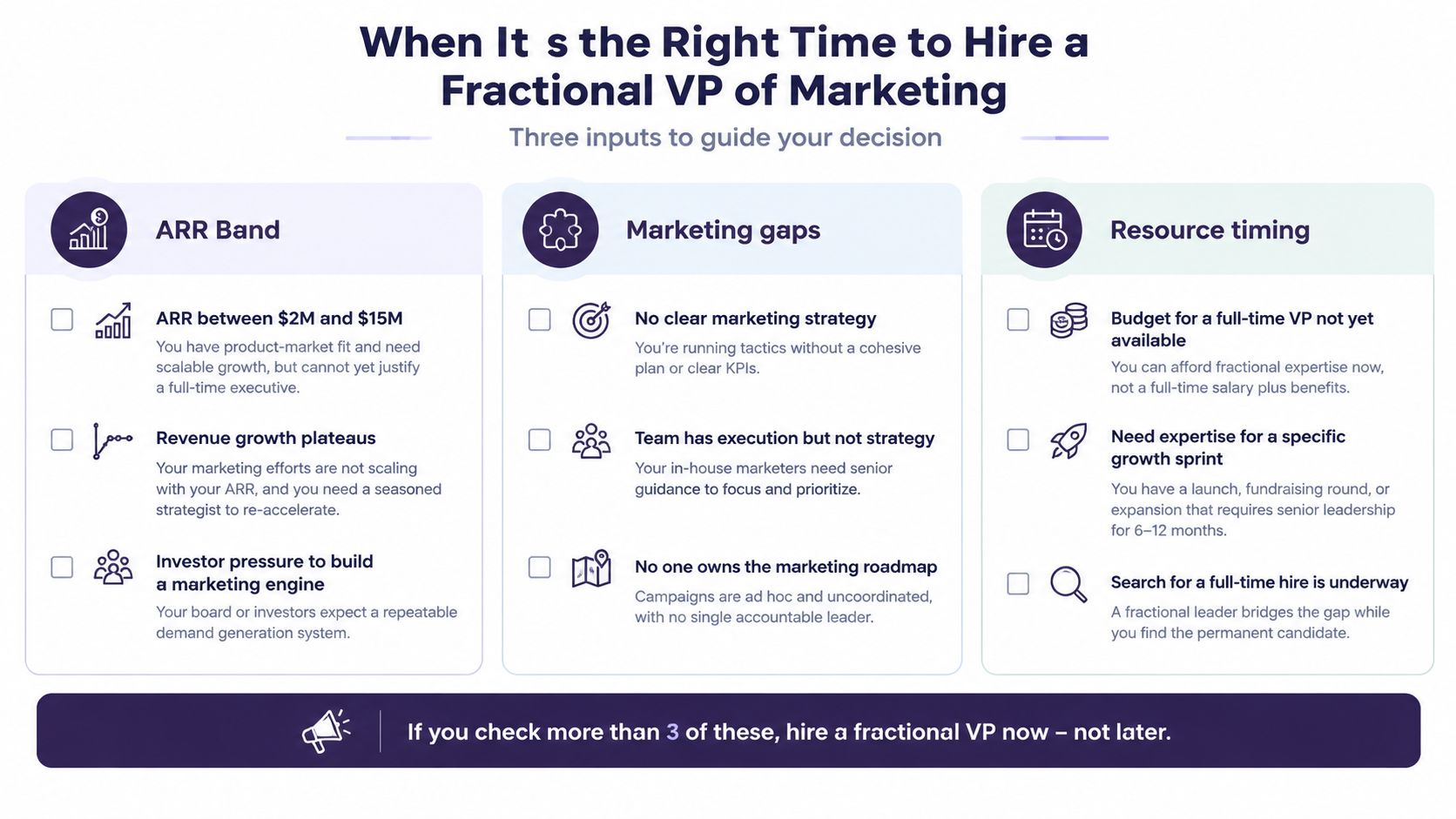
The right time is less about a fashionable revenue milestone and more about the interaction between revenue, pipeline, and team capability. The common working zone for a fractional engagement is $2 million to $15 million in ARR, where the company needs scalable growth but may not be ready for a full-time executive.
Start with the pipeline signal. If qualified pipeline has stalled or growth has flatlined across consecutive quarters, adding more disconnected tactics won't fix the problem. You need a senior person to diagnose the bottleneck, choose a smaller number of bets, and make sales and marketing share definitions.
Then inspect the team. A coordinator, content writer, or demand generation manager may be able to execute, but they still need someone to set priorities, review performance, and make difficult trade-offs. Hiring another junior contributor into that structure often creates more work for the founder.
Three inputs to check
- Revenue stage: If ARR sits between $2 million and $15 million, a fractional leader may provide the senior judgment required for the next stage without forcing a permanent executive hire.
- Pipeline condition: If qualified pipeline has stalled or growth has flatlined for consecutive quarters, treat that as an ownership problem until the data proves otherwise.
- Team maturity: If capable marketers are executing without strategy, a fractional VP can give them direction and remove the founder from daily management.
The wrong moment is just as important. Don't hire before product-market fit is reasonably clear, while the founder still needs to function as the head of sales, or when even an $8,000 monthly retainer would force cuts elsewhere. Those thresholds are practical filters, not guarantees.

Ask yourself one question before scheduling calls: If this person disappeared after the first month, what marketing decision or operating responsibility would immediately fall back onto me? If the answer includes pipeline planning, team management, budget allocation, and reporting, you likely have an ownership gap. If the answer is “we need more blog posts,” you probably need execution capacity instead.
Costs, Pricing Models, and How to Measure ROI
Pricing varies because the scope varies. A senior operator with experience in startup exits, enterprise marketing, PLG, healthcare, or another specialized environment will price differently from a generalist taking on a narrow advisory assignment. Time commitment, team size, channel complexity, and budget authority also change the economics.
Common 2025 engagement ranges include $7,000 to $15,000 per month for one to two days a week, $12,000 to $25,000 per month for three days, and project-based work starting around $25,000, as outlined in this fractional CMO pricing and hiring report. Treat those as planning ranges, not a menu. A low retainer with an impossible scope is more expensive than a properly sized engagement.
| Engagement Type | Monthly Cost | Time Commitment | Primary ROI Metric |
|---|---|---|---|
| Focused retainer | $7,000 to $15,000 | One to two days weekly | Marketing-sourced pipeline |
| Embedded retainer | $12,000 to $25,000 | Three days weekly | Qualified pipeline value and conversion |
| Project engagement | Starting around $25,000 | Defined scope | Completion of a revenue-linked growth initiative |
The ROI mistake is measuring the executive like a content producer. Impressions, traffic, and raw MQL counts can help diagnose activity, but they shouldn't decide whether the engagement continues. Use marketing-sourced pipeline dollar value, CAC, and CAC payback period as the commercial core.
A worked example makes the logic clearer. Suppose the fractional VP helps generate $400,000 in net-new ARR, and the company reaches a 4x CAC payback within 6 months. Compare the attributable acquisition investment and the engagement cost against the resulting ARR, then test whether the result holds after sales capacity, implementation costs, and attribution limits are considered. If the economics remain positive at the high end of the retainer range, the engagement has paid for itself commercially.
Don't wait indefinitely for perfect attribution. Establish the baseline before the first campaign, agree on source definitions with sales, and review the scorecard at thirty, sixty, and ninety days. The ninety-day decision should be explicit: renew, scale hours, change the scope, or exit.
Sample Job Description and Interview Questions
Source candidates through trusted operator networks, founder referrals, executive marketplaces, and people who can provide references from comparable businesses. A strong profile should show repeated ownership of pipeline and teams, not just impressive brand names or a portfolio of presentations.
Use a job description that makes the operating seat unmistakable:
Fractional VP of Marketing
Own the marketing function for a growth-stage company on a part-time basis. Define the ICP and positioning, build the quarterly pipeline plan, manage internal marketers and external partners, allocate channel spend, improve reporting, and provide a candid weekly readout to the CEO.
The engagement includes strategy, execution leadership, team coaching, vendor management, and hands-on work where senior judgment is required. The expected commitment is agreed during scoping, with deliverables tied to a thirty-, sixty-, and ninety-day plan. Compensation is structured as a monthly retainer aligned to time, scope, experience, and specialist expertise.
Ask questions that force the candidate into specifics. The guidance in these marketing executive interview questions is useful, but the following three reveal the most.
Tell me about a stalled pipeline you diagnosed. What did you inspect first, what did you stop, and what changed?
A green flag is a clear sequence involving CRM data, sales interviews, conversion stages, and a decision to focus resources. A red flag is a generic answer about “increasing awareness.”Describe a channel or agency that underperformed under your leadership. How did you handle it?
Look for a defined threshold, direct feedback, a corrective plan, and a willingness to cut spend. Be wary of candidates who blame creative, sales, or the vendor without explaining their own decision.How would you split your time between strategy, team coaching, and hands-on execution here?
A strong answer changes with the company's bottleneck and includes a way to protect strategic work. A weak answer gives a fixed ratio without asking about the team, pipeline, or current operating system.
For references, ask whether the executive has handled prior fractional engagements, whether clients retained or expanded the relationship, and why each contract ended. Also ask what the person owned without prompting. The answer will tell you more than a polished recommendation.
Real-World Outcomes and How to Get Started
One Series A SaaS founder hired a fractional VP after demand generation had become a collection of disconnected campaigns. The executive started with a pipeline audit, interviewed sales, clarified the ICP, and assigned one owner to each channel. The founder reports that qualified pipeline increased 2.4x in one quarter. That result is part of the scenario provided for this article, not a general benchmark, and it depended on tight scoping, fast access to data, and a shared definition of qualified pipeline.
The founder made three decisions that protected the engagement. First, they gave the VP authority over agency priorities and campaign sequencing. Second, they kept the scorecard narrow. Third, they required a thirty-, sixty-, and ninety-day plan before expanding the commitment.
A bootstrapped B2B founder made the opposite mistake. They hired a senior marketer too early, expected strategic guidance without granting execution authority, and accepted strategy decks instead of shipped work. After ninety days, the founder rolled the work back in-house because the engagement had created documentation without changing the operating rhythm.
The lesson isn't that fractional leadership always works for one stage and fails for another. The lesson is that the role must match the problem. If you need positioning and executive alignment, hire for that. If you need someone to manage campaigns, contractors, and reporting, say so. If you need both, reserve enough time for both and make the trade-off visible.
Before the first conversation, prepare your current pipeline definition, sales capacity, active channels, marketing spend, team map, agency contracts, and the decisions currently waiting on the founder. Write down what success must look like by day thirty, day sixty, and day ninety. A qualified marketplace such as Shiny can help connect companies with fractional executives for part-time leadership engagements, but the quality of the match still depends on how clearly you define the ownership gap.
Shiny connects companies with vetted fractional executives, including marketing leaders who can work part-time while owning strategy, execution, and pipeline accountability. Visit Shiny to explore potential matches and start a focused consultation with your current pipeline data and ninety-day priorities ready.