


A 205% year-over-year increase in go-to-market engineering job postings from 2024 to 2025 signals something counterintuitive: many revenue teams don't have a people problem first. They have a systems problem. The role has moved from an obscure title to a mainstream hiring category in roughly two years, and reporting counted more than 3,000 open GTM Engineer roles by early 2026 (GTM Engineering Pulse).
That growth doesn't mean every company needs another automation specialist. It means revenue leaders are discovering that AI agents, CRM workflows, enrichment systems, and sales execution need an operating layer that keeps them accurate. Without shared definitions, clean identities, routing rules, and human review, automation makes mistakes faster.
Go-to-market engineering is that operating layer. It combines commercial judgment with data, workflow design, and technical execution. The strongest teams don't start by asking which AI tool to buy. They ask what signal matters, who owns the next action, what evidence supports the decision, and how the system learns from the result.
Why Go to Market Engineering Is the Fastest-Growing Role in B2B
The title is new, but the underlying work isn't. Revenue teams have always needed people who understand customer data, sales processes, marketing programs, and operational bottlenecks. What changed is the speed and complexity of the systems those people now have to design.
The historical shift is useful. Industry commentary frames the 2000s as sales-led GTM, the 2010s as product-led growth, and the 2020s as an automation-and-data era built around continuously improving feedback loops (Digital Applied's B2B GTM playbook). Earlier operations teams often managed campaigns, fields, handoffs, and reports. GTM engineers design the connected system that decides what happens next.
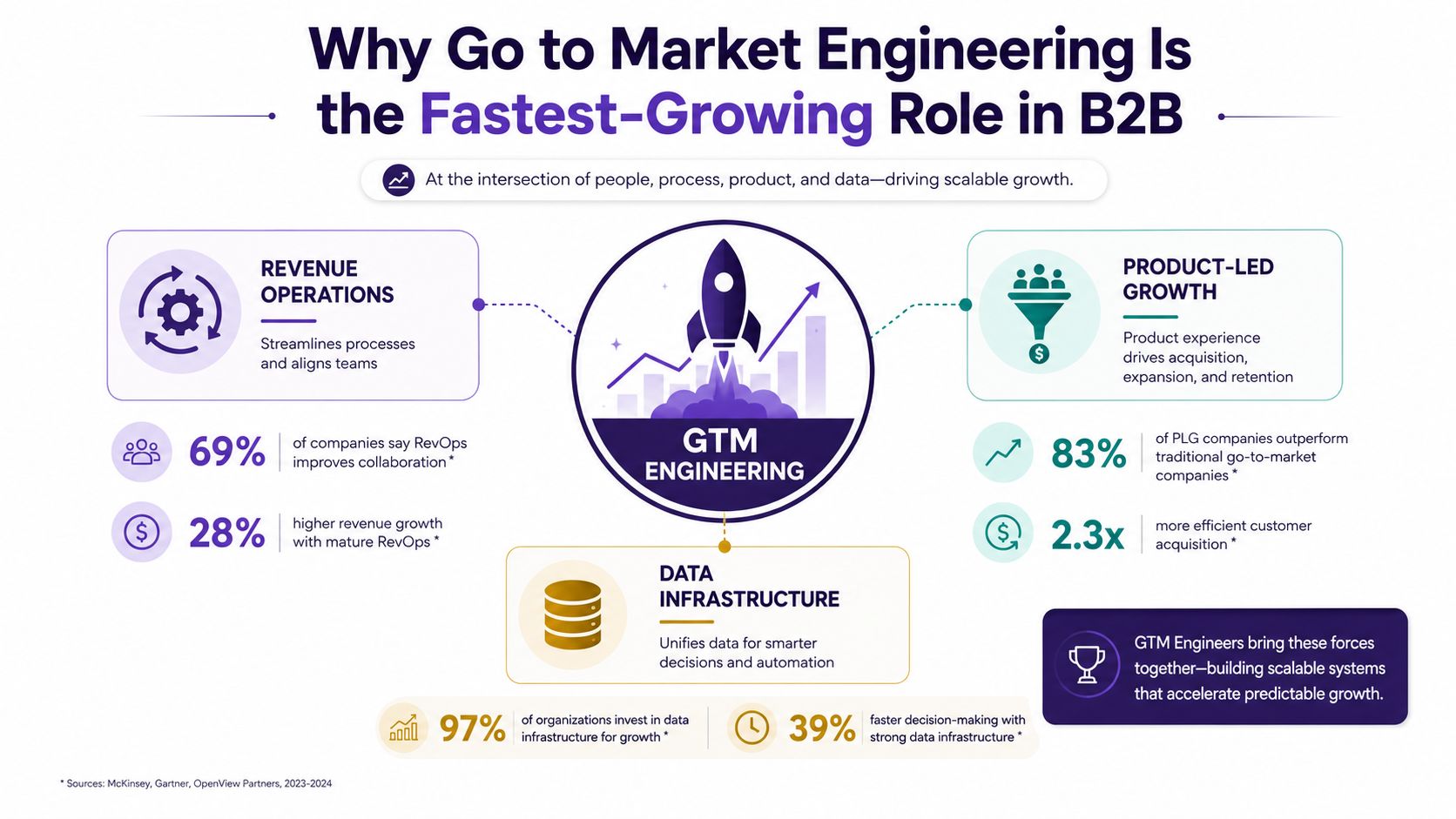

From campaign execution to revenue infrastructure
A campaign-centric organization asks, “Did we launch the program?” A system-centric organization asks:
- Signal quality: Did the system capture meaningful intent, firmographic, and engagement data?
- Decision logic: Did it distinguish a high-fit account from a noisy activity spike?
- Execution: Did the correct seller, sequence, or customer success owner receive the next action?
- Learning: Did the outcome improve the model, routing rule, or message?
That distinction explains why traditional RevOps and marketing operations can feel stretched. Those functions may own the CRM, reporting, or campaign machinery, but GTM engineering treats revenue workflows as products. A GTM engineer maps the problem, defines the inputs and outputs, prototypes a solution, tests edge cases, and hardens the workflow before wider deployment.
AI adoption is accelerating this model. In a 2025 HBR Analytic Services survey of 522 B2B leaders, the most common AI uses included analyzing data sets for insights at 52%, optimizing marketing campaigns at 51%, coaching sales representatives at 45%, refining customer personas at 44%, and personalizing content at 43% (Digital Applied's summary of the survey). Those uses share a requirement: someone has to connect the model to trustworthy data and a business process.
Practical distinction: RevOps keeps the revenue machine reliable. GTM engineering also builds and tests new machinery.
Why the role matters now
Modern buyers move between product usage, peer research, content, sales conversations, and AI-assisted discovery. A team that treats each interaction as an isolated campaign will miss the pattern. A team with a unified system can connect account identity, engagement, product behavior, and commercial context.
That doesn't make GTM engineering a replacement for marketing, sales, product, or RevOps. It creates a technical execution layer across them. The role is valuable when the business has enough data and process complexity that manual coordination creates delays, duplicate work, inconsistent prioritization, or unreliable reporting.
The practical test is simple. If your team can describe its revenue process only as a collection of tools and handoffs, it isn't engineered yet.
The Core Building Blocks of a GTM Engineering Function
A reliable GTM engineering function has four connected building blocks. They should be audited in order because downstream automation can't compensate for a weak foundation.
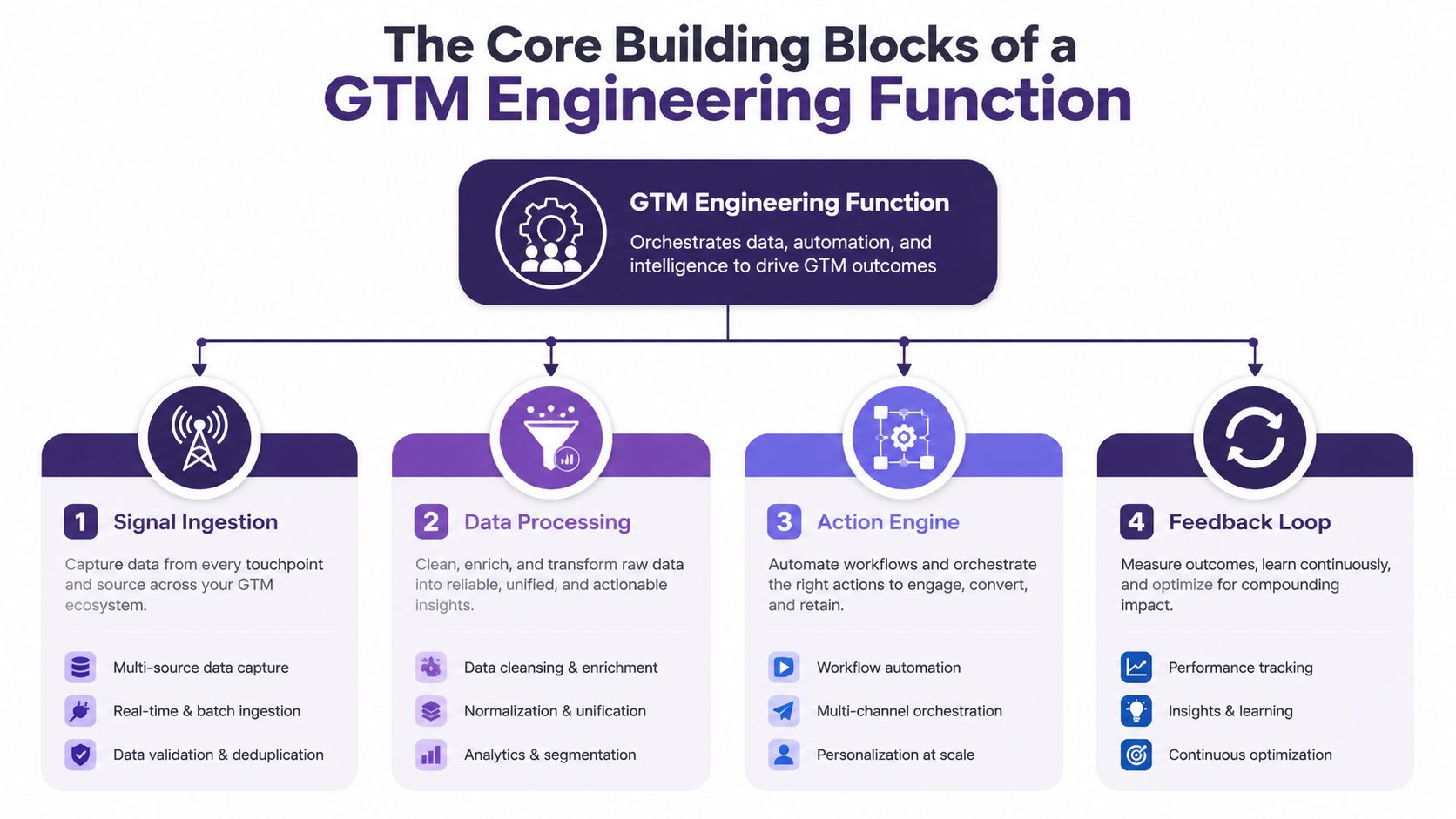
Signal ingestion
The system first needs useful inputs. These can include intent signals, firmographic attributes, product activity, website engagement, sales interactions, support conversations, and customer lifecycle events.
The mistake is collecting everything without deciding what it means. A page visit might indicate research, curiosity, or an automated request. A new executive hire might create an opportunity, but only if the account fits the product's market and the timing matches a relevant use case.
Create a signal catalogue with an owner, definition, source, freshness expectation, and permitted use. That catalogue prevents every team from inventing its own interpretation of “engaged.”
Data processing and identity resolution
Raw signals need to become usable records. This layer standardizes fields, resolves people and companies to the correct account, handles missing values, removes duplicates, and applies confidence rules.
Identity resolution is where many ambitious systems fail. If a prospect appears under a personal email, a subsidiary domain, and a parent company record, the agent needs a deterministic way to relate those identities. Otherwise, sales may receive multiple tasks for one buyer, marketing may send conflicting messages, and reporting may split one opportunity across several accounts.
Action orchestration
Routing logic translates processed data into action. It decides whether to create a CRM task, update an account, enroll a contact in a sequence, notify a seller, suppress outreach, or send the signal to customer success.
Use explicit conditions rather than vague AI judgment wherever the consequence is material. For example, an action can require a valid account match, an approved territory owner, a recent signal, and a fit threshold before it reaches a seller. Tools such as Salesforce, HubSpot, Outreach, Slack, and warehouse workflows can participate, but the architecture should define which system is authoritative for each field and action.
A useful go-to-market strategy framework can help connect these technical decisions to target market, positioning, channels, pricing, sales motion, enablement, and measurement.
Feedback loops
The final layer measures what happened. Did the seller accept the lead? Did the account progress? Was the signal misleading? Did a customer success alert result in a useful intervention?
Store outcomes in a way the system can use. A routing rule that creates tasks but never records acceptance, rejection, conversion, or suppression can't improve. Feedback also needs human annotation. A seller's reason for rejecting a lead may reveal a bad ICP definition, a stale data source, or a missing exclusion rule.
The audit question is straightforward: Can your system explain why it took an action, who approved it, and what happened afterward? If not, you have automation, but not a GTM engineering function.
The Operational Design Gap That Derails Most GTM Systems
Most GTM engineering advice starts with tools. That sequence is backwards. An AI agent can enrich records, summarize calls, draft messages, and route work, but it can't decide what “qualified” means unless the organization has already defined the term.
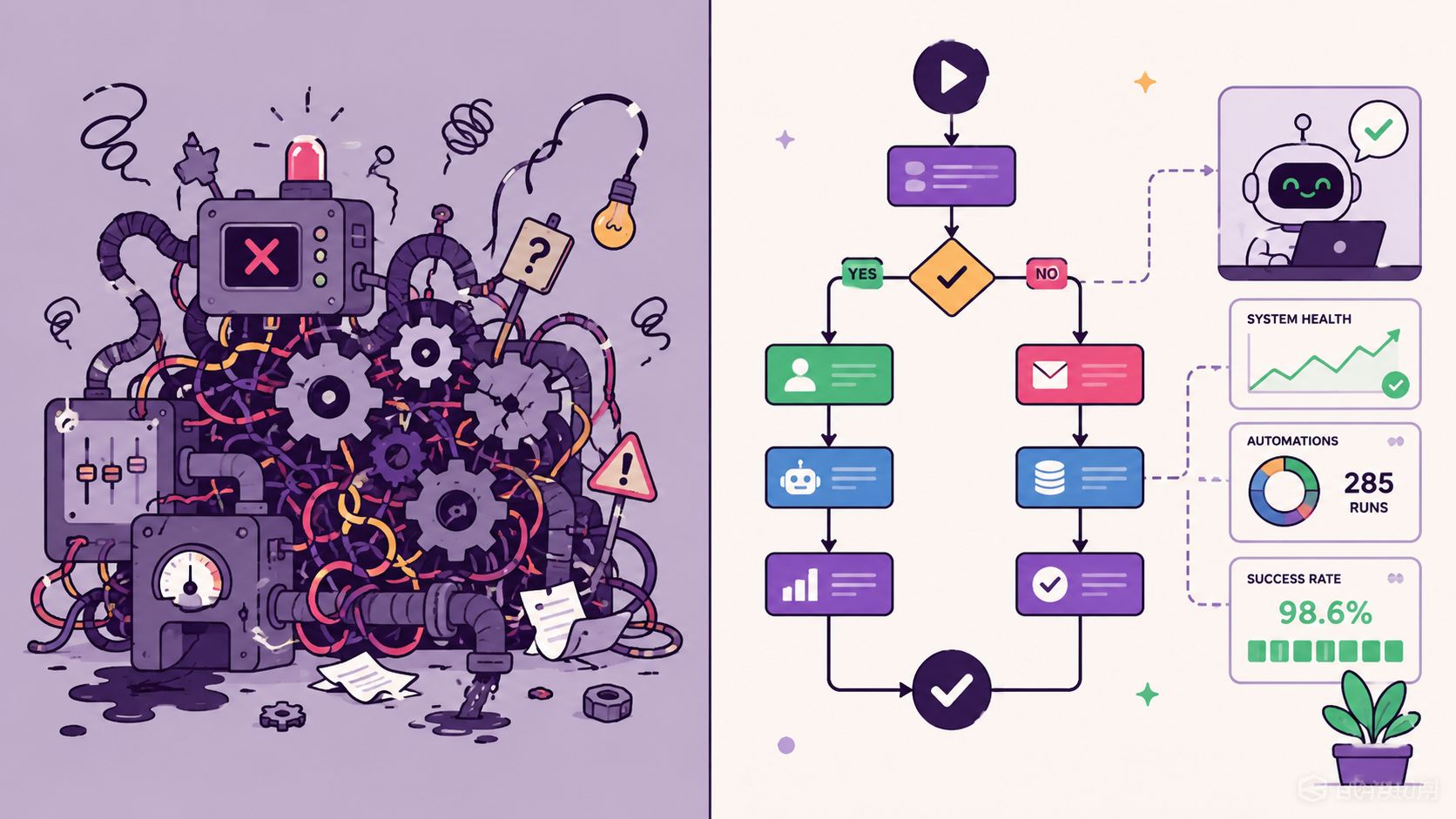
Shared context comes first
Agents need access to the same commercial context as the people who supervise them. That includes the ICP, territory rules, lifecycle stages, product limitations, pricing boundaries, suppression policies, and definitions for pipeline, opportunity, activation, retention, and expansion.
Without shared context, two agents can make internally consistent but contradictory decisions. One may treat a trial user as a marketing lead, while another treats the same person as an active opportunity. The failure isn't the model's creativity. The failure is the organization's missing contract.
Write the context down in operational terms:
- Stage definitions: Specify entry criteria, exit criteria, and disqualifying conditions.
- Ownership rules: Define the account, contact, opportunity, and customer success owner.
- Evidence requirements: State which sources and signal freshness support an action.
- Escalation rules: Identify decisions that require human review.
- Rollback procedures: Document how operators reverse an incorrect update or sequence.
Governance prevents speed from becoming risk
Human-in-the-loop controls shouldn't mean approving every low-risk task manually. They should concentrate review where errors are expensive or hard to reverse.
An agent might be allowed to normalize a job title or draft an internal summary. It may need approval before changing lifecycle stage, merging accounts, sending a sensitive message, changing a forecast category, or launching a sequence against a strategic account.
Governance rule: Automate preparation broadly, automate irreversible decisions narrowly.
Use a permission matrix that maps each agent to its data access, write access, allowed actions, confidence threshold, and review requirement. Add test records that represent edge cases, such as subsidiaries, shared domains, duplicate contacts, conflicting owners, and stale intent. Run those records before every material workflow change.
Identity and funnel design are control layers
Identity resolution deserves its own owner because every downstream metric depends on it. Establish a canonical account key, document parent-child relationships, and define how the system handles uncertain matches. When confidence is low, the correct action is often to create a review queue rather than force a match.
Funnel definitions need the same discipline. If marketing, sales, and customer success each use different meanings for “qualified,” the feedback loop will teach the wrong lesson. Agents will optimize for activity that looks successful in one report and useless in another.
The overlooked skill in GTM engineering isn't prompt writing. It's operational design under uncertainty. Teams that define context, identity, permissions, evidence, and review paths can scale agents with confidence. Teams that skip those controls create a faster route to bad routing, duplicate records, and untraceable decisions.
Staffing GTM Engineering with Fractional Executive Leadership
GTM engineering often stalls before implementation because the company needs senior judgment before it can justify a permanent executive hire. The work crosses revenue, marketing, product, data, and finance. A junior operator may configure tools, but cannot resolve competing priorities, set decision rights, or hold leaders accountable for the operating model.
Fractional leadership fills that gap through a part-time or limited-term engagement. An experienced executive may support several organizations and dedicate a fraction of full-time hours, often one or two days per week or a defined number of hours each month. The company gets senior judgment while the scope, governance, and team design are still being proven (James Mattison's research on fractional leadership). This approach also aligns with the broader fractional C-suite advantage and strategic guide to executive leadership.
Compare the operating models
| Dimension | Full-Time Executive | Fractional Executive |
|---|---|---|
| Hiring timeline | Traditional executive searches often take 3 to 6 months (DataIntelo research) | Engagements can usually begin within weeks |
| Cost structure | C-suite compensation commonly exceeds $250,000 annually | Usually structured as a monthly retainer or daily rate |
| Relative cost | Higher fixed commitment | Research describes 40% to 70% cost savings versus full-time equivalents |
| Best fit | A durable leadership need with a stable scope | A transformation, interim gap, or specialist mandate |
| Risk profile | A poor fit can create long-term disruption | The company can define a bounded mandate and review progress sooner |
A permanent CRO, VP of Revenue Operations, or Head of GTM Systems makes sense when the operating model is stable, the scope is broad, and the company needs daily leadership across a growing organization.
Fractional leadership fits the earlier design phase. The mandate may include funnel governance, system architecture, hiring the first GTM engineer, CRM repair, or preparation for a new market. These are executive decisions, yet they do not always justify a permanent seat before the system has a proven operating rhythm.
Where fractional leadership makes the difference
A fractional CRO can align positioning, pricing, sales motion, and revenue accountability. A fractional VP of Revenue Operations can define data ownership, lifecycle stages, forecasting discipline, and routing governance. A fractional Head of GTM Systems can turn those decisions into architecture, tooling standards, agent permissions, and deployment controls.
The engagement should produce operating assets, not only advice. Require a decision log, ownership model, hiring plan, architecture principles, and review cadence. Set the boundaries for what agents may read, write, change, and escalate. Without those controls, automation can scale inconsistent definitions and make accountability harder to recover.
Hiring risk also supports a bounded trial. Research on senior leadership mistakes places the median cost of a bad VP hire at 27 times the role's base salary, with about 60% of that cost not appearing directly on the income statement (Pawan Joshi's analysis of VP hiring postmortems). Fractional leadership does not remove that risk. It gives the company time to test leadership fit, priorities, and execution before making a larger commitment.
The fractional executive market has moved beyond a niche staffing tactic. Independent market research places it above $5.7 billion, with 14% annual growth (Think Fractional's market report). For growth-stage companies, the decision is about securing the judgment required to design and govern the system while the permanent organization takes shape.
Implementing Your GTM Engineering Function Step by Step
Start with the operating problem, not the platform. A GTM engineering function should have a clear commercial mandate, an accountable executive sponsor, and a controlled path from experiment to production.
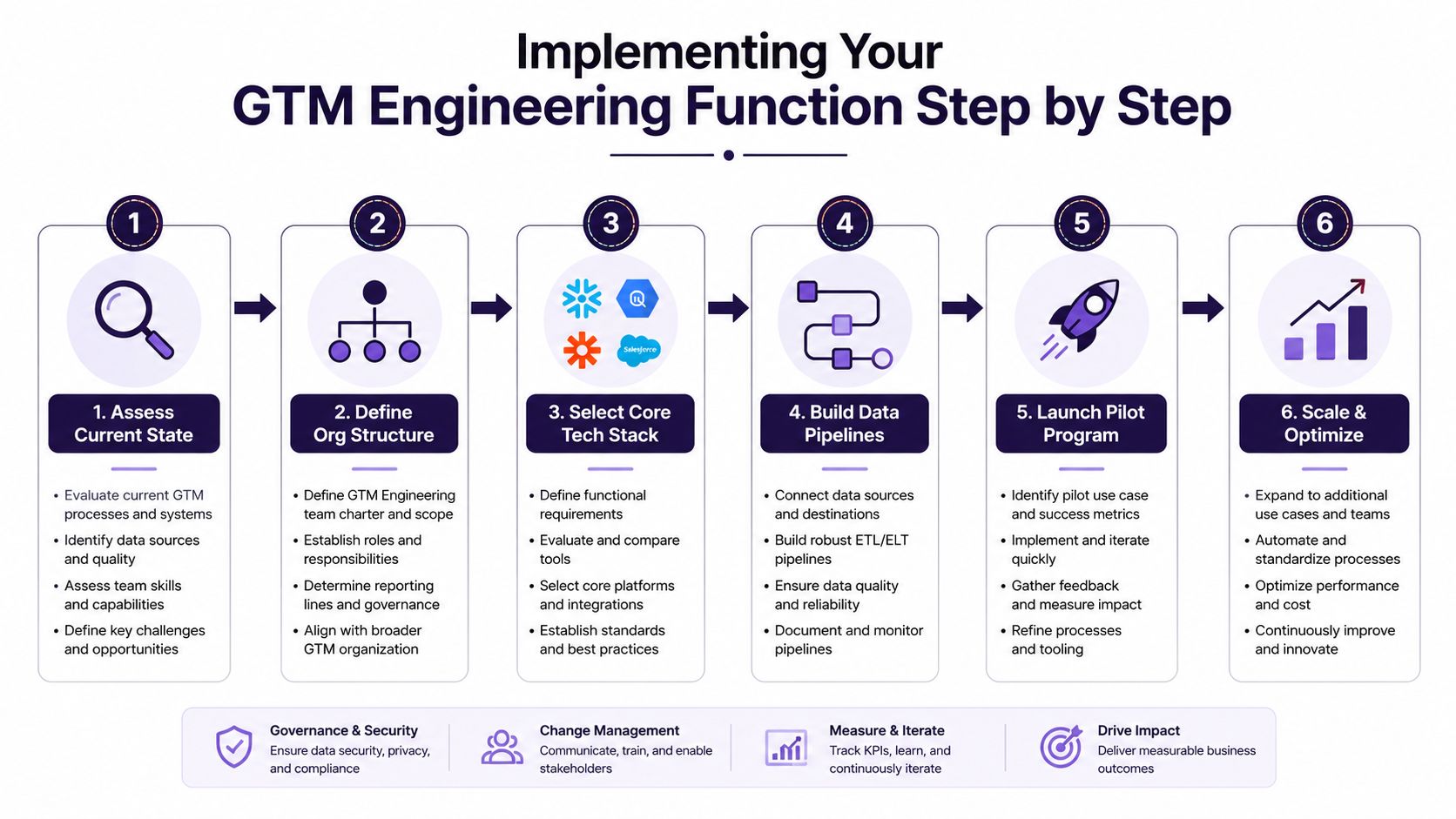
1. Assess the current state
Map how a signal moves from source to outcome. Follow an inbound form, product event, outbound account, renewal risk, or support escalation through every system and handoff.
Record where data is duplicated, where ownership changes, where humans re-enter information, and where no one can explain the decision. Interview sellers, marketers, customer success managers, and administrators. Their workarounds often expose the actual architecture more clearly than a systems diagram.
2. Define the org structure
Teams should begin close to RevOps because that function usually understands CRM data, ownership, lifecycle management, and reporting. The function can later support growth, sales, product-led motions, or customer success as the foundation becomes dependable.
Define one executive owner and one backlog. GTM engineering shouldn't become a queue for every automation request. Prioritize work by revenue impact, operational risk, repeatability, and the quality of available signals.
3. Select the core stack
Separate capabilities from brands. You need a system of record, reliable data sources, workflow orchestration, sequencing or engagement tools, observability, and a place to document decisions.
Buy commodity capabilities when they are mature and maintainable. Build differentiated logic when your ICP, product behavior, routing model, or customer data creates a real advantage. Test integration behavior, permissions, rate limits, failure handling, and auditability before approving a tool.
For CRM foundations, this CRM implementation guide provides a useful reference point for turning process decisions into a controlled system rollout.
4. Build the data pipelines
Begin with identity, schema, ownership, and freshness. Then connect signals to the fields and objects that downstream workflows use.
A pipeline isn't complete when records arrive. It needs validation, duplicate handling, error queues, retry behavior, and an owner who reviews exceptions. Keep raw inputs separate from interpreted fields so operators can inspect what the system saw before it made a decision.
5. Launch a narrow pilot
Choose one workflow with a clear user, clear trigger, and measurable outcome. An inbound routing pilot, account research workflow, or customer risk alert is easier to test than a company-wide autonomous prospecting program.
Run the pilot in shadow mode first. Let the system make recommendations while humans compare them with current practice. Then permit low-risk actions, add approval gates for material changes, and document every exception.
6. Scale through measurement
Track leading indicators such as signal coverage, match confidence, routing latency, task acceptance, suppression accuracy, exception volume, and human override reasons. Pair them with commercial outcomes, including progression, conversion, retention, or expansion, depending on the workflow.
Document the system like an internal product. Every production workflow should have an owner, purpose, input contract, action policy, review threshold, test cases, and rollback plan.
Process discipline affects revenue timing. One benchmark summary reports that companies with documented GTM processes reach first revenue 30% faster, while structured GTM approaches achieve 2.1x higher client acquisition rates (The Starr Conspiracy's GTM benchmarks). The same benchmark set says 77% of B2B product launches miss year-one revenue targets, and identifies poor cross-functional coordination in 68% of failed launches. Positioning and messaging gaps account for 68% of GTM failures in that benchmark set (The Starr Conspiracy's GTM benchmarks).
Those figures point to a practical conclusion. Launch gating isn't bureaucracy. It protects the company from scaling a broken offer, unclear ownership, or unreliable data.
Your GTM Engineering Launch Checklist and Next Steps
A GTM engineering function is ready for production when people can trust both its actions and its limits. Use this checklist before expanding automation.
Before launch
- Define the ICP: Document firmographic fit, use-case fit, exclusions, and buying signals.
- Name the owner: Assign one accountable owner for the workflow and one executive sponsor for trade-offs.
- Test identity resolution: Use duplicate contacts, subsidiaries, shared domains, and uncertain matches.
- Verify routing: Confirm territory, account ownership, lifecycle stage, suppression, and escalation rules.
- Protect CRM hygiene: Separate authoritative fields from inferred fields and create an exception queue.
- Set agent permissions: Approve read, write, send, merge, and escalation privileges individually.
- Create rollback paths: Record how operators reverse updates, stop sequences, and restore prior values.
On launch day
Watch the first actions, not just the dashboard. Review match confidence, routing outcomes, duplicate creation, rejected tasks, human overrides, and messages that reach the wrong audience.
Instrument first-revenue milestones so the team can see weak signals before the launch window closes. If the system produces activity but no useful progression, stop and diagnose the signal, offer, message, or ownership rule instead of adding more volume.
After launch
Review the feedback loop on a fixed operating cadence. Compare accepted and rejected recommendations, investigate overrides, retire stale signals, and update definitions when the sales motion changes.
The buyer environment also demands a different optimization target. Recent market commentary describes earlier AI-assisted research, compressed deal cycles, and rising smaller commitments, which shifts GTM engineering toward evidence, speed to lead, and proof of value, not outbound volume alone (GTM eAgency's 2026 market commentary). Your system should help a buyer understand the problem, validate the fit, experience value quickly, and move forward with less friction.
Agent governance deserves a recurring review as models and workflows change. Ask whether the agent still has the right context, whether its evidence remains reliable, whether humans can see why it acted, and whether the business can stop or reverse it safely.
The fastest path isn't always a permanent hire. If the mandate is urgent but the long-term org design is still uncertain, fractional executive leadership can establish the control layer, prioritize the roadmap, and help recruit or develop the eventual owner.
Shiny connects growth-stage companies with fractional executives who can lead revenue, RevOps, GTM systems, and related functions on a part-time basis. Visit Shiny to explore executive support for designing a governed GTM engineering function or schedule a consultation around your current systems, hiring gap, and launch priorities.