


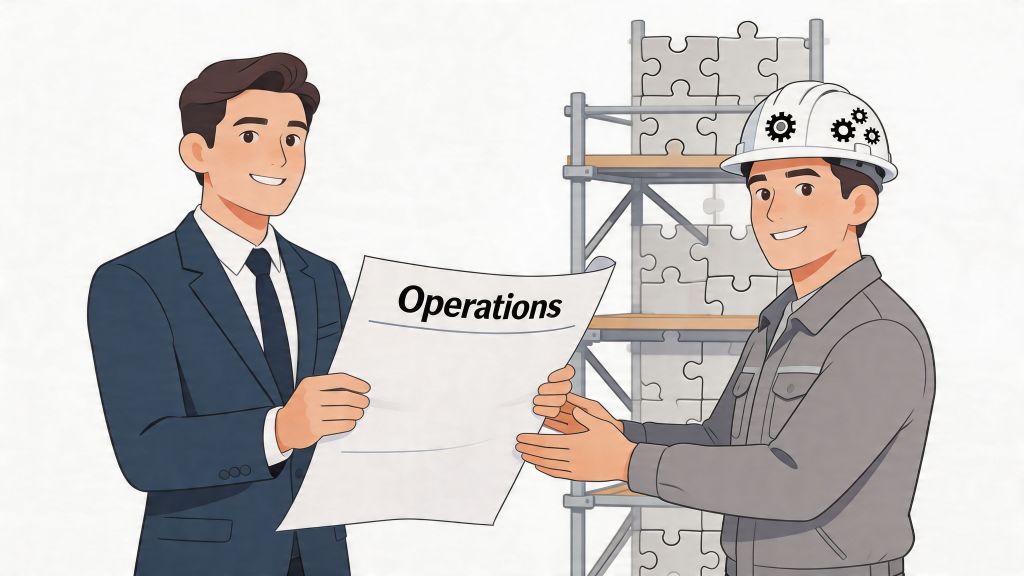
A lot of founders hit the same wall at roughly the same stage. The product is working, customers are coming in, the team is bigger than it used to be, and suddenly your day is gone before you've touched strategy. You're approving tools, chasing handoffs, resolving confusion between sales and delivery, and getting pulled into issues that shouldn't need your involvement.
At first, that feels temporary. Then it becomes your operating model.
The problem usually isn't ambition or effort. It's that the company has outgrown informal coordination. What used to work when everyone sat close together, talked constantly, and fixed problems on the fly stops working when more people, customers, tools, and promises enter the picture. That's when a head of operations becomes less of a luxury and more of a missing piece.
The Founder's Dilemma When Growth Creates Chaos
A founder launches with speed. In the beginning, speed covers a lot of sins. A missed handoff gets fixed in Slack. A customer issue gets escalated directly to the founder. A recruiting gap gets patched with overtime and goodwill.
Then growth changes the math.
One team starts selling work another team can't deliver on the promised timeline. New hires don't know who owns what. Finance asks for cleaner reporting. Customers expect consistency, not heroics. The founder becomes the human router for every unresolved issue.
That usually looks like this:
- Meetings multiply: People need more alignment because the process isn't clear.
- Deadlines slip: Work depends on tribal knowledge instead of documented handoffs.
- Teams duplicate effort: Two people solve the same problem in different ways.
- The founder gets trapped in triage: Important work loses to urgent work.
If that sounds familiar, you're not failing. You're seeing the normal limit of founder-led operations. A useful framework for that moment is learning how to manage competing priorities as a leader, because operational chaos is often just priority conflict made visible.
You don't feel the need for operations leadership when things are calm. You feel it when every decision keeps bouncing back to the founder.
A head of operations steps into that gap. Not to add bureaucracy. To remove friction.
They create structure where the company currently depends on memory, improvisation, and founder availability. They make sure work moves from one function to the next without constant intervention. They turn "we should fix that" into a repeatable system.
For a founder, the relief is immediate. Fewer avoidable escalations. Cleaner accountability. More time spent on direction, not coordination.
What Is a Head of Operations The Startup's System Architect
A startup can survive for a long time on hustle, shared context, and a founder who keeps every thread in their head. Then the company reaches a point where that approach stops scaling. Sales closes faster than onboarding can absorb. Hiring adds people faster than managers can align them. Simple questions start bouncing between teams because no one designed the path work is supposed to follow.
That is the job of a head of operations.
They build the company's operating system. The founder sets direction. The head of operations makes sure work can move through the business in a repeatable way, with clear owners, useful data, and fewer avoidable surprises. If a startup is a machine for turning effort into outcomes, this role is the person tightening the belts, aligning the gears, and replacing the parts that fail under load.


How the role works in practice
A good head of operations looks across functions and asks the questions founders rarely have time to sit with:
- Where does work stall?
- Which decisions have no clear owner?
- What process breaks first if volume doubles?
- Which tools help, and which tools create more admin?
Those questions matter because startups usually do not break from lack of ambition. They break at the handoffs. A deal closes, but implementation lacks context. A customer issue reaches the wrong team three times. Finance needs one version of the truth, while sales and delivery each keep their own spreadsheet.
The head of operations closes those gaps. They sit near the center of execution, close enough to see how work happens in real life rather than how it looks on the org chart. That can include planning rhythms, reporting, vendor management, hiring workflows, escalation paths, and the rules for how teams hand work to one another.
In early and growth-stage startups, this capability does not always need to start as a full-time hire. Sometimes the smartest move is fractional support first. If the company needs structure, clearer ownership, and better cross-functional flow, but not yet a full executive seat, a part-time operator can build the core systems before the role expands.
Head of operations versus COO
Founders often mix up the head of operations and the COO because both roles deal with execution. The difference is usually scope and altitude.
A COO often owns company-wide execution at the executive level. In larger companies, that can include multiple departments, strategic planning, and leadership across a broad operating portfolio.
A head of operations is usually closer to the ground. They turn strategy into management routines, workflows, decision rules, and reporting habits that people can use each week. In many startups, that hands-on builder matters before a formal C-suite operator does. If you're comparing adjacent roles, this breakdown of what a VP of Operations does can help clarify the differences.
Why this role matters under pressure
Operations work shows its value long before a crisis, but pressure is where the gaps become obvious. When a key person is out, a major customer escalates, or a system fails, the company falls back on whatever structure already exists.
A strong head of operations plans for that reality. They define who decides what, how issues get escalated, what must be documented, and which processes need backup coverage. In practical terms, they reduce the number of moments where the business has to stop and ask, "Who knows how this works?"
That is why this role is more than an efficiency hire. It is a resilience hire. And for many startups, it is a capability you can access in stages, starting fractionally when the warning signs appear and expanding the role once complexity becomes permanent.
Practical rule: If your company depends on one person remembering how everything works, you do not have an operating system. You have a risk.
Core Responsibilities and Essential Skills
Growth rarely breaks because people stop working hard. It breaks because the work no longer fits inside shared memory.
A head of operations fixes that by turning scattered effort into a repeatable system. If the founder is the person steering the company toward the right market, the head of operations builds the gearbox that transfers that direction into daily execution. In an early-stage startup, you do not always need that capability as a full-time hire on day one. You often need it first as focused, part-time operating leadership that can identify the strain points, install structure, and show you where complexity is becoming permanent.


Process optimization
This is usually the first place the pain shows up.
Sales closes deals one way, onboarding starts another way, and delivery improvises the rest. Nothing looks broken in isolation. Together, the gaps create delays, rework, and customer frustration. A head of operations studies how work moves across the company, then rebuilds the weak joints so the business does not keep stalling at the same handoffs.
Typical responsibilities include:
- Workflow mapping: Documenting the sequence of work between teams so handoffs are clear.
- Bottleneck removal: Finding where approvals, information, or capacity slow everything down.
- SOP creation: Writing practical standard operating procedures for repeatable work.
- Escalation design: Setting rules for what gets raised, who owns it, and how quickly it must be resolved.
The point is not more documentation for its own sake. It is fewer avoidable errors, fewer heroics, and less time spent rediscovering the same fix every week.
Resource management
Founders often feel resource problems as budget problems. They are usually coordination problems first.
One team has idle capacity while another is buried. A tool gets renewed because no one owns the decision. Contractors fill a gap that should have been solved with a better process. A strong operator treats people, software, vendors, and budget like parts of one system, because waste in startups often hides in the gaps between those categories.
That work often includes:
- Capacity planning: Matching workload to actual team bandwidth.
- Vendor oversight: Reviewing contracts, usage, and service levels before costs drift.
- Budget coordination: Connecting spend to operating priorities with finance.
- Cross-functional alignment: Preventing one department from improving its own output while creating friction for another.
A useful test is simple. If your team keeps solving urgent problems by adding cost, a head of operations asks whether the issue is unclear ownership, poor sequencing, or a broken process.
Technology and systems
Startup tools should act like a connected control panel. Too often, they behave like a drawer full of unrelated cables.
A head of operations brings order here. They decide which system is the source of truth, where information should live, when automation helps, and when a new tool would only add another layer of confusion. They do not need to administer every platform themselves. They need to make sure your systems support the way the business runs.
A capable operator will ask questions like these:
- What system holds the official record?
- Where is data being entered twice?
- Which reports does the team trust enough to use for decisions?
- What breaks if one key person is out for a week?
If you are comparing this role with broader executive ownership, this guide to chief operating officer duties and responsibilities helps clarify where hands-on operating design ends and company-wide executive accountability begins.
Team enablement and the skills that matter
The best heads of operations are builders of clarity.
They see patterns that other people experience only as daily frustration. They can listen to sales, finance, customer success, and product describe the same problem in different language, then translate that noise into one decision, one workflow, and one owner.
Look for these skills:
- Systems thinking: They understand how a small failure in one process creates downstream issues elsewhere.
- Data discipline: They want evidence before redesigning a workflow.
- Operational judgment: They know which work should be standardized and which work still needs flexibility.
- Cross-functional communication: They can get teams with different incentives to work from the same operating rules.
- Bias for action: They fix obvious friction without waiting for perfect certainty.
- Calm under ambiguity: They can build structure while the company is still changing fast.
For a founder, the deeper value is judgment. A head of operations is the person who can tell the difference between a temporary mess that the team can absorb and a structural problem that will keep taxing the business until someone redesigns it. That is why many startups start with fractional support first. They need the capability before they need the full-time title.
The Key KPIs Your Head of Operations Will Own
A founder usually feels the problem before seeing it on a dashboard. Orders are going out, customers are still buying, revenue looks fine, yet the company feels harder to run each month. Cash gets tied up in stock. Deliveries slip. Small mistakes create rework. Margin shrinks even while sales grow.
That is why KPI ownership matters. A head of operations gives the company a control panel for execution. The goal is not to produce more reports. The goal is to spot where the machine is losing time, cash, or consistency before those losses become normal.

What the metrics are really measuring
Each KPI answers a different operating question.
Inventory turnover asks, "Are we turning stock into cash at a healthy pace?" If turnover is low, money is sitting on shelves instead of funding growth.
OEE, or Overall Equipment Effectiveness, asks, "Are our assets producing as expected?" In manufacturing or other asset-heavy operations, it combines availability, performance, and quality into one measure of how well equipment is being used.
On-time delivery rate asks, "Can we keep the promises we make?" This is one of the clearest signs that planning, staffing, and execution are aligned.
First pass yield asks, "How often do we get the work right the first time?" A weak number here usually means the business is paying twice for the same output, once to do it and again to fix it.
Gross profit margin asks, "Is growth creating value or just more work?" Revenue can hide operational waste. Margin exposes it.
A useful way to read these metrics is to treat them like warning lights on a car dashboard. One light rarely tells the whole story. Together, they tell you where to inspect the engine.
How a strong head of operations uses KPIs
Good operators do not stop at reporting.
If on-time delivery drops, they trace the failure back through scheduling, approvals, supplier performance, staffing, or forecasting. If inventory turnover weakens, they look at purchasing habits, demand planning, and product mix. If first pass yield falls, they check whether the issue starts in training, handoffs, unclear specs, or quality control.
That is the core job. KPIs are not scorekeeping. They are diagnostic tools.
Metrics matter only when they change a decision, a process, or an owner.
In some businesses, benchmark ranges are useful as reference points. According to FoodGrads' discussion of operations metrics, operations leaders often watch OEE above 85% and, for retailers, inventory turnover at 8 to 12 times per year. Those numbers are not universal targets for every startup, but they help founders see what "healthy" can look like in more mature operating environments.
A simple founder lens
You do not need to become the person running the spreadsheet. You do need to know what each number is saying about the business model.
| KPI | What it often signals |
|---|---|
| Gross profit margin | Whether growth is healthy or expensive |
| On-time delivery | Whether planning and execution are aligned |
| First pass yield | Whether quality is built into the process |
| Inventory turnover | Whether working capital is tied up unnecessarily |
| OEE | Whether assets are being used effectively |
For many startups, this is also where fractional support makes sense first. You may not need a full-time executive to build a sensible KPI system, set baselines, and create an operating review rhythm. You may need experienced judgment a few days a month to decide which numbers matter, who owns them, and what action each one should trigger.
When that work is done well, KPIs stop being board-deck decoration. They become the operating language that helps the company grow without losing control.
When to Hire Your First Head of Operations
The right time usually isn't "as early as possible." It's when the business has enough motion that informal coordination no longer holds.
You can often feel that moment before you can name it. The company isn't broken, but everything takes more effort than it should.
Signals founders shouldn't ignore
A few signs show up again and again:
- You are the fallback process: Team members come to you because ownership isn't clear.
- Work quality depends on who handled it: Results vary too much from person to person.
- Customer experience is becoming uneven: Delivery, onboarding, or support feels less predictable as volume increases.
- Teams argue about priorities instead of executing them: Sales, product, and operations don't share the same definition of urgent.
- Important decisions are late: Not because they're hard, but because the path to decision is muddy.
If you're seeing several of those at once, an operations leader can prevent small fractures from becoming structural problems.
Why part-time can be the right first move
A lot of founders assume they need a fully defined senior role before they bring in help. Usually they need the opposite. They need someone senior enough to clarify the role by fixing the system.
A part-time or fractional head of operations makes sense when your company needs:
- A process audit
- A better operating cadence
- Cross-functional alignment
- A decision-making framework
- Cleaner accountability without another layer of management
That model is especially useful when the work is important but not yet full-time in scope. You may need executive judgment now, but not a permanent hire attached to every hour of the week.
The trigger isn't headcount alone. It's when growth starts exposing the limits of improvisation.
Full-Time vs Fractional The Strategic Tradeoffs
Founders often frame this as a hiring decision. It's better framed as an access decision. Do you need this capability all week, or do you need the right operator focused on the right problems for a smaller slice of time?
That distinction matters because operations leadership is expensive to hire poorly and valuable to hire well.
A full-time head of operations can command a base salary from $120,000 to over $200,000, plus benefits and equity, while fractional executives can provide similar expertise for 50-75% less cost, according to the U.S. Bureau of Labor Statistics-linked salary context in this role overview.
Full-Time vs. Fractional Head of Operations Comparison
| Factor | Full-Time Head of Operations | Fractional Head of Operations |
|---|---|---|
| Cost | Higher fixed commitment, often salary plus benefits and equity | Lower financial commitment for senior expertise |
| Scope | Better when the role is broad, constant, and deeply embedded | Better when the company needs targeted intervention or staged buildout |
| Speed to impact | May require a longer onboarding arc, especially if the role is newly defined | Often brings pattern recognition quickly because they’ve solved similar issues before |
| Flexibility | Harder to scale down if needs change | Easier to increase or reduce involvement as priorities shift |
| Risk | Higher if the role is poorly scoped or the hire is mismatched | Lower if you need to test the function before building it fully |
| Founder use case | Works when operations is a permanent executive lane | Works when the founder needs immediate leverage without a long-term lock-in |
When full-time makes sense
A full-time hire is usually the right call when operations is already a large management domain. That might mean multiple teams reporting in, heavy internal complexity, or a business model where daily operational oversight is central to value delivery.
It's also useful when the company has already reached process maturity in some areas and now needs a permanent executive to run and scale an established function.
When fractional makes more sense
Fractional is often the smarter first move when the business is still shaping the role.
Examples include:
- You know there are bottlenecks, but not which one to fix first
- You need senior judgment, not another junior project manager
- You want to build systems before committing to a permanent org design
- You need leadership in a narrow time window, such as post-fundraise, post-launch, or during a scaling transition
This model also fits founders who need immediate relief without the weight of a full executive search. You can get experienced operational leadership, test the value of the role, and learn what the business needs before locking in a larger commitment.
The real tradeoff
The choice isn't between serious and less serious leadership.
It's between embedded permanence and targeted advantage.
A full-time head of operations can become a long-term pillar. A fractional head of operations can create order, build systems, and prepare the company for that eventual hire. For many startups, that sequence is the more rational path.
How to Interview and Hire Your First Head of Operations
Most founders interview operations candidates too generally. They ask about leadership style, communication, or strengths and weaknesses. That won't tell you whether someone can untangle a messy business.
You need questions that force the candidate to think like an operator.

Ask for problem-solving, not philosophy
Good interview prompts are specific and situational:
- Tell me about a process that was breaking as volume increased. How did you diagnose it?
- If you joined us for a limited number of hours each week, what would you audit first?
- Describe a time sales and delivery were misaligned. What changed after you stepped in?
- Which operating metrics do you trust first when you're new to a business, and why?
- How do you decide whether a process needs standardization or just clearer ownership?
Strong candidates answer with sequence. They explain what they observed, how they framed the problem, what they changed, and how they knew it worked. Weak candidates stay abstract.
What to listen for in their answers
A capable head of operations usually reveals themselves in the details.
Look for these signals:
- They ask clarifying questions: Good operators don't rush to prescribe.
- They talk in systems: They connect departments instead of discussing one team in isolation.
- They use metrics appropriately: They don't hide behind dashboards, but they don't ignore them either.
- They respect startup constraints: They know the difference between ideal process and workable process.
- They show prioritization discipline: They can explain why they'd fix one thing before another.
A strong operator makes complexity feel more manageable. A weak one adds process without reducing confusion.
Scope the role before you evaluate the person
Many hiring mistakes start before the first interview. Founders post for a catch-all operator when they really need one of three things: process cleanup, team coordination, or operational strategy.
Write down the actual outcomes you need in the next stretch of growth. Then hire against those.
For example, the brief might be:
- Clean up handoffs between sales and implementation
- Establish a weekly operating rhythm
- Improve reporting quality across functions
- Build onboarding and accountability systems for a growing team
That kind of scope helps you decide whether you need a full-time executive, a builder for a fixed phase, or a fractional head of operations with deep pattern recognition.
Build Your Startup's Engine for Scalable Growth
A head of operations gives your company something founders rarely have enough of during growth. Structure that doesn't slow you down.
When this role is working, teams know how work moves, decisions happen faster, quality becomes more consistent, and the founder gets pulled into fewer avoidable fires. That's why the role matters. It doesn't just keep the business organized. It makes growth survivable.
For many startups, the smartest first step isn't a permanent executive hire. It's getting the capability in place, proving where it provides advantage, and building from there.
If you're at the stage where growth is creating friction but a full-time executive still feels premature, Shiny can help you explore a practical middle path. Shiny connects founders with vetted fractional executives for focused leadership support, including experienced operators who can step in, diagnose what’s breaking, and help build the systems your next stage of growth will require.