


Your CFO resigns on a Monday. Payroll is due, investors want an updated forecast, and a lender is asking questions nobody on the current finance team can answer confidently. Meanwhile, the board is telling you to start a permanent search.
That's the moment many founders search for how to hire interim CFOs. The instinct is understandable, but posting a job description and hoping the right executive appears is a weak response to an urgent operating problem. You need a leader who can stabilize the business, deliver specific outcomes, and leave the finance function stronger than they found it.
Interim CFO work has evolved beyond vacancy coverage. It now includes fundraising preparation, cash-flow management, reporting upgrades, financial due diligence, post-merger integration, and finance-function redesign. Boyden's 2025 Interim CFO Survey found that nearly 70% of respondents expected the interim market to grow or remain unchanged during 2025, while 41% expected growth (Boyden's 2025 Interim CFO Survey).
The right question isn't “Who has the most impressive CFO résumé?” It's “What must this person accomplish in the next 90 days, and which executive has done that work in a company like ours?”
The Moment Founders Start Searching for an Interim CFO
A founder usually starts searching after finance stops answering forward-looking questions. The CFO leaves before a fundraising process, the cash forecast proves unreliable, or an acquisition creates reporting demands the existing team cannot handle. The immediate problem is not an empty title. It is a leadership gap with consequences for cash, investors, lenders, and execution.
Historical reporting may continue on schedule while decisions about runway, working capital, lender communication, and transaction readiness remain unowned. A controller can keep accounting operations running, but that does not automatically provide the executive judgment needed for investor conversations, finance-function redesign, or difficult trade-offs under pressure.


The old hiring response creates the wrong incentives
The usual response is to reuse an old recruiter brief, screen for familiar credentials, and treat the interim executive as a placeholder until a permanent candidate arrives. That process rewards résumé fit instead of problem fit. It can produce a credible executive without a clear mandate or the capacity to deliver quickly.
Set the mandate before reviewing candidates. Define what must be true after 30, 60, and 90 days, such as a reliable cash forecast, decision-ready reporting, documented controls, or a finance team that can operate without constant escalation. Then match the candidate to the company's stage, the reason for the search, and the amount of leadership the business actually needs. A part-time operator may fit a contained reporting rebuild. A transaction or severe cash problem may require sustained executive involvement.
An interim CFO should make decisions, establish an operating rhythm, improve financial visibility, and transfer knowledge to the team. The engagement needs a clear start, measurable deliverables, and a defined exit. Scale deals now dominate M&A activity, pushing interim demand toward work before transactions and during post-merger integration, as noted in Boyden's interim CFO research.
When an Interim CFO Makes Sense
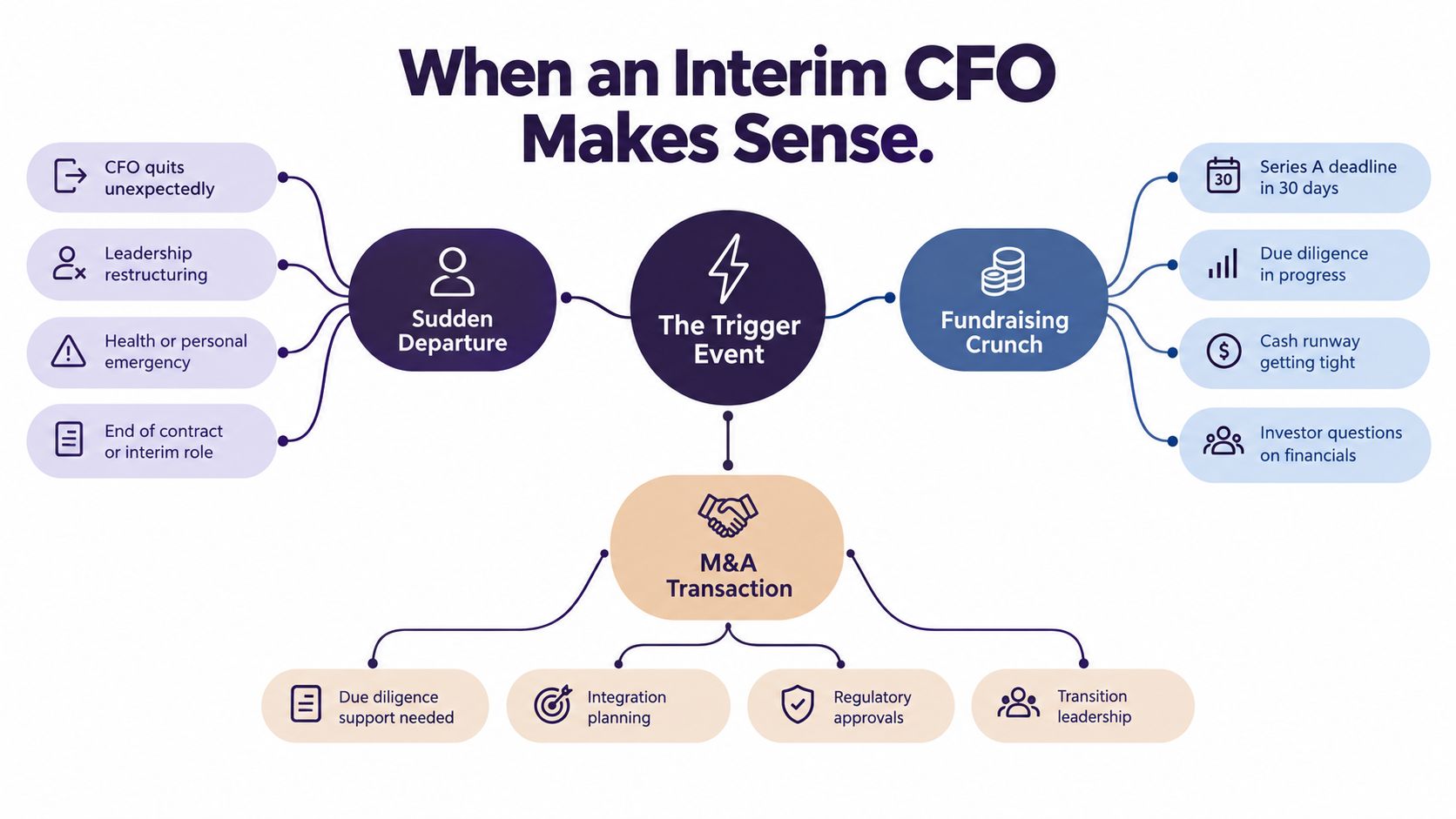
Start with the decision test. If reconciliations are late but forecasting, controls, and strategy remain sound, hire a stronger controller. If the books are unreliable and the company faces a financing, transaction, or liquidity event, bring in senior interim leadership. Waiting while the team works around a finance gap usually creates more expensive problems.
Set the mandate before reviewing candidates. Define what must be true after 30, 60, and 90 days, such as a reliable cash forecast, decision-ready reporting, documented controls, or a finance team that can operate without constant escalation. Then match the candidate to the company's stage, the trigger, and the leadership capacity required.
Common situations include:
- Sudden departure: The CFO leaves, and the company needs continuity for cash forecasting, lender communication, audits, budgeting, or a permanent search.
- Fundraising preparation: Investors need reliable reporting, defensible metrics, a coherent forecast, and a finance leader who can manage diligence.
- M&A activity: A transaction requires financial due diligence, data-room preparation, valuation support, or integration planning.
- Audit or lender pressure: The company needs stronger controls, reconciled data, covenant reporting, or clear explanations for financial variances.
- Rapid growth: Hiring, customer concentration, payment terms, and product expansion have made the existing finance operation too fragile.
- Post-merger integration: Two accounting systems, reporting structures, or teams need to become one operating function.

Match the trigger to the required level of leadership
Use an interim CFO when the trigger is urgent and finite. A part-time operator may fit a contained reporting rebuild or recurring planning need. A transaction, severe cash problem, or leadership vacuum demands sustained executive involvement. The mandate, not the résumé, should determine the engagement.
Smaller companies often need senior finance judgment without a full-time executive structure. Fewer than 15% of businesses with less than $5 million in revenue employ a full-time controller or CFO, according to the AICPA survey figure reported by Expertise Accelerated. Those companies may still need budgeting, lender materials, board reporting, unit-economics analysis, or financing preparation.
Choose a fractional CFO when the need is recurring but part-time. Make a permanent hire when executive finance ownership will continue and the long-term role is clear. End the interim engagement when the 30-90 day deliverables are complete, the operating rhythm is stable, and the team can carry the work forward.
Interim vs Fractional vs Full-Time CFO
These models solve different problems. Confusing them is one of the fastest ways to create an expensive mismatch.
An interim CFO usually takes ownership of a defined transition, crisis, transaction, or leadership gap. The work may be intense, and the executive often operates close to full-time because decisions can't wait for a weekly meeting.
A fractional CFO provides recurring senior finance leadership on a part-time basis. For many growth-stage companies, 5 to 25 hours per week can cover forecasting, management reporting, fundraising support, board preparation, and finance-team leadership when there isn't a full-time workload.
A full-time CFO is a permanent executive appointment. It makes sense when the company needs continuous ownership of finance strategy, capital allocation, investor relations, risk, and organizational development.
| Engagement Type | Best For | Typical Duration | Intensity | Typical Commitment |
|---|---|---|---|---|
| Interim CFO | Crisis coverage, transaction, fundraising, transition, integration | Defined engagement | High, often near full-time | Dedicated for the mandate |
| Fractional CFO | Recurring strategic finance without a full-time workload | Ongoing | Part-time | 5 to 25 hours per week |
| Full-time CFO | Permanent executive ownership of the finance function | Indefinite | Full-time | Long-term employment |
The choice isn't just about cost. It's about trigger, duration, intensity, and continuity.
A company preparing for a transaction shouldn't hire a fractional CFO merely because the schedule feels cheaper. A stable company with recurring reporting and forecasting needs shouldn't bring in a full-time interim executive for work that can be handled through a part-time operating rhythm.
For a clear explanation of the fractional model, see what a fractional CFO means. Then write down the work that must happen, the decisions the executive must own, and the point at which the company should no longer need the engagement.
Where to Find Interim CFO Candidates
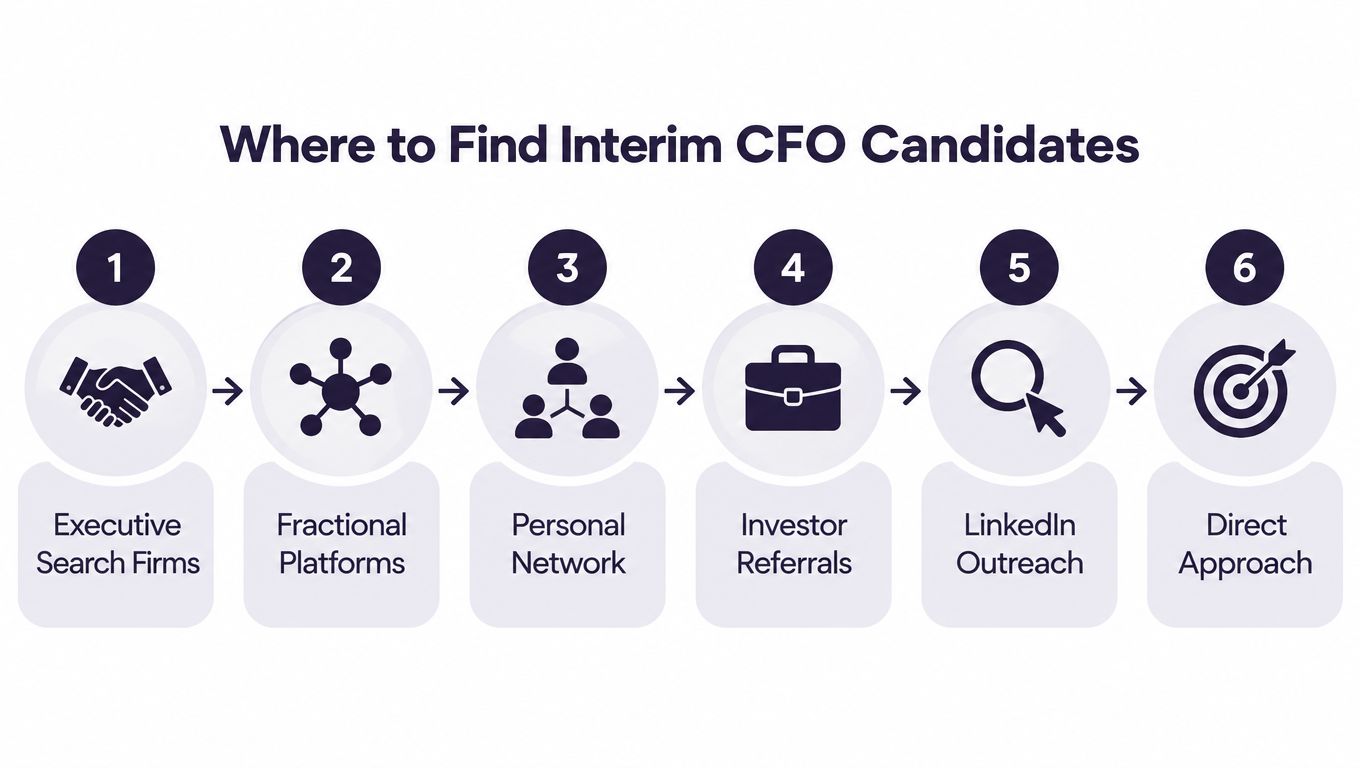
The best candidates rarely come from one channel. Build a short, deliberate sourcing process instead of waiting for a single referral to solve the search.
Start with people who have seen the company up close. Ask board members, investors, lenders, attorneys, accountants, and founders in your operating network for names. These referrals can reveal how an executive behaved during pressure, not just which companies appear on a résumé.
Use channels for different purposes
- Executive search firms: Boutique firms offer curation and access to executives who are comfortable entering difficult situations. They usually cost more, but they can reduce screening noise.
- Fractional executive platforms: Platforms can produce faster matches and make part-time availability easier to compare. The trade-off is that you need to validate the candidate's actual operating history.
- Investor and board referrals: These are useful for transaction, fundraising, and lender-sensitive situations because the referrer may have observed the executive's judgment directly.
- LinkedIn outreach: Search for CFOs who describe transformation, integration, turnaround, or growth-stage work rather than relying only on the CFO title.
- Direct industry contacts: Ask leaders in similar business models who they trust with messy data, rapid decisions, and incomplete information.
Move quickly, but don't skip calibration
Experienced supply is tightening. Forty-two percent of newly appointed CFOs had prior public-company CFO experience in Q1 2026, compared with a seven-year average of 35%, according to Fortune's report on battle-tested CFO hiring. The same report stated that interim appointments represented 12% of new CFO hires, up from 6% in 2025. Those figures point to a practical conclusion, strong candidates may be engaged before your search is fully organized.
Prepare a one-page brief before contacting anyone. Include the trigger, decision rights, expected weekly commitment, finance-team structure, systems, stakeholders, and measurable outcomes. Ask every candidate to respond to the same brief so you can compare operating judgment instead of presentation quality.
How to Evaluate and Interview Interim CFO Candidates
Credentials are a filter, not a hiring decision. A CPA, investment-banking background, or public-company history may be useful, but none proves that an executive can stabilize your finance function with incomplete data and limited time.
I evaluate candidates across four dimensions.
1. Context fit
Has the candidate worked in a company with a similar stage, business model, financing structure, and level of operational complexity? A public-company CFO may be excellent at governance and investor relations but ineffective in a founder-led company where the finance team is small and the systems are unfinished.
The relevant question isn't whether they have held a bigger title. It's whether they have solved problems at your scale.
2. Trigger fit
Ask for a specific example involving the situation you're facing:
- “Tell me about the first week after a CFO departure.”
- “How did you prepare a company for fundraising when the reporting was unreliable?”
- “What did you personally own during financial due diligence?”
- “Describe a cash crisis where the forecast changed your operating decisions.”
- “What did you do when a finance-system implementation fell behind?”
Listen for sequence, decisions, obstacles, and outcomes. Candidates who speak only in broad leadership language usually haven't done enough hands-on work recently.

3. Part-time operating ability
Fractional work punishes executives who need constant context. Ask how the candidate will structure the week, what information they need before meetings, and which decisions they can make asynchronously.
A strong part-time CFO creates a reliable cadence. A weak one attends meetings, requests more data, and leaves the team waiting for direction.
4. Knowledge transfer
The executive should improve the team, not create dependency. Ask what documentation they leave behind, how they coach the controller or finance manager, and how they define a clean handoff.
Use the practical framework in these CFO interview questions to build a consistent interview scorecard. Then require a short working assignment: a 30-day diagnostic plan, a list of required data access, weekly deliverables, and a sample 13-week cash model.
The cheapest candidate is rarely the best value. The most credentialed candidate may also be the wrong choice for a company between $1 million and $50 million in revenue if they can't operate in a lean environment, work with founders, or build processes from incomplete data.
Pricing Models, Contracts, and Engagement Terms
Interim CFO pricing usually follows the shape of the work. Don't choose a billing model before defining the mandate.
Hourly billing suits targeted advisory work, short diagnostic assignments, or unpredictable support. It gives the company flexibility, but it can encourage both sides to count time instead of measuring progress.
A monthly retainer works better for ongoing fractional leadership. It gives the executive predictable access and gives the company a recurring operating cadence. Define the expected availability, meeting rhythm, deliverables, and response expectations so the retainer doesn't become a vague subscription to executive attention.
Project pricing fits a defined outcome, such as preparing for a transaction, implementing a reporting package, or rebuilding the cash forecast. The scope must be specific enough to prevent disputes when the initial diagnosis reveals additional work.
Equity participation may appear attractive to a cash-constrained company, but it complicates incentives and future expectations. Use it only when the role, vesting, termination treatment, and relationship to cash compensation are documented clearly.
Terms that protect the company
Your agreement should cover:
- Scope and authority: State what the CFO owns, which decisions require founder or board approval, and who can access sensitive systems.
- Deliverables and exit criteria: Name the reports, forecasts, process improvements, and handoff materials the executive must produce.
- Confidentiality and intellectual property: Protect financial data, models, customer information, and work created during the engagement.
- Termination: Define notice, payment obligations, transition support, and treatment of unfinished deliverables.
- Equity terms: If equity exists, document vesting, acceleration, repurchase, and termination provisions.
Don't negotiate every sentence. Negotiate the points that determine accountability, access, authority, and exit. A contract that gives the CFO flexibility without defining deliverables leaves the founder carrying all the risk.
Onboarding and the First 90 Days
A good interim CFO should make the business more governable within the first 90 days. That doesn't mean solving every financial problem. It means establishing reliable information, controlling cash, creating operating rhythm, and giving the company a clear path forward.
The first mistake founders make is asking for a strategic plan before the underlying data can support one. Strategy built on unreconciled accounting, inconsistent definitions, or an unreliable forecast is polished guesswork.
The first phase establishes control
Begin with cash. The interim CFO should create a 13-week cash-flow forecast, identify minimum-cash thresholds, map expected receipts and payments, and distinguish committed obligations from assumptions. This turns runway from a feeling into a management tool.
Then reconcile the accounting data. The CFO should identify gaps in revenue recognition, accounts receivable, accounts payable, payroll, inventory, debt, deferred revenue, and other areas that affect decision-making. The objective isn't perfect historical accounting on day one. It's knowing which numbers leadership can trust and which require qualification.
A practical first-phase checklist includes:
- Bank and debt balances
- Expected customer collections
- Payroll and tax obligations
- Vendor commitments
- Upcoming financing or transaction deadlines
- Reporting dependencies
- Data owners and system access
Cash-flow management deserves this attention because 60% of small-business owners identify it as their top financial concern, according to the International Journal of Research and Scientific Innovation. A growing SaaS company can increase revenue while creating a working-capital problem by offering customers longer payment terms. An interim CFO should quantify that gap, prioritize collections, and test whether planned hiring remains affordable.
The second phase stabilizes reporting
Once cash visibility improves, stabilize the close, controls, and covenant or investor reporting. The CFO should identify which close tasks are late, which reconciliations are weak, and which approvals depend on one person's memory.
The goal is a repeatable monthly close and a management pack that leaders use. That package may include revenue, gross margin, operating expenses, cash, receivables, forecast variance, unit economics, and key operating metrics. The exact contents depend on the business, but the cadence must be consistent.
Deloitte's CFO-transition research emphasizes the importance of talent and relationships during execution, while Bridgespan recommends explicit priorities across multiple time horizons and clear communication expectations during onboarding (Deloitte's CFO transition research). Give the interim CFO direct access to the founder, board, finance team, operating leaders, lender, and investors where appropriate.
Use a structured executive onboarding checklist to prepare system access, stakeholder introductions, decision rights, historical documents, and the first meeting schedule before the start date.
The third phase creates the operating roadmap
By the end of the engagement's initial phase, the CFO should convert findings into a 3-, 6-, and 12-month roadmap. The roadmap should separate urgent controls from capability building and longer-term strategic work.
A useful roadmap answers:
- Which financial risks require immediate action?
- Which processes need an owner, system, or policy?
- Which reports should the board and leadership team receive regularly?
- Which finance hires or role changes are necessary?
- What should the next permanent or fractional CFO inherit?
Gartner describes a four-step transition model of prepare, connect, assess, and act, and reports that an open change strategy can increase the probability of successful change by as much as 24% (Gartner's CFO priorities research). Treat that figure as a change-management benchmark, not as a guaranteed interim-CFO result.
Define success before the start date
The founder and interim CFO should agree on exit criteria before work begins. Useful measures include:
- Close-cycle reliability
- Forecast variance
- Overdue receivables
- Gross-margin visibility
- Cash runway
- Investor or lender reporting timeliness
- Completion of a finance-process map
- Documented succession or handoff plan
Review progress weekly. Keep the meeting short and operational. Discuss what was delivered, what is blocked, which assumptions changed, and what the CFO will complete next.
The engagement should end when the mandate is complete, not when everyone gets tired of discussing it. If the company still needs recurring strategic finance support, convert the relationship into a defined fractional arrangement or begin a permanent search with better information. Don't let an interim CFO become an indefinite substitute for succession planning.
The strongest interim leaders leave behind more than clean reports. They leave a functioning cadence, clearer ownership, usable models, documented processes, and a team that can keep operating without them. If you need help finding that kind of executive, a curated fractional marketplace can reduce the cold-start problem by connecting your mandate with candidates who match your stage, trigger, and availability.
Shiny connects growing companies with vetted fractional executives, including CFOs available for 5 to 25 hours per week, and supports matching, interviews, and onboarding through its platform. Visit Shiny to define your finance mandate and explore candidates who fit the work your business needs now.