



Trying to build a sales team without a blueprint is like trying to build a house without one. You might get a few walls up, but it's going to be a mess. The temptation for founders is to just hire a salesperson and hope they figure it out.
That's a recipe for disaster.
Before you even think about writing a job description, you need to lay the groundwork. This isn't about bureaucracy; it's about building a predictable revenue engine instead of just hoping for the best.
Build Your Sales Team on a Solid Foundation


Jumping straight to hiring is a classic mistake. You're hungry for growth and think a salesperson will magically conjure a pipeline out of thin air. It almost never works that way. You have to do the strategic work first to prevent costly mis-hires and set your future team up for success.
Pinpoint Your Ideal Customer Profile
First things first: get brutally honest about who your best customers are. This means defining your Ideal Customer Profile (ICP). An ICP isn't just a vague idea; it's a hyper-specific description of the exact type of company that gets the most value from your product and, in turn, provides the most value back to you.
Don't stop at industry and company size. Dig deeper.
- What are their specific pain points?
- What business goals are they trying to achieve?
- Who are the actual decision-makers, and what keeps them up at night?
A well-defined ICP is the North Star for your entire go-to-market strategy. It ensures you stop wasting time and money chasing leads that were never going to close anyway.
Define Your Core Sales Motion
Once you know who you're selling to, you need to map out how you're going to sell to them. This is your sales motion—the playbook your team will run to turn a prospect into a customer.
There are two primary motions to think about:
- Inbound Sales: This is all about converting leads that come to you. They find you through your content, SEO, or paid ads. The sales team's job here is to qualify these interested prospects and guide them through the final steps of the buying journey.
- Outbound Sales: This is a proactive game. Your team initiates contact with companies that fit your ICP but might not know you exist yet. Think targeted email outreach, cold calls, and social selling to spark conversations from scratch.
Most companies eventually blend both, but your primary motion will dictate the skills you need in your first hires. This clarity is crucial, especially as sales continues to evolve.
The shift to remote work has cemented inside sales as a dominant force. In fact, inside sales reps now make up about 40% of high-growth B2B sales teams, a massive increase from just 10% a few years ago. It’s an incredibly efficient model, but efficiency alone doesn't guarantee success. You can find more insights on sales statistics that underscore why having a solid strategy is non-negotiable.
Choose the Right Sales Team Structure
With your ICP and sales motion dialed in, you can finally decide on a team structure that actually makes sense for your stage. Picking a model that's too complex too early creates chaos. Pick one that's too simple, and you'll hit a ceiling fast.
A sales team without a process is just a group of people making calls. A sales team with the wrong structure for its stage is an engine designed to fail.
The structure you choose needs to support your sales motion and your company's growth trajectory. A small startup with two reps needs a different setup than a scale-up with twenty.
Here’s a quick rundown of the most common models to help you figure out what's best for you right now.
Comparing Sales Team Structures
| Structure Model | Best For | Pros | Cons |
|---|---|---|---|
| The Island | Very early-stage startups with 1-3 highly experienced reps. | Simple to manage, high rep autonomy, low overhead. | Doesn't scale well, heavily reliant on individual "hero" sellers. |
| The Assembly Line | Companies with a predictable sales process ready to scale. | Highly efficient, clear roles (SDRs, AEs, CSMs), very scalable. | Can create silos between teams, requires more management. |
| The Pod | Companies targeting specific verticals or enterprise accounts. | Fosters deep collaboration, increases accountability, improves customer experience. | Higher cost per pod, can be complex to coordinate. |
Choosing the right structure is the final piece of your foundation. It ensures that as you add people, you're plugging them into a system designed for predictable success, not just adding to the payroll.
Only after you’ve nailed down your ICP, sales motion, and structure is it time to start thinking about finding your first hire.
Find Your First Sales Superstars
Once you've got a solid strategy in place, it’s time for the most critical step: hiring the right people. This isn't about slapping a generic job ad on LinkedIn and crossing your fingers. It's about finding those rare individuals who have the unique mix of grit, curiosity, and raw hunger that defines a top performer in a fast-growing company.
Remember, your first hires aren't just running a playbook; they're helping you write it. They have to be comfortable with chaos and thrive in an environment that's still under construction. That means you need a hiring process that looks past a polished resume and digs into a candidate's true character and capabilities.
The Founder's Dilemma: A Leader or a Doer?
One of the first hurdles you'll face is deciding who to hire first. Do you bring on a junior sales rep to start hitting the phones, or do you invest in a senior leader to build the systems? Here’s the problem: hiring a junior rep without a proven process is like sending a soldier into battle without a map—it almost never ends well.
On the flip side, a full-time, six-figure VP of Sales is usually expensive overkill for a company that only needs a few hours of high-level guidance a week. This is exactly where a modern approach like fractional leadership completely changes the game.
Imagine hiring an experienced architect for a few hours a week to design the blueprints for your house, rather than paying them a full-time salary to also hammer in the nails. That’s the power of fractional sales leadership.
A fractional VP of Sales gives you the strategic oversight, process development, and coaching your new team desperately needs, but at a fraction of the cost of a full-time executive. They build the engine so your first full-time hires can just focus on driving. This model perfectly bridges the gap, setting up your first reps for success from day one.
Crafting a Job Description That Attracts Builders
To find the right kind of people, your job description has to speak their language. Ditch the corporate jargon and focus on the mission and the impact they'll have. You're not looking for a cog in a machine; you're looking for an engine builder.
Be honest about the reality of the role. Highlight the opportunity to get in on the ground floor, shape the sales culture, and directly influence the company’s future. This approach naturally filters out candidates who need a perfectly polished system and attracts the ones who get excited by the challenge of creating one. To see this in action, check out our detailed guide on crafting an effective sales leader job description.
Moving Beyond the Resume with Scorecards
Let's be real—interviews can be deceiving. A charismatic candidate can easily charm their way through a conversation, but charm alone doesn't close deals. The best way to make your hiring process objective and data-driven is to use an interview scorecard.
A scorecard forces you to define the essential traits for the role before you even start interviewing. This ensures you're evaluating every single candidate against the same standards, removing personal bias and focusing on what actually matters.
Here are a few non-negotiable traits to include on a scorecard for an early-stage sales hire:
- Coachability: How well do they take in and act on feedback?
- Curiosity: Are they asking smart, insightful questions about the business, product, and customer?
- Resilience: Can they give you specific examples of bouncing back from major professional setbacks?
- Problem-Solving: When you give them a hypothetical sales challenge, do they show a structured way of thinking to find a solution?
This method helps you spot candidates with the raw ingredients for success, not just the ones who are great at interviewing. A structured process, combined with strong leadership, is the key to turning new hires into A-players. In fact, effective coaching can shorten ramp-up time by 14% and improve a seller's skills by 20%. You can learn more about the impact of these strategies with these sales enablement statistics.
By focusing on the right leadership model from the start and using a structured, objective hiring process, you dramatically boost your odds of landing true sales superstars. These foundational hires will not only drive your first wave of revenue but will also set the cultural tone for the entire sales organization you build down the road.
Design Your Onboarding and Compensation Plan
You’ve found your first sales superstars. Great. But the hard work isn't over—in many ways, it's just beginning. The next step is creating an environment where they can actually succeed long-term.
Even the most talented reps will flame out without a clear path to productivity and a compensation structure that rewards the right behaviors. This is a classic founder mistake: pouring all your energy into finding the perfect hire, only to neglect their critical first 90 days.
A well-designed onboarding program and a motivating comp plan are the twin engines that drive new hire success. They slash churn, shorten the time it takes for a rep to become productive, and get your team pulling in the same direction from day one. This isn't just about a few training sessions; it's about building a predictable system for turning raw talent into consistent revenue.
This timeline lays out the key phases of finding, interviewing, and bringing your foundational sales talent on board.
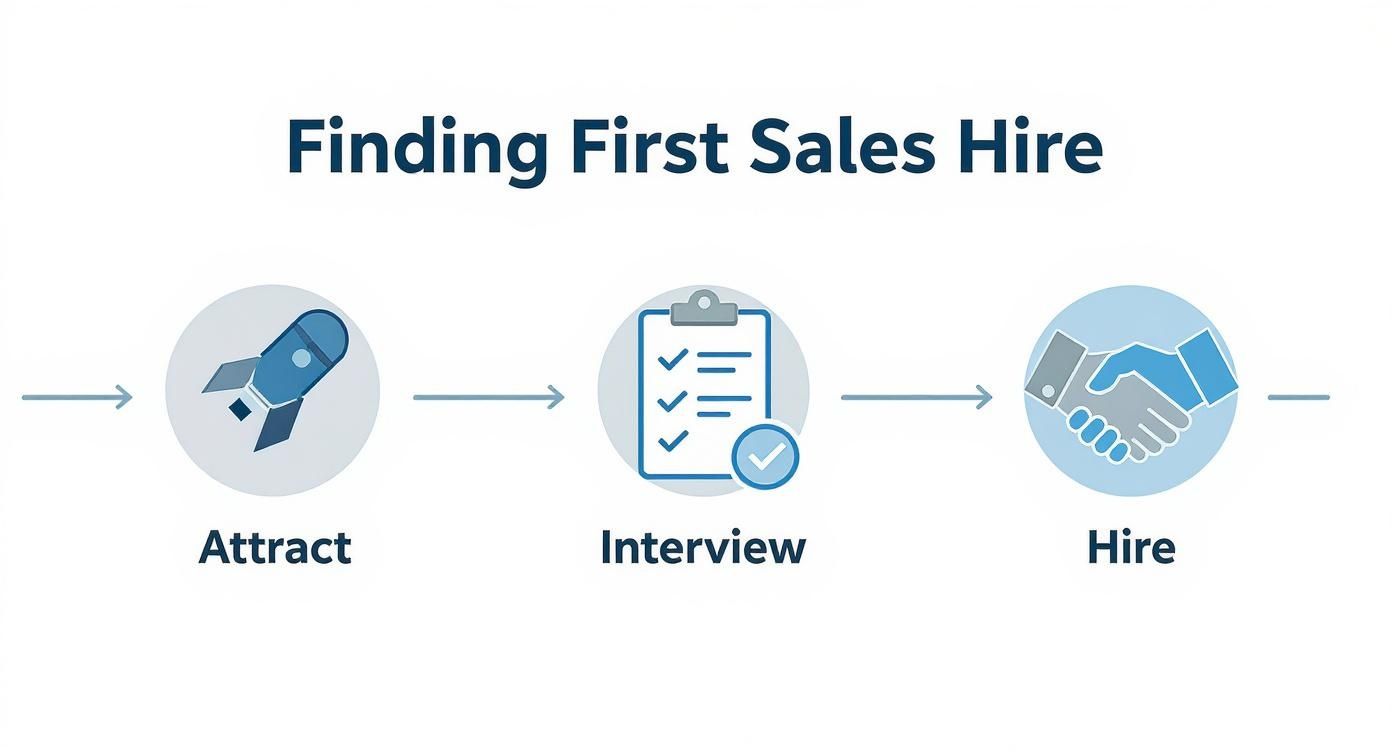

As you can see, the real work starts the moment they sign the offer. A thoughtful onboarding process and a fair compensation plan are completely non-negotiable.
Crafting a Compelling Compensation Package
Your compensation plan is more than just a paycheck. It's a powerful tool that screams what you value as a company. A bad plan incentivizes the wrong things, like rampant discounting just to close a deal or chasing small, easy wins. A great one aligns a rep's personal drive with your company's revenue goals.
The heart of nearly every sales comp plan is On-Target Earnings (OTE). This is the total income a salesperson can make if they hit 100% of their quota, and it’s typically broken down into two parts:
- Base Salary: This provides stability. It covers the bills and lets your reps focus on building a healthy pipeline instead of making desperate, short-sighted decisions.
- Variable Commission: This is the "at-risk" portion tied directly to their performance. It's the fuel that motivates them to crush their targets.
For a B2B SaaS Account Executive (AE), a 50/50 split is common. For example, an AE with a $140,000 OTE would have a $70,000 base salary and could earn another $70,000 in commission by hitting their quota. For a Sales Development Representative (SDR) who is focused on booking meetings, the split might look more like 70/30 to reflect the different nature of their role.
Your compensation plan should be simple enough to explain on a napkin. If it requires a complex spreadsheet to understand, it’s too complicated and won't effectively motivate your team.
Building a Realistic Ramp-Up Plan
Don't expect your new hire to be a top performer on day one. It just doesn't happen. A ramp-up plan acknowledges this learning curve by setting prorated quotas for the first few months. This prevents new reps from feeling like they're drowning and burning out before they even get a chance to swim.
A typical ramp-up period lasts for one quarter (90 days), with quotas that scale up gradually.
- Month 1: No quota. The entire focus is on training, learning the product inside and out, and shadowing your veteran reps.
- Month 2: 25-50% of the full quota. The rep starts actively prospecting and handling leads, but with plenty of oversight.
- Month 3: 50-75% of the full quota. Now they're expected to manage their pipeline more independently and start closing their first deals.
By the start of Month 4, your rep should be fully ramped and carrying a 100% quota. This structured path gives them a clear, achievable runway to full productivity.
The 30-60-90 Day Onboarding Blueprint
A world-class onboarding program is a strategic investment that pays off in both performance and retention. Think of it as a structured journey that immerses your new hire in the company's culture, product, customers, and sales process.
Here’s a simple framework to follow:
- Days 1-30: Immersion and Learning
- Focus: Soaking up company culture, product knowledge, and truly understanding your customer.
- Activities: Meet key people in every department, finish all product training, listen to a ton of call recordings, and learn the tech stack.
- Goal: Build a rock-solid foundation of knowledge and confidence.
- Days 31-60: Practice and Application
- Focus: Internalizing the sales process and starting to get their hands dirty.
- Activities: Role-play different sales scenarios, shadow top performers on live calls, begin managing some inbound leads, and make those first outreach attempts.
- Goal: Start applying what they've learned in a controlled, supportive environment.
- Days 61-90: Execution and Refinement
- Focus: Building a real pipeline and moving towards their quota.
- Activities: Independently manage the full sales cycle, run their own discovery calls and demos, and start building a forecast.
- Goal: Prove they can do the job and begin contributing to the team's targets.
A strong onboarding plan is crucial for every role, but it's especially vital for leadership. For more detailed guidance, check out our executive onboarding checklist to make sure your new leaders hit the ground running.
By investing in a deliberate onboarding and compensation strategy, you won't just attract top talent—you'll create the conditions for them to truly thrive. That's how you build a sales team that's poised for scalable success.
Build a Repeatable Sales Process and Tech Stack
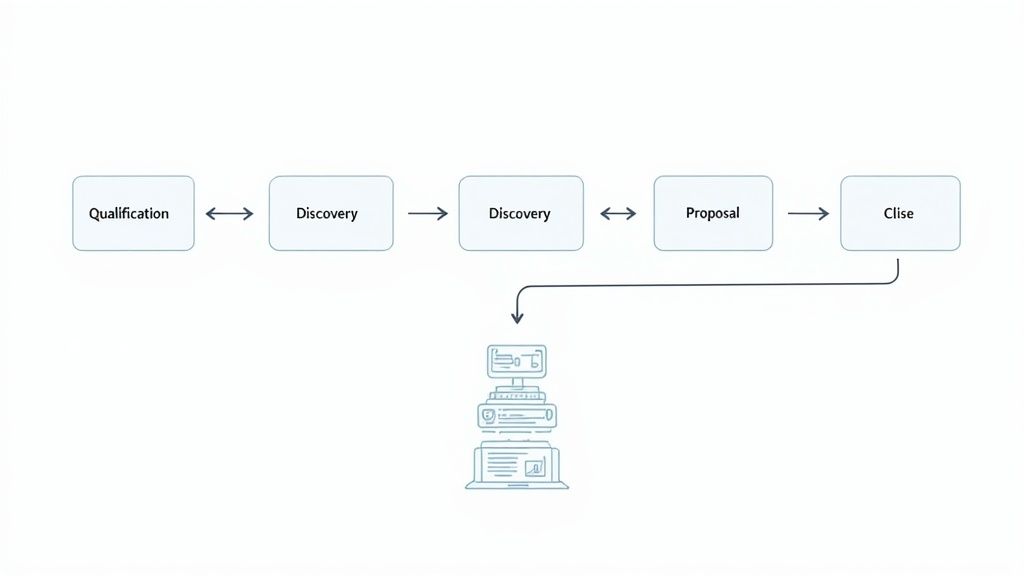
A sales team without a solid process is really just a group of people making calls. They might land a few deals on pure talent or luck, but their success will be all over the place and impossible to scale. If you want to build a real revenue engine, you need a standardized, repeatable sales process that guides every rep from the first "hello" to a closed deal.
Think of this process as your team's GPS. It's a clear map for navigating even the most complex deals. It ensures every prospect gets a consistent experience, makes your forecasting way more accurate, and slashes the ramp-up time for new hires. When everyone’s running the same playbook, you can quickly spot where deals are getting stuck and figure out how to fix them.
Defining Your Sales Pipeline Stages
The bedrock of any repeatable process is a well-defined sales pipeline. This isn't just some list of active deals; it's a visual map of your customer's journey, broken down into clear, distinct stages. While the exact stages depend on your business, a typical B2B pipeline has a few key milestones you can't skip.
Every single stage needs clear exit criteria—specific, non-negotiable actions that have to happen before a deal can move forward. This simple rule stops reps from advancing deals based on "gut feelings" and keeps your pipeline clean, honest, and reliable.
Here are a few common pipeline stages and what their exit criteria might look like:
- Qualification: Is this lead a good fit? The exit criteria usually involves confirming budget, authority, need, and timeline (BANT).
- Discovery: The rep gets on a deep-dive call to truly understand the prospect’s pain points, goals, and frustrations. A common exit criterion is getting mutual agreement that your solution can solve their problem.
- Proposal/Demo: The rep presents a tailored solution showing exactly how your product addresses the prospect's needs. The key here is getting verbal confirmation that the proposal hits the mark.
- Negotiation: You hammer out the final pricing, terms, and contracts. This stage should only start after the prospect has agreed in principle to move forward.
- Closed Won/Lost: The final outcome.
Choosing a Tech Stack That Empowers, Not Overwhelms
With your process mapped out, it's time to pick the tech that will bring it to life. The goal is to choose tools that automate the boring admin work and deliver valuable insights, freeing up your reps to do what they do best: sell. Resist the urge to buy every shiny new tool on the market. A lean, effective stack is always better than a bloated, confusing one.
Your sales process should drive your tech choices, not the other way around. Select tools that fit seamlessly into the workflow you’ve designed to make your team more efficient and effective.
A modern sales tech stack really boils down to three essential pillars. When they work together, they create a seriously powerful system for growth.
The Core Components of a Modern Stack
- Customer Relationship Management (CRM): This is the heart of your entire sales operation. A CRM is your single source of truth for all data on prospects, customers, and deals. It tracks every interaction, manages your pipeline, and gives you the analytics needed to make smart decisions. For founders setting one up for the first time, our guide on how to implement a CRM system is a great place to start.
- Sales Engagement Platform: These tools streamline and automate outreach across email, phone, and social media. They let reps run multi-step campaigns to engage prospects consistently, ensuring no one ever falls through the cracks. If you're running any kind of outbound or high-volume sales motion, this is a must-have.
- Conversation Intelligence Software: This is a total game-changer for coaching. These platforms record, transcribe, and analyze sales calls using AI. They can flag key moments, track talk-to-listen ratios, and even pinpoint which phrases are closing deals. The data gives you objective, powerful feedback for coaching your reps on what’s actually working.
By building out a standardized process and backing it up with the right tech, you turn sales from an art form into a science. And that systematic approach is exactly what you need to build a team that delivers predictable, scalable revenue.
Manage Performance with Motivating Goals
Once your team is in place, your role shifts from builder to leader. Now, your primary job is to guide and empower your reps to reach their full potential. This is all about the day-to-day management and coaching that turns a group of talented individuals into a high-performing team that crushes its numbers, quarter after quarter.
It all starts with defining what success actually looks like. Vague goals just create confused teams. To manage performance effectively, you have to set clear, motivating quotas and zero in on the key performance indicators (KPIs) that truly predict success—not just report on past events.
It’s about using data to inspire action, not just to inspect results.
Set Quotas That Motivate, Not Discourage
A sales quota is so much more than a number; it's a target that focuses effort and fuels ambition. A well-designed quota is challenging enough to stretch a rep's capabilities but realistic enough that they believe they can hit it.
Get this balance wrong, and you risk either demotivating your team with impossible goals or fostering complacency with targets that are way too easy.
Strategic quota setting is still a cornerstone of successful sales management. The best sales leaders are evolving their approach, seeing quotas less as a rigid target and more as a dynamic tool for motivation and alignment, backed by solid coaching and intuitive tools. In this space, Salesforce is a dominant force, with 69% of US sales leaders using the platform for quota management. You can learn more about how top teams are approaching quota management.
Your quota is the destination on the map. Without it, your team is just driving. With it, they have a clear place to go and a reason to accelerate.
This kind of clarity is what turns individual effort into collective momentum. It creates a shared understanding of what the team needs to accomplish together.
Understand the Power of Leading and Lagging Indicators
To get a true picture of your team's health, you need to track more than just closed revenue. Relying only on lagging indicators is like trying to drive a car by only looking in the rearview mirror—it tells you where you’ve been, but not where you're going.
-
Lagging Indicators: These are output metrics measuring past results. The most obvious one is revenue closed. While crucial, it's a historical data point. By the time you see a problem here, it's often too late to fix the current quarter.
-
Leading Indicators: These are your input metrics—the activities that predict future success. They give you a real-time pulse on your pipeline's health. Think of them as the dials on your dashboard telling you if you have enough fuel to reach your destination.
Focusing on leading indicators lets you coach proactively. If a rep's number of discovery calls drops this week, you can step in and help before their closed-won numbers take a hit a month from now.
Essential Sales KPIs and What They Measure
To effectively steer your team, you need a balanced dashboard of metrics. Here are the essential KPIs that give you a complete picture of performance, from the initial outreach to the final signed contract. Tracking both leading and lagging indicators is the key to not only hitting your current targets but also building a predictable revenue engine for the future.
| KPI | Type | What It Measures | Why It's Important |
|---|---|---|---|
| Meetings Booked | Leading | The number of initial appointments set by a rep. | A direct measure of prospecting activity and top-of-funnel health. |
| Pipeline Generated | Leading | The total value of new opportunities created. | Shows if reps are building enough future business to hit long-term goals. |
| Sales Cycle Length | Lagging | The average time it takes to close a deal. | Helps identify bottlenecks in the sales process and improve forecasting. |
| Win Rate | Lagging | The percentage of opportunities that are won. | A key indicator of sales effectiveness and qualification quality. |
| Average Deal Size | Lagging | The average revenue value of a closed-won deal. | Crucial for understanding deal economics and setting accurate quotas. |
By keeping a close eye on these metrics, you can spot trends, identify coaching opportunities, and make data-driven decisions that keep your team on track.
Establish an Effective Meeting Rhythm
Data and KPIs are useless without a forum to discuss them. An effective meeting rhythm creates a predictable cadence for accountability, coaching, and strategic alignment. This isn’t about more meetings; it’s about better, more purposeful ones.
-
Weekly Pipeline Review: This is a team meeting focused on strategy, not just a status update. Review the overall pipeline health, dive into key deals, and brainstorm solutions for stalled opportunities. Keep it forward-looking and collaborative.
-
Weekly One-on-One: This is the most important meeting you'll have all week. It’s dedicated coaching time for each rep. The focus should be on their development—reviewing their leading indicators, listening to call recordings, and helping them work through specific challenges.
-
Quarterly Business Review (QBR): This is a look back and a look forward. Reps present their results from the previous quarter and lay out their strategic plan to hit their goals for the next one. This fosters a sense of ownership and gets them thinking like a CEO of their own territory.
When you combine motivating goals with a clear view of performance and a consistent coaching rhythm, you create a culture of continuous improvement. This is how you build a sales team that not only hits its targets but consistently pushes the boundaries of what's possible.
Scale Your Team and Prepare for Growth
Your first sales hires are crushing their quotas. The process you built is humming along, and revenue is finally climbing. You've hit a huge milestone. But this isn't the finish line.
Building that initial team is just the beginning. The next critical phase is preparing to scale that success without breaking everything you've worked so hard to create.
Scaling isn’t just about throwing more bodies at the problem. It’s a strategic shift. You have to evolve your processes, your tech stack, and your leadership to support a larger, more complex sales organization. Get this right, and you'll turn that foundational team into a powerful, long-term growth engine.
Knowing When It’s Time to Expand
Growth needs to be deliberate, not reactive. Simply hiring more reps when things feel busy often leads to chaos, missed quotas, and diminishing returns. Instead, you need to look for clear signals that the business is truly ready for its next phase of expansion.
These are the indicators I tell founders to watch for:
- Consistent Quota Attainment: Your current reps are regularly hitting or exceeding their targets. This is the ultimate proof that your sales motion is effective and can handle more volume.
- Predictable Lead Flow: Your marketing efforts are generating a steady, reliable stream of qualified leads that your current team can't fully get to. Leads are slipping through the cracks.
- High Rep Utilization: Your salespeople are completely maxed out. If they're turning away potential deals or can't follow up properly because they're stretched too thin, it's a clear sign you need more capacity.
Scaling a sales team is like adding lanes to a highway. You don't do it because there are a few cars; you do it when consistent traffic proves the current infrastructure can't handle the demand.
Once these signs appear, you can confidently start planning your next move. That might mean hiring another Account Executive, bringing on your first Sales Development Representative, or adding a dedicated sales manager.
Evolving from Fractional to Full-Time Leadership
For so many early-stage companies, a fractional sales leader is the perfect first step. They bring invaluable senior-level expertise to build the initial playbook and coach the first hires, all without the hefty price tag of a full-time executive salary. But as your team grows, your leadership needs will change.
Managing a team of five or more reps, refining complex processes, and setting long-term strategy quickly becomes a full-time job. This is the natural inflection point where it makes sense to transition from fractional support to a dedicated, in-house VP of Sales.
This transition marks a huge step in your company’s maturity. A full-time leader can immerse themselves completely in the culture, provide constant, on-the-ground coaching, and take total ownership of the revenue number. They become the strategic driver responsible for steering the entire sales organization through its next chapter of growth.
Building a world-class sales team is a journey, not a destination. It requires looking ahead and committing to evolving your strategy as your business grows. The foundation you’ve built is strong, but the real test is how well it adapts to scale.
If you’re navigating these critical growth stages and need the right leadership to guide you, we can help. Schedule a consultation to discover how our network of vetted fractional and full-time executives can help you build and scale a sales team that drives lasting success.
Common Questions About Building a Sales Team
As you start thinking about building out your sales function, a lot of questions pop up. It’s totally natural. Moving from founder-led sales to a scalable revenue engine is a path filled with make-or-break decisions. Let's tackle some of the most common ones we hear from founders.
What Is the Most Common Mistake to Avoid?
The single biggest mistake I see is hiring salespeople before you have a proven, repeatable sales process.
So many founders, desperate to pour gas on the fire, hire a rep and just expect them to work some kind of magic. This almost never works. More often than not, it just leads to high turnover, wasted cash, and a lot of frustration.
A much smarter approach is for the founder to keep handling sales initially, or to bring in a fractional sales leader. This lets you build the playbook first. Get the process down, figure out what works, and then hire reps to execute on that proven system. You'll be setting them up for success from day one.
When Should I Hire a Sales Leader Versus Another Rep?
This really comes down to what you need most right now: execution or strategy.
- Hire another salesperson when your current process is humming along and you simply need more hands on deck to handle lead flow. The machine is already built; you just need more people to run it.
- Hire a sales leader when you need someone to build or seriously refine your strategy, processes, and systems. If you're managing more than 3-5 reps and find yourself spending all your time coaching instead of doing your actual job, it’s time for dedicated leadership.
For early-stage companies, this is where fractional leadership really shines. You get the strategic oversight you desperately need without the hefty price tag of a full-time executive.
Hiring another rep solves for volume. Hiring a leader solves for scalability. Knowing which problem you're trying to fix is the key to making the right decision.
How Much Should I Budget for a New Salesperson?
Don't just think about their base salary. That's a rookie mistake. A good rule of thumb is to plan for 1.5 to 2 times the rep's base salary to cover their total first-year cost.
This all-in budget has to include their full On-Target Earnings (OTE), which is their base pay plus commission. But you also have to factor in other big expenses like recruitment fees (often 15-20% of the first-year salary), tech licenses for your CRM and other tools, onboarding costs, training, and benefits. It’s a major investment, so you need to plan your finances carefully.
How Does Fractional Sales Leadership Actually Help?
Fractional sales leadership is a genuine game-changer for growing businesses. It lets you bring on a seasoned VP of Sales on a part-time or contract basis, giving you access to top-tier strategic thinking right when you need it most.
This model is perfect for startups that need help building a sales process, defining KPIs, crafting comp plans, and coaching the first few hires, but just can't justify a full-time executive salary yet. It effectively de-risks the whole process of building your sales team by injecting proven methodologies and expert leadership, which speeds up growth and helps you dodge those costly early-stage blunders.
Nailing these early decisions is absolutely critical if you want to build a sales team that lasts. If you're ready to lay a strong foundation with an expert guide, the right leadership can make all the difference. At Shiny, we connect you with a network of over 3,000 vetted executives who can provide the fractional or full-time leadership you need to scale your business.
Schedule a consultation to find the right executive for your team.