


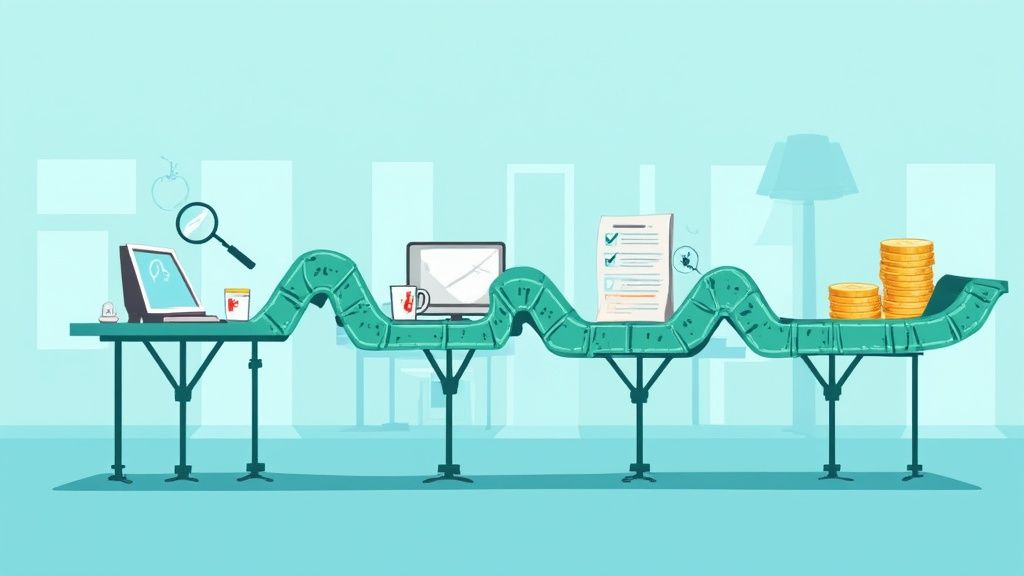
Building a solid sales pipeline isn't just about listing deals; it's about architecting the exact steps your team takes to turn a curious prospect into a paying customer. It’s a visual, repeatable system for managing every single opportunity.
This framework gives your sales team instant clarity. At a glance, they know where every deal stands, what needs to happen next, and how close you are to smashing your revenue targets. It’s the essential roadmap you need for predictable growth.
Why Your Sales Pipeline Is Your Revenue Blueprint
You wouldn't build a house without a blueprint, right? A high-performing sales pipeline is exactly that for your business. It's a strategic system for forecasting and managing revenue, not just a random to-do list for your reps.
It's easy to get this mixed up with a sales funnel, but the difference is critical. A sales funnel shows the buyer's journey from their perspective—from awareness to purchase. A sales pipeline, on the other hand, details the specific actions your sales team takes at each step to move a deal forward.
This shift in perspective is everything. It’s what turns sales from an unpredictable art into a repeatable science.
Think of it like a factory assembly line. Leads, your raw materials, enter at one end. They then move through a series of well-defined stations—your sales stages—where specific work gets done. Finally, a closed deal emerges as the finished product.
A well-defined sales pipeline allows you to spot bottlenecks, ensure quality control, and make your entire sales motion repeatable and scalable. It turns unpredictable sales activities into a consistent revenue engine.
This assembly line analogy makes it clear why a structured pipeline is so valuable. If deals stall, you can pinpoint the exact stage causing the logjam. Perhaps your "Solution Demo" stage has a poor conversion rate. That’s a clear signal that your reps need better training or your presentation is falling flat. Without that visibility, you’re just flying blind.
The Foundation of Predictable Growth
Ultimately, building a sales pipeline is about creating predictability. Once you know your average deal size, win rate, and sales cycle length, you can forecast future revenue with real confidence. This data-driven approach empowers leaders to make smarter decisions on hiring, budgeting, and overall business strategy.
This foundation is especially crucial for growing businesses that lack a seasoned, full-time CRO to architect this system from the ground up. This is where fractional leadership becomes a game-changer. It gives you access to executive-level expertise to design and implement a killer sales process, all without the six-figure commitment of a full-time hire.
Defining Your Custom Sales Pipeline Stages
Your business isn't a carbon copy of your competitor, so why should your sales pipeline be? Many companies fall into the trap of using a generic pipeline with vague stages like "Contacted" or "Qualified." This approach fails to capture the unique nuances of your customer's buying journey.
To build a sales pipeline that works, you must define custom stages that mirror the real steps a prospect takes to become a client. Ditch fuzzy labels for clear, action-oriented milestones. For instance, instead of "Initial Contact," you might have "Prospecting" followed by "Discovery Call Scheduled." Each stage must represent a tangible step forward.
Establishing Clear Entry and Exit Criteria
The real magic of custom stages lies in setting strict entry and exit criteria. A deal should only move from one stage to the next when a specific, verifiable action has occurred. This discipline removes guesswork and ensures your entire team operates from the same playbook.
Think of it like this:
- Entry Criteria: What absolutely must happen for a deal to enter this stage? (e.g., "To enter the 'Solution Demo' stage, the prospect must have confirmed their key pain points on a discovery call.")
- Exit Criteria: What specific milestone signals that the deal is ready for the next phase? (e.g., "To exit the 'Solution Demo' stage, the prospect must agree to a follow-up call to review a formal proposal.")
This turns your pipeline from a passive list into an active management tool. The flow chart below nails the core concept: a well-defined pipeline is the engine that converts raw leads into real revenue. Your custom stages make that engine run smoothly.
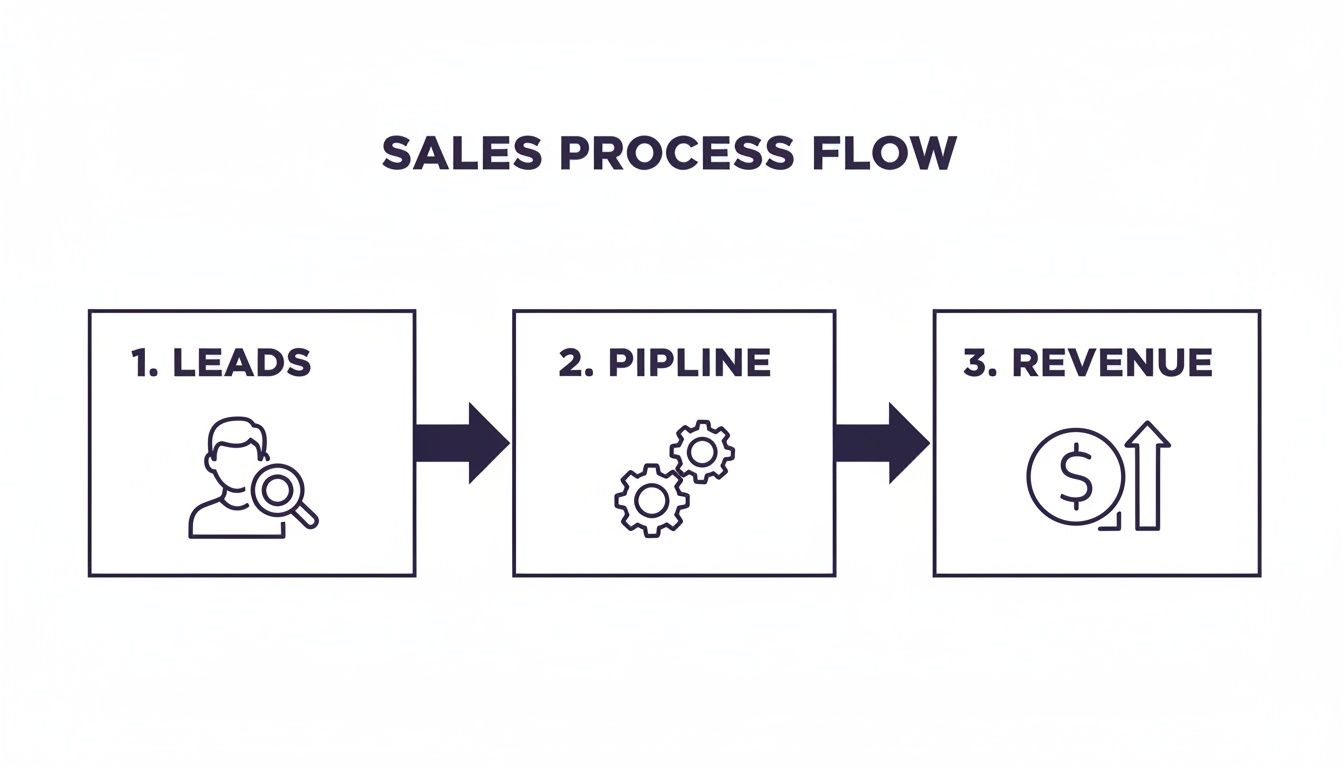

This visual perfectly illustrates how a structured pipeline is the bridge between potential interest and tangible business results.
Tailoring Stages To Your Business Model
Your business model dictates your pipeline's structure. A B2B SaaS company selling software has a totally different sales cycle than a consulting firm connecting businesses with fractional executives.
For example, a SaaS company’s stages might include "Trial Started" and "Technical Fit Call." A fractional leadership firm, on the other hand, would likely have stages like "Executive Needs Assessment" and "Candidate Matching," reflecting a more consultative, relationship-driven sale.
Understanding this difference is critical for proper sales funnel optimization, where every stage is designed with a clear purpose.
Here’s a look at how pipeline stages can differ based on the business model.
Example Sales Pipeline Stages Breakdown
| Stage Name | SaaS Company Example Action | Consulting Firm Example Action |
|---|---|---|
| Prospecting | Rep identifies 20 companies matching the Ideal Customer Profile (ICP). | Partner identifies 10 target executives through their network. |
| Qualification | A 15-minute discovery call confirms budget and primary pain point. | An initial call confirms the C-suite is actively seeking a fractional hire. |
| Solution Demo / Proposal | A live demo of the software platform is completed with key stakeholders. | A detailed proposal outlining potential candidates and scope of work is presented. |
| Negotiation / Closing | The contract is sent for review and signature via DocuSign. | The final candidate is selected and the retainer agreement is negotiated. |
| Closed-Won | The signed contract is returned and the account is moved to onboarding. | The agreement is signed and the first invoice is paid. |
See the difference? The stages themselves tell a story about the unique path a customer takes for each business.
The goal is to build a logical, transparent progression that anyone on your sales team can understand and execute flawlessly. Your pipeline stages should tell a clear story about where a deal is and what needs to happen next.
Without this strategic thinking, you're just tracking activity, not driving outcomes. For many growing companies, designing this critical infrastructure is a major hurdle. Partnering with an experienced fractional sales leader can provide the expertise needed to build a pipeline that not only works but also scales with your business.
Filling Your Pipeline with High-Quality Leads
A perfectly designed sales pipeline is just an empty framework without a steady stream of potential customers. But this isn't a numbers game—stuffing more names into the top of the funnel won't get you far. The goal is to fill your pipeline with qualified prospects who have a real problem you are uniquely positioned to solve.
Getting that caliber of lead requires a thoughtful mix of inbound and outbound strategies. It’s about meeting your ideal customer where they already are. For most businesses, a balanced approach is the only way to keep the pipeline consistently full.
Pinpointing Your Most Effective Channels
Your lead generation channels should directly reflect your business model and ideal customer. It’s common sense, but many companies get this wrong.
For example, a firm that connects businesses with fractional executives would get huge value from targeted LinkedIn outreach and hosting expert-led webinars. These channels put you right in front of decision-makers.
On the other hand, an e-commerce brand would pour resources into paid social media ads and influencer marketing. The point is to avoid a scattergun approach and focus on the channels with the highest concentration of potential buyers.
- Inbound Marketing: This is about creating valuable content that pulls prospects toward you. Think SEO-optimized blog posts, insightful whitepapers, and how-to videos that address your customer's biggest pain points.
- Outbound Prospecting: This is a more direct approach. It includes strategic social selling on platforms like LinkedIn, targeted email campaigns, and building partnerships with complementary businesses.
When you understand where your audience spends their time, you can invest resources wisely and generate a higher return. For a deeper look, check out these proven demand generation strategies that can help you attract more high-intent leads.
Quality Over Quantity Always Wins
Let me be clear: the goal of lead generation isn't just volume; it's quality. A pipeline clogged with poor-fit leads is a massive drain on your sales team's most valuable asset: their time. Chasing unqualified leads is a primary reason so much of a salesperson's day is spent on non-revenue-generating activities.
Investing time in pre-qualifying leads is one of the highest-leverage activities a sales organization can perform. It ensures that your team’s energy is focused exclusively on opportunities with a genuine chance of closing.
This means you need a basic pre-qualification process before a lead is passed to a sales rep. This could be as simple as adding a few critical qualifying questions to your lead capture forms—asking about company size, industry, or specific challenges. This initial filter ensures that by the time a lead lands in your team's queue, they have already demonstrated a baseline level of fit.
For many growing companies, building this entire lead generation and qualification engine from scratch is a monumental task. This is exactly where the right fractional executive can step in. They can architect and implement these systems, transforming your pipeline from a simple list of contacts into a predictable, revenue-generating machine.
Mastering Lead Qualification and Deal Momentum
Getting leads in the door is just the first step. The real magic happens when you efficiently move those leads through your pipeline. This is where mastering lead qualification comes in—it’s about separating the serious buyers from the window shoppers so your team can focus their energy where it counts.
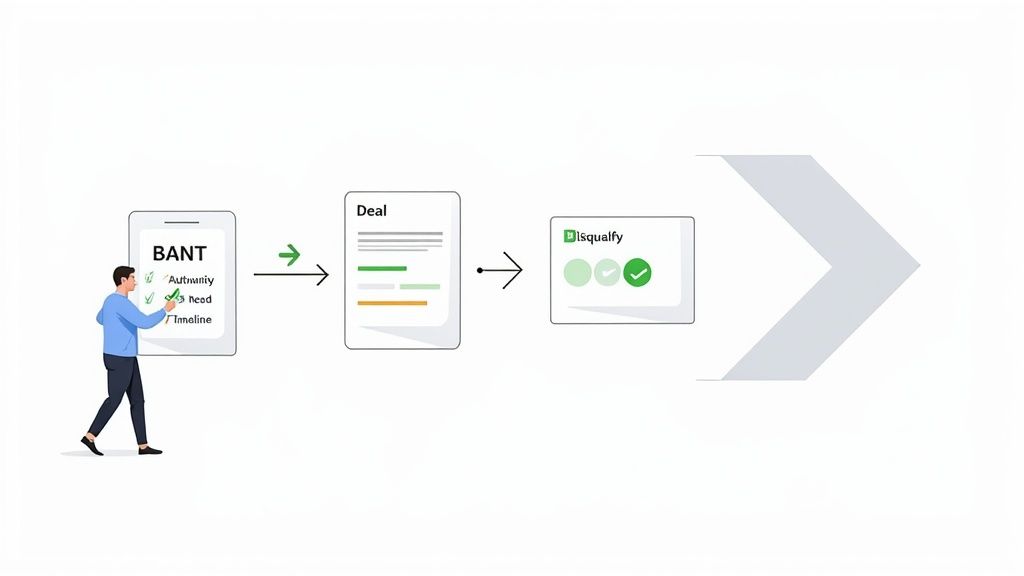

This isn’t about guesswork. Proven frameworks give you a structured way to qualify leads, acting like a checklist to ensure you’re asking the right questions from the get-go. This is absolutely essential if you want to build sales pipeline velocity.
Adopting a Modern Qualification Framework
A classic framework like BANT is a great place to start. It gives your team a simple mental model to confirm a prospect’s core buying criteria before sinking too much time into a deal.
- Budget: Does the prospect have money set aside for a solution like yours?
- Authority: Are you talking to the person who can sign the check, or an influencer?
- Need: Is there a real, pressing business problem that your solution can solve?
- Timeline: Do they have a clear timeframe for implementation?
But today’s buying journey is rarely that straightforward. You can modernize BANT by digging deeper into the "Need" and understanding its impact. Try asking, "What happens if you don't solve this problem in the next six months?" This shifts the conversation from budget constraints to the value and urgency of your solution.
The Power of Proactive Disqualification
Just as important as qualifying leads is knowing when to cut them loose. It feels wrong at first, but top-performing sales teams are ruthless about disqualifying poor-fit opportunities. A pipeline clogged with cold deals is a recipe for wasted time and inaccurate forecasts.
Knowing when to walk away from a deal is a core discipline. It keeps your pipeline healthy, your forecasts reliable, and your team focused on opportunities they can actually win.
Disqualifying a lead isn't a failure; it’s a strategic move. If a prospect lacks clear authority, has no defined timeline, or their needs don't match what you do best, it's better to move on. This frees up your team's energy for deals with real momentum.
For growing companies, building this kind of disciplined sales process can be a huge challenge. The right fractional executive brings the experience to instill these best practices, creating a qualification system that turns good leads into great customers.
Using Technology to Automate and Scale Your Pipeline
Trying to manage a sales pipeline manually is like navigating a highway on a bicycle. You might get somewhere eventually, but you'll never keep up with the speed of modern business.
To build a sales pipeline that can scale, you must move beyond spreadsheets and embrace technology that does the heavy lifting. This is where a good Customer Relationship Management (CRM) system and AI-powered tools become non-negotiable.
Automation isn't about replacing salespeople. It's about freeing them from repetitive admin work so they can focus on what really matters: having strategic conversations and building relationships that close bigger deals, faster.
The Rise of AI in Sales
Artificial intelligence is completely changing how sales teams operate. Building a strong sales pipeline today means leaning into AI-driven tools that transform how B2B teams score leads, automate outreach, and forecast revenue.
The data shows that AI can improve lead quality by 37%, shrink sales cycles by 28%, and deliver 43% higher accuracy in predictive lead scoring.
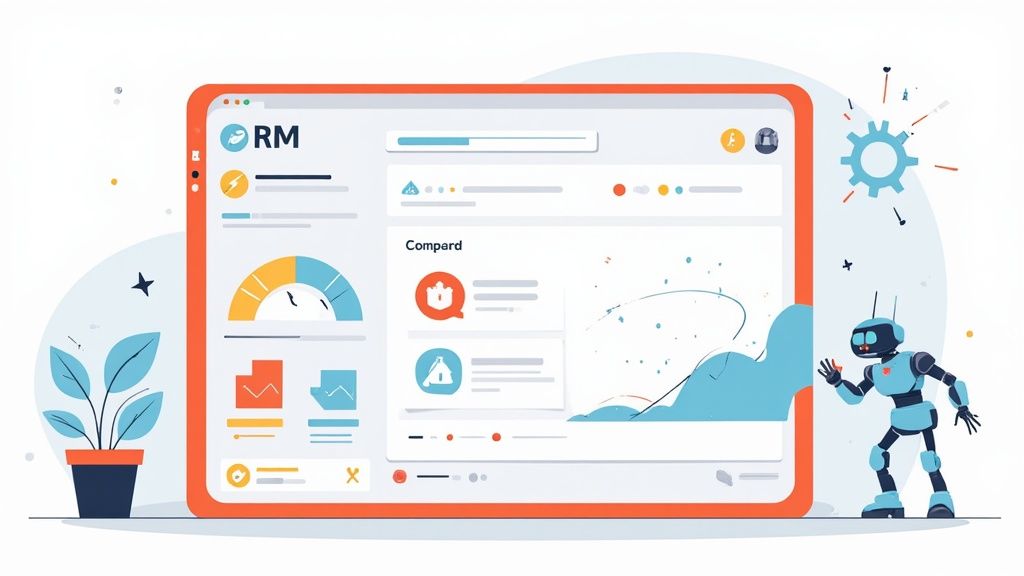
These tools can sift through thousands of data points to predict which leads are most likely to convert, allowing your team to prioritize their efforts with incredible precision.
Technology’s role is to augment human ability, not replace it. The right tech stack turns your good salespeople into great ones by giving them the data and time they need to excel.
Making Technology Work for You
Simply buying a CRM subscription won't cut it. The real magic happens with effective implementation and integration into your daily workflow.
A well-configured system becomes the single source of truth for your entire pipeline, giving you a clear view of performance. You can instantly see which deals are stalling, where bottlenecks are forming, and which reps might need coaching. For a deeper dive, check out our guide on how to implement a CRM system successfully.
The challenge for many growing businesses isn't just picking the right software, but having the strategic vision to weave it all into a cohesive sales process. This is where experienced leadership becomes critical. A fractional sales executive can design a tech-enabled sales motion that truly aligns with your business goals, ensuring you get a real return on your software investment.
Tracking the Right Metrics for Pipeline Optimization
Your sales pipeline is a living part of your business, not a static list of deals. To turn it into a predictable revenue engine, you have to constantly check its pulse. This isn't about drowning in data; it's about focusing on a few key numbers that tell you what's working and what's not.
Moving from reactive problem-solving to proactive, data-driven strategy starts here. When you use a CRM to watch these trends, you can spot trouble long before it torpedoes your forecast. For instance, a dragging sales cycle could signal a bottleneck at the proposal stage. A low win rate might point to weak lead qualification.
The Essential Pipeline KPIs
You can't build a high-performing sales process by guessing. These four metrics are non-negotiable for understanding your pipeline's health. They expose bottlenecks and give you the hard data needed to make smarter coaching and strategy decisions.
- Win Rate: The percentage of opportunities that turn into closed-won deals. If it's low, you might have issues with lead quality, your sales messaging, or your competitive positioning.
- Average Deal Size: Knowing the average value of a closed deal is critical for forecasting. If this number shrinks, it might be time to re-examine your pricing or ideal customer profile.
- Sales Cycle Length: How long it takes to get a deal from first contact to a signed contract. A lengthening sales cycle is often the first red flag of friction in your process.
- Pipeline Velocity: This formula—((Number of Opportunities x Average Deal Size x Win Rate) / Sales Cycle Length)—tells you how much revenue flows through your pipeline daily. It's a powerful indicator of overall efficiency.
A pipeline without metrics is just a wish list. Tracking these KPIs transforms your sales process from a series of hopeful activities into a predictable system for generating revenue.
From Data to Actionable Insights
Knowing your numbers isn't enough. The real magic happens when you use that data to ask smarter questions and drive real change. For example, by tracking conversion rates between each stage, you can pinpoint the exact moment where deals are getting stuck.
Getting a handle on pipeline metrics is more important than ever. Recent data shows that the largest group of sales teams now have a win rate between 21-25%. That's a significant drop from the 31-40% range seen in previous years. This shift makes it clear: you must be vigilant with your data to keep your pipeline healthy. You can see more on the latest sales pipeline metric benchmarks.
For many growing businesses, the biggest challenge is turning raw data into a concrete action plan. This is where the right leadership can be a game-changer, bringing in the expertise to not only track these metrics but also build a culture of constant improvement around them.
Your Sales Pipeline Questions, Answered
Building a sales pipeline isn't a one-and-done task. It’s a dynamic part of your business that needs regular attention. As you scale and the market shifts, new challenges and questions will arise. Let's tackle a couple of the most common ones.
How Often Should I Review My Sales Pipeline?
The cadence of your pipeline review depends on the audience. Effective reviews happen on different timelines.
- Daily: Individual reps should live in their pipeline daily. It’s their roadmap for who to call, what follow-ups are needed, and where to focus.
- Weekly: Sales managers should hold weekly pipeline meetings with their teams. This is a strategy session to dive into specific deals, brainstorm ways to overcome roadblocks, and maintain momentum.
- Monthly/Quarterly: The leadership team needs a high-level view. A monthly or quarterly review is crucial for accurate forecasting and aligning the sales engine with broader company goals.
What Is a Common Mistake When Building a Sales Pipeline?
The single biggest mistake is creating poorly defined stages. This usually goes one of two ways: too many stages, which makes the process clunky and confusing, or too few, which leaves massive gaps in understanding and makes forecasting a guessing game.
You're looking for the sweet spot, which for most businesses is between 5-7 distinct stages. The key is that each stage must have clear entry and exit criteria. You have to know exactly what action moves a deal from "Qualified Lead" to "Demo Scheduled." This clarity is what turns your pipeline from a simple list into a predictable revenue machine.
Building and fine-tuning a sales pipeline that drives results requires strategic leadership. If you recognize the pain points in this article but lack the in-house expertise to solve them, a fractional executive can provide the guidance you need. Shiny connects you with a network of over 3,000 vetted executives who can architect a sales process that drives predictable growth—without the cost and commitment of a full-time hire. Explore our fractional executives or schedule a consultation to discuss how we can help build your revenue engine.