



Hoping for revenue isn't a strategy. A real sales strategy is your blueprint for predictable growth—the difference between random activity and a revenue-generating machine. It aligns your team, clarifies your place in the market, and steers every action toward measurable goals. Without it, you're just guessing.
Your Blueprint for Predictable Revenue Growth
A sales strategy isn't a document you write once and bury in a folder. It’s the operational DNA for your entire revenue team. Imagine building a house without an architectural plan. You wouldn't just start throwing up walls, right? Similarly, you can't build a high-performing sales team without a clear strategy answering the big questions: who are we selling to, why should they care, and how will we guide them from prospect to loyal customer?
Without this plan, your team is flying blind. Reps operate in silos, messaging becomes inconsistent, and you waste time and money chasing leads that were never a good fit.
A solid strategy brings clarity and purpose, making every email, call, and demo intentional. It forces you to answer the tough questions before they become expensive problems:
- Alignment: Are marketing, sales, and customer success telling the same story to the same ideal customer?
- Efficiency: Is our sales process repeatable, scalable, and tailored to our target market?
- Performance: Are we tracking the right metrics that lead to closed deals, or just vanity numbers?
This guide cuts through the theory to give you a practical framework for building this strategy from the ground up.
This Define, Map, Execute flow shows that great results come from getting the foundation right. But building this foundation requires expertise. This is where seasoned fractional sales leadership offers a game-changing advantage. They bring the expert guidance needed to nail this blueprint without the hefty cost of a full-time executive. If you’re ready to stop guessing and start building, we connect you with the architects who know how to get it done.
Define Your Ideal Customer and Value Proposition
Before you think about a sales process, you must nail two things: who you're selling to and why they should care. Building a strategy without this foundation is like building a house on sand. Your efforts will be shaky, inefficient, and likely crumble under pressure.
It all starts with a painfully clear picture of your Ideal Customer Profile (ICP). This isn't a vague "tech companies" description. A true ICP is a data-driven blueprint of your perfect customer—the ones who get the most value from your product, stick around the longest, and are profitable to serve.
Moving Beyond Basic Demographics
A weak ICP stops at surface-level details. A strong one—the kind that makes you money—digs deeper. Think of it as a hyper-specific filter that weeds out bad leads before your team wastes a second on them. An effective ICP is built on three pillars:
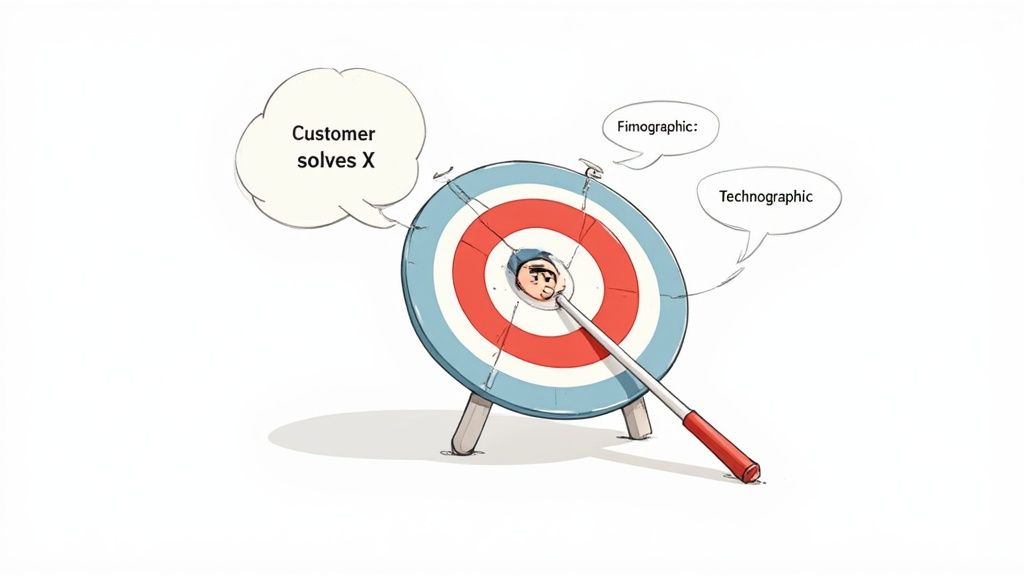
- Firmographics: The baseline stats like industry, annual revenue, employee count, and location. For example, "US-based manufacturing companies with 100-500 employees and $20-$100 million in annual revenue."
- Technographics: The tech stack they use. Knowing they're on Salesforce or HubSpot tells you about their compatibility, budget, and operational maturity.
- Behavioral Signals: The magic lies here. These are actions that signal buying intent. Did they just hire a new VP of Sales? Announce a new funding round? These are powerful triggers that tell you it's the right time to reach out.
Analogy: Your ICP is like a dating profile for your business. The more specific you are about the qualities you're looking for, the higher the chance of finding a perfect match. Your best customers hold the keys to finding more just like them.
Translating Insight into a Powerful Value Proposition
Once you know exactly who you're talking to, you can craft a message that lands. Your value proposition is the short, punchy promise of the value you deliver. It must immediately answer the prospect's unspoken question: "What's in it for me?"
A great value prop isn't a feature list; it's a clear statement about the outcome you create. It speaks directly to your ICP's biggest headache and positions your solution as the cure.
For instance, instead of saying, "We sell project management software with Gantt charts," a stronger value prop is, "We help construction managers finish projects on time and under budget by simplifying crew scheduling." See the difference? One is about your product; the other is about their problem.
To sharpen your value proposition, you also need to understand your place in the market. That means doing a serious deep-dive on your competition. Check out our guide on building a competitive analysis framework to structure this process.
This foundational work is the most important part of your sales strategy. A fractional leader can instill this expert thinking in your company, ensuring your growth is built on a rock-solid, strategic foundation.
Design Your Go-to-Market Motion and Sales Process

You know the ‘who’ and the ‘why.’ Now, it’s time for the ‘how’—the engine that will drive your revenue. This means designing your Go-to-Market (GTM) motion and your sales process.
Your GTM motion is your high-level game plan for reaching customers. It dictates whether your sales are driven by your product, your marketing, or your sales team. Nail this, and you align everything with how your customer actually wants to buy.
Choosing Your Go-to-Market Model
Not all products are sold the same way. Forcing the wrong GTM motion is a recipe for wasted effort. A simple software tool might thrive with a product-led model, while a complex enterprise system needs a hands-on, sales-led approach.
Which GTM model fits your business? It comes down to your product's complexity, price, and how your ideal customer makes decisions.
Choosing Your Go-to-Market (GTM) Model
| GTM Model | Best For | Key Characteristics | Primary Sales Motion |
|---|---|---|---|
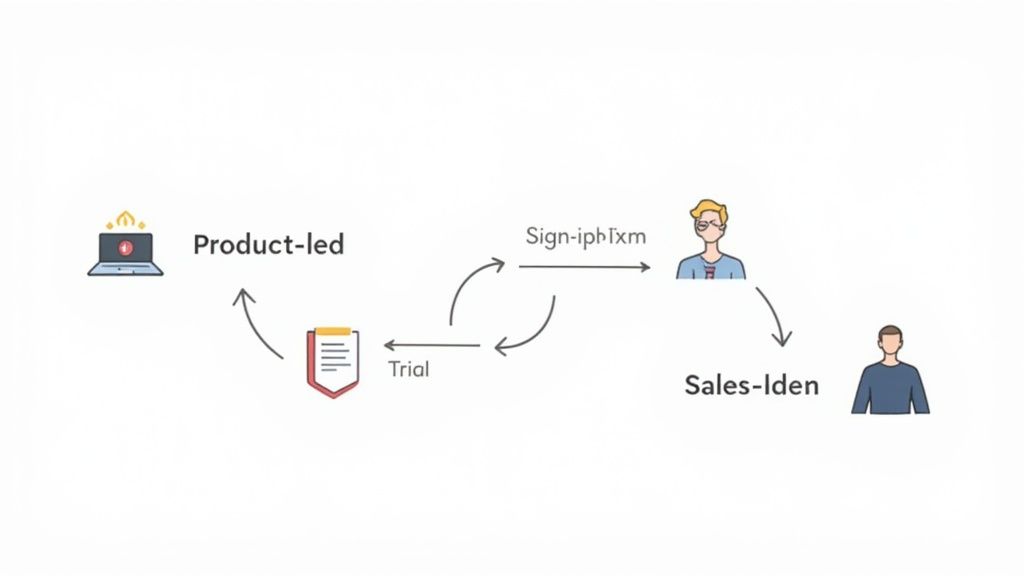
| Product-Led Growth (PLG) | Low-cost, simple products with a fast time-to-value (e.g., Slack, Calendly). | Users sign up for a freemium version or trial, experience value quickly, and upgrade themselves. The product is the main driver of acquisition. | Self-serve, automated onboarding, with sales assisting larger accounts. |
| Sales-Led Growth (SLG) | High-ticket, complex products with longer sales cycles (e.g., enterprise software). | Relies on a sales team to proactively find, educate, and guide prospects through a multi-stage buying journey. Essential for deals with multiple stakeholders. | Outbound prospecting, high-touch demos, and consultative selling. |
| Marketing-Led Growth (MLG) | Products that require some education but aren't overly complex. | Uses content like blogs, webinars, and ebooks to attract and nurture leads. Marketing warms up leads before handing them to sales. | Inbound lead generation, content marketing, and lead nurturing. |
Architecting Your Sales Process
Once you’ve picked your GTM motion, you need to map out the repeatable steps to turn a prospect into a customer. This is your sales process. A well-defined process gives your reps a clear roadmap, ensures a consistent customer experience, and makes it possible to forecast revenue accurately.
Think of it as an assembly line for deals. Each stage represents a key milestone in the buyer’s journey.
A common mistake is over-engineering the sales process. Start simple. Use a few distinct stages that reflect genuine progress—like Discovery, Qualification, Demo, Proposal, and Closed-Won/Lost. You can always add detail later.
Defining these stages helps you spot where deals stall. When you think about how to build a sales team, it’s vital that everyone understands these stages and what it takes to advance a deal.
This is more important than ever. Around 67% of the buyer's journey now happens online before a prospect even talks to a salesperson. Your sales process must be backed by great enablement—structured training and targeted content, which correlate with a 49% higher win rate. It’s no surprise that 81% of sales teams are investing in AI to build a more effective sales engine.
A fractional sales leader acts as the architect of your revenue system. They bring real-world experience to choose the right GTM motion and build a practical sales process your team can execute on day one, connecting strategy directly to tangible results.
Build Your Tech Stack and Sales Playbook
A brilliant strategy is just a document until you give your team the tools and rules to execute it. That’s where your tech stack and sales playbook come in. They are the engine and the operating manual for your sales machine.
At the heart of it all is your Customer Relationship Management (CRM) system. This is non-negotiable. A CRM is your single source of truth for all data on leads, prospects, and customers, giving everyone a unified view of every relationship.
Assembling Your Core Sales Technology
Your tech stack is a carefully chosen ecosystem designed for efficiency. The goal isn't to buy every shiny new app, but to pick tools that solve specific problems. It's like a mechanic's toolbox: you just need the right wrenches for the job.
- Prospecting Tools: Platforms like LinkedIn Sales Navigator or ZoomInfo are fundamental for building targeted lead lists.
- Engagement Platforms: Tools like Outreach or Salesloft help reps manage high-volume communication without sacrificing a personal touch.
- Analytics and Intelligence Software: These tools provide data-driven insights so you can see what’s working, what isn't, and coach your team effectively.
Having the right tech is a requirement to keep up. Digital has reshaped B2B buying, which is why 78% of salespeople using social selling outperform their peers. As B2B digital revenue grows, your tech stack keeps you in the game. You can find more in the latest sales statistics.
Crafting a Practical Sales Playbook
If your tech stack is the "what," your sales playbook is the "how." It’s your team’s guide to winning—a living document that translates strategy into clear, actionable instructions. A great playbook isn't a rigid script; it's a collection of best practices, resources, and guidelines.
Your sales playbook should be a GPS, not a straightjacket. It provides the best route but allows for detours when a rep's on-the-ground intelligence calls for it. The goal is to enable, not restrict.
Your playbook should contain:
- ICP and Persona Deep Dive: Reiterate who you sell to, their pain points, and their goals.
- Messaging and Email Templates: Provide proven templates that reps can personalize.
- Objection Handling Guide: List common objections and provide framework-based responses.
- Competitive Battle Cards: Create simple summaries of your top competitors, highlighting their weaknesses and your differentiators.
- Process and CRM Rules: Clearly define your sales stages and how to log activities for clean data and accurate forecasting.
Building this infrastructure can feel overwhelming. An experienced fractional sales leader can quickly assess your needs, select the right technology, and build a playbook based on proven frameworks, ensuring your team is equipped not just to sell, but to win.
Set Meaningful KPIs and Motivate Your Team
"What gets measured gets managed." It's a cliché because it's true. But are you measuring the right things? It’s easy to get lost in activity metrics like call volume or emails sent. These show your team is busy, but not if they're being effective.
A winning sales strategy ditches vanity metrics for Key Performance Indicators (KPIs) that reveal the health of your revenue engine. This gives you the clarity to coach your team, make smart decisions, and forecast with confidence.
Choosing KPIs That Actually Drive Growth
The right KPIs are like a dashboard for your sales process, instantly highlighting what's working and what's broken. Focus on a handful of outcome-driven metrics that tie directly to your business goals.
- Funnel Conversion Rates: What percentage of leads move from Discovery to Demo? From Demo to Proposal? This shows you exactly where your process is leaking and is the fastest way to find and fix bottlenecks.
- Average Sales Cycle Length: How long does it take to close a deal? If this timeline is getting longer, it’s a major red flag that could signal problems with pricing, process, or targeting.
- Customer Acquisition Cost (CAC): What does it cost in sales and marketing to land one new customer? This keeps everyone honest about the cost of growth.
- Customer Lifetime Value (LTV): How much revenue will a customer generate over their relationship with you? The LTV to CAC ratio is a fundamental indicator of whether your business is built to last.
The best sales strategies are built on data. By pulling information from your CRM and other tools, you get a 360-degree view of your customer and can even use predictive analytics for AI-driven recommendations. Learn more about leveraging data for sales performance.
Aligning Compensation with Company Goals
Your comp plan is the most powerful tool you have for shaping your team's behavior. A poorly designed plan will have reps chasing bad-fit deals to hit a quota. A great plan aligns every rep's personal motivation with the company's biggest goals.
Don't just use a one-size-fits-all commission. Think about the specific behaviors you want to encourage. For instance, a SaaS company fighting churn might offer a bonus for multi-year contracts. A business cracking a new market could offer a huge accelerator for the first 10 customers signed in that territory.
An experienced fractional sales leader can dissect your business model and build a KPI framework and comp plan that doesn't just motivate the team—it drives sustainable, profitable growth.
Accelerate Growth with Fractional Sales Leadership
You’ve mapped out the process, chosen the tech, and set the KPIs. Now comes the hardest part: execution. Hiring a seasoned, full-time VP of Sales is a massive financial commitment, with an average salary easily topping $300,000. That one hire can cripple a growing company's budget.
This is where fractional sales leadership becomes a strategic game-changer. It’s about getting the right expertise at the right time, without the full-time price tag.
The Architect for Your Revenue Engine
Analogy: You bring in a world-class architect to design the blueprint for your house and oversee the critical early construction. They ensure the foundation is solid before stepping back. A fractional sales leader does the same for your revenue engine.
They bring top-tier strategic thinking to build and execute your sales strategy on a part-time basis. This isn't just about giving advice—it's about rolling up their sleeves and owning the results.
A consultant hands you a report and walks away. A fractional sales leader embeds in your team, owns the outcomes, and is held accountable for hitting the KPIs they helped set. It’s the difference between being given a map and hiring an expert guide.
This model is a lifesaver for startups and SMBs that need senior-level strategic thinking but aren't ready for a full-time executive headcount. You get all the firepower right when it matters most.
How a Fractional Leader Puts Your Strategy Into Action
A great fractional executive builds systems and transfers knowledge, leaving your organization stronger. They focus on implementing proven frameworks and coaching your team to run them effectively. This approach helps you sidestep costly mistakes.
Here’s where they make an immediate impact:
- Process Implementation: They take your sales process from a whiteboard sketch to a living system inside your CRM.
- Team Coaching: They work one-on-one with reps, providing hands-on coaching to shrink sales cycles and improve win rates.
- Accountability: They establish a rhythm of accountability through pipeline reviews and KPI tracking, keeping the team focused on what matters.
This model gives you access to elite leadership talent to install a scalable sales culture. To learn more, explore the core concepts of fractional leadership. By bringing on a fractional leader, you're investing in a proven system for scaling your business intelligently.
Common Questions About Sales Strategy Development

Even with a great blueprint, questions always come up. Here are answers to a few common ones.
How Often Should I Review My Sales Strategy?
Your sales strategy is a living document, not a stone tablet. It needs to evolve with real-world feedback and market shifts. For startups or companies in fast-moving markets, a quarterly review is non-negotiable to stay agile. At a minimum, every business needs a deep-dive annual review to set the high-level direction for the next year.
What Is the Biggest Mistake in Sales Strategy?
The single most destructive mistake is building a strategy on assumptions instead of a deeply researched Ideal Customer Profile (ICP). Get the ICP wrong, and everything that follows is flawed. Your messaging will miss, your team will waste time on bad-fit leads, and your entire sales process will feel disconnected. A rock-solid ICP is the foundation of everything.
Can I Build a Strategy Without a Sales Team?
Absolutely. In fact, it’s even more critical when the founder is making the first sales. A solid strategy ensures every minute you spend is on high-impact activities. It creates the perfect framework for when you're ready to hire your first salesperson. This is also the perfect time to engage a fractional sales leader to build the process from the ground up, letting you focus on execution.
A consultant advises you, then walks away. A fractional sales leader becomes part of your leadership team. They don't just hand you a strategy; they roll up their sleeves, own its execution, and are accountable for results—all on a part-time basis.
It's the difference between being handed a map and hiring an expert guide to lead you through the mountains.
Building a winning sales strategy requires expert leadership. At Shiny, we connect you with a network of over 3,000 vetted fractional executives who provide the strategic firepower to scale intelligently. Schedule a consultation to find your perfect match.