



You're trying to get noticed without paying an agency retainer, buying sponsorships, or burning a week on cold outreach that goes nowhere. That's where most founders start. They have a real product, a few customer wins, maybe a launch coming up, and no clear path to earned media coverage.
The problem isn't that free PR doesn't work. It's that most advice about it points small companies toward influencer gifting, not actual journalism. Most “free PR” content focuses on influencers, leaving 78% of SMBs without clear guidance on earned media strategies, while 90% of tutorials overlook serious business storytelling tactics aimed at top-tier journalism, according to Forbes Communications Council.
Introduction to Free PR and Fractional Leadership
A typical small business version of this looks familiar. The founder writes a press release, sends it to a list scraped from the internet, and hears nothing back. A week later, they conclude PR is fluff.
It usually isn't. The issue is strategy.
Free PR works when the company acts like a publisher and a source, not like a buyer asking for attention. Reporters don't need another “we're excited to announce” email. They need a timely angle, a clear point of view, and evidence that the story matters to their audience.
That's also why fractional leadership matters here. A part-time communications or PR leader can shape the message, pressure-test the angle, and keep outreach disciplined without the cost of a full-time executive. For many growing firms, that's the practical middle ground between doing nothing and overhiring. If you're weighing that model more broadly, this guide to fractional leadership is a useful starting point.
Think of free PR like courtroom advocacy. Facts alone rarely win. Facts organized into a strong argument do.
Crafting a Compelling Story Angle
Most PR fails before the email gets sent. The angle is weak, too broad, or centered on the company instead of the reader.
Journalists see hundreds of pitches weekly. To stand out, you need a narrative that speaks to what they care about.
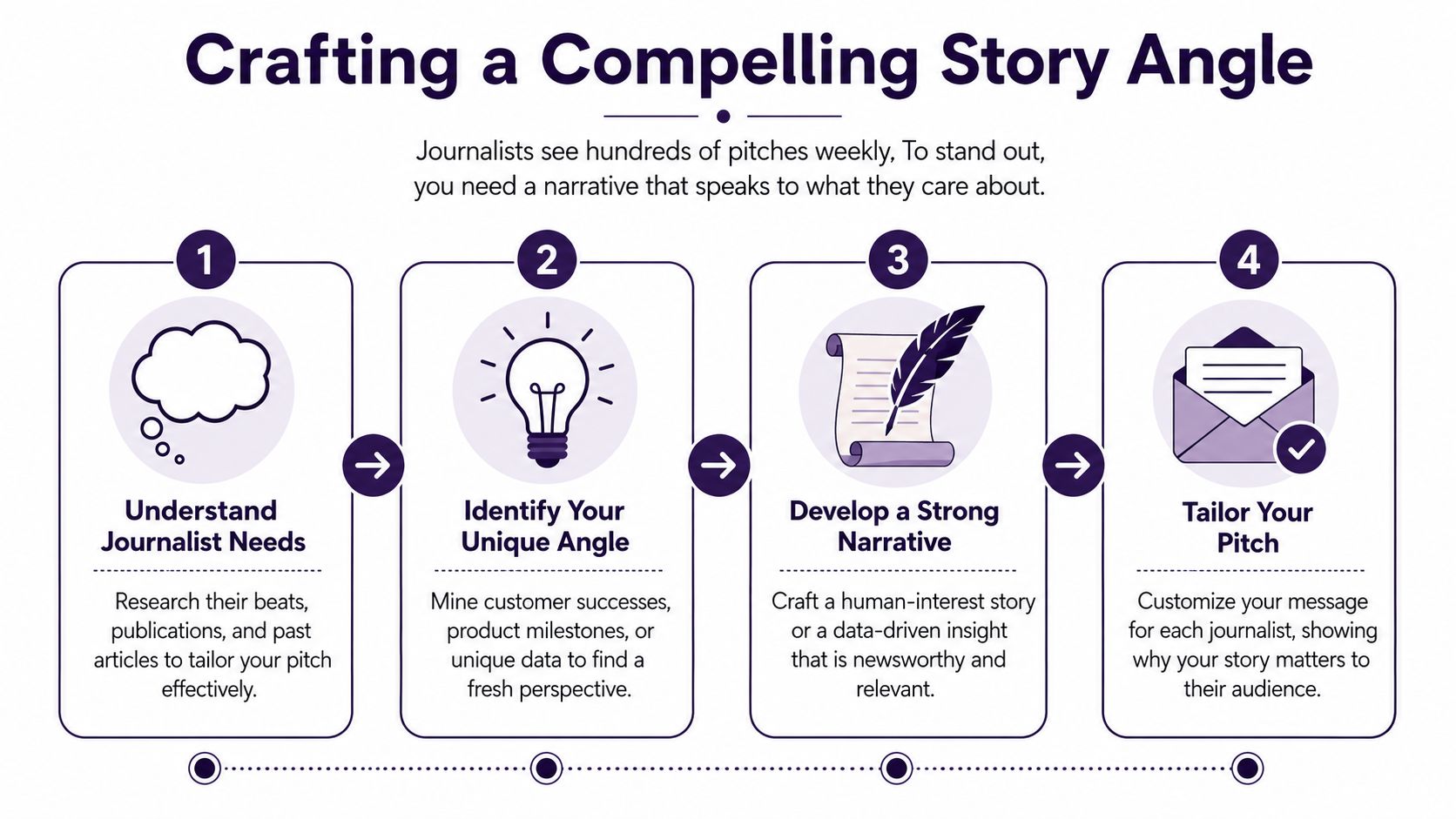

Start with what's actually newsworthy
A founder usually thinks the story is “we launched.” It rarely is.
The better question is: why would someone outside your company care right now? Good answers often come from customer behavior, industry shifts, unusual founder experience, local impact, or a practical problem your product solves in a way people can visualize.
A few usable angle types:
- Customer outcome angle. Turn a client result into a business trend story.
- Founder insight angle. Use lived experience when it reveals a bigger market problem.
- Contrarian angle. Show why a common assumption in your space is wrong.
- Local or industry angle. Tie your company to a region, workforce issue, or niche market shift.
A useful test is whether the story still sounds interesting after removing your brand name. If it collapses, it's probably marketing copy, not PR.
Practical rule: Your company is often the proof point, not the headline.
Build several versions before you pitch
I usually advise teams to draft multiple angle variations before picking one. Not because every variation will be good, but because the first one is usually the most self-centered.
Try this exercise:
- Write one angle focused on a customer problem.
- Write one tied to a current market conversation.
- Write one with a founder or human-interest lens.
- Write one framed for local business media.
- Write one framed for a niche trade publication.
Then compare those drafts against recent headlines from the outlets you want. You're not copying tone. You're checking fit. If a publication covers operational challenges for small manufacturers, don't send a startup-celebration pitch. Send a story about bottlenecks, margins, hiring, or technology adoption.
That same discipline also sharpens positioning. If your angle keeps drifting, the problem may be your messaging, not your PR. This breakdown of a unique value proposition helps tighten the core claim before you start outreach.
Use examples a reporter can repeat
Abstract claims die in inboxes. Specific scenes travel.
Instead of saying your tool improves operations, explain that a team used it to replace a messy manual process, shorten back-and-forth, or surface reporting faster. If you can't describe the practical before-and-after in plain language, the angle still isn't ready.
A strong pitch often sounds less like promotion and more like a sharp opening paragraph in a reported article:
A growing number of small firms are trying to get enterprise-level communications results without agency overhead, and many are turning to part-time senior operators to do it.
That's a story frame. It gives the journalist a trend, a subject, and a reason to care.
Building a Targeted Media List and Outreach Plan
A bad media list ruins good stories. Founders often think PR outreach is a volume game. It isn't. It's a relevance game.
A scattergun approach won't cut it. Here you'll learn how to build a data-driven media list.
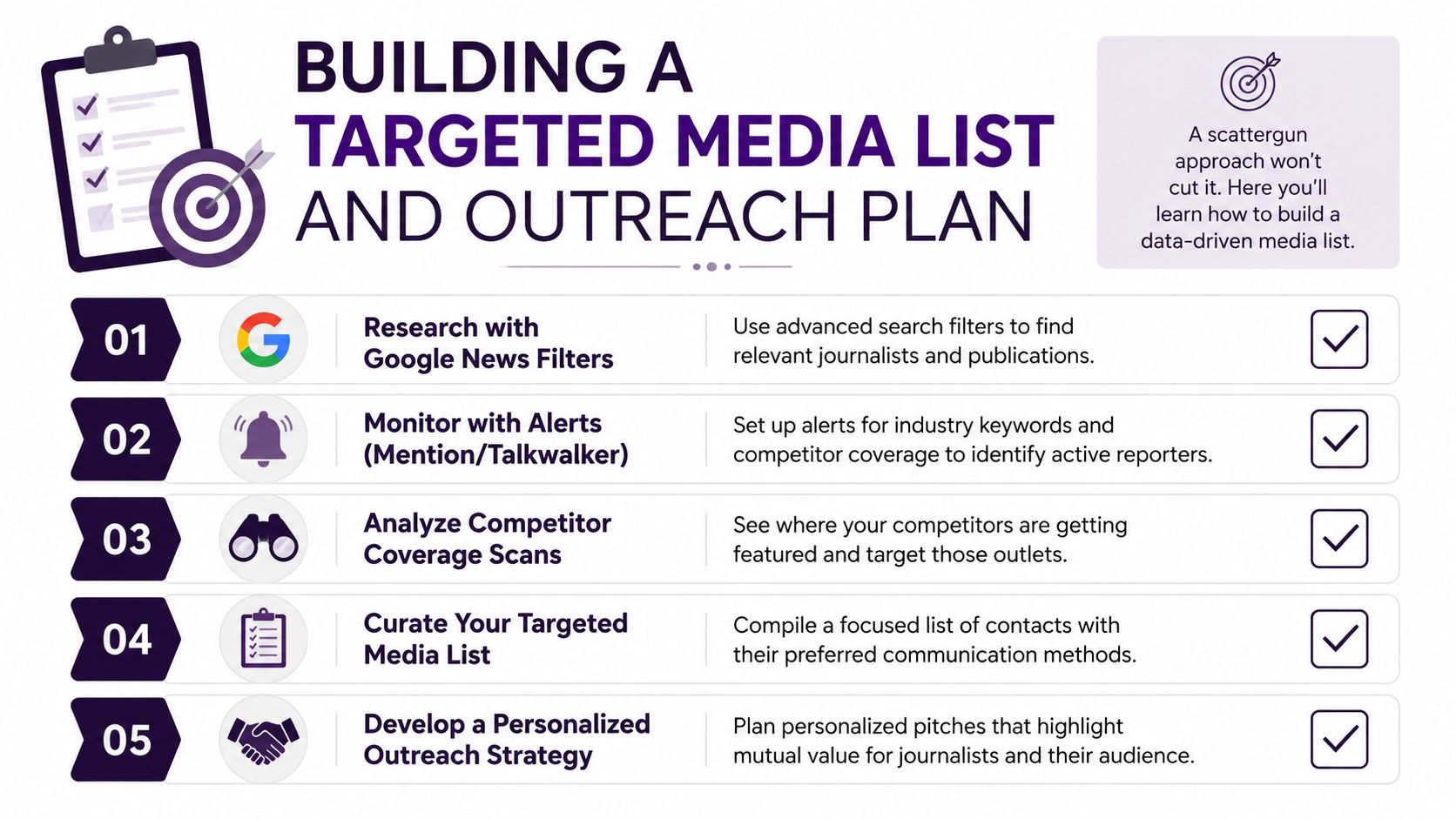
Build the list from observed coverage
Start with competitors and adjacent companies. Search Google News and use a custom date range of roughly the last several months so you're looking at current coverage, not stale bylines. Then log each relevant result in a spreadsheet.
The basic columns should include:
| Outlet | Journalist | Recent topic | Why they fit | Contact path |
|---|---|---|---|---|
| Publication name | Reporter or editor | What they recently covered | Your relevant angle | Email, form, or social handle |
This is slow if you do it manually from scratch. It gets faster when you use alerts from tools like Mention or Talkwalker to track competitor names, industry keywords, and recurring themes. A 14-step journalist-mapping methodology built around that process can reduce manual research by over 60%, according to this free PR methodology breakdown on Medium.
Segment before you send anything
A clean list is only useful if it's segmented. Don't lump everyone together.
Create practical groups such as:
- Tier by outlet type. National business press, trade publications, local media, newsletters, podcasts.
- Segment by beat. Funding, AI, operations, founder stories, workplace, retail, healthcare, manufacturing.
- Mark by relationship warmth. Never contacted, engaged on social, replied before, requested future updates.
Your outreach style should change by segment. A local editor may care about jobs, regional growth, or community relevance. A trade reporter may want technical detail and customer context. A national journalist may only care if your story reflects a broader shift.
The best media list isn't the biggest one. It's the one that lets you explain, in one sentence, why each person should hear from you.
Personalize with restraint
Personalization doesn't mean writing a long note about how much you loved every article they've published. It means proving you understand their beat.
Good personalization sounds like this: you covered warehouse staffing pressure in midsize logistics firms, and we're seeing the same issue from another angle.
Bad personalization sounds like this: I really enjoyed your inspiring article and thought you'd love our exciting announcement.
Keep the actual pitch short. One clear subject line. One sentence on why them. One sentence on the angle. One short proof point. One clear ask.
That's enough.
Leveraging HARO and Community Channels
A founder answers a reporter request at 6:40 a.m., gets quoted by noon, and sees a prospect mention that article on a sales call two days later. That kind of coverage usually starts with speed, relevance, and a usable quote. Small businesses can compete here because they can respond faster than larger teams.
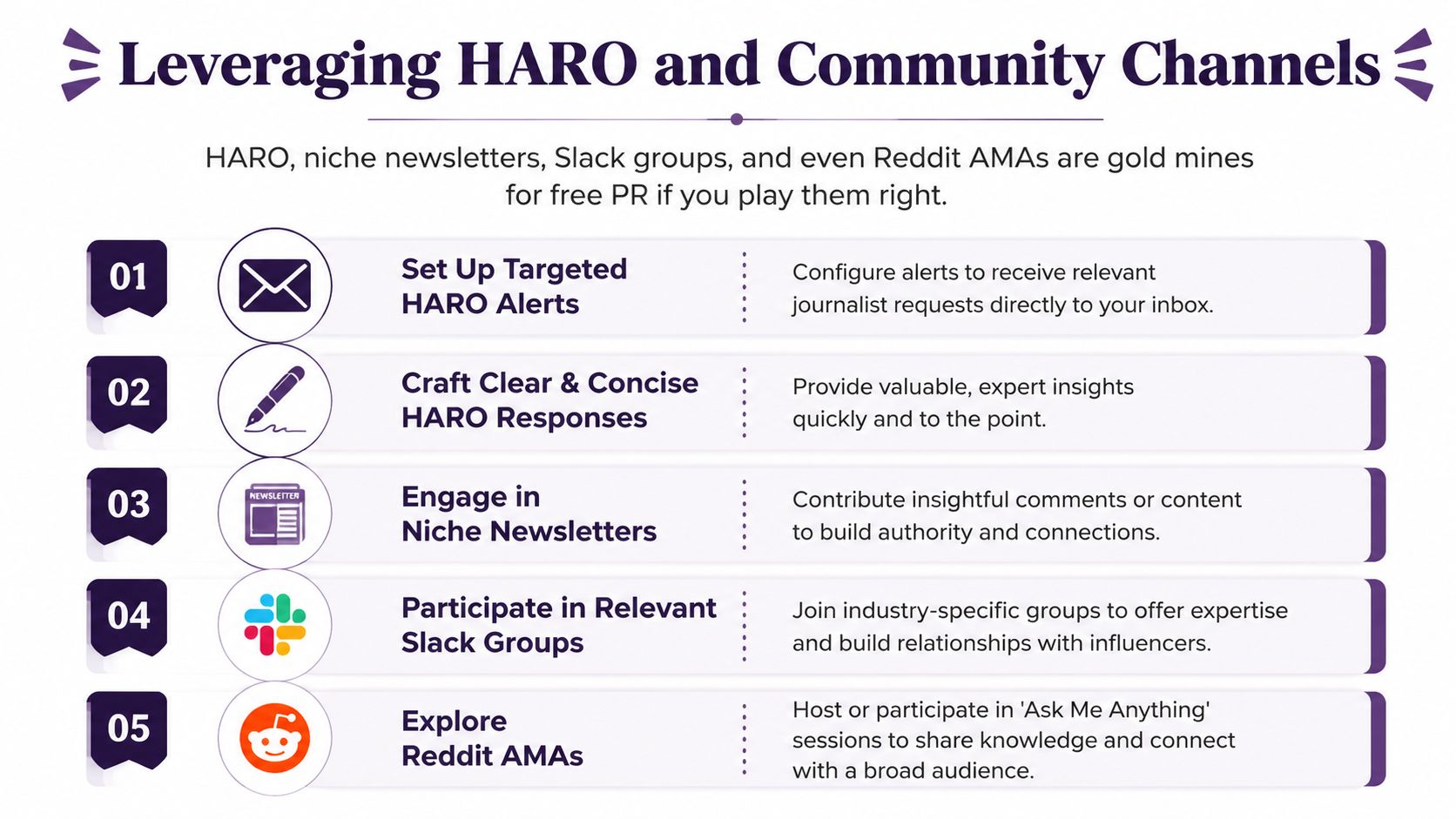
Treat HARO like a response desk, not a branding exercise
HARO-style requests reward clear answers. Reporters are usually on deadline. They do not need your company history. They need a sharp point of view, a credential that proves you can speak on the topic, and a quote they can drop into a draft without heavy editing.
A useful response usually includes:
- The answer in the first line. Start with the insight, not your introduction.
- A brief credibility marker. State your role, company, and why you have firsthand knowledge.
- One quotable sentence. Write it in plain language, with a specific opinion or observation.
- A fast follow-up option. Offer to send one example, customer pattern, or additional comment if needed.
I usually tell founders to keep these replies tight enough to read on a phone. If the reporter has to hunt for the quote, the reply is too long.
Community channels often surface the story before the press does
This is one of the most underused earned media tactics for SMBs.
Industry Slack groups, association forums, customer communities, neighborhood business groups, niche newsletters, and LinkedIn communities can show you what people are already struggling with. Repeated questions about delayed payments, staffing gaps, insurance costs, AI workflows, or wholesale margins often point to a stronger PR angle than the announcement you planned to pitch.
These channels also help you test language. If operators keep using the same phrase to describe a problem, use that phrase in your outreach. It will sound closer to the market and less like marketing copy.
If you want more examples of how this fits into a broader earned media program, this guide to digital PR strategies for small teams is a useful reference.
A few channels consistently punch above their weight for smaller companies:
- Niche newsletters. Many editors want a sharp contributor insight or short case example.
- Industry Slack groups. Smart comments build familiarity before any pitch goes out.
- Local business communities. Chambers, merchant groups, and regional founder networks can lead to local media angles that scale into trade coverage.
- Reddit and specialist forums. Good for pressure-testing your point of view and seeing which questions keep coming up.
- Conference panels and webinars. A strong talk can become a future quote source, byline topic, or reporter hook.
Contribute before you ask
Transactional behavior gets ignored fast in community spaces. Founders who only show up to promote a launch usually burn the room.
A better approach is simple. Answer questions with specifics. Share a lesson from the field. Introduce a useful source. Offer context that helps other operators make a decision. Then, when you pitch a reporter or newsletter editor, your name already carries some credibility.
This is also where fractional PR leadership helps. Someone with media judgment can spot which community discussions are just chatter and which ones signal a real story worth developing.
If your comments would still be useful with your company name removed, you are contributing at the right level.
Measuring Coverage and Timing Your Launches
A founder gets a nice mention, posts it on LinkedIn, and moves on. Two weeks later, nothing changed in the pipeline, branded search stayed flat, and the sales team never used the piece. That is the difference between getting coverage and getting value from coverage.
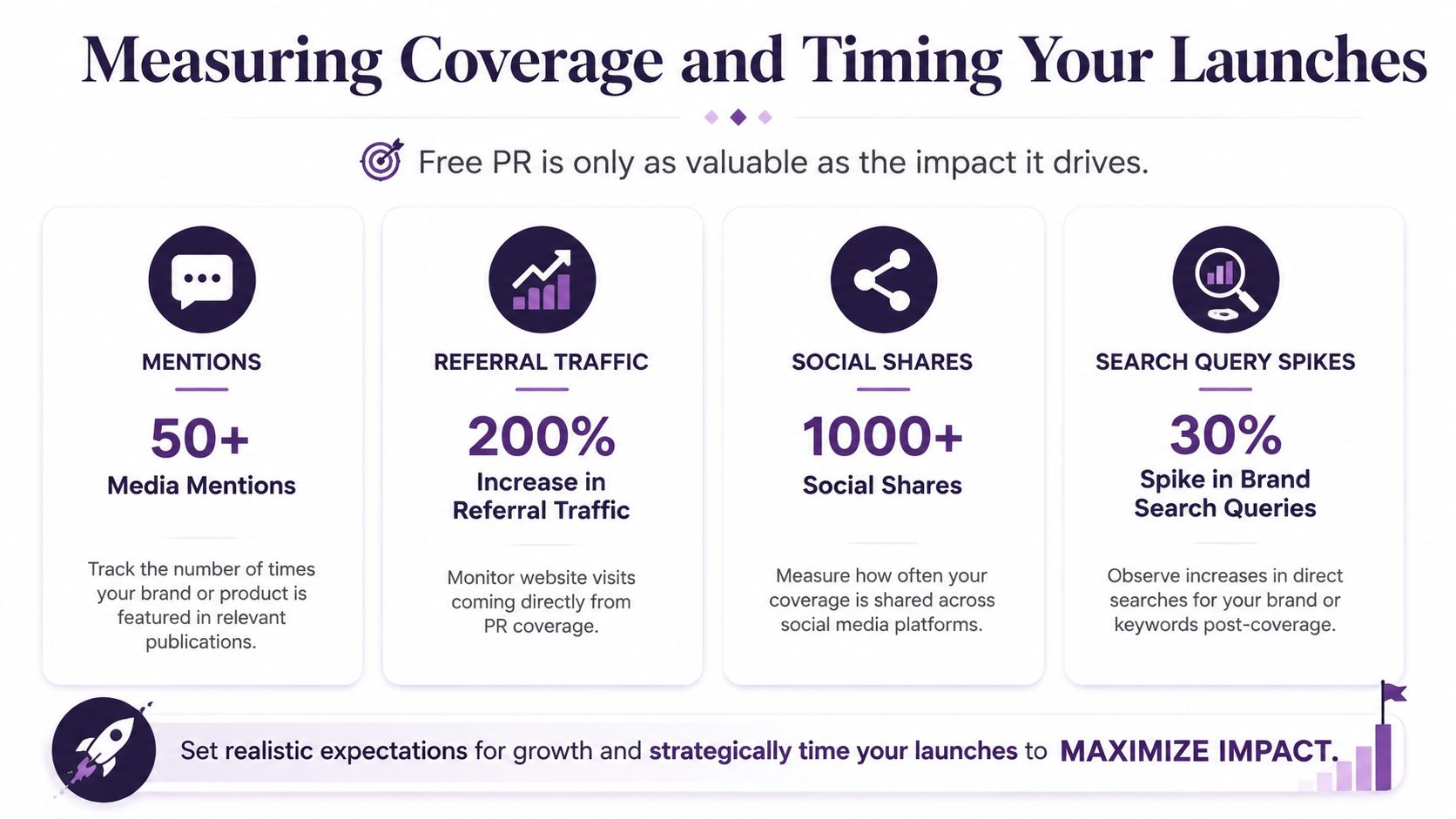
Small businesses need a tighter standard than "we got published." The useful question is whether the coverage improved trust, created demand, or made sales conversations easier. A local feature that sends qualified leads can beat a national mention that looks good and does nothing.
Start with a simple scorecard after every press push.
| Metric | Description | Recommended Tool |
|---|---|---|
| Mentions | Track where your company, founder, or product appears | Google Alerts |
| Referral traffic | Monitor visits coming from published coverage | Google Analytics |
| Social shares | See whether the story spreads after publication | LinkedIn analytics or native platform analytics |
| Search query spikes | Watch for increases in branded search interest | Google Search Console |
That baseline is enough for most SMB teams.
I also tell founders to log two things that analytics platforms often miss. First, did prospects mention the coverage on calls, in replies, or in DMs? Second, did the piece help open a door with a partner, distributor, investor, or recruiter? Earned media often works as credibility transfer before it shows up as a clean conversion path.
Timing matters just as much as measurement. Reporters rarely care that a company wants attention this month. They care whether the story connects to something already happening in the market, in their beat, or in their audience's inbox.
Good timing anchors usually look like this:
- A release with a clear customer outcome
- A milestone that changes the business in a visible way
- A conference talk, award, or public event
- A timely trend where your team has actual operating insight
- A customer behavior shift you spotted early
As noted earlier, outreach performs better when the angle already shows signs of interest and the pitch is designed for the journalist. For SMBs, that does not mean chasing virality. It means checking whether the story gets a response in smaller, relevant places first. A founder post with strong comments, a trade newsletter reply thread, or repeated questions in a local business group can all signal that the angle is ready.
The trade-off is speed versus strength. Teams that rush out a launch before the story is clear usually get scattered coverage or no response at all. Teams that wait too long miss the moment and end up pitching old news. The right window is when the proof is real, the angle is sharp, and the audience has a reason to care now.
Review the outcome like an operator. Did the outlet reach buyers or just peers? Did the article carry the point you wanted associated with the company? Did visitors hit a page that matched the story they just read?
Those answers should shape the next launch calendar, not sit in a spreadsheet no one revisits.
Common PR Mistakes and Next Steps
Most bad PR outcomes come from a short list of avoidable errors.
The biggest one is self-promotion. According to the Entrepreneur guidance cited earlier, 70% of pitches get rejected immediately when they use self-promotional language. The next mistakes are just as common: skipping the basic who, what, where, when, and why, pitching before any traction exists, and sending the same email to everyone.
A cleaner approach looks like this:
- Lead with the story, not the company
- State the five Ws quickly
- Pitch the right person
- Use follow-up sparingly
- Know when execution needs senior oversight
That last point matters more than many teams admit. Once PR starts touching launch timing, founder visibility, partnerships, or crisis sensitivity, someone has to own the strategic layer. For many SMBs, a full-time communications hire is too expensive too early. Hiring a fractional executive typically saves companies 50% to 80% compared to full-time C-suite hires and can deliver 3 to 10x ROI through faster time to impact and improved decision accuracy, according to fractional executive market data from Fractional C-Suite.
That's why fractional PR leadership is often the right next step. You get judgment, structure, and accountability without committing to a full-time overhead line before the business is ready.
If you need senior PR or communications leadership without making a full-time hire, Shiny can help you find the right fractional executive. It's a practical way to add strategic firepower, sharpen your story, and build a repeatable earned media engine.