


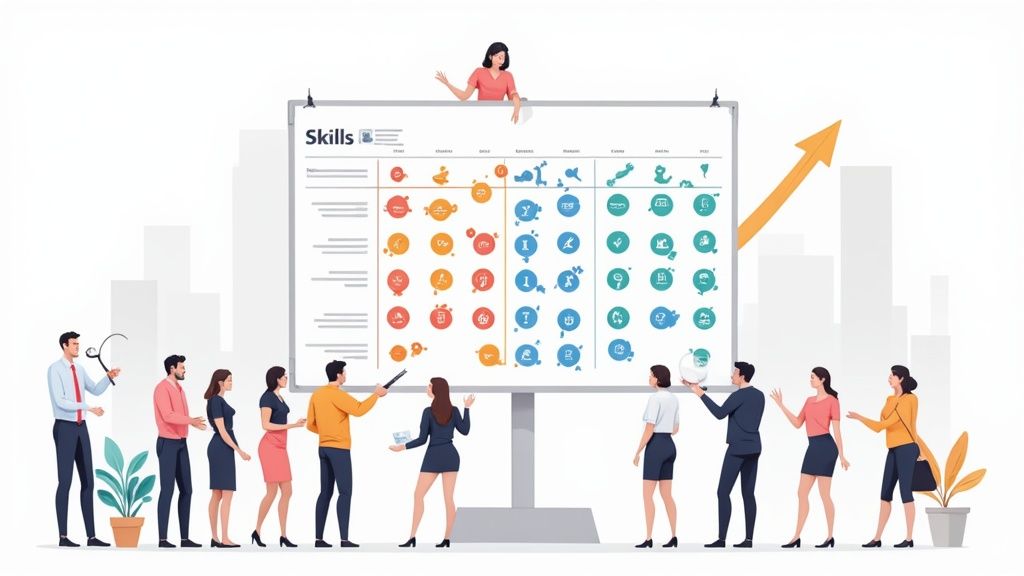
Identifying skill gaps isn’t just another HR task—it’s a critical business function. For ambitious companies, it’s not an audit; it’s a strategic roadmap. A proper skill gap analysis is how you future-proof your company, ensuring your team’s abilities are perfectly aligned with your most important business goals.
Think of your business as a high-performance race car. Unseen skill gaps are like running it on the wrong fuel. Eventually, the engine sputters, and everything grinds to a halt. In too many companies, these gaps are the invisible threats that quietly kill productivity, choke innovation, and sap forward momentum. They represent the empty space between what your team can do and what your business needs them to do to win.


This isn’t just an administrative exercise; it’s a fundamental business risk. The numbers don't lie: a staggering 87% of companies worldwide either face a skills gap now or know one is coming. The World Economic Forum predicts over half of all employees will need major upskilling by 2025 to keep pace. You can dig into more of these insights from the Future of Jobs Report 2025 on instride.com.
The Real-World Impact of Capability Blind Spots
I’ve seen this pain point derail businesses firsthand. Consider a large retail company that dominated its market for decades with a massive brick-and-mortar footprint. When e-commerce emerged, the leadership team dismissed it as a secondary channel, not the fundamental market shift it was. Their internal talent was concentrated in traditional retail—supply chain, in-store merchandising, and operations.
They were completely missing the critical digital skills needed to compete:
- Data analytics to understand online shopper behavior.
- Digital marketing to drive traffic and build an online brand.
- E-commerce platform management to create a seamless user experience.
While they perfected their physical stores, nimble, digital-first competitors swooped in and captured the online market. By the time the executives recognized their blind spot, they had lost significant market share and were facing a long, expensive game of catch-up.
This is the hard truth: The most dangerous skill gaps are the ones you don't even see until it's too late. It's not about what your team can't do today; it's about what your business won't be able to do tomorrow.
A skill gap analysis is your roadmap for building a team that can execute your vision. It helps you break out of a reactive hiring cycle and move into a proactive state of talent development. When you find a pressing void at the leadership level, bringing in a fractional executive provides an immediate infusion of high-level expertise, giving you the strategic direction needed to navigate market changes without missing a beat.
Aligning Your Goals with Future Skill Needs
Before you can spot a single skill gap, you need a map. Trying to find gaps without a clear destination is like packing for a trip without knowing if you're heading to the beach or the mountains—you'll end up with all the wrong gear.
Your business goals are that destination. An effective skill gap analysis is anchored not in what your team can do today, but in what they must be able to do to achieve your future vision.
This process translates high-level strategic objectives—like your 1-year and 3-year plans—into the specific, on-the-ground capabilities your team needs to execute. Without this critical first step, you risk investing in training or hiring for skills that, while useful, don't directly move the needle on what matters most.
From Business Goals to Required Competencies
Let's make this tangible. Imagine your primary strategic goal for the next 18 months is to launch a new flagship SaaS product. This mission demands a very specific set of skills across multiple departments.
You can break that single goal down into the core competencies you absolutely need:
- Product Development: More than just good coders, you need a team with deep proficiency in agile development methodologies, experience with scalable cloud architecture, and expertise in cybersecurity protocols to protect customer data.
- Go-to-Market Strategy: A great product won't sell itself. This requires a marketing team skilled in product marketing—people who can craft compelling messaging—and a sales team trained in solution selling for a technical product.
- Customer Lifecycle Management: Keeping customers is crucial. This demands a team with strong customer success management skills, capable of onboarding users smoothly and proactively preventing churn.
By deconstructing one major goal, you've created a preliminary checklist of non-negotiable skills. This exercise ensures your talent strategy is a direct enabler of your business vision.
Conducting a Strategic Leadership Workshop
One of the best ways to nail down these required skills is to get your leadership team in a room for a focused workshop. The objective is to build consensus on what future success looks like and which capabilities are essential to get there. This isn't a casual brainstorm; it's a strategic alignment meeting.
The most powerful question you can ask your leadership team is this: "To hit our three-year revenue target, what must our organization be world-class at doing?" The answers will immediately highlight your most critical skill areas.
This workshop should produce a clear, documented outline of the competencies needed for each major business goal. That output becomes the foundation for the rest of your analysis. It transforms an abstract goal like "growing the company" into a concrete list of skills like "enterprise sales negotiation," "financial modeling for M&A," or "building an international supply chain."
Using a strategic workforce planning template can help organize these thoughts into an actionable plan. With this blueprint, you have the clarity to measure your current team against it, making the next step—auditing your existing capabilities—far more objective and impactful.
Auditing Your Team’s Current Capabilities
Once you’ve aligned your business goals with the future skills you’ll need, it’s time to take an honest, objective inventory of the capabilities you already have in-house. This is where you shift from planning to assessment, building a clear snapshot of your current talent pool.
A proper audit goes beyond simple checklists. It’s about understanding both the “what” (tangible skills like software proficiency and certifications) and the “how” (less tangible but critical competencies like leadership, adaptability, and problem-solving).
A Multi-Pronged Approach to Data Collection
Relying on a single source of information will give you a skewed view. To get an accurate picture, you need to gather insights from several angles. This combination of methods helps balance out individual biases and provides a holistic read on each person's strengths and development areas.
A robust audit typically includes:
- Self-Assessments: Ask employees to rate their own proficiency in key competencies. This not only provides valuable data but also involves your team in their own development journey.
- 360-Degree Feedback: Gather anonymous feedback from peers, direct reports, and managers. This is incredibly effective for uncovering soft skills and leadership qualities that aren't visible in performance metrics.
- Performance Data Analysis: Look at the hard numbers. Dig into performance reviews, project completion rates, and other KPIs to provide an objective baseline.
Probing Deeper with Manager Interviews
While data and surveys are foundational, structured conversations with managers can uncover nuances that numbers alone can't capture. These interviews should be designed to reveal deeper insights about team dynamics, hidden talents, and potential risks.
Move beyond generic questions. Use specific, scenario-based prompts to get to the heart of your team's real-world capabilities.
Expert Tip: Ask managers forward-looking questions that force them to think strategically. For instance: "If a key competitor launched a surprise product tomorrow, who on your team would you pull into the war room first, and what specific role would they play?"
Here are a few powerful prompts to adapt:
- "Who do you consistently rely on for creative problem-solving? Can you give me an example?"
- "If you had to launch a critical, high-stakes project next week, who would lead it, and what support would they need?"
- "Describe a time a team member showed exceptional adaptability when things went sideways."
Questions like these help identify not just technical skill, but also resilience, initiative, and leadership potential. For a deeper dive into evaluating high-level talent, check out our guide on how to conduct an executive skills assessment.
By combining these methods, you'll build a comprehensive snapshot of your talent pool—the crucial raw material for visualizing the gaps in a skills matrix.
Visualizing Gaps with a Skills Matrix
You've collected feedback, analyzed performance data, and conducted insightful interviews. Now you have a mountain of disconnected information. The next step is to turn that raw data into a clear, actionable picture. This is where a skills matrix becomes your best tool for making talent gaps impossible to ignore.
A skills matrix is a talent heat map for your organization. Typically a simple spreadsheet, it lines up your team members against the critical skills needed for their roles and for the company's future. It turns abstract data points into a visual story, instantly showing where you're strong, where people need to grow, and where you have serious blind spots.
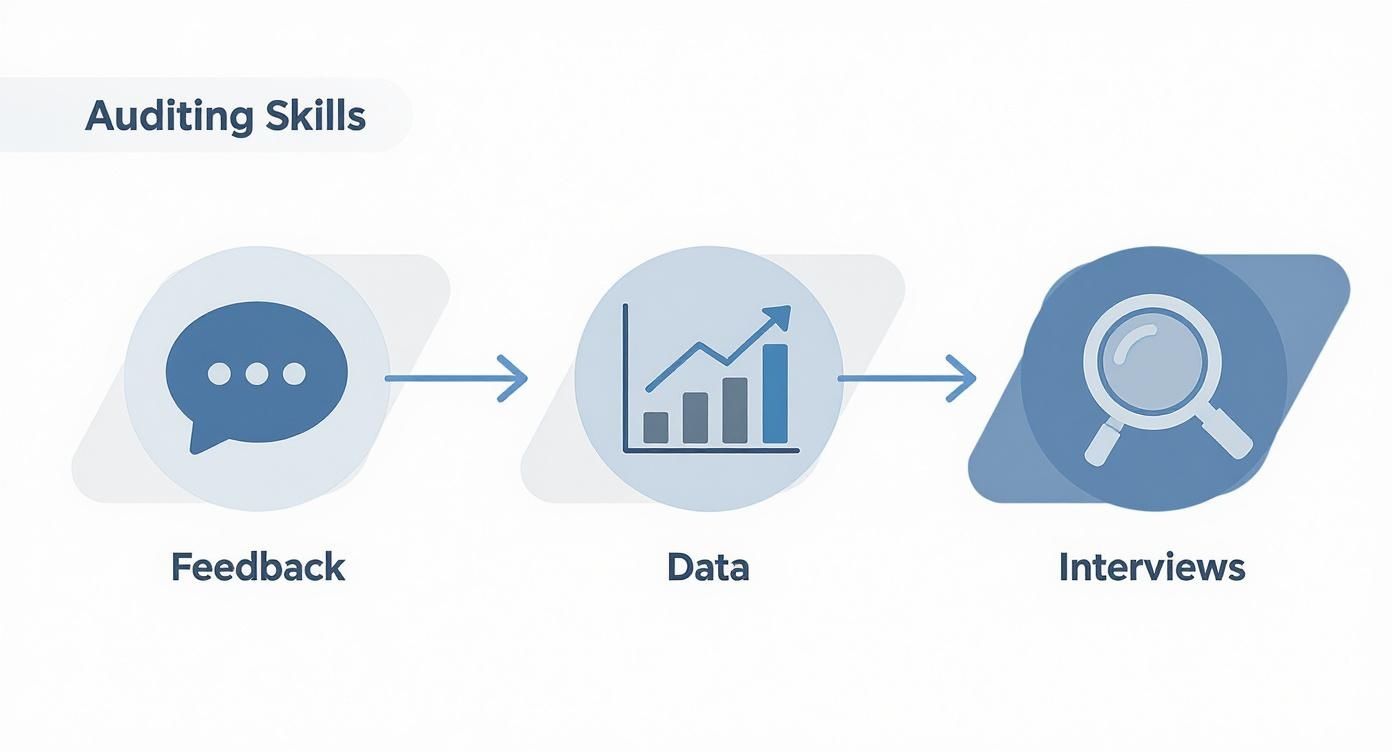

This systematic approach ensures your skills matrix is built on a solid foundation of evidence, not just gut feelings.
Building Your Own Skills Matrix
You don't need fancy software. A basic spreadsheet program like Google Sheets or Excel is all you need.
Here’s a simple way to set it up:
- List Your Team Members: Down the first column, put the names of everyone on the team or in the department you're analyzing.
- Map Required Competencies: Across the top row, list the core skills you identified earlier. Be specific. Instead of a vague term like "Marketing," break it down into tangible skills like "SEO Strategy," "Paid Search Management," "Content Creation," and "Marketing Analytics."
- Establish a Scoring System: Use a consistent way to rate everyone. A simple 0-4 scale tied to a clear level of expertise works well. This consistency is crucial for objective comparisons.
To ensure your scoring is consistent, a clear rubric is essential. It removes subjectivity and helps everyone involved understand exactly what each score means.
Sample Skills Matrix Scoring Rubric
| Score | Proficiency Level | Description |
|---|---|---|
| 0 | No Experience | Has no training or experience in this skill. Requires full guidance and supervision. |
| 1 | Beginner | Has basic theoretical knowledge but limited practical application. Can perform simple tasks with direct supervision. |
| 2 | Intermediate | Can perform tasks independently with occasional guidance. Understands the concepts and can handle routine challenges. |
| 3 | Advanced | Can work independently and handle complex tasks without supervision. Capable of mentoring others in this skill. |
| 4 | Expert | Is a recognized authority on the subject. Can innovate, strategize, and teach the skill at the highest level. |
Using a rubric like this ensures every rating on your matrix is based on the same standards, giving you data you can trust.
Interpreting the Matrix for Strategic Action
Once filled out, your skills matrix becomes a roadmap for action. As you look for patterns, you’ll quickly spot two major types of gaps.
The first is the team-wide skill shortage. For example, your marketing team's matrix might show that nearly everyone has a 1 or 2 in "Marketing Analytics." That’s a massive red flag indicating the entire team is flying blind. This collective gap calls for group training, a new analytics tool, or bringing in an expert to level everyone up.
The second—and often more dangerous—gap is the single point of failure. This happens when a critical, high-level skill is held by only one person. Imagine your entire tech infrastructure depends on a single developer who is the only one with a "4" in "Cloud Infrastructure Management." What happens if they leave? A huge part of your operation walks out the door with them.
Identifying a single point of failure is one of the most urgent outcomes of a skills matrix. It’s a direct alert that you have a high-risk dependency that needs to be addressed immediately through cross-training or hiring.
By spotting these dependencies, you shift from being reactive to proactive. Your data is no longer just information; it's a clear directive on where to invest your time and money, whether that’s in training, hiring, or bringing in fractional leadership to fill a critical void.
How to Bridge the Gaps You've Found
Your skills matrix has given you a data-driven map of exactly where the gaps are. Now it's time to move from analysis to action. This is where you build the bridges between where your team is today and where it needs to be tomorrow.
Remember, not all gaps are created equal. A small weakness in a new software tool is a world away from a critical void in leadership. The goal is to pick the right solution for the right problem—the one that drives the biggest business impact.

Ultimately, your decision will likely come down to three core strategies, each suited for a different kind of challenge.
Cultivate Talent Through Upskilling and Training
Your first and best move is often to look inward. Investing in the people you already have boosts both their skills and their loyalty. Upskilling is perfect for tackling widespread, foundational skill shortages that are holding back an entire team.
If your sales team is struggling with the new CRM, a targeted group training session is a no-brainer. If your marketing team is weak on data analysis, a series of workshops can lift everyone’s game.
This is a true win-win. You close a capability gap while signaling to your team that you're invested in their careers—a huge driver for employee retention.
To formalize this, create clear professional development plan examples with your team members. This turns a vague goal like "get better at analytics" into a concrete roadmap with specific milestones.
Inject New DNA with Strategic Hiring
Sometimes, a gap is too wide or too specialized to be filled by training. When you're building a new function from the ground up or need expertise that's completely missing, it's time to hire.
For instance, if your company wants to expand into Europe but no one has experience with international logistics, that’s not a skill you can learn in a weekend workshop. In this scenario, hiring a full-time Head of International Operations is the right move to build that capability for the long haul.
Accelerate Impact with Fractional Leadership
But what about the gaps that are both critical and urgent? Perhaps you have a sudden departure in leadership, or you need C-suite expertise to steer a high-stakes project, but you aren't ready to commit to a $400k+ full-time executive salary.
This is exactly where fractional leadership shines.
A fractional executive is a seasoned leader who joins your team on a part-time basis to deliver immediate strategic impact without the long-term overhead.
Consider these common business pain points:
- Go-to-Market Blitz: You need to launch a product, but your current team is stretched thin. A fractional CMO can jump in, architect the entire strategy, and execute the launch with the precision of a seasoned pro.
- Operational Mess: Inefficient processes are eating into your profits. A fractional COO can diagnose the bottlenecks, roll out new systems, and streamline operations in a matter of months.
- The Expertise Chasm: The demand for specialized skills, especially in tech, is soaring. The global hunt for AI specialists, for example, far outstrips supply. For niche roles, a full-time hire can be almost impossible to find quickly.
Fractional leadership bridges the gap between needing top-tier strategic guidance right now and the long, expensive search for a permanent executive. It gives you instant access to the experience you need to solve your most pressing business problems and maintain your growth trajectory.
Don't Let Your Skill Analysis Gather Dust
You’ve identified your team's biggest skill gaps—a huge win. But this is the starting line, not the finish.
Markets shift, goals evolve, and new technologies emerge overnight. A skill gap analysis can't be a report you complete once and file away. To have any real impact, it must be a living, breathing part of your growth strategy.
When you treat skill analysis as an ongoing process, you shift from being reactive to proactive. It’s how you ensure your team is always ready for what's next, keeping your talent development perfectly synced with your business goals.
Make It a Rhythm, Not a Report
The best leaders bake skill analysis right into their regular business rhythm. They don’t wait for a crisis to expose a vulnerability. Instead, they treat it like reviewing the P&L or the sales pipeline—it’s a routine health check.
A quarterly review of your skills matrix is a great place to start. It’s frequent enough to catch emerging gaps before they become major problems but gives you enough time to see if your training programs or new hires are moving the needle.
The moment a skill gap analysis becomes an annual "check-the-box" exercise is the moment it loses its strategic value. True agility comes from making it a continuous conversation, not a yearly report.
This regular check-in also proves the ROI of your efforts. Did that training program improve project efficiency? You’ll see it in the data. Brought in a fractional COO to plug an operations gap? You can directly measure the gains against your initial assessment.
Staying Ahead in a World That Won't Slow Down
The pace of change, especially in tech, is relentless. Skills that are essential today could be table stakes tomorrow.
Just look at the data. The Coursera Global Skills Report 2025 points to massive shortages in fields like AI ethics and machine learning. In North America alone, the demand for specialized AI roles outstrips the available talent by a ratio of up to 1-to-3.2.
Waiting a full year to see where your team stands is a surefire way to fall behind.
When your regular check-ins reveal a critical, high-level leadership gap that's threatening your momentum, you need a solution—fast. For those moments, bringing in a fractional executive is often the quickest and most effective way to get the expertise you need to keep growing.
Got Questions? We've Got Answers
As you start digging into skill gaps, a few questions always seem to pop up. Here’s some straight talk based on what we see with founders every day.
How Often Should I Run A Skill Gap Analysis?
A deep-dive analysis once a year is a solid baseline.
But don't just set it and forget it. We strongly recommend a lighter 'pulse check' every quarter, or anytime a major event occurs—like a product launch, a pivot, or entering a new market. Think of it as a continuous conversation, not a one-off event. That's how you keep your talent strategy locked in with your business goals.
What Are The Biggest Mistakes I Should Avoid?
Easy. The number one mistake is doing the analysis in a vacuum, completely disconnected from your company's strategic goals. If you do that, you're just collecting data for the sake of it.
Another classic pitfall is relying on a single source of truth. Just asking managers for their opinions isn't enough.
You need a 360-degree view. Combine self-assessments, hard performance data, and candid conversations to get an accurate picture. But the absolute worst mistake? Doing all the work to identify the gaps and then… nothing. You have to act on what you find.
When Does Hiring A Fractional Executive Make Sense?
A fractional executive is your best bet when you have an urgent need for senior-level strategic muscle but you're not ready to commit to a full-time C-suite salary.
It's the perfect solution for specific, high-stakes challenges like:
- Spinning up a marketing function from scratch.
- Navigating the complexities of a new market entry.
- Providing interim leadership during a critical transition.
This model gives you immediate access to top-tier expertise right when it matters most, delivering a huge impact without the long-term overhead.
Identifying skill gaps is one thing; acting on them is what drives growth. When you uncover a critical leadership void, you need a solution that’s both fast and effective. Shiny is a marketplace of vetted, experienced fractional executives ready to step in and make a difference from day one.
Explore our talent pool and discover how the right part-time leader can solve your biggest challenges and accelerate your growth.