



Winning a negotiation happens long before you sit down at the table. Too many startups make the costly mistake of rushing into discussions without a clear strategy, turning what should be a collaborative process into a reactive argument.
Solid prep work is what separates a fantastic outcome from a regrettable one. It’s not about winning every point; it's about achieving your core business objectives. Many founders, juggling a dozen other priorities, simply don't have the time for this deep prep, and that's a huge business pain point.
This is where seasoned leadership makes a difference. An experienced executive, even on a fractional basis, brings the strategic discipline needed to ensure every negotiation is built on a solid foundation.
Building Your Negotiation Game Plan
You have to do your homework. This isn’t just about making a list of demands; it's about building a comprehensive strategy that gives you leverage and confidence.
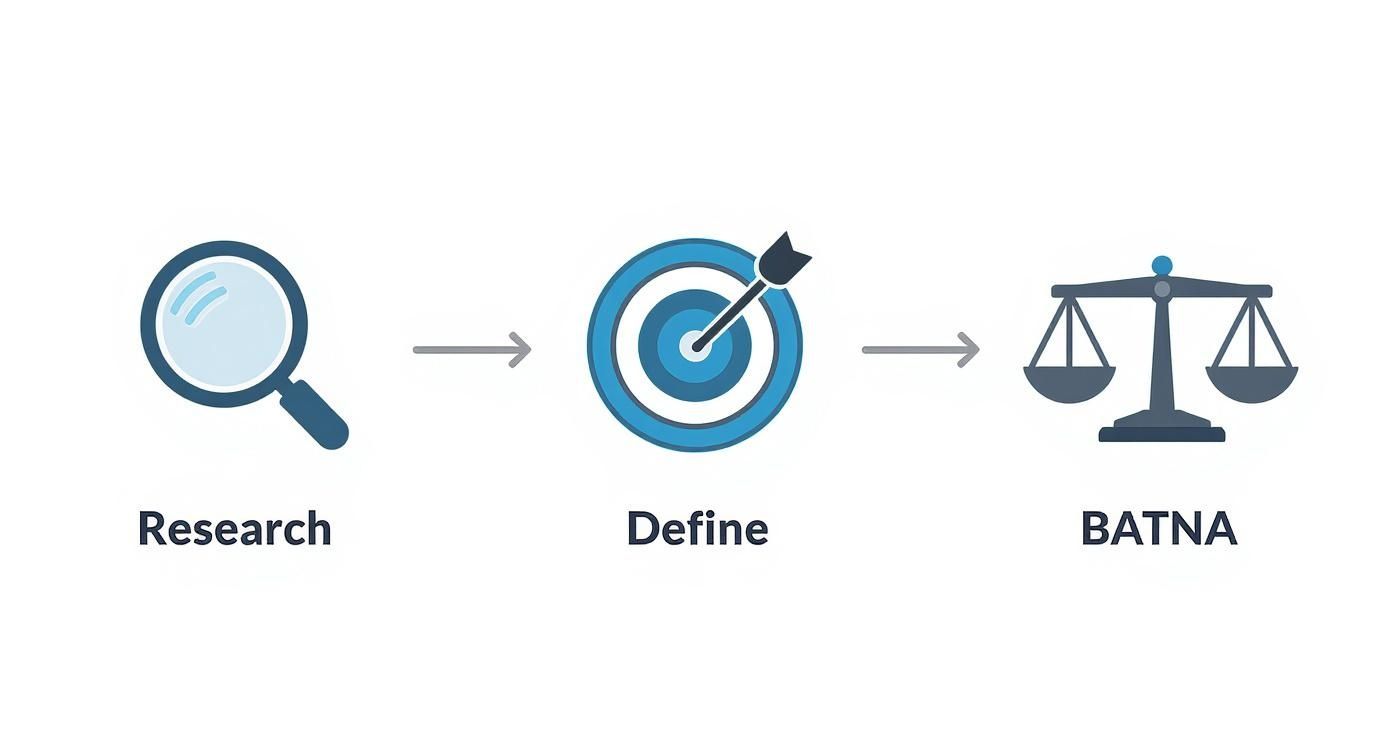

Research and Understand the Other Party
First, gather intel. You need to understand the other party's world—their goals, pressures, and priorities. Don't just focus on what they're asking for; dig into why they're asking for it. This context is gold.
Ask yourself these questions:
- What are their business objectives? Are they trying to break into a new market? Cut costs? Secure a critical supply chain component?
- What pressures are they under? Maybe they have intense competition, new regulations to deal with, or investors breathing down their necks.
- Who is the real decision-maker? Make sure you’re talking to the person who can actually sign off on the deal.
This legwork turns a simple negotiation into a strategic conversation.
Define Your Objectives and Limits
Once you have a better feel for their side, it's time to get crystal clear on your own. This means being brutally honest with yourself about what you absolutely need versus what would just be nice to have.
A good way to do this is to bucket your terms:
- Non-Negotiables: These are your walk-away points. If you can't get these, you have to be ready to end the discussion. This might be a minimum price, specific IP ownership rights, or a critical deadline.
- Nice-to-Haves: These are the terms you'd love to get but are willing to trade for concessions on your bigger priorities. Think longer payment terms, a joint press release, or extra support services.
Having this framework gives you a clear roadmap. It lets you make smart, structured concessions without accidentally giving away the farm.
Establish Your Ultimate Leverage
Your biggest source of power in any negotiation is your Best Alternative to a Negotiated Agreement (BATNA). This isn't just a "Plan B"—it's the absolute best course of action you can take if the current deal completely falls apart.
A strong BATNA is your safety net. It lets you negotiate with confidence because you know you have a viable alternative. A weak or non-existent BATNA forces you to accept bad terms out of desperation.
For instance, if you're a freelance developer negotiating a project rate, your BATNA could be another client's offer or even taking time to work on your own product. Using a contracting hourly rate calculator can help ground your financial needs in hard numbers, strengthening your resolve. Knowing this alternative gives you the power to walk away from a lowball offer without flinching.
Before you ever start talking terms, make sure you've covered these essential preparation steps. We've put together a checklist to help you stay organized and enter any negotiation from a position of strength.
Your Pre-Negotiation Checklist
| Preparation Step | Key Objective | Example Action |
|---|---|---|
| Research Opponent | Understand their needs, pressures, and goals. | Review their latest press releases, investor reports, and key personnel on LinkedIn. |
| Define Objectives | Clearly separate "must-haves" from "nice-to-haves." | Create a two-column list of your terms, categorizing each one. |
| Establish BATNA | Identify your best alternative if the deal fails. | Get a competing offer from another vendor or outline an alternative internal project. |
| Set Walk-Away Point | Determine the absolute minimum acceptable outcome. | Define a specific price or term that, if not met, will trigger you to walk away. |
| Identify Key Stakeholders | Know who has the final say on their side. | Ask your contact, "Who else besides yourself will be involved in the final decision?" |
Going through this checklist ensures you’re not just prepared, but strategically positioned to secure the best possible outcome for your business.
Mastering Real-World Negotiation Tactics
Let's be clear: negotiation isn't a battle you win with brute force. It's a strategic conversation. Success comes from applying practical tactics and a bit of psychology to guide the discussion toward a place where everyone feels like they've won. It’s about building a versatile toolkit you can pull from, whether you're hashing out a simple vendor agreement or a multi-million dollar partnership.


The best negotiators don't just show up and state their demands. They frame the entire conversation from the very first sentence. This proactive approach sets the tone and gives you a massive advantage right out of the gate.
Anchor the Discussion in Your Favor
One of the most powerful psychological tools you have is anchoring. The first number thrown on the table—whether it's a price, a deadline, or a quantity—becomes the anchor for the entire conversation. If you let the other side set that anchor, you’ll spend the rest of the negotiation just trying to drag the numbers back in your direction.
You need to make the first offer. Always.
Your offer should be ambitious but credible, rooted firmly in your research and your BATNA. For example, say you're a SaaS startup negotiating a marketing contract. Your ideal budget is $10,000 per month. You could anchor the conversation with an initial proposal of $8,500. This gives you room to move up without immediately hitting your ceiling.
Anchoring isn’t about making an outrageous demand; it's about establishing a favorable starting point that shapes perceptions of value throughout the negotiation. It frames the entire discussion around your terms, not theirs.
Making the first move shows confidence and preparation. It forces the other party to react to your position, immediately putting them on the defensive and giving you control of the narrative.
Use Bracketing and Strategic Concessions
Once you've dropped your anchor, the other party will almost certainly counter. This is where a tactic called bracketing comes into play. The goal here is to make smart concessions that steer the final number toward your target by proposing a new figure that "brackets" their counteroffer.
Let's say you're negotiating your rate for a fractional CMO role. You anchor at $120,000, and the company counters at $95,000. Your real target is $110,000. Instead of just splitting the difference, you might make a strategic concession and counter at $115,000. This move brackets their offer and makes your target of $110,000 look like a perfectly reasonable middle ground.
To really make this tactic work, never give up a concession without asking for something in return. This is the principle of reciprocity, and it's non-negotiable.
- If you concede on price: Ask for longer payment terms or a slightly reduced scope of work.
- If you agree to a shorter timeline: Request additional resources or a bonus for early completion.
- If you provide a discount: Ask for a testimonial or a case study after the project is successfully completed.
This "give-and-get" mindset means you're never just giving away value. You're turning concessions into strategic trades that help you hit your secondary objectives.
Frame Proposals for Mutual Wins
How you present your terms is just as important as what they are. People are far more receptive to ideas framed around what they stand to gain, not what they might lose. So, instead of focusing only on what you need, make sure you're clearly articulating how your proposals benefit them, too.
Imagine your startup is negotiating with a big enterprise client. The client is pushing for a steep discount that would crush your margins.
- Conflict-focused framing: "We can't offer a 20% discount; our margins are too thin." (This just shuts the door.)
- Mutual-win framing: "While a 20% discount isn't quite feasible, we can offer a 10% discount if we sign a longer, two-year agreement. This gives you budget certainty and locks in a strategic partner for the long term."
The second approach completely reframes the discussion. It's no longer a haggle over price; it's a conversation about partnership and stability. You're showing them you understand their need for cost control while aligning it with your need for commitment.
This collaborative mindset is the bedrock of an integrative negotiation, where both sides work to expand the total value of the deal instead of just fighting over a fixed pie. This is absolutely critical for long-term partnerships. For startups navigating these complex deals, bringing in a fractional executive can provide the seasoned perspective needed to frame these conversations for success.
Decoding Critical Contract Clauses
You’ve done the hard work. After all the back-and-forth, you’ve finally shaken hands on the big picture. But a great deal can fall apart in the fine print. The real risk is often buried in dense legalese that can make or break your startup. Getting comfortable with this language isn't just a good idea—it's essential.
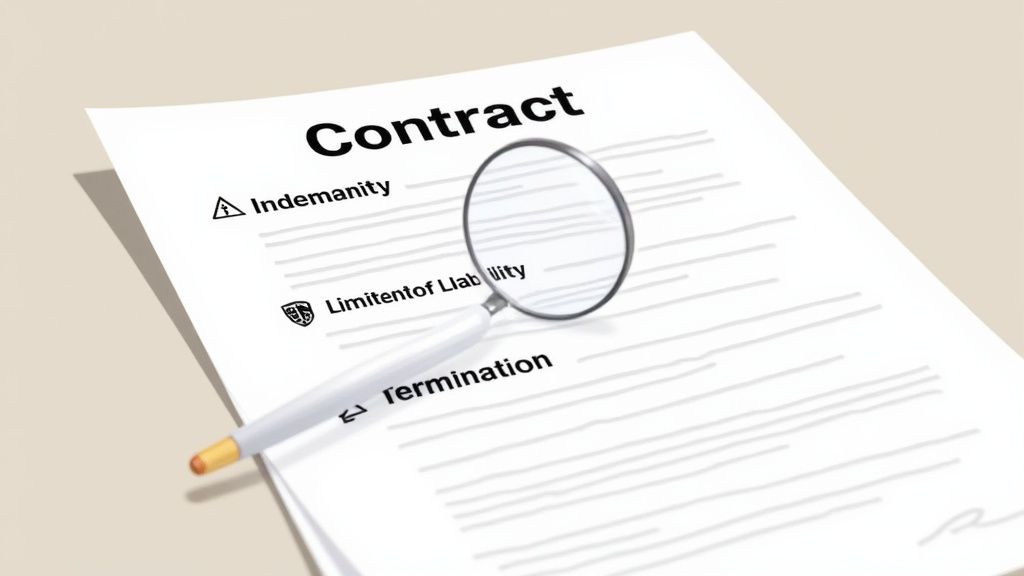
This challenge is a classic business pain point for founders who lack a legal background. High-stakes international deals now take an average of 29.6 weeks to get signed, while even simpler domestic contracts need about 4.4 weeks. This is precisely why knowing what to look for from day one is so critical.
Unpacking the Indemnification Clause
First up is the Indemnification clause, sometimes called a "hold harmless" agreement. Put simply, this clause decides who pays up if legal trouble strikes. One party agrees to cover the other's losses if a specific event happens, like a lawsuit from a third party.
For example, imagine your SaaS company provides analytics software. If your code inadvertently causes a data breach for your client, this clause determines who is financially responsible for the fallout.
- What to watch for: Keep an eye out for one-sided or overly broad indemnification clauses. If you’re being asked to cover the other party for problems completely out of your control, that’s a massive red flag.
- What to negotiate: Your goal should be a mutual indemnification clause. This means both parties agree to cover losses that stem from their own mistakes or contract breaches, creating a much fairer distribution of risk.
The Limitation of Liability Clause
Next is the Limitation of Liability (LoL) clause, and it's one of your most important financial shields. This clause puts a cap on the total amount of damages one party can be forced to pay the other if they break the contract.
Without a solid LoL clause, your financial risk is theoretically unlimited. A small slip-up on a $10,000 project could spiral into a lawsuit claiming millions in damages. This clause puts a reasonable ceiling on that exposure.
The Limitation of Liability clause is your financial firewall. It prevents a single contractual dispute from becoming an existential threat to your startup. Never sign a significant contract without one.
A common approach is to cap liability at the total value of the contract or the fees paid over a specific period, like the last 12 months. For a startup, negotiating this cap is just as important as negotiating the price itself. The financial stability you gain from strong contract terms is a huge asset, especially when you decide to find out more by reading our guide on how to raise seed funding.
Termination for Convenience Explained
Finally, let's break down the Termination for Convenience clause. This gives one or both parties the right to end the contract at any time, for any reason, without needing to prove the other side did anything wrong. It’s basically a no-fault exit ramp.
This is a power move usually reserved for the client. While it gives them flexibility, it can create a ton of uncertainty for your startup. Think about a client pulling the plug on a year-long project just one month in, leaving you with a team on the bench and a hole in your revenue forecast.
When this clause shows up, your negotiation should focus on the consequences of them using it:
- Payment for work completed: Make sure you get paid for every bit of work you’ve done up to the termination date.
- Wind-down costs: Negotiate for reimbursement of any non-cancelable costs you've already committed to, like software licenses or deposits for subcontractors.
- Notice period: Push for a reasonable heads-up, like 30 or 60 days, to give your business time to adjust and find new projects for your team.
These clauses might seem intimidating, but understanding them is the first step toward negotiating them from a position of strength. For many startups, bringing in an experienced fractional executive can be a game-changer. They have the commercial savvy to cut through the jargon and turn these critical details into another opportunity to protect your company's future.
Using Technology to Gain an Edge
In any negotiation, the smartest person in the room is often the one with the best tools. For a growing startup, trying to match the legal and operational firepower of a larger company can feel like an uphill battle. Technology is the great equalizer here, allowing you to punch far above your weight.

This isn't about manual redlining and endless, confusing email chains anymore. Modern tools can save you critical time, slash legal fees, and arm you with data-driven insights that build a much stronger negotiating position. It’s how you turn a defensive, reactive review process into a proactive strategic advantage.
Automate and Analyze with AI
Artificial intelligence has officially moved from a buzzword to a genuinely practical tool for contract management. AI-powered contract analysis platforms can scan a dense, 50-page agreement in seconds, doing the heavy lifting that would take a person hours, if not days, to complete.
These tools can automatically:
- Flag Risky Clauses: Instantly spot non-standard or problematic language around things like liability, indemnification, or termination clauses.
- Suggest Stronger Wording: Offer alternative phrasing based on a massive database of successful contracts and industry best practices.
- Benchmark Against Standards: Compare the terms in your draft to what’s considered normal in your industry, revealing if the other party is making unreasonable demands.
This kind of automation gives you an immediate, data-backed second opinion. While many dealmakers are using AI to automate clause reviews and get risk alerts, only 23% of companies have fully integrated these tools. This presents a huge opportunity for agile startups to get ahead of the curve. You can find more insights about AI in contract negotiations on procurementtactics.com.
Streamline with Contract Lifecycle Management
Beyond the initial analysis, just managing contracts from draft to renewal is a major operational headache. This is where a Contract Lifecycle Management (CLM) platform becomes a game-changer. A CLM system acts as a central, organized hub for every single agreement your company signs.
Think of it like a CRM, but for your contracts. Instead of tracking customer interactions, a CLM tracks every stage of a contract’s journey. For a deeper dive, you can learn more about how to implement a CRM system in our related guide.
A good CLM platform helps you:
- Centralize Documents: No more hunting through old emails or scattered shared drives for the latest version.
- Automate Workflows: Set up approval chains so the right people review the contract at the right time, every time.
- Track Key Dates: Never miss a renewal deadline or an opt-out window again, thanks to automated alerts.
A CLM system transforms contract management from a chaotic, reactive mess into a streamlined, predictable process. It gives you the visibility and control needed to ensure no detail ever slips through the cracks.
Gaining an Unfair Advantage
For a startup founder, time is your most precious resource. Every hour you spend manually poring over legal documents is an hour you're not spending on growing the business. By adopting accessible tools like AI analyzers and CLM platforms, you reclaim that time and gain a powerful analytical edge.
Of course, this tech support works best when guided by experienced leadership. A fractional executive, for instance, can bring the strategic oversight to not only select the right tools but also interpret their outputs effectively. They can translate a risk-flagged clause into a clear business conversation, ensuring your technology doesn't just provide data—it drives better outcomes.
This combination of smart tech and seasoned expertise is how modern startups negotiate and win.
From Signature to Success
Getting that signature feels like the finish line, doesn't it? But really, it's the starting gun. The real work of turning a piece of paper into a valuable partnership begins the moment the ink is dry.
What happens next is what separates a contract that delivers real value from one that just sits in a folder, slowly leaking potential. It all comes down to two things: nailing the final details before the signature and then actively managing the relationship that follows. This is how you build a strategic partnership that pays off for years.
Finalizing the Agreement
Before anyone signs anything, one last, meticulous review is non-negotiable. This isn’t a quick skim. You're making sure every verbal agreement and handshake deal from the negotiation is perfectly mirrored in the final document. Ambiguity is your worst enemy at this stage.
Your final check should hammer out a few key points:
- Accuracy: Are all names, dates, prices, and quantities 100% correct? A simple typo can become a massive headache later.
- Completeness: Does the contract include all the terms, schedules, and attachments you agreed on? Nothing should be left to an "unwritten understanding."
- Clarity: Is the language crystal clear? Vague terms like "reasonable efforts" or "a timely manner" should be defined to head off future arguments.
This is your last chance to catch mistakes before they become legally binding. Once that contract is signed, trying to argue a term was just a typo gets a whole lot harder.
Managing the Post-Signature Relationship
With the contract signed, the game shifts from negotiation to execution. This is where so many companies drop the ball. They celebrate the win, file the document, and forget about it—letting a great deal fall apart due to poor follow-through.
Proactive management is the only way to prevent this. A solid post-signature process ensures everyone knows their responsibilities and keeps the partnership on track. It turns the contract from a static document into a living, breathing guide for your relationship.
A contract isn't a trophy to be filed away; it's a roadmap. The most successful partnerships are the ones where both sides stay engaged, constantly working to deliver on the promise of the deal long after it's closed.
You don't need a complicated system, but you do need discipline and clear ownership.
Tracking Obligations and Deadlines
Every contract is a web of obligations and deadlines. Forgetting a key date—like a renewal notification or a performance review—can have serious financial consequences. A missed renewal deadline can lock you into another year with a vendor you wanted to drop, costing you thousands.
To stay on top of everything, here’s a simple process:
- Create a Contract Summary: Boil the contract down to a single page with the essentials: key dates, payment terms, deliverables, and contact info for both sides.
- Use a Centralized Calendar: Plug every critical deadline into a shared calendar with automated alerts. Renewals, reports, termination notices—everything.
- Assign Ownership: Make one person responsible for managing the contract and tracking its performance. This creates accountability and ensures nothing slips through the cracks.
This simple setup gives you the visibility you need to manage your obligations proactively instead of scrambling to fix problems after the fact.
Open and regular communication is the bedrock of any good partnership. Don't wait for a problem to be the reason you talk. Set up a regular rhythm for check-ins, whether it's a quick weekly email or a more formal quarterly business review.
These meetings are your chance to discuss progress, tackle issues as they come up, and find new ways to improve the partnership. It builds trust and turns a simple transaction into a genuine alliance. For startups that just don't have the bandwidth for this crucial oversight, a fractional executive can step in and build these processes, making sure every contract not only gets signed but truly delivers.
Ready to build the expert leadership team that can turn your contracts into strategic assets? Schedule a consultation with us to discover how a fractional executive can drive your success.
Questions That Always Come Up in Contract Negotiations
Even the best-laid negotiation plans can get messy in the heat of the moment. It’s totally normal. Knowing how to handle the tough questions and tricky situations when they pop up is what separates a good deal from a great one. Let's tackle some of the most common curveballs we see founders face.
What’s the Single Biggest Mistake Founders Make?
Hands down, it's a lack of preparation. It happens all the time. Founders get so focused on the headline number—the price—that they rush into talks without doing their homework. They haven't defined their Best Alternative to a Negotiated Agreement (BATNA), they don't really know what the other side wants, and they haven't even figured out their own non-negotiables.
This leaves them making reactive decisions, often giving in on critical terms just to get the deal signed. Right behind that is the classic mistake of not reading every single word of the contract. The clauses covering liability, termination, and who owns the IP might seem like boring legal jargon, but they can make or break your company down the line.
How Do You Know When to Walk Away?
You walk the second a deal demands you give up one of your non-negotiables. It’s that simple. Remember, walking away isn't a sign of failure. It's a strategic move to save your business from a toxic agreement that could do serious long-term damage.
Keep an eye out for these other major red flags. If you see them, it might be time to pack your bags:
- They won't compromise. If the other side is completely rigid on basic points of fairness, that’s a bad sign.
- The risk is unacceptable. They're pushing for terms that expose your startup to huge liabilities you can't afford.
- The partnership feels one-sided. If it already feels like you're doing all the giving, imagine what the relationship will be like six months from now.
A strong BATNA is what gives you the confidence to get up from the table. It’s not an act of desperation; it's a calculated business decision. It ensures you only sign deals that actually help your company grow.
How Can a Startup Possibly Negotiate with a Much Larger Company?
Going up against a corporate giant feels daunting, but you have leverage they don't. Your startup is agile, you have specialized expertise, and you’re bringing fresh solutions to the table—all things big companies struggle to do internally. Your job is to clearly articulate that unique value. Frame yourself as a strategic partner, not just another vendor they can squeeze.
Your best bet is to build a real relationship with your main contact. Turn them into your internal champion who will go to bat for your deal. Be polite, but stay firm on your most critical points, and always, always back up your asks with data and solid business logic.
Let’s be realistic: you'll probably have to accept some of their standard legal language. That’s okay. Focus your negotiating firepower on the clauses that truly matter to your startup’s health. These usually come down to:
- Payment terms
- Intellectual property rights
- Limitation of liability
By zeroing in on what’s most important, you can walk away with a fair deal that protects your business without getting stuck in a battle over every comma. For founders who need a seasoned pro to guide these conversations, fractional leadership can provide the exact expertise needed to level the playing field.
Navigating complex negotiations requires more than just good advice; it requires experienced leadership. Shiny connects you with a marketplace of over 3,000 vetted fractional executives who can provide the strategic oversight needed to turn every contract into a competitive advantage. Explore our fractional executives and find the right partner to help your startup thrive.