



Raising seed funding isn't just about having a great idea. It's about proving your idea has legs, and that you have the right team to execute on it.
Before you ever ask for that first check, you need a compelling story, some early traction—like a working MVP or real customer feedback—and a team that screams "we can do this." It’s all about turning a concept into a business investors can actually get behind.
Building Your Foundation for Seed Funding


Before you build an investor list or tweak your pitch deck, you need to build an investable company. This is the real work that separates founders who struggle from those who have investors knocking on their door. It’s less about a "revolutionary" idea and more about showing tangible progress and a crystal-clear vision.
The global seed funding scene is as competitive as ever. A recent analysis showed that about $2.3 billion was raised in seed rounds worldwide over just ten months. That tells you investors are hungry, but with thousands of startups vying for that capital, you have to nail the fundamentals to stand out. You can get more great insights on the funding landscape over at growthlist.co.
Define Your Narrative and Prove Traction
Your company's story is your single most powerful fundraising asset. Investors hear hundreds of pitches; what makes yours stick is a sharp, compelling narrative that answers the big questions right away.
What problem are you solving? Who has it? And why does it need to be solved now? Vague answers are a death sentence. Instead of saying you're "improving productivity," get specific: "We save e-commerce managers 10 hours a week by automating inventory reconciliation." See the difference?
Investors fund momentum, not just ideas. Traction is the hard evidence that your story is hitting a nerve in the market. At the seed stage, it doesn't always have to be revenue. Early traction can come in many forms:
- A functional MVP: Show, don’t just tell. A working product, even a clunky one, is infinitely more convincing than a polished slide deck.
- Early customer feedback: Letters of intent (LOIs), glowing survey results, or powerful testimonials from beta users all prove that people want what you're building.
- A growing waitlist: A long list of sign-ups shows there’s pent-up demand just waiting for you to launch.
Assemble a Credible Leadership Team
At the end of the day, investors bet on people. Your founding team has to convince them you have the unique blend of skills, grit, and passion to see this through. An incomplete team is a massive red flag. Investors need to see that you have your core functions covered.
A common pain point for early-stage founders is demonstrating financial acumen. Investors need to believe you can manage capital effectively and build a sustainable business, but few founding teams include a seasoned finance leader from day one.
This is exactly where fractional leadership becomes a strategic advantage.
Think of it like hiring a world-class architect to design your dream home. You wouldn't hire them to pour the concrete, but their expertise in the blueprint stage is invaluable. Similarly, a fractional CFO adds an instant layer of credibility. They can build a financial model that holds up under scrutiny, help you articulate a clear growth plan, and confidently field the tough questions that come up in due diligence. It signals to investors that you're serious about financial discipline and ready to scale. For a deeper dive, check out our guide on the essentials of startup financial modeling.
Putting in this foundational work makes the entire fundraising process smoother. It shifts the dynamic from you chasing investors to investors being genuinely intrigued by the solid business you've already started to build.
Crafting a Pitch Deck That Gets Meetings

Let's be blunt: your pitch deck is your startup’s resume. It’s often the very first real look an investor gets into your business, and it absolutely needs to be compelling enough to stand on its own. You won't be in the room to explain it.
A great deck doesn’t just spit out facts; it tells a powerful story that makes an investor lean in and think, “I need to meet this team.” Think of it as the key that unlocks the door to a real conversation. If your story is confusing, your slides are a mess, or your numbers feel pulled from thin air, that door stays shut.
The Core Slides Every Seed Deck Needs
While every business is unique, successful seed-stage decks almost always follow a familiar narrative arc. Investors are conditioned to see a logical flow that walks them from the problem, to your solution, and finally to the massive opportunity it represents.
Build your story around these key slides:
- The Problem: Get right to the point. Who has this pain, and how bad is it? Make it relatable.
- Your Solution: Present your product or service as the elegant, obvious answer to that pain.
- Market Size (TAM, SAM, SOM): Show investors the scale of the opportunity. Be ambitious, but ground your numbers in reality.
- Business Model: In simple terms, how do you make money? Is it SaaS, a marketplace fee, advertising? Be specific.
- The Team: This is crucial. Why are you and your co-founders the only people who can win in this market?
- The Ask: State exactly how much you’re raising and what milestones that capital will help you achieve.
A pitch deck's only job is to get a meeting. It doesn't need to close the deal on the spot. Keep it concise, visual, and ideally under 15-20 slides. If an investor can't grasp your core concept in under five minutes, you've probably lost them.
Avoiding Common Pitch Deck Red Flags
Investors see thousands of decks a year. They've developed a sixth sense for red flags.
Overly dense slides crammed with tiny text are an instant turn-off. It signals you can't distill complex ideas into clear, digestible points—a bad sign for a founder.
Likewise, unbelievable financial projections will kill your credibility before you even get a meeting. No one expects you to have a perfect five-year forecast, but your assumptions must be logical and defensible. This is another area where bringing in experienced leadership, even on a fractional basis, makes a huge difference. A seasoned CFO, for instance, helps you build a financial narrative that inspires confidence, not skepticism.
For a complete walkthrough, check out our guide to building an investor pitch deck template for more actionable advice.
Finding and Engaging the Right Investors
Fundraising is a game of precision, not a numbers game. Too many founders fall into the ‘spray and pray’ trap—blasting their deck to every investor they can find. That’s a surefire way to burn through your time, energy, and, frankly, your reputation. Raising a successful seed round means focusing your efforts on finding the right partners, not just anyone with a checkbook.
This isn't just about securing capital. It's about finding people who get your vision, believe in your team, and can actually help you beyond just wiring money. A bad investor can be far more damaging than no investor at all.
Build a Highly Targeted Investor List
First things first: you need to build a highly targeted list of potential investors. Think of this as your fundraising CRM. It’s time to stop thinking about who might invest and start identifying who is most likely to invest based on their actual track record and public interests.
Your research should zero in on a few critical criteria:
- Industry Focus: Do they specialize in your world (e.g., SaaS, HealthTech, FinTech)? An investor who already speaks your language will grasp your value proposition in minutes, not hours.
- Stage Alignment: Do they consistently write seed-stage checks? A massive growth fund that typically invests in Series C is the wrong target for a pre-revenue startup, no matter how big their brand is.
- Thesis Alignment: Dig into their blog posts, listen to their podcast interviews, and look at the other companies they’ve backed. Does your company’s mission actually resonate with the themes they care about?
The best investors want to feel like they are seeing a deal before their peers. Positioning your outreach as an early, exclusive look taps directly into this desire and creates genuine excitement around your fundraise.
As you build this list, it’s helpful to understand the different players you'll be talking to. Each type of investor brings something different to the table—not just in terms of cash, but also in expertise and network access.
Key Investor Archetypes for a Seed Round
| Investor Type | Typical Check Size | Primary Value-Add | Best For |
|---|---|---|---|
| Angel Investors | $25k – $250k | Industry expertise, mentorship, early network access | Founders needing early validation and hands-on advice from experienced operators. |
| Micro VCs | $100k – $750k | Focused support, faster decisions, specific industry knowledge | Startups that fit a niche thesis and want a more personal relationship with their lead investor. |
| Seed-Stage VCs | $500k – $2M+ | Brand credibility, structured support, follow-on capital potential | Companies ready to scale quickly and need a partner to help them get to Series A and beyond. |
| Family Offices | Varies ($100k – $1M+) | Patient capital, long-term perspective, potential strategic connections | Founders who value a long-term partnership and may not fit the traditional VC growth model. |
Understanding these archetypes helps you tailor your pitch and expectations. An angel might want to roll up their sleeves and help you with product, while a VC firm will be more focused on board seats and structured reporting.
The Power of a Warm Introduction
Once your target list is dialed in, your next mission is to get a warm introduction. Cold emails have a notoriously low success rate. Think about it—VCs get hundreds of pitches a week. A referral from a trusted source is your golden ticket to cut through the noise and guarantee your deck actually gets opened.
Start by mapping your network. Use platforms like LinkedIn to find mutual connections to the partners on your target list. The absolute best introductions come from other founders in that investor's portfolio. Their endorsement carries serious weight.
When you ask for an intro, make it ridiculously easy for the person helping you out. Draft a short, forwardable email that clearly explains:
- Who you are and what your company does (in one sentence).
- Why you're specifically reaching out to this investor.
- A quick highlight of your traction or a key milestone.
- A link to your well-crafted, concise pitch deck.
This methodical approach turns your fundraising from a chaotic scramble into a strategic process. By focusing on investors who are already primed to be interested in what you’re building, you dramatically increase your chances of not just getting a meeting, but finding a true partner for your journey.
As you prepare for these crucial conversations, remember that investors are vetting your entire operation. Having seasoned experts, even fractional executives, advising on key areas like finance or tech can build immense confidence and show you’re ready to scale professionally. Discover how our vetted executives can give you the edge you need by scheduling a consultation.
Mastering Your Pitch and Due Diligence
Getting that first meeting is a huge win, but let's be honest—that was the easy part. The real work begins the second you walk into the room (or hop on the Zoom call). Nailing the pitch and the due diligence that follows is what separates a warm intro from a signed term sheet.
This is where your story, your numbers, and your team's chemistry get put under a microscope.
Navigating the Pitch Meeting
Your pitch isn't just a presentation; it's a conversation. You have to read the room, build a real connection, and field tough questions without getting defensive. Investors are vetting you and your thought process just as much as they're vetting the business model.
The best pitches feel like a dynamic back-and-forth. Sure, your deck provides the structure, but the magic happens when investors interrupt you to dig into your assumptions about the market or your competitive moat.
Tough questions are a good sign. It means they're engaged. When an investor starts grilling you on your customer acquisition cost, they aren't trying to tear you down. They're trying to genuinely understand the engine of your growth. Your job is to answer directly and back it up with data—or at least a logical, well-reasoned hypothesis.
When an investor asks a question you don’t have a perfect answer for, don’t fake it. A response like, "That's a great question. Here’s how we're thinking about it and the experiments we plan to run to find the answer," shows honesty, strategic thinking, and self-awareness—qualities every investor values.
Preparing for Due Diligence
If the meeting goes well, get ready for due diligence. This is where investors shift from the big-picture story to the nitty-gritty details, digging through your records to make sure everything adds up. Being disorganized here can kill a deal in a heartbeat.
You need a clean, well-organized data room ready to share before they even ask for it.
This virtual folder should have everything an investor needs, all neatly labeled and easy to find. It’s a simple thing, but it signals professionalism and shows you respect their time. Make sure it includes:
- Financials: Your detailed financial model, historical statements, and cap table.
- Legal Docs: Articles of incorporation, bylaws, and any key contracts.
- Team Info: Founder bios and key employee or advisor agreements.
- Product & Tech: A technical overview, product roadmap, and any IP filings.
This is exactly where having seasoned leadership becomes your secret weapon. The investor’s technical team will have sharp, specific questions for your CTO. Their analysts will want to pressure-test your financial model with your CFO.
Having a fractional CTO or CFO in your corner is a total game-changer. They bring the precise expertise needed to handle these domain-specific questions with authority and confidence. Their presence alone builds immense trust and proves to investors you have the operational maturity to manage their capital and execute your vision.
Ready to show investors you have the executive firepower to succeed? Explore our network of vetted fractional leaders who can help you confidently navigate due diligence and secure the funding you need.
Decoding Term Sheets and Negotiating Your Deal
Getting your first term sheet is a huge milestone. It’s that tangible proof you’ve been working for—an investor truly believes in your vision. But don't pop the champagne just yet. The most critical part of the process is just getting started. Now you have to negotiate the terms that will define your partnership and shape the future of your company.
This document, often packed with dense legalese, is about so much more than just valuation. It lays out the rules of engagement for your entire relationship with your investors. It dictates control, how future fundraising will work, and who gets what in an exit. Your goal here isn't to "win" a negotiation; it's to land a fair, founder-friendly deal that aligns everyone for the long haul.
Key Terms That Truly Matter
Valuation always grabs the headlines, but honestly, several other clauses have a much bigger impact on your control and financial outcomes down the road. If you're learning how to raise seed funding, getting your head around these is non-negotiable.
Here are the big ones to watch:
- Liquidation Preference: This determines who gets paid first—and how much—when the company is sold. A standard 1x non-participating preference is what you want to see. It’s widely considered the most founder-friendly option.
- Pro-Rata Rights: These rights give your current investors the option to buy shares in future rounds to maintain their ownership percentage. It can be a powerful signal of insider confidence, but be aware it can also crowd out new investors you might want to bring in.
- Board Composition: The term sheet will spell out who gets a seat on your board of directors. As a founder, your top priority should be maintaining control of the board, or at the very least, ensuring it’s balanced. This is crucial for steering the company’s direction.
The journey from that first pitch to signing the deal is really all about building trust and showing you’re prepared for what’s next.
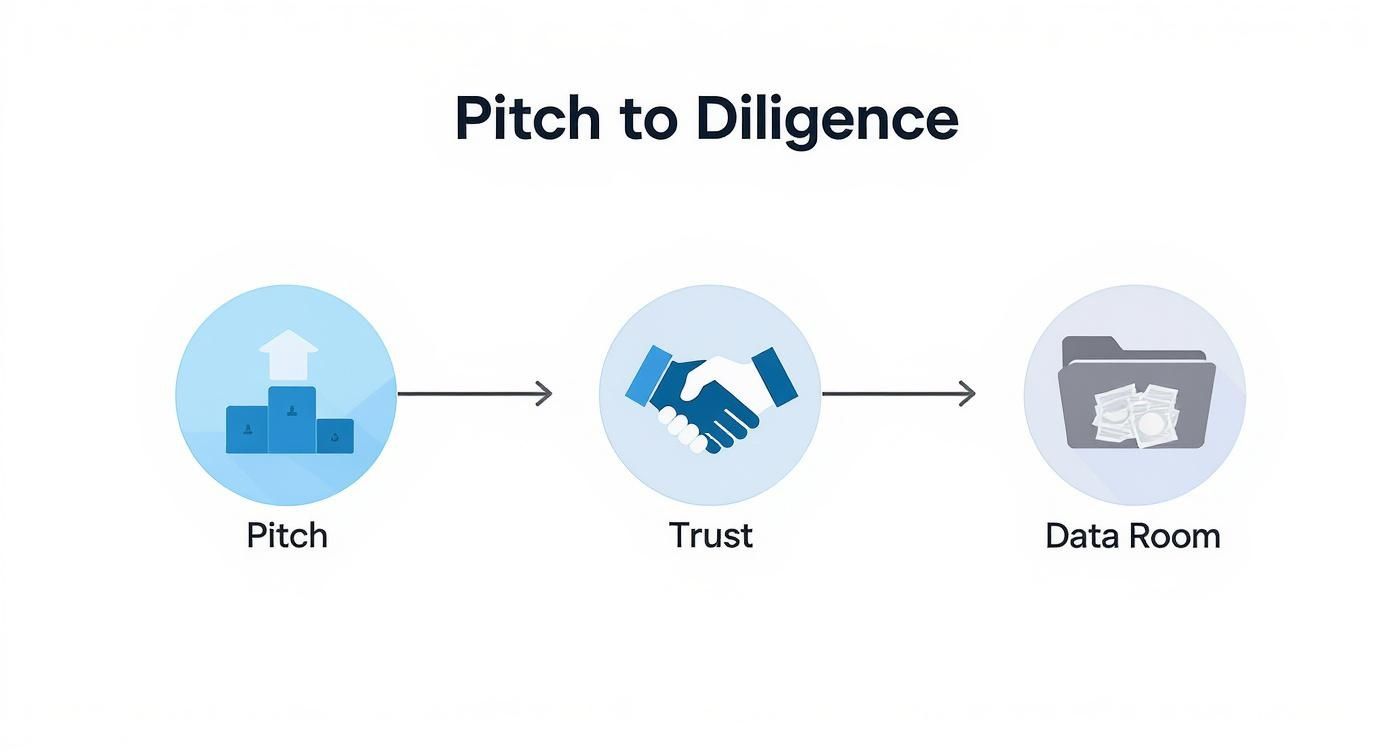

This process really boils down to a strong pitch earning an investor's trust, which is the key that unlocks the door to due diligence and the data room.
Understanding Your Company's Valuation
Valuation is, of course, a massive piece of the negotiation puzzle. While there's certainly an art to it, you need to anchor your expectations in real-world market data. Right now, median seed valuations are reportedly somewhere between $12 million and $18 million pre-money.
But that number can swing wildly depending on your industry and traction. For instance, AI companies are in a league of their own, often commanding valuations around $45 million thanks to insane market demand. You can get a better sense of the landscape by checking out this 2025 seed funding guide.
Don’t get obsessed with chasing the highest possible valuation. A sky-high valuation can create unrealistic expectations, making it incredibly difficult to show enough growth to raise your next round. That can lead to a dreaded "down round." A fair valuation that reflects your actual progress is a much healthier foundation for growth.
Getting comfortable with valuation metrics is essential. A great place to start is by understanding the difference between equity value and enterprise value. We break it down in our guide on what enterprise value is.
Negotiating a term sheet feels incredibly intimidating, especially if you're a first-time founder. This is where having an experienced advisor, like a fractional CFO, can be a game-changer. They've seen hundreds of these. They can model the financial impact of different terms, spot founder-unfriendly clauses from a mile away, and help you argue your case from a position of strength.
Ready to lock in a deal that sets you up for success? Schedule a consultation to connect with a vetted executive who can guide you through this critical process.
Closing Your Round and Fueling Growth
Getting those verbal "yes" commitments from investors feels incredible, but don't pop the champagne just yet. A fundraising round isn't truly over until the money is wired and sitting in your bank account.
The final stretch involves a flurry of activity—coordinating legal paperwork with multiple investors and finalizing all the closing documents. It requires an almost obsessive level of attention to detail. Once that capital is secure, the real work begins. Those first 90 days post-funding will set the tone for your company's next chapter and are your best chance to build immediate, undeniable momentum.
With fresh capital in hand, the pressure to execute is on. This means quickly getting your financial reporting systems in order, establishing a clear communication rhythm with your new board, and starting to knock down the early milestones you promised.
While recent data shows a rebound in the venture world, with the median YC seed round now hitting $3.1 million, investors are being more selective than ever. They want to see clear metrics and a massive market opportunity. You can learn more about these evolving seed funding benchmarks at Rebel Fund.
Deploying Capital with Discipline
This is the moment when strategic leadership becomes absolutely non-negotiable. You have to deploy that capital with discipline to maximize your runway and deliver results. Bringing in an experienced executive, even on a part-time basis, can be a game-changer here.
For instance, a fractional CFO can step in and immediately implement the financial controls and reporting systems your investors expect to see. At the same time, a fractional CMO can start building a scalable growth engine to acquire customers efficiently, making sure your burn rate is justified by tangible progress. Their expertise helps you sidestep common early-stage mistakes and establish an operational cadence built for sustainable growth.
The goal isn't just to spend the money; it's to invest it in activities that directly drive up your company's valuation for the next round. This requires a level of operational expertise that many founding teams are still developing.
By bringing in seasoned leadership, you send a powerful signal to your new partners that you're serious about professional management and accountability. You get the benefit of C-suite experience guiding critical decisions—from hiring key talent to refining your go-to-market strategy—all without the full-time executive price tag.
Ready to turn that seed funding into real, measurable growth? Explore our network of vetted executives who can help you build the operational foundation needed to deliver on your promises and scale with confidence.
Common Questions About Raising Seed Funding
The fundraising world is full of its own language and high-stakes decisions. If you're figuring out how to raise a seed round for the first time, getting a handle on a few of the most common questions can make the entire process feel a lot more manageable.
How Long Does It Take to Raise a Seed Round?
Brace yourself: a seed round typically takes three to six months from the day you start to the day the money is in the bank. This isn't just about pitching; it covers all the prep work, investor research, meetings, negotiations, and the final legal paperwork.
It’s a marathon, not a sprint. The biggest mistake founders make is waiting until they're running low on cash to start the process. You need to kick things off long before you're staring at an empty bank account.
How Much Equity Should I Give Away?
Most founders sell between 15% and 25% of their company in a seed round. The exact number will hinge on your valuation, how much capital you're raising, and what the market looks like at the moment.
A good deal gets you the fuel you need to hit your next major milestones without giving up too much control of the company this early in the game. Your goal is to raise enough capital to significantly increase your company’s value before the next round. Giving away too much equity now can create challenges for future fundraising and dilute your stake more than necessary.
Priced Round vs. a SAFE Note?
You'll hear these terms a lot. A priced round is exactly what it sounds like: you and your investors agree on a specific valuation for your company, and they buy shares at a set price.
A SAFE (Simple Agreement for Future Equity) is a bit different. It lets investors put money in now, and that capital converts into equity during a future priced round. This conversion usually happens at a discount to the future valuation or is capped at a certain valuation, protecting the early investor.
SAFEs have become incredibly popular for seed rounds because they're generally faster and cheaper to close than a full priced round. There are strategic pros and cons to each, and the right choice really depends on your specific goals and timeline.
Navigating the complexities of fundraising is much easier when you have an expert in your corner. Our platform connects you with a network of over 3,000 vetted fractional executives who provide the strategic financial and operational leadership needed to close your round with confidence. Find the right expert for your team by scheduling a consultation.