



Your VP of Engineering just resigned. A release is slipping. Customers are reporting reliability issues. The board wants a credible technology plan before the next fundraising conversation, and the team left behind is working hard but pulling in different directions.
That's usually the point where founders make one of two mistakes. They rush into a permanent executive search before they understand the actual problem, or they push the existing team to “hold things together” while hidden risks pile up in infrastructure, security, and delivery.
A better move is often simpler. Bring in an Interim IT Executive who can stabilize the operation fast, make hard calls, and create a realistic path forward without locking the company into the wrong long-term hire.
The Moment Your Tech Strategy Needs a Lifeline
A startup can look healthy from the outside and still be one missed deployment away from chaos.
The product roadmap may be full. Revenue may be growing. Then a technical leader leaves, an integration breaks, or the stack starts fighting the business. Engineers stop debating what to build and start debating what's on fire. The CEO becomes the default escalation point for architecture, hiring, vendor decisions, and security questions they shouldn't be handling directly.
That's where an interim IT executive changes the picture.
This person isn't there to warm a seat. They step in when the company needs senior judgment now, not after a long recruiting cycle. In practice, that means taking control of priorities, calming the team, clarifying risks, and giving leadership a credible operating plan.
What this looks like in real life
Think of an interim leader like the emergency general contractor you hire when a renovation uncovers structural damage. You don't need a motivational speech. You need someone who can inspect the foundation, stop the water leak, coordinate the trades, and tell you what can wait.
For startups, the same logic applies when:
- A key leader exits: Delivery slows because nobody owns technical decisions at the executive level.
- Growth exposes weak systems: The product works, but the infrastructure, data flows, and internal processes don't scale cleanly.
- A financing or diligence event is coming: Investors want confidence in technology operations, not a hopeful narrative.
This isn't fringe behavior anymore. The global interim executive market is projected to reach $11.8 billion by 2027, with 78% of companies now using interim services to fill leadership gaps, reflecting a broad move toward agile leadership solutions, according to Taplow Group's overview of interim executive management.
Interim leadership works best when the company needs clarity before commitment.
For founders, that's the value. You buy speed, objectivity, and execution at the exact moment permanent hiring would be slowest and riskiest.
What an Interim IT Executive Actually Does
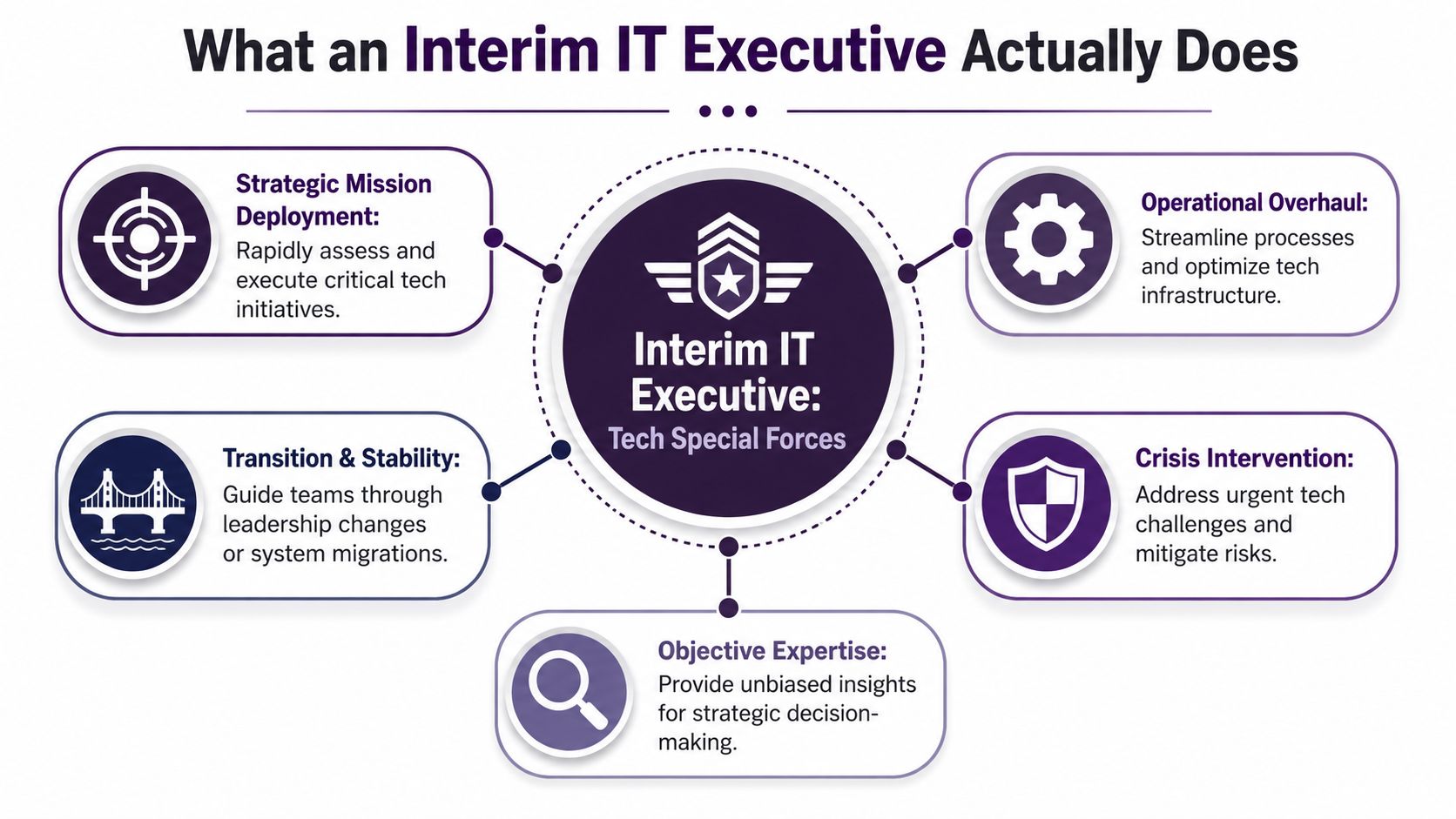
An interim IT executive is the tech version of special forces. They're deployed for specific missions where speed, judgment, and execution matter more than org-chart permanence.
They usually enter a company during a leadership gap, a crisis, a transformation, or a stretch of growth that the current systems can't support. Their job is to get the business stable, focused, and moving again.

Their real mandate
On paper, the title might look like interim CIO, CTO, or technology leader. In practice, the mandate usually comes down to a handful of high-stakes responsibilities:
- Stabilize operations: Triage outages, delivery bottlenecks, vendor issues, and team confusion.
- Assess the estate: Review legacy systems, architecture decisions, security posture, data flows, and the health of current delivery practices.
- Create decision clarity: Tell the CEO and board what's urgent, what's noise, and what trade-offs the company is making.
- Lead through transition: Keep engineering, product, and operations aligned while the company changes structure, priorities, or ownership.
- Build the handoff: Leave behind a stronger operating rhythm, better documentation, and a clearer brief for a permanent or fractional successor.
If you want a deeper look at how this role compares to broader executive technology oversight, this guide on what an interim chief information officer does is a useful companion.
The 30 60 90 day pattern
The best interim IT executives don't start by launching giant strategy decks. They start by locating operational truth.
According to GQ Interim's breakdown of the interim IT manager role, an interim technology leader typically assesses legacy systems and immediate risks in the first 30 days, implements quick wins by 60 days, and by 90 days drives measurable impact by modernizing infrastructure, optimizing cybersecurity, and accelerating digital transformation.
A practical 30-60-90 sequence often looks like this:
| Timeframe | What happens |
|---|---|
| First 30 days | Audit systems, meet key stakeholders, review incidents, identify single points of failure, clarify decision rights |
| By 60 days | Fix the most dangerous bottlenecks, restore operating cadence, reset project priorities, tighten communication between technical and business teams |
| By 90 days | Put durable changes in place across infrastructure, security, delivery processes, and strategic technology planning |
Practical rule: If an interim leader can't explain the top technical risks and business trade-offs in plain English within the first month, they're observing, not leading.
What works and what doesn't
What works:
- A finite mission: “Stabilize delivery, clean up infrastructure risk, prepare for Series B diligence.”
- Direct access to leadership: The interim executive needs regular time with the CEO and key functional heads.
- Authority to act: Advice alone won't fix a drifting technology function.
What doesn't work:
- A vague charter: “Come in and help with tech.”
- Treating them like a senior project manager: This role is about executive judgment, not task chasing.
- Expecting long-term cultural change in a short window: They can set the direction and operating model, but the company still has to carry it forward.
Clear Signals You Need an Interim IT Leader Now
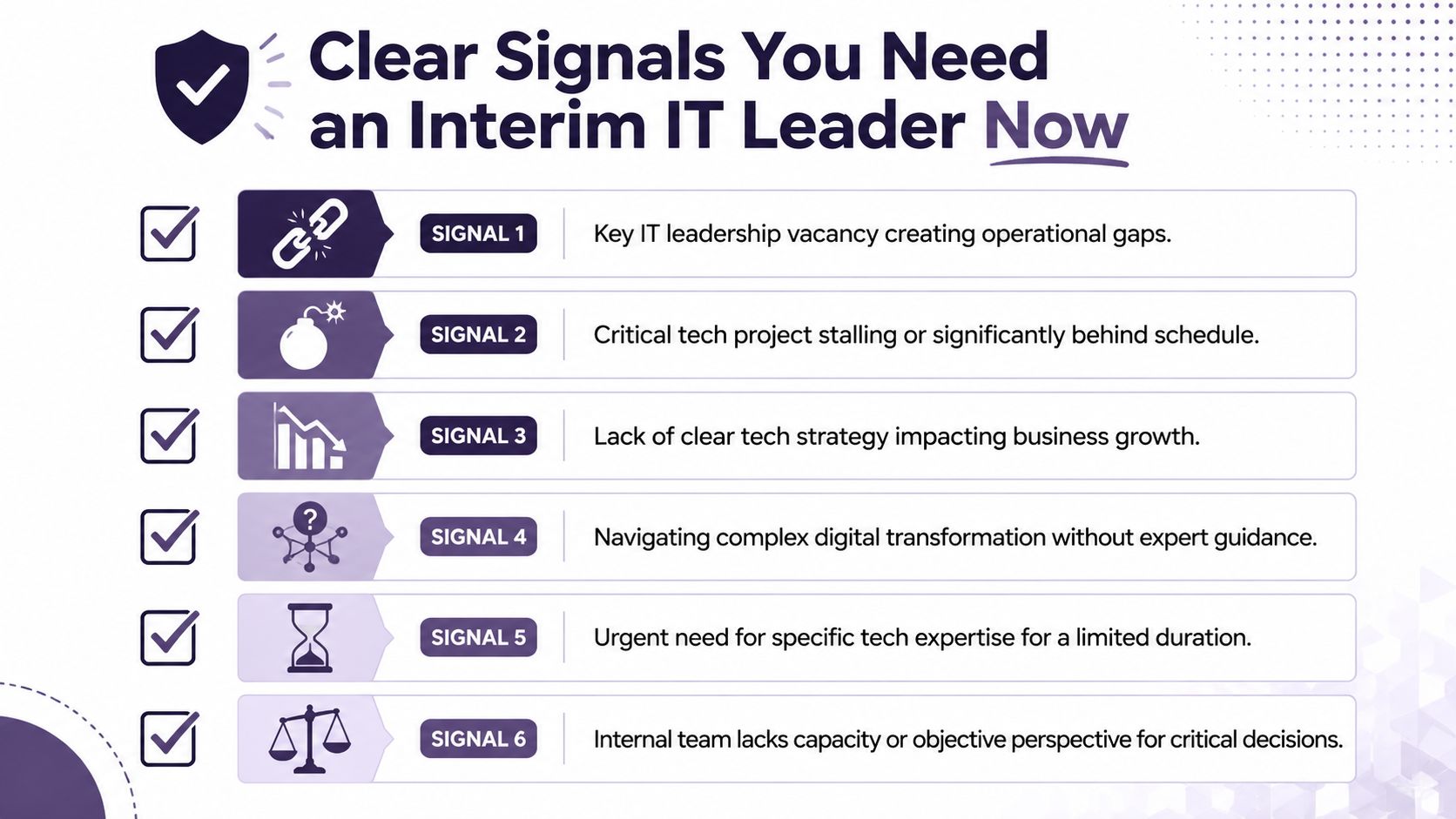
Most companies don't wake up one morning and say, “We need an interim IT executive.” They feel symptoms first. Deadlines slip. Cross-functional trust drops. The CEO gets pulled into technical decisions that should already have an owner.
If several of the signals below sound familiar, waiting usually makes the fix more expensive.
Leadership and execution signals
Use this as a practical checklist.
Your top technical leader left suddenly
A resignation at the CTO, CIO, or VP Engineering level creates more than a management gap. Architecture decisions stall, hiring slows, and the rest of the team starts managing around uncertainty.A critical initiative is stuck
ERP work, cloud migration, platform rebuilds, AI implementation, or a major product release can stall when nobody has both technical depth and executive authority to force decisions across teams.The business has outgrown its current systems
What worked at an earlier stage often becomes a drag on growth. Manual reporting, fragile integrations, unclear ownership, and recurring reliability problems usually point to leadership debt, not just technical debt.
A startup can survive an imperfect stack longer than it can survive unclear ownership.
Risk and transition signals
Some triggers are less visible but more dangerous.
A security incident or serious compliance concern surfaced
After a breach or a near miss, companies need someone who can coordinate incident response, prioritize restoration, and communicate clearly between technical teams and management.You're integrating a merger, acquisition, or major partnership
Technology integration fails when nobody owns the hard calls on systems, data, vendors, and sequencing. An interim leader brings neutral judgment when internal politics are high.Fundraising or diligence is around the corner
Investors don't expect perfection. They do expect a credible explanation of risk, roadmap, and operational control. An interim executive can turn scattered technical facts into a coherent leadership narrative.
The easiest self-test
Ask three questions:
- Who makes the final technology call today?
- Can that person explain the biggest risks in business terms?
- Do they have enough authority to change course this quarter?
If the answers are fuzzy, delayed, or split across too many people, you probably don't have a tooling problem. You have a leadership problem.
Interim vs Full-Time vs Fractional A Strategic Cost-Benefit Analysis
Founders usually frame this choice the wrong way. They ask which model is cheaper. The better question is which model fits the current mission.
A full-time executive makes sense when the company already understands the role, the scope is stable, and there's enough ongoing complexity to justify a permanent seat. An interim executive fits when the business needs immediate control during disruption. A fractional executive works well when the company needs senior guidance consistently, but not at full-time intensity.
The most useful approach for startups is often a hybrid. Get full-time senior attention during diagnosis and stabilization, then reduce the scope once the system is under control.
Hiring Model Comparison IT Executive
| Factor | Interim Executive | Full-Time Executive | Fractional Executive |
|---|---|---|---|
| Primary use case | Crisis, transition, turnaround, urgent transformation | Long-term ownership and org building | Ongoing strategic guidance with lean overhead |
| Speed to start | Fastest when you need immediate leadership | Usually slower due to search and negotiation | Often faster than full-time, especially for defined scope |
| Commitment level | Time-bound and mission-driven | Permanent hire with broad long-term commitment | Flexible, part-time engagement |
| Best for startups | Leadership gaps, system instability, pre-fundraise cleanup | Mature stage teams with sustained executive needs | Budget-conscious teams that need experience but not a full seat |
| Main trade-off | Not designed to stay forever | Highest commitment and hardest to reverse | Less daily involvement during acute crises |
The hybrid model that often works best
A lot of startups don't need a permanent technology executive immediately. They need one strong operator to come in, assess reality, make the first hard decisions, and stop the bleeding. After that, they may only need part-time executive oversight.
That's why the full-time-to-fractional path is so effective. According to Fortium Partners' guidance on hiring an interim technology leader, many organizations can shift to part-time interim leadership after an initial 30-day full-time assessment, and 40% of mid-sized firms now prefer this fractional approach after that assessment phase.
That sequence maps cleanly to startup reality:
- Start intense: Give the executive enough time and access to diagnose systems, team issues, and delivery risk.
- Narrow the charter: Once priorities are clear, reduce involvement to strategy, vendor oversight, hiring support, and executive decision-making.
- Preserve flexibility: Keep access to senior talent without carrying the cost and commitment of a full-time seat before the company is ready.
For founders comparing options, this guide to hiring a fractional CTO helps clarify where fractional leadership fits after the immediate stabilization period.
Where companies get this wrong
The common mistakes are predictable:
Hiring full-time too early
If the company hasn't defined the mission, the search becomes a personality contest instead of a business decision.Using fractional too early in a crisis
Part-time leadership can be ideal later. It's often too light during the first wave of incident response, org reset, or transformation triage.Keeping interim leadership too vague
Interim work succeeds when the deliverables are concrete. Clean up infrastructure risk, reset roadmap governance, prepare diligence materials, rebuild vendor discipline.
Budget discipline matters, but role design matters more. A cheaper model with the wrong scope usually costs more in delay, rework, and executive distraction.
How to Find and Hire the Right IT Executive
A founder usually starts this search after something has already gone wrong. The roadmap slipped again. A security issue exposed weak ownership. The senior engineer keeping everything together just resigned. In that moment, a polished executive search process is less useful than a hiring process built around immediate business outcomes.
That changes how you evaluate candidates. The right interim IT executive is not the person with the cleanest resume or the broadest corporate pedigree. It is the person who can enter a messy startup environment, sort signal from noise fast, make decisions under pressure, and leave the company in better shape than they found it.
Start with the mission, not the title
Many startups write a job description for a generic CTO, CIO, or VP of Engineering and hope the market interprets the nuance. That usually produces the wrong shortlist.
Write the brief around four things:
What triggered the hire
A leadership gap, delivery instability, investor diligence, a security event, cost pressure, failed scaling, or an integration problem.What business result you need
Restore delivery predictability, reduce platform risk, prepare technical diligence, reset vendor spend, improve engineering management, or stabilize operations ahead of growth.What authority the person will have
Team oversight, architectural direction, vendor management, budget input, hiring decisions, board reporting, or all of the above.What the engagement should become
A short intervention, a bridge to a permanent hire, or an initial full-time assessment that later shifts into a part-time model.
That last point matters more than many founders expect. For startups, the best hire is often not a permanent executive from day one. It is an interim leader who can assess the situation at full intensity, then continue in a fractional capacity once the fires are contained and the leadership need becomes narrower.
Screen for transition experience
A startup in trouble does not need theory. It needs someone who has already handled uncertainty, conflict, and incomplete information.
Russell Reynolds Associates notes in its interim executive services overview that companies use interim leaders during moments such as transformation, leadership gaps, and periods that demand immediate operational impact. That is the right screening lens here.
Look for candidates who have done some version of these assignments before:
- Inherited a weak or unclear engineering org
- Stepped into a post-founder or post-executive leadership gap
- Handled diligence, restructuring, or post-acquisition integration
- Stabilized delivery after repeated misses
- Reduced technology cost without freezing growth
- Built a roadmap for permanent hiring after the reset
Industry knowledge helps. Pattern recognition matters more. I would rather hire an interim executive who has fixed three similar leadership messes in adjacent environments than someone with the exact title from a larger company who has never had to make trade-offs with limited time and incomplete data.
Interview for operating judgment
Traditional executive interviews overvalue polish. Interim hiring should test diagnosis, prioritization, and decision quality.
Use scenario questions that force the candidate to show how they think:
- “You arrive and the CEO wants speed, the product lead wants new features, and the engineering manager says reliability is breaking. How do you set priorities in the first two weeks?”
- “What would you review in the first ten days to judge delivery risk, security exposure, and team health?”
- “Tell me about a time you walked into a skeptical team. What did you change first, and what did you leave alone?”
- “How do you decide whether to replace a vendor, rebuild internal capability, or keep the current setup for six more months?”
- “At what point would you recommend a full-time executive search versus a continued fractional model?”
Strong candidates answer with sequencing and trade-offs. They talk about access, decision rights, financial constraints, and how they earn trust without promising a rescue fantasy.
Weak candidates stay abstract. They describe leadership values but not operating moves.
Use references to test the hard parts
Reference checks matter more with interim executives because you are hiring for compressed impact.
Ask former CEOs, board members, or operators specific questions:
- Did this person create clarity quickly?
- Could they make hard calls with limited data?
- How did they handle strong personalities or founder tension?
- Did they leave behind a team and operating cadence that lasted?
- Would you use them again in a high-stakes transition?
If references cannot speak clearly about outcomes, pace, and judgment, keep looking.
Budget against risk, not salary bands
Interim executives often look expensive if you compare their rate to a salaried leader on a spreadsheet. That is the wrong comparison.
The cost question is whether this person reduces expensive failure. Missed launches, poor diligence prep, avoidable cloud spend, weak security decisions, and six months of executive drift all cost more than a focused interim engagement. Forbes, citing the Interim Management Report 2025, reports average interim manager day rates in Europe of €1,032 internationally and €1,177 in Germany. Use that as a planning reference, not a universal quote for startup technology leadership.
The practical hiring model for many startups is simple. Pay for strong full-time attention during diagnosis and stabilization. If the company no longer needs daily executive involvement, reduce the scope and retain the same person in a part-time structure. That gives the business continuity, lower cost, and access to senior judgment while you decide whether a permanent hire is justified.
If you want that handoff to work, treat the search and ramp-up as one process. Good executive onboarding practices for modern leadership success help you assess candidates based on how quickly they can get context, authority, and traction once they start.
Onboarding and Measuring Success for Rapid Impact
Monday morning. A startup brings in an interim IT executive to stop release failures, reduce cloud waste, and get security under control before the next board meeting. By Friday, that person still lacks budget visibility, cannot reprioritize engineering work, and needs founder approval for vendor decisions. The engagement is already off track.
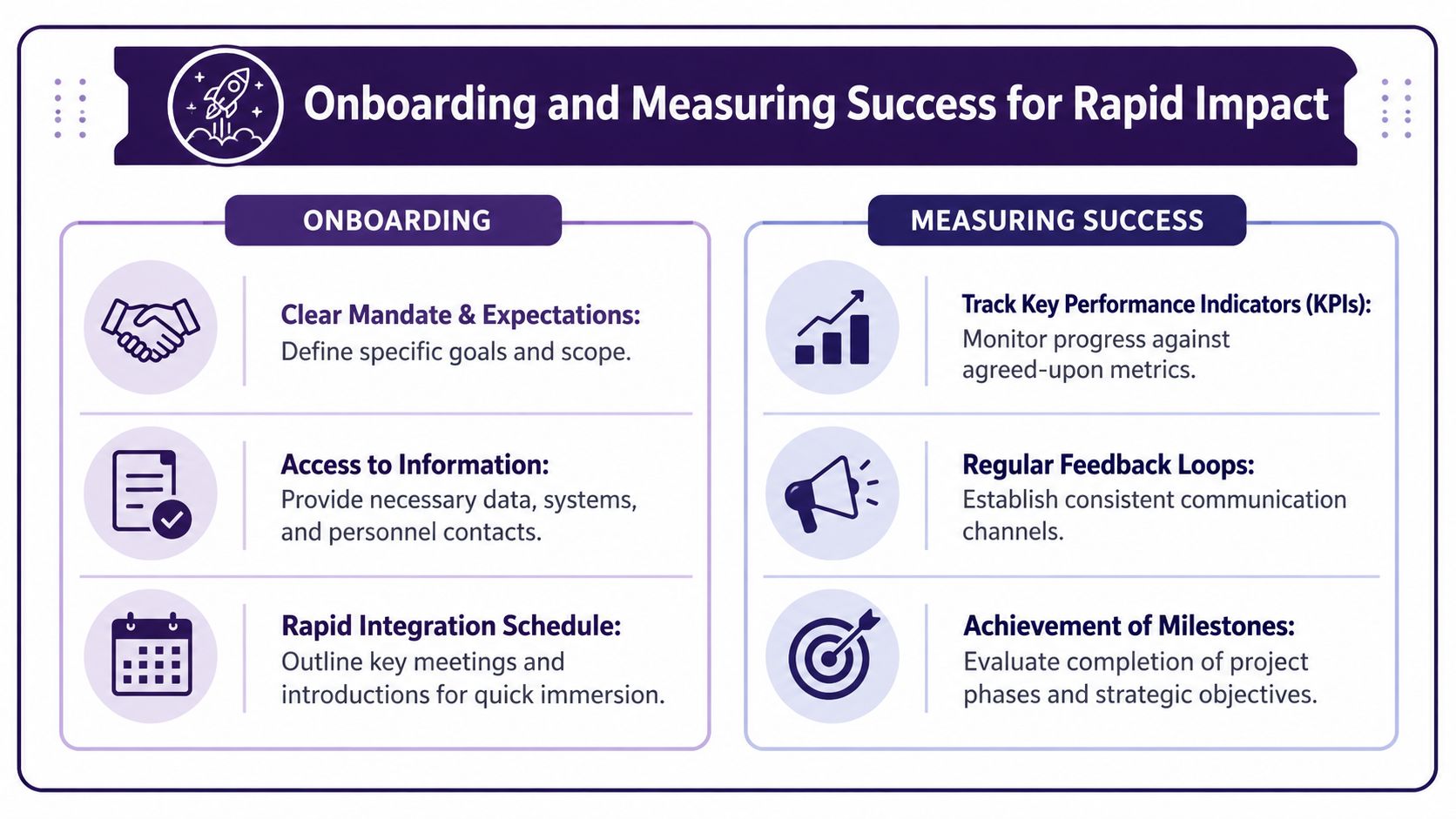
Interim leaders create value fast only when the company treats them like an executive from day one. If they are expected to own outcomes, they need clear authority, direct access to data, and a visible mandate across the team.
Give authority early
Founders often make the same mistake. They hire an interim CIO or CTO to fix execution, then route every meaningful decision back through existing leadership. That setup slows diagnosis, confuses the team, and leaves the interim accountable for results they cannot control.
Set decision rights in writing during the first week. The team should know who owns vendor approvals, incident escalation, roadmap trade-offs, staffing changes, and reporting to the CEO or board. Open access just as quickly. Jira, GitHub, cloud dashboards, contracts, security findings, budget data, and postmortems should be available immediately.
The practical test is simple. If the interim leader identifies a risky project, can they stop it, redirect the team, and explain the decision to stakeholders without waiting in a permission queue? If not, the company has hired advice, not leadership.
For a useful framework, apply these executive onboarding best practices for modern leadership success to the interim role as well.
Measure outcomes that matter
A good interim engagement should change operating performance within weeks. The right scorecard depends on the mission, but it should track business control rather than activity.
Use measures such as:
- Operational stability: Fewer repeated incidents, faster escalation, clearer ownership during outages.
- Delivery discipline: Tighter prioritization, fewer stalled initiatives, more predictable release planning.
- Risk visibility: Leadership can explain the top technical and security risks clearly, with owners and timelines attached.
- Cross-functional execution: Better coordination between engineering, product, security, and finance.
- Leadership continuity: A defined org shape, cleaner documentation, and a realistic brief for the next full-time or fractional leader.
This is also where startups get the long-term return. The best interim executive does not just patch the immediate problem. They leave behind operating cadences, clearer accountabilities, and a leadership baseline the company can keep after the intense full-time phase drops into a part-time fractional model.
Keep the cadence tight
Run a weekly operating review with a short agenda. Decisions made. Risks raised. Blockers removed. Metrics that changed. That cadence keeps the CEO informed without pulling the interim executive back into constant status reporting.
I usually advise founders to ask one blunt question every two weeks: what is under control now that was not under control before? The answer should show up in execution, cost, or risk reduction.
If the engagement works, the company ends up with more than a calmer technology function. It gets a management system that can hold up under growth.
The Future of Your Tech Leadership Is Flexible
The old model assumed senior leadership had to arrive full-time, long-term, and all at once. That no longer fits how many startups grow.
An interim IT executive gives founders something more useful than a temporary substitute. They provide fast control during unstable moments, objective judgment when internal opinions are colliding, and a path to stronger execution without forcing a premature permanent hire.
For many companies, the smartest version of this model is flexible by design. Start with deep involvement when the business needs triage and hard decisions. Shift to fractional oversight once the stack, team, and roadmap are back under control.
That broader shift isn't slowing down. The global fractional executive market is projected to grow from USD 8.6 billion in 2025 to USD 34.2 billion by 2034, expanding at a CAGR of 16.2%, according to Growth Market Reports' outlook on the fractional executive market.
For founders, that means access to senior technology leadership is becoming more modular, more affordable, and more aligned with real operating needs. You don't have to choose between doing without and overhiring. You can match the leadership model to the mission.
If you're weighing interim or fractional leadership for your business, Shiny can help you find vetted executives who fit the stage, scope, and urgency of the role. It's a practical way to explore your options or schedule a consultation before making a full-time commitment.