


A Part Time Chief Marketing Officer, often called a Fractional CMO, is an experienced marketing executive you bring on board on a contract basis. They provide the high-level strategic leadership your business needs, but for a fraction of the time and cost of a full-time hire. This flexible model makes top-tier marketing talent accessible to practically any business.
The Rise of On-Demand Marketing Leadership
Many growing businesses eventually hit a frustrating wall. Their marketing just isn't working like it used to, the founder is swamped trying to make strategic calls, and the team desperately needs senior guidance.
But the budget can’t support a six-figure executive salary plus benefits. This is an incredibly common pain point, and it's fueling a major shift in how companies think about leadership.
Instead of getting bogged down in the lengthy and expensive process of hiring a full-time executive, savvy founders are turning to fractional leadership. The demand for fractional Chief Marketing Officers has exploded, surging by an incredible 57% since 2020. To put that in perspective, traditional full-time executive roles grew by just 2.3% in that same timeframe. According to insights from MovingMinds.io, this data points to a clear trend: businesses want agility and proven expertise without the long-term financial handcuffs.
Strategy Without the Full-Time Price Tag
Think of a Part Time Chief Marketing Officer like hiring a world-class architect to draw up the blueprints for your dream home. You bring them in for their specialized, strategic genius to create a bulletproof plan. You don't keep them on the payroll to pour the concrete; you empower your existing team to execute that brilliant vision.
This "strategy-on-demand" approach has serious advantages for agile companies:
- Access to Elite Talent: You can bring in a seasoned marketing leader with a proven track record in your industry—the kind of pro who might otherwise be out of reach.
- Cost-Effectiveness: You get C-suite level guidance for a fraction of the cost of a full-time salary, benefits package, and bonuses. That's precious capital you can pour back into growth.
- Immediate Impact: A skilled fractional leader gets up to speed fast. They diagnose strategic gaps and start rolling out impactful changes within weeks, not months.
This model is fundamentally changing how companies access executive-level direction. It allows you to tap into the strategic horsepower needed to navigate complex markets and drive real growth, all while keeping your operations lean. For a deeper dive, check out our guide on what fractional marketing is and how it works. Ultimately, it’s all about getting precisely the right expertise at exactly the right time.
Choosing Your Marketing Leadership Model
Once you realize you need senior marketing leadership, you’ve hit a critical fork in the road. The path you take next isn't just about budget; it's a strategic choice that will define how you grow. You have three main options: hire a part time chief marketing officer, bring on a full-time CMO, or sign with a marketing agency.
Each route has unique pros and cons. A full-time executive offers total immersion in your business but comes with a massive financial and long-term commitment. An agency provides a team of specialists but often lacks the singular strategic focus a growing business desperately needs.
The fractional model, however, strikes a perfect balance between the two.
Comparing the Core Options
Making the right call means comparing these models on the factors that actually matter to a scaling company: cost, strategic depth, team integration, and operational flexibility.
A part time chief marketing officer is built for strategic impact without the hefty executive overhead. They bring C-suite experience from different industries, which means you get a fresh, unbiased perspective on your challenges. This model is perfect for companies that have a team needing high-level direction or are building a marketing function from scratch.
A full-time CMO is the traditional heavyweight champion. This person becomes a core part of your leadership team, completely embedded in your company culture. This is the right move for well-funded, established companies with complex marketing operations. The catch? The cost often blows past $300,000 annually once you factor in salary and benefits, putting it out of reach for most growing businesses.
A marketing agency acts as an outsourced execution arm. You get access to specialists in SEO, PPC, and content. While great for running campaigns, agencies usually operate at arm's length. They're juggling multiple clients, and their focus is almost always on tactical delivery, not the deep, integrated strategic leadership that drives the business forward.
Key Takeaway: The question isn't which model is "best," but which is best for your business right now. A startup needing its first real marketing strategy has completely different needs than a large corporation optimizing a multi-million dollar budget.
This decision tree gives you a quick visual for thinking through the initial cost considerations.
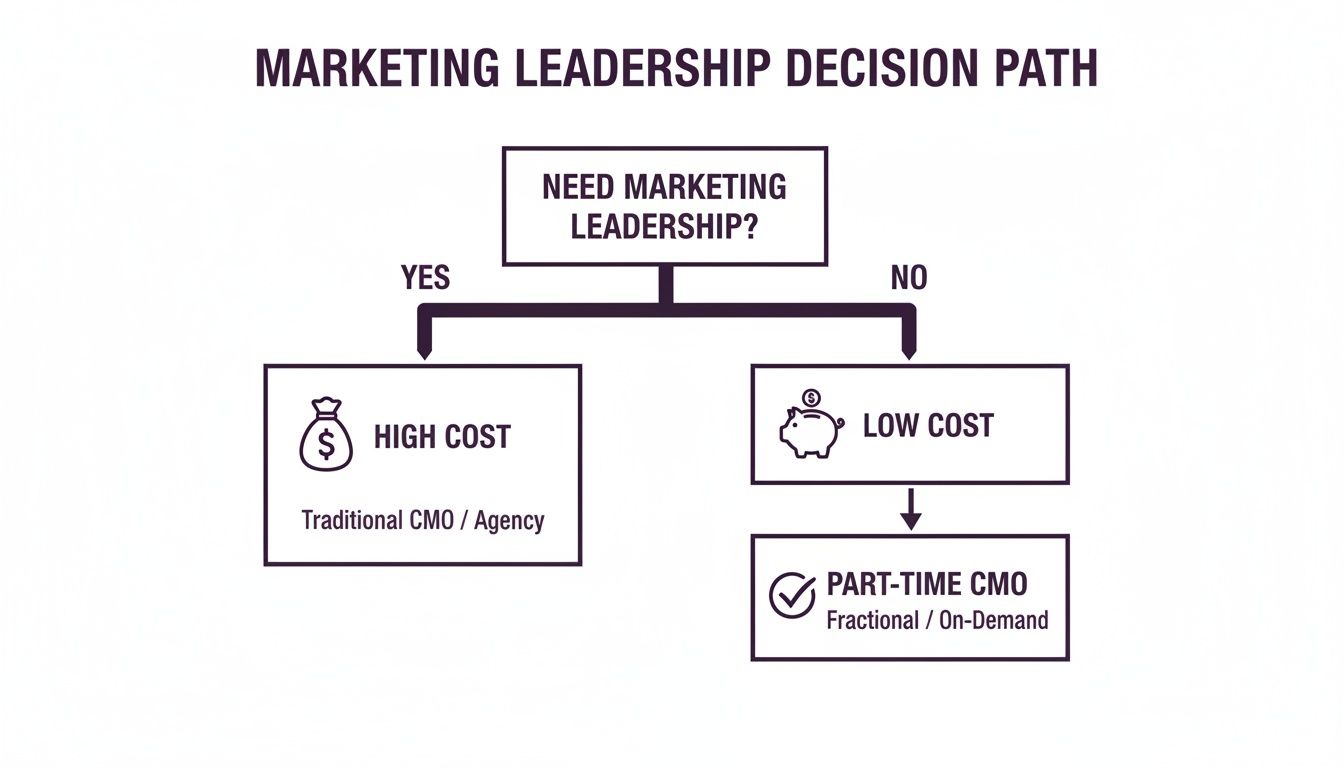

As the flowchart shows, if budget is a top concern, the part-time CMO is a direct route to senior-level expertise without the eye-watering cost of a traditional executive hire.
Marketing Leadership Model Comparison
How do these three models really stack up side-by-side? This table puts the key differences in black and white, helping you see where each option shines—and where it falls short.
| Factor | Part Time Chief Marketing Officer | Full-Time CMO | Marketing Agency |
|---|---|---|---|
| Overall Cost | Moderate (fraction of full-time) | Very High (salary + benefits + bonus) | Variable (retainer-based) |
| Strategic Focus | High (primary function) | High (embedded in leadership) | Varies (often execution-focused) |
| Team Integration | High (acts as internal leader) | Very High (full-time team member) | Low (acts as external vendor) |
| Flexibility | Very High (scalable contracts) | Low (long-term commitment) | Moderate (contracts can be rigid) |
| Breadth of Experience | Broad (cross-industry insights) | Deep (focused on one company) | Broad (multiple client accounts) |
Ultimately, the part time chief marketing officer model is built for agility. It gives you the power to dial senior strategic support up or down as your needs evolve, ensuring you never overpay for leadership you aren't fully using. It’s the sweet spot, combining the integrated leadership of a full-time hire with the cost-efficiency of an outsourced partner.
Key Signs You Need a Part Time CMO
Figuring out the right time to bring in senior marketing leadership can feel like a guessing game. Many founders think they're "too small" for a CMO, but waiting too long means leaving money on the table. The reality is, certain business challenges are flashing red lights, signaling it's time for a strategic expert.
A part time chief marketing officer is the perfect solution for businesses hitting these specific growing pains. You get executive-level firepower without the full-time financial commitment. If any of these scenarios hit too close to home, it might be time to think fractionally.
Your Growth Has Hit a Plateau
Remember those marketing tactics that got you to your first million? They're not working anymore. Your lead flow has gone flat, customer acquisition costs are inching up, and your team is recycling old ideas with worse results. This is the classic growth plateau.
It's a clear sign your business has outgrown its current marketing playbook. You don't just need more marketing; you need a smarter, more sophisticated strategy. A part time CMO brings a fresh perspective and the high-level experience to diagnose what’s broken, rebuild your strategy, and get that growth curve pointing up again.
The Founder Is the Bottleneck
Is your week filled with approving ad copy, debating campaign ideas, or getting lost in analytics? When the founder gets dragged into the marketing weeds, it pulls your attention from the things that only you can do—like product, fundraising, and steering the overall vision.
This is a huge red flag. Your job is to be the captain of the ship, not the one paddling the canoe. Handing the marketing reins to a trusted part time CMO frees you up to focus on your highest-impact work.
Key Insight: A common myth is that you need a huge marketing team before you can hire a CMO. The truth is, a fractional leader is often most impactful when they're guiding a small, nimble team or even just a single marketing coordinator.
Your Marketing Team Lacks Senior Guidance
You might have a fantastic team of junior marketers who are brilliant at getting things done. What they're missing, however, is the strategic veteran who can build a cohesive plan that ties back to your business goals.
Without a leader connecting their daily tasks to the big picture, their efforts can feel random and disconnected. A part time CMO provides the mentorship and strategic direction they're craving, transforming a group of individual contributors into a high-performing marketing engine.
Here are a few tell-tale signs your team needs a leader:
- Reactive vs. Proactive: The team is constantly putting out fires instead of executing a thoughtful, long-term plan.
- No Clear Metrics: Nobody can agree on what "success" actually looks like. Key performance indicators (KPIs) are either nonexistent or ignored.
- Siloed Efforts: The content team has no idea what the paid ads team is doing, and neither aligns their work with what sales actually needs to close deals.
A fractional leader steps in to connect these dots, forge a unified strategy, and empower your existing talent to deliver measurable results.
What a Part Time CMO Actually Delivers
So, beyond high-level meetings, what does a part-time CMO actually do? Their job is to be the engine of your marketing, ensuring every action ties back to real, tangible business growth. They don't just hand you a roadmap; they make sure the team follows it.
A great fractional leader is the bridge between your company's big vision and your marketing team's day-to-day execution. They translate broad business goals into a concrete marketing plan, complete with budgets, timelines, and clear responsibilities.

Core Responsibilities and Scope of Work
While the exact scope can be tailored, a part-time CMO typically owns several mission-critical functions. They roll up their sleeves and actively manage the marketing department's output and performance.
Their responsibilities generally fall into four key buckets:
- Strategic Planning and Oversight: They dive deep into market research, sharpen your target audience definition, nail down brand positioning, and build a marketing strategy that is welded to your revenue goals.
- Team Leadership and Mentorship: A fractional CMO takes the helm of your existing marketing team, providing clear direction, mentoring junior talent, and helping build a high-performing culture.
- Budget Management and Allocation: They take full ownership of your marketing spend, ensuring every dollar is invested wisely. This means setting the budget, allocating funds, and tracking performance to optimize for ROI.
- Campaign and Performance Management: They oversee the execution of all marketing campaigns. Critically, they also build the systems to track, analyze, and report on performance so everyone knows what's working.
This hands-on leadership brings much-needed stability to the notoriously volatile executive world. Recent analysis from Spencer Stuart shows the average CMO tenure has dropped to just 4.1 years—well below the C-suite average. This trend underscores why the steady, results-focused partnership of a part-time CMO is so appealing.
Key Performance Indicators They Will Impact
At the end of the day, you hire a part-time CMO to move the needle on the metrics that actually matter. They live and breathe data, focusing their energy on improving the numbers that directly affect your bottom line.
A world-class part-time CMO doesn't measure success by the number of meetings they attend. They measure it by the tangible, quantifiable impact they have on revenue growth and profitability.
They will set up a dashboard to track these metrics, making it simple to see the direct ROI from your marketing investment. Here are the KPIs a results-driven fractional CMO will own and obsess over:
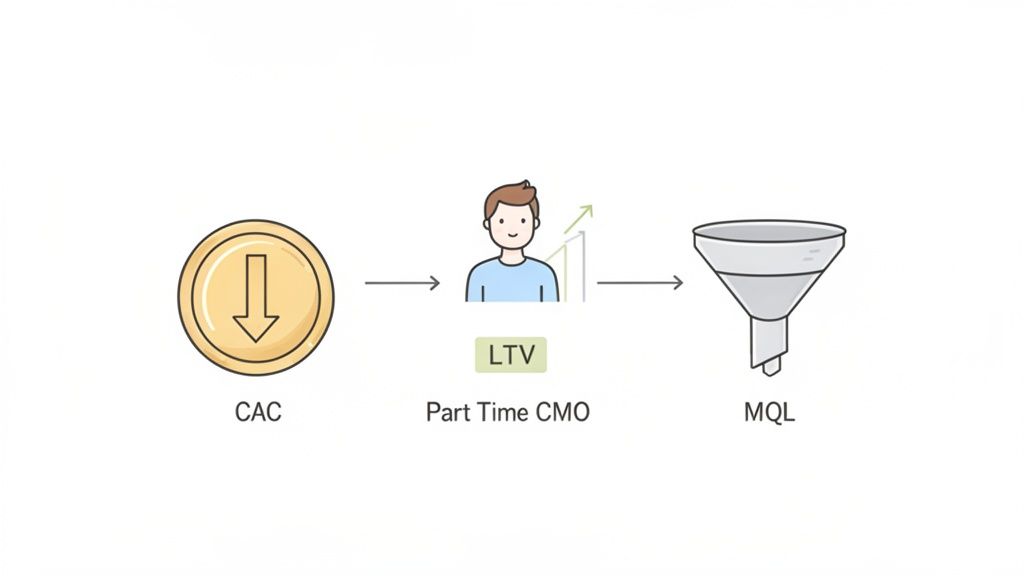
- Customer Acquisition Cost (CAC): The total cost to land a new customer. A primary goal is always to drive this number down by optimizing marketing channels.
- Customer Lifetime Value (LTV): The total revenue you can expect from a single customer over time. They will implement strategies to increase this, boosting long-term profitability.
- Marketing-Qualified Leads (MQLs): The number of high-quality leads flowing to your sales team. Their job is to increase both the volume and quality of these leads.
- Lead-to-Customer Conversion Rate: The percentage of leads that actually become paying customers. This metric is a gut check on the effectiveness of the entire funnel.
- Marketing ROI: The overall return on your marketing investment. This is the ultimate measure of success, proving that your marketing is a direct contributor to business growth.
By focusing on these concrete outcomes, a part-time chief marketing officer transforms your marketing from a cost center into a predictable revenue driver.
Understanding Fractional CMO Pricing and Contracts
Let's talk about one of the biggest reasons founders look into a part time chief marketing officer: the massive financial upside. You get C-suite strategic brainpower without the full-time executive salary, benefits, and equity. But to make it work, you need to understand how these deals are priced and structured.
Unlike a rigid salary, fractional engagements are all about flexibility. The pricing model should directly reflect your business needs, budget, and desired results. Getting this clear upfront means no surprises and sets you up for a transparent, results-focused partnership.
Common Pricing Models for Fractional CMOs
Most part time CMO engagements use one of three common pricing structures, each built for different situations.
- Monthly Retainer: This is the go-to model for ongoing strategic leadership. You pay a fixed fee each month for an agreed-upon number of hours or days. It's the perfect setup for companies needing consistent guidance and long-term strategy execution.
- Project-Based Fee: Got a specific, one-off initiative like a product launch or a rebrand? A project-based fee is your best bet. You agree on a flat fee for the whole project, giving you total cost certainty from day one.
- Hourly Rate: For companies that need ad-hoc support or an expert to consult on a specific challenge, an hourly rate provides maximum flexibility. It's great for short-term problem-solving.
Expert Insight: The best pricing model depends on your goals. A retainer is for building a deep, ongoing partnership. A project fee is for hitting a specific, time-bound objective with a clear beginning and end.
Typical Costs and Contract Terms
So, what does this actually look like in your budget? A part time chief marketing officer usually costs 30-50% less than a full-time CMO's total compensation package.
This often translates to monthly retainers of $5,000 to $25,000 or hourly rates between $200 and $350 for a seasoned pro. For a complete breakdown, you can learn more about fractional CMO cost structures and see what makes sense for your budget.
Beyond the numbers, the contract itself is the rulebook. A solid agreement provides the clarity everyone needs. You should always look for contracts that clearly define:
- Scope of Work (SOW): This lays out exactly what the CMO is responsible for, what they'll deliver, and which business goals they're expected to impact.
- Time Commitment: The agreement must spell out the expected number of hours or days per week or month.
- Engagement Length: Most fractional contracts start with an initial term, often three to six months, with an option to renew.
- Confidentiality and IP: These are standard but essential clauses that protect your sensitive business information.
Getting a handle on these financial and contractual details lets you walk into the hiring process with confidence. It’s all about creating the transparency needed to find a trusted partner who can drive your marketing forward.
How to Hire and Onboard the Right Marketing Leader
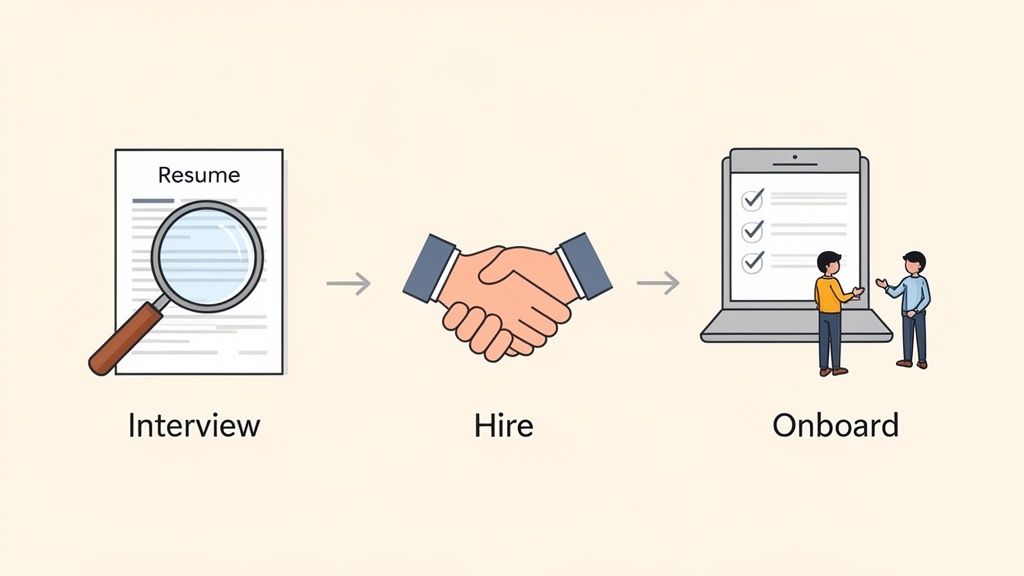
Finding the right part-time chief marketing officer isn't about filling an org chart; it’s about bringing in a strategic partner who can steer your growth. This process goes beyond scanning résumés. You're looking for a leader with the right mix of industry experience, hands-on capabilities, and the personality to click with your team.
The best candidates have a proven history of solving the exact types of problems your business is wrestling with right now. They should be just as comfortable mapping out a high-level strategy as they are rolling up their sleeves to help get it done.
Asking the Right Interview Questions
Once you have a shortlist, the interview becomes your most critical tool. Generic questions won't cut it. You need to dig deep to understand how they think, strategize, and lead.
Your goal is to get past their list of accomplishments and see their mind at work. These questions are designed to uncover their problem-solving instincts.
Here are a few questions to get the real conversation started:
- Strategic Thinking: "Walk me through your plan for the first 90 days here. What would you prioritize, and what specific outcomes would you be shooting for?"
- Problem-Solving: "Tell me about a time you inherited a marketing strategy that was failing. How did you diagnose the problem, and what steps did you take to turn it around?"
- Leadership and Mentorship: "How do you approach leading a more junior marketing team? How do you empower them while keeping everyone aligned with the bigger picture?"
- Data-Driven Approach: "For a business like ours, what are the most critical marketing KPIs we should be obsessed with, and how would you set up tracking and reporting?"
Setting Your New Leader Up for Success
Getting the right person in the door is only half the battle. A successful engagement hinges on a smooth, thorough onboarding process. A part-time chief marketing officer has to get up to speed fast to deliver value, and it's your job to clear the runway for them.
A fast and focused onboarding is the single greatest accelerator for a fractional executive's impact. The more context and access you provide in week one, the faster you'll see tangible results in month one.
A structured onboarding ensures your new leader isn't burning precious hours just trying to find information. To make their transition seamless from day one, give them immediate access to three key areas.
- Grant Full Data Access: Your new CMO needs the keys to the kingdom. That means unrestricted access to your analytics platforms (Google Analytics, CRM, ad accounts) and any historical performance data.
- Facilitate Key Introductions: Get meetings on the calendar with key stakeholders across the company—heads of sales, product, and finance, plus everyone on the marketing team.
- Provide Historical Context: Put together a simple brief or hold a kickoff meeting to download them on past marketing strategies. Be honest about what worked, what failed, and the big business challenges you're facing.
By managing the hiring and onboarding process with intention, you turn a new hire into a deeply integrated strategic partner who can make a real impact—fast.
Answering Your Lingering Questions
Even after seeing the benefits laid out, you probably still have a few practical questions. That's completely normal. Let's dig into some of the most common ones we hear from founders to clear up any final uncertainties.
How Many Hours Does a Part-Time CMO Actually Work?
This is usually the first question people ask, and the honest answer is: it depends. A part-time chief marketing officer typically works anywhere from 10 to 20 hours per week, but this isn't a rigid rule. The beauty of the model is that it flexes to fit exactly what you need.
An early-stage startup might just need 10 hours a week for high-level strategy and team mentorship. But a scale-up gearing up for a major product launch might need 20-25 hours a week for a more intensive push. You only pay for the strategic horsepower you actually use.
Can a Part-Time Leader Truly Integrate With Our Team?
The next big concern is usually about culture. Can a part-time, often remote, leader really feel like part of the team? The answer is a resounding yes—as long as you set them up for success.
Getting integration right comes down to a few simple practices:
- Scheduled Check-ins: Lock in regular, recurring meetings with the leadership team and the marketing department to create a predictable rhythm.
- Shared Communication Channels: Get them into your company's Slack or Microsoft Teams channels on day one. This makes them accessible for real-time collaboration.
- A Real Onboarding: A structured onboarding that introduces them to key people and gives them the company's backstory is crucial for building rapport and understanding.
When you nail these basics, a fractional leader stops feeling like an outside consultant and becomes a seamless extension of your core team.
What Is the Typical ROI I Can Expect?
Ultimately, this is a business decision, and it all comes down to results. While the exact ROI will vary, you should expect to see a tangible impact on key metrics within the first 90 to 180 days.
The ROI of a fractional CMO isn't just a number on a spreadsheet; it's the strategic clarity and sustainable growth engine they build, which pays dividends long after their initial engagement.
The return on your investment will show up clearly in the KPIs we've already discussed—things like a lower Customer Acquisition Cost (CAC), a higher Customer Lifetime Value (LTV), and a jump in marketing-qualified leads. A great fractional CMO will insist on setting up a performance dashboard from the get-go, making it simple to track progress and tie their guidance directly to your bottom line.
Finding a leader with the right expertise and cultural fit is the most critical step. If you're ready to unlock strategic growth without the full-time cost, exploring our network of vetted executives is your next step. At Shiny, our marketplace connects you with over 3,000 top-tier leaders ready to drive results for your business. Schedule a consultation today to find your perfect part-time chief marketing officer at https://useshiny.com.