


What exactly is a part-time chief marketing officer?
Think of them as a seasoned marketing executive who provides top-level strategic leadership for your company, but on a flexible, fractional basis. This isn't a junior consultant; it's C-suite expertise on demand. This model is a game-changer for businesses that need proven growth strategies without the hefty salary and long-term commitment of a full-time executive.
The Strategic Shift to Fractional Marketing Leadership
The traditional C-suite is evolving. Many businesses today are stuck in a common bind: they desperately need executive-level marketing strategy to compete, but can't justify the six-figure salary and benefits package for a full-time CMO.
This is where the part-time chief marketing officer enters—not as a compromise, but as a powerful strategic advantage.
Hiring a fractional CMO is like having an expert architect on call. You wouldn't hire a full-time architect to live in your house year-round. You bring them in to design the blueprint, oversee the critical construction phases, and ensure the foundation is solid. Once the structure is sound, your own team can manage the day-to-day. A part-time CMO functions the same way for your marketing.
The Problem with the Traditional CMO Role
The pressure on modern marketing leaders has never been higher, a fact reflected in their job security. Recent data shows the average tenure for a Chief Marketing Officer has dropped to a mere 3.3 years. This makes it one of the most volatile seats in the C-suite, especially when compared to the average CEO tenure of 7.4 years. You can read more about the pressures driving this trend on consultport.com.
This high-turnover reality has paved the way for a more flexible and sustainable leadership model. Companies now realize they can solve critical business challenges without the financial risk of a full-time executive hire.
This approach is part of a larger movement toward agile, high-impact leadership. We explore how this model applies across different C-suite roles in our complete guide to fractional leadership.
A part-time CMO gets right to the heart of the problems that stall growth for startups and SMBs. They provide the strategic oversight needed to connect scattered marketing tactics to clear business goals, transforming random activity into a powerful, cohesive growth engine.
By bringing in a fractional marketing leader, companies gain a trusted partner who can build a scalable marketing function, mentor the existing team, and deliver measurable results.
What a Part-Time CMO Actually Delivers
Let's be clear: a part-time CMO doesn't just parachute in, drop off a PowerPoint deck, and vanish. They embed themselves in your leadership team, taking genuine ownership of your marketing strategy and, more importantly, the outcomes.
Their value isn’t measured in hours clocked, but in momentum created. Think of them less as a consultant and more as a temporary, high-impact partner dedicated to your growth.
Their work boils down to three core functions that build upon each other to create a powerful engine for smart, scalable growth.
Developing a Winning Strategy
First, a part-time CMO acts as your strategic architect. They aren’t there to polish ad campaigns; they're there to build your entire marketing blueprint. This begins with a deep dive into your business:
- Analyzing your market position and competitors.
- Defining your ideal customer profile (ICP).
- Crafting a brand message that resonates and converts.
From this foundation, they develop a clear, actionable go-to-market roadmap that aligns every marketing activity with your overarching business goals. Every dollar is spent with purpose.
Building and Leading Your Team
A brilliant strategy is useless without a strong team to execute it. A fractional CMO provides the senior-level direction that helps your existing team level up. They mentor junior marketers, sharpening their skills and showing them how their daily tasks contribute to the bigger picture.
They also assess your marketing department's structure, identify skill gaps, and streamline workflows. Their leadership transforms a group of individual contributors into a cohesive, high-performing unit. This team-building function is one of the core responsibilities of a chief marketing officer, which we cover in our full guide.
Driving Performance and Owning Results
Ultimately, a part-time CMO is accountable for driving measurable performance. They establish the key performance indicators (KPIs) that truly matter—moving beyond vanity metrics to focus on revenue, customer acquisition cost (CAC), and lifetime value (LTV).
They implement the right analytics and reporting systems to track progress, giving leadership a clear, data-driven view of what’s working. This allows for quick pivots, campaign optimization, and full ownership of marketing’s contribution to the bottom line.
A part-time CMO is your Strategic Architect, designing the entire marketing foundation for long-term growth. They aren't a daily project manager just executing tasks. Their job is to build the engine, not just keep the wheels spinning.
The shift to this flexible model is a direct response to the roadblocks businesses face when trying to access top-tier talent without breaking the bank.
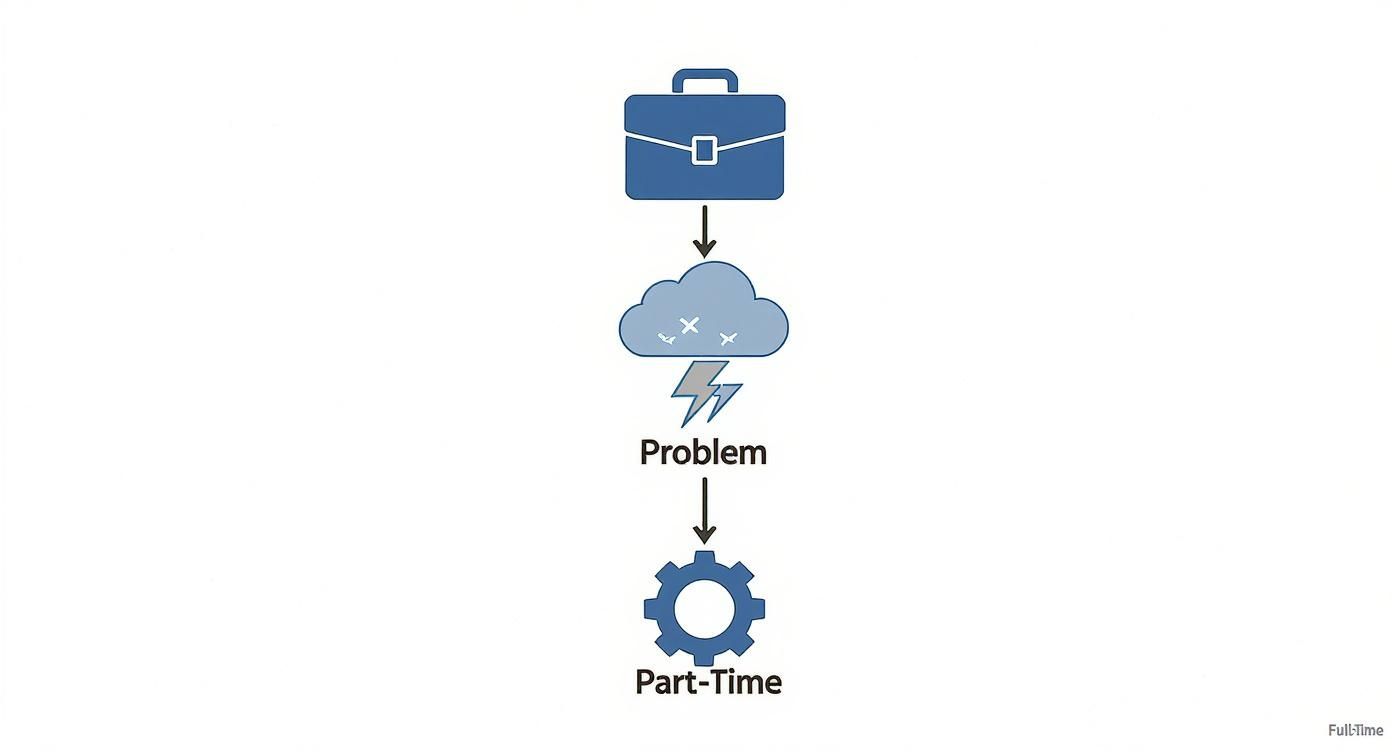

As the diagram illustrates, the part-time model is a direct solution to the problems of the traditional, full-time executive role. Choosing between a full-time hire, a fractional leader, or an agency can be complex, as each offers a different mix of cost, integration, and focus.
The table below breaks down how these three options compare.
Full-Time CMO vs Part-Time CMO vs Marketing Agency
| Attribute | Full-Time CMO | Part-Time CMO | Marketing Agency |
|---|---|---|---|
| Typical Cost | $200k-$350k+ salary & benefits | $3k-$15k monthly retainer | $5k-$25k+ monthly retainer |
| Engagement | Full-time employee, deeply integrated | Part-time leader, strategically integrated | External vendor, project-based |
| Strategic Focus | Long-term company-wide strategy | High-level strategy & team leadership | Tactical execution of campaigns |
This comparison highlights the unique value of a part-time CMO: you get the strategic mind of a full-timer with the cost and flexibility of an agency, all while being deeply integrated with your leadership team.
Signs Your Business Needs a Part-Time CMO
Many businesses hit a growth wall not because their team isn't working hard, but because there's no high-level strategic direction. Your team might be busy with campaigns and content, but without an experienced leader guiding the ship, those efforts often feel disconnected and fail to produce meaningful results.
Recognizing these pain points is the first step. If you're wrestling with persistent challenges, it might be time to bring in a part-time chief marketing officer to provide the senior leadership needed to solve them.


Your Growth Has Stalled or Plateaued
This is the most common trigger. You had strong initial traction, but now revenue has flatlined. The marketing tactics that got you here are no longer effective, and you're unsure how to reignite growth.
A fractional leader brings a fresh perspective and a proven strategic playbook. They can quickly diagnose the root cause of the slowdown—whether it's market saturation, messaging issues, or a leaky funnel—and build a new roadmap to get you scaling again.
Your Marketing Lacks Clear Direction
Does your marketing feel like a series of random activities? You're posting on social media, publishing blog posts, and sending emails, but there's no cohesive strategy tying it all together. Your team is busy, but not productive, because they lack senior-level guidance.
A part-time CMO closes this leadership gap by:
- Defining a Unified Strategy: Ensuring every marketing effort directly supports core business goals.
- Mentoring and Developing Talent: Providing the coaching your junior marketers need to grow their skills and execute with confidence.
- Establishing Clear KPIs: Shifting the team’s focus from vanity metrics to the numbers that actually impact revenue.
You Are Wasting Money on Ineffective Campaigns
Another red flag is a leaky marketing budget. You're pouring money into channels like paid ads or content, but the return on investment (ROI) is poor. Without expert oversight, it's easy to burn through cash on campaigns that don't convert, driving up customer acquisition costs.
A part-time CMO is an expert in optimizing marketing spend. They bring the financial know-how to dig into performance data, cut out the waste, and redirect your budget to the channels that actually deliver, making every dollar work harder for you.
This model is an incredibly cost-effective solution. In the US, where 25% of businesses now use fractional hiring, companies are turning to part-time CMOs for this exact reason. With retainers typically between $3,000 and $15,000 per month, it’s a strategic investment that pales in comparison to the $200,000 to $350,000 annual cost of a full-time executive. You can read more about the rise of fractional CMOs on consultport.com.
If these challenges sound familiar, you're not alone. The solution doesn't have to be a full-time hire. A fractional executive provides the exact expertise you need to build a powerful, sustainable growth engine.
Industries Where Fractional CMOs Make the Biggest Splash
While a part-time CMO can add value to almost any business, their impact is most profound in certain industries. Sectors defined by rapid change, fierce competition, and the need for specialized knowledge are ideal environments for this flexible leadership model.
The demand for fractional CMOs is growing rapidly. This isn't a fleeting trend; it’s a fundamental shift in how companies approach marketing leadership. Industries like tech, healthcare, and e-commerce are leading the charge because they face constant innovation, complex regulations, or rapidly changing consumer expectations. You can get a deeper look into why this demand is blowing up over at cnvcmo.com.
Technology and SaaS Startups
For tech and Software-as-a-Service (SaaS) companies, speed is everything. There is a narrow window to achieve product-market fit and capture market share. These businesses require a powerful go-to-market strategy from day one, but often lack the budget for a full-time, seasoned marketing executive.
A part-time CMO is the perfect fit. They bring a proven playbook for:
- Rapid Scaling: Building and activating demand generation engines designed for fast, sustainable growth.
- Market Positioning: Crafting a compelling brand story that cuts through the noise in a crowded tech landscape.
- Investor Confidence: Presenting a credible, data-backed marketing plan that clearly maps the path to growth for VCs.
Healthcare and HealthTech
The healthcare industry operates under a unique set of rules. Businesses must navigate strict regulations like HIPAA while building genuine trust with patients and providers. Generic marketing tactics don't just fail here—they can damage your brand's credibility.
A part-time CMO with deep healthcare experience brings specialized knowledge that is non-negotiable. They understand how to navigate the legal complexities while creating marketing campaigns that are both ethical and effective, building the trust that is essential for success.
E-commerce and Direct-to-Consumer Brands
In the e-commerce space, the competition for customer attention is relentless. Customer acquisition costs are always rising, and building true brand loyalty is a constant challenge. Success requires sophisticated, data-driven marketing that optimizes every touchpoint of the customer journey.
A fractional CMO for an e-commerce brand is like a master strategist, zeroing in on the metrics that actually drive profit—think Customer Acquisition Cost (CAC) and Lifetime Value (LTV). They go way beyond just running a few ad campaigns to build a complete, holistic system for sustainable growth.
By bringing in this level of expertise, DTC and e-commerce brands gain a leader who can fine-tune their entire digital marketing machine—from paid ads and SEO to email funnels and conversion rate optimization.
If your company operates in one of these fast-moving sectors, a fractional leader could be exactly what you need to break through to the next stage of growth.
How to Hire and Integrate Your Part-Time CMO
Bringing a part-time CMO on board is a major strategic decision. To ensure success, you need a clear process for finding the right leader and integrating them into your company. This isn't just about hiring a contractor; it's about forging a true partnership.
A structured process ensures you find an expert who doesn't just give advice but takes genuine ownership of your growth—like drafting a detailed blueprint before building a house.
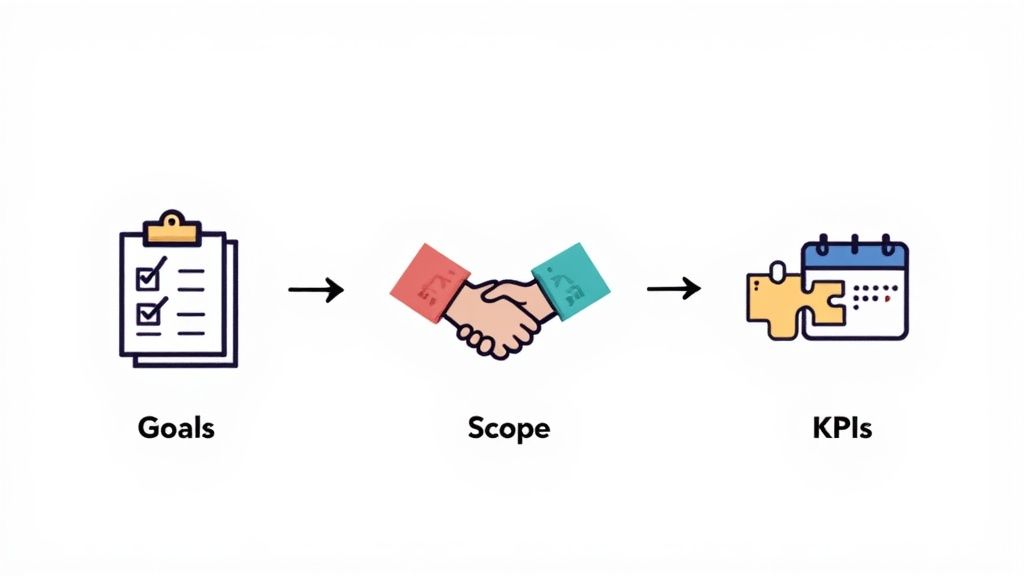
Define Your Goals and Scope
Before looking at a single resume, you must define what success looks like. What specific business outcomes do you expect this person to drive? Vague goals like "improve marketing" are insufficient. Get specific.
- Are you trying to increase qualified leads by 30% in six months?
- Do you need to break into a new market segment?
- Is the goal to slash customer acquisition costs by 20%?
These clear, measurable goals become the foundation of your search and the benchmark for their performance. This clarity also helps define the scope of their work, ensuring you're aligned from day one.
Find the Right Expertise
Not all part-time CMOs are created equal. You need a leader with the right specialized skills for your unique challenges. Do you need a B2B SaaS expert who lives and breathes demand generation, or a DTC brand builder who excels at forging emotional connections with consumers?
Look into their background:
- Industry Experience: Have they navigated the specific hurdles of your industry, like HealthTech, FinTech, or e-commerce?
- Company Stage: Do they have a track record of scaling companies from your current size to where you want to go? The playbook for taking a startup from $1M to $10M is very different from managing a $100M marketing budget.
Finding the right expertise is the difference between a good hire and a game-changing one.
Vet for Strategic Thinking
During the interview process, move beyond standard questions about past campaigns. You are hiring a strategist, so your questions should test their ability to think critically and solve complex, high-level problems.
Ask questions that reveal their thought process:
- "Walk me through your first 30 days diagnosing our current marketing challenges."
- "Tell me about a time you aligned a disconnected sales and marketing team. What steps did you take?"
- "Based on our business goals, what would be your top three marketing priorities, and why?"
A great part-time CMO won't just recite textbook answers. They’ll ask you smart, probing questions right back. This shows they're diagnosing the underlying issues before they even think about prescribing solutions. Their curiosity is just as important as their experience.
Structure the Engagement for Success
Once you've found your ideal candidate, structure the partnership for total clarity and accountability. This means setting clear expectations around communication, deliverables, and performance measurement.
Create a formal agreement that outlines:
- Communication Cadence: How often will you meet? What reporting should you expect?
- Key Deliverables: What are they responsible for in the first 90 days? (e.g., a strategic roadmap, a revised budget, a new KPI dashboard).
- Performance Metrics: Revisit the goals you defined earlier and agree on how you'll measure success together.
A successful integration is as critical as the hiring process. For more on this, see our guide on executive onboarding best practices for modern leadership success.
A structured process reduces risk and sets the stage for a powerful, results-driven partnership.
Avoiding Pitfalls for a Successful Partnership
Hiring a part-time CMO can transform your business, but it's not a plug-and-play solution. The most successful partnerships are built by proactively avoiding a few common traps.
The most frequent mistake is treating a fractional leader like a full-time employee who just works fewer hours. This mindset leads to micromanagement and focusing on hours worked instead of outcomes achieved. A part-time CMO’s value lies in their strategic impact, not their timesheet.
Misaligned Expectations and Integration Gaps
Another common pitfall is a mismatch between strategy and execution. Your part-time CMO is the architect of your growth engine, not the project manager for every marketing task. Without a clear plan, you might expect them to handle minor campaign tweaks when their focus should be on your overall customer acquisition strategy.
To prevent this, create a detailed Statement of Work (SOW) that clearly defines deliverables and goals.
A successful partnership thrives on integration. Your part-time CMO isn't an outsider; they are a temporary but vital member of your leadership team. Failing to loop them into key meetings and decision-making processes will severely limit their effectiveness.
It’s also important to recognize that marketing leadership itself is evolving. Today, 37% of Fortune 500 CEOs come from a marketing background, and 9% of CMOs now work on a part-time basis. This is a fundamental shift toward flexible, high-impact leadership woven into core business strategy. You can read more about the evolution of marketing leadership in this Spencer Stuart study.
By anticipating these potential issues, you build the foundation for a powerful and effective partnership based on trust and clear communication.
Frequently Asked Questions
How Much Does a Part-Time CMO Cost?
Cost is always a key consideration. A part-time CMO's retainer typically falls between $3,000 to $15,000 per month, depending on their experience, industry focus, and the scope of the engagement.
This model provides access to a true executive leader for a fraction of a full-time CMO's cost, whose salary often starts at $200,000 annually before benefits and equity.
What's the Difference Between a Part-Time CMO and a Marketing Consultant?
These roles are often confused but are fundamentally different. A marketing consultant is typically hired for a specific project with a defined endpoint. They analyze a problem, provide recommendations, and their engagement concludes.
A part-time CMO, however, becomes an integrated member of your leadership team. They don't just advise; they take ownership. They are responsible for the overall marketing strategy, lead and develop your team, and are accountable for long-term business growth.
How Do I Know If My Business Is Ready for a Part-Time CMO?
You're likely ready if you feel your growth has hit a plateau. Perhaps your marketing efforts feel scattered and lack a unified direction tied to business goals.
Other signs include having a talented team that needs senior-level mentorship to reach its full potential, or recognizing the need for executive strategy without the budget for a full-time hire. If this sounds familiar, it’s probably the right time to explore this option.
Finding the right fractional leader can fundamentally change your company's growth trajectory. We connect businesses with a network of over 3,000 vetted executives ready to make an immediate impact.
Ready to find the perfect strategic partner for your business? Schedule a consultation today to explore our network and find the right match.