



Before you even think about writing a line of code or mocking up a single screen, you have to do the real work. The earliest stage of product development for startups isn’t about guesswork or blindly following a founder’s vision. It’s about building a rock-solid foundation through rigorous validation and deep market understanding. You need to be absolutely sure you’re solving a genuine, painful problem for a very specific group of people.
Building Your Foundation for a Winning Product

Every truly great product begins not with a brilliant solution, but with a deeply understood problem. I’ve seen countless startups fail because they built something they thought people wanted, only to find a painful disconnect with the actual market after launching. This initial phase is your best chance to avoid that common and costly mistake.

Your first job is to get past your own assumptions. That means getting out of the building and talking to potential customers. The goal here isn’t to pitch your idea—it’s to listen. Really listen. You need to run interviews, send out surveys, and just observe how people work to uncover their true frustrations and pain points.
Define Your Target Audience with Precision
A product for “everyone” is almost always a product for no one. Vague descriptions like “small business owners” just won’t cut it. You have to get much more specific and build a detailed persona.
- Who are they, really? Nail down their specific role, their industry, and the size of their company.
- What are their biggest daily headaches? Pinpoint the exact tasks that create friction and waste their time.
- What are they doing now? Understand the tools and clunky workarounds they currently rely on.
Answering these questions forces you to build empathy and ensures your vision is grounded in a real-world need. For example, instead of targeting all “project managers,” you might discover your sweet spot is “non-technical project managers at marketing agencies with fewer than 20 employees.” That kind of focus is a superpower.
Find Your Unique Space in the Market
Once you have a grip on your audience, it’s time to scope out the competition. This isn’t just about making a list of competitors; it’s about spotting the gaps and opportunities they’ve missed. Sure, see what they do well, but more importantly, figure out where they drop the ball. Is their pricing a nightmare? Is the user experience a clunky mess? Are they completely ignoring a key customer segment you’ve identified?
A classic startup mistake is shying away from markets that already have players. Competition is often proof of a validated, valuable market. Your goal isn’t to be the only one, but to be a distinctly better choice for a specific group of users.
This kind of strategic analysis helps you carve out a unique, defensible spot for yourself. On top of that, the entire development landscape is changing. Projections show that by 2025, a staggering 70% of new business applications will be created using low-code or no-code platforms, which can massively accelerate these early validation cycles. You can check out more software development statistics to see the trends.
This is a critical stage where experienced leadership is priceless. Bringing in a fractional executive from a marketplace like Shiny can provide the strategic oversight to guide this foundational work. They’ve been here before. They can help you sidestep your own biases and set a clear, validated course for building a product that people will actually want to use and pay for.
Building Your Minimum Viable Product the Smart Way

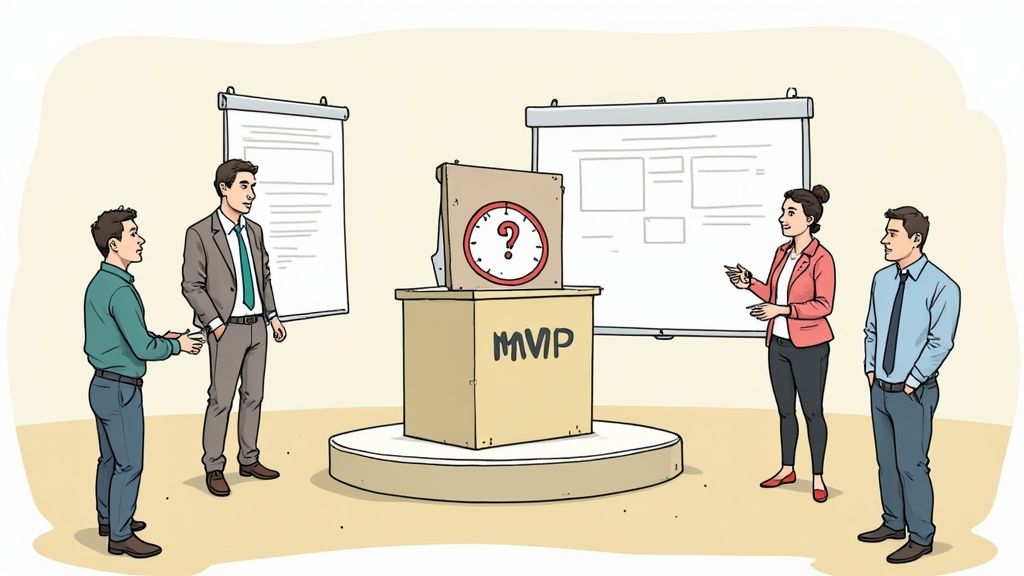
Once you’ve confirmed you’re solving a real problem, it’s time to build. This is where the rubber meets the road in product development for startups—the Minimum Viable Product (MVP) phase. Think of the MVP as your first real conversation with the market. Get it right, and you’ll learn volumes.
An MVP isn’t a buggy, half-baked product. It’s the simplest, most stripped-down version of your idea that delivers genuine value to your first users and kicks off the feedback loop.
The entire point is to test your biggest assumption with the least amount of effort. Just look at Dropbox. Their biggest question wasn’t about the tech; it was whether people actually wanted a file-syncing service. Their brilliant MVP wasn’t an app at all. It was a simple explainer video. The flood of sign-ups they got was all the validation they needed to start coding.
Defining Your Core Feature Set
This is where so many founders go wrong. Feature creep is a real and dangerous temptation. Adding “just one more thing” feels harmless, but it’s the fastest way to blow your timeline, bloat your budget, and muddy the feedback you get. Your MVP has to be laser-focused on solving one primary pain point for a very specific group of people.
To get there, you have to be ruthless about separating the “must-haves” from the “nice-to-haves.” I’ve seen a simple prioritization framework work wonders here:
- Must-Have: These features are non-negotiable. Without them, the product simply doesn’t solve the core problem.
- Should-Have: Important features, for sure. They add a ton of value, but the product can launch and function without them initially.
- Could-Have: These are the bells and whistles. Great ideas for later, but completely out of scope for now.
- Won’t-Have (For Now): Features you’ve explicitly decided to shelve for the foreseeable future.
When you categorize your feature list like this, the path forward becomes crystal clear. Your MVP is only the “Must-Haves.” Everything else gets tossed into the backlog to be prioritized later, based on what real users tell you they need.
Remember, the “V” in MVP stands for Viable. It has to work. It must solve the core problem reliably. A clunky, frustrating experience won’t just give you bad data; it’ll alienate the exact early adopters you need to learn from.
Executing the Build with an Expert Eye
Building an MVP is a tightrope walk between speed and quality. You need to move fast, but you can’t cut corners so badly that you build on a foundation of sand. I’ve seen countless startups grind to a halt because they accumulated so much “tech debt” in the early days that every new feature became a massive undertaking.
This is a perfect spot to bring in fractional leadership. A fractional Head of Product or CTO from a marketplace like Shiny can come in and immediately take charge of the MVP build. They’ve done this before and know exactly where the pitfalls are.
They can help you:
- Lock down the feature scope and fend off scope creep.
- Manage the development process, whether it’s your own team or an outsourced firm.
- Make sure the technical architecture is solid and won’t need a complete rewrite in six months.
With their guidance, your product development for startups becomes both efficient and strategically sound. You’ll launch an MVP that not only works but also maximizes learning, setting you up perfectly for the next stage of growth.
Weaving AI Into Your Product Development Fabric
Let’s be honest: “Artificial Intelligence” gets thrown around a lot. But it’s so much more than a buzzword. For sharp startups, it’s a real-deal toolkit that’s changing how we build products. Used right, AI is a massive force multiplier, giving your team the kind of analytical and creative firepower that used to be reserved for corporations with huge R&D budgets.
The secret is to get past the hype and put it to work on specific, high-value tasks. Think of generative AI tools as your tireless brainstorming partner. In minutes, they can spin up hundreds of user story variations, mock up different interfaces, or even draft initial code snippets. This collapses the early stages of creation, letting you see and test ideas faster than ever before.
Gaining Deeper User Insights
Beyond just sparking ideas, AI is a game-changer for understanding your users. AI-powered analytics can chew through mountains of user data—feedback forms, support tickets, in-app behavior—and spot patterns a human team could easily miss. Imagine automatically flagging the top three friction points that always show up right before a user churns. All without someone having to spend days buried in a spreadsheet.
This completely changes the build-measure-learn loop. Instead of just relying on broad survey results, you can get incredibly granular insights into how specific user segments are actually interacting with your product.
This level of detail is also what powers genuinely personalized user experiences. AI algorithms can help you serve up the right feature, piece of content, or notification to the right person at the perfect moment—a proven strategy for driving engagement and long-term retention.
Avoiding the “AI for Hype’s Sake” Trap
The biggest mistake I see founders make is bolting on AI for show instead of for genuine business impact. The goal isn’t just to say you “use AI.” It’s to solve a real problem with it. And that’s where having some strategic guidance is absolutely critical.
The most effective AI integrations are often invisible to the end-user but deliver clear, measurable value to the business. Think smarter search results, better product recommendations, or more efficient internal workflows—not just a flashy chatbot.
This disciplined approach is becoming non-negotiable. By 2025, AI is expected to revolutionize product management, boosting productivity by as much as 40% and seriously cutting down time to market. For startups in a dog-eat-dog space, that kind of efficiency isn’t just a nice-to-have; it’s a survival tool. You can dig into more of the research on AI’s impact on product trends to see what’s coming.
Figuring out where to place your AI bets is tough. You need someone who can connect the tech to your business goals. For example, the right AI for an e-commerce app focused on customer acquisition is completely different from one that optimizes logistics for a B2B platform. If your AI strategy is tied directly to your messaging and how you get customers, it helps to understand what specialized leadership looks like. Check out our guide on what a fractional CMO does to see how that kind of expertise can guide these calls.
A dedicated fractional AI strategist from a marketplace like Shiny can pinpoint these high-impact opportunities, making sure every dollar you invest in AI shows up on your bottom line.
Mastering the Build-Measure-Learn Feedback Loop

Getting your MVP into the hands of real users isn’t the finish line; it’s the starting gun. Now, the real work begins. This is where the Build-Measure-Learn feedback loop—the absolute heart of the lean startup method—comes into play.
This isn’t just some business school theory. It’s the disciplined process that separates companies that guess from companies that know. The entire system hinges on turning user behavior into your next big breakthrough, fast. You build a feature, measure how users react, and then learn from that data to decide what to build (or fix) next. It’s the core of smart product development for startups and it stops you from wasting months building something nobody wants.
Measuring What Truly Matters
The “measure” step is where so many startups stumble. It’s incredibly easy to get seduced by vanity metrics—things like total sign-ups or page views. They look great on a chart but tell you absolutely nothing about whether people actually like or use your product.
Instead, you need to obsess over actionable metrics that reflect genuine user behavior.
Focus on numbers that answer real questions:
- Activation Rate: What percentage of new users actually complete that critical first step, like creating their first project or inviting a teammate? This tells you if they “get” the value you’re offering.
- Feature Adoption Rate: You just launched a new feature. Great. But what percentage of your active users are even trying it? This is the ultimate test of whether your new idea is hitting the mark.
- Retention Cohorts: Of the users who signed up in a specific week, how many are still active one, two, or four weeks later? This is the single most important health metric for your product, period.
These numbers paint an honest, unfiltered picture. You’re not just chasing sign-ups; you’re building a product that keeps people coming back.
Essential Metrics for the Build-Measure-Learn Cycle
Tracking the right data is non-negotiable. This table breaks down some of the most critical metrics to watch at each stage of the feedback loop, helping you make data-driven decisions instead of just going with your gut.
| Metric Category | Example Metrics | What It Tells You |
|---|---|---|
| User Acquisition | Customer Acquisition Cost (CAC), Sign-up Rate | How effectively your marketing efforts are attracting new users and at what cost. |
| User Engagement | Daily/Monthly Active Users (DAU/MAU), Session Length | How often and how deeply users are interacting with your product. |
| Feature Adoption | Feature Adoption Rate, Time to Adopt | Which features resonate with users and how quickly they discover them. |
| User Retention | Churn Rate, Retention Cohorts, LTV | How well your product is at keeping users over time and the long-term value they bring. |
| User Satisfaction | Net Promoter Score (NPS), Customer Support Tickets | How happy users are with your product and what their biggest pain points are. |
By keeping a close eye on these metrics, you can quickly identify what’s working and what isn’t, allowing you to iterate much more effectively.
From Data to Decisions
Gathering data is only half the battle. The “learn” phase is where the magic happens. This is about translating raw numbers and qualitative feedback—from surveys, user interviews, and support tickets—into concrete product decisions. It’s where you connect the “what” (the quantitative data) with the “why” (the qualitative insights).
A real breakthrough often happens when you combine data points. For instance, your analytics might show a huge user drop-off during onboarding. But it’s the qualitative interviews that will reveal the exact point of confusion or frustration that’s causing it.
This is exactly where bringing in a fractional product manager can be a game-changer. An expert from a marketplace like Shiny lives and breathes this stuff. They know precisely which tools to use, which metrics to monitor, and how to run feedback sessions that get to the truth.
Most importantly, they can turn that chaotic mess of data and feedback into a prioritized backlog of improvements. This ensures your dev team is always working on the one thing that will have the biggest impact, turning the feedback loop from a reactive process into a predictable engine for growth.
Scaling Your Product and Team for Sustainable Growth
That leap from a successful MVP to a genuinely scalable product? It’s where so many promising startups hit a wall. Growth is thrilling, but it brings a completely different flavor of complexity.
Suddenly, the scrappy, lean architecture that worked wonders for your first 1,000 users starts to creak and groan under the weight of 100,000. This is a pivotal moment in product development for startups. It demands a shift in thinking—away from short-term validation and toward long-term sustainability.
Your early wins were likely built on pure speed and agility. Now, the challenge is keeping that spirit alive while laying a much more robust foundation. This is the point where all that “tech debt”—the shortcuts you took to launch fast—starts coming due. If you don’t manage it, it can absolutely cripple your ability to innovate, turning every new feature into a monumental slog.
Evolving Your Technical Architecture
As your user base grows, your tech stack has to grow up, too. This doesn’t mean you need to torch everything and start over, but it does mean making strategic, forward-thinking calls. The goal is a system that can handle more traffic, more complex features, and a much larger dataset without falling over.
A few key things to think about for your architecture:
- Decoupling Services: Moving from a single monolithic beast to smaller, independent microservices can make the whole system more resilient and way easier to update.
- Database Scalability: Is your database ready for a 10x or 100x flood of data? This might mean exploring sharding, replication, or even migrating to a more scalable database solution altogether.
- Infrastructure Automation: Bringing in tools for automated deployments and scaling (like Kubernetes) cuts down on manual work and lets you respond to traffic spikes in an instant.
Making these architectural calls requires deep technical expertise and foresight—exactly what a senior leader brings to the table. This is the perfect time to bring in a fractional CTO. They’ve navigated these waters before and can provide the high-level guidance to make sure your tech stack is built for the future, not just for today.
Scaling Your Team the Smart Way
As the product grows, the team has to follow. But scaling a team isn’t just about adding more bodies; it’s about adding the right people at the right time. Hiring full-time executives is a massive commitment, both in capital and time. For many startups, a more flexible approach is a game-changer.
The real challenge isn’t just finding talent; it’s maintaining your product-focused culture. As you add more people, you risk slowing down decision-making and losing the agility that made you successful in the first place.
This is where fractional leadership offers a huge advantage. Instead of taking on the massive cost of a full-time C-suite, you can bring in seasoned executives from a marketplace like Shiny for a set number of hours per week. A fractional CTO can oversee your technical scaling, a fractional Head of Product can manage the roadmap, and a fractional CMO can dial in your growth strategy. For a more detailed look at the hurdles at this stage, you can check out our guide to overcome startup scaling challenges.
This model keeps your core team lean and focused while giving you access to world-class strategic leadership. It lets you build a scalable product and a sustainable organization, making sure your growth story has a long and successful next chapter.
Common Questions About Startup Product Development
Every founder I talk to has a similar set of questions that keep them up at night. You’re constantly making high-stakes decisions with limited information, and the world of product development can feel like a minefield. Let’s tackle some of the most frequent queries we hear from founders in the trenches.
Getting these sorted out is key. It lets you focus your energy where it actually matters—building a product that people will love.
How Much Does It Typically Cost to Build an MVP?
This is the classic “it depends” question, but I can give you some realistic guardrails. The price for a Minimum Viable Product (MVP) can be as low as a few thousand dollars if you’re using no-code tools, but it can easily climb past $100,000 for something more complex that needs custom engineering.
What drives that final number? A few key things:
- Complexity: How many moving parts and unique features are absolutely essential to solve the core problem for your first users?
- Tech Stack: Are you piecing together a prototype with a simple no-code builder, or do you need a team of software engineers for custom development?
- Team Structure: The cost difference between hiring an in-house team, juggling freelancers, or partnering with an agency is huge. Where your talent is located also makes a big difference.
My most important piece of advice here is to be ruthless with your scope. An MVP isn’t your dream product. Its only job is to test your biggest assumption and get that crucial feedback loop started.
Should I Use No-Code or Custom Code for My Product?
Think of this as a strategic decision, not just a technical one. For the earliest stages, no-code and low-code platforms are incredible. They give non-technical founders the power to build and launch functional prototypes fast, making them perfect for testing an idea without breaking the bank.
But once you start finding real product-market fit and need to scale, you’ll likely hit a ceiling. Custom code gives you the unlimited flexibility, performance, and control you need for a mature product with a large user base or truly unique features. A smart, common path is to validate your concept with a no-code MVP, and then, once you’ve secured funding and proven the demand, migrate to a custom-coded solution.
How Do I Know When to Pivot My Product?
This is one of the hardest calls a founder has to make. A true pivot isn’t just tweaking a feature—it’s a fundamental shift in your strategy. You might be changing your target customer, the problem you solve, or your entire business model.
The signal to pivot comes directly from your Build-Measure-Learn feedback loop. If your metrics are flat despite multiple iterations, user feedback consistently invalidates your core hypothesis, and you just aren’t making progress toward product-market fit, it’s time to listen. A pivot is an admission that your initial strategy was wrong, but it’s fueled by the valuable market intelligence you’ve already gathered. It’s a smart course correction, not a failure.
Of course, having the right team in place to interpret that data and make the tough call is everything. Getting the right people on the bus is a massive part of the product journey. To learn more about building a team that can navigate these choppy waters, check out our guide on startup hiring best practices.
Ready to build your product with world-class leadership without the full-time cost? Shiny connects you with a marketplace of over 650 vetted fractional executives who can guide your product strategy, technical architecture, and team scaling. Find the exact expertise you need at https://useshiny.com.