


Product-market fit validation is the process of proving your product satisfies a strong market demand before you run out of money. It’s confirming that real customers not only want but will actually pay for what you're building. This is the single most important hurdle that separates high-growth rocket ships from the startups that never get off the launchpad.
For early-stage companies, navigating this phase is fraught with uncertainty. Founders are often too close to the product to see it objectively. This is where the right leadership can make all the difference.
Why Product Market Fit Is Your Startup’s North Star


Let’s be direct: most startups fail because they build something nobody actually wants. The startup graveyard is overflowing with clever ideas that never found an audience. This isn't just a possibility; it's a statistical certainty for founders who skip the essential work of product market fit validation.
The numbers tell a sobering story. Of the 30,000 new products launched every year, a shocking 95% fail. The primary culprit? A complete disconnect with the market.
It's the same for new companies. Of the 305 million startups created annually, 90% go under, with "no market need" consistently ranking as the number one killer. These aren't just stats; they're warnings.
The Power of Early Validation
Think of early-stage product development not as a straight line to a finished product, but as a series of quick, cheap experiments. The goal isn't perfection; it's learning. This mindset is the heart of the lean startup methodology. The faster you prove (or disprove) your core assumptions, the more efficiently you use your capital.
Consider Dropbox's classic origin story. Before writing complex code, the founders simply created an explainer video demonstrating their vision for file syncing. They shared it with their target audience of tech early adopters to see if the idea had legs.
The response was immediate and overwhelming, driving tens of thousands of sign-ups overnight. This single, low-cost experiment provided all the validation they needed, completely de-risking their venture.
Product market fit isn't a box you check on a to-do list. It’s the engine that drives your growth. Until you have it, nothing else—not marketing, not sales, not scaling—really matters.
Navigating the Validation Maze with Expert Guidance
Finding product-market fit is rarely a straight shot. It demands a specific skillset: knowing which questions to ask, which metrics to ignore, and having the courage to pivot based on what the market is telling you. For most founders, this is new and intimidating territory.
This is where bringing in seasoned leadership can be a game-changer. A fractional executive—like a part-time Chief Product Officer or CMO—provides the strategic guidance you need without the hefty price tag of a full-time C-suite hire.
These are leaders who have been through the validation gauntlet multiple times. They bring proven frameworks, battle-tested instincts, and an objective eye, helping you find the truth about your market faster.
Building a Foundation for Real Validation
Real product-market fit validation doesn’t happen after you launch. It starts with a solid, strategic foundation. Building a product on assumptions is the quickest way for startups to burn through cash and destroy team morale. You need to treat your early ideas like a scientific experiment.
It all starts by forming a sharp, testable hypothesis. A vague idea like "people need a better project management tool" is useless. A strong hypothesis, on the other hand, is specific and can be proven wrong.
For instance: "Marketing managers at B2B SaaS companies with 50-200 employees struggle to track cross-channel campaign ROI and will pay for a dashboard that integrates their data." See the difference? Now you have a clear target audience and a concrete problem to solve.
Define Your Ideal Customer Profile
With a solid hypothesis, the next step is to get crystal clear on your Ideal Customer Profile (ICP). The temptation to build for "everyone" is a classic startup trap. It’s far better to dominate a small, specific niche than to be a nobody in a massive market.
Your ICP needs to go beyond basic demographics. Dig into the specific behaviors and deep-seated pain points that define your perfect customer.
- Firmographics: What's the company size, industry, and location? (e.g., US-based SaaS companies with $5M-$20M ARR).
- Role & Responsibilities: Who is the exact person feeling this pain? (e.g., VPs of Marketing, not junior coordinators).
- Pain Points: What specific, urgent problem keeps them up at night? (e.g., "I spend 10 hours a week manually compiling reports that are still inaccurate.").
- Watering Holes: Where do they hang out online? (e.g., Specific industry podcasts, newsletters, or Slack communities).
This level of detail is a game-changer. It stops you from wasting countless hours interviewing and testing with people who were never going to buy from you anyway.
Scope a Minimum Viable Product That Teaches
Once you know who you're building for, you can scope a Minimum Viable Product (MVP). The 'V' for viable is key—it has to solve a core piece of your ICP's problem well enough to be valuable. But the real goal of an MVP isn't to be a stripped-down product; it's to be the fastest way to learn.
The purpose of an MVP is to start the learning feedback loop. It is the minimum set of features necessary to engage with early evangelists and test your core hypothesis.
Your MVP might not even involve code. It could be a high-fidelity prototype, a concierge service where you manually provide the solution, or a "Wizard of Oz" test where the front-end looks real but humans pull the levers behind the scenes. These methods maximize learning while minimizing wasted engineering hours.
Nailing this strategy is a core part of the broader product development process for startups, ensuring every step is a deliberate move toward validation.
Gauging User Love with The Sean Ellis Test
Qualitative feedback gives you the stories and context that raw numbers can't. It's your window into how users feel about your product. But how do you put a number on something as fuzzy as "user love"?
The Sean Ellis Test is a brilliantly simple survey designed for this purpose.
It cuts through the noise to answer one critical question: Is your product a 'nice-to-have' or a 'must-have'? It forces you to get a clear signal directly from the people who use your product, moving you beyond your own assumptions. It all comes down to one core question that has become the gold standard for measuring product-market fit.
The Famous 40% Rule
The core of the Sean Ellis Test is refreshingly simple. After surveying hundreds of startups, growth expert Sean Ellis developed what's now known as the 40% Rule.
Ask your users a straightforward question: "How disappointed would you be if you could no longer use this product?"
If at least 40% answer "very disappointed," you're likely on the right track. This isn't a random number. As detailed in various analyses of product-market fit importance, startups hitting this benchmark consistently built high-growth companies. Those who fell short usually struggled.
Hitting that 40% threshold is the tipping point. It separates products with a passionate, loyal user base from those that are just another option. It’s one of the strongest early signals that you’ve built something people truly rely on.
A classic example is Slack. When they ran this exact survey during their early beta and the results blew past the 40% mark, they knew they hadn't just built another messaging app. They had created a tool that teams couldn't imagine their workday without.
How to Run the Test the Right Way
Just blasting this survey to your entire user base won't give you clean data. You have to be strategic about who you ask and when you ask them.
- When to Survey: Target users who've had enough time to experience your product's core value. Think about users who have been active for a couple of weeks or have completed a key action multiple times.
- Whom to Survey: Zero in on users who match your Ideal Customer Profile (ICP). Their feedback is what truly matters for validating your core hypothesis.
- Keep it Simple: The main question is the star. You can add a couple of follow-ups like, "What's the main benefit you get from our product?" or "How could we improve?" but don't overwhelm users.
Pro Tip: Don't just look at the overall score. Segment your responses. What does the "very disappointed" percentage look like for different user personas or company sizes? You might find you have incredible PMF with a specific niche, even if your overall score is just shy of 40%.
This simple survey gives you a clear pulse on how dependent your users are on what you've built. If you’re struggling to make sense of these signals, an experienced fractional leader can bring much-needed clarity, helping you analyze the results and turn user feedback into a concrete plan of action.
Tracking the Metrics That Truly Matter for PMF
Qualitative signals like the Sean Ellis Test tell you how users feel. To know if you've truly hit product-market fit, you also need cold, hard numbers. Quantitative metrics deliver undeniable proof that your product is creating real, sustainable business value.
It's easy to get distracted by vanity metrics like website traffic or total sign-ups. Seasoned investors and executives look past the surface. They want data that proves the underlying health of your business model. This means focusing on metrics that demonstrate genuine user engagement, loyalty, and economic viability.
The Core PMF Dashboard Metrics
To get a clear picture, you need a dashboard centered on a few key performance indicators. These are the numbers that tell the real story of your traction. You can explore a deeper dive into other crucial key performance indicators for startups to round out your understanding.
For now, let’s focus on the essentials for validating PMF:
- Customer Retention Rate: What percentage of your customers are still with you after a month? A quarter? A year? A retention curve that flattens out over time is one of the most powerful signals of PMF.
- Churn Rate: This is the flip side of retention. How many customers are you losing each period? High churn is like trying to fill a leaky bucket; it makes sustainable growth impossible.
- Net Promoter Score (NPS): This classic metric measures customer loyalty by asking: How likely are you to recommend our product? A high NPS score is a leading indicator that you have enthusiastic advocates who will drive organic growth.
The chart below visualizes results from the Sean Ellis Test, a key qualitative signal that complements these hard metrics.
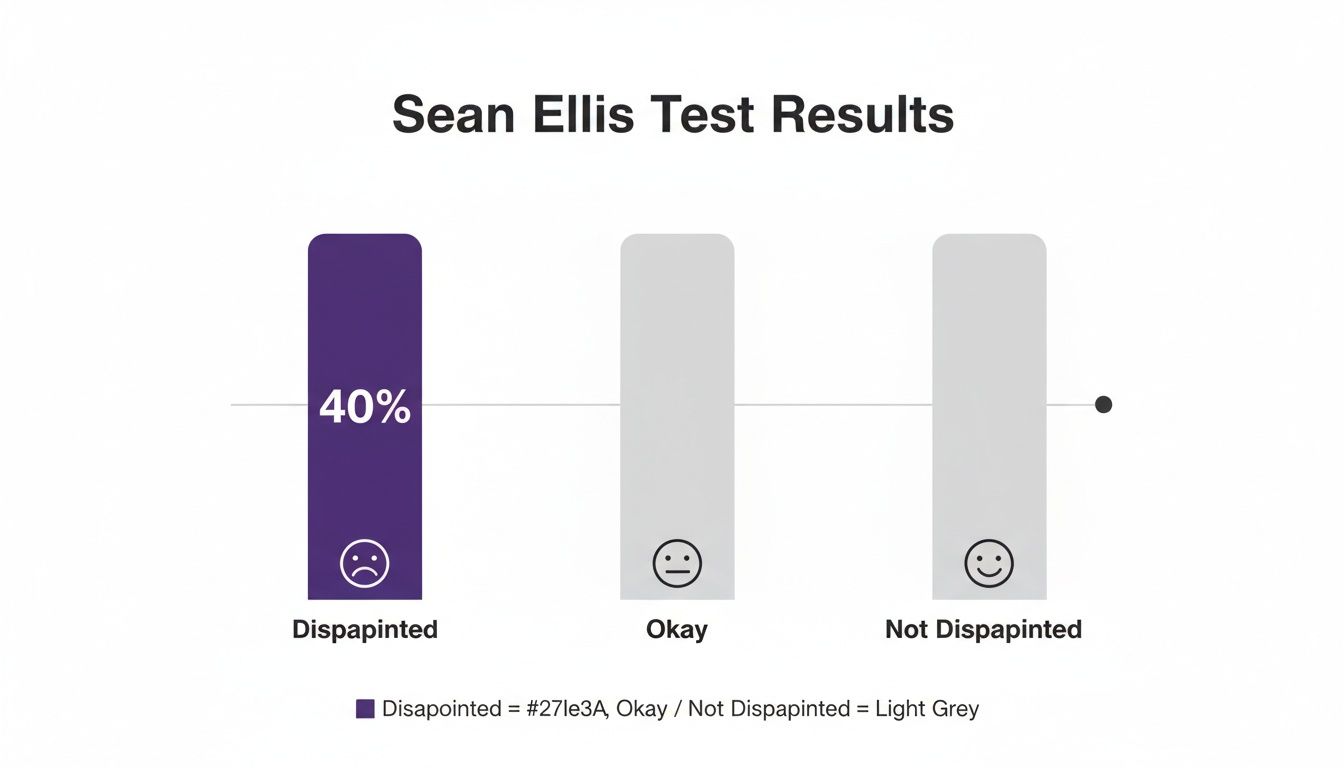

As you can see, hitting that 40% "very disappointed" threshold is a strong indicator that you’ve built something a core group of users simply can't live without.
The Ultimate Economic Proof: LTV to CAC Ratio
If one number encapsulates the financial reality of product-market fit, it’s the ratio between Lifetime Value (LTV) and Customer Acquisition Cost (CAC).
This single metric answers the ultimate question: Is your business model actually profitable in the long run?
True product-market fit is proven by metrics like low churn and a healthy LTV to CAC ratio. For a typical SaaS company, a monthly churn rate under 5-7% is a good signpost.
Economically, strong PMF demands an LTV that is at least 3x your CAC. Pre-PMF startups often struggle at a 1:1 ratio. In contrast, a post-PMF company can hit ratios of 5:1 or even higher.
A healthy LTV:CAC ratio is the clearest signal to investors and your leadership team that you've graduated from a promising idea to a scalable business. It proves you have a repeatable, profitable way to grow.
Key Product Market Fit Metrics and Industry Benchmarks
Here's a table of the most critical metrics for PMF validation, along with some standard benchmarks.
| Metric | What It Measures | Strong PMF Benchmark |
|---|---|---|
| Sean Ellis Test | % of users who would be "very disappointed" if the product disappeared | > 40% |
| Customer Retention | % of users who remain active over a specific time period (e.g., month-over-month) | SaaS: > 90% monthly; Consumer: > 30% monthly |
| Monthly Churn Rate | % of customers who cancel or don't renew their subscription each month | SaaS: < 5-7% |
| Net Promoter Score (NPS) | Customer loyalty and willingness to recommend the product (on a -100 to 100 scale) | > 50 is excellent; > 70 is world-class |
| LTV:CAC Ratio | The lifetime value of a customer relative to the cost of acquiring them | > 3:1 |
These benchmarks provide a solid gut check, but remember that "good" can vary by industry. The most important thing is to track these trends consistently and understand what's driving them.
Going Beyond the Data: Finding Answers in Customer Conversations
Metrics tell you what's happening. Data might show a 50% drop-off rate during onboarding, but it will never tell you why. That’s where talking to your customers comes in.
Getting qualitative feedback—the stories, the frustrations, the "aha!" moments—is the only way to truly understand if you're on the path to product-market fit. A candid conversation reveals the friction that your analytics can only hint at.
But be careful. Asking "What features do you want?" is a classic startup mistake. Most people aren't product designers. They’ll suggest surface-level fixes instead of articulating the deep, underlying problem. A much better approach is the "Jobs to Be Done" framework.
What Job Are They Hiring Your Product to Do?
The Jobs to Be Done (JTBD) framework is a game-changer for customer interviews. It forces you to stop thinking about your product's features and start focusing on the customer's real motivation. Your goal is to understand the progress they are trying to make.
Think of it this way: nobody buys a drill because they want a drill. They buy a drill because they need a hole in the wall to hang a picture. The drill is simply the tool they "hire" to get the job done. Your product is no different.
To get at this deeper layer of insight, you need to ask open-ended questions that uncover their story.
- Uncover the Struggle: "Walk me through the last time you had to deal with [the core problem]. What was that like?"
- Explore the Search: "Before you found us, what other things did you try? What did you like or dislike about those?"
- Find the Trigger: "What was going on that made you think, 'I need to find a better way to do this right now?'"
- Define the Outcome: "Now that you're using our product, what can you do that you couldn't before?"
These aren't just questions on a checklist; they're conversation starters. You're not conducting a survey. You're listening for the context, emotions, and desired outcomes. The real gold is always buried in the details of their stories.
Who to Talk To and How to Take Action
For a complete picture, talk to different groups: power users who love your product, customers who recently churned, and prospects who decided not to buy. Each holds a critical piece of the PMF puzzle.
But here’s where many teams get stuck: turning rich, messy feedback into a clear product roadmap. It’s easy to get lost in anecdotes and feature requests.
This is exactly where a fractional executive can be invaluable. A seasoned Chief Product Officer, for instance, has the pattern recognition to sift through customer conversations and separate critical signals from noise. They build a system for continuous feedback, ensuring insights are used to make strategic decisions that move you closer to product-market fit.
Answering Your PMF Validation Questions
The road to product-market fit is rarely a straight line. It's filled with twists, turns, and a lot of questions. As a founder, you're constantly wrestling with uncertainty. Here are some of the most common questions from teams in the trenches.
How Long Does It Take to Find Product-Market Fit?
There's no magic number. It can take a few intense months or a couple of years. The timeline depends on your industry, market complexity, and—most importantly—how fast your team can iterate.
Instead of fixating on a deadline, obsess over the velocity of your learning. A rapid "build-measure-learn" cycle is far more valuable than rushing to a conclusion that might be a false positive. Consistent, validated progress is the key.
Can You Lose Product-Market Fit After Finding It?
Absolutely. Product-market fit isn't a permanent trophy you put on the shelf; it's a moving target. Markets shift, new competitors emerge, and customer needs evolve.
PMF is not a one-time achievement. It's a dynamic equilibrium between your product and the market that requires continuous attention and adaptation.
Look at companies like Nokia or MySpace. They had an incredible grip on their market and then lost it because they failed to adapt. Your best defense is to never stop listening to your customers and keep innovation baked into your company's DNA.
What Is the Difference Between Problem-Solution Fit and Product-Market Fit?
Think of these as two distinct stages of your validation journey. You must nail the first one before tackling the second.
-
Problem-Solution Fit: This is the initial 'aha!' moment. You've confirmed you’re solving a high-value problem for a specific customer. You have evidence that the pain point is significant and your proposed solution gets early adopters excited. You know that people care.
-
Product-Market Fit: This is proof that you've built the right product to solve that problem for a market big enough to build a real business. You've validated not just the 'what' but also the 'how'—at scale. You now have a repeatable and profitable model for acquiring and keeping customers.
You must achieve problem-solution fit first. Only then does the work of finding true product-market fit begin.
How Can a Fractional Leader Help with PMF Validation?
Bringing in a fractional executive—like a part-time Chief Marketing Officer (CMO) or Chief Product Officer (CPO)—is like adding years of pattern recognition to your team without the full-time cost. They've been through this exact process before, multiple times.
A good fractional leader can immediately implement proven testing frameworks, help you separate real signals from noise, and provide the unbiased, strategic counsel you need when deciding whether to pivot or persevere. For a startup, this targeted expertise can dramatically shorten the path to finding and scaling PMF.
Navigating the complexities of product market fit validation requires seasoned leadership. If you're looking for an experienced executive to provide the strategic guidance to accelerate your growth, our network can help.
Schedule a consultation to find the right leader for your team.