


A product roadmap is the story of your product’s future. It’s a strategic guide laying out the vision, direction, and priorities over time. Think of it less as a rigid project plan and more as a flexible map that connects your high-level strategy to your team's day-to-day work.
The goal is to get everyone, from engineering to sales, aligned on both the what and the why behind your product's journey. But building and maintaining one that drives real business results requires expert leadership—something many growing companies struggle to find.
What Is a Product Roadmap and Why Does It Matter


Imagine trying to build a house without a blueprint. You might get a wall up here and a window there, but you'll likely end up with a chaotic, unstable structure. A product roadmap is that blueprint. It’s a high-level, visual summary that maps out how your product will evolve, and its main job is to communicate the strategic reasoning behind what you’re building.
For startups and SMBs, this is non-negotiable. With tight resources, you can't afford to have teams operating in silos, building features that don't ladder up to a bigger goal. A solid roadmap ensures every team understands the vision and their part in making it happen, creating powerful momentum.
The Strategic 'Why' vs. The Tactical 'How'
One of the biggest mistakes founders make is confusing their roadmap with a project plan or a feature backlog. They are fundamentally different tools for different jobs.
A backlog is a tactical laundry list of tasks for the development team—it’s all about the "how" and "when." It's granular and focused on pure execution. A product roadmap, on the other hand, is a strategic document. It focuses on the "what" and "why," communicating outcomes and intent rather than specific outputs and hard deadlines.
A roadmap’s job is to communicate the strategic direction for your product. It provides context for the team's daily work and answers the critical question, "Why are we building this?" for stakeholders.
This distinction is crucial. When stakeholders see a roadmap filled with exact dates, they treat it like a promise. This is a common trap. An effective roadmap uses broader time horizons—like "Now, Next, Later"—to stay flexible while painting a clear picture of the future. If you need a starting point, this strategic roadmap template can help structure your vision without getting bogged down in dates.
Ultimately, a strong roadmap forces the right conversations. It shifts the discussion from "When is feature X shipping?" to "What customer problem are we solving?" This is how you stop being a feature factory and become an outcome-driven powerhouse.
Aligning Roadmaps to Business Objectives
A roadmap that isn’t directly tied to business objectives is just a wish list. To turn it into a powerful strategic tool, you must get out of the "feature factory" mindset and start thinking about outcomes.
For every item on your roadmap, you need a clear, defensible answer to the question, "Why are we building this?" That answer must connect directly to a measurable business goal—whether that's growing revenue, boosting customer retention, or breaking into a new market.
When you anchor your roadmap to tangible results, it becomes a strategic communication tool. This ensures your team’s effort creates real, measurable value.
From Feature Lists to Business Outcomes
Shifting from outputs (shipping features) to outcomes (driving results) requires a deliberate change in how you frame your work. Instead of listing "Build new dashboard," you frame the initiative around the goal it serves, like "Improve user engagement by providing actionable insights." It's a subtle change with a massive strategic impact.
This is especially critical today. An eye-opening 92% of product leaders are now responsible for revenue generation, but only 26% have high visibility into the ROI of what they launch. You can find more insights on how roadmaps connect to revenue on airtable.com.
By linking every roadmap item to a key result (like those in an OKR framework), you close that gap. You build a clear line of sight from your team's work all the way to the bottom line.
How to Connect Your Roadmap to Business Goals
Making this connection is a practical exercise. It’s about translating high-level company objectives into specific, measurable goals that the product team can influence. This alignment ensures every feature has a purpose that stakeholders can easily understand.
A truly strategic roadmap doesn't just show what you're building; it tells the story of how you're going to win. Each initiative is a chapter in that story, moving the company closer to its ultimate goals.
Ready to start? Here’s a simple, three-step process:
- Start with Company OKRs: Identify the top 3-5 objectives for the company for the next quarter or year.
- Define Product-Led Key Results: For each objective, determine how the product team can contribute. For example, if a company goal is to "Increase market share," a product key result might be to "Reduce new user churn by 15%."
- Map Initiatives to Key Results: Brainstorm and prioritize product initiatives that will directly move the needle on those key results.
This method guarantees your roadmap is a focused plan designed to achieve valuable business outcomes. It empowers you to confidently explain your product’s ROI, turning your roadmap into a cornerstone of your business strategy.
Choosing the Right Prioritization Framework
Once your roadmap is grounded in business objectives, the real work begins: deciding what to build first. Without a structured approach, prioritization meetings can devolve into a battle of opinions where the loudest voice wins. A formal prioritization framework strips away subjectivity, giving you a consistent, data-informed process for making those tough calls.
Think of a framework as a lens that brings your options into focus. It helps you weigh different initiatives against the same criteria, ensuring every choice pushes you closer to your goals. For growth-stage companies, this is non-negotiable.
If you want to dive deeper, check out our guide on strategic decision making frameworks.
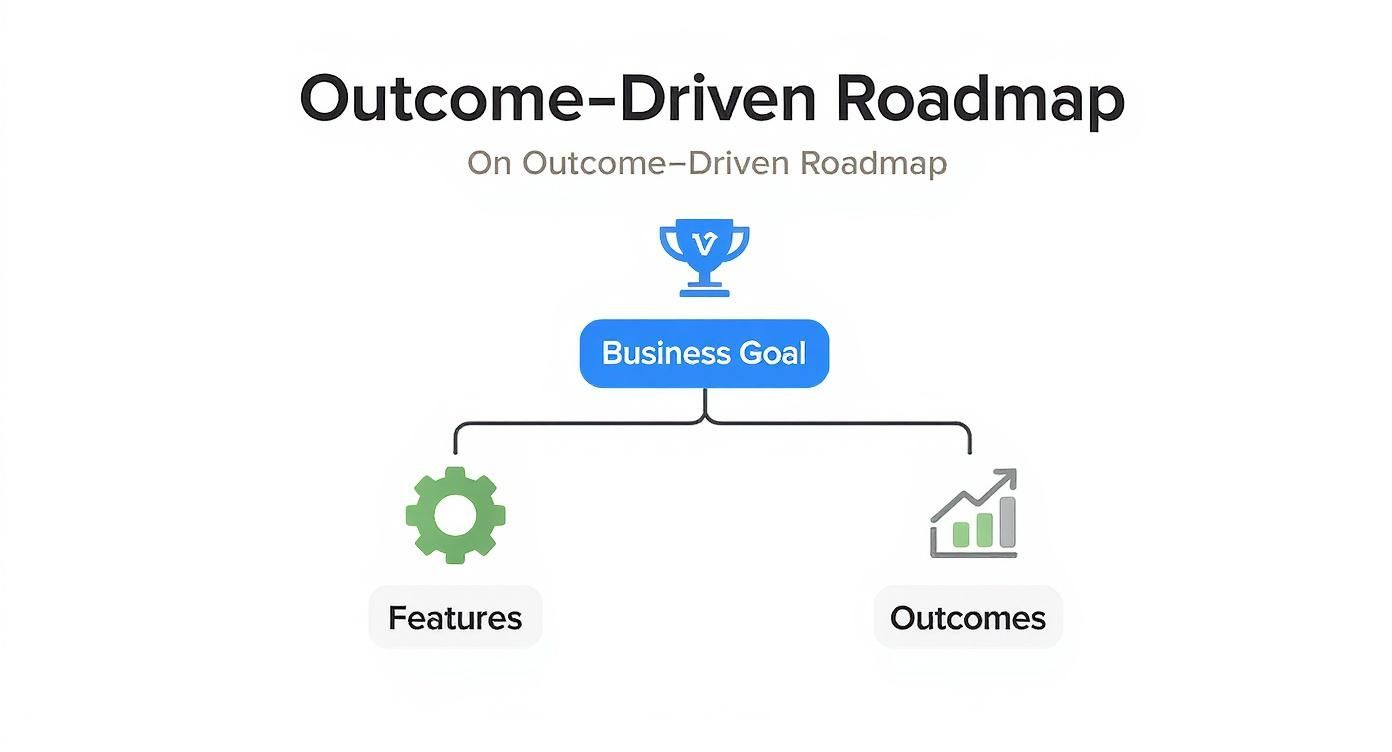

The big takeaway? While features are the building blocks, genuine strategic alignment comes from defining and tracking the outcomes those features are supposed to create.
Popular Prioritization Frameworks Compared
Let’s be clear: there’s no single "best" framework. The right one depends on your company’s stage, your team’s culture, and the data you have on hand. A framework that works for a data-rich enterprise could overwhelm an early-stage startup.
Choosing a framework is less about finding the "best" one and more about finding the one that best fits your team's current needs. The goal is to create clarity and confidence in your decision-making process.
To help you get started, here's a look at some of the most common frameworks. Each provides a unique way to balance customer value, business impact, and development effort.
Comparison of Common Prioritization Frameworks
This table breaks down a few popular frameworks to help you see which one might be the right fit for your team.
| Framework | Best For | Key Benefit | Potential Drawback |
|---|---|---|---|
| Value vs. Effort | Early-stage startups needing quick alignment. | Simple, fast, and highly visual. Excellent for sparking discussions and spotting low-hanging fruit. | Relies heavily on team estimates, which can be subjective and lack quantitative rigor. |
| RICE Scoring | Data-informed teams that can quantify impact. | Takes the guesswork out by scoring initiatives on Reach, Impact, Confidence, and Effort. | Demands access to reliable data, which you might not have for new products or experimental features. |
| MoSCoW Method | Teams needing to lock down scope and manage stakeholder expectations for a release. | Clearly flags feature importance by sorting items into Must-have, Should-have, Could-have, or Won't-have. | Can lead to "scope creep" if stakeholders push to classify too many items as "Must-haves." |
Picking a framework that makes sense for your context gives you a repeatable system for making choices you can stand behind. This discipline is a cornerstone of great product management.
Building a Customer-Centric Roadmap
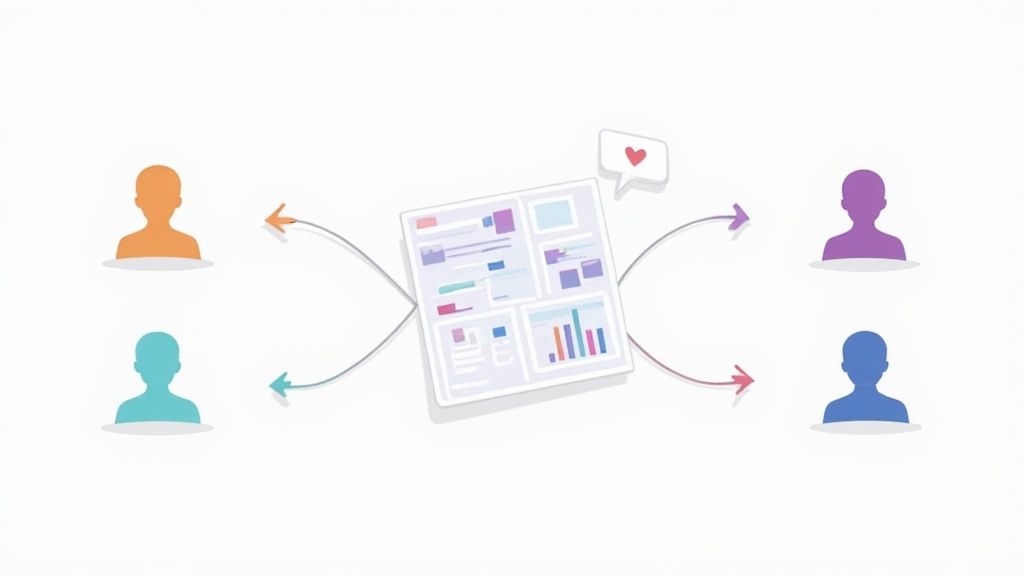
The best products don't just have cool features; they solve real problems for real people. A customer-centric roadmap shifts your team's focus from an internal wish list to an external problem-solving guide. It’s about making sure every initiative is validated by your users.
Instead of asking, "What can we build?" the guiding question becomes, "What customer problem must we solve?" This simple change de-risks development, tightens product-market fit, and helps you build something people genuinely want. It's a foundational principle in effective product development for startups.
Creating Robust Feedback Loops
To build a roadmap that puts customers first, you must get good at listening. This means creating structured channels for feedback to flow from the front lines directly back to the product team. Your sales and customer support teams are goldmines of user insight—they talk to customers every day.
These teams hear unfiltered frustrations, brilliant feature ideas, and clever workarounds. By setting up simple feedback loops—like a dedicated Slack channel or a regular sync meeting—you can capture these qualitative insights and turn them into actionable candidates for your roadmap.
Synthesizing Customer Insights Effectively
Gathering feedback is only half the battle. The magic happens when you synthesize it, finding the patterns and themes that point to underlying problems. It's easy to drown in individual feature requests. The key is to constantly look for the “why” behind the “what.”
A single customer asking for a button is a request. A hundred customers struggling with the same workflow is a problem worth solving. Your job is to connect those dots.
Here are a few practical ways to make sense of all that customer data:
- Affinity Mapping: Group feedback notes from interviews, support tickets, and sales calls on a virtual whiteboard to spot recurring themes.
- User Behavior Analysis: Dive into product analytics to see where users get stuck, confused, or drop off. This hard data often confirms anecdotal feedback.
- Customer Interviews: Get on the phone. Go beyond surveys and have real conversations to uncover the root cause of their challenges.
When you anchor your strategy in validated user needs, you build a powerful foundation. Products built this way consistently see higher adoption and better market alignment. If building this level of strategic focus feels overwhelming, a fractional product leader can provide the expert guidance needed to establish these critical processes.
Keep Your Roadmap Alive with a Consistent Review Cadence
A product roadmap isn't a "set it and forget it" document. It’s a living guide meant to navigate the messy, ever-changing reality of building a product. To keep it valuable, you have to treat it that way.
That means establishing a regular rhythm for reviewing and adapting it. Without a consistent cadence, even the most perfectly crafted roadmap will become irrelevant faster than you can say "scope creep."
This rhythm builds trust and creates predictable moments for everyone to recalibrate. When stakeholders know when to expect updates and when they can offer input, you eliminate last-minute fire drills and keep the entire company rowing in the same direction.
The Power of a Dual-Cadence System
The most effective teams adopt a dual-cadence approach. It’s a simple but powerful way to balance high-level strategic thinking with tactical execution. This system keeps you from getting lost in the weeds while ensuring you don't lose touch with the realities of shipping software.
It breaks down into two distinct meeting types:
- Quarterly Strategic Reviews: Think of these as your 30,000-foot view sessions. The goal is to zoom out and ensure your big-picture themes still align with company objectives. Are we still climbing the right mountain?
- Monthly Tactical Check-Ins: These are your on-the-ground meetings. They're focused and operational, designed to assess progress on near-term goals, digest new feedback, and tweak priorities for the next few sprints.
Teams that lock in this recurring review schedule show much better alignment with business goals. To dive deeper, check out these product roadmap alignment best practices.
Sample Meeting Agendas
To keep these meetings from turning into meandering conversations, you need structure. A simple, clear agenda ensures you stay on track.
The purpose of a review cadence isn’t just to report status; it’s to make decisions. Are we still working on the right things? What have we learned that might change our direction?
Here’s a straightforward agenda for a Quarterly Strategic Review:
- State of the Business: Restate the company’s main goals for the quarter to get everyone on the same page.
- Progress on Key Results: Review the data. How did our product initiatives actually move the needle on key metrics?
- Intel from the Field: What's changed in the market? Have any competitors made a move we need to react to?
- Locking in Next Quarter's Themes: Based on the discussion, do our themes for the next quarter still hold up? Re-validate or adjust.
This structured cadence provides the agility to adapt to new information without derailing your long-term vision. If getting these processes off the ground feels like a struggle, bringing in a fractional CPO can provide the battle-tested experience needed to build a roadmapping rhythm that sticks.
Communicating Your Roadmap for Maximum Impact
A brilliant roadmap is useless if it just sits in a folder. Its real power is unlocked only when you share it effectively, turning a static document into a tool for alignment and inspiration.
One of the biggest mistakes product leaders make is creating a one-size-fits-all roadmap presentation. This rarely works. Different audiences have different needs, and your communication must adapt.
Think of it like a film director using different camera angles to tell a story. You have to present the roadmap through different lenses. Your executive team doesn't need to see every user story, and your engineering team needs more than just high-level themes. Tailoring the view is essential for getting buy-in.
Tailoring Your Message for Different Audiences
To make your roadmap land, you need to speak their language. This means creating specific views that highlight what matters most to them, translating your vision into terms they understand and care about.
- For Executives: Keep it high-level and theme-based. Focus on the "why" and show how product initiatives will drive key business results like revenue growth or market expansion.
- For Engineering: This is where you get into the details. Show features, dependencies, and technical considerations so developers can plan sprints and make smart architectural decisions.
- For Sales & Marketing: They care about what they can sell and when. Create an outcome-focused view that highlights customer benefits and upcoming launches to help them prepare go-to-market strategies.
A great roadmap tells a compelling story about the future. It’s your job to narrate that story in a way that inspires each audience, whether you’re talking to the board, your developers, or your customers.
To master roadmap communication, shift your mindset from giving status updates to genuine storytelling. Explain the rationale behind your choices. Ditch the rigid dates that create anxiety and use flexible timelines like "Now, Next, Later" to manage expectations. This approach builds trust and transforms your roadmap from a simple plan into a powerful instrument of strategic alignment.
Answering Your Top Product Roadmap Questions
As you get comfortable with roadmapping, a few common questions always seem to pop up. Let's tackle them head-on.
How Often Should I Update My Product Roadmap?
Think of your roadmap as a living guide, not a stone tablet. The best product leaders use a two-part cadence to keep it relevant without causing chaos.
- Quarterly Strategic Review: Every three months, zoom out. Re-examine your high-level themes and goals to ensure alignment with the bigger business picture.
- Monthly (or Bi-Weekly) Tactical Check-in: Zoom in. Look at what’s right in front of you. This is where you can react to new customer insights and adjust priorities for the next few sprints.
What’s the Biggest Roadmap Mistake to Avoid?
By far, the most damaging mistake is treating your roadmap like a Gantt chart. When you fill it with hard deadlines for features months or a year out, you set everyone up for disappointment. It creates a false sense of certainty and kills your ability to adapt.
A roadmap is a statement of intent and direction, not a promise of specific features on specific dates. Shift your focus from output (features) to outcomes (goals). Use flexible timeframes like ‘Now, Next, Later’ to show priority without locking yourself into dates you can’t possibly keep.
This simple change turns the roadmap from a source of pressure into a powerful tool for communication and strategic alignment.
Should We Share Our Product Roadmap Publicly?
This is a tricky one. Making your roadmap public can be a huge win for transparency, building trust and excitement with your customers. On the flip side, you're also handing your competitors your playbook and setting expectations that can be tough to manage.
Most companies find a happy medium. Share a simplified, theme-based version of your roadmap. This lets you communicate your vision and general direction, gaining the benefits of transparency without painting yourself into a corner.
Executing a world-class roadmap requires world-class leadership, but hiring a full-time executive is often out of reach for growing companies. That's where fractional leadership comes in.
At Shiny, we connect you with vetted, on-demand executives who bring the strategic expertise you need to build, communicate, and deliver on your product vision—at a fraction of the cost of a full-time hire. If you're ready to elevate your product strategy but not ready for the commitment of a full-time C-suite, we can help.
Explore our marketplace of vetted executives or schedule a consultation to find the perfect fractional leader for your team.