


In the fast-paced world of startups and scale-ups, the role of a Chief Marketing Officer (CMO) is more critical and complex than ever. It's not just about flashy ads or managing social media; it's about architecting the entire engine of customer acquisition, retention, and brand growth. Founders often grapple with a key question: when is the right time to bring on this level of strategic leadership, and can we even afford it?
This guide demystifies the essential responsibilities of a CMO by breaking them down into 10 core functions. We'll provide a clear roadmap for what high-level marketing leadership should accomplish, helping you understand where your business might have critical gaps.
More importantly, we'll explore these responsibilities through a modern lens, revealing how fractional leadership offers a powerful, cost-effective solution. You don't need a six-figure salary on your payroll from day one to access world-class strategic thinking.
Consider this analogy: you wouldn't hire a full-time, in-house architect just to design your first small office space; you'd bring in an expert for that specific project. The same principle applies to marketing leadership. A fractional CMO provides the C-suite expertise you need, for the exact amount of time you need it, solving your immediate growth challenges without the long-term overhead.
Let’s dive into the specific functions that can reshape your growth trajectory and how to secure that expertise efficiently.
1. Strategic Marketing Planning & Vision Setting
One of the core responsibilities of a CMO is to act as the architect of the company's marketing future. This goes beyond creating campaign calendars. It involves developing a comprehensive, long-term marketing strategy that is deeply intertwined with the company’s primary business objectives.
For a startup or a scale-up, this strategic function is paramount. A strong CMO will build a scalable marketing roadmap that not only addresses immediate goals like lead generation but also anticipates future market shifts. This ensures marketing isn’t a siloed function but a central engine for revenue.
How It Works in Practice
A CMO translates business goals into a marketing blueprint. If the company aims to increase market share by 20%, the CMO defines the strategies to achieve it, whether through aggressive content marketing, product-led growth, or a community-first approach.
- HubSpot: Built its entire go-to-market strategy around inbound marketing, positioning itself as an educational resource rather than just a software vendor. This vision created a powerful, self-sustaining lead-generation machine.
- Stripe: Focused its vision on a developer-centric strategy, winning over a crucial user base by providing exceptional documentation and tools, which in turn drove business adoption.
Key Insight: A marketing strategy isn't a static document. It's a living framework that requires constant data-driven validation and alignment with product development and sales.
For businesses needing this high-level strategic guidance without the cost of a full-time executive, a fractional CMO can provide the necessary vision and planning. They bring a wealth of experience to establish a strong foundation, making them an ideal fit for growth-stage companies. For a deeper dive into building your company's roadmap, you can learn more about how to develop a comprehensive guide for business success in strategic growth planning.
2. Brand Development & Management
Beyond campaigns and metrics, a CMO is the primary steward of the company’s most valuable intangible asset: its brand. This critical responsibility involves shaping the company's identity, voice, and promise to the market. It’s about defining what the business stands for and ensuring consistency across every single touchpoint.

For a growth-stage company, a powerful brand is a competitive moat. It fosters loyalty, justifies premium pricing, and attracts top talent. The CMO ensures this brand isn't just a logo or color palette but a living, breathing entity that informs product decisions, sales conversations, and customer support interactions.
How It Works in Practice
A CMO translates the company’s core mission into a cohesive brand identity and messaging framework. If the business goal is to disrupt an established industry, the CMO will craft a brand personality that is bold, innovative, and customer-centric.
- Airbnb: Evolved its brand from a simple "place to stay" to "Belong Anywhere." This shift, guided by marketing leadership, transformed the company into a global community-focused platform, creating deep emotional resonance.
- Mailchimp: Cultivated a playful, approachable brand identity in the serious world of B2B software. This unique positioning made marketing automation accessible and less intimidating for small businesses.
Key Insight: A strong brand acts as an internal compass and an external magnet. It aligns the entire organization around a shared purpose while attracting and retaining ideal customers.
For businesses that need to define or refine their market position, a fractional CMO can provide the expert guidance needed to build a memorable brand without the full-time executive salary. They specialize in conducting competitive analysis, developing messaging frameworks, and creating brand guidelines that drive long-term growth. You can find out more about how C-suite roles can accelerate your growth on our resource page.
3. Marketing Team Leadership & Development
A CMO's strategic vision is only as powerful as the team executing it. A critical responsibility of a CMO is to build, lead, and nurture a high-performing marketing department. This involves recruiting the right talent, establishing clear performance metrics, mentoring team members, and fostering a culture of innovation and accountability.
For a growing business, this leadership function is essential for scaling marketing efforts effectively. A great CMO designs an organizational structure that can adapt to changing needs, ensuring that every role contributes directly to strategic goals. This leadership transforms marketing from a series of disconnected tasks into a cohesive, results-driven engine.
How It Works in Practice
The CMO is the architect of the marketing organization. They ensure the team has the skills, resources, and motivation to turn strategy into tangible outcomes. If the company needs to scale content production, the CMO hires and develops writers and SEO specialists; if the goal is brand awareness, they build a team skilled in PR and communications.
- HubSpot: Fostered an internal marketing team that not only executed its inbound strategy but also served as a living case study for its own methodology, creating a powerful feedback loop of innovation.
- Intercom: Built a lean but highly specialized marketing team structure, with experts in distinct areas like product marketing and content. This allowed for deep functional expertise and agile execution.
Key Insight: A high-performing marketing team isn't just a collection of specialists; it's a unified group with clear roles, shared goals, and a leader who removes roadblocks and empowers them to succeed.
For companies needing to fill specific skill gaps or build a team from the ground up, a fractional CMO can implement the necessary hiring frameworks and leadership. They can identify talent needs, manage agency partners, and establish the cultural foundation for success. You can explore a detailed guide to learn more about how to build high-performing teams.
4. Digital Marketing & Demand Generation Strategy
A modern CMO is the conductor of the company’s digital orchestra, orchestrating all channels to create a unified demand generation engine. This responsibility involves crafting and executing a multi-channel strategy that includes SEO, paid advertising, content marketing, and marketing automation. The goal is to generate a predictable pipeline of qualified leads in a measurable, scalable way.
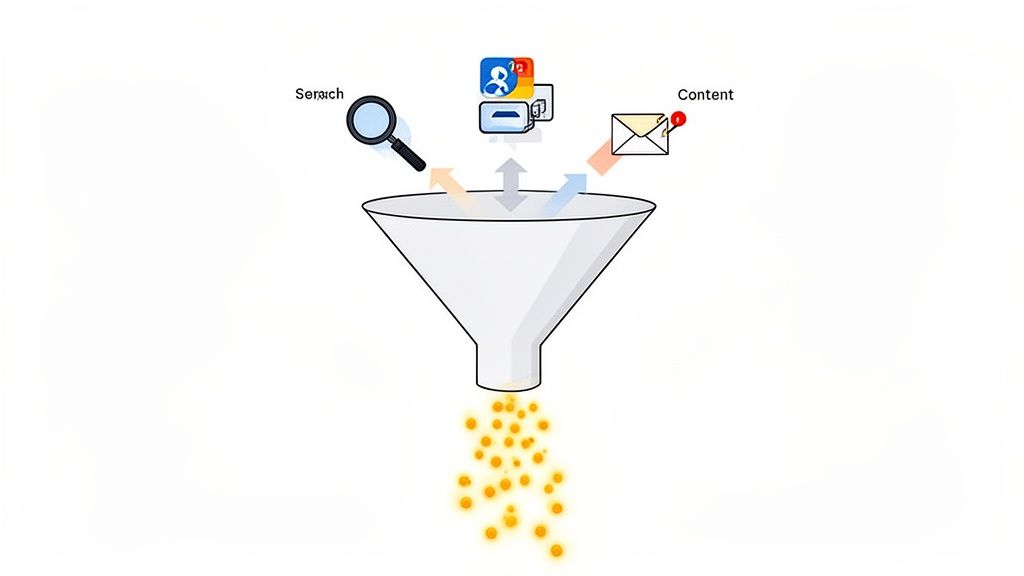
For a B2B SaaS or tech company, this function is the lifeblood of revenue growth. The CMO must ensure that every digital touchpoint serves a strategic purpose in moving prospects through the funnel. It's about building a system that attracts, nurtures, and converts, transforming marketing from a cost center into a primary driver of business results.
How It Works in Practice
The CMO aligns digital tactics with the overall buyer journey. If the goal is to capture high-intent leads, the CMO might prioritize paid search and G2 campaigns, while using thought leadership content and webinars to nurture top-of-funnel interest.
- Drift: Revolutionized B2B marketing with its conversational marketing approach. Its vision focused on using chatbots to engage website visitors in real-time, generating qualified leads instantly.
- Salesforce: Mastered demand generation through its powerful thought leadership and webinar strategy, using platforms like Dreamforce to build a massive community and a consistent lead flow.
Key Insight: An effective demand generation strategy isn't just about volume; it's about quality and efficiency. It requires tight alignment with sales on lead definitions (MQLs/SQLs) and continuous optimization of customer acquisition cost (CAC).
Companies needing to build or optimize their lead-generation engine can benefit immensely from a fractional CMO's expertise. They can implement sophisticated marketing automation, define channel strategies, and establish the analytics framework needed for growth without the immediate overhead of a full-time hire. To learn more about building a pipeline, you can explore these actionable demand generation strategies.
5. Sales Enablement & Alignment
A CMO’s responsibility extends far beyond generating leads; it involves ensuring the sales team can effectively convert those leads into revenue. This is where sales enablement and alignment become critical. The CMO must work hand-in-hand with sales leadership to bridge the gap between marketing activities and sales outcomes.
This function is especially vital in growth-stage companies where every lead counts and sales cycle efficiency directly impacts cash flow. A well-aligned marketing and sales engine ensures marketing generates highly qualified leads and equips the sales team with the precise tools, content, and messaging needed to win deals.
How It Works in Practice
The CMO is responsible for creating a feedback loop between marketing and sales. If the sales team consistently faces a specific competitor, the CMO’s team develops battle cards to handle objections. If a particular vertical shows high conversion rates, marketing doubles down on targeted content for that industry.
- Salesforce: Pioneered this alignment by creating a vast library of sales cloud enablement content, case studies, and ROI calculators that directly address customer pain points, empowering their reps to have more value-driven conversations.
- Zoom: During its rapid growth, Zoom’s marketing team quickly produced enablement materials that helped sales teams articulate the platform’s value for new use cases like remote education and telehealth.
Key Insight: Sales enablement isn’t just about creating collateral. It’s a strategic function that requires a deep understanding of the sales process, customer objections, and competitive landscape.
For companies struggling to harmonize their sales and marketing efforts, a fractional CMO can implement the frameworks needed for tight alignment. They establish clear lead qualification criteria (MQLs and SQLs), set up regular alignment meetings, and build the foundational sales playbook, ensuring both teams are working toward the same revenue goals.
6. Customer Marketing & Retention Programs
While customer acquisition often steals the spotlight, one of the most critical responsibilities of a CMO is nurturing the customers you already have. This involves creating programs designed to maximize customer lifetime value (LTV) through retention, upsells, and advocacy. A strong customer marketing strategy turns happy users into loyal advocates, creating a powerful, cost-effective growth loop.
For growth-stage companies, focusing on retention is not just a "nice-to-have"; it's a direct driver of profitability. Acquiring a new customer can be five to 25 times more expensive than retaining an existing one. An effective CMO builds the infrastructure to onboard, educate, and delight customers, ensuring they see continuous value.
How It Works in Practice
The CMO’s role is to build a post-purchase journey that fosters loyalty and expansion. If the business goal is to increase Net Revenue Retention (NRR), the CMO will implement programs like customer-exclusive webinars, loyalty rewards, or user communities to drive deeper product adoption and identify upsell opportunities.
- Slack: Excels with extensive customer onboarding and education programs. Its help center, tutorials, and in-app tips are designed to ensure users quickly become power users, which directly drives team-wide adoption and upgrades.
- HubSpot: Fosters a massive community through its INBOUND conference and HubSpot User Groups (HUGs). This creates a powerful sense of belonging and turns customers into brand evangelists.
Key Insight: Customer marketing transforms your customer base from a simple revenue source into a sustainable growth engine. Advocacy, referrals, and case studies from happy customers are your most authentic marketing assets.
Developing a robust retention strategy requires dedicated expertise. A fractional CMO can be instrumental in building this function from the ground up, implementing proven frameworks for customer segmentation, onboarding, and advocacy without the immediate overhead of a full-time executive team.
7. Marketing Analytics & Performance Measurement
A modern CMO's authority is rooted in data. This responsibility involves establishing a comprehensive measurement framework to track marketing performance, calculate ROI, and demonstrate tangible business impact. It’s about moving beyond vanity metrics to connect marketing activities directly to revenue. The CMO ensures that every strategic decision is informed by data, not just intuition.

For a growth-stage company, this data-driven approach is non-negotiable. An effective CMO builds the analytics infrastructure needed to scale marketing efficiently, identifying which channels are working, where to double down, and what to cut. This focus on performance measurement transforms marketing into a predictable, revenue-generating engine.
How It Works in Practice
A CMO champions a culture of accountability by defining clear KPIs tied to business goals. If the objective is to improve customer retention, the CMO will track metrics like churn rate, repeat purchase rate, and Net Promoter Score (NPS), using the insights to refine post-purchase engagement strategies.
- Mixpanel: Enables companies to perform deep cohort analysis, helping marketing and product teams understand how user behavior impacts long-term retention.
- Salesforce Marketing Cloud: Provides end-to-end analytics, connecting marketing touchpoints across the entire customer journey to a final sale. This gives CMOs a clear view of campaign ROI.
Key Insight: Effective performance measurement isn't just about reporting the numbers; it's about telling the story behind them and using those insights to drive the next strategic action.
For businesses that lack the expertise to build this analytical foundation, a fractional CMO can be transformative. They can quickly implement the necessary tools, establish a reporting cadence, and train the team to think with a data-first mindset, ensuring the company’s marketing efforts are both measurable and impactful.
8. Product Marketing & Positioning
A core responsibility of a CMO is to ensure that a product doesn't just exist but connects with its intended audience. This involves defining how the market perceives the product. The CMO architects the narrative, developing clear, compelling positioning and messaging that highlights the unique value the product delivers.
For a startup, particularly in crowded markets like SaaS, strong product marketing is the difference between being another "me-too" solution and becoming a category leader. The CMO drives the strategy to articulate why the product matters, turning features into tangible benefits that solve real-world problems for a specific buyer.
How It Works in Practice
A CMO translates deep customer and market insights into a powerful positioning framework. If the product is a new project management tool, the CMO decides whether to position it as the simplest tool for freelancers or the most integrated solution for enterprises. This decision shapes every subsequent marketing and sales action.
- Slack: Masterfully positioned itself as the central hub "where work happens," moving beyond a simple chat tool to become an indispensable collaboration platform. This vision differentiated it from countless competitors.
- Notion: Evolved its positioning from a note-taking app to the "all-in-one workspace," a compelling narrative that captured the market's desire for consolidated tools and drove its viral growth.
Key Insight: Product positioning isn't a one-time exercise. It must be continuously monitored, tested, and refreshed as the market evolves, competitors emerge, and customer needs change.
For companies struggling to articulate their unique value, a fractional CMO can provide the strategic clarity needed to overhaul product marketing. They bring an objective, expert perspective to conduct competitive audits, interview customers, and build a messaging framework that truly resonates, setting the stage for accelerated growth.
9. Marketing Budget Management & Resource Allocation
A critical, board-level responsibility of a CMO is acting as the steward of the company’s marketing investment. This involves strategically developing, justifying, and managing the marketing budget to maximize return and fuel growth. The CMO is accountable for allocating finite resources to the initiatives with the highest potential ROI.
For a growth-stage company, disciplined budget management is the difference between sustainable scaling and burning through cash. A CMO must build a financial framework that supports both proven channels and calculated risks. This fiduciary duty ensures that marketing is not just a cost center but a primary driver of the company’s profitability.
How It Works in Practice
The CMO transforms business goals into a financial plan, allocating funds across channels, campaigns, and technologies. If the objective is to acquire 1,000 new enterprise customers, the CMO models the costs across different strategies like account-based marketing, paid media, and event sponsorships to determine the most capital-efficient path forward.
- Buffer: Is known for its transparent approach to finance, including marketing budgets. By openly tracking spending and ROI, they ensure every team member understands the financial impact of their efforts.
- Salesforce: Implements a rigorous annual budget review process, reallocating funds based on deep performance analysis of every channel and campaign. This data-driven approach allows them to quickly defund underperforming activities and double down on what works.
Key Insight: The marketing budget is not an allowance; it's an investment portfolio. A great CMO manages it like one, constantly rebalancing to mitigate risk and seize opportunities for outsized returns.
This level of financial acumen is often hard to find, but it's a non-negotiable skill. For companies needing expert financial oversight in their marketing function, a fractional CMO can build a sophisticated budgeting and forecasting model. They establish the systems for tracking ROI and ensuring resources are allocated effectively, setting the business on a path to profitable growth.
10. Market Insights & Strategic Positioning
Beyond executing campaigns, a modern CMO serves as the company's eyes and ears in the market. This responsibility involves conducting deep market research, monitoring competitive dynamics, and providing strategic insights that inform critical business decisions far beyond the marketing department. The CMO's role is to understand emerging trends and identify untapped growth opportunities.
For a growth-stage company, this function is a powerful offensive and defensive tool. A CMO who excels here ensures the business doesn't build its strategy in a vacuum. Instead, they root every decision, from product roadmaps to sales positioning, in a solid understanding of market realities, ensuring the company remains relevant, competitive, and ahead of the curve.
How It Works in Practice
The CMO translates raw market data into a clear strategic advantage. If a new competitor enters the market with a disruptive pricing model, the CMO analyzes the potential impact, gauges customer sentiment, and recommends a strategic response. This makes the CMO a vital partner to the CEO and board.
- Salesforce: Publishes regular, in-depth research reports on industry trends (like its "State of Marketing" report), establishing itself as a thought leader and using those insights to shape its product development.
- Gartner: While a research firm itself, its own marketing exemplifies this principle. It leverages its market analysis to position itself as the definitive source for technology insights, influencing purchasing decisions across entire industries.
Key Insight: Strategic positioning is not a one-time activity. It requires a continuous feedback loop where customer data, competitive intelligence, and market trends are constantly gathered and used to refine the company's place in the market.
For businesses that need to sharpen their competitive edge but lack dedicated resources for market intelligence, a fractional CMO can establish these critical functions. They implement systems for ongoing analysis and translate insights into actionable strategies, providing executive-level guidance that directly impacts business direction and growth.
CMO Responsibilities: 10-Point Comparison
| Initiative | 🔄 Implementation complexity | Resource requirements | 📊 Expected outcomes (speed ⚡) | Ideal use cases | ⭐ Key advantages / 💡 Tip |
|---|---|---|---|---|---|
| Strategic Marketing Planning & Vision Setting | High 🔄🔄🔄 | Moderate–High: leadership time, market research, planning budget | Long‑term, high impact; foundational for growth (slow ⚡) | Startups/growth-stage needing scalable roadmap and alignment | Provides clear direction and measurable objectives ⭐; Review semi‑annually 💡 |
| Brand Development & Management | High 🔄🔄🔄 | High: design, creative, content, brand tooling | Builds brand equity and differentiation (long term, slow ⚡) | Market differentiation, premium positioning, product launches | Creates memorable market presence and trust ⭐; Maintain strict brand guidelines 💡 |
| Marketing Team Leadership & Development | Medium 🔄🔄 | High: hiring, management, training costs | Improved execution and capability (medium speed ⚡) | Scaling teams, building in-house marketing capability | Develops talent and institutional knowledge ⭐; Use fractional leaders for skill gaps 💡 |
| Digital Marketing & Demand Generation Strategy | Medium 🔄🔄 | Medium: ad spend, tools, content production | Measurable leads and revenue; rapid testing and scaling (fast ⚡⚡) | Customer acquisition, growth experiments, scalable channels | Trackable ROI and scalable acquisition ⭐; Automate and A/B test continuously 💡 |
| Sales Enablement & Alignment | Medium 🔄🔄 | Low–Medium: collateral, training, ABM resources | Higher close rates and shorter sales cycles (medium ⚡) | Sales-driven growth, enterprise/ABM strategies | Improves win rates and consistency across teams ⭐; Define MQLs and meet monthly 💡 |
| Customer Marketing & Retention Programs | Medium 🔄🔄 | Medium: CS collaboration, content, loyalty programs | Increased LTV and lower churn (medium‑long term, medium ⚡) | SaaS/subscription, businesses focused on expansion revenue | Boosts profitability via retention and advocacy ⭐; Segment customers and personalize onboarding 💡 |
| Marketing Analytics & Performance Measurement | High 🔄🔄🔄 | Medium–High: analytics tools, integrations, analyst skills | Clear ROI, optimization levers and accountability (medium speed ⚡) | Scaling firms needing data‑driven decisions and attribution | Enables data‑driven optimization and transparency ⭐; Define 3–5 core KPIs and dashboard them 💡 |
| Product Marketing & Positioning | High 🔄🔄🔄 | Medium: research, messaging, cross‑functional coordination | Faster product adoption and clearer value (medium speed ⚡) | New product launches, feature differentiation, GTM planning | Accelerates adoption and pricing power ⭐; Test messaging with target customers early 💡 |
| Marketing Budget Management & Resource Allocation | Medium 🔄🔄 | Low–Medium: forecasting tools, finance alignment | Optimized ROI and spend control (medium speed ⚡) | Resource‑constrained startups, scaling spend allocation | Maximizes marketing ROI and prevents waste ⭐; Reserve 10–15% for experiments 💡 |
| Market Insights & Strategic Positioning | High 🔄🔄🔄 | Medium–High: research subscriptions, analyst time, interviews | Informs strategic moves and identifies opportunities (long term, slow ⚡) | Competitive markets, strategic pivots, board/CEO advising | Provides early market signals and growth opportunities ⭐; Present insights to leadership regularly 💡 |
Build Your Marketing Leadership the Smart Way
Navigating the extensive list of the responsibilities of a CMO reveals a fundamental truth: marketing leadership is not a luxury, it's the engine of sustainable growth. From setting the strategic vision to driving demand, the CMO function touches every critical aspect of your revenue pipeline.
However, for startups and scale-ups, this realization often creates a difficult paradox. You recognize the urgent need for senior strategic guidance, yet the six-figure salary and long-term commitment of a full-time executive can be prohibitive. Hiring the wrong leader is a costly mistake that can set a company back months, if not years. This challenge paralyzes many businesses, leaving them stuck with a "leadership gap" that stifles their potential.
The Fractional CMO: Your Strategic Advantage
The modern business landscape offers a more agile and cost-effective solution: the fractional leadership model. A fractional CMO provides the exact C-level expertise you need, precisely when you need it, without the financial burden of a full-time hire.
Think of it as gaining access to a world-class strategic mind for a dedicated portion of their time, whether it's 10, 15, or 20 hours a week. A fractional CMO integrates into your leadership team, mentors your junior marketers, owns KPIs, and drives execution. They bring decades of experience, allowing you to bypass the steep learning curve and avoid common pitfalls.
Actionable Next Steps: Assess and Engage
How can you leverage this insight? Your path forward can be broken down into three clear steps:
- Audit Your Leadership Gaps: Review the ten core CMO responsibilities in this article. Where are your critical gaps? Are you struggling with high-level strategy? Is your brand messaging inconsistent? Pinpoint the 2-3 areas where senior leadership would make the most immediate impact.
- Define Your Ideal CMO Profile: Based on your audit, create a clear job description for a fractional CMO. If your primary need is scaling lead generation, you need an expert in performance marketing. If you're struggling with market positioning, you need a leader with deep experience in product marketing. Focus on the skills that solve your most pressing problems now.
- Explore the Fractional Talent Pool: Instead of a traditional executive search, tap into curated networks of vetted fractional leaders. This accelerates your hiring process from months to weeks, giving you access to a pre-qualified pool of executives who are ready to make an immediate impact.
The role of the CMO is the strategic core of customer acquisition and revenue growth. By embracing the fractional model, you are making a calculated, high-ROI investment in your company's future. You are choosing to build your marketing leadership the smart way.
Ready to close your marketing leadership gap and accelerate your growth? Shiny connects you with a network of world-class, vetted fractional executives who can step in and drive immediate results. Explore our platform to find the perfect strategic partner who understands the unique responsibilities of a CMO for your stage and industry.