



You've built a strong product. The demo lands. Early users like the workflow. Investors nod at the market slide.
Then the hard questions start.
Can you support that health claim? Who reviews clinical risk? What happens if a customer asks for evidence your intervention is safe, appropriate, or medically sound? Why is your product roadmap being driven by engineers and marketers when the actual buyer cares about patient outcomes, clinical workflow, and trust?
That's the wall many HealthTech founders hit. It's not a product problem. It's a medical leadership problem.
If your company touches diagnosis, treatment, care navigation, patient behavior, clinician workflow, employee health, regulated communications, or any health-related decision, the role of chief medical officer stops being a nice-to-have. It becomes a business function. A good CMO helps you avoid sloppy claims, weak studies, avoidable risk, confused messaging, and product choices that look clever in a pitch deck but fall apart under clinical scrutiny.
Most founders wait too long. They assume they need a full-time executive with a massive salary and years of hospital administration. Usually, they don't. They need the right medical operator at the right stage, with enough authority to shape product, compliance, and go-to-market before mistakes get expensive.
Your Brilliant HealthTech Idea Is Hitting a Wall
A founder closes a strong demo, gets real buyer interest, and then the deal stalls in procurement, clinical review, or legal. The product did its job. The company still looked unprepared.
That is the point where many HealthTech startups stop behaving like software companies and start getting judged like healthcare companies.
You can feel the shift fast. A clinician questions your claims. An employer asks who oversees medical quality. A payer wants evidence, safety logic, and a credible medical voice on the call. If nobody on your leadership team can answer with authority, growth slows down for reasons your roadmap will not fix.


The cost of operating without medical leadership
Startups often copy the wrong model. They assume the chief medical officer is a late-stage executive borrowed from hospitals, large insurers, or public companies. That view is outdated and expensive.
A startup CMO has a different job. The role is less about hierarchy and internal administration. It is about making your product credible, your claims defensible, your risk manageable, and your commercial story believable to serious buyers.
Without that layer of medical leadership, the same problems show up again and again:
- Product priorities drift because feature decisions are made without clinical judgment.
- Claims get sloppy because marketing pushes language that sounds strong but cannot survive scrutiny.
- Sales cycles get longer because enterprise buyers want a medical counterpart, not another founder-led explanation.
- Risk piles up because regulatory, safety, and workflow concerns get spotted after launch instead of before it.
Practical rule: If a customer asks, “Who owns medical judgment here?” and the answer is vague, you have a revenue problem.
Why founders need to treat this as a business function
Medical leadership now shows up far beyond hospitals and health systems. Companies in multiple industries have added CMO roles as medical judgment became tied to trust, safety, and reputation. The trend is clear. The role is now strategic, not ceremonial.
For startup founders, the lesson is straightforward. A CMO is not there to add prestige to your About page. A strong CMO helps you win deals, avoid expensive product mistakes, sharpen positioning, and keep the company out of preventable trouble.
And for most early and growth-stage HealthTech companies, the smart move is not a full-time hospital-style executive. It is a fractional CMO with enough experience and authority to shape product, compliance, and go-to-market before weak decisions become expensive habits.
What a Chief Medical Officer Actually Does
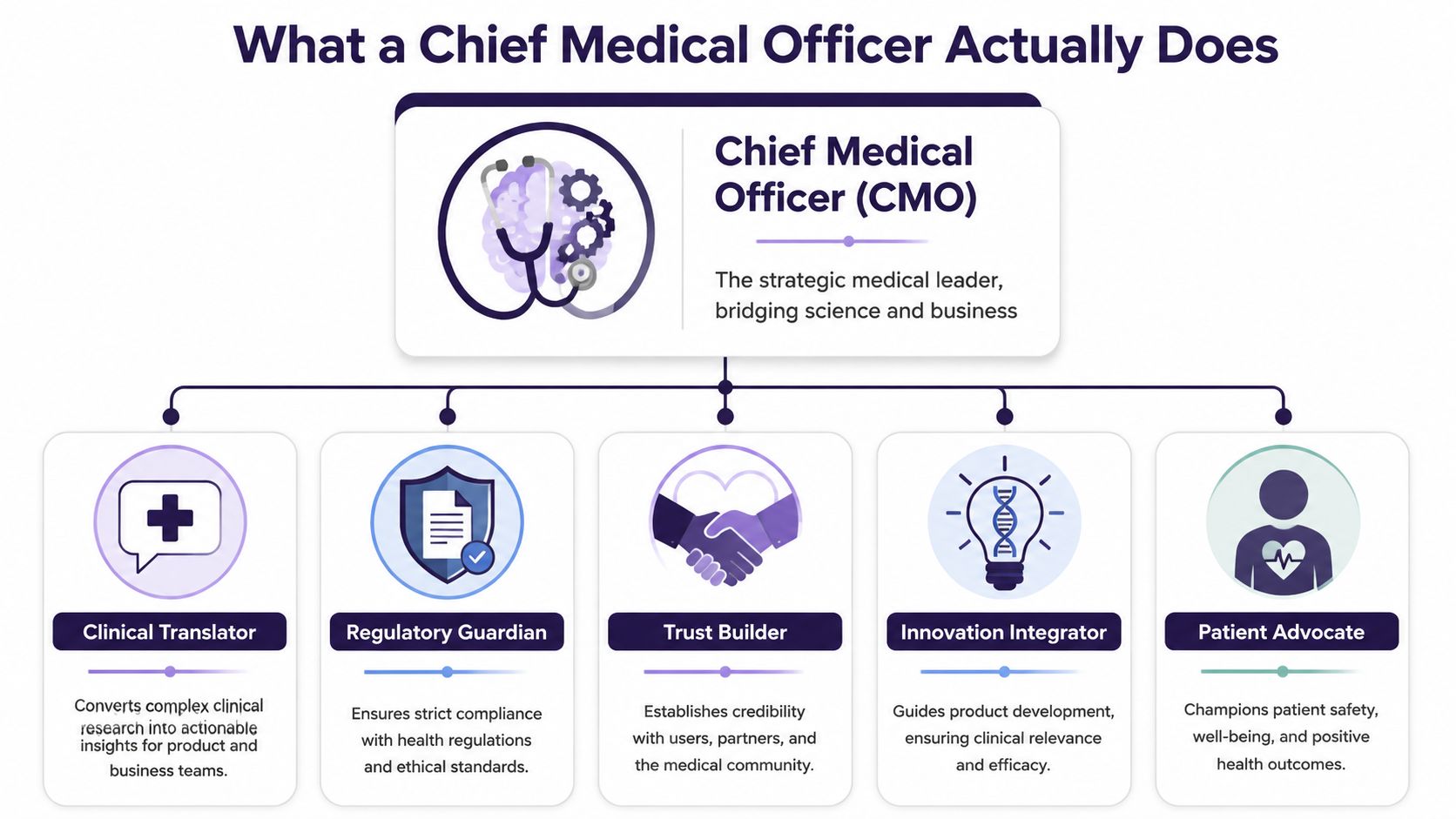
The cleanest way to understand the role of chief medical officer is this. The CMO is your internal translator between medicine and business.
Your engineers speak product logic. Your commercial team speaks market urgency. Your investors speak growth. Your legal team speaks risk. Your customers, depending on the market, may speak outcomes, evidence, workflow, and safety. The CMO translates across all of it.

The modern CMO is not just a figurehead
In many organizations, the chief medical officer serves as the critical link between administration and medical staff, translating administrative goals into clinical operations. The role has expanded beyond peer review to include technology acquisition, process improvement, and regulatory compliance, which is why many organizations now treat it as a full-time executive function, as described by the American Association for Physician Leadership.
That matters for startups because a serious CMO doesn't just lend their name to your website. They make decisions.
They pressure-test whether your clinical assumptions hold up. They tell the team when a claim crosses the line. They shape how you validate a feature, how you present outcomes, and how you position the product with credible medical logic.
What founders should expect from the role
A capable startup CMO usually owns or influences work like this:
Clinical risk review
They identify where the product could create patient harm, inappropriate use, or poor clinical judgment.Evidence strategy
They help design the right level of validation for your stage. Not every company needs a giant study. Every serious company needs a credible evidence plan.Medical oversight for claims
They review website copy, sales decks, provider materials, and public statements so your team doesn't promise more than the product can support.External credibility
They represent the company with clinicians, partners, customers, and sometimes investors who need to hear the medical story from someone with real authority.Product guidance
They help decide what should be built, what shouldn't, and what needs guardrails.
A startup CMO should make your product safer, your claims cleaner, and your commercial story easier to believe.
What this looks like in practice
Think of the CMO as the person who asks the uncomfortable but necessary questions.
If your app nudges a patient toward a behavior, is that advice clinically appropriate? If your AI surfaces recommendations, what oversight exists? If your marketing team wants to say the product improves outcomes, what evidence supports that wording? If a provider system buys your platform, what medical governance will they expect to see?
Those questions don't slow the business down. They keep the business from stepping on rakes.
The Core Competencies of a High-Impact CMO
A founder usually notices the gap at the same moment. Product wants to ship. Sales wants stronger claims. A buyer asks tough clinical questions. Nobody in the room can answer with enough authority to move the deal forward or protect the company.
That is the competency test for a startup CMO.
In a hospital or enterprise health system, the role often centers on large-scale physician leadership, quality programs, and administrative oversight. In a startup, the job is narrower and more commercial. You need a medical leader who can sharpen product decisions, strengthen credibility in the market, and keep the company out of avoidable clinical and regulatory trouble.
Clinical credibility that translates into business trust
Strong credentials still matter. If your CMO lacks real clinical experience, discerning buyers will spot it quickly. The point is not to copy a hospital-style job description. The point is to hire someone whose judgment carries weight with providers, health system partners, payers, and your own team.
That credibility has to hold up under pressure. Can this person challenge a risky feature, defend an evidence plan in a buyer meeting, and explain why a claim needs to change before it creates exposure? If not, the title does not help you.
Startup CMOs need four competencies, not one
Clinical expertise is only the entry ticket. High-impact startup CMOs combine medical judgment with operating judgment.
| Competency | What it looks like in a startup |
|---|---|
| Clinical depth | Assesses patient safety, appropriateness, and evidence quality with practical judgment |
| Product judgment | Helps teams decide what to build now, what needs constraints, and what should wait |
| Commercial fluency | Understands how medical credibility affects pipeline, buyer confidence, and deal velocity |
| Executive range | Makes clear calls with incomplete information, tight timelines, and limited resources |
This is why many decorated physicians struggle in growth companies. They are trained for thoroughness in environments built for certainty. Startups run on prioritization. Your CMO has to protect rigor without turning every decision into a committee exercise.
Communication is a core operating skill
Founders often overweight pedigree and underweight translation.
The right CMO can explain a clinical risk to engineers in plain language. They can tell sales exactly where the line is on claims. They can speak with an investor, a customer physician, and a product lead without changing the substance of the message.
Look for these signals:
- They make hard medical issues easy to understand
- They challenge assumptions without slowing every team down
- They can defend a position in both clinical and commercial conversations
- They treat regulation, evidence, product, and go-to-market as connected decisions
A startup does not need a ceremonial physician executive. It needs someone who improves decision quality across the company.
For most SMB and growth-stage HealthTech companies, that points to an experienced part-time operator rather than a traditional full-time executive buildout. If you want the broader strategy behind that model, read this guide to the fractional C-suite advantage for executive leadership.
The best startup CMO can move from clinical judgment to product tradeoffs to revenue conversations without losing rigor. That range is what makes the role valuable.
Full-Time vs Fractional CMO When to Hire Which
A startup founder usually hits this decision at the same moment. Sales is asking for stronger clinical credibility. Product needs faster answers on risk and evidence. Investors want to know who owns medical judgment. The mistake is assuming that means you need a full-time executive.
You usually do not.
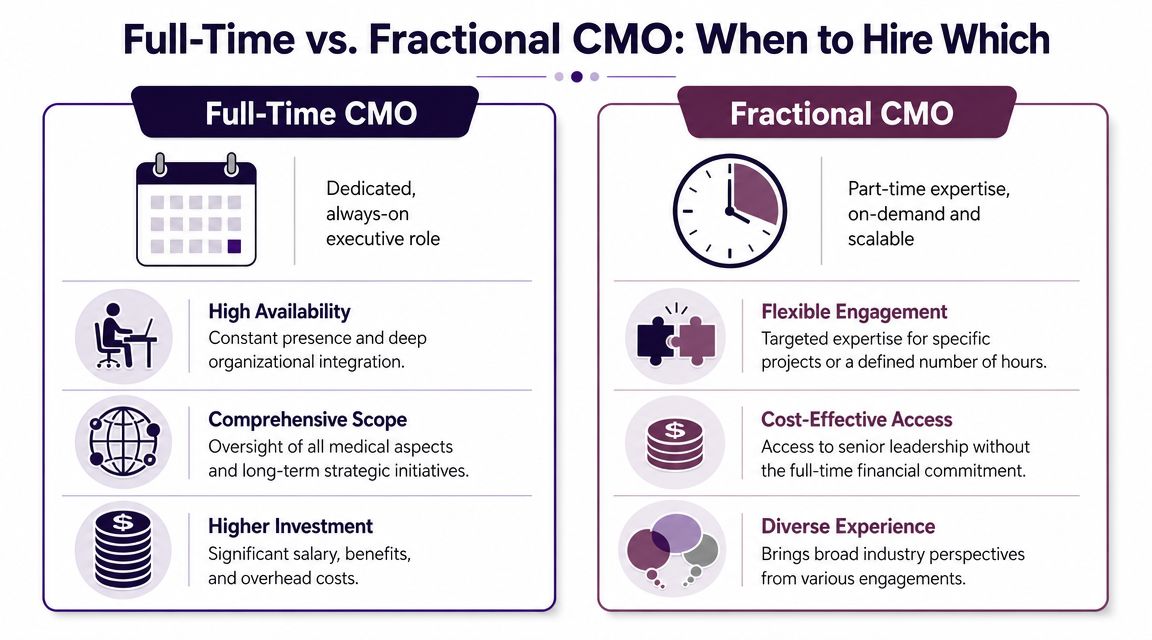
A full-time CMO makes sense when medical leadership is part of daily operations across the company. That is the hospital system model. It fits organizations running broad clinical programs, formal governance, quality oversight, physician management, and ongoing regulatory accountability.
A growing HealthTech company has a different need. It needs senior clinical judgment at the points where business risk is highest, not a permanent executive seat filled before the workload exists. That is why the fractional model is usually the smarter choice.
The startup decision framework
Use a simple test. Ask whether your company needs continuous medical management or high-stakes medical judgment.
| Factor | Full-Time CMO | Fractional CMO |
|---|---|---|
| Commitment | Embedded executive role across the business | Part-time leadership for defined priorities |
| Best for | Companies with constant medical oversight needs | Startups with focused strategic, product, and commercial needs |
| Hiring risk | High, because the role is expensive and hard to unwind | Lower, because scope can be defined and adjusted |
| Speed | Often slower due to search complexity | Usually faster if you know the scope |
| Operating model | Broad internal ownership | Targeted, high-value intervention |
That distinction matters. Corporate and hospital CMOs are often built around standing responsibilities. Startup CMOs are built around decision quality, product credibility, and commercial trust.
When full-time is the right call
Hire full-time when the role already looks like an operating department, not an executive overlay.
Choose full-time if these conditions are true:
- Medical operations are active every day across multiple teams, sites, or care settings.
- Clinical governance needs a constant executive owner for quality, compliance, and medical management.
- The CMO will manage a sizable internal team with direct operational responsibility.
- Your need is permanent and expanding, not tied to a launch, evidence plan, enterprise push, or regulatory milestone.
If your company resembles a provider organization more than a software company, hire for the traditional model. If it does not, do not force one.
Why fractional is the default smart choice
For startup and SMB HealthTech companies, fractional should be the default until the business proves otherwise.
You are not buying hours. You are buying judgment in the decisions that can change revenue, delay launch, create compliance exposure, or weaken buyer confidence. A strong fractional CMO gives you that without carrying full-time executive cost before the role earns it.
The work usually centers on a narrow set of high-value moments:
- Product and feature review when clinical logic or safety risk affects what ships
- Claims and evidence decisions when marketing, sales, or investor scrutiny gets sharper
- Enterprise buyer conversations when a physician executive needs to trust your approach
- Validation planning so the company can support its story with real evidence
- Milestone support around launches, partnerships, diligence, or incidents
That operating logic is not unique to the medical function. It is the same reason many growth-stage companies choose fractional C-suite leadership as a smarter operating model for executive coverage.
What founders get wrong
Founders often confuse fractional with light commitment. That is the wrong comparison.
The apt comparison is between a scoped operator and an underused full-time executive. A fractional CMO with authority, access, and clear ownership can have far more impact than a permanent hire who spends half the week in meetings that do not need medical input.
Shiny is one example of a marketplace model that connects companies with fractional executives for a defined weekly commitment. That setup fits CMO hiring when the need is real, but the workload still comes in spikes tied to product, regulatory, and commercial decisions.
Hire full-time when medical leadership is your operating backbone. Hire fractional when medical leadership is your strategic advantage.
How a CMO Integrates with Your Product and Commercial Teams
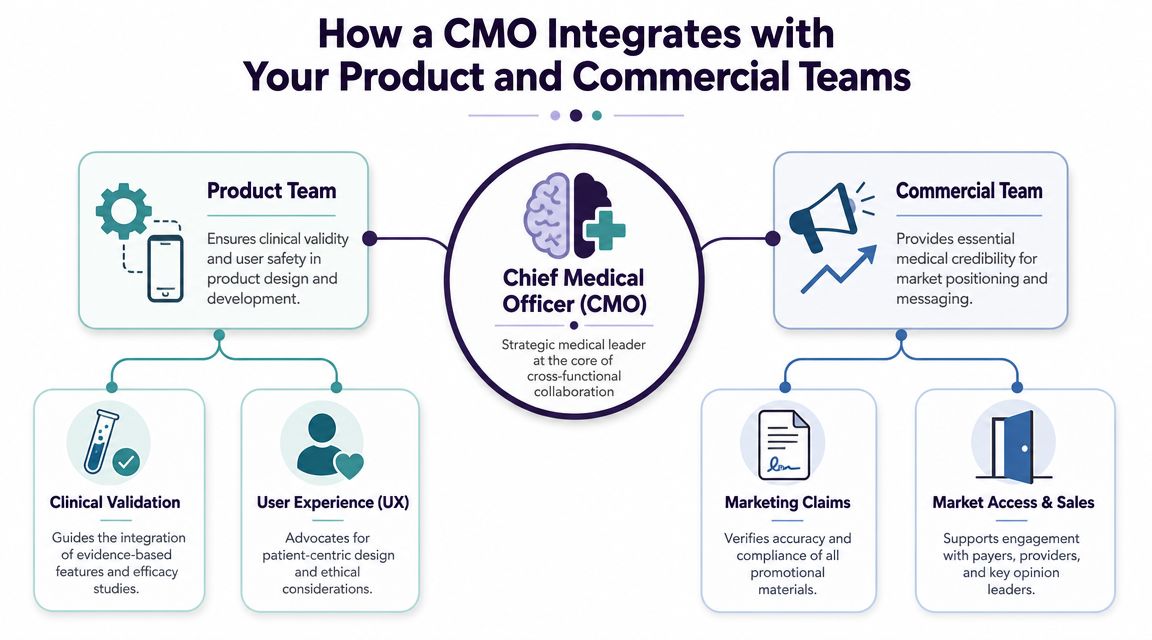
A good CMO shouldn't sit off to the side reviewing documents once a month. They should be embedded where product choices and market claims get made.
That doesn't mean they become the bottleneck. It means they become part of the decision loop.
With product teams
The CMO helps product leaders answer a hard question early. Should this feature exist at all?
That sounds obvious, but many teams build health features because they test well in interviews or look compelling in a roadmap deck. The CMO brings clinical relevance into that conversation. They can flag when a workflow creates confusion, when a recommendation could be misused, or when the product needs clearer boundaries.
Typical touchpoints include:
- Feature review for safety, appropriateness, and clinical usefulness
- Protocol or validation input when the company needs evidence behind a workflow
- UX review where patient or clinician interpretation affects risk
With commercial teams
The commercial side often gets the biggest immediate lift from the role of chief medical officer.
Marketing teams need to know what they can say. Sales teams need a credible medical narrative for discerning buyers. Partnerships teams need support when hospitals, employers, or health plans ask detailed clinical questions.
A CMO helps teams avoid two common mistakes. First, underselling a legitimate medical value proposition because nobody can articulate it well. Second, overselling with claims that create credibility problems later.
For teams building in this space, healthcare technology consultants can also complement a CMO by bringing operational and market perspective across implementation, product strategy, and commercialization.
Your product team builds what users touch. Your CMO helps decide whether that experience is clinically sound and commercially believable.
With legal and leadership
The CMO also plays a quiet but important role with legal and the executive team. They reduce friction by resolving clinical questions before they become legal problems or board-level concerns.
That means fewer last-minute rewrites, fewer panicked debates over wording, and better alignment on where the company is taking responsible risk versus reckless risk.
Your First CMO Hiring Checklist and Key Questions
You feel the need for clinical leadership before you can define the job. That is exactly when founders make bad hires.
A startup does not need the hospital version of a CMO with a broad ceremonial remit and little day-to-day product involvement. It needs a medical leader who can make decisions, tighten claims, and help the company sell with confidence. In most cases, that points to a fractional operator with clear authority, not a vague advisor with an impressive title.
Start with scope, not resumes
Do not start with credentials. Start with the business problem.
If you hire before defining the role, you will get one of two bad outcomes. A senior clinician who expects an enterprise support structure you do not have, or a part-time advisor who joins calls and changes nothing. Founders should write the mandate before they review a single profile.
Use this checklist:
Clarify the trigger
State why you are hiring now. Product launch, enterprise sales pressure, fundraising diligence, claim review, clinical validation, or a specific risk issue.Define the decisions they own
Decide whether the CMO signs off on claims, shapes study design, joins buyer calls, reviews incidents, or sets clinical priorities for the roadmap.Set the operating cadence
Specify how they work with leadership, product, legal, and commercial teams each week or month.Choose the model
Pick the structure that fits the stage. For early and growth-stage companies, fractional is usually the right default. It gives you real medical leadership without the cost and inertia of a full-time executive hire.Plan onboarding
Give them fast access to the product, positioning, customer objections, legal questions, and the people who make decisions.
One more rule. Tie the role to outcomes. If you cannot say how this person will improve product judgment, reduce claim risk, shorten sales friction, or strengthen investor credibility, the scope is still too loose.
Ask questions that reveal startup fit
Good candidates know medicine. Strong candidates know how to apply it inside a company that is still building, selling, and changing fast.
Ask questions that force them to show judgment:
What is the biggest clinical or medical credibility risk in our current product?
This shows whether they can diagnose problems quickly from imperfect information.Tell me about a time you balanced clinical best practice with budget, speed, or commercial pressure. What decision did you make?
You want disciplined judgment, not rigid purity.How would you validate our core product claim at our current stage?
The right answer fits your stage. Early startups need practical evidence plans, not oversized studies that stall the business.What should our marketing team stop saying right now?
A useful CMO can hear risky language and correct it fast. If your team also needs help translating clinical credibility into messaging, this guide to digital marketing for life sciences is a useful companion.How would you spend your first 30 days working with product, sales, and leadership?
Their answer should sound operational. If it sounds abstract, keep looking.
Do not ask whether they are strategic. Ask how they make tradeoffs when evidence, timing, and revenue pressure collide.
Check for signs they can actually work in a startup
Startup fit is not a personality trait. It is a working style.
Look for candidates who can make a call without hiding behind committee process, explain medical risk in plain business language, and stay useful across product, commercial, and leadership conversations. A corporate or hospital CMO may have deep credibility and still be wrong for your company if they are used to large teams, slow approvals, and narrow ownership.
The broader market has already shifted in this direction, as noted earlier. Medical leadership is showing up earlier because trust, regulation, and clinical scrutiny now affect product adoption and revenue. For a startup, that does not mean rushing into a full-time executive search. It means treating medical leadership as a strategic function early, then buying it in the form that matches your stage.
For most founders, that form is fractional. It is faster to hire, easier to scope, and far more likely to produce useful output in the first 90 days.
The CMO as Your Strategic Growth Catalyst
The role of chief medical officer is often framed too defensively. That's a mistake.
Yes, a CMO helps reduce risk. Beyond that, they help your company become more credible, more focused, and easier to buy from. They sharpen product judgment. They strengthen claims. They help commercial teams walk into harder conversations with real authority. That is not overhead. That is a powerful asset.
For most startups, the smartest move isn't waiting until the org chart looks mature enough for a full-time executive. It's bringing in the right fractional medical leader early enough to influence product, trust, and go-to-market while the company is still flexible.
If you're also thinking about how medical credibility shows up in messaging and market education, this piece on digital marketing for life sciences is a useful next read.
If you're evaluating whether your business needs a full-time or fractional medical leader, Shiny offers a practical way to scope the role and connect with vetted executives who can step in for focused weekly support. A short consultation can help you determine whether you need strategic oversight, product guidance, commercial support, or a broader clinical leadership function.