


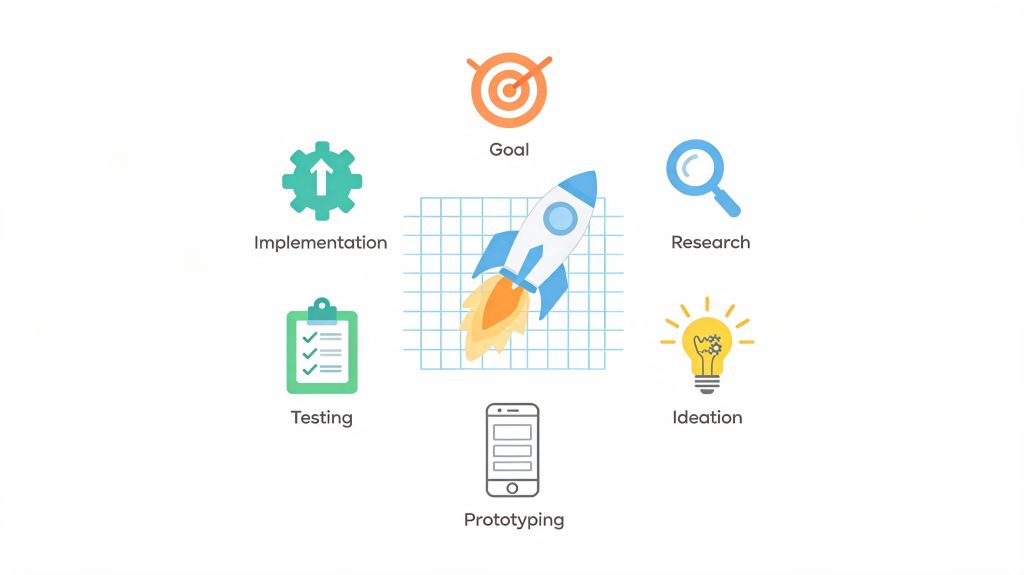
A lot of startups don't have a product problem. They have a process problem.
The team is busy. Engineering is shipping. Marketing is asking for landing pages, pricing changes, onboarding tweaks, and three “quick wins” from customer calls. Sales wants one feature for a big prospect. Support wants another because current users keep tripping over the same workflow. Everyone is working hard, and the product still feels scattered.
That usually shows up as missed launches, rework, and features that sound good in planning but don't change customer behavior once they're live. The six step design process gives teams a way out of that loop. Not as a creative exercise, but as an operating system for deciding what to build, why it matters, and how to validate it before you burn cash on full implementation.
For startups, the challenge isn't understanding the theory. It's applying it with a lean team, limited time, and no appetite for month-long workshops.
From Chaos to Clarity The Case for a Design Process
Monday starts with one pricing request from sales, two onboarding fixes from support, and a homepage rewrite from marketing. By Thursday, engineering has three versions of the requirement, nobody agrees on the success metric, and the founder is settling priority calls in Slack. I have seen that pattern in early-stage teams more than once. It is rarely a talent problem. It is an operating problem.
A design process gives the company a way to make product decisions in sequence instead of by volume. The six step design process helps teams define the problem, examine user needs, generate options, test assumptions, and ship with a clear measure of success. Good teams do not treat those steps like a rigid handoff. They compress some stages, run parts in parallel, and increase depth only where the business risk justifies it.
What breaks first is usually decision quality, not visual quality.
The warning signs are familiar:
- Roadmaps drift: priorities change week to week because the team never agreed on the problem behind the request.
- Discovery gets skipped: a stakeholder opinion becomes a build plan before anyone checks it with users.
- Estimates get worse: engineering is asked for timing and scope before the team has stable requirements.
- Feedback arrives too late: customers react after launch, when fixes cost more and internal trust drops.
Startups feel this harder because they do not have spare capacity. A larger company can hide weak process behind extra headcount for a while. A lean team cannot. Founders need a way to decide which questions require research, which bets deserve a prototype, and which requests should die early. A quick SWOT analysis for product and team priorities can help clarify where the process is breaking before the next sprint absorbs the cost.
One review of execution gaps in the six-step model found that 73% of design projects exceed timelines (review of the six-step process gap). That tracks with what happens inside startups that skip definition and testing. Timelines slip because teams are still making core decisions after build work has started.
The practical rule is simple. If the team cannot do every step at full depth, shorten the steps. Keep the steps that prevent expensive mistakes.
Fractional executives often create the biggest gain here. A fractional Head of Product can tighten scope and decision ownership. A fractional CMO can bring market context, message testing, and customer insight before the team builds the wrong thing. A fractional CTO can pressure-test technical assumptions early, when changing direction is still cheap. A fractional COO can keep the process tied to resources, sequencing, and revenue goals instead of letting it turn into an abstract workshop.
That mix matters for startups because each stage of the design process has a different failure mode. Founders do not need a full executive bench to cover all of them. They need targeted senior judgment at the points where ambiguity is expensive.
Stage One Define Goals and Research Users
The first two moves are the ones teams rush past. That's a mistake.
The Define phase is where you turn raw observations, stakeholder requests, and market noise into an actual business problem worth solving. It has been described as “the bridge between research and ideation” in Group107's breakdown of the six-step design process. For startups in the $1M-$50M range, that bridge matters because growth usually creates competing agendas faster than internal alignment can keep up.


Start with the business, not the feature
A weak starting question is “What should we build?”
A better one is “What business outcome are we trying to change, for which users, and what evidence says this matters now?”
That shifts the conversation fast. Instead of arguing over interface ideas, you anchor the team around operating goals such as activation, expansion, retention, or conversion quality. Then you ask what users are struggling with that blocks that outcome.
At this stage, strong teams produce a short set of working artifacts:
- Project Brief: the problem, audience, constraints, business context, and decision owners.
- Prioritized Feature Backlog: not a wish list, but an ordered list tied to the problem being solved.
- User Stories and Acceptance Criteria: enough detail for design and engineering to evaluate scope.
- Success Metrics: the KPIs you'll watch so launch decisions don't turn into opinion contests.
Those deliverables reduce scope creep and tighten team alignment because everyone can see what's in, what's out, and how success will be judged.
Keep research lean and useful
Early user research doesn't need to be expensive. It does need to be disciplined.
A practical lean stack often includes:
- Customer interviews: talk to recent buyers, churned accounts, and active users separately.
- Support ticket review: look for recurring friction in onboarding, setup, or handoff points.
- Sales call analysis: identify promises, objections, and feature assumptions that keep repeating.
- Competitive review: compare flows, positioning, and value framing across category alternatives.
- Basic strategic framing: a lightweight market scan or a structured exercise like a SWOT analysis for startups and growing teams.
Teams waste time when they collect user quotes without making decisions from them. Research only pays off when somebody synthesizes it into clear trade-offs.
Who should own this stage
This is usually the most impactful place for a fractional CMO, fractional CPO, or experienced Head of Product.
Why? Because this phase needs someone who can connect market signals to business priorities. A good operator can translate vague founder intent into a brief that design, engineering, and GTM teams can use. They also know when enough research is enough. Startups don't need endless discovery. They need enough evidence to stop guessing.
Here's a simple ownership view:
| Workstream | Best-fit fractional leader | What they drive |
|---|---|---|
| Market framing | Fractional CMO | Segment priorities, positioning inputs, buyer language |
| Product definition | Fractional CPO or Head of Product | Brief, backlog, success criteria |
| Stakeholder alignment | Founder plus fractional operator | Trade-offs, decision rights, timeline |
The biggest trap here is pretending alignment exists because everyone nodded in a meeting. If it isn't written down in the brief, backlog, and KPI list, it isn't aligned.
Stage Two Ideate Solutions and Create Prototypes
Once the problem is defined, teams need volume before they need polish.
That's where ideation helps. Not because brainstorming is magical, but because the first idea is usually the most obvious one. Obvious ideas often mirror internal bias more than user reality. You need enough concepts on the table to compare approaches before picking a direction.


What works in lean teams
You don't need a full workshop calendar. You need constrained exercises.
A few methods work well for startups:
- Crazy Eights: each person sketches multiple rough concepts quickly. Good for breaking groupthink.
- How Might We prompts: reframes a problem into solvable questions without locking into one answer.
- Journey breakdowns: map each step a user takes and ask where friction or confusion appears.
- Constraint-led ideation: force ideas to fit technical limits, brand limits, or time-to-launch needs.
The goal isn't to impress anyone with creativity. It's to generate options with different assumptions built in.
Prototype at the cheapest level that answers the question
Founders often overbuild prototypes. If you're testing structure, don't design final visuals. If you're testing comprehension, don't waste time on production-ready interactions.
Use the lightest prototype that can produce useful feedback:
| Prototype type | Best used for | Typical tools |
|---|---|---|
| Paper sketches | Flow ideas, page order, rough hierarchy | Pen, paper, whiteboard |
| Wireframes | Layout and information structure | Figma, Balsamiq |
| Clickable mockups | Task completion, interaction logic, user walkthroughs | Figma, Framer |
A rough sketch is often enough to expose whether the concept makes sense. A polished mockup is useful when the sequence of actions matters.
For companies that need extra support, outside specialists can help shape this stage. That can mean a contract product designer, an agency sprint, or a focused advisor through a service like a UX design consultant engagement.
Where the fractional CTO adds real leverage
Ideation gets expensive when the team falls in love with ideas engineering can't deliver cleanly.
A fractional CTO or senior technical product leader is valuable here because they pressure-test feasibility early. They can flag when a concept needs a heavy data model change, a brittle integration, or an architecture decision you're not ready to make. That doesn't kill ideas. It improves them.
A strong prototype answers a business question. It is not a miniature version of the final product.
The handoff between product and technology is what separates productive prototyping from expensive theatre. Good teams leave this stage with a small number of viable concepts, a preferred direction, and clarity on what still needs validation.
Stage Three Test Assumptions and Validate with Users
A startup spends six weeks shaping a promising prototype, gets a few encouraging comments from friendly contacts, and greenlights the build. Three months later, the team learns the actual buyer cannot complete the core workflow without help. That mistake is common, and it is expensive.
Testing is the point where assumptions either get corrected cheaply or harden into roadmap debt.
Startups usually miss here for one of two reasons. They test with the wrong people, or they ask the kind of questions that produce polite approval instead of useful evidence. Friendly feedback feels productive. It rarely protects the business.
According to Netcode Design's summary of the test-iterate cycle, fixing issues after launch can cost 10-100x more. The same review says teams that iterate 2-3 times before launch report 30-40% higher product adoption, and that experienced fractional leaders can compress what often takes 2-3 months into 3-4 weeks.

What good testing looks like
Good testing answers a business question. Can the target user complete the task, understand the value, and move forward without a sales call or product manager filling in the gaps?
A strong testing round usually includes:
Relevant participants
Recruit current users, recent lost deals, trial users, or people who match the buying role closely. If the product supports a specialized workflow, broad consumer feedback is noise.Task-based sessions
Ask participants to complete a realistic job. Reset a dashboard. Invite a teammate. Generate a report. Specific tasks expose friction faster than opinion questions.Observation over explanation
Watch where users hesitate, misread labels, abandon the flow, or invent workarounds. Hold back. Once the moderator starts rescuing, the session stops being diagnostic.Pattern review after each round
Record sessions with Zoom, Loom, or Maze. Group findings by severity and frequency. One confused user is a note. Five users stuck at the same step is a priority.Decisions tied to impact
Separate cosmetic feedback from blockers to activation, conversion, or retention. That keeps the team from polishing low-value details while core friction stays in place.
Questions that reveal signal
A useful moderator question is: “What would you expect to happen next?”
A weak one is: “Would it help if we changed this button?”
The first shows how the user understands the product. The second supplies the answer. Teams that need to conserve time and budget should treat testing this way because it aligns with a broader lean startup methodology for reducing product risk. The goal is fast evidence, not internal consensus.
If users need your explanation to finish the task, the product is still carrying hidden risk.
Where fractional leaders add the most value
This is one of the highest-return places to bring in fractional support.
A fractional CMO or GTM leader can help recruit the right participants fast, especially in narrow markets where access is the primary bottleneck. They usually know which customer segments matter, which prospects are worth interviewing, and how to frame outreach so people respond.
A fractional product leader helps the team separate usability problems from market problems. That distinction matters. If users struggle because labels are vague, the fix is straightforward. If they struggle because the workflow solves a problem they do not care about, the issue sits higher up in the strategy.
A fractional COO keeps testing from turning into an isolated design exercise. The role matters when findings affect onboarding, support, pricing, or internal process changes. In early-stage companies, that cross-functional follow-through is often the difference between “we learned something” and “we changed the business.”
One testing round is rarely enough. Strong teams run enough cycles to remove major confusion, confirm the value proposition holds up with real users, and enter build with fewer expensive surprises.
Stage Four Implement the Solution and Measure Success
A startup gets through research, prototyping, and validation with good signal. Then the build starts, deadlines tighten, and the team slips back into old habits. Engineering optimizes for speed, marketing plans around a date, support hears about changes late, and the original user problem starts to blur.
That is the ultimate test of the process.
The implementation and scaling phase is where companies struggle most when ownership is fuzzy. This design-thinking accountability discussion makes the point clearly. Mapping process ownership to executive roles keeps decisions from stalling in handoffs and keeps design tied to business execution.

Implementation needs explicit owners
A validated prototype still leaves hard operating questions unanswered. What ships first. What gets cut. What support needs to prepare for. Which message goes to market. Who decides whether the early results justify more investment.
Resource-constrained startups usually do not need four full-time executives to answer those questions. They do need clear ownership. Fractional leaders are often the highest-value option here because this stage is less about generating ideas and more about judgment, sequencing, and cross-functional follow-through.
| Phase of execution | Primary owner | Core responsibility |
|---|---|---|
| Build and release planning | Fractional CTO or VP Engineering | Scope control, sequencing, technical delivery |
| Operational readiness | Fractional COO | Cross-team coordination, support readiness, process updates |
| Market rollout | Fractional CMO | Messaging, launch assets, channel coordination |
| Business impact review | Fractional CFO or finance leader | KPI review, ROI framing, resource decisions |
The trade-offs are rarely clean. Engineering wants room to reduce technical risk. Marketing wants a date the market can trust. Customer success needs time to update training and support flows. Finance wants to know whether the release changes revenue, retention, or cost to serve. If nobody has authority to settle those conflicts, the company ships a compromised version late and still cannot explain whether it worked.
Measure outcomes, not shipping activity
Release is a milestone. It is not the result.
Use the success criteria set earlier and translate them into an operating review the team can run. For one product, that may be activation rate and time to first value. For another, it may be adoption quality, repeat usage, or conversion through a key step in the funnel. The metric has to match the problem the team set out to solve.
A few habits make this stage sharper:
- Capture a baseline before launch: without a before-and-after view, results turn into opinion.
- Set a review window in advance: a one-week read can catch usability issues, while a longer window may be needed for retention or revenue effects.
- Track leading and lagging indicators: early behavior shows whether users are engaging, and later metrics show whether the business benefits.
- Record what changed around the release: pricing, onboarding, messaging, and support changes can distort the read if they are not documented.
I have seen startups miss the signal in both directions. Some call a launch successful because the feature shipped on time, even though customer behavior barely moved. Others kill a good idea too early because they never aligned on how long measurement should take or who owned the readout.
Launches fail quietly when nobody owns the question, “Did this solve the problem we said it would solve?”
One operational option for startups that need flexible executive coverage is Shiny's fractional executive marketplace, which connects companies with part-time leaders across functions. The practical benefit is simple. Founders can assign real accountability at implementation without taking on full-time executive overhead too early.
Making the Design Process Your Competitive Edge
The six step design process works because it forces better decisions early, cheaper learning in the middle, and clearer accountability at the end.
For startups, the advantage isn't that the process is elegant. It's that it helps lean teams stop wasting expensive attention on the wrong problems. You don't need a large in-house design org to do that well. You need discipline in Define, honesty in Test, and adult ownership in implementation.
The best resource-constrained teams treat the process as flexible but not optional. They compress steps when needed. They run some work in parallel. They bring in fractional leadership where judgment matters most. They keep the parts that reduce risk and skip the theatre that slows them down.
That's usually the difference between a roadmap that looks busy and a product organization that learns.
If your team needs that kind of structure but doesn't need full-time executive overhead, Shiny can help you find a fractional leader who fits the stage you're in, whether that's product definition, go-to-market alignment, technical feasibility, or launch execution. A short conversation can help you decide which role would create the most impact first.