


Software development project management isn't just a fancy term—it's the structured process of planning, building, and launching software projects to hit specific goals. Think of it as the central nervous system for turning a big idea into a real, market-ready product on time and on budget. Without it, even the most brilliant development teams can drift into chaos, burning through cash and missing deadlines.
Your Blueprint for Digital Success


Trying to build great software without a solid management framework is like starting construction on a skyscraper without architectural plans. The foundation is shaky, communication breaks down, and the whole thing is at risk of collapse. This is a common pain point for startups and SMBs, where a lack of structured oversight leads directly to blown budgets, missed deadlines, and a completely burnt-out team.
Effective software development project management flips this chaotic process on its head, turning it into a predictable, repeatable engine for growth. It provides the clarity and direction your team needs to cut through the complexities of coding, testing, and deployment.
Why Structured Management Is Non-Negotiable
A classic pain point for growing businesses is the massive gap between a great idea and a successful launch. Project management is the bridge that closes that gap, making sure every single action is purposeful and tied to the bigger business goals. It's the discipline that keeps talented, creative teams focused and moving forward together.
When you get it right, the benefits are huge:
- Clear Vision and Alignment: Everyone—from your newest developer to your key stakeholders—is on the same page about the project's goals, scope, and what "done" actually looks like.
- Risk Mitigation: You start spotting potential roadblocks before they happen. This proactive approach stops small hiccups from snowballing into major crises that can derail the entire project.
- Resource Optimization: Your budget, people, and time are managed efficiently. This isn't about being cheap; it's about getting the absolute maximum return on every dollar you invest.
- Improved Stakeholder Communication: A structured process means regular, transparent updates. This builds trust, manages expectations, and keeps everyone feeling confident and informed.
Think of a great project manager as an orchestra conductor. Each musician is a master of their instrument, but without the conductor's guidance, you just get noise. The conductor unifies their efforts, sets the tempo, and ensures every part contributes to a beautiful final piece.
Ultimately, a strong management approach is the key to creating a repeatable system for success. It lays the groundwork for scaling your technical team and hitting your long-term goals, much like the strategic planning found in a well-crafted digital transformation roadmap. This guide is your practical playbook for putting these principles into action and turning ambitious ideas into tangible wins.
Navigating Modern Development Methodologies
Picking a development methodology is a lot like choosing an operating system for your team. It sets the ground rules for how work gets done, how you make decisions, and—most importantly—how you react to change. The right choice creates a smooth, efficient rhythm. The wrong one? It feels like you're constantly hitting roadblocks and dealing with unnecessary friction.
At the highest level, you have two foundational philosophies: Waterfall and Agile.
Think of it like building a house. The Waterfall method is like having a detailed architectural blueprint from day one. Every single element—the foundation, the walls, the wiring—has to be perfectly finished in a rigid sequence before the next phase can even begin. There’s zero room to decide you want an open-concept kitchen halfway through the build.
Agile, on the other hand, is like starting with a solid one-room cabin and then adding new rooms and features as you live in it. You get a functional core built quickly, then you expand and refine it based on what you actually need. It’s all about adapting as you go.
The Classic Waterfall Model
The Waterfall model is the traditional, linear approach. Each stage of the project must be fully completed before you can move on to the next. It flows downwards, just like a waterfall, through phases like requirements, design, implementation, testing, and deployment.
This highly structured method works brilliantly when your project requirements are crystal clear, fully documented, and absolutely not going to change.
- Best for: Projects with a fixed scope, especially in regulated industries. Think building a compliance system for a bank or developing medical device software where specifications are locked in from the start.
- Challenges: Its greatest strength—its structure—is also its biggest weakness. If the market shifts or a design flaw is found late in the game, making changes is incredibly expensive and time-consuming. You often have to go back several steps, which can derail the entire project.
Embracing Agility with Scrum and Kanban
Agile isn’t a single method, but a philosophy built around flexibility, collaboration, and making steady, iterative progress. Instead of aiming for one massive "big bang" launch, Agile teams deliver small, working pieces of the product in short cycles. This lets them get feedback early and often.
Two of the most popular frameworks for putting Agile into practice are Scrum and Kanban.
Scrum is a more structured Agile framework. It organizes all work into sprints—short, time-boxed periods that usually last two to four weeks. At the start of each sprint, the team commits to a specific set of tasks. Regular meetings, like the daily stand-up, keep everyone aligned. It creates a predictable, repeatable rhythm for the development team.
Kanban is more fluid. It's all about visualizing your workflow on a Kanban board, with columns like "To Do," "In Progress," and "Done." The main goal is to limit the amount of work in progress at any one time. This system makes it incredibly easy to spot bottlenecks and manage a continuous stream of work without the fixed deadlines of a sprint. It’s perfect for teams handling ongoing support tickets or unpredictable feature requests.
Agile frameworks like Scrum and Kanban treat software development like a sculptor revealing a masterpiece. Instead of having a perfect final image from day one, the team chips away at the marble, making small, deliberate changes and adjustments based on how the form is taking shape. This iterative process ensures the final product truly meets the vision.
Comparing Project Management Methodologies
Choosing between Agile, Waterfall, and a Hybrid model depends heavily on your project's specific needs. Each one offers a different balance of flexibility, structure, and speed. Here’s a quick breakdown to help you decide which path is right for your team.
| Attribute | Agile (e.g., Scrum) | Waterfall | Hybrid |
|---|---|---|---|
| Flexibility | High. Changes are welcomed between sprints. | Low. Changes are difficult and costly once a phase is complete. | Moderate. Blends upfront planning with adaptive execution. |
| Speed | Fast, with iterative delivery of features. | Slow, with one final delivery at the end. | Moderate. Can accelerate development after an initial planning phase. |
| Documentation | Minimal, focuses on working software. | Extensive and required at each stage. | Balanced. Upfront documentation with lighter docs during sprints. |
| Ideal Projects | Complex projects with evolving requirements. | Simple projects with fixed, well-understood requirements. | Projects that need upfront planning but also flexibility during development. |
Ultimately, there's no single "best" methodology. The goal is to pick the one that aligns with your project goals, team culture, and the level of uncertainty you're facing.
The Rise of Hybrid Methodologies
For a lot of teams, going purely Agile or purely Waterfall just doesn’t feel right. This has led to the rise of Hybrid models that borrow the best elements from both.
A common approach is to use a Waterfall-style process for the initial high-level planning and requirements gathering. This gives stakeholders and the team a clear roadmap. But once development starts, the team switches to Agile sprints for the actual coding, testing, and refinement. You can see a similar iterative spirit in our guide to the Lean Startup methodology.
This blend of predictability and adaptability has become the new normal. Research shows that by 2025, a staggering 60% of project managers across all industries will be using hybrid methods. It reflects a fundamental truth in modern development: you need a solid plan, but you also need to be ready to pivot when you get new information from the market.
Building Your High-Performing Development Team

Frameworks and fancy tools are great, but let’s be honest—projects are built by people. Getting the right team in place, with everyone knowing exactly what they’re responsible for, is the single most important part of turning an idea into a real, working product.
Without that clarity, you’re setting yourself up for chaos. You get overlapping work, wires get crossed, and accountability goes out the window. It’s a recipe for stalling out even the most brilliant projects.
Think of it like coaching a sports team. Every player has a specific position, and winning depends entirely on how they play together. Good software development project management makes sure everyone knows their position, the playbook, and what the team is trying to achieve.
The Core Players and Their Roles
Titles can shift from company to company, but a solid development team almost always has these core functions. Nailing down who does what is the key to building a team that just clicks.
-
The Product Owner (The Visionary): This person is the guardian of the product's vision. They represent the customer and the stakeholders, constantly answering what we should build and why it matters. Their main job is to own the product backlog, relentlessly prioritizing it so the team is always focused on creating the most value.
-
The Project Manager or Scrum Master (The Facilitator): This role is all about the how. A Project Manager ensures the project runs smoothly, managing resources, timelines, and risks. In Agile setups, the Scrum Master is more of a servant-leader—clearing roadblocks and keeping the team true to its process. They’re the leader on the field, executing the game plan.
-
The Development Team (The Builders): These are the folks who actually build the product—the engineers, designers, and QA specialists. They’re the experts tasked with designing, coding, testing, and ultimately delivering a high-quality product. The best teams are collaborative, take ownership, and are fully committed to the project's success.
A common mistake is viewing these roles as a strict hierarchy. They aren't. They're a partnership. The Product Owner points to the destination, the Project Manager maps out the route, and the Development Team sails the ship.
Addressing the Realities of Small Teams
Let’s get real. In a startup or a small business, you rarely have the luxury of a dedicated person for every role. Founders, lead developers, and product leads end up wearing a bunch of different hats. Your lead dev is probably the unofficial project manager, and the CEO is almost certainly the product owner.
This can work for a while, but it’s a difficult model to scale. As the project gets more complicated, the lack of dedicated leadership creates bottlenecks and kills focus. Important tasks start slipping through the cracks, deadlines get missed, and quality suffers. Our leadership guide on building high-performing teams dives deeper into how to handle this as you grow.
Knowing when you've hit the breaking point is critical. When your key people are so stuck in the weeds of daily management that they can't do their actual jobs, you have a leadership gap. That’s your cue that you need to bring in reinforcements to keep the momentum going and help your project management mature alongside your company.
To bridge this gap, many growing businesses are turning to a more flexible solution: fractional leadership. You can bring in a seasoned leader who provides the strategic oversight and process you need, but without the full-time cost. This gives your project the experienced direction it needs to thrive and frees up your internal team to do what they do best. It’s about finding the right partner to keep you on track and drive real growth.
A Practical Guide to the Software Project Lifecycle
Every single software project, whether it's a slick mobile app or a sprawling enterprise platform, goes on a predictable journey. Getting a handle on this lifecycle is the bedrock of solid software development project management. It gives you a roadmap from that first lightbulb moment all the way to a product people can actually use.
Without that map? Teams just wander. They burn through cash and time, feeling busy but never really getting anywhere.
Think of the lifecycle like the seasons of a project. Each phase has its own climate, its own set of activities, and its own goals. You can't just skip winter and expect a spring harvest. A structured approach means you’re tackling the right tasks at the right time, building momentum and drastically cutting your risk of failure.
This visual shows you how the pieces fit together, moving from one stage to the next.
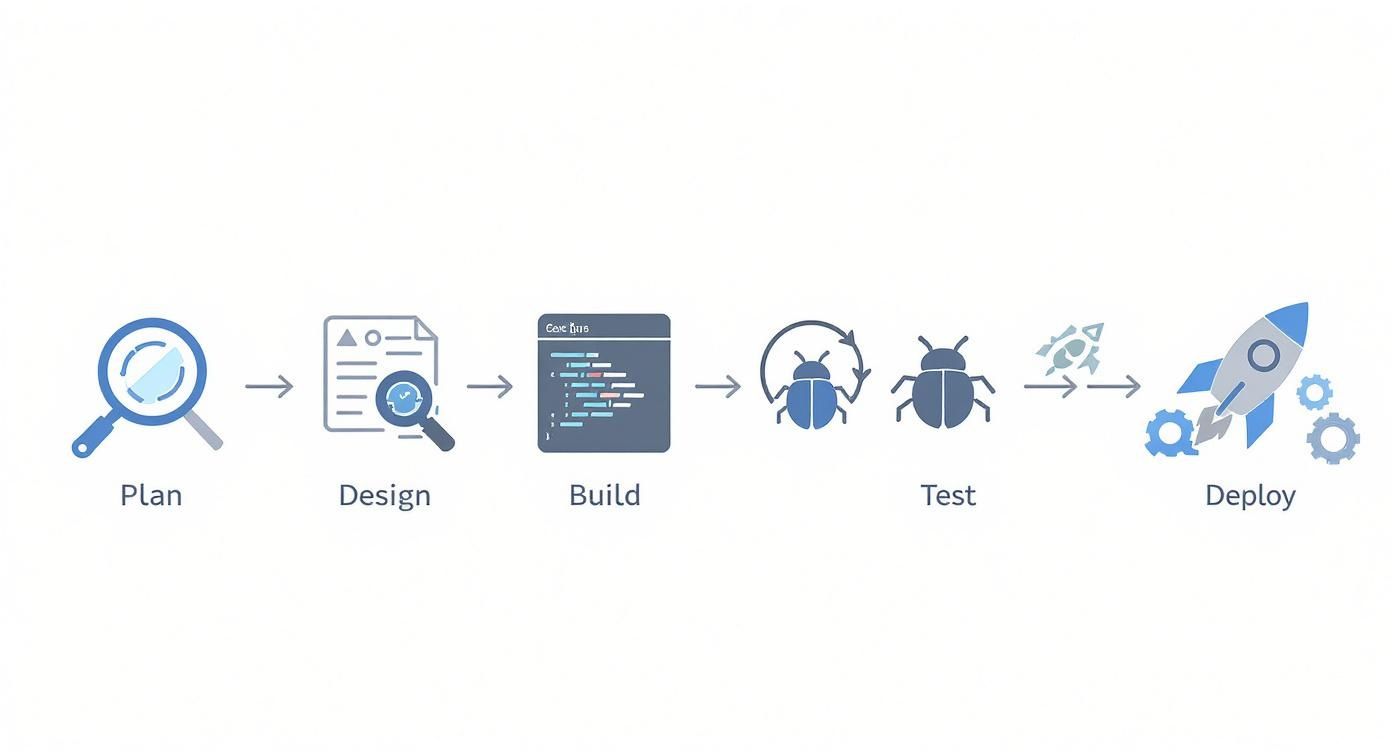

As you can see, it’s a logical flow: plan, design, build, test, and then release it into the wild.
Phase 1: Discovery and Planning
This is where it all begins. It’s the foundational stage where you nail down the "why" and the "what" of your project. This part is less about writing code and more about deep, strategic thinking. Trying to skip this is like setting sail without a destination—you'll definitely be moving, but you won't end up anywhere useful.
The entire goal here is to get crystal clear on what you're building. A shocking number of projects go off the rails right here. In fact, industry research shows that roughly 25% of software projects fail outright or deliver disappointing results, often because of a breakdown in this initial planning. What’s more, over 57% of developers point to unclear requirements as a major roadblock that leads to endless rework and delays. You can learn more about these software development statistics and how to steer clear of the common traps.
Key activities during this phase look like this:
- Defining Business Goals: What exact problem are we solving? How will we know if we've succeeded?
- Stakeholder Interviews: Talking to everyone who has a stake in the outcome, from your customers to your CEO, to understand their needs.
- Requirements Gathering: Getting everything down on paper—every single feature and function the software must have.
- Creating a Project Roadmap: Sketching out the major milestones, key features, and a high-level timeline.
Phase 2: UI/UX Design
Once you have a solid plan, the spotlight shifts to the user. How will they experience this thing? This phase isn’t just about making things look pretty; it's about crafting a product that’s intuitive, efficient, and maybe even a little delightful to use. A great UI/UX design is your brand's silent ambassador.
Here, designers take all those documented requirements and turn them into tangible, visual guides. The process usually moves from rough, low-fidelity sketches to high-fidelity prototypes that look and feel almost like the real deal.
"Design is not just what it looks like and feels like. Design is how it works." – Steve Jobs
That quote absolutely nails it. This stage is all about building empathy for the user and designing a solution that solves their problem without making them think too hard. The output is a set of wireframes, mockups, and interactive prototypes that will serve as the blueprint for the development team.
Phase 3: Development Sprints
This is where the rubber meets the road and the vision finally starts turning into functional code. If you’re following an Agile approach, this phase gets broken down into a series of sprints. These are short, intensely focused cycles (usually 1-4 weeks) where the team builds and delivers small, testable chunks of the software.
Each sprint kicks off with a planning meeting to pull tasks from the product backlog and wraps up with a review to show off what’s been built. This iterative loop allows for constant feedback and course correction, making sure the project stays aligned with what the business actually needs as it evolves.
Phase 4: Quality Assurance and Testing
Running right alongside development is Quality Assurance (QA). This is the systematic process of making sure the software is free of bugs, meets every requirement, and provides a smooth user experience. Think of it as the critical safety net that catches problems before they ever reach your customers.
QA isn't a one-and-done check at the very end. It's a continuous effort that involves several different kinds of testing:
- Unit Testing: Checking that individual pieces of code work as expected.
- Integration Testing: Making sure all the different parts of the software play nicely together.
- User Acceptance Testing (UAT): Putting the software in front of actual users to confirm it meets their needs and solves their problems.
Phase 5: Deployment and Maintenance
The final phase is the launch. Deployment is all about releasing the tested, polished software to your customers or internal users. But the work doesn’t stop there. Far from it.
After launch, the focus shifts to maintenance and support. This means fixing any bugs that crop up, monitoring the software's performance, and planning for future updates and new features based on real user feedback. It’s this cycle of continuous improvement that keeps a product relevant and successful long after its big debut.
Choosing the Right Project Management Tools
The right tools in software development project management are a force multiplier for your team's skills. They can massively boost effectiveness. But the wrong tools? They just create friction, adding layers of complexity and grinding everything to a halt. Sifting through the crowded market of project management software is a huge step in setting your team up to win.
Picking a tool isn't just about ticking off features on a list; it's about finding a perfect match for your team's DNA—your size, your project's complexity, and your workflow. It's kind of like choosing a vehicle. You wouldn't take a semi-truck to run a quick errand, and you wouldn't try to haul lumber in a two-seater sports car. Each is built for a different job.
Matching the Tool to the Team
The real trick is to understand the "why" behind each popular platform. Don't get lost in feature-by-feature comparisons. Instead, think about the kind of work your team actually does and how they like to work together. A scrappy startup just finding its groove has completely different needs than a big, established team juggling a dozen complex product lines.
-
For Simplicity and Visibility (Startups and Small Teams): Tools like Trello or Asana are fantastic starting points. They lean on simple, visual Kanban boards that make it dead simple to see who's working on what. The drag-and-drop interface is so intuitive that small teams can be up and running in minutes with almost no learning curve.
-
For Robustness and Scalability (Growing and Enterprise Teams): As your projects get bigger, you need more power under the hood. Jira is the industry standard for good reason. It offers deep customization, powerful reporting, and advanced workflow automation—all the heavy-duty stuff larger teams need to manage complex backlogs, squash bugs, and map out multi-sprint roadmaps. It definitely takes more time to master, but its power for sophisticated software development is second to none.
A tool is only as good as the process it supports. Before you commit to any software, map out your ideal workflow. The right platform will feel like a natural extension of how your team already wants to work, not something that forces them into a rigid, uncomfortable structure.
Creating a Seamless Workflow
Your project management tool can't be an island. To really get your money's worth, it has to plug in seamlessly with the other platforms your team lives in every day. This creates a single source of truth and cuts out the constant context-switching that absolutely kills productivity.
Look for rock-solid integrations with essential developer tools like GitHub or GitLab. When you connect your project board to your code repository, you can set up automatic updates—like moving a task to "Done" the second a pull request is merged. In the same way, integrating with communication hubs like Slack or Microsoft Teams makes sure important project updates and notifications pop up right where the conversation is already happening.
The numbers back this up. By 2025, an estimated 82% of companies globally will use project management software. But here’s the catch: there's a huge gap between having a tool and using it well. Only 23% of organizations use their PM software consistently. The data shows that high-performing projects are 77% more likely to use these tools properly, and the gains are massive. You can explore more project management statistics to see the full impact on efficiency. Nailing this focus on process and tooling is a core strength a fractional leader brings to the table, making sure your investment actually pays off.
Bridging the Leadership Gap with Fractional Executives
Many growing businesses eventually hit an invisible wall. Their software projects start getting bigger and more complex, but they can't possibly justify the six-figure salary that comes with a full-time, senior technology leader like a Chief Technology Officer (CTO) or VP of Engineering.
This creates a dangerous "leadership gap"—a void right where strategic direction, process maturity, and high-level oversight ought to be.
Without that senior guidance, even the most talented development teams can lose their way. Projects stall, technical debt piles up, and the critical link between the tech being built and the actual business goals starts to fray. It’s a classic dilemma that can seriously pump the brakes on a company's growth.
Thankfully, there’s a modern, flexible solution designed for this exact problem: fractional leadership.
The Power of On-Demand Expertise
Think of a fractional executive like hiring a world-class surgeon for a specific, critical operation. You get elite, specialized expertise precisely when you need it most, but you don’t have to keep them on the permanent payroll. This model gives you access to top-tier talent for a fraction of what a full-time hire would cost.
A fractional technology leader steps in to provide the high-level strategy and process your team is missing. They aren't just an advisor; they're a hands-on part of your team, dedicated to driving results for a set number of hours each week.
A fractional executive is the master architect for your project. While your team is expertly laying the bricks and mortar, the fractional leader ensures the blueprint is sound, the foundation is stable, and the final structure aligns perfectly with your long-term business objectives.
Their main goal is to level up your software development project management capabilities from the inside out. They bring years of experience from scaling other companies, allowing them to install proven frameworks and mentor your current team members, building skills that stick around long after their engagement ends.
What a Fractional Leader Delivers
A fractional CTO or VP of Engineering does a lot more than just show up for meetings. They become an integral part of your leadership, taking real ownership of key outcomes and de-risking your most important technical initiatives.
Their impact is felt across several critical areas:
- Strategic Alignment: They make sure your technology roadmap is directly supporting your business goals, preventing the team from building features that don't actually drive revenue or growth.
- Process Implementation: They introduce and fine-tune project management methodologies—like Agile or Hybrid models—that are a perfect fit for your team's size and the complexity of your projects.
- Team Mentorship: They act as a coach for your lead developers and project managers, helping them grow into stronger leaders and boosting the capabilities of the entire team.
- Risk Mitigation: With a seasoned eye, they spot potential technical, budgetary, and timeline risks long before they blow up into project-derailing crises.
This approach really offers the best of both worlds. You get the strategic firepower of a seasoned executive to steer your projects to success while keeping the financial agility you need to grow your business. It’s a powerful way to make sure your most vital software initiatives have the experienced leadership they need to succeed.
If your projects are missing that senior-level direction, looking into a fractional engagement could provide the exact expertise you need to get back on the fast track. Schedule a consultation with us to learn how connecting with the right executive can transform your development process.
Frequently Asked Questions
When you're in the trenches of managing a software project, a lot of the same questions tend to pop up. Let's tackle some of the most common ones head-on with some practical, no-nonsense answers.
What Is the Biggest Mistake to Avoid?
The single biggest mistake? Kicking off development with fuzzy, unclear requirements. It’s a recipe for disaster.
When your team doesn’t have a rock-solid, shared understanding of what they're building and why, you're signing up for endless rework, blown deadlines, and a torched budget. Before a single line of code is written, you need a rigorous process for gathering, documenting, and getting sign-off on requirements from every stakeholder. Think of this initial clarity as the north star for your entire project.
How Do I Choose Between Agile and Waterfall?
This really comes down to the nature of your project. There's no single right answer, but there are clear indicators for which to lean on.
Choose Waterfall if your requirements are set in stone, fully documented, and unlikely to change. This is often the case for things like compliance-heavy systems or projects with a major hardware component.
Go with Agile when you expect the scope to evolve, you need to get a product to market fast, and you want to bake user feedback into the process. For most modern software development, a Hybrid approach often hits the sweet spot—you get the benefit of some upfront planning combined with the flexibility of iterative execution.
My Small Team Cannot Afford a Project Manager. What Should We Do?
This is an incredibly common spot for startups and small businesses to be in. In the very beginning, a founder or the lead developer can usually juggle project management using simple tools like Trello. But this approach doesn't scale. As the project gets more complex, it starts pulling your most valuable people away from what they do best.
This is the perfect scenario for fractional leadership. A fractional CTO or project manager brings the strategic oversight and process discipline you need for a fraction of what a full-time hire would cost. It's the ideal way to keep your project on track without breaking the bank.
How Can I Improve Communication Between Teams?
Getting technical and non-technical folks on the same page is all about creating a shared language and clear, consistent channels for communication.
- Make it Visual: Roadmaps, user flow diagrams, and wireframes are your best friends. They make abstract ideas tangible for everyone, regardless of their technical background.
- Hold Regular, Purposeful Meetings: Schedule cross-functional check-ins with clear agendas. This isn't about meeting for meeting's sake; it's about keeping everyone aligned and moving in the same direction.
- Designate a Translator: A product owner or project manager should be the official go-between. Their job is to translate business needs into technical tasks and then communicate technical progress back to stakeholders in plain English.
When you do this well, everyone is working from the same playbook. Misunderstandings plummet and progress accelerates.
Feeling the strain of a leadership gap in your development process? Shiny connects you with experienced, vetted fractional executives who can provide the strategic direction your projects need to thrive. Explore our network of top-tier talent and schedule a consultation to find the perfect fit for your team. Find your executive at https://useshiny.com.