



Ready to Ignite Growth?
Looking to scale your startup? This listicle delivers 11 powerful startup growth strategies to fuel your success. Learn how tactics like growth hacking, product-led growth (PLG), and strategic partnerships can dramatically impact your trajectory. Whether you’re in SaaS, FinTech, HealthTech, or another industry, these proven startup growth strategies provide actionable insights to help you achieve your goals. Let’s get started.
1. Growth Hacking
Growth hacking is a data-driven approach to rapidly scaling a startup by experimenting with marketing channels and product development. Unlike traditional marketing, which often relies on large budgets and established strategies, growth hacking prioritizes low-cost, innovative tactics to acquire and retain customers. It’s about finding clever ways to achieve exponential growth with limited resources, making it particularly appealing to startups. The core principle is to test, analyze, and iterate relentlessly to pinpoint the most effective strategies.


Growth hacking distinguishes itself through its specific features. It embraces a data-driven mindset, relying heavily on analytics to inform decisions. Experimentation and A/B testing are paramount, allowing growth hackers to rapidly identify what resonates with the target audience. Cross-functional teams, comprising marketers, developers, engineers, and product managers, work collaboratively to optimize the entire customer journey. The focus remains firmly on key metrics like activation, retention, referral, and revenue – the pillars of sustainable growth.
Growth hacking earns its place on this list of startup growth strategies due to its potential for rapid, cost-effective scaling. It’s particularly relevant for startups navigating the early stages of growth with limited resources.
Examples of Successful Growth Hacking:
- Dropbox’s Referral Program: Dropbox incentivized existing users to refer new users by offering both parties additional free storage space. This viral loop fueled rapid user acquisition.
- Airbnb’s Craigslist Integration: Airbnb cleverly leveraged Craigslist’s existing user base by allowing hosts to cross-post their listings, gaining significant exposure at minimal cost.
- Hotmail’s Automatic Email Signature: By including “Get your free email at Hotmail” in every outgoing email, Hotmail ingeniously turned its users into brand ambassadors, driving organic growth.
- PayPal’s Initial Incentives: Offering $10 signup and referral bonuses, PayPal quickly gained traction by directly incentivizing user acquisition.
Actionable Tips for Implementing Growth Hacking:
- Define Core Metrics: Clearly identify the key performance indicators (KPIs) that align with your growth goals. These might include customer acquisition cost (CAC), customer lifetime value (CLTV), or conversion rates.
- Build a Cross-Functional Growth Team: Assemble a team with diverse skill sets, including marketing, product development, and engineering, to tackle growth challenges holistically.
- Implement a Systematic Testing Framework: Establish a structured approach to A/B testing, ensuring that experiments are designed and executed effectively to generate actionable insights.
- Focus on the Full Funnel: While acquisition is important, don’t neglect other stages of the customer journey. Optimize for activation, retention, and referral to build sustainable growth.
- Foster a Culture of Learning: Encourage experimentation and embrace failures as learning opportunities. Celebrate both successes and the insights gained from unsuccessful experiments.
Pros of Growth Hacking:
- Cost-Effective: Emphasizes low-cost strategies, making it ideal for startups with limited budgets.
- Rapid Results: Quick experimentation cycles allow for rapid identification of effective strategies.
- Exponential Growth Potential: When successful, growth hacking can lead to explosive growth.
- Adaptability: The iterative nature of growth hacking enables startups to adapt quickly to changing market conditions.
Cons of Growth Hacking:
- Short-Term Focus: The emphasis on rapid growth can sometimes overshadow long-term brand building.
- Technical Expertise Required: Effective growth hacking requires analytical skills and technical proficiency.
- No Guaranteed Success: Like any strategy, growth hacking requires constant iteration and doesn’t guarantee success.
- Sustainability Challenges: Strategies may not be sustainable in the long term without continuous evolution.
Growth hacking, popularized by figures like Sean Ellis, Andrew Chen, Brian Balfour, and Facebook’s growth team under Chamath Palihapitiya, represents a powerful approach to startup growth. By focusing on data-driven experimentation, rapid iteration, and creative problem-solving, startups can unlock significant growth potential even with limited resources. However, it’s crucial to be mindful of the potential drawbacks and maintain a balance between rapid growth and long-term brand building.
2. Product-Led Growth (PLG)
Product-Led Growth (PLG) is a powerful startup growth strategy where the product itself is the primary driver of customer acquisition, conversion, and expansion. Instead of relying heavily on traditional sales and marketing efforts, PLG companies prioritize building products that provide immediate user value and often incorporate viral or network effects to fuel organic growth. This approach allows users to experience the core value proposition firsthand, leading to higher conversion rates and lower customer acquisition costs.

PLG is often characterized by features such as free trials or freemium business models, self-service onboarding processes, and in-product user education. As users engage with the product and realize its value, they are encouraged to expand their usage, often through usage-based or value-based pricing models. This organic expansion is a key component of the PLG flywheel. Product-led growth hinges on a deep understanding of user needs and continuous iteration. Incorporating best practices for product development from resources like Saylo’s “8 Best Practices Product Development Tips for 2025” can significantly enhance your PLG strategy.
Several successful companies have implemented PLG strategies to achieve remarkable growth. Slack, for instance, offers a free tier that allows teams to experience the platform’s core communication features and easily expand as their needs grow. Zoom’s focus on usability and free 40-minute meetings has made it a ubiquitous video conferencing solution. Similarly, Calendly’s simple scheduling solution and Canva’s freemium design tool, with its built-in viral sharing capabilities, exemplify the effectiveness of PLG. Notion’s collaborative features and template sharing have also contributed to its widespread adoption.
Why Choose PLG as a Startup Growth Strategy?
PLG offers numerous advantages, especially for startups seeking efficient and scalable growth. It typically leads to lower customer acquisition costs compared to traditional sales-led approaches. The self-service nature of PLG allows for more efficient scaling, as growth isn’t solely dependent on sales team expansion. Furthermore, PLG generates highly qualified leads based on actual product usage, providing valuable insights into user behavior. The focus on product experience also leads to more satisfied users.
Pros of PLG:
- Lower customer acquisition costs
- More efficient scaling potential
- Creates highly qualified leads
- Better user experience
- Data-rich approach to understanding customer behavior
Cons of PLG:
- Requires exceptional product design and development
- May lead to slower initial growth compared to sales-led approaches
- Potential monetization challenges with freemium models
- Not equally effective for all types of products or markets
Tips for Implementing PLG:
- Identify and optimize your product’s “aha moment”: The moment a user realizes the core value of your product.
- Create a seamless onboarding experience: Deliver value quickly and efficiently to new users.
- Implement product analytics: Understand user behavior and identify areas for improvement.
- Design natural expansion points within the user experience: Encourage users to upgrade or expand their usage.
- Balance free features with premium offerings carefully: Ensure a sustainable business model while providing sufficient value in the free tier.
PLG isn’t a one-size-fits-all solution. It’s most effective for products that can deliver value quickly and independently, have inherent virality or network effects, and cater to a market receptive to self-service solutions. However, when implemented effectively, PLG can be a highly effective startup growth strategy, leading to sustainable and scalable growth.
3. Blitzscaling
Blitzscaling is a high-octane growth strategy that prioritizes speed over efficiency in the face of uncertainty. It’s a deliberate process of rapidly scaling your business, even at the expense of short-term profitability and operational efficiency, to capture significant market share and establish a dominant position before competitors can react. This approach is based on the premise that in certain markets, being the first to achieve massive scale creates a powerful network effect and competitive advantage that is nearly impossible to overcome. Think of it as a land grab in the digital age. It’s about achieving rapid dominance, becoming the go-to solution, and solidifying your position as a market leader.

Blitzscaling involves several key features: prioritizing speed above all else, massive capital investment to fuel rapid expansion, aggressive hiring and team scaling to support the accelerated growth, a laser focus on capturing market share as quickly as possible, and a high tolerance for uncertainty and inevitable mistakes along the way. This strategy is not for the faint of heart. It requires a bold vision, a willingness to take calculated risks, and the ability to adapt quickly in a constantly evolving environment. Learn more about Blitzscaling
This approach is particularly relevant for startups operating in winner-takes-most markets where network effects are significant. Classic examples of successful blitzscaling include Amazon’s relentless investment in growth despite years of initial losses, Uber’s aggressive global expansion fueled by substantial subsidies, and Facebook’s prioritization of user growth over early monetization. These companies understood that in their respective markets, achieving scale quickly was paramount to long-term success. Other notable examples include LinkedIn’s rapid scaling under Reid Hoffman (who popularized the term) and the aggressive growth strategies employed by Chinese tech giants like DiDi and Meituan.
Pros:
- First-Mover Advantage: Blitzscaling allows you to establish a strong foothold in a nascent market and build a significant lead before competitors gain traction.
- Network Effects: Rapid growth can trigger powerful network effects, making your product or service more valuable as more users join the platform.
- Exponential Value Creation: Successfully executed blitzscaling can lead to exponential growth in company value and market capitalization.
- Attracts Talent and Investment: Rapid growth attracts top talent, media attention, and investor interest, further fueling the expansion cycle.
Cons:
- Capital Intensive: Blitzscaling requires significant capital investment and carries the risk of substantial cash burn.
- High Risk of Failure: The aggressive nature of blitzscaling means a higher risk of failure if the strategy is not executed effectively.
- Organizational Challenges: Rapid scaling can lead to organizational chaos, cultural issues, and difficulties in maintaining consistent quality and efficiency.
- Inefficiencies: Prioritizing speed over efficiency often results in operational inefficiencies that must be addressed later.
- Vulnerability to Downturns: Blitzscaling can make companies vulnerable during economic downturns due to high operating costs and dependence on continuous funding.
Tips for Implementing Blitzscaling:
- Market Analysis: Ensure you’re operating in a market where winner-takes-most dynamics apply and network effects are strong.
- Secure Funding: Secure sufficient capital upfront to weather the period of rapid growth and potential losses.
- Scalable Infrastructure: Build organizational structures and systems that can scale rapidly to accommodate the influx of new users and employees.
- Key Metrics: Focus on the key metrics that truly drive growth and value creation for your business.
- Cultural Adaptation: Be prepared to manage the cultural transitions that inevitably occur as your company scales rapidly.
Blitzscaling deserves a place on this list of startup growth strategies because, while risky, it offers the potential for unparalleled growth and market dominance in the right circumstances. For startups operating in highly competitive, winner-takes-all markets, blitzscaling can be the key to achieving breakout success and establishing a lasting competitive advantage. This approach is particularly relevant for founders seeking to attract executive talent and investment to rapidly scale their ventures in fast-moving industries like SaaS, FinTech, and HealthTech.
4. Viral Loop Marketing: Ignite Exponential Growth for Your Startup
Viral loop marketing, a powerful engine for startup growth strategies, leverages the inherent power of word-of-mouth marketing to create a self-perpetuating cycle of user acquisition. By designing your product or service to encourage existing users to refer new users, you can unlock rapid, cost-effective expansion, particularly crucial in the early stages of a startup. This strategy earns its place among essential startup growth strategies due to its potential to drive exponential growth with minimal marketing spend.
How it Works: Building a Referral Engine
The core of viral loop marketing lies in integrating referral mechanisms directly into the product experience. The goal is to make sharing the product a natural extension of using it. This is achieved through features like built-in product sharing buttons, incentivized referral programs, and leveraging network effects that increase the product’s value as more users join. By tracking the viral coefficient (K-factor), which measures how many new users each existing user brings in, you can gauge the effectiveness of your viral loop and identify areas for optimization.
Fueling the Fire: Real-World Examples
Several successful companies have demonstrated the power of viral loop marketing:
- Dropbox: Offering free storage space to both the referrer and the referee incentivized users to share the service, fueling its early growth.
- Robinhood: Similar to Dropbox, Robinhood leveraged free stock rewards for referrals to attract a large user base.
- Clubhouse: The initial invitation-only model created a sense of exclusivity and desirability, driving organic growth through referrals.
- WhatsApp: The inherent network effect of messaging apps – their value increases as more contacts join – naturally encourages users to invite others.
- Venmo: The public feed of transactions created social proof and awareness, prompting curiosity and driving new user adoption.
Actionable Tips for Implementing Viral Loop Marketing:
- Identify Natural Sharing Moments: Pinpoint key moments in the user journey where sharing feels organic and valuable.
- Frictionless Sharing: Make the referral process as simple and seamless as possible, minimizing the steps required for users to share.
- Two-Sided Incentives: Reward both the referrer and the referee to maximize motivation for sharing.
- Measure and Optimize: Continuously monitor your viral coefficient (K-factor) and identify areas for improvement.
- Onboarding is Key: Ensure new users who join through referrals experience the core value of your product quickly.
Pros and Cons: Weighing the Benefits and Challenges
Pros:
- Exponential Growth Potential: Viral loops can lead to rapid, organic user acquisition.
- Low Customer Acquisition Cost (CAC): Leveraging referrals significantly reduces reliance on expensive marketing channels.
- Built-in Trust: New users acquired through referrals often come with pre-existing trust in the product.
- Self-Perpetuating Growth: A well-designed viral loop can create a sustainable cycle of user acquisition.
- Automatic Scaling: Growth automatically scales with the existing user base.
Cons:
- Difficult to Design and Implement: Creating an effective viral loop requires careful planning and execution.
- Dependence on Initial User Experience: A poor user experience can hinder viral growth.
- Market Saturation Challenges: Maintaining a high viral coefficient can be difficult as the market becomes saturated.
- Potential for Low-Quality Users: Misaligned incentives can attract users who are not truly engaged with the product.
- Continuous Optimization Required: Maintaining a healthy viral loop requires ongoing monitoring and adjustments.
When and Why to Use Viral Loop Marketing:
Viral loop marketing is particularly effective for startups and businesses with products or services that benefit from network effects or have inherent sharing potential. It’s an ideal strategy for achieving rapid, cost-effective growth in the early stages, but requires ongoing optimization and adaptation as the market evolves. This approach is especially relevant for startups seeking executive talent and needing cost-effective leadership in industries like SaaS, FinTech, and HealthTech. By understanding the principles and implementing them effectively, you can unlock the potential of viral growth and propel your startup to success. Pioneered by individuals like Andrew Chen (author of “The Cold Start Problem”) and David Skok, and implemented successfully by companies like PayPal and early Facebook, viral loop marketing remains a valuable tool in the startup growth arsenal.
5. SaaS Land and Expand: A Startup Growth Strategy for Sustainable Success
The SaaS Land and Expand strategy is a powerful approach to startup growth, particularly effective for businesses selling to enterprise customers. It deserves a place on this list because it allows startups to secure initial deals with less friction and then systematically grow revenue within existing accounts, ultimately leading to higher customer lifetime value and more predictable revenue streams. This strategy is all about getting your foot in the door and then expanding your presence within the organization. It’s a crucial startup growth strategy for building a sustainable, scalable business.
How it Works:
The “land” phase focuses on securing a smaller initial contract, often targeting a specific department or team within a larger organization. This initial deal emphasizes a low barrier to entry, perhaps with a limited feature set, a smaller number of user licenses, or a pilot program. The key is to minimize the initial investment required by the customer and demonstrate quick wins.
Once the initial product is successfully implemented and adopted (crucial for this strategy), the “expand” phase begins. This involves upselling existing customers with additional features, more user licenses, broader deployments across other departments, or entirely new products within your portfolio. This creates a ripple effect within the organization, increasing your product’s value and deepening your customer relationship.
Features of a Successful Land and Expand Strategy:
- Low-friction initial adoption point: Free trials, freemium models, or pilot programs are common tactics to lower the barrier to entry.
- Tiered pricing structures: This allows customers to start small and scale up as their needs grow.
- Customer success focus to drive expansion: Dedicated customer success managers are crucial for onboarding, training, and identifying expansion opportunities.
- Account-based marketing for expansion opportunities: Targeting key decision-makers within existing accounts with personalized messaging.
- Usage monitoring to identify expansion triggers: Tracking product usage helps identify when customers are ready for upgrades or additional features.
Pros:
- Lower initial sales resistance: Smaller initial commitments make it easier to close deals.
- Reduces customer acquisition costs for expansion revenue: Selling to existing customers is significantly cheaper than acquiring new ones.
- Creates predictable expansion revenue streams: Forecasting becomes more accurate as you understand customer usage patterns and expansion potential.
- Builds deeper customer relationships over time: Consistent engagement fosters trust and loyalty.
- Can lead to high lifetime customer value: Expanding within existing accounts maximizes revenue potential from each customer.
Cons:
- Requires strong product adoption to succeed: If the initial product doesn’t deliver value, expansion is unlikely.
- May lead to lower initial contract values: Starting small can impact initial revenue recognition.
- Demands significant investment in customer success: Building a robust customer success team is essential but can be expensive.
- Can create complex pricing and packaging challenges: Managing tiered pricing and various product bundles can become complicated.
- Expansion sales cycle can still be lengthy: Even within existing accounts, expanding usage can take time and negotiation.
Examples of Successful Land and Expand:
- Slack: Started with free teams and converted to paid plans as usage and team size grew.
- Salesforce: Often begins with sales department adoption and then expands to marketing, service, and other departments.
- DocuSign: Starts with specific departments (e.g., legal) and expands company-wide for various document signing needs.
- Zoom: Penetrated organizations through individual users before securing larger corporate contracts.
- HubSpot: Expanded from its initial marketing platform to include sales and service hubs.
Tips for Implementing Land and Expand:
- Design your product architecture to facilitate easy expansion: Modular design allows for easy addition of features and users.
- Create clear upgrade paths with obvious value increases: Make it clear to customers how they can benefit from upgrading.
- Build robust usage analytics to identify expansion opportunities: Track key metrics to understand customer behavior and identify expansion triggers.
- Invest heavily in customer success from the beginning: Dedicated customer success managers are vital for driving adoption and expansion.
- Develop internal champions who advocate for your solution: Cultivating relationships within the customer organization can help drive organic growth.
Popularized By:
The Land and Expand strategy has been championed by figures like Tomasz Tunguz (venture capitalist at Redpoint), Jason Lemkin (founder of SaaStr), and through methodologies like Gainsight’s customer success framework. Enterprise SaaS pioneers like Salesforce and Workday have also demonstrated its effectiveness.
6. Market Development Strategy
Market development is a crucial startup growth strategy that focuses on expanding your customer base with your existing products. Instead of investing heavily in new product development, this approach leverages your current offerings to tap into new markets, segments, or geographies. It’s a powerful way to drive growth, particularly when you’ve achieved product-market fit with your initial target audience and are looking for further expansion as part of your overall startup growth strategies.
How Market Development Works
Market development revolves around identifying and penetrating untapped markets for your existing products. This could involve:
- Geographic Expansion: Expanding into new cities, regions, or even countries. This can involve adapting your product or service for local markets (localization) and navigating different regulatory landscapes.
- Targeting New Customer Segments: Identifying new customer groups who could benefit from your product. For example, if you initially targeted small businesses, you could explore opportunities within the enterprise market.
- Finding New Use Cases: Discovering new applications or uses for your existing product that you may not have initially considered. This often comes from observing customer behavior and gathering feedback.
- Channel Expansion: Exploring new distribution channels to reach a wider audience. This might involve partnering with retailers, leveraging online marketplaces, or developing a direct-to-consumer sales strategy.
- Localization and Adaptation: Tailoring your product, messaging, and support to the specific needs and preferences of different target markets.
Examples of Successful Market Development
Several prominent companies have successfully employed market development as a core growth strategy:
- Stripe: Known for its methodical country-by-country expansion, focusing on adapting its payment processing platform to local regulations and banking systems.
- Netflix: Initially a US-based DVD rental service, Netflix expanded globally, adapting its content library and user interface for diverse international markets.
- Airbnb: Started by focusing on urban accommodations, Airbnb expanded into rural markets and also catered to the luxury travel segment by adding high-end properties.
- HubSpot: Initially targeting small and medium-sized businesses (SMBs), HubSpot successfully moved upmarket to serve larger enterprise customers.
- Square: Beginning with a focus on small retailers, Square broadened its market by offering solutions for restaurants and service businesses.
Actionable Tips for Market Development
- Conduct Thorough Market Research: Before entering a new market, understand the competitive landscape, customer needs, and local regulations.
- Consider Strategic Partnerships: Partnering with local businesses or established players can accelerate market entry and provide valuable insights.
- Adapt Marketing Messages: Tailor your marketing messaging to resonate with the specific needs and pain points of each new target segment.
- Balance Standardization with Localization: While maintaining consistency in your core brand identity, adapt your product and messaging to local cultural nuances.
- Build Local Teams: Employing local teams who understand the regional market is essential for effective communication and customer support.
Pros and Cons of Market Development
Pros:
- Leverages existing product investment and expertise.
- Diversifies revenue streams and reduces market dependency.
- Can extend product lifecycle and increase returns on R&D.
- Often less risky than new product development.
- May uncover unexpected growth opportunities.
Cons:
- Requires significant market research and adaptation.
- May strain operational resources across multiple markets.
- Cultural or regulatory differences can create challenges.
- May face established local competitors in new markets.
- Can dilute focus from core customer segments.
When and Why to Use Market Development
Market development is an ideal startup growth strategy when:
- You’ve achieved product-market fit with your initial target audience.
- You have capacity for expansion and operational resources to support it.
- Market research indicates significant untapped potential in new markets or segments.
- You want to diversify your revenue streams and reduce reliance on a single market.
This strategy deserves a place on this list because it’s a proven and often more cost-effective way to grow a startup compared to developing entirely new products. By leveraging existing assets and expertise, businesses can achieve significant growth and expand their reach while minimizing risk. Learn more about Market Development Strategy
7. Content Marketing and SEO Strategy
Content marketing and SEO strategy is a powerful, long-term approach to driving sustainable growth for startups. It focuses on creating, publishing, and distributing valuable, relevant content to attract, engage, and convert a clearly defined audience. This isn’t about quick wins; it’s about building a robust online presence that establishes your startup as a thought leader in your industry, attracts organic traffic through search engines, and generates inbound leads. This strategy deserves a place on this list because it provides a cost-effective and scalable way to build brand awareness, drive qualified traffic, and nurture potential customers through the sales funnel. It’s especially valuable for startups with limited marketing budgets who need to maximize their ROI.
How it Works:
Content marketing and SEO work in tandem. You begin by identifying your target audience and their needs. Through keyword research, you determine the terms they use when searching for solutions your startup offers. This informs your content creation strategy. You then create high-quality, informative content, optimized for those keywords, that addresses their pain points and offers valuable insights. When your target audience searches for those keywords, search engines like Google surface your content, driving organic traffic to your website. This content can take many forms, including:
- Educational Blog Posts, Guides, and Resources: These pieces offer in-depth information on relevant topics, positioning your startup as an expert.
- Lead Magnets and Gated Content for Lead Generation: Offering valuable resources like ebooks, webinars, or templates in exchange for contact information allows you to capture leads and nurture them through email marketing.
- Consistent Publishing Cadence to Build Authority: Regularly publishing fresh, high-quality content signals to search engines that your website is active and authoritative, improving your search rankings.
Examples of Successful Implementation:
Several successful companies have leveraged content marketing and SEO to fuel their growth:
- HubSpot: Their inbound marketing blog and resource center is a gold standard for educational content that attracts and converts leads.
- Moz: Known for their SEO guides and Whiteboard Friday videos, Moz has established itself as a leading authority in the SEO space.
- Ahrefs: Their in-depth SEO tutorials and research attract a highly targeted audience of SEO professionals.
Actionable Tips for Startups:
- Start with Comprehensive Keyword Research: Identify the keywords your target audience is using to find solutions like yours. Tools like Ahrefs, SEMrush, and even Google Keyword Planner can help.
- Focus on Creating 10x Content: Your content should be significantly better than what your competitors are offering. Think in terms of providing unique insights, data-driven analysis, and actionable advice.
- Build a Content Calendar: Maintaining consistency is key. A content calendar helps you plan and schedule your content creation and distribution efforts.
- Repurpose Content Across Multiple Formats and Channels: Maximize your content’s reach by repurposing it into different formats (e.g., blog post into an infographic or video) and distributing it across various channels (e.g., social media, email marketing).
- Balance Short-Term Lead Generation with Long-Term Authority Building: While lead generation is important, don’t neglect the long-term benefits of building brand authority and trust.
Pros:
- Creates sustainable, long-term marketing assets
- Relatively low cost compared to paid acquisition
- Builds brand authority and thought leadership
- Attracts pre-qualified traffic with high intent
- Compounds in value over time
Cons:
- Takes significant time to show results (6-12+ months)
- Requires consistent effort and quality content creation
- Subject to search algorithm changes
- Increasingly competitive in many industries
- Can be resource-intensive to produce quality content
When and Why to Use This Approach:
Content marketing and SEO are ideal for startups that:
- Are looking for a sustainable, long-term growth strategy
- Have a clearly defined target audience
- Are willing to invest the time and effort required to create high-quality content
- Want to build brand authority and thought leadership in their industry
By focusing on providing valuable content that addresses the needs of your target audience, you can establish your startup as a trusted resource, drive organic traffic, and generate leads – all essential ingredients for sustainable startup growth. This approach is particularly relevant for the target audience of startup founders, SMBs, and companies in SaaS, FinTech, and HealthTech, who are seeking cost-effective and scalable marketing solutions. It offers a powerful alternative to expensive paid advertising campaigns, allowing startups to build a strong online presence and attract qualified leads organically.
8. Community-Led Growth
Community-led growth is a powerful startup growth strategy that prioritizes building and nurturing a thriving community around your product or service. This approach leverages the collective power of users, advocates, and contributors to drive product adoption, improve user experience, and create a sustainable competitive advantage. Instead of relying solely on traditional marketing, community-led growth taps into the organic power of shared enthusiasm and network effects. This makes it a particularly effective strategy for startups seeking cost-effective and sustainable growth.
How it Works:
Community-led growth operates on the principle that engaged users are your best advocates. By fostering a sense of belonging and shared purpose, you create a network that organically promotes your product, provides valuable feedback, and even contributes to its development. This approach goes beyond simple customer satisfaction; it aims to cultivate true brand loyalty and advocacy.
Features of a Community-Led Growth Strategy:
- User forums and discussion platforms: Provide a space for users to connect, share tips, and ask questions.
- Ambassador or advocate programs: Empower passionate users to become official representatives of your brand.
- User events and meetups (virtual or physical): Facilitate real-world connections and foster a sense of community.
- User-generated content and templates: Encourage users to create and share content related to your product, like Notion’s template gallery.
- Open feedback channels and public roadmaps: Demonstrate transparency and involve the community in product development.
Examples of Successful Implementation:
- Notion: Their template gallery and ambassador program encourage users to share their expertise and contribute to the platform’s growth.
- Figma: The community file sharing and plugin ecosystem fosters collaboration and expands the platform’s functionality.
- Salesforce: The Trailblazer community and certification program create a strong network of skilled users and advocates.
- GitHub: The open-source community and contribution model drive innovation and build a vast repository of valuable code.
- Webflow: The Webflow University and expert showcase empower users to learn and excel with the platform, creating a self-sustaining ecosystem of skilled users.
Pros:
- Creates strong loyalty and reduces churn: A sense of belonging keeps users engaged and invested in your product.
- Provides valuable product feedback and ideas: Direct access to user insights informs product development and ensures you’re building what customers want.
- Community members help with user support and onboarding: Reduces the burden on your support team and creates a more welcoming environment for new users.
- Generates authentic word-of-mouth marketing: Enthusiastic users become your most effective marketers.
- Creates defensibility through network effects: As your community grows, so does the value of your product, making it harder for competitors to catch up.
Cons:
- Takes significant time and resources to build: Cultivating a thriving community requires dedicated effort and investment.
- Requires dedicated community management: You need skilled individuals to moderate discussions, address concerns, and foster a positive environment.
- Can create expectations for product direction: Community feedback can sometimes be conflicting and difficult to manage.
- May amplify negative feedback if not managed well: Negative experiences shared within the community can quickly escalate if not addressed promptly and effectively.
- ROI can be difficult to measure directly: The impact of community-led growth can be subtle and difficult to quantify in traditional metrics.
Tips for Implementing Community-Led Growth:
- Start with a clear community purpose and value proposition: Define what your community stands for and what members will gain from participating.
- Designate dedicated community managers from the beginning: Invest in experienced professionals to nurture and guide your community.
- Create multiple engagement levels for different user types: Cater to varying levels of involvement and commitment.
- Recognize and reward community contributors publicly: Acknowledge and appreciate the contributions of your most active members.
- Connect community insights to product development: Close the feedback loop and demonstrate that you’re listening to your users.
Why Community-Led Growth Deserves Its Place in Your Startup Growth Strategy:
For startups, especially in competitive landscapes like SaaS, FinTech, and HealthTech, community-led growth offers a sustainable and cost-effective way to build a loyal user base, drive product adoption, and create a strong competitive moat. By prioritizing the needs and contributions of your users, you build not just a customer base, but a thriving ecosystem that fuels long-term growth. This resonates deeply with today’s users who value authenticity and connection. For entrepreneurs facing the challenges of executive recruitment and needing to maximize resources, community-led growth offers a powerful alternative to traditional, expensive marketing campaigns. It allows smaller teams to punch above their weight by leveraging the power of their user base.
9. Strategic Partnerships and Ecosystem Strategy
Strategic partnerships and ecosystem strategy deserve a prominent place in any list of startup growth strategies because they offer a powerful way to accelerate growth beyond what’s possible through solo efforts. This approach focuses on forming mutually beneficial relationships with other businesses to expand market reach, enhance product offerings, and tap into new customer bases. Effectively, you’re building a value network that drives both customer acquisition and retention. For startups, this can be a game-changer, especially when internal resources are limited.
This strategy works by leveraging the strengths and resources of different businesses. Instead of building everything in-house, you identify partners who complement your offerings and collaborate to create a more compelling value proposition for your target audience. This can manifest in various forms:
- Technology Integrations and API Partnerships: Connecting your product with other software through APIs creates a seamless user experience and expands functionality. Think of integrating your project management software with a popular CRM.
- Reseller and Channel Partner Programs: Leveraging existing sales networks of other companies provides access to a wider customer base without the cost of building your own sales team from scratch.
- Co-marketing and Joint Promotional Activities: Sharing marketing resources and collaborating on campaigns can significantly increase brand visibility and reach a larger audience. A joint webinar or co-branded content are common examples.
- Marketplace or App Store Ecosystems: Participating in established marketplaces or app stores provides instant access to a large pool of potential customers already engaged with the platform.
- Strategic Alliances with Complementary Services: Partnering with businesses that offer complementary services allows you to offer a more complete solution to your customers. For instance, a web design agency partnering with an SEO firm.
Successful Implementations:
- Shopify’s App Store Ecosystem: Shopify’s thriving app store allows third-party developers to build and sell apps that enhance the functionality of Shopify stores, creating immense value for both merchants and developers.
- HubSpot’s Solutions Partner Program: HubSpot works with agencies to provide marketing, sales, and customer service software to their clients, expanding HubSpot’s reach through a network of trusted partners.
- Stripe’s Partnerships: Stripe seamlessly integrates with platforms like Shopify and WooCommerce, providing a streamlined payment processing solution for businesses on these platforms.
- Salesforce’s AppExchange: Similar to Shopify, Salesforce’s AppExchange offers a vast marketplace of apps that extend the functionality of Salesforce, creating a powerful ecosystem.
- Zapier’s Integration Platform: Zapier connects thousands of apps, allowing users to automate workflows and integrate different software solutions without coding.
Actionable Tips for Startups:
- Define Clear Goals and Metrics: Start with a clear understanding of what you want to achieve through partnerships. Define specific, measurable, achievable, relevant, and time-bound (SMART) goals and track your progress.
- Structured Onboarding: Create a smooth onboarding process for new partners to ensure they understand your product, target audience, and partnership objectives.
- Invest in Partner Enablement: Provide partners with the resources and training they need to effectively sell or integrate your product.
- Seamless Integration: Make it easy for partners to integrate with your technology through well-documented APIs and developer resources.
- Open Communication: Establish clear communication channels with your partners and maintain regular contact to address any issues and ensure alignment.
Pros and Cons:
Pros:
- Accelerated market access and customer acquisition
- Leverage partners’ existing customer bases
- Increased product stickiness through integrations
- Shared development and marketing costs
- Enhanced credibility by association
Cons:
- Requires significant relationship management
- Success depends partly on partners’ performance
- Potential product strategy dependencies
- Complex revenue sharing arrangements
- Partner priorities can shift unexpectedly
When considering bringing on a Chief Marketing Officer (CMO) to manage these complex partnerships, learn more about Strategic Partnerships and Ecosystem Strategy. Building and managing these relationships often requires dedicated resources and expertise.
This strategy is particularly valuable for startups looking to scale quickly and efficiently. By leveraging the resources and reach of established players, startups can gain a competitive edge and overcome the challenges of limited resources and brand recognition. For industries like SaaS, FinTech, and HealthTech, where integration and partnerships are often crucial for success, this strategy becomes even more vital.
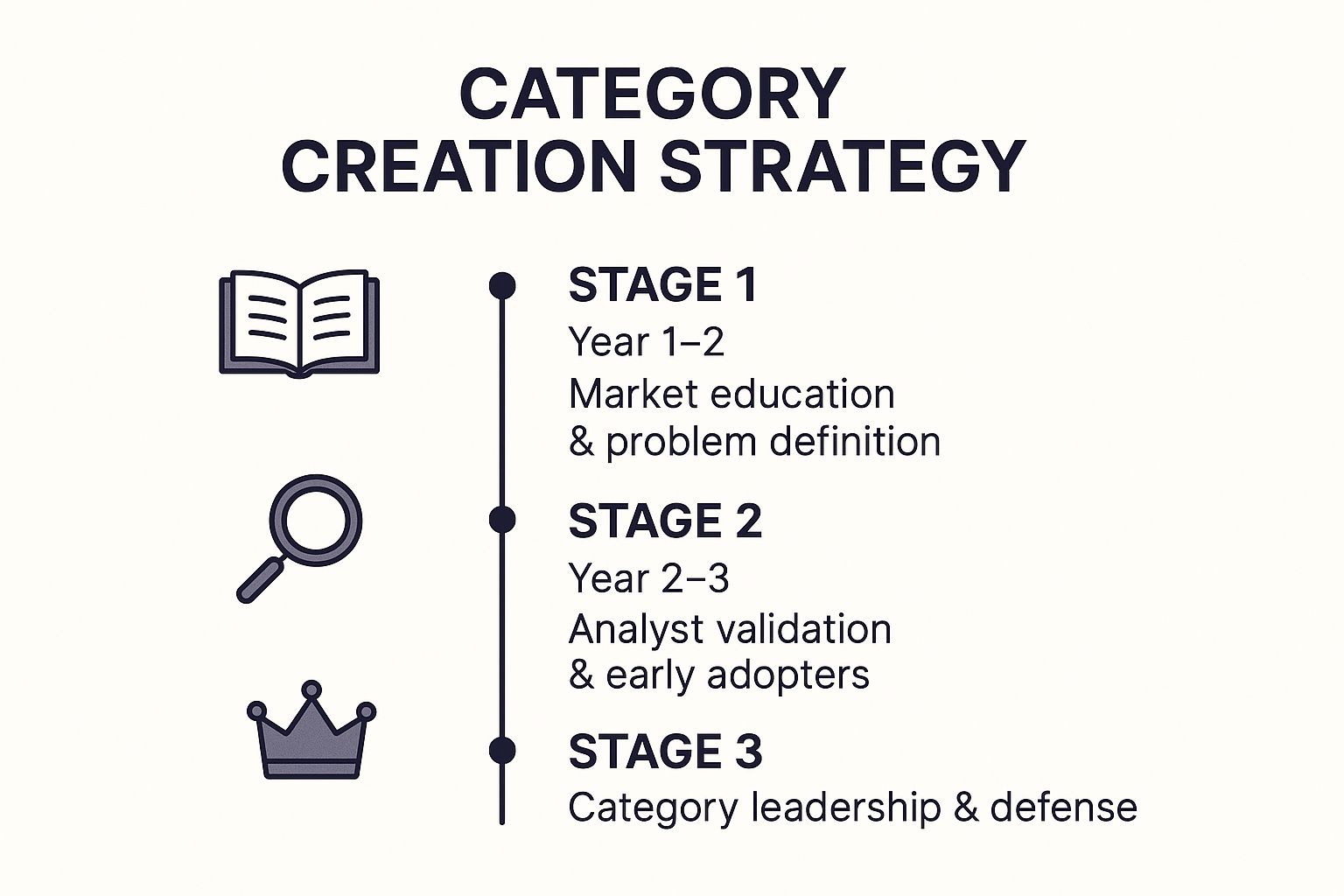
10. Category Creation Strategy
Category creation is a powerful, albeit challenging, startup growth strategy that focuses on defining and dominating an entirely new market category. Instead of battling established competitors in a crowded marketplace, this approach involves crafting a new space in the minds of potential customers. This strategy aims to make your product synonymous with the new category itself, effectively positioning your company as the leader and go-to solution. This approach is particularly relevant to startups looking for disruptive growth and a way to stand out amongst the noise. It deserves a place on this list of startup growth strategies because, when executed effectively, it offers a path to rapid growth, significant market share, and potentially outsized valuations.
How It Works:
Category creation involves more than just launching a new product; it requires a fundamental shift in how customers perceive a problem and its solution. It’s about defining the problem in a new light and presenting your product as the pioneering solution. This entails educating the market about the new category, its benefits, and why your product is the ideal solution.
Features of a Category Creation Strategy:
- Clear category naming and definition: A concise and memorable name is crucial. The definition must clearly articulate the problem the category solves and the value it provides.
- Thought leadership content: Content marketing plays a crucial role. This includes creating articles, white papers, blog posts, and other resources that explain the new category, its importance, and your company’s vision.
- Educational marketing: Focus on educating the market about the problem your category addresses, rather than solely promoting your product. This can include webinars, workshops, and online courses.
- Industry analyst relations: Building relationships with industry analysts can help validate the new category and gain credibility.
- Ecosystem building: Foster a community around the new category. This can involve partnering with complementary businesses, hosting events, and building online forums.
Pros:
- Reduced competition: By creating a new space, you effectively minimize direct competition, at least initially.
- Thought leadership positioning: You establish your company as the innovator and expert in the new category.
- Premium pricing: As the category definer, you can command premium pricing.
- Strong differentiation: Category creation provides inherent differentiation and market positioning.
- High valuation potential: Investors are often drawn to category creators due to their potential for market dominance.
Cons:
- Significant investment: Educating the market requires substantial investment in marketing and content creation.
- High risk: If the category doesn’t resonate with the market, the strategy can fail.
- Demanding consistency: Consistent messaging and positioning are crucial for long-term success.
- Longer time to product-market fit: It can take longer to achieve product-market fit as you’re essentially creating the market.
- Reliance on market recognition: Success hinges on broader market acceptance of the new category.
Examples of Successful Category Creation:
- HubSpot and “Inbound Marketing”: HubSpot effectively created the inbound marketing category, shifting the focus from outbound interruptions to attracting customers through valuable content and experiences.
- Salesforce and “Cloud Computing for Business”: Salesforce pioneered the concept of cloud-based CRM and effectively defined the category of cloud computing for business applications.
- Gainsight and “Customer Success”: Gainsight established the customer success category, emphasizing the importance of proactive engagement and retention strategies.
- Drift and “Conversational Marketing”: Drift spearheaded the conversational marketing category, focusing on real-time engagement and personalized experiences through chatbots and other tools.
- Gong and “Revenue Intelligence”: Gong defined the revenue intelligence category, leveraging AI to analyze sales conversations and improve performance.
Actionable Tips for Startups:
- Ensure true innovation: Your product must represent a genuinely new approach, not just a slight variation on an existing offering.
- Develop a compelling category name and definition: This is crucial for market understanding and recognition.
- Invest heavily in thought leadership and market education: Content marketing and educational initiatives are essential for building awareness and driving adoption.
- Build relationships with industry analysts: Analyst validation can significantly boost credibility.
- Create category-specific metrics and benchmarks: This helps demonstrate the value and impact of the new category.
When to Use This Strategy:
Category creation is most effective when you have a truly disruptive product that addresses a significant unmet need in the market. It requires a long-term vision, a willingness to invest in market education, and a commitment to consistent messaging. This is particularly beneficial for startups that want to avoid head-to-head competition in established markets and position themselves for rapid growth and market leadership. It is a high-risk, high-reward strategy that can be immensely powerful when executed correctly. By focusing on educating the market and building a strong brand around the new category, startups can achieve significant competitive advantage and establish themselves as the undisputed leader in their space.
11. Leveraging Fractional Executives for Startup Growth
Scaling a startup often requires experienced leadership, but hiring full-time executives can be a significant financial burden. Fractional executives offer a strategic solution, providing high-level expertise on a part-time or project basis. This approach allows startups to access C-suite level talent without the commitment and cost of traditional hiring, accelerating growth while maintaining financial flexibility.

This infographic visualizes the typical startup growth stages and highlights when fractional executives can be most impactful. It demonstrates how these leaders can provide targeted support during crucial periods.
Fractional executives bring a wealth of experience across various domains like sales, marketing, finance, and operations. They can guide strategic planning, implement efficient processes, mentor internal teams, and navigate complex challenges. For instance, a fractional CMO can develop a go-to-market strategy, while a fractional CFO can optimize fundraising efforts. Companies like Airbnb and Slack leveraged fractional talent in their early stages to achieve rapid growth without overspending on permanent hires.
The infographic outlines a typical timeline for fractional executive engagement within a startup’s lifecycle:
- Seed Stage (Pre-Seed – Series A): Focus on product-market fit, initial traction, and securing seed funding. A fractional CMO or CTO can be instrumental in building the initial product and acquiring early customers.
- Growth Stage (Series B – Series C): Scaling operations, expanding into new markets, and building a strong team. A fractional COO or CFO can help streamline processes and manage rapid growth.
- Maturity Stage (Series D and beyond): Preparing for an IPO or acquisition. A fractional CFO or General Counsel can provide expertise in financial management and legal compliance.
This structured approach allows startups to access specialized expertise precisely when needed, optimizing resource allocation and maximizing impact. The infographic clearly demonstrates the strategic alignment of fractional executives with various stages of startup growth.
Actionable Tips for Implementing this Strategy:
- Identify Key Needs: Determine which areas require senior-level expertise.
- Define Scope and Objectives: Clearly outline the fractional executive’s responsibilities and expected outcomes.
- Vet Candidates Thoroughly: Look for experience, industry knowledge, and cultural fit.
- Establish Clear Communication Channels: Ensure seamless integration with the existing team.
- Regularly Evaluate Performance: Track progress and make adjustments as needed.
Pros and Cons of Leveraging Fractional Executives:
Pros:
- Cost-Effective: Access to senior expertise without the high salaries and benefits of full-time executives.
- Flexibility: Scale up or down as needed, adapting to changing business demands.
- Specialized Expertise: Target specific areas for improvement with experienced professionals.
- Faster Implementation: Fractional executives can quickly onboard and start delivering results.
Cons:
- Management Overhead: Requires coordination and communication with external resources.
- Potential Cultural Mismatch: Ensuring a good fit with the company culture is crucial.
- Limited Availability: Highly sought-after fractional executives may have limited bandwidth.
Leveraging fractional executives deserves a place in this list of startup growth strategies because it offers a powerful and cost-effective way to access high-level talent, driving growth and navigating critical stages of development. This approach is particularly beneficial for startups seeking to optimize their resources and achieve rapid scalability without compromising on leadership expertise. This strategy caters directly to the target audience of startup founders, SMEs, and companies in high-growth sectors like SaaS, FinTech, and HealthTech, who are seeking flexible and cost-effective leadership solutions.
Startup Growth Strategies Comparison
| Strategy | Implementation Complexity 🔄 | Resource Requirements ⚡ | Expected Outcomes 📊 | Ideal Use Cases 💡 | Key Advantages ⭐ |
|---|---|---|---|---|---|
| Growth Hacking | Medium – requires technical & analytical skills | Moderate – cross-functional teams, data tools | Rapid user/customer acquisition, scalable growth | Startups, agile companies seeking fast growth on budget | Cost-effective, rapid experimentation, adaptable |
| Product-Led Growth (PLG) | Medium – needs strong product design | Moderate – product development focus | Sustainable growth through product usage | SaaS, freemium models, self-service products | Lower CAC, qualified leads, better UX |
| Blitzscaling | High – rapid scaling with organizational risks | Very high – massive capital, aggressive hiring | Market leadership through speed, first-mover advantage | Winner-takes-most markets, venture-backed startups | Exponential growth, network effects, market dominance |
| Viral Loop Marketing | Medium to High – difficult to design effective loops | Low to moderate – product & marketing integration | Exponential viral user growth, low CAC | Products with natural sharing moments, referral-driven growth | Low CAC, self-sustaining user acquisition |
| SaaS Land and Expand | Medium – requires customer success and pricing strategy | Moderate – customer success investment | Predictable expansion revenue, deeper customer relationships | Enterprise SaaS targeting multiple departments | Lower initial sales resistance, high LTV |
| Market Development Strategy | Medium – requires market research and localization | Moderate to High – market adaptation efforts | New customer segments, diversified revenue streams | Existing products entering new markets or segments | Leverages existing products, reduces market dependency |
| Content Marketing and SEO | Medium to High – requires consistent quality output | Moderate – content creation and SEO expertise | Long-term sustainable organic growth | B2B & B2C, industries targeting inbound leads | Builds authority, sustainable traffic, cost-effective |
| Community-Led Growth | Medium to High – continuous community management | Moderate – dedicated resources, community managers | Strong loyalty, word-of-mouth, product feedback | Products benefiting from strong user networks | Reduces churn, authentic marketing, network effects |
| Strategic Partnerships & Ecosystem | High – relationship and integration management | Moderate to High – partner enablement and tech | Accelerated market access, shared resources | Platform businesses, complex ecosystems | Leverages partner networks, cost sharing, credibility |
| Category Creation Strategy | High – requires market education and consistent positioning | High – heavy investment in thought leadership | Market differentiation, premium pricing, category leadership | Innovative products creating new markets | Creates new space, strong positioning, valuation upsides |
Fueling Your Startup’s Journey to Success
Mastering startup growth strategies is paramount for navigating the competitive landscape and achieving sustainable success. From leveraging growth hacking tactics and product-led growth to harnessing the power of viral loops and strategic partnerships, the strategies outlined in this article offer a comprehensive toolkit for scaling your business. Key takeaways include understanding the nuances of each approach, identifying the right fit for your specific business model, and effectively implementing them to maximize impact. Whether you’re focused on SaaS land and expand, community-led growth, or even creating an entirely new category, implementing the right strategy at the right time is critical. By understanding and implementing these startup growth strategies, you’ll not only drive short-term gains but also build a foundation for long-term market leadership and sustainable growth.
Successfully executing these strategies often requires experienced leadership. However, acquiring top-tier executive talent can be challenging, especially for resource-constrained startups. That’s where Shiny comes in. Shiny offers a solution by connecting you with vetted, fractional executives across a diverse range of industries, providing the expertise you need to implement these startup growth strategies effectively and efficiently. Ready to accelerate your growth trajectory? Explore Shiny’s marketplace of fractional executives today and discover how their flexible, part-time leadership solutions can help you achieve your business goals. Shiny