


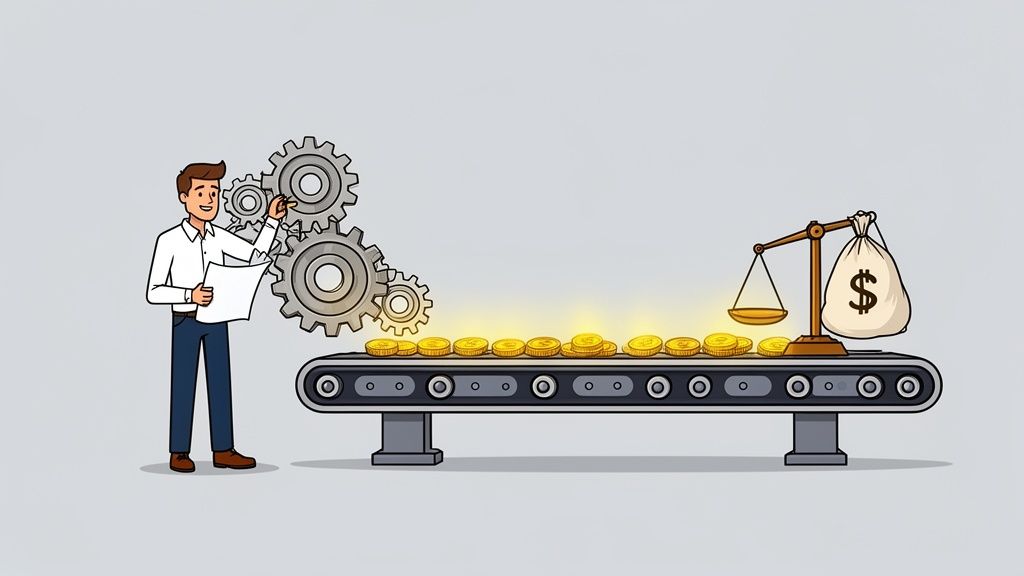
The strategy of cost leadership isn't just about being the "cheap" option. It's a disciplined approach to engineering your entire business to operate at the absolute lowest cost in your industry. This allows you to set competitive prices that attract a broad customer base, all while protecting healthy profit margins. It's about being smarter, faster, and leaner than everyone else.
But executing this strategy requires specialized expertise. You need leaders who understand operational efficiency, supply chain logistics, and lean financial modeling—skills that are often out of reach for a growing business. This is where the right guidance becomes a game-changer.
Understanding the Foundation of Cost Leadership
Picture two food trucks on the same street. One is a gourmet taco truck, serving unique creations with rare ingredients for $15 a pop. It’s a differentiation strategy focused on a unique experience. The other truck sells classic burgers for just $5. This isn't just a cheaper burger; it's a masterpiece of efficiency. The owner has a hyper-focused menu, buys ingredients in massive bulk, and has a process so streamlined they can serve hundreds of customers an hour.
That's the heart of cost leadership. It’s not about cutting corners on quality to hit a low price point. It’s about building a business model where every single decision—from sourcing materials to delivering the final product—is relentlessly optimized for lower costs.


The Core Principle Driving Success
The main goal is to build a lower cost base than any of your competitors. This creates a powerful defensive moat around your business. When rivals feel pressured to lower their prices to keep up with you, their profit margins get squeezed—or disappear entirely. Meanwhile, yours stay healthy. In a price-sensitive market, that advantage is formidable.
This approach changes the game. It allows you to offer your products at lower prices while staying profitable, often by investing heavily in tech or processes that multiply productivity. As one of Michael Porter’s generic strategies, cost leadership is a pillar for building a sustainable competitive advantage that demands a constant, unwavering focus on efficiency. You can explore more of this framework and its applications on platforms like EPAM.
The core idea is simple: by becoming the most efficient operator, you gain control over your market’s pricing structure. You can either undercut competitors to gain market share or match their prices and enjoy a significantly higher profit margin.
What Cost Leadership Is Not
It’s critical to understand that cost leadership is not the same as just being a low-price provider. Any company can slash prices temporarily, often by selling at a loss just to lure in customers. That's a race to the bottom and a common business pain point.
True cost leadership is different. It’s built on a sustainable, low-cost structure that’s baked into your operations. It’s about achieving operational excellence, not short-term promotional gimmicks.
For a startup, getting this right is a game-changer. A well-executed cost leadership strategy provides the fuel for growth by:
- Increasing Market Share: Lower prices naturally attract a broader slice of the market, especially budget-conscious customers.
- Improving Profitability: Even with lower prices, your lower cost base means every sale still generates a solid profit.
- Creating a Barrier to Entry: Potential competitors will look at your efficiency and price points and realize it’s incredibly difficult to compete.
The Pillars of a Winning Cost Leadership Strategy
Pursuing a cost leadership strategy isn't about a single magic bullet. It's a disciplined, relentless practice built on several core pillars. Think of it like building a temple—each pillar is non-negotiable and essential for holding the whole thing up. If one weakens, the entire structure becomes unstable and vulnerable.
To build this low-cost operational foundation, you must be obsessive about four key areas. This level of focus often requires executive-level expertise in operations, finance, and supply chain management.

These pillars aren't just business school theory. They're the active ingredients that systematically drive down your cost base, turning your startup into a lean, efficient machine that competitors just can't keep up with.
Achieving Economies of Scale
The easiest pillar to grasp is economies of scale. In short: the more you make, the cheaper each unit gets. This happens because you spread your fixed costs—like factory rent or a manager's salary—across a much larger volume of goods.
Imagine you run a t-shirt printing shop. The setup cost for the printing press is high for just one shirt. But if you print 10,000 t-shirts in a single run, that setup cost per shirt drops to almost nothing. This principle holds true for everything from manufacturing physical products to developing software.
Cost leaders are aggressive about achieving scale. They aim to dominate a market segment to max out their production volume. This pushes their per-unit cost so far below smaller rivals that it creates a powerful feedback loop: gaining market share leads to cost advantages, which in turn helps them gain even more market share.
Driving Relentless Process Optimization
The second pillar is an outright obsession with process optimization. This is about putting every single step in your operation under a microscope to find and eliminate waste, friction, and pointless complexity. The goal is to make every workflow as lean and effective as it can possibly be.
The Toyota Production System is the classic playbook here. Toyota didn't just build cars; they engineered a whole philosophy where every action had a purpose, inventory was minimal (just-in-time), and continuous improvement was baked into the culture. This focus on eliminating waste slashed their production costs while keeping quality high.
For a business chasing cost leadership, waste isn't just an expense—it's the enemy. Every wasted minute, every extra component, and every redundant step is a chance for a competitor to get ahead.
To put this into practice, you must map your core processes and ask some tough questions:
- Eliminate: Which steps add zero value and can be cut entirely?
- Simplify: Can we streamline this complicated procedure to make it faster?
- Automate: What manual tasks can we hand off to software to cut down on errors and labor?
This constant fine-tuning is what builds a lasting cost advantage. As you find new ways to do more with less, your whole operation gets stronger. We dive deeper into this in our guide on how to improve operational efficiency.
Masterful Supply Chain Management
For many companies, the supply chain is the single biggest line item on the budget. The third pillar, masterful supply chain management, is all about wrestling those costs down through smart sourcing, tough negotiation, and efficient logistics. This goes way beyond just asking your suppliers for a better price.
Effective supply chain management really comes down to:
- Strategic Sourcing: Instead of dealing with dozens of suppliers, you might consolidate your purchasing with a few key partners to unlock significant volume discounts.
- Tough Negotiation: Using your scale to lock in favorable contracts, payment terms, and rock-bottom pricing is a core skill.
- Logistical Efficiency: Optimizing everything from shipping routes and warehousing to inventory levels to crush carrying costs and transportation fees.
A cost leader in the grocery world, for example, doesn't just buy vegetables. It builds a hyper-efficient distribution network with its own truck fleet and centralized warehouses to get produce from the farm to the store shelf faster and cheaper than anyone else. That direct control over logistics becomes a massive source of savings.
The Strategic Use of Technology
The final pillar is the strategic use of technology. Modern tools are an incredible force multiplier for any cost leadership play. They can automate tedious manual work, generate data for smarter decisions, and reduce the chance of human error. Technology isn't a nice-to-have anymore; it's a fundamental enabler of efficiency.
Whether it’s robotic process automation (RPA) handling back-office tasks or an AI-powered inventory system that predicts demand with scary accuracy, tech can carve out huge chunks of operational cost.
A startup can use cloud infrastructure to dodge massive upfront server costs, or deploy chatbots to handle common customer questions, which frees up human agents for more complex problems. The key is to invest in tech that gives you a clear and measurable return by directly cutting costs or boosting productivity.
Real-World Examples of Cost Leadership Strategy
Theory is one thing, but seeing how companies actually pull off cost leadership in the real world is where the most valuable lessons are. The best in the business didn't just find a cheaper supplier and call it a day. They re-engineered their entire operation, from top to bottom, with a single-minded focus on building an unbeatable cost structure.
These real-world examples prove that cost leadership isn't just for one type of company. It's a strategic discipline that works just as well in retail and airlines as it does for the modern direct-to-consumer startups shaking things up today.


Walmart: The Retail Colossus
When you think of cost leadership, Walmart is probably the first name that pops into your head. The company built a global retail empire on the promise of "Always Low Prices." That wasn't just a catchy slogan; it was the outcome of a decades-long obsession with supply chain mastery and operational efficiency.
Walmart’s strategy was layered. They used their massive scale to get incredible bargaining power with suppliers, were early adopters of logistics tech, and had an almost fanatical focus on squeezing waste out of the system. By building their own distribution centers and running their own trucking fleet, they cut out the middlemen and slashed transportation costs. That level of vertical integration gave them jaw-dropping control over their cost base.
This strategy was so powerful it made them the world's largest retailer—around one hundred million Americans walk into a Walmart in a typical week. Slogans like 'Always Low Prices' and 'Save Money. Live Better.' became synonymous with their price-driven advantage. By trimming fat at every possible turn, Walmart could sell quality goods at prices their competitors simply couldn't touch. You can dive deeper into how Walmart's cost structure gave them an edge in various strategic management analyses.
Ryanair: Revolutionizing Air Travel
The airline industry is notoriously tough, bogged down by high fixed costs. Then came Ryanair, a disruptor that applied cost leadership with surgical precision. The entire airline is a masterclass in stripping an operation down to its absolute essentials to offer rock-bottom fares.
Ryanair’s success boils down to a few core tactics:
- Standardized Fleet: They use only one type of aircraft—the Boeing 737. This move radically simplifies maintenance, crew training, and spare parts inventory, unlocking massive cost savings.
- Secondary Airports: Ryanair famously steers clear of expensive international hubs. Instead, it flies into smaller, regional airports with lower landing fees and faster turnaround times. This keeps their planes in the air making money, not sitting on the ground costing money.
- Unbundled Services: Your base fare gets you a seat. That’s it. Everything else, from checked bags to a bottle of water, is an optional add-on. This allows Ryanair to advertise shockingly low prices while pulling in a ton of ancillary revenue.
This no-frills approach meant Ryanair could consistently offer fares that legacy carriers, with their unionized workforces and complex hub-and-spoke models, had no hope of matching.
The Modern Startup Play: Direct-to-Consumer Brands
Cost leadership isn't just a game for corporate giants. Modern startups, especially in the direct-to-consumer (DTC) world, are using it to blow up established industries. Just look at the wave of DTC mattress companies that popped up over the last decade.
By cutting out the middlemen—expensive retail showrooms, sales commissions, and traditional distribution networks—these startups completely re-engineered the cost structure of selling a mattress.
Instead of going to a physical store, you order online. The mattress shows up at your door compressed in a box, which dramatically cuts down on shipping and warehousing costs. This lean model lets them sell a high-quality product for a fraction of what you’d pay in a traditional retail store, passing those savings directly to the customer.
It's a perfect modern example of cost leadership, proving that a smart business model can be a startup’s most powerful weapon.
How to Implement Cost Leadership in Your Startup
So, you're sold on the idea of cost leadership. But how do you actually make it happen in your startup? It's not about making random, panicked budget cuts. It’s about methodically rewiring your startup's operations to be leaner and more efficient from the ground up.
This means moving past gut feelings and embracing a disciplined, step-by-step process. Think of it as a continuous cycle: analyze, act, and reinforce. The goal is to turn your entire company into a highly competitive, low-cost machine. This is where an experienced leader—even a part-time one—can provide invaluable guidance.
Conduct a Deep-Dive Cost Analysis
You can't fix what you don't measure. The very first step is to put your expenses under a microscope to figure out exactly where every single dollar is going. This isn't about looking at a high-level P&L statement; it's about getting granular.
You need to map out your entire value chain, from buying raw materials to getting the final product to your customer. Along the way, you'll pinpoint your main cost drivers—these are the activities that have the biggest influence on your total expenses.
You might be surprised by what you find. For example:
- Maybe 35% of your logistics budget is being wasted on last-minute expedited shipping because of poor inventory planning.
- Your Customer Acquisition Cost (CAC) might be sky-high because you're throwing money at the wrong advertising channels.
- A single bottleneck in your manufacturing process could be driving up labor costs and creating expensive downtime.
This kind of deep analysis gives you the hard data you need to make smart decisions. You're no longer guessing where the problems are; you know exactly where to find the biggest opportunities for savings.
Set Aggressive Cost-Reduction Targets
Once you know what’s driving your costs, it’s time to set some real goals. Vague ambitions like "spend less money" are completely useless. You need to set clear, aggressive, and measurable targets tied to specific Key Performance Indicators (KPIs).
A core part of any cost leadership strategy is accountability. When you put hard numbers on your goals, you create a clear benchmark for what success looks like and make your team responsible for hitting those numbers.
Your targets should be SMART—Specific, Measurable, Achievable, Relevant, and Time-bound. Here are a few examples of what strong cost-reduction KPIs look like:
- Reduce Cost of Goods Sold (COGS) as a percentage of revenue by 15% in the next six months by renegotiating with our top three suppliers.
- Lower Customer Acquisition Cost (CAC) by 20% next quarter by shifting our marketing budget to the channels that are actually converting.
- Cut operational overhead by 10% this fiscal year by automating three key back-office tasks.
These concrete targets give everyone in the organization a clear focus and a sense of urgency. If you're looking for more inspiration, our guide on impactful cost reduction strategies is a great place to start.
Re-Engineer Core Processes and Technology
With your targets locked in, it's time to get your hands dirty and redesign the processes that are costing you money. This means mapping out your key workflows and hunting down every bit of waste, every bottleneck, and every redundant step. Think like an engineer: how can this system be built better and more efficiently?
This almost always involves using technology, but the key is to prioritize tech that gives you the biggest bang for your buck on cost savings. Don’t just adopt new tools because they’re trendy; find ones that directly tackle your biggest cost drivers.
- Struggling with high labor costs? Use Robotic Process Automation (RPA) to take over repetitive tasks like data entry or invoicing.
- Carrying too much inventory? An inventory management system with predictive analytics can help you optimize stock levels and slash carrying costs.
- Customer support getting expensive? A simple chatbot can handle the most common questions, freeing up your human agents to deal with more complex problems.
The aim here is to build a lean operational engine where smart processes and the right technology work together to cut waste and boost output.
Why Fractional Executives Are Your Secret Weapon
Pulling off a true strategy of cost leadership takes some serious heavy-hitters. You need leaders who can completely rebuild your operations, design financial models that actually work, and negotiate like their life depends on it. For most startups, hiring full-time executives in finance, operations, and supply chain with that kind of resume is just not in the budget.
That leaves you in a tough spot. You need elite talent to build a low-cost business, but you can’t afford that talent until your costs are already under control. This is the exact problem fractional leadership was born to solve, and it’s a massive advantage for any startup.

The fractional model lets you bring in a seasoned Chief Operating Officer (COO) for just 10 hours a week to overhaul your production workflow. Or you could hire a fractional Chief Financial Officer (CFO) to lock down your financial controls and find savings you never knew you had. You get the exact expertise you need, for only the time you need it, at a fraction of the cost.
Access to Elite Talent Without the Full-Time Cost
Let’s be real—the biggest perk of fractional leadership is the price tag. A full-time C-suite executive can easily run you $250,000 or more in salary, not to mention benefits and equity. When you’re watching every penny of your burn rate, that’s a non-starter.
A fractional leader delivers that same high-level strategic thinking, just on a part-time schedule. You get their decades of experience—building efficient systems, wrangling complex budgets, and driving down costs—without the six-figure hole in your bank account. It’s a move that lives and breathes the cost leadership principle: get the biggest possible impact for the lowest possible cost.
The goal isn't just to save money on a salary. It's to invest that executive's focused time into activities that generate an enormous return on investment, like overhauling a supply chain to cut costs by 20% or implementing a new financial system that reveals major cash flow leaks.
Hiring a fractional executive isn't just a cost-saving measure; it’s an offensive move to strengthen your bottom line. You're basically renting a specialist's brain to solve your most expensive problems.
Specialized Expertise for Targeted Problems
A cost leadership strategy isn't built in a day. It’s a series of smart, targeted moves across specific parts of the business. Fractional executives are the specialists you bring in to make those moves with speed and precision.
Here’s what that looks like in practice:
- A Fractional CFO: They can dive into your financials to find your real cost drivers, build a budget you can actually stick to, and set up KPIs to measure efficiency. They'll also find better financing terms or uncover tax savings you didn't even know were on the table.
- A Fractional COO: They will map out every step of your operations, find the bottlenecks slowing you down, and implement lean methods to slash waste. They are masters of optimizing workflows to cut labor costs and boost output.
- A Fractional Supply Chain Head: They can renegotiate supplier contracts with the confidence of an industry vet, redesign your logistics to cut shipping costs, and set up inventory systems that stop cash from being tied up on shelves.
This focused expertise is the key. You're not hiring a generalist to figure things out. You’re hiring a seasoned pro to solve a specific, high-stakes problem that’s blocking your path to cost leadership. For a deeper look into this flexible model, check out our guide on the advantages of a fractional C-suite.
By bringing this top-tier talent into your team, you get the strategic horsepower needed to build a lean, resilient operation. They bring the discipline, the proven frameworks, and the tough execution it takes to win on cost, giving your startup a huge competitive edge without breaking the bank.
Navigating the Common Risks and Pitfalls
A cost leadership strategy can feel like a direct path to market dominance, but it's a tightrope walk. Chasing lower costs at any price is a dangerous game that can backfire spectacularly, eroding customer trust, sparking profit-killing price wars, or leaving you exposed when the market shifts.
The most successful low-cost players are just as obsessed with the risks as they are with the rewards. Understanding these pitfalls from the get-go is how you build a low-cost structure that's not just effective, but sustainable for the long haul.
Avoiding the Quality Trap
The most immediate and seductive danger in any cost-cutting mission is the quality trap. In the relentless hunt for savings, it’s incredibly easy to accidentally chip away at your product or service. You might swap out a core material for a cheaper one that doesn't quite hold up, or you might scale back customer support, leaving users stuck in long queues.
These might feel like smart, incremental savings in the moment, but they slowly poison your brand. Customers who were drawn in by a great price will bolt the second they feel the quality has slipped.
The goal of cost leadership is to reduce the cost of producing quality, not to reduce quality itself. It’s a critical distinction that separates sustainable leaders from companies that quickly fail.
To protect your quality, you need to build guardrails. This means:
- Defining Clear Quality Standards: Before you cut a single dollar, establish non-negotiable quality metrics for your product and service. What can't be compromised?
- Monitoring Customer Feedback: Keep a close eye on reviews, support tickets, and satisfaction scores. Any dip in these numbers is a red flag that your cuts have gone too deep.
- Focusing on Process, Not Components: Zero in on savings from process efficiencies—like automation or smarter workflows—rather than cheapening the core components your customers actually care about.
Sidestepping Destructive Price Wars
The second major risk is accidentally starting a destructive price war. When your primary weapon is a low price, competitors often feel they have no choice but to match you, kicking off a race to the bottom. In this scenario, nobody wins. Profit margins get vaporized across the industry, and while customers benefit temporarily, it's often not a sustainable situation.
There can only be one true lowest-cost player. If your low price is just a temporary tactic and not baked into your operational DNA, a bigger competitor can simply outlast you, absorbing losses until you're out of business.
To avoid this, you need a defensible cost structure, not just a low price. This means your cost advantage has to come from deep, operational strengths that are tough for others to copy—things like proprietary technology, exclusive supplier deals, or a hyper-efficient logistics network.
Overcoming Operational Tunnel Vision
Finally, an intense focus on internal efficiency can create operational tunnel vision. When the whole team is laser-focused on shaving pennies off processes and hitting internal cost targets, it’s easy to lose sight of the world outside your walls. You get so caught up in fine-tuning the engine that you don't notice the road ahead is changing.
Market trends shift, customer needs evolve, and new technologies pop up. If you're too internally focused, you risk getting blindsided by a competitor who introduces a killer new feature or a better overall experience, even if they charge a bit more. A cost leader who stops innovating is a sitting duck.
The solution is to bake market awareness into your culture, right alongside efficiency. Encourage your teams to talk to customers, watch competitors, and experiment with new ideas. This ensures your lean machine is not only efficient today but also agile enough to adapt to whatever the market throws at you tomorrow.
Your Questions About Cost Leadership Answered
It's natural to have questions before diving into a major strategy like this. Cost leadership sounds powerful on paper, but founders always ask us about how it actually works in the real world—especially for a lean startup.
Let's clear up some of the most common questions so you can decide if this is the right move for your company.
Can a Small Startup Truly Compete on Cost Against Giants?
Absolutely, but not by playing their game. You can’t out-muscle a corporation on day one, but you can be a whole lot smarter and faster. The secret is to avoid a head-to-head battle across their entire market. Instead, you pick a specific niche and build an unbeatable cost structure there.
Your biggest advantages are your speed and your lack of red tape. You can jump on modern, low-cost tech in a heartbeat, run incredibly lean, and make decisions in hours, not fiscal quarters. Think about it: a new e-commerce brand can use a dropshipping model and targeted digital marketing to own a product category for a fraction of the operational cost of a legacy retailer still paying for massive physical storefronts.
Focus on winning your niche first. Your agility is what lets you build a defensible, low-cost model before the big guys even notice you're there.
Does Cost Leadership Mean My Product Has to Be Low Quality?
This is the single biggest—and most damaging—myth out there. The answer is a hard no. The goal isn't to make a cheap product; it's to lower the cost of producing and delivering a great product. Smart cost leaders are obsessed with cutting waste and perfecting their processes, not with swapping in shoddy materials.
True cost leadership is about achieving efficiency without compromise. It’s the difference between a cheaply made product that falls apart and a well-made product created through a hyper-efficient system.
Companies like IKEA and Toyota are perfect examples. They’re known globally for solid quality and reliability, yet they are absolute masters of cost leadership. They pull this off through brilliant system design, world-class supply chain management, and a deep-seated culture of continuous improvement—not by cheating the customer on quality.
How Do I Know if This Strategy Is Right for My Business?
Cost leadership isn't a silver bullet. You have to be honest about your market and your own capabilities to know if it's the right fit. Ask yourself these questions:
- Is my target market obsessed with price? If your customers are making buying decisions almost entirely on cost, this strategy has serious legs.
- Is the product basically standardized? This approach works wonders when products are easily compared, making price the most obvious tie-breaker.
- Can I spot massive waste in how my competitors operate? If you look at your industry and see bloated overhead, outdated tech, or clunky processes, that’s your opening. A leaner operator can come in and clean up.
On the other hand, this strategy is a poor fit for markets built on extreme customization, luxury branding, or high-touch service models. In those cases, uniqueness and experience—not price—are what drive the business.
Executing a disciplined cost leadership strategy requires deep operational and financial expertise. Shiny connects you with a network of over 3,000 vetted fractional executives who can provide this senior-level guidance for a fraction of the cost of a full-time hire. If you're ready to build a more efficient, profitable business, explore our marketplace at https://useshiny.com or schedule a consultation to find the right leader to build your competitive edge.