


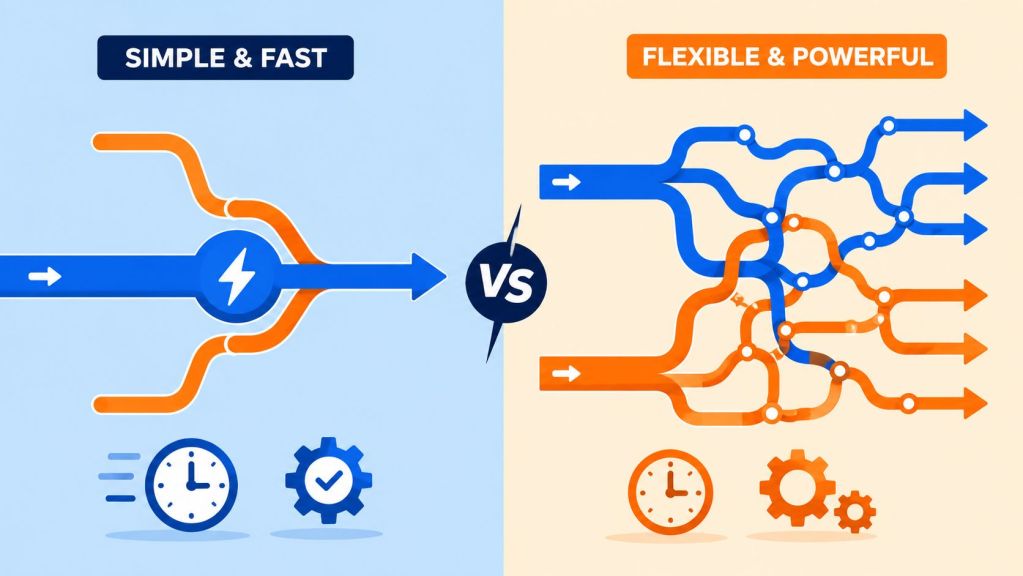
Your team has a feature ready, but it can't ship. One engineer is resolving a merge conflict in a branch created last week. Another is waiting for develop to stabilize. The founder wants a customer commitment by Friday, while nobody trusts main enough to deploy on Thursday.
That tension is usually blamed on testing, staffing, or product scope. Often, the branching model is part of the problem. Trunk based development vs Gitflow isn't a debate about developer taste. It's a decision about how quickly your company can integrate work, respond to customers, and make credible release commitments.
I've migrated three scale-ups away from Gitflow. My default recommendation is trunk-based development, but only after the team earns the right to use it. If your CI pipeline is unreliable, your regression suite is thin, and unfinished work has nowhere to hide, moving to trunk too early will make the team slower and less confident.
Why Your Branching Model Is Suddenly a Business Problem
A founder usually notices the symptoms before anyone names the cause. Product asks why a small customer request is still waiting. Sales asks whether a promised integration can ship this month. Engineers spend an afternoon merging branches, then spend another afternoon figuring out which version contains the fix.
The team responds rationally. They create more branches to protect production. They add another review gate. They keep work on develop until it feels safe. Each decision reduces immediate anxiety, but it also pushes integration further away from the moment when engineers wrote the code.
That creates a business constraint. A slow release process affects customer feedback loops, hiring credibility, roadmap commitments, and incident response. When candidates ask how the team ships, “we merge everything into a release branch after QA catches up” tells them more than your job description does.
A branching policy belongs in the same conversation as engineering ownership and delivery metrics. A technical leader needs to assess it alongside architecture, team structure, deployment controls, and product risk. Founders who need help defining that leadership remit can use this practical explanation of what a CTO actually does.
The decision hiding underneath the branch names
The question isn't "Which workflow do developers prefer?" Ask this instead:
Can this team keep one shared branch releasable while integrating small changes continuously?
If the answer is yes, trunk-based development will usually produce a cleaner operating rhythm. If the answer is no, Gitflow may be giving the team structure it needs, even if that structure carries more overhead.
The two models represent different assumptions. Trunk-based development assumes frequent integration and automated protection. Gitflow assumes explicit release coordination and longer periods of isolation. Neither branch name fixes weak testing or unclear ownership.
A small team with limited platform engineering capacity shouldn't copy the workflow of a highly automated organization by prestige. It should choose the model that matches its actual ability to test, review, deploy, roll back, and communicate risk.
What Trunk-Based Development and Gitflow Actually Are
Trunk-based development has one shared integration line, usually called main. Engineers work from that branch, make a small change, and merge back quickly. Some teams commit directly to trunk, while others use short-lived branches for review and CI checks.
The important constraint is time. Guidance commonly recommends integrating at least once per day, with temporary branches lasting hours rather than days. The main branch should remain releasable, so incomplete work is hidden with feature flags instead of being isolated in a branch for weeks.
That changes how engineers slice work. A large checkout redesign doesn't arrive as one massive pull request. The team lands the database preparation, interface changes, and behavior changes as compatible increments. A flag keeps the unfinished customer experience disabled until the product is ready.
Gitflow makes releases explicit
Gitflow was formally introduced by Vincent Driessen in January 2010. Its structure centers on two long-lived primary branches, master or main for production and develop for integration, with supporting feature, release, and hotfix branches. The model became one of the best-known Git branching approaches during the 2010s, when many teams were still coordinating parallel branches manually. The historical account of Gitflow places that milestone in the broader history of source control.
A feature starts from develop and stays there while engineers build it. Completed features merge into develop, a release branch is created when the team is ready to stabilize a version, and the finished release merges into production. A hotfix branches from production and is merged back through the appropriate lines.
Gitflow's philosophy is versioned release management. The team gathers work, stabilizes a defined package, and ships it as an explicit event. That makes the branch graph more ceremonial, but it gives teams a visible place to coordinate release preparation and support multiple versions.
Trunk-based development is substantially older than Gitflow. It has been described as a persistent approach since the mid-1990s and as a tactical source-control pattern used as far back as the 1980s, so its preference for one shared integration line predates GitFlow by decades. In two sentences for a nontechnical co-founder: trunk-based development merges small changes into one releasable line continuously. Gitflow separates integration and production work so teams can assemble and stabilize scheduled releases.
Comparing the Two Workflows Side by Side
The practical difference appears in the distance between writing code and integrating it. Trunk-based teams keep that distance short. Gitflow teams intentionally allow it to grow so they can coordinate a larger release boundary.
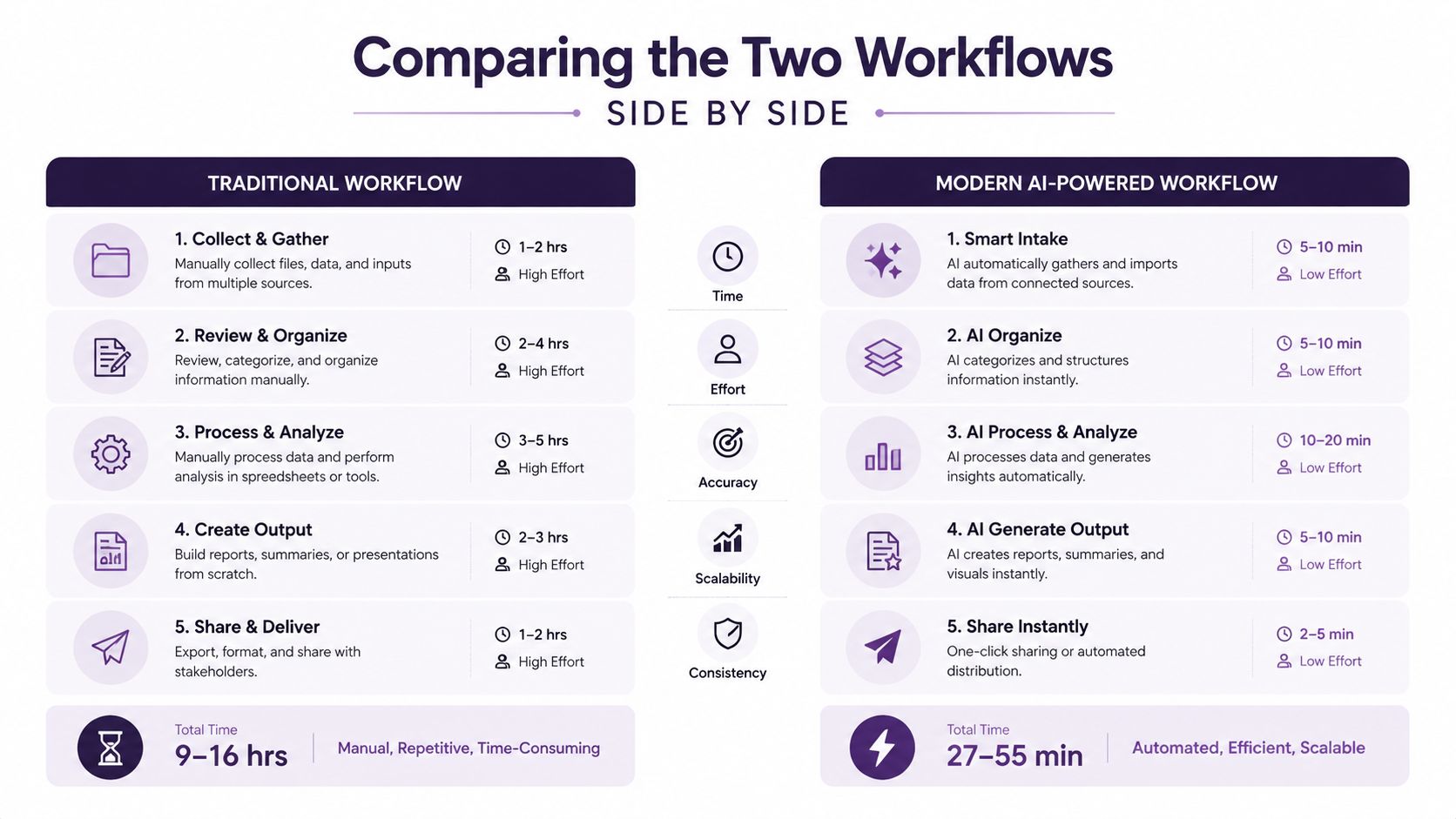

Trunk-based development vs Gitflow at a glance
| Criteria | Trunk-Based Development | Gitflow |
|---|---|---|
| Branch lifespan | Temporary branches usually last hours, with integration at least daily | Feature and release branches can last days to weeks |
| Merge frequency | Small, continuous merges into the shared trunk | Occasional, larger merges into develop or release branches |
| Release cadence | Fits continuous delivery and frequent deployments | Fits scheduled release trains and explicit stabilization periods |
| Merge-conflict risk | Lower when changes stay small and integration stays frequent | Higher as branches drift and merge surfaces grow |
| CI/CD alignment | Strong fit, but depends on reliable automated checks | Compatible with CI/CD, though the branch structure adds coordination |
| Incomplete work | Hidden behind feature flags | Isolated on feature branches until it is ready |
| Rollback mechanism | Revert a small change or disable its feature flag | Redeploy a tagged release or apply a hotfix branch |
| Parallel versions | Awkward unless the team adds release branches or another convention | Native through release and hotfix branches |
| Operating overhead | Lower branch ceremony, higher automation discipline | Higher branch ceremony, lower dependence on feature flags |
Trunk-based development optimizes for integration frequency. A developer merges a narrow change while the context is fresh, CI tests it, and the next engineer works from the updated trunk. Small diffs make failures easier to locate and reduce the amount of code that must be reconciled at once.
Feature flags do important work here. They let engineers deploy code that isn't yet visible to customers, which separates integration from release. That separation is powerful, but it creates a new responsibility. Someone must define flag ownership, remove stale flags, test both paths, and control who can change rollout settings.
Gitflow optimizes for release coordination. Its long-lived branches offer isolation, which can be useful when QA, compliance, or customer support needs a defined version boundary. The price is drift. A feature branch can look healthy in isolation while becoming expensive to merge into the current integration state.
The right comparison isn't “simple versus complicated.” It's low branch overhead versus high automation requirements, or fast integration versus stronger release ceremony. Teams that ignore that trade are likely to adopt half of trunk-based development and none of its safeguards.
How Each Model Performs Under Real Engineering Pressure
The performance evidence favors trunk-based development, but it doesn't justify cargo-cult adoption. Research cited by LaunchDarkly from the DORA report found that elite performers were 2.3 times more likely to use trunk-based development than other teams, according to this comparison of trunk-based development and Gitflow.
The same DORA line of evidence links elite performance with dramatically faster delivery outcomes, including up to 182 times more frequent deployments and 127 times faster change lead times compared with low performers, as reported in that source. Those figures describe high-performing teams and shouldn't be treated as a promise that changing branch names will create the same results.
Trunk-based development aligns with those outcomes because it removes waiting points. Engineers merge smaller changes, CI evaluates the main line continuously, and product teams can release without assembling a large batch of work. Comparative workflow data describes trunk-based teams deploying multiple times per day, while Gitflow teams typically operate on two to four week release cycles in that analysis of software engineering workflows.
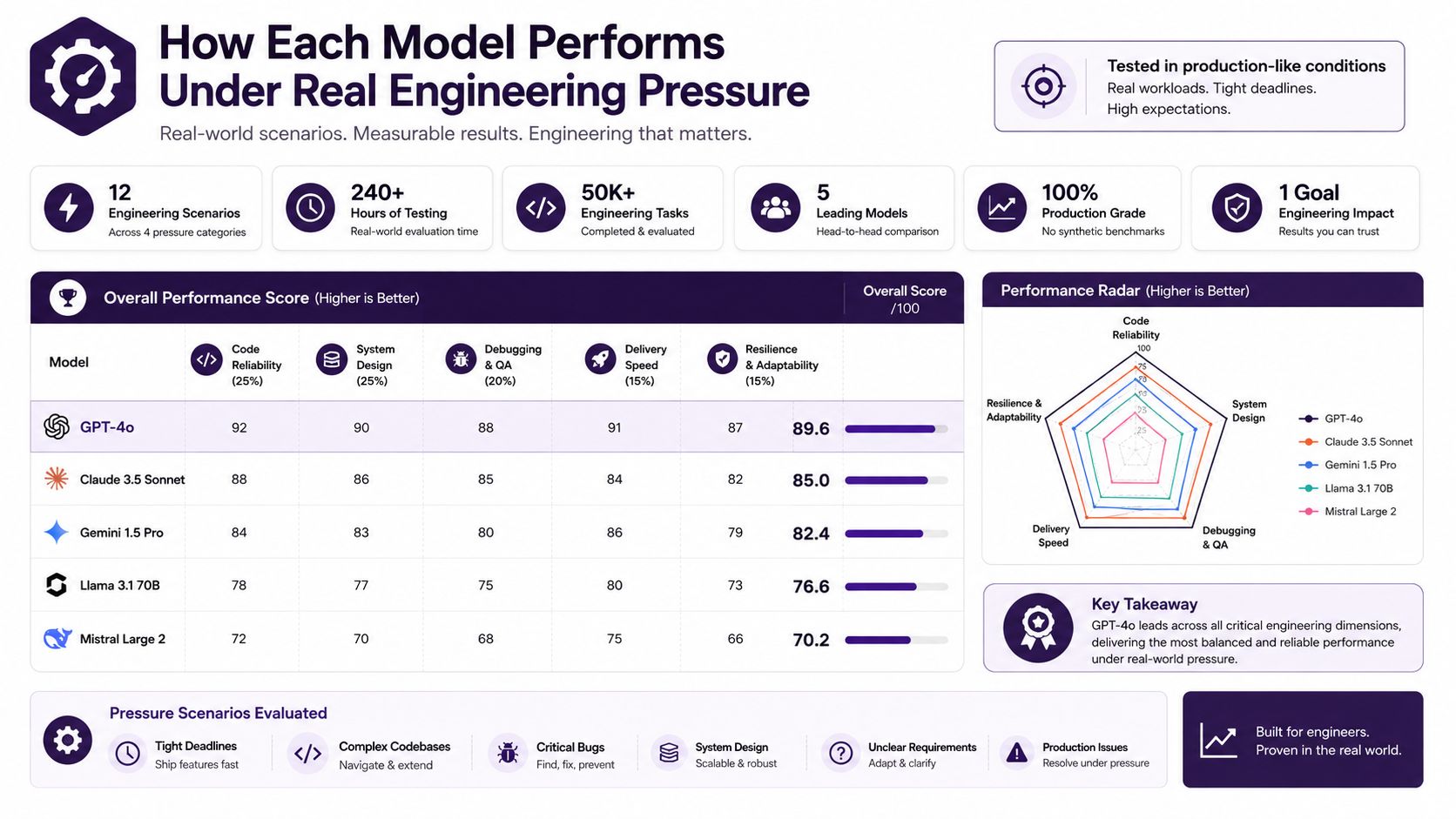
Speed only counts when the pipeline can protect you
Consider a SaaS team releasing customer-facing improvements throughout the day. A feature flag hides a new workflow, automated tests run on every merge, and the deployment system can revert a small change. Trunk-based development supports that operating model because integration happens close to the moment of implementation.
Now consider a hardware-adjacent product with scheduled releases, lengthy validation, and customers running distinct supported versions. A release branch may provide a useful boundary for stabilization and documentation. For that team, Gitflow's slower rhythm may reflect the product's obligations rather than an engineering failure.
The prerequisites are essential:
- Automated regression testing: The suite must catch meaningful regressions when engineers merge.
- Fast, dependable CI: A slow or flaky pipeline turns every merge into a queue.
- Feature-flag discipline: Teams need a safe way to integrate incomplete behavior without exposing it.
- Clear ownership: Someone must protect main, manage rollbacks, and resolve broken builds quickly.
Track those capabilities with a practical KPI framework for software development, not with deployment frequency alone. Trunk-based development can improve flow, but it exposes weak engineering systems immediately. That exposure is useful only if leaders are prepared to fix what it reveals.
Which Model Fits Your Team Size and Cadence
Choose the model based on the product's release reality, not on what sounds modern in an engineering presentation. The most useful question is whether your team has one live version that should receive small changes continuously, or several versions that require explicit coordination.
Choose trunk-based development when these conditions are true
A small, senior team shipping a SaaS product multiple times per day is the clearest fit. Engineers can keep changes narrow, review them quickly, and use flags when a feature isn't ready for general access.
Trunk-based development also suits:
- Flag-enabled SaaS products: One production version stays live, and incomplete features can remain hidden.
- Continuously delivered mobile products: The team can integrate code frequently while coordinating customer exposure through controlled rollout mechanisms.
- B2B platforms with one supported version: The engineering organization doesn't need a separate branch for every customer release.
- Teams with strong release ownership: Engineers know who responds when main breaks and who removes old flags.
The model is especially effective when product managers value rapid customer feedback and sales teams need realistic commitments based on a dependable delivery pipeline.
Stay with Gitflow when release boundaries are real
Gitflow remains appropriate when customers run multiple production versions in parallel or when the organization has scheduled release trains. Regulated products may need a defined stabilization branch for approvals, documentation, and controlled deployment windows.
It can also fit a larger team where merge discipline is uneven and the organization hasn't yet built the automation needed to keep trunk safe. That isn't a permanent excuse. It is a candid assessment of current operating capacity.
Decision rule: If your biggest risk is integrating too often, evaluate Gitflow. If your biggest risk is discovering integration problems too late, move toward trunk-based development.
Early-stage companies without dependable CI/CD shouldn't adopt trunk because a blog post called it the default. Their first investment should be automated testing, deploy automation, and ownership of the release process. Gitflow may provide a more honest temporary structure while those capabilities develop.
A fractional engineering leader can help make that assessment without turning it into a branding exercise. The leader should inspect the pipeline, test coverage, release history, incident patterns, and product obligations, then recommend a workflow the team can operate consistently.
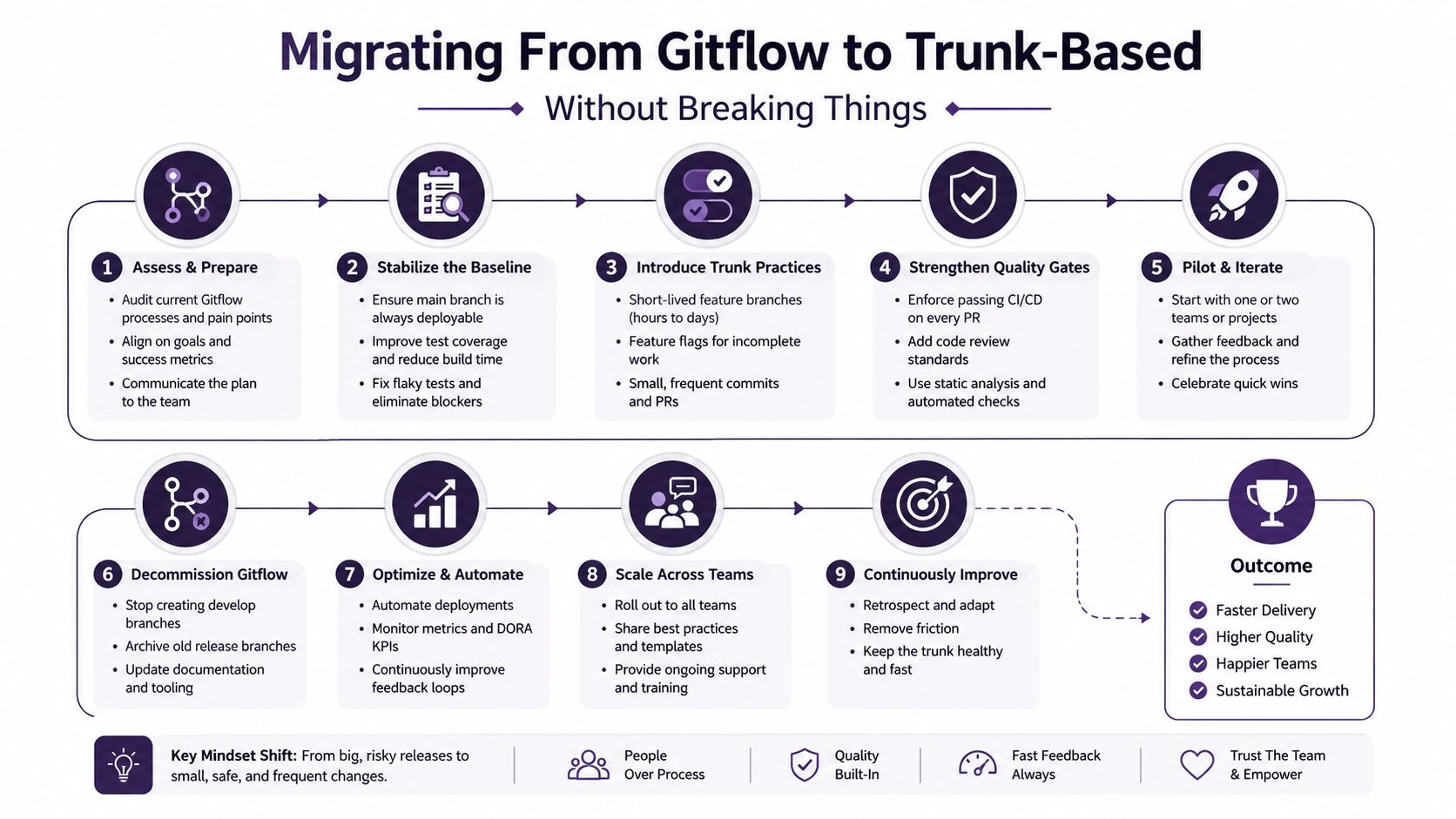
Migrating From Gitflow to Trunk-Based Without Breaking Things
Don't delete develop on a Friday and call the migration complete. Trunk-based development is a destination that requires supporting systems, not a branch cleanup task.
Before changing the branch topology, establish four conditions:
- A green CI pipeline that runs consistently on pull requests and merges.
- An automated regression suite that checks important behavior on every merge.
- Feature flags for incomplete work, including ownership and cleanup rules.
- A cultural expectation that main stays releasable, even when delivery pressure rises.
A team that lacks these conditions should improve them first. Otherwise, main becomes the new dumping ground for untested changes and the organization will blame trunk-based development for a readiness problem.
Use a staged migration
Start by shortening the life of existing feature branches. Set a policy that requires daily integration with develop, then reduce the allowed lifespan until branches are measured in hours. This exposes conflicts while they're still small and teaches the team to divide large work into compatible increments.
Next, introduce feature flags before removing the integration branch. Engineers need a safe place for incomplete behavior, and flags provide that place without keeping code isolated. The team should document who can enable a flag, how it gets tested, and when it must be removed.
Then reduce the role of release branches. Cut them closer to the actual release, accept only stabilization changes, and push ordinary feature work toward the main integration line. Once develop no longer contains unique coordination value, decommission it.
A practical software development project management approach should track the migration as operational work, with owners for CI reliability, test coverage, flags, branch policy, and release decisions.
A policy your team can adapt
Branch policy: All feature branches must merge into main within hours, not days. Every merge requires passing automated checks and review. Incomplete functionality must use a feature flag. Main must remain releasable, and any broken build takes priority over new feature work.
For a team of 10 to 30 engineers, plan for one to two quarters for the migration, based on the cited migration guidance at DeployHQ's workflow comparison. The duration depends on how much test automation, pipeline repair, and team coaching remain.
The hidden cost is substantial. Engineers must write tests, platform owners must improve CI, product managers must accept incremental delivery, and someone must manage the growing inventory of flags. Those tasks don't appear in a branch diagram, but they determine whether the migration succeeds.
The Case for Staying on Gitflow a Little Longer
A Series A SaaS company with 6 engineers, no dedicated DevOps hire, and no feature-flag infrastructure shouldn't switch to trunk-based development for status. Gitflow's release branches may be a more honest match for the team's current coordination ability while it improves testing and deployment automation.
The bottleneck may not be branching at all. If the regression suite is incomplete and deployments are manual, trunk moves risk closer to production. The engineering leader should fix those constraints before changing the branch model.
A fractional CTO or VP Engineering working 5 to 25 hours a week can audit CI/CD maturity, set a workable policy, and prevent an expensive migration before the team is ready.
Shiny connects growth-stage companies with experienced fractional executives who can assess delivery systems, engineering leadership needs, and operating gaps without forcing an immediate full-time hire. Visit Shiny to explore the marketplace and schedule a consultation about the right technical leadership for your team.