


In the relentless pursuit of growth, many executives default to simply 'working harder.' But what if the key to unlocking your company's potential isn't about more hours, but smarter systems? True scalability comes from optimizing operations, not just maximizing effort.
Many businesses hit a growth ceiling because they are bogged down by repetitive tasks, unclear strategies, and inefficient workflows that burn out their best people. The good news is that there are proven methodologies and strategic ways to improve business efficiency that fundamentally transform how you operate.
This article moves beyond generic advice. We provide an actionable roundup of 12 powerful strategies designed to eliminate waste, boost productivity, and build a more resilient organization. You will find specific tactics ranging from process automation to strategic talent solutions like fractional leadership, which provides specialized executive expertise without the cost of a full-time hire.
Each point is a blueprint for implementation, helping you identify and solve the specific bottlenecks holding your business back. It's time to stop working harder and start working smarter. Let's explore how to build a business that runs itself and scales predictably.
1. Lean Manufacturing & Process Optimization
Lean Manufacturing is a systematic method for maximizing customer value while minimizing waste. Originating from the Toyota Production System, this approach creates more value with fewer resources by identifying and eliminating non-value-adding activities.
For any business, adopting lean principles is one of the most effective ways to improve business efficiency. It directly targets operational waste, reduces costs, and improves product quality and delivery times.


This methodology isn't just for large manufacturers. Think of it like a professional chef organizing their kitchen (a concept called mise en place). Every tool and ingredient is placed for maximum efficiency, eliminating wasted motion. This same principle applies to any business process, from software development to customer onboarding.
How to Implement Lean Principles
Successfully integrating lean requires a strategic, ground-up approach. It's not about a single overhaul but a cultural shift toward efficiency.
- Start with a Value Stream Map: Visualize every step in your process, from the initial customer request to final delivery. This map will expose bottlenecks, delays, and waste.
- Engage Your Team: Your frontline employees are process experts. Involve them in identifying problems and brainstorming solutions.
- Use Visual Management: Implement tools like Kanban boards to make workflows, progress, and problems visible to everyone. This improves communication and accountability.
- Measure Everything: Establish clear Key Performance Indicators (KPIs) to track improvements in areas like cycle time, defect rates, and inventory levels.
Implementing such a profound operational shift can be challenging without seasoned leadership. Many growing businesses find that a fractional COO with deep expertise in lean methodologies can guide this transformation efficiently, ensuring the principles are applied correctly for maximum impact. You can explore a variety of these proven strategies in our guide to process improvement methods.
2. Automation & Robotic Process Automation (RPA)
Automation uses technology to perform repetitive, manual tasks with minimal human intervention. A subset of this, Robotic Process Automation (RPA), employs software "bots" to mimic human actions and interact with digital systems, such as entering data or processing transactions.
For growing businesses, implementing RPA is one of the most direct ways to improve business efficiency. It reduces human error, accelerates task completion, and frees up skilled employees for more strategic, high-value work.
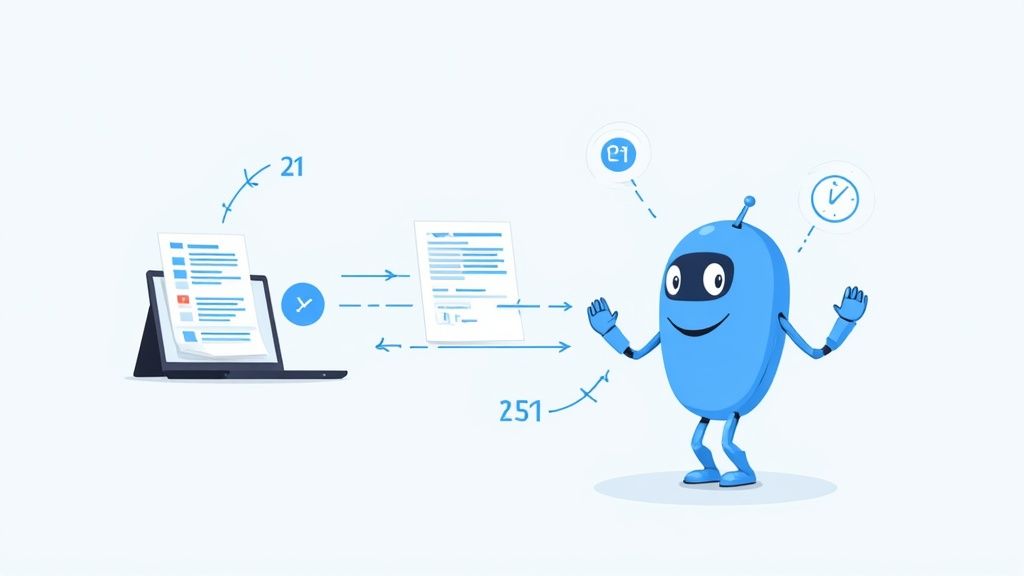
Think of RPA as a digital assistant for your team. A real-world example is an accounting firm that uses bots to automatically download bank statements, extract transaction data, and enter it into their accounting software. This saves hundreds of hours per month, allowing accountants to focus on financial analysis and client advisory instead of data entry.
How to Implement Automation & RPA
A successful automation strategy requires careful planning. It's about targeting the right processes for the highest impact.
- Identify High-Impact Processes: Start with tasks that are highly repetitive, rule-based, and prone to human error, like invoice processing or data entry.
- Standardize Before Automating: Ensure the process you want to automate is already optimized. Automating a broken process only makes it faster at producing poor results.
- Run a Pilot Program: Test your automation on a small scale first. This allows you to work out any issues and demonstrate ROI before a full-scale rollout.
- Prioritize Change Management: Communicate the benefits to your team, emphasizing that automation is a tool to support them, not replace them.
Implementing a robust automation strategy often requires deep technical and operational expertise. A fractional COO or CTO can provide the strategic oversight needed to identify the best opportunities, select the right tools, and manage the implementation, ensuring a clear return on investment.
3. Six Sigma & Data-Driven Quality Management
Six Sigma is a disciplined, data-driven methodology that uses statistical analysis to eliminate defects and minimize variability. Where Lean focuses on waste, Six Sigma hones in on quality, aiming for near-perfection.
For businesses aiming to enhance customer satisfaction and reliability, adopting this approach is one of the most impactful ways to improve business efficiency. It’s about making decisions based on verifiable data rather than assumptions, leading to more predictable outcomes.
How to Implement Six Sigma
Successfully deploying Six Sigma requires a structured approach focused on measurement and analysis.
- Define and Measure: Identify what is "critical-to-quality" from the customer's perspective. Establish clear metrics and collect data to measure current performance.
- Analyze and Improve: Use statistical tools to analyze the data, identify the root causes of defects, and implement solutions to remove them.
- Control and Sustain: Implement controls to ensure the improvements are sustained over time. Continue monitoring the process to prevent it from regressing.
- Train Your Team: Invest in training key employees as "Green Belts" or "Black Belts" who can lead these data-intensive projects.
Implementing a robust Six Sigma program often benefits from an expert who can navigate its statistical complexities. A fractional COO with a background in quality management can provide the necessary leadership to embed these practices correctly. You can find more strategies in our guide to data-driven decision-making.
4. Agile & Scrum Methodologies
Agile is an iterative project management approach that emphasizes flexibility, team collaboration, and rapid delivery. Instead of a single, long-term plan, Agile breaks large projects into short, manageable cycles called "sprints."
This allows businesses to adapt quickly to changing market demands and customer feedback, making it one of the most effective ways to improve business efficiency in dynamic environments.
Think of it as building a house. A traditional approach would finalize every detail before laying a single brick. An Agile approach might focus on building a livable foundation and first floor (a "minimum viable product"), gathering feedback from the owner, and then iterating on the next floors and features based on that input.
How to Implement Agile Principles
Integrating Agile requires a mindset shift from rigid planning to adaptive execution. It empowers teams to respond to challenges and opportunities as they arise.
- Start with a Pilot Project: Select a single, well-defined project to test Agile principles before attempting a company-wide rollout.
- Invest in Training: Ensure your team understands the core concepts of Agile and Scrum, including roles like Product Owner and Scrum Master.
- Use Project Management Tools: Leverage platforms like Jira or Asana to manage backlogs, track sprint progress, and maintain transparency.
- Conduct Regular Retrospectives: At the end of each sprint, hold a meeting to discuss what went well, what didn't, and what can be improved. This is the engine of continuous improvement.
5. Business Process Management (BPM) & Workflow Optimization
Business Process Management (BPM) is a continuous discipline of modeling, executing, monitoring, and optimizing business workflows. By providing clear visibility into how work actually flows, BPM is one of the most powerful ways to improve business efficiency, pinpointing bottlenecks and eliminating redundancies.
For example, a marketing agency used BPM to map its client onboarding process. They discovered that delays were consistently caused by waiting for client assets. By redesigning the workflow to include an automated asset collection portal before the project kickoff, they cut onboarding time by 40%.
How to Implement BPM
Integrating BPM requires a structured, holistic view of your operations.
- Map Current Processes: Before you can improve a process, you must understand it. Create "As-Is" diagrams for key workflows to visualize every step.
- Involve Cross-Functional Stakeholders: Get input from everyone involved in the process. Their diverse perspectives are crucial for identifying real-world pain points.
- Prioritize High-Impact Processes: Start with processes that have the biggest impact on costs, revenue, or customer satisfaction for a quick win.
- Implement Monitoring Dashboards: Use KPIs to track process performance continuously. Metrics like cycle time and error rates will show if your changes are working.
Successfully orchestrating a BPM initiative often requires strong operational leadership. A fractional COO can provide the necessary expertise to guide process mapping and technology implementation, ensuring your optimization efforts deliver tangible results. You can find more approaches in our overview of process improvement methods.
6. Employee Training & Development Programs
Employee training is a strategic investment in enhancing your team's skills and knowledge. For businesses aiming to improve efficiency, this isn't a perk but a necessity. Well-trained employees are more productive, make fewer errors, innovate more effectively, and are more engaged.
The core philosophy is that an organization's capacity to learn and adapt faster than its competitors is the ultimate competitive advantage. It's about building capabilities internally to solve tomorrow's problems.
How to Implement Training & Development
Building an effective training program requires a deliberate, strategic approach rather than ad-hoc workshops.
- Align Training with Business Goals: Identify the key skills your business needs to achieve its objectives. Design training programs that directly address these competency gaps.
- Offer Diverse Learning Formats: Cater to different learning styles with a mix of self-paced online courses, instructor-led workshops, and peer mentoring.
- Create Clear Advancement Pathways: Show employees how acquiring new skills translates into career growth within the company. This provides powerful motivation.
- Track Training Effectiveness: Measure the impact of your programs on key performance metrics. Look for improvements in productivity or error reduction after training.
For growing businesses, designing a curriculum that aligns with strategic goals can be a challenge. An experienced fractional executive can help architect a development program that builds the exact capabilities your team needs to scale.
7. Supply Chain Optimization & Vendor Management
Supply Chain Optimization is the strategic management of the entire flow of goods, data, and finances, from procuring raw materials to delivering the final product. A well-managed supply chain is a powerful tool to improve business efficiency. It directly impacts costs, delivery speed, and customer satisfaction.
A small e-commerce business optimizing its shipping partners or a local restaurant building strong relationships with regional farmers are both applying these principles. The goal is to create a seamless, responsive, and cost-effective system that meets customer demand reliably.
How to Optimize Your Supply Chain
Effective supply chain management requires a proactive and data-driven approach.
- Analyze and Segment Suppliers: Not all vendors are created equal. Categorize them based on their strategic importance and develop tailored management strategies for each group.
- Implement Vendor Performance Scorecards: Track key metrics like on-time delivery, quality, and cost to hold suppliers accountable.
- Use Supply Chain Visibility Tools: Adopt technology that provides real-time tracking of inventory and shipments to anticipate disruptions.
- Negotiate Strategic Partnerships: Shift from purely transactional relationships to long-term partnerships with key suppliers to foster collaboration and reliability.
Mastering a complex supply chain can be a major hurdle for growing companies. A fractional COO with deep experience in logistics can provide the strategic oversight needed to identify inefficiencies, negotiate better terms, and build a resilient supply chain.
8. Key Performance Indicators (KPI) & Analytics Dashboard
Key Performance Indicators (KPIs) are quantifiable measures a business uses to gauge performance against strategic objectives. An analytics dashboard translates these metrics into a real-time, visual snapshot of your company’s health.
This approach is one of the most powerful ways to improve business efficiency because it moves decision-making from guesswork to a data-driven process.
Small and medium-sized businesses can use tools like Tableau or Power BI to build dashboards that provide immediate clarity on sales cycles, marketing ROI, or operational costs. The core principle is making performance visible and accountable.
How to Implement KPIs and Dashboards
Implementing an effective KPI framework requires a clear understanding of your business goals.
- Align KPIs with Strategic Goals: Start with your top-level objectives. If your goal is profitability, relevant KPIs would be customer acquisition cost (CAC), lifetime value (LTV), and profit margin.
- Use a Mix of Indicators: Track both lagging indicators (past results, like revenue) and leading indicators (which predict future outcomes, like sales pipeline growth).
- Keep Dashboards Simple: An effective dashboard tells a story at a glance. Focus on 5-10 primary KPIs to avoid information overload.
- Review and Discuss Regularly: Data is useless without action. Schedule regular team meetings to review the dashboard and make strategic adjustments.
Defining the right KPIs can be complex. A fractional executive with a strong analytical background can help identify the most impactful metrics for your specific business model, ensuring your team is focused on activities that generate tangible results.
9. Outsourcing & Offshoring Non-Core Activities
Outsourcing involves delegating non-core business functions to specialized external providers. For small and medium-sized businesses, this strategy is a powerful way to improve business efficiency by allowing the core team to focus on what they do best: driving growth and innovation.
By handing over tasks like IT support, accounting, or customer service to experts, companies can access higher-quality services at a fraction of the cost of an in-house team.
For example, a startup can outsource its entire finance and accounting function to a specialized firm, gaining access to CFO-level expertise without the corresponding salary. The core principle is leveraging external talent to perform essential tasks more efficiently.
How to Implement Outsourcing Strategically
Successful outsourcing requires careful planning and management. It's about smart delegation, not just offloading work.
- Identify Non-Core Functions: Analyze your business processes. Which activities are critical but don't directly contribute to your unique value proposition? These are prime candidates for outsourcing.
- Define Clear Scope and SLAs: Create a detailed document outlining the scope of work and Service Level Agreements (SLAs). Ambiguity is the enemy of a successful partnership.
- Select the Right Partner: Don't just choose the cheapest option. Look for vendors with a proven track record and industry-specific expertise.
- Establish Strong Governance: Implement regular check-ins, performance reviews, and clear communication channels to manage the relationship effectively.
For leadership roles, this concept extends to fractional executives. Instead of outsourcing an entire department, a growing company can bring in a part-time COO or CMO to manage that function. This provides top-tier strategic guidance without the commitment of a full-time hire, a core value proposition we specialize in at Shiny.
10. Workplace Culture & Organizational Design Optimization
Workplace culture is a foundational element that directly influences productivity. This approach involves strategically aligning your company's structure, values, and work environment to enhance employee engagement and collaboration.
Optimizing culture is one of the most powerful ways to improve business efficiency because it fosters a motivated workforce that drives growth from within. This isn't about office perks; it's about creating an ecosystem where people can do their best work.
How to Optimize Your Culture & Design
Building a high-performance culture requires intentional effort and consistent leadership.
- Establish and Live Your Values: Define the core principles that guide your business. These values should inform everything from hiring to strategic planning.
- Invest in Flexibility and Autonomy: Trust your team. Providing flexibility in how, when, and where work gets done can significantly boost morale and productivity.
- Foster Transparent Communication: Create channels for open, honest feedback. When leadership is transparent about goals and challenges, it builds trust and alignment.
- Celebrate Wins and Build Community: Actively recognize individual and team achievements to reinforce positive behaviors and improve collaboration.
A toxic or misaligned culture is a primary source of inefficiency. An experienced fractional executive, such as a Chief People Officer or COO, can be instrumental in diagnosing cultural issues and redesigning your organizational structure for peak performance.
11. Continuous Improvement Culture & Innovation Programs
A continuous improvement culture is a mindset that actively encourages all employees to consistently seek out incremental enhancements. It goes beyond one-time projects, embedding the pursuit of excellence into the daily fabric of the business.
Fostering this culture is a powerful way to improve business efficiency by unlocking the collective intelligence of the entire team.
The goal is to make small, ongoing improvements a shared responsibility, driving momentum that compounds over time.
How to Foster This Culture
Building an environment of innovation requires deliberate leadership and structured support.
- Create a Safe Space for Ideas: Establish a clear system for employees to submit suggestions. Crucially, create psychological safety where "smart failures" are viewed as learning opportunities.
- Dedicate Time and Resources: Show that innovation is a priority by allocating specific time for improvement activities, like brainstorming sessions or innovation challenges.
- Reward and Recognize Efforts: Acknowledge and celebrate both small wins and major breakthroughs to reinforce the desired behavior.
- Provide Strategic Direction: Ensure everyone understands the company's goals to help focus creative energy on the most impactful areas.
Cultivating this culture often requires a leader who can champion the cause. A fractional executive can provide the focused leadership needed to install these programs and guide the cultural shift, ensuring your team’s innovative potential translates into tangible business results.
12. Technology Stack Modernization & Integration
Technology Stack Modernization involves replacing outdated legacy systems with modern, integrated solutions. This strategic overhaul improves operational efficiency by reducing technical debt.
For growing businesses, relying on cumbersome, siloed software is a direct path to inefficiency. Modernizing your tech stack is one of the most impactful ways to improve business efficiency in the digital age.
How to Modernize Your Technology Stack
A successful modernization project requires careful planning to minimize disruption and maximize ROI.
- Conduct a Thorough Tech Audit: Begin by evaluating your current systems. Identify pain points, redundancies, and gaps in functionality.
- Develop a Phased Migration Plan: Avoid a "big bang" approach. Plan a gradual, phased rollout to minimize operational risks.
- Prioritize Integration Capabilities: When selecting new software, ensure it can integrate smoothly with other tools in your stack via APIs.
- Invest in Employee Training: New technology is only effective if your team knows how to use it. Allocate resources for comprehensive training.
Guiding a complex modernization requires both technical and strategic leadership. A fractional CIO or CTO can provide the expert oversight needed to manage the transition, from vendor selection to implementation. You can see how this fits into a broader strategy in our guide to building a digital transformation roadmap.
12-Point Business Efficiency Comparison
| Approach | Implementation Complexity 🔄 | Resource & Cost ⚡ | Expected Outcomes 📊⭐ | Ideal Use Cases 💡 | Key Advantages ⭐ |
|---|---|---|---|---|---|
| Lean Manufacturing & Process Optimization | Medium–High — requires cultural change and structured rollout | Moderate–High upfront (training, process mapping); lower OPEX over time | Reduced waste, improved quality and shorter lead times | High-volume manufacturing, supply chains, repetitive operations | Systematic waste elimination, stable quality, engaged workforce |
| Automation & Robotic Process Automation (RPA) | Medium — technical integration and process standardization needed | High initial tech investment; scalable with lower marginal cost | Dramatically faster processing, fewer errors, 24/7 operations | High-volume, rule-based back-office tasks and data entry | Speed, accuracy, scalability, clear ROI on repetitive tasks |
| Six Sigma & Data-Driven Quality Management | High — requires statistical expertise and certified roles | High (training, data tools, certification); ongoing measurement costs | Significant defect reduction, measurable process variation control | Quality-critical manufacturing and services with measurable metrics | Robust, quantifiable quality improvements and root-cause elimination |
| Agile & Scrum Methodologies | Medium — requires mindset shift and team training | Low–Moderate (training, tooling); flexible budget needs | Faster time-to-market, iterative improvements, better stakeholder feedback | Product development, software teams, fast-changing projects | Rapid delivery, adaptability, improved team collaboration |
| Business Process Management (BPM) & Workflow Optimization | High — complex design, orchestration and IT integration | High (BPM software, integration, training); ongoing maintenance | Greater transparency, fewer bottlenecks, lower cycle times | Cross-departmental processes, regulated environments, enterprise workflows | End-to-end visibility, compliance, continuous redesign capability |
| Employee Training & Development Programs | Medium — program design and sustained commitment required | Moderate–High (content, platforms, time); ongoing investment | Higher productivity, retention, and capability build-up | Organizations needing skill upgrades, leadership pipelines | Builds internal capability, improves engagement and decision-making |
| Supply Chain Optimization & Vendor Management | High — requires data integration and cross-party collaboration | High (systems, analytics, supplier programs); potential long-term savings | Lower procurement/logistics costs, improved delivery reliability | Retail, manufacturing, distribution, global sourcing | Cost reduction, resilience, better supplier performance |
| KPI & Analytics Dashboard | Medium — requires data hygiene and BI implementation | Moderate (BI tools, data engineering); scalable once set up | Real-time visibility, better decisions, early problem detection | Any data-driven organization seeking performance transparency | Data-driven accountability, trend detection, informed decisions |
| Outsourcing & Offshoring Non-Core Activities | Medium — vendor selection and governance complexity | Low–Moderate to High depending on scope; potential cost savings | Cost reduction, access to expertise, increased focus on core work | Non-core functions (IT support, manufacturing, BPO) | Cost efficiency, scalability, access to specialized skills |
| Workplace Culture & Organizational Design Optimization | High — long-term cultural change and leadership alignment | Moderate (programs, change initiatives); returns accrue over time | Higher engagement, retention, innovation and productivity | Knowledge work, creative industries, talent-competitive markets | Better attraction/retention, improved collaboration and wellbeing |
| Continuous Improvement Culture & Innovation Programs | Medium — needs sustained leadership support and governance | Moderate (program infrastructure, incentives); ongoing resource allocation | Incremental efficiencies, new ideas, increased employee ownership | Organizations seeking ongoing incremental innovation and engagement | Harnesses workforce ideas, continuous gains, adaptable organization |
| Technology Stack Modernization & Integration | High — complex migration, interoperability and risk management | High upfront (cloud, APIs, migration); reduces technical debt long-term | Faster innovation, improved reliability, better data access | Enterprises with legacy systems needing agility and scale | Reduced technical debt, scalability, faster feature delivery |
The Ultimate Efficiency Lever: Fractional Leadership
We've just explored twelve powerful ways to improve business efficiency. We've covered everything from process mapping with Lean to the strategic high ground of KPI dashboards and technology modernization. Each strategy offers a distinct path toward a leaner, more agile, and more profitable organization.
But the journey from understanding these concepts to successfully implementing them is where many businesses falter. The knowledge is accessible, but the execution requires a rare blend of deep expertise, focused leadership, and dedicated time—resources that are often in short supply.
From Theory to Tangible ROI: The Execution Gap
The core challenge isn't a lack of good ideas; it's a deficit in execution capacity. You know you need to implement a new CRM, but who will lead the project? You see the value in data, but who has the expertise to build the right analytics dashboards? This is the execution gap—the chasm between strategic ambition and operational reality.
Closing this gap is the single most critical step in transforming your business. For many companies, the traditional solution of hiring a full-time, C-suite executive is financially prohibitive. A top-tier Chief Operating Officer comes with a hefty salary and equity package that can strain cash flow.
Key Insight: The greatest barrier to improved business efficiency is not the absence of strategy, but the absence of experienced leadership to drive its implementation.
Fractional Leadership: The Strategic Shortcut to Efficiency
This is precisely where fractional leadership emerges as the ultimate efficiency lever. It resolves the classic dilemma: needing enterprise-level expertise without the enterprise-level budget. A fractional executive is not a consultant who advises and leaves. They are a true part-time member of your leadership team, embedding themselves in your organization to own and execute critical initiatives.
Imagine bringing on a seasoned expert to:
- Modernize Technology: A fractional CTO can audit your systems, select the right software, and manage the entire integration process.
- Optimize Processes: A fractional COO can lead a BPM initiative, mapping your current state, identifying bottlenecks, and implementing streamlined workflows.
- Build a Data-Driven Culture: A fractional data expert can establish your analytics framework, define meaningful KPIs, and train your team to turn insights into action.
By leveraging fractional talent, you are "renting" the precise expertise you need, for the exact amount of time you need it. This model provides an unparalleled ROI, focusing senior-level firepower directly on your most significant efficiency challenges. It’s the most direct and cost-effective way to translate the strategies in this article into measurable results.
Ready to close the gap between planning and execution? Shiny connects you with a curated network of over 3,000 vetted, C-suite executives ready to drive growth and efficiency for your business on a fractional basis. Explore how the right part-time leader can transform your operations by scheduling a consultation today.