


So, what exactly does a fractional CFO do?
It’s a fair question, and the simplest answer is this: a fractional CFO brings high-level, strategic financial leadership to your company on a part-time basis.
Think of them less as a number-cruncher and more as an experienced co-pilot for your business, helping you navigate the financial complexities of growth so you can focus on your vision.
Your Strategic Financial Co-Pilot for Business Growth
Most founders are visionaries. You live and breathe your product, your customers, and your mission. But wrestling with complex financial models, cash flow projections, and investor reports? That’s often a different story, and it's precisely where a fractional CFO steps in.
They aren't just bookkeepers or accountants focused on historical numbers. A great fractional CFO is forward-looking. They’re your partner in navigating the financial landscape to steer your company toward sustainable, intelligent growth.
Because they work on a flexible basis, you can scale their support up or down as needed—perfect for the dynamic, often unpredictable, life of a startup.
More Than Just Numbers
A fractional CFO’s real magic is translating raw financial data into a story—a compelling narrative for investors and a clear roadmap for your team. They’re there to help you answer the tough "what if" questions that keep you up at night.
Their support typically centers on three key areas:
- Strategic Planning: Building robust financial models that map out your cash flow, project future revenue, and chart a believable course to profitability.
- Fundraising Support: Getting your company ready for the scrutiny of due diligence, crafting a defensible financial story, and speaking the language of VCs and other investors.
- Operational Efficiency: Pinpointing opportunities to improve your margins, manage expenses intelligently, and extend your cash runway without killing your momentum.
Imagine you're deciding whether to hire three new engineers. Your gut says yes, but your fractional CFO can model the real-world impact on your runway, helping you make a data-backed decision instead of a guess. It's about bringing the financial discipline of a seasoned executive to the table, without the hefty salary and equity of a full-time hire. This flexible approach is a key part of the fractional C-suite advantage.
Fractional CFO vs. Full-Time CFO At a Glance
It can be tough to decide which route is right for your company. This simple table breaks down the core differences between bringing on a fractional expert versus hiring a full-time executive.
| Aspect | Fractional CFO | Full-Time CFO |
|---|---|---|
| Cost | A fraction of a full-time salary; no benefits or equity typically required. | Full executive salary ($250k+), plus benefits, bonus, and often equity. |
| Commitment | Flexible, part-time engagement (e.g., 5-20 hours/week); can scale up or down. | Full-time, long-term commitment. |
| Focus | Primarily strategic: fundraising, financial modeling, cash flow management. | Broad scope: covers strategy, day-to-day financial operations, and team management. |
| Best For | Early-stage to growth-stage startups needing expert guidance without the full cost. | Mature companies or those with complex, daily financial operational needs. |
Ultimately, the choice depends on your stage, budget, and immediate needs. For many startups, a fractional CFO offers the perfect blend of world-class expertise and capital efficiency.
Core Responsibilities Beyond the Balance Sheet
It’s a common mistake to think a fractional CFO just lives in historical financial statements. In reality, their work is less about looking in the rearview mirror and far more about navigating the road ahead.
They aren't just reporting on what happened last quarter; they’re actively shaping what happens next. This means they move beyond traditional accounting, transforming reactive bookkeeping into a proactive engine for growth.
The Three Pillars of Strategic Finance
The best way to understand a fractional CFO's role is to break it down into three core areas. Think of it as a pyramid: bookkeeping is the solid base, but the real value comes from the strategic leadership at the top.
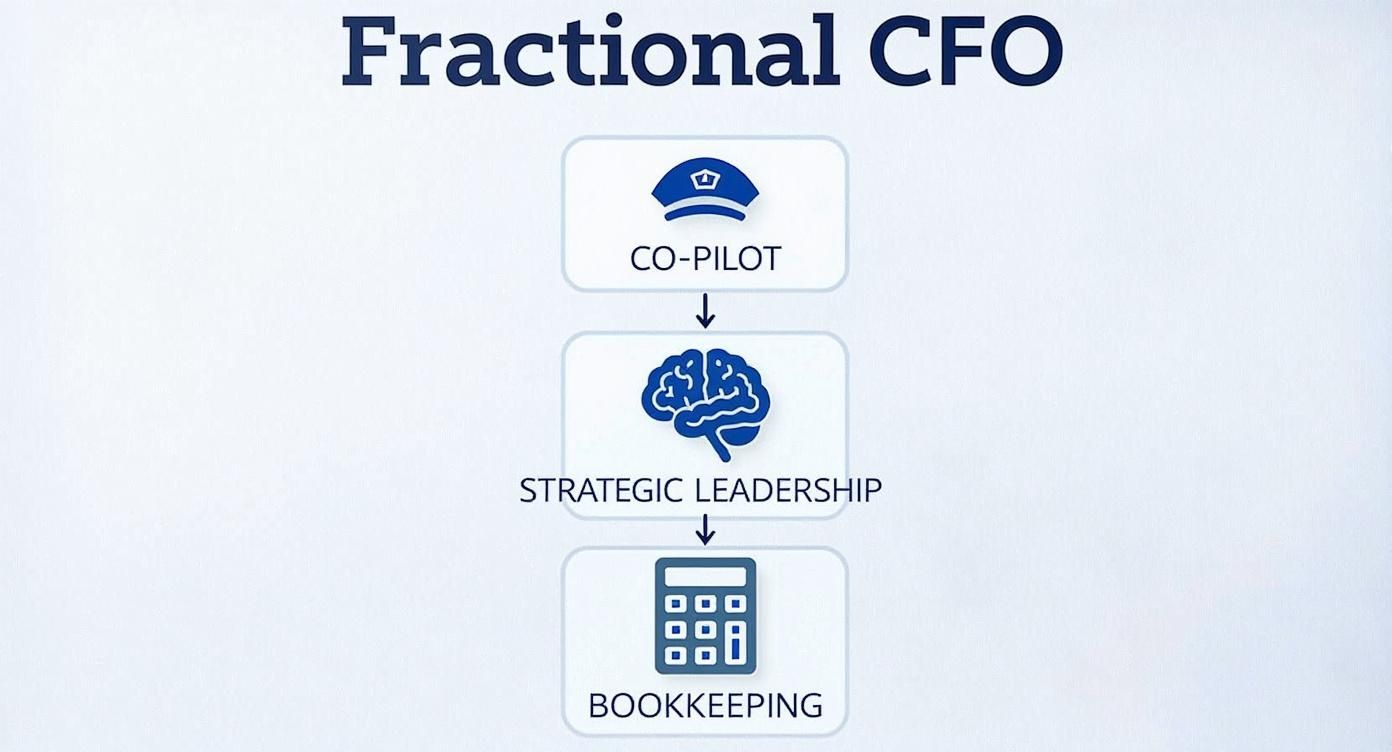

This structure highlights why a fractional CFO is so much more than an accountant. While accurate books are non-negotiable, it’s the strategic layer they add that truly changes the game for a startup.
Here’s what that looks like in practice:
- Financial Planning and Analysis (FP&A): This is the heart of their strategic contribution. They build powerful financial models that forecast everything—revenue, expenses, and cash flow—to run "what-if" scenarios and guide decision-making.
- Cash Flow Management: For a startup, cash is oxygen. A fractional CFO sets up systems to monitor your burn rate and, most importantly, extend your runway, giving you an early warning if you’re heading for a cash crunch.
- Investor and Stakeholder Management: They are masters at translating complex financial data into a clear, compelling story for your board and potential investors, confidently defending your projections under intense due diligence.
- Operational Efficiency: A good fractional CFO digs into your operations to find savings. They might analyze your customer acquisition cost (CAC) against your customer lifetime value (LTV) to ensure growth is profitable.
Connecting Financial Strategy to Real Business Results
So, what does a fractional CFO actually do that moves the needle for a business? This isn't about theoretical jargon; it’s about translating numbers on a spreadsheet into tangible results you can see and measure.
Think of it this way: a fractional CFO ensures your company’s financial engine isn’t just running, but is finely tuned for peak performance. This means every strategic decision—from new hires to marketing campaigns—is backed by solid numbers and a clear understanding of its financial impact.


This connection directly translates into a measurable return on investment. A 2022 study found that 55% of startups who brought on a fractional CFO saw significant revenue growth, while an impressive 65% reported better profit margins. Those aren't vanity metrics; that's real cash hitting the bottom line. You can learn more about how fractional CFOs drive growth on EightX.
From Projections to Profitability
The true impact of a great fractional CFO becomes obvious during your company's biggest moments.
For example, imagine walking into a Series A investor meeting not with hope, but with an airtight financial model that easily stands up to grueling due diligence questions. That confidence comes directly from their work.
Or, consider how strategic cash management could stretch your runway by six crucial months. That’s the breathing room you need to hit your next product milestone without scrambling for a desperate, last-minute fundraise.
A fractional CFO doesn't just manage your finances; they weaponize them for growth. Their job is to turn your balance sheet and P&L into a strategic asset that helps you win in the market.
Key Metrics That Improve
The value really crystallizes when you look at the specific numbers they influence. With their guidance, companies often see dramatic improvements in the metrics that define business health.
Here are a few examples of what gets better:
- Higher Gross Margins: By digging into your cost of goods sold (COGS) and pricing strategies, they find hidden opportunities to make every single sale more profitable.
- Lower Cost of Capital: Their experience and network help you secure funding—whether debt or equity—on much more favorable terms.
- More Predictable Revenue: They build reliable forecasting models that give you a clear picture of future income, letting you make smarter, data-driven decisions.
Ultimately, bringing on a fractional CFO isn't just filling a role. It's an investment in your company’s financial maturity and its capacity to compete at a higher level.
Understanding the Cost and Value Proposition
When you’re thinking about bringing on a fractional CFO, the conversation rightly lands on cost. For founders, every dollar has a job to do. So, what’s the real investment?
The good news is that the entire model is built for flexibility. Pricing depends on your company's stage and specific needs. A startup gearing up for a funding round might need project-based help, while a more established business may prefer a monthly retainer for ongoing strategic advice.
The bottom line: you only pay for the support you actually need. Our guide on part-time CFO costs breaks down these models in more detail.
The Real Cost-Benefit Analysis
The true value snaps into focus when you weigh the investment against the alternative: hiring a full-time CFO. For a growing startup, that’s a massive commitment—a hefty salary, benefits, and a slice of equity.
A fractional CFO gives you access to the same high-caliber strategic mind—someone who has likely guided dozens of companies through the exact challenges you're facing—for a fraction of the fully-loaded cost of a permanent hire.
The numbers don't lie. In 2025, you'll see fractional CFOs charging anywhere from $175 to $450 per hour, with monthly retainers landing between $2,000 and $14,500. Compare that to a full-time CFO, whose total compensation can easily top $500,000 annually.
This means startups can slash their executive financial leadership costs by a staggering 80–90%. You can see a more detailed breakdown of these cost benchmarks at CFOAdvisors.com.
This isn't just about pinching pennies; it's about smart capital allocation. It’s freeing up cash to pour back into your product, marketing, or team—the real engines of growth—all while having an elite financial strategist in your corner.
Key Signs Your Business Is Ready for a Fractional CFO
Knowing the right time to bring in a fractional CFO isn't always obvious, but the signs are usually tied to specific growing pains. Most founders eventually hit a wall where the financial side of the business becomes too complex to handle alone, creating a bottleneck that slows everything down.
Are you spending more time lost in spreadsheets than leading your team? Are you gearing up to raise capital but lack a credible financial story? These are giant, flashing signs that you need strategic financial guidance.

A Quick Diagnostic Checklist
If you find yourself nodding along to more than one of these, take it as a clear signal. Your business has likely hit an inflection point where a fractional CFO shifts from a "nice-to-have" luxury to a business necessity.
Ask yourself these questions:
- Are we gearing up for a fundraise? Investors expect bulletproof financial models. A fractional CFO lives and breathes this work.
- Is my financial visibility poor? If you can't confidently map out your cash runway, you're essentially flying blind.
- Have our financial operations outgrown our team? When your bookkeeper gets strategic questions they can't answer, it’s a sign you need senior leadership.
- Are we making big moves based on gut feelings? Major decisions—like expanding into a new market or overhauling pricing—demand rigorous financial modeling to de-risk them.
- Does our board need more sophisticated reporting? A fractional CFO delivers the professional, data-driven insights that serious stakeholders demand.
Answering "yes" highlights a clear need for the strategic expertise a fractional CFO brings. They don’t just put out fires; they build your financial function into an engine for growth.
How to Find the Right Financial Leader for Your Team
Figuring out you need a fractional CFO is a huge step forward. Now for the tricky part: finding the right one.
This isn't just about hiring a numbers expert. It's about finding a true strategic partner who understands the nuances of your industry and growth stage. A fractional CFO who has helped a SaaS company land its Series B has a completely different playbook than one who guided a manufacturing firm through supply chain chaos.
The key is finding someone with relevant, hands-on experience.
Vetting Your Next Strategic Partner
To ensure you have a great fit, your vetting process must go beyond their resume. You need to dig into their strategic thinking and communication style.
Try asking questions that reveal how they think:
- How would you approach building our financial forecast for the next 18 months?
- Based on where we are now, what are the top three financial metrics we should be obsessed with?
- Can you walk me through a time you helped a company like ours navigate a major financial hurdle?
This decision puts you at the forefront of a major hiring trend. The demand for fractional executives is exploding, with a reported 103% year-over-year increase in the U.S. alone. You can learn more about this industry growth at NOW CFO.
And if you’re still wrapping your head around the role, understanding what a fractional chief financial officer can do will make the value crystal clear.
Finding this ideal match can feel like searching for a needle in a haystack. We take the guesswork out of it by connecting growing companies with elite, pre-vetted financial executives who are ready to make an impact from day one.
Got Questions About Fractional CFOs?
Alright, you've got the basics down, but a few practical questions might still be floating around. Let's tackle the most common ones we hear from founders just like you.
What’s the real difference between a fractional CFO and a controller?
This is a big one. A controller is laser-focused on your financial history—they make sure the accounting is clean, handle compliance, and close the books. They’re the historian of your company’s finances. A fractional CFO, on the other hand, is the architect of your financial future. They use that historical data to build forecasts, shape business strategy, and spearhead fundraising.
How many hours does a fractional CFO actually work?
There’s no one-size-fits-all answer, which is the beauty of the model. An early-stage company might only need a few hours a month for high-level guidance. But if you’re heading into a fundraising round, that could easily ramp up to 10-15 hours a week. Engagements are flexible, allowing you to scale hours up or down as your business hits different milestones.
Can a fractional CFO genuinely help my company raise money?
Absolutely. In fact, this is one of their most critical roles. A seasoned fractional CFO knows exactly what investors want to see. They will prepare your company for the intense scrutiny of due diligence by cleaning up your financial records, building a bulletproof financial model, and helping you craft the financial narrative for your pitch deck. Having their credibility in your corner can dramatically improve your odds of success.
Finding the right financial leader is a game-changing moment for any scaling business. If you're ready to add a strategic financial partner to your team, we can help. Shiny gives you access to a curated network of over 3,000 elite, pre-vetted executives ready to step in and drive growth.
Schedule a consultation to find the perfect fractional CFO for your team.