



A Vice President of Operations is the strategic architect who turns a company's vision into day-to-day reality. They design, build, and optimize the internal systems that allow a business to run efficiently, profitably, and at scale.
In short, they ensure every part of your business works in harmony to achieve sustainable growth. If your CEO sets the destination, the VP of Operations builds the high-performance engine to get you there.
The Strategic Architect of Your Business Engine
Most startups eventually hit a wall. The initial passion that got you off the ground isn't enough to manage growing complexity. Founders get trapped putting out daily fires, processes start to break, and costs begin to spiral.
This chaotic phase is a clear sign: you need an operational architect. So, what exactly does a VP of Operations do? They step in to build the robust internal engine your company needs to win the race.
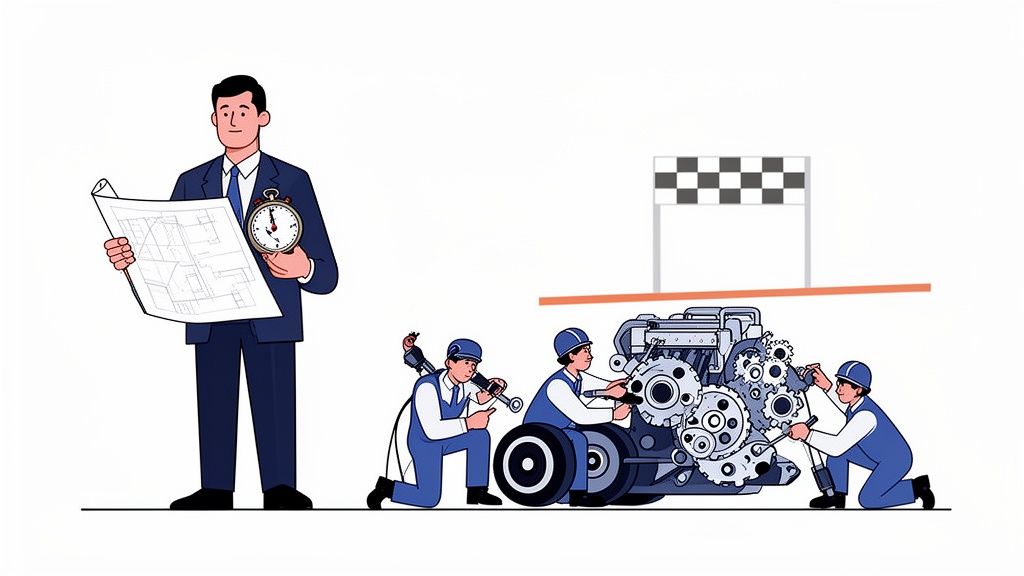

Think of your company as a Formula 1 car. The CEO is the driver, setting the race strategy. The VP of Operations is the chief engineer. Their job is to:
- Design the Engine: Create workflows and systems that can handle more speed and demand without breaking down.
- Manage the Pit Crew: Oversee key departments like supply chain, customer service, and project management to ensure perfect coordination.
- Fine-Tune Performance: Dive into data to spot bottlenecks, eliminate waste, and constantly optimize every moving part for maximum horsepower.
From Chaos to Cohesion
Without this leadership, a company gets stuck in chaotic growth instead of achieving streamlined success. The VP of Ops builds the bridge between ambitious goals and the practical, on-the-ground steps required to hit them.
This means they get deeply involved in your organization's strategic business planning to ensure operational capabilities align with your long-term vision. They make sure the car not only finishes the race but is built to win championships.
A strong VP of Operations doesn't just manage processes; they build a resilient operational foundation that becomes a competitive advantage. They turn the CEO’s "what" into a tangible "how."
For a scaling business, this role is the powerhouse that transforms vision into real value. For instance, a startup jumping from $1M to $10M in revenue will inevitably face supply chain roadblocks. A skilled VP of Ops can implement strategies that boost profitability by up to 25% through process improvements alone.
While a full-time executive costs upwards of $250K a year, a fractional leader can deliver incredible impact for a fraction of that, focusing on high-leverage projects like quality assurance programs that might cut product defects by 30%.
Core Responsibilities of a VP of Operations at a Glance
To quickly grasp the scope of this role, it helps to break down their responsibilities into key functional areas. The VP of Ops is the conductor of the orchestra, ensuring each section plays its part perfectly.
Here’s a quick summary of what they own:
| Functional Area | Core Objective | Example Action |
|---|---|---|
| Process Improvement | Boost efficiency, reduce waste, and cut operational costs across the board. | Implementing a Lean Six Sigma methodology to streamline the production line. |
| Supply Chain Management | Ensure a seamless flow of goods from procurement to final delivery. | Negotiating better terms with suppliers or diversifying the supplier base. |
| Project Management | Deliver projects on time, within budget, and to the required quality standard. | Setting up a company-wide project management tool like Asana or Monday.com. |
| Customer Service | Increase customer satisfaction and loyalty through excellent support systems. | Overhauling the customer ticketing system to reduce response times by 50%. |
| Quality Control | Maintain high standards for products and services. | Establishing a quality assurance program that catches defects before shipment. |
| Team Leadership | Build, mentor, and manage a high-performing operations team. | Creating career development paths and training programs for operations staff. |
Ultimately, the VP of Operations is the glue that holds the company's internal functions together, allowing it to scale smoothly and predictably.
The Three Pillars of Operational Leadership
To truly understand what a VP of Operations does, look past the job description. An effective operations leader is the architect of the company’s engine, building it on three distinct but interconnected pillars. These are the foundational elements they manage to turn a CEO's vision into measurable, real-world results.
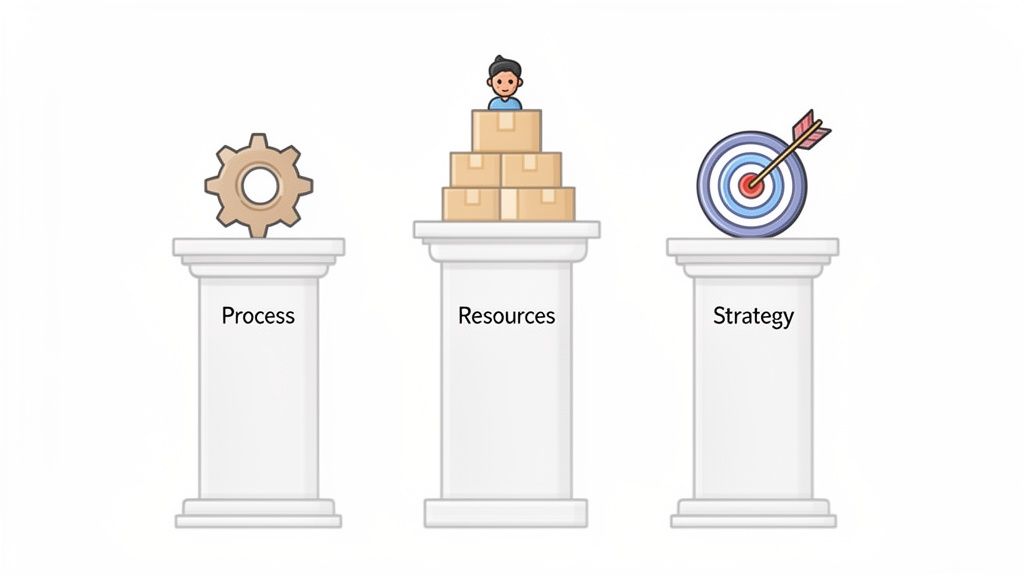
Each pillar is a critical domain of ownership, and a world-class VP of Operations must be a master of all three to drive sustainable growth.
Pillar One: Process Optimization
At its core, a business is a collection of processes. From how a new customer is onboarded to how a product is shipped, these workflows define how well the company runs. Process Optimization is all about making these systems as smooth, fast, and cost-effective as possible.
A VP of Operations will meticulously map out existing workflows to find hidden bottlenecks and wasteful steps. They constantly ask questions like:
- Where are tasks getting stuck or delayed?
- Which steps are redundant or add no real value?
- How can we use technology to automate tedious manual work?
They then design and implement new systems to fix these issues. This isn't just about small tweaks; it’s about architecting a more powerful operational engine from the ground up.
Real-World Example: Think of a direct-to-consumer brand struggling with slow shipping times. A VP of Operations might analyze the entire fulfillment process—from warehouse layout to carrier selection—and implement a new inventory management system that cuts order processing time from 48 hours to just four. The result? Happier customers and a much stronger competitive edge.
Pillar Two: Resource Management
The second pillar, Resource Management, is about making the most of every asset the company has. This includes everything from physical inventory and vendor contracts to the most important resource of all: people.
A great VP of Ops owns the supply chain, negotiating with vendors to lock in better pricing and more reliable delivery schedules. They’re also responsible for human capital planning, ensuring the right people are in the right roles and that teams are structured for maximum productivity.
This is especially critical in startups, where a staggering 70% fail due to issues with operational scaling. The VP of Operations acts as a strategic architect, analyzing operational data to recommend crucial resource shifts. For example, a sharp VP might spot a 22% waste in inventory and implement just-in-time systems, freeing up significant capital for R&D. Learn more about how VPs of Operations drive growth and manage compliance to help companies scale successfully.
Pillar Three: Strategic Execution
Finally, the third pillar is Strategic Execution. This is where the VP of Operations translates high-level company goals into concrete, actionable plans. While the CEO sets the "what" and the "why," the VP of Ops is the absolute master of "how" and "when."
They break down the company's grand vision into department-level objectives with clear metrics and timelines. This leader ensures every team understands its role in the bigger picture and is held accountable for its results. They build the dashboards and reporting systems that track progress, allowing the leadership team to make data-driven decisions.
This pillar ensures that the company's strategy doesn't just stay on a whiteboard—it actually gets done.
For founders struggling to bridge the gap between vision and reality, this is where an experienced operations leader becomes indispensable. If your business is facing these challenges but isn't ready for a full-time hire, exploring fractional executive options can provide the expert guidance you need without the long-term commitment.
How to Spot a World-Class Operations Leader
Hiring the right VP of Operations can feel like searching for a needle in a haystack. The ideal candidate isn't just a manager who keeps the trains running on time; they're a systems thinker with a clear track record of scaling complex operations.
To find this person, you have to look beyond the resume. A world-class operations leader is a rare blend of analytical and charismatic. They need to be sharp enough to tear apart a Profit & Loss (P&L) statement to find hidden savings, yet persuasive enough to get a warehouse team excited about a new inventory process. It's this combination that lets them build systems that are actually adopted by the people who use them every day.
The Essential Skillset Mix
When you're looking for a VP of Operations, you're searching for a balanced portfolio of technical chops and people skills. The best leaders merge quantitative analysis with genuine leadership to get things done.
Hard Skills: The Technical Foundation
These are the measurable, hands-on abilities an operations leader needs to manage the machinery of the business.
- Financial Acumen: A deep understanding of P&L statements, budgeting, and cost analysis is non-negotiable.
- Data Analysis: They must be able to interpret operational metrics, spot trends, and use KPIs to make informed decisions.
- Supply Chain Expertise: For any business that touches a physical product, this is critical. This includes procurement, inventory management, and logistics.
- Process Improvement Methodologies: Experience with frameworks like Lean, Six Sigma, or Agile shows they have a systematic way to hunt down waste.
Soft Skills: The Leadership Multiplier
These skills are what separate a manager from a true leader. It’s how they rally the team to execute.
- Strategic Thinking: They see the big picture and connect today's operational changes to the company's long-term vision.
- Cross-Functional Communication: This role is the central hub. They must communicate clearly with everyone from the C-suite to warehouse staff.
- Problem-Solving: When things go wrong, they stay calm, think on their feet, and find a practical solution, fast.
- Change Management: They know how to guide a team through transition, build buy-in for new processes, and make new systems stick.
Key Interview Questions to Uncover True Potential
Your average interview questions won’t cut it. To find out if you're talking to a top-tier VP of Operations, ask questions that force them to show, not just tell, how they think.
-
"Walk me through a time you inherited a broken process. How did you diagnose the root cause, what steps did you take to fix it, and how did you measure the outcome?"
- What it reveals: This gets to the heart of their methodology—from diagnosis and planning to execution and measurement. You're looking for a data-driven approach.
-
"Describe a situation where you had to make a significant operational decision with incomplete data. What was your thought process, and what was the result?"
- What it reveals: This tests their judgment and ability to act decisively under pressure, revealing a structured way of managing uncertainty.
-
"Tell me about a time you had to get buy-in from other department leaders for a major operational change. What were the challenges, and how did you align everyone?"
- What it reveals: This puts their communication and collaboration skills under the microscope. The best candidates build consensus rather than dictating change.
Finding an executive with this complete package is tough, which is why many growing companies turn to fractional leadership. A seasoned fractional VP of Operations gives you access to this high-caliber expertise without the immediate cost and commitment of a full-time hire. They provide the strategic oversight needed to build a scalable foundation for your business.
How to Measure Operational Success with KPIs
A great VP of Operations doesn't run on gut feelings; they live and breathe data. The mantra is simple: you can't improve what you can't measure. If you want to understand what a VP of Operations does, look at the key performance indicators (KPIs) they own. These metrics are the scoreboard for how well the business is running.
By tracking the right KPIs, a VP of Ops turns fuzzy goals like “making customers happier” into concrete, measurable targets. This data-first approach lets founders set clear expectations and hold their operations leader accountable for results that hit the bottom line.
To drive these metrics, a VP of Operations needs to be a master of several domains, from P&L management to supply chain oversight and, of course, leadership.
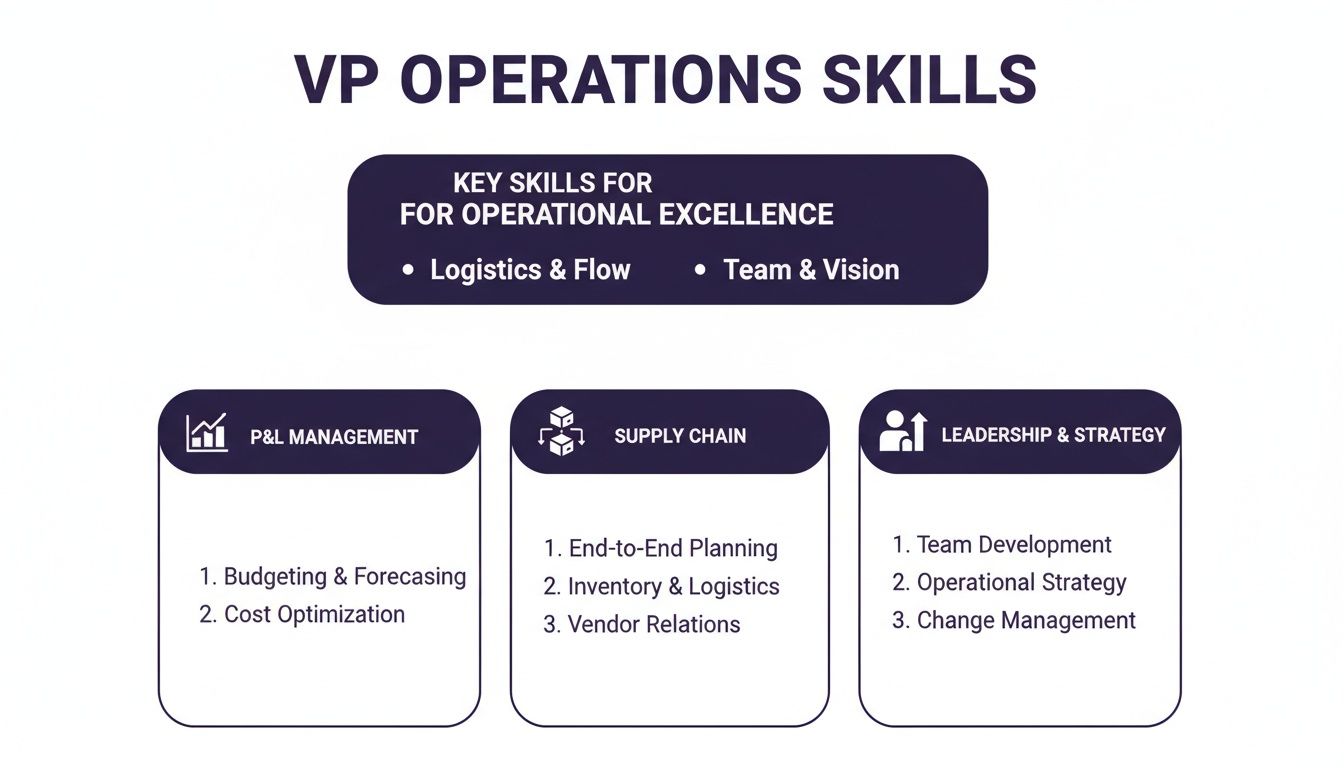

This blend of financial know-how, logistical expertise, and strong leadership is what allows them to effectively manage and improve the numbers that really matter.
Core Operations KPIs Explained
While the exact KPIs can change depending on the industry, a few metrics are universally crucial for measuring operational health. A skilled VP of Ops will have dashboards monitoring these numbers constantly.
These are the numbers that tell the real story of how your company is performing.
- Cost of Goods Sold (COGS): The direct cost of making your product or delivering your service. A core mission is to drive down COGS without sacrificing quality.
- Order Fulfillment Rate: The percentage of orders processed, shipped, and delivered correctly and on time. A high rate signifies a reliable supply chain and happy customers.
- Inventory Turnover: This ratio tells you how many times you've sold and replaced your inventory in a given period. High turnover means sales are strong and cash isn't tied up in unsold stock.
- Customer Satisfaction Score (CSAT): A direct pulse on how happy customers are. The VP of Operations influences everything from product quality to the effectiveness of customer support.
For companies pushing toward the $50M revenue mark, this kind of oversight is non-negotiable. VPs in these roles often build dashboards tracking around 15 core KPIs. In some industries, this focus has been shown to improve profit margins by as much as 14%. They use this data to budget for complex projects and have been known to boost customer satisfaction scores by 30 points after revamping service centers.
Connecting KPIs to Business Goals
KPIs are more than just numbers on a dashboard; they’re tools for hitting bigger business objectives. A true operations leader doesn’t track metrics for the sake of it. Each KPI needs to answer a critical question about the business. For a deeper dive, check out our guide on key performance indicators for startups.
To give you a better idea of how this works in practice, the focus of an operations leader shifts based on the business model. What matters for a SaaS company is very different from what keeps an ecommerce or manufacturing leader up at night.
Comparing Operations KPIs Across Industries
| Industry | Primary KPIs | Business Goal |
|---|---|---|
| SaaS | – Customer Churn Rate – Customer Lifetime Value (LTV) – Server Uptime/Reliability |
Retain customers and maximize long-term value from a subscription-based model. |
| Ecommerce | – Order Fulfillment Rate – Inventory Turnover – Average Shipping Time |
Deliver products quickly and efficiently to drive customer loyalty and manage cash flow. |
| Manufacturing | – Production Output – Defect Rate – Machine Downtime |
Maximize production efficiency and product quality while minimizing operational costs. |
As the table shows, an effective VP of Operations tailors their focus to what drives success for that specific business. They connect the dots between daily operational tasks and the company's ultimate destination.
By prioritizing KPIs that directly support the company's strategy, the VP of Operations ensures their team's everyday work is pushing the company toward its long-term vision.
Choosing Your Model: Full-Time vs. Fractional Ops Leaders
Deciding to hire your first senior operations leader is a huge milestone. But how do you know when it’s truly the right time? The signals are usually screaming at you.
If you’re spending more than 20% of your week wrestling with logistical fires, supply chain snags, or internal process breakdowns, that’s a major red flag. Other tell-tale signs? Declining profit margins even as revenue climbs, or a general feeling that your teams are working harder but getting less done. These are symptoms of operational debt.
Once you’ve decided you need help, the next big question is what kind of help you need. This brings most founders to a fork in the road: should you hire a full-time VP of Operations, or bring in a fractional leader?
The Full-Time Commitment
Hiring a full-time VP of Operations is a serious commitment. You’re bringing a key executive onto your leadership team, which comes with a hefty price tag—often a base salary well over $180,000, plus bonuses, equity, and benefits. For a well-funded company with complex, ongoing operational needs, this is often the correct long-term move.
The catch? The hiring process is slow and risky. Finding the right person can take months, and a mis-hire at this level can be catastrophic, costing you both money and momentum.
The Fractional Alternative: Strategic Expertise on Demand
The fractional model offers a more flexible and cost-effective approach. A fractional VP of Operations is an experienced, top-tier executive who works with your company part-time—typically between five and 20 hours a week. This isn’t a junior consultant; it’s a seasoned leader who has already scaled companies just like yours.
This model is a perfect fit for startups that need senior-level strategic guidance but don’t have the budget or the 40-hour-per-week need for a full-time executive. If you want to learn more about this agile leadership model, you can explore the benefits of engaging with fractional COO services.
Analogy: Hiring a full-time VP of Ops is like having a general surgeon on your hospital’s permanent staff. Hiring a fractional VP is like bringing in a world-renowned specialist for a single, complex operation. You get elite expertise focused precisely where you need it, for exactly as long as you need it.
This targeted approach means a fractional leader can make a huge impact, fast. They aren’t there to manage routine tasks; they’re there to diagnose your biggest operational bottlenecks, design systems that can scale, and mentor your existing team to execute the plan.
Making the Right Choice for Your Stage
So, which path is right for you? It boils down to your company's stage, budget, and specific operational challenges. Here’s a quick comparison to help you think it through:
| Factor | Full-Time VP of Operations | Fractional VP of Operations |
|---|---|---|
| Cost | High (six-figure salary, equity, benefits) | Lower (fixed monthly retainer, no benefits) |
| Commitment | Long-term, full-time employment | Flexible, project-based, or ongoing part-time |
| Speed to Impact | Slower (long hiring and onboarding process) | Faster (quick to engage and start solving problems) |
| Focus | Broad (day-to-day management and strategy) | Narrow (focused on specific strategic initiatives) |
| Best For | Mature scale-ups with complex, daily needs | Startups needing expert guidance to overcome key growth hurdles |
For many growing businesses, fractional leadership is the perfect bridge. It de-risks the hiring process and delivers the strategic horsepower needed to build a solid operational foundation. You get the wisdom without the full-time wage, letting you pour those savings back into other critical areas of the business.
Find Your Next Operations Leader with Shiny
Scaling a business is a messy, beautiful struggle. But the journey from chaotic growth to streamlined success hinges on having a strong VP of Operations. They build the systems that prevent everything from breaking as you grow.
The problem? Hiring an executive of this caliber the old-fashioned way is slow, expensive, and full of risk. A bad hire can set you back months and kill your momentum. Founders often feel stuck between two bad options: drain the bank account for a full-time executive you're not ready for, or let operational friction grind your growth to a halt.
There’s a smarter way to get the leadership you need, right when you need it. This is where fractional leadership changes the game.
A Modern Solution for a Common Pain Point
Imagine getting direct access to a curated network of the world's best operations leaders—executives who have already scaled businesses in every field imaginable. That’s what we’ve built at Shiny. We connect ambitious companies with our deep pool of vetted, experienced VPs of Operations who are ready for flexible, part-time engagements.
Our platform is designed to take the risk out of executive hiring. Instead of a months-long search, you can be talking to a perfectly matched leader in a matter of days.
This model offers clear advantages:
- Cost-Effectiveness: Get C-suite expertise for a fraction of a full-time salary, freeing up capital for growth.
- Immediate Impact: Our executives are seasoned pros. They jump in, diagnose key challenges, and start implementing solutions from day one.
- Unmatched Flexibility: Engage a leader for exactly what you need and easily scale their involvement up or down as your business evolves.
Focus on Your Vision—We’ll Help You Build the Engine
So, what does a VP of Operations do? They build the engine that lets you scale efficiently. With a fractional leader, you get the strategic horsepower to optimize your processes and execute on your vision without the heavy financial drag. This lets you get back to focusing on what you do best—innovation, product, and growth.
Ready to find the operations leader who can take your business to the next level? Explore our network of world-class fractional executives or schedule a consultation to learn how we can help you achieve your goals.
Answering Your Top Questions
Getting the right leadership structure in place can feel tricky. To help clear things up, here are answers to the most common questions we hear from founders about the VP of Operations role.
What's the Difference Between a COO and a VP of Operations?
It comes down to scope. While the roles overlap, the key difference is strategic versus tactical.
A Chief Operating Officer (COO) usually operates at a higher altitude. They’re thinking long-term, acting as the CEO's right-hand person, and focusing on the overall health and future direction of the business.
A VP of Operations is deep in the trenches. Their world is the here and now—managing the day-to-day processes, systems, and teams that keep the business humming. Their primary focus is always on execution.
What Salary Should I Expect for a Full-Time VP of Operations?
A full-time VP of Operations is a major hire, and compensation varies based on industry, company size, and location.
Generally, you can expect a base salary anywhere from $180,000 to over $350,000 a year, plus performance bonuses and equity. This is exactly why so many scaling businesses look at fractional executives—you get the same caliber of expertise at a fraction of the cost.
How Can a Fractional VP Make an Impact in Just 10 Hours a Week?
It’s about focus, not hours. A seasoned fractional VP of Ops knows how to zero in on the activities that will deliver the biggest impact.
Here’s how they usually start:
- Diagnose Bottlenecks: They quickly spot the core issues strangling your growth.
- Build a Roadmap: They create a clear, step-by-step plan for fixing them.
- Level Up Your Team: They mentor your existing people, empowering them to run the new systems independently.
They aren’t there to just fill a seat. They provide targeted expertise and strategic direction, freeing you up to focus on the big picture.
What Are the First Priorities for a New VP of Operations?
A great VP of Ops won’t walk in on day one with all the answers. Their first 90 days are about a structured approach: learn, assess, and then develop a plan.
An effective operations leader spends their initial weeks listening and gathering data. They don't arrive with a pre-made playbook; they build one based on the unique challenges and opportunities within your business.
They'll start by talking to key people and digging into your operational data to identify "quick wins." From there, they'll create a strategic roadmap that lays out the priorities, initiatives, and KPIs for the next 6-12 months.
Finding the right operational leader is make-or-break for scaling your business. Shiny's marketplace connects you with a network of over 3,000 vetted, top-tier fractional executives ready to solve your biggest challenges. Schedule a consultation today to find the expert who can build your engine for growth.