


In simple terms, Enterprise Value (EV) is the total takeover price of a company. Think of it like buying a house—you don't just pay for the owner's equity. You also have to take on their mortgage (debt), but you get to keep any cash left on the kitchen counter. EV gives you this complete financial picture.
For founders, grasping this concept isn't just an academic exercise. It's the key to understanding your company's true worth, which is a critical pain point when you're trying to raise capital, plan an exit, or simply make smarter financial decisions.
Unpacking What Enterprise Value Truly Means
Market capitalization, or market cap, is the number you hear thrown around on the news. It’s a straightforward calculation: share price multiplied by the number of outstanding shares. While it tells you what the company's equity is worth on paper, it only reveals part of the story.
Market cap completely ignores a company's debt and cash reserves—two massive factors that are critical for understanding its true financial health and total cost. This is exactly where Enterprise Value comes in. It offers a much more complete valuation by including both debt and cash, providing a clearer, more realistic view of a company’s worth.
EV answers the real-world question: "If I bought this entire business today, what would be the total cost to acquire every single piece of it, from its operations to its obligations?"
The House Buying Analogy For Enterprise Value
Let's stick with the house analogy to make this tangible. Imagine you want to buy a house listed for $500,000. That’s its "market cap" or equity value.
But the current owner still has a $200,000 mortgage. To truly own the house, you can’t just pay the owner; you must also assume or pay off that mortgage. So, the real cost to acquire the house is now up to $700,000.
Then, during the final walkthrough, you discover the owner left $20,000 in cash inside a safe. As the new owner, that cash is now yours, which effectively reduces your net purchase price. Your final "enterprise value" for the house is $500,000 (equity) + $200,000 (debt) – $20,000 (cash) = $680,000. EV applies this same practical logic to businesses.
Why Enterprise Value Matters More Than Market Cap
Focusing only on market cap can be seriously misleading. A company might have a low market cap but be drowning in massive debt, making it a much riskier and more expensive acquisition than it appears at first glance.
On the flip side, another company might have a high market cap but also hold a huge amount of cash, making it cheaper to acquire than its stock price suggests.
To give you a sense of just how different these two metrics can be, let's compare them side-by-side.
Enterprise Value vs Market Capitalization at a Glance
| Metric | What It Measures | Includes | Best For |
|---|---|---|---|
| Market Cap | The total value of a company's outstanding equity shares. | Equity Value Only | Getting a quick snapshot of a public company's size and equity market perception. |
| Enterprise Value (EV) | The total theoretical takeover price of a business. | Equity, Debt, Cash | M&A, comparing companies with different capital structures, and fundamental analysis. |
This table shows why sophisticated investors and acquirers lean so heavily on EV. It cuts through the noise of how a company is financed to reveal its core operational value.
Enterprise value is one of the most fundamental metrics in finance for assessing a company’s total worth, especially in mergers and acquisitions. Unlike market capitalization, EV accounts for all financial claims on a company, including both equity and debt.
For a real-world example, look at Apple Inc. Its market cap is approximately $2.7 trillion, but it also has total debt around $120 billion and cash reserves exceeding $166 billion. This puts its enterprise value at about $2.65 trillion—slightly less than its market cap because its massive cash stockpile effectively lowers the theoretical takeover price.
This holistic view is why investors, acquirers, and strategic leaders rely on EV. It helps them compare companies with different capital structures on an apples-to-apples basis. For founders, getting a handle on this metric is the first step toward understanding how outsiders really value their business, which is essential for fundraising, strategic planning, and eventual exit opportunities. Properly calculating and interpreting these figures is also a key component of building solid financial strategies, much like understanding the fundamentals of unit economics is for profitability.
How to Calculate Your Enterprise Value Step-By-Step
Okay, so you get the concept of Enterprise Value. But the real magic happens when you can actually apply it to your own business.
The calculation itself is pretty straightforward, but the inputs—especially for a private company—are where the real thinking comes in. Let’s walk through how it’s done, starting with a public company before diving into the nuances for founders like you.
The basic formula is a simple three-part equation. This visual breaks it down nicely:
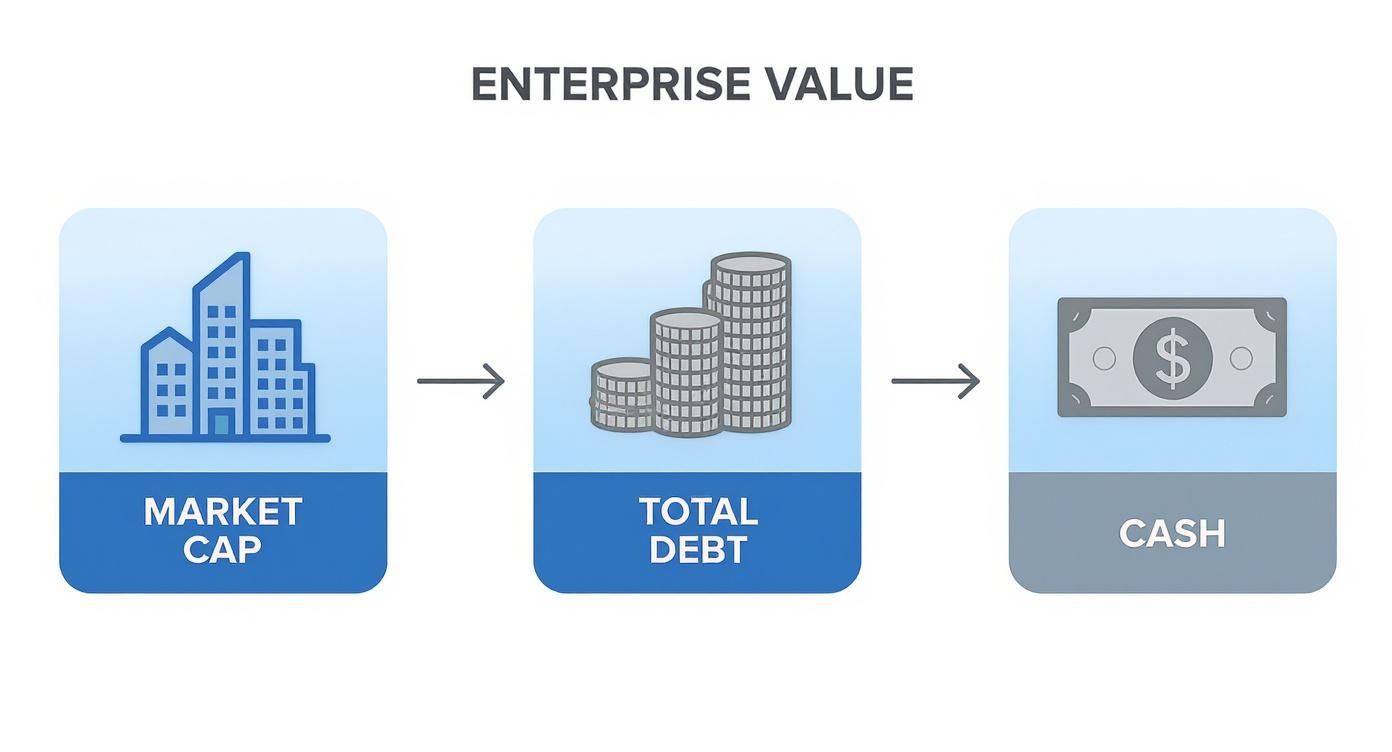

As you can see, you start with the market value of the company's equity, tack on all its debt, and then subtract any cash it has sitting around. The result is the company's total takeover price.
Calculating EV for a Public Company
For a company on the stock market, finding the numbers for the EV formula is a walk in the park. Everything is publicly disclosed in their financial statements.
Here’s where you’d look for each piece of the puzzle:
- Market Capitalization: This is the easiest part. Just multiply the current share price by the total number of outstanding shares. Financial news sites usually list this figure directly.
- Total Debt: You'll find this on the company's balance sheet. It includes everything from short-term loans and bonds to long-term debt and capital leases.
- Cash and Cash Equivalents: This is also sitting right there on the balance sheet. It’s the company’s most liquid stuff—cash in the bank, short-term marketable securities, and the like.
Let’s run through a quick example. Imagine a public company, "TechCorp Inc.," with a market cap of $500 million. Its balance sheet shows $150 million in total debt and $50 million in cash.
The math is simple: $500M (Market Cap) + $150M (Debt) – $50M (Cash) = $600M (Enterprise Value).
The Challenge of Calculating EV for a Private Company
This is where things get a bit more art than science for founders. Private companies don't have a stock price, so there's no "market cap" to just look up. You have to estimate it. This is a common pain point for founders, but it's a solvable one.
For private businesses, calculating enterprise value is less about finding precise numbers and more about making well-reasoned estimates. The goal is to arrive at a defensible figure that reflects your company's current worth in a potential transaction scenario.
So, how do you put a number on your company's equity? You’ve got a few options.
- Use Your Last Funding Round: This is the go-to method for most startups. If investors valued your company at $20 million post-money six months ago, that’s a fantastic starting point for your equity value.
- Comparable Company Analysis (Comps): Take a look at recent acquisitions or funding rounds for similar private companies in your space. If a competitor with similar revenue just got acquired for $50 million, you can use that as a benchmark, adjusting for differences in scale, growth rate, and market position.
- Use Valuation Multiples: You can also apply industry-standard valuation multiples (like EV/Revenue or EV/EBITDA) from public companies to your own financials. For example, if similar public companies trade at 4x revenue and your annual revenue is $5 million, your estimated EV might be in the ballpark of $20 million. This is a core part of building a solid financial forecast. For a deeper dive, check out our guide on creating a startup financial model.
Once you've landed on an estimated equity value, the next step is to nail down your "debt." For a startup, this is more than just traditional bank loans. You need to include:
- Bank loans and lines of credit.
- Convertible notes.
- Capital leases for equipment.
Finally, just like with a public company, you subtract your cash and cash equivalents. This whole exercise turns an abstract metric into a tangible tool you can use for strategic planning, fundraising, and eventually, a successful exit.
Going Beyond the Basic Enterprise Value Formula
The simple formula—Market Cap + Debt – Cash—is a fantastic starting point. Think of it as a rough sketch; now, it’s time to add the color and detail that reveal the complete picture.
To arrive at a truly accurate valuation that stands up to the scrutiny of investors and acquirers, you need to dig deeper. These aren't just academic exercises; each adjustment represents a real claim on the company's assets or a financial nuance that impacts its true takeover cost. Getting these details right is what separates a back-of-the-napkin estimate from a defensible valuation.

Why Subtracting Cash Is So Important
We've touched on subtracting cash, but it's worth re-emphasizing why this step is so critical. When an acquirer buys a company, they gain control of everything inside it—including the cash sitting in its bank accounts.
That cash can be immediately used to pay down the debt they just assumed, cover acquisition costs, or even pay themselves a dividend. Because of this, financial analysts view that cash as an immediate reduction in the net purchase price.
A company’s cash and cash equivalents are subtracted because an acquirer effectively gets that money back upon closing the deal. This makes the net cost of the acquisition lower, and the Enterprise Value formula reflects this reality.
For example, if a company is acquired for $100 million but has $15 million in cash, the acquirer's net outlay is really only $85 million. Enterprise value must account for this to accurately reflect the economic reality of the transaction.
Adding Minority Interest to the Calculation
Things get more complex when a company doesn't fully own all of its subsidiaries. Let’s say a parent company owns 80% of a smaller company. Due to consolidation accounting rules, it will report 100% of that subsidiary's revenue and debt on its own financial statements.
See the problem? The parent company's market cap only reflects the value of its 80% stake, creating a mismatch. To correct it, we must add the value of the 20% it doesn't own—known as minority interest—back into the enterprise value calculation.
This ensures the valuation reflects the total value of all the assets and operations being consolidated, not just the slice owned by the parent company's shareholders. It makes for a fair, apples-to-apples comparison.
Accounting for Preferred Stock
Another crucial adjustment is for preferred stock. While technically a form of equity, preferred stock often behaves more like debt from a valuation perspective.
Here’s why it’s usually added to enterprise value:
- Fixed Dividends: Preferred shares typically pay a fixed dividend, similar to the interest payments on a bond.
- Priority in Liquidation: In a sale or bankruptcy, preferred stockholders get paid back before common stockholders, just like lenders.
- No Voting Rights: They generally don't come with the voting rights that common shares do.
Because of these debt-like features, an acquirer would need to pay off these preferred shareholders to gain full control. The value of preferred stock is therefore added to the EV formula to reflect this claim on the company's assets. Failing to include it would understate the true cost of an acquisition.
Understanding these adjustments is a major step toward financial mastery. It shows you're thinking like a sophisticated investor or a seasoned CFO—someone who looks beyond the surface to grasp the underlying financial structure of a business. This is where founders often hit a wall; you're an expert in your product, not necessarily complex valuation. This is the exact pain point where bringing in fractional finance leadership can provide the expert guidance needed to navigate these complexities and build a truly defensible valuation.
Putting Enterprise Value to Work in Your Business
Knowing how to calculate Enterprise Value is the first step, but its real power comes from how you use it. This isn't just another number to plug into a spreadsheet; it's a strategic tool that informs some of the most critical decisions a founder will ever make. For business owners, knowing your EV translates directly into a stronger negotiating position, a clearer growth path, and a more compelling story for investors.
When you can confidently articulate what your enterprise value is, you shift from reactive decision-making to proactive strategic planning. It turns abstract financial data into concrete, actionable intelligence. Let's break down the three most vital ways you can put this powerful metric to work.

Navigating Mergers and Acquisitions
In the high-stakes game of mergers and acquisitions (M&A), Enterprise Value is the undisputed starting point for any serious conversation. An acquirer isn't just buying your shares; they're taking on your entire operation—warts and all, including every dollar of debt. EV gives them the clean, comprehensive valuation needed to assess the real price tag of the deal.
Think about it this way: a potential buyer is eyeing two SaaS companies. Company A has a $50 million market cap and zero debt. Company B also has a $50 million market cap but is carrying $20 million in debt. A buyer focused only on market cap might see them as equals. But a savvy acquirer using EV sees the truth: Company B’s enterprise value is actually $70 million, making it a much more expensive acquisition.
This isn't just a hypothetical. The global M&A market in 2024 was valued at a staggering $3.2 trillion, and in nearly every major deal, EV was the cornerstone of the valuation. A perfect example is Microsoft’s acquisition of Activision Blizzard, a deal valued at $68.7 billion in enterprise value. That massive figure wasn't just the price for equity; it included assuming Activision’s debt and subtracting its cash, showing the true cost for Microsoft to fully own the business. You can find more insights on how EV is applied in major acquisitions by reviewing detailed financial analyses from sources like the Wall Street Journal or financial news outlets.
Securing Funding and Impressing Investors
When you’re pitching to venture capitalists or private equity firms, you can bet they're thinking in terms of enterprise value. They use EV-based multiples like EV/Revenue or EV/EBITDA to benchmark your startup against others in your industry, which helps them figure out if your valuation ask is grounded in reality.
Investors rely on Enterprise Value because it cuts through the noise of different funding structures. It allows them to compare a bootstrapped company to a debt-financed one on an even playing field, focusing purely on the core operational value.
If you walk into a meeting armed only with a revenue projection, you're essentially letting them drive the valuation conversation. But if you can present a well-reasoned calculation of your enterprise value, backed by solid comps, you immediately signal financial sophistication and take control of the narrative. It shows you understand your business not just as a product but as a financial asset.
Benchmarking Your Company's Performance
Finally, enterprise value is an essential tool for looking in the mirror and tracking your own performance. By calculating your EV regularly and keeping an eye on key multiples, you can get a clear read on how efficiently your business is creating value over time.
Are you growing your EV faster than your competitors? How does your EV/EBITDA multiple stack up against the industry average? Answering these questions gives you critical context for your next strategic move.
Here’s how you can use EV for internal benchmarking:
- Track EV Growth: Calculate your EV quarterly or annually to measure pure value creation. Is the needle moving in the right direction?
- Compare EV/Revenue Multiples: See if you're generating more enterprise value per dollar of revenue than your peers. This tells you how efficiently you're turning sales into long-term worth.
- Analyze EV/EBITDA: Use this to assess your operational efficiency, stripping away the effects of financing and tax strategies.
These practical applications show that understanding what enterprise value is goes far beyond financial theory. It’s a foundational concept for building a resilient, valuable company. But you don't have to navigate this alone. If you're ready to translate these insights into a powerful growth strategy, exploring our fractional leadership services can connect you with the seasoned financial expertise you need to succeed.
Choosing the Right Valuation Multiples for Your Company
Once you get a handle on Enterprise Value, you can unlock its real power: valuation multiples. Not all metrics are created equal, and leaning too heavily on common ones like the Price-to-Earnings (P/E) ratio can give you a completely warped view of your company's actual health.
EV-based multiples, on the other hand, paint a much more honest picture.
Think of it like comparing two athletes. The P/E ratio is like looking only at their salary. Athlete A might earn $10 million a year and Athlete B earns $5 million. At a glance, you'd think Athlete A is the more valuable player.
But what if Athlete A is drowning in endorsement debts and has a history of off-field drama? EV-based multiples are like looking at their raw performance stats—speed, strength, and consistency on the field. Those numbers tell you who the better performer is, regardless of their financial baggage.
The Power of Capital Structure-Neutral Metrics
The biggest advantage of using Enterprise Value in multiples is that it’s capital structure-neutral. This just means it strips away the noise caused by a company's financing decisions, letting you make a true apples-to-apples comparison.
A bootstrapped company with zero debt will look wildly different from a venture-backed competitor with significant loans if you only use an equity-based multiple. EV-based multiples level the playing field. They zero in on the core operational performance, answering the real question: "How efficiently does this business generate profit or revenue from its entire pool of capital?"
This is exactly why sophisticated investors and acquirers almost always prefer metrics like EV/EBITDA or EV/Revenue.
By neutralizing the effects of debt and cash, Enterprise Value-based multiples reveal the underlying operational value of a company. This allows for a more accurate comparison between businesses with different funding strategies, tax rates, and depreciation schedules.
How Different Multiples Tell Different Stories
Let's look at a quick example. Imagine two software companies, "Bootstrapped Co" and "Funded Co." Both are generating $2 million in EBITDA.
| Metric | Bootstrapped Co | Funded Co |
|---|---|---|
| Market Cap | $12 million | $12 million |
| Total Debt | $0 | $8 million |
| Cash | $2 million | $1 million |
| Enterprise Value | $10 million | $19 million |
| EV/EBITDA Multiple | 5.0x | 9.5x |
See that? Even with the same market cap and EBITDA, their EV/EBITDA multiples are worlds apart. Funded Co's multiple is nearly double because it reflects the additional capital (debt) invested to achieve that same level of profit. This shows how Enterprise Value gives a far more nuanced and useful assessment.
Comparing Valuation Multiples: EV vs. Equity Metrics
To really understand your company's value, you need to know which tool to use for the job. Some multiples look at the business through the lens of an equity investor, while others, like those based on EV, look at the total operational value. Here's a breakdown to help you see the difference.
| Multiple | Formula | What It Tells You | Best Use Case |
|---|---|---|---|
| EV/Revenue | Enterprise Value / Total Revenue | How the market values each dollar of a company's sales, independent of profitability or capital structure. | Valuing early-stage, high-growth companies that are not yet profitable. Also useful for comparing companies in the same industry with different business models. |
| EV/EBITDA | Enterprise Value / EBITDA | How the market values a company's core operational profitability before interest, taxes, depreciation, and amortization. | The go-to multiple for comparing mature, profitable businesses across industries, as it normalizes for financing and accounting decisions. |
| Price/Earnings (P/E) | Market Cap / Net Income | How much investors are willing to pay for each dollar of a company's net earnings. | Quick, high-level analysis of profitable public companies. Can be misleading when comparing companies with different debt levels or tax situations. |
| Price/Sales (P/S) | Market Cap / Total Revenue | How the market values a company's revenue from an equity perspective. | Valuing companies in cyclical industries or those in a temporary downturn where earnings are negative. Less accurate than EV/Revenue. |
While P/E and P/S ratios can be useful for a quick glance, they often hide more than they reveal. EV-based multiples dig deeper, giving you a clearer view of operational performance—which is what truly matters in M&A, fundraising, and strategic planning.
Enterprise Value is also critical for benchmarking your company against the broader market. For instance, the average EV/EBITDA multiple for S&P 500 companies hovers around 12x, but this swings wildly by industry. Tech firms often trade at 15–20x, while utilities might be closer to 8–10x. These differences are driven by growth expectations and risk—factors that EV helps normalize. To see more real-world examples, WallStreetPrep.com offers deep dives into how EV is applied in M&A deals.
Picking the right multiples is crucial for accurately benchmarking your business and negotiating from a position of strength. Getting this right often requires financial expertise that goes beyond day-to-day operations—this is where strategic fractional leadership can make all the difference.
Turning Your Enterprise Value Into a Growth Strategy
Knowing your enterprise value is one thing. Actually improving it? That’s the real challenge for founders.
For most business leaders, diving this deep into financial strategy feels like a distraction. It pulls you away from building the product, talking to customers, and leading your team—the very things that drive your value in the first place. This is exactly where bringing in the right strategic partner can be a game-changer.
You don't need a full-time, six-figure executive to start steering the ship. A fractional CFO brings the high-level expertise needed to optimize your company's financial health, get you ready for the tough questions in due diligence, and tell a story that resonates with investors. They offer years of hard-won experience without the hefty price tag or long-term commitment of a C-suite hire.
From a Number on a Page to Actionable Growth
A great financial leader does more than just run the numbers on your EV; they translate those metrics into a concrete plan for growth. Their real job is to pinpoint the levers in your business that will make the biggest impact on your valuation.
This kind of strategic guidance plays out in a few key ways:
- Boosting Profitability: They'll dig into your margins and operational efficiency to find ways to lift your EBITDA, which has a direct, positive effect on your EV.
- Optimizing Your Capital Structure: They help you manage debt smartly and make sure your cash on hand is working for the business, not dragging down its valuation.
- Building a Bulletproof Narrative: When it’s time to raise money or sell, they'll weave a compelling story around your financials, justifying your valuation to skeptical investors or potential buyers.
A fractional executive’s true value is their ability to connect the dots between raw financial data and smart strategic moves. They don’t just report the numbers; they give you the roadmap to improve them, turning your enterprise value from a static metric into a dynamic target you can actively pursue.
This level of strategic insight is often the missing piece for ambitious founders. You can dive deeper into what they do by reading our guide on the meaning of a fractional CFO. Ultimately, their goal isn't just to help you understand what your company is worth today, but to give you the tools and confidence to build its value over time.
For founders who are ready to move beyond just calculating enterprise value to actively maximizing it, strategic financial leadership is non-negotiable. At Shiny, we connect founders with the precise, vetted financial talent they need to navigate these complex growth stages. If you’re ready to build a more valuable business, explore our network of fractional executives and see how the right partnership can unlock your company's full potential.
Got Questions About Enterprise Value?
As founders start wrapping their heads around enterprise value, a few questions almost always pop up. Let's tackle the big ones, because getting these right is crucial for making smart decisions down the road.
Can Enterprise Value Actually Be Negative?
Yep, it can. It's rare, but it happens. A negative enterprise value means a company is sitting on more cash than its market cap and all its debt combined.
Think about it this way: an acquirer could theoretically buy the company, use the company's own cash to pay off every single one of its debts, and still have money left in the bank. It's like being paid to buy a business. This usually signals one of two things: either the market is seriously undervaluing the company's core business, or there are some major underlying problems that have tanked its stock price.
How Often Should I Calculate My EV?
You definitely don't need to be running this number every day. Think of calculating your enterprise value as a strategic health check-up you perform at key moments.
It's time to crunch the numbers in a few specific situations:
- During fundraising rounds to build a solid case for your valuation with investors.
- When you get an M&A offer to set a realistic baseline for any negotiations.
- Annually during strategic planning to benchmark your performance against competitors and set meaningful growth targets.
What’s the Difference Between Enterprise Value and Equity Value?
This is easily the most important distinction to nail down. They measure two completely different things, and mixing them up can lead to some expensive misunderstandings.
Equity Value (what most people call Market Cap) is the slice of the business that belongs to the shareholders. In contrast, Enterprise Value is the total value of the entire business—it accounts for the claims of both shareholders and lenders.
Imagine the business is a pizza. Equity value is just the slice for the stockholders. Enterprise value is the whole pizza, crust and all, representing the worth of everything used to generate profit. That’s why EV gives you a much more complete, apples-to-apples picture for valuation.
Getting comfortable with concepts like enterprise value is a massive step toward building a more valuable company. But you don’t have to figure it all out on your own. Shiny connects you with a network of over 3,000 vetted, part-time executives who provide the strategic financial leadership you need to accelerate your growth.
Ready to partner with an expert who can help you navigate your next funding round, M&A opportunity, or strategic plan? Schedule a consultation to find your perfect fractional executive.