



Strategic alignment is a business term for a simple, powerful idea: getting every single person, team, and department in your company pulling in the same direction. It’s about forging a direct link between your big-picture vision and the day-to-day work that makes it a reality.
Think of it this way: without alignment, even the most brilliant strategy will fall apart the moment it meets reality.
Understanding the Four Pillars of Strategic Alignment


Imagine your company is a competitive rowing team. If every rower just paddles whenever and however they feel like it, the boat won’t just move slowly—it’ll probably spin in circles. Strategic alignment is the coxswain calling the rhythm, making sure everyone rows in perfect sync toward the same finish line.
It’s the framework that turns your strategy from a dusty document into a living, breathing part of your culture.
When you get it right, everything clicks. Marketing campaigns directly feed sales goals. Product development is laser-focused on solving the customer problems outlined in the company vision. Instead of siloed teams chasing their own pet projects, everyone shares one definition of success and knows exactly how their work contributes.
The Core Components of Alignment
To achieve strategic alignment, you need to build a company on four core pillars. These aren't just buzzwords; they're the load-bearing walls of a focused, high-growth company.
These pillars work together to create the kind of organization that doesn't just grow, but grows efficiently and with purpose.
The Four Pillars of Strategic Alignment
| Pillar | Description | Why It Matters for Growth |
|---|---|---|
| Shared Mission & Vision | This is your North Star. It’s the "why" behind what you do and the future you’re building. Every goal must flow from this purpose. | A clear vision keeps the team motivated through tough times and prevents drift into markets or products that don't fit. |
| Coordinated Action | This is where the rubber meets the road. It means translating strategy into concrete actions, budgets, and resources to support your goals. | This stops teams from wasting time and money on low-impact activities. Every dollar spent and hour worked pushes the main goals forward. |
| Effective Communication | Communication must be clear, constant, and flow in all directions. Everyone needs to understand the strategy and their role in it. | When people know the "why" behind their tasks, they make better independent decisions and feel more engaged and accountable. |
| Strong Leadership & Culture | Leaders must constantly champion the vision and build a culture of accountability and collaboration that reinforces the strategy. | A strong culture acts as a guidance system, empowering people to act in alignment with company goals without constant oversight. |
Each pillar is essential. A great vision with poor execution goes nowhere, and flawless execution of the wrong strategy is just a fast track to failure.
Strategic alignment isn’t a one-off project. It's a continuous discipline that connects your big-picture strategy with ground-level execution, turning ambitious goals into real, measurable results.
Ultimately, this harmony is a make-or-break issue for startups and growth-stage companies. Misalignment burns cash, wastes time, and kills morale. But a fully aligned team? They can navigate any challenge and scale with incredible efficiency. Often, bringing in the right leadership—whether full-time or fractional—is the catalyst that builds and sustains this crucial connection.
Why Strategic Alignment Is Non-Negotiable for Growth
Understanding what strategic alignment is is one thing. Realizing why it’s the secret sauce for ambitious companies is what sparks change. For a growing business, alignment isn’t a fuzzy concept—it's the operational backbone that separates rapid, sustainable scaling from chaotic, stalled progress.
Without it, your brilliant strategy is just a document collecting dust.
Misalignment is a silent killer of growth. It’s the marketing team hitting lead goals that the sales team can't close. It’s the product team shipping features that customers don't want. This internal friction wastes precious capital and burns out your best people.
The High Cost of Internal Disconnect
Picture two startups fighting for the same market share.
One is a mess of silos. Departments hoard information, budgets are fought over based on politics, not priorities, and every new idea gets bogged down in meetings. They move at a snail's pace and miss opportunities.
The other company is different. Everyone—from engineering to sales—operates with a shared understanding of the mission. When a market opportunity appears, they pivot fast because the end goal is clear. Resources flow to high-impact projects, not pet projects. This is the tangible competitive edge that alignment delivers.
Fueling a Motivated and Effective Workforce
Strategic alignment does more than just make things run smoothly; it gives people a reason to care. When your team can draw a straight line from their daily tasks to the company's grand vision, their work has meaning. That connection is a powerful driver of engagement.
A motivated workforce isn't just happier; it's sharper, more productive, and more innovative. When people understand the 'why' behind the 'what,' they make smarter, independent decisions that push the whole company forward.
This bond between day-to-day work and the big picture is what builds a resilient culture. It turns a group of individual employees into a single, mission-driven force.
Turning Strategy into Measurable Performance
When a company gets serious about strategic alignment, the results are real and measurable. Research has repeatedly shown that when business strategy, company structure, and technology all pull in the same direction, performance improves dramatically. You can dig deeper by learning more about the principles of strategic alignment.
An aligned organization doesn't just have a strategy; it has a system where:
- Resources are Amplified: Every dollar and hour is spent on work that directly moves the needle on primary goals.
- Accountability is Clear: With unified goals, it's easy to define who owns what. Everyone knows their role and what they're responsible for.
- Momentum is Built: Small wins in one department fuel wins in another, creating a powerful forward thrust.
For any business looking to scale, this isn't just a "nice-to-have." Often, the quickest way to diagnose misalignment and build this foundation is to bring in an experienced fractional executive who has done it before.
Connecting Your Purpose, Profit, and Market
Real strategic alignment goes beyond getting departments to talk to each other. It's a deeper harmony between three crucial forces: your company's core purpose, its path to profitability, and the demands of the market. When these three are in sync, you create a powerful engine for growth.
Think of your purpose as your company’s North Star. It's the "why" behind what you do. This purpose should be so clear that it guides every major decision.
But a noble purpose alone doesn't pay the bills. Profit is the fuel that allows you to chase that purpose. True alignment ensures your hunt for profit always serves your purpose, never conflicts with it.
Finding Harmony Between Mission and Margin
Striking this balance isn't accidental. A truly aligned company ensures purpose and profit feel like natural partners. For a great deep dive on this, MIT Sloan Review has an excellent analysis of reconciling purpose and profitability through strategy.
This turns your purpose into a practical filter for every strategic choice. It helps you decide:
- What to Continue: Which products perfectly embody your mission and have strong market demand?
- What to Stop: Which offerings, however profitable, are pulling you off-mission?
- What to Start: What new opportunities align with your purpose and solve an emerging market need?
Imagine a sustainable goods company that gets a chance to launch a lucrative but environmentally questionable product line. A strategically aligned company would pass on it. The decision reinforces their purpose, strengthens their brand, and builds a powerful bond with their target market. That's alignment in action.
Building a Purpose-Driven Culture
When your purpose is clear and constantly communicated, it becomes part of your company's DNA. This is the secret to attracting and keeping the best people—the ones who want to be part of something that matters.
A purpose-driven culture creates resilience. When the market gets rocky, a shared mission is the glue that holds the team together. It's the motivation to innovate and push forward when others would give up.
This kind of culture also resonates deeply with customers. When your marketing, products, and customer service all echo a consistent purpose, you build a loyal community that is far more valuable than customers won over with a discount.
Getting this trinity of purpose, profit, and market into alignment is a huge challenge. For many growth-stage companies, bringing in a fractional executive provides the exact expertise needed to build this framework, ensuring the company doesn't just scale fast, but scales with a clear direction.
A Step-by-Step Framework for Achieving Alignment
Knowing what strategic alignment is gets you in the door. Making it happen requires a practical, repeatable process that turns the abstract goal of alignment into an actionable roadmap.
Think of it as a continuous discipline, not a one-time project.
Step 1: Clarify Your Mission, Vision, and Values
Before you can align your team, you have to give them a destination. Your mission (why you exist), vision (where you're going), and values (how you behave) are the bedrock of your strategy.
If this foundation is shaky, any alignment efforts you build on top of it will eventually crumble.
For this to work, you have to:
- Involve Key Stakeholders: Get your leadership team in a room to hammer out these core statements. Getting their buy-in from the beginning is key.
- Communicate Relentlessly: Weave your mission and vision into onboarding, all-hands meetings, and every strategic document until they become part of your company’s shared language.
Step 2: Translate Strategy Into Measurable Objectives
A grand vision is useless if it doesn't lead to concrete action. The next step is breaking down your high-level strategy into specific, measurable, and time-bound objectives that every team can own.
This is where frameworks like Objectives and Key Results (OKRs) are game-changers. OKRs create a clear hierarchy of goals, cascading from the company-wide vision down to individual tasks.
For example, a company objective to "Increase Market Share" might translate into a marketing team OKR to "Generate 1,000 Enterprise-Level Leads" and a product team OKR to "Launch Three New Integrations Requested by Enterprise Customers." This process ensures that daily work is directly tethered to big-picture priorities.
For a deeper dive on this, our guide on the strategic planning process steps breaks down how to turn a vision into a real, workable plan.
Step 3: Align Resources and Structure
With clear objectives in place, you now have to point your resources—people, budget, and tech—in the right direction. This step forces you to funnel your money and your best people toward the activities with the biggest strategic impact.
This is where strategic alignment stops being a concept and becomes tangible.
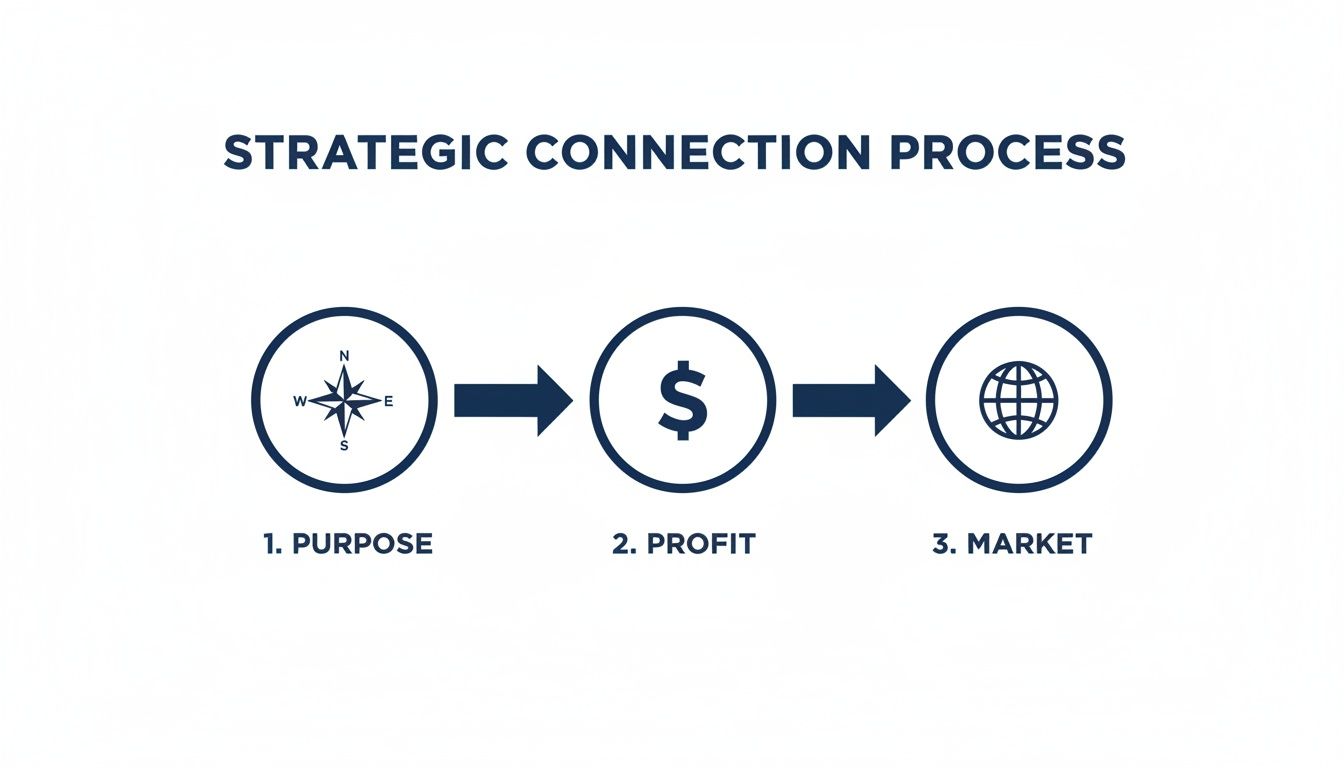

This simple flow shows that your financial goals (Profit) and market strategies must always serve the organization's core Purpose. When they don't, you're out of alignment.
This requires asking hard questions:
- Is our budget allocated to our most important projects?
- Do our team structures encourage collaboration or create silos?
- Are we investing in the right tools to get the job done?
Answering these questions honestly often reveals a painful gap between where you say you want to go and where you’re actually spending your time and money.
Alignment in action is simple: Your calendar and your bank statements should reflect your strategic plan. If they don’t, your organization is not aligned.
Step 4: Create Communication and Feedback Loops
Finally, strategic alignment isn't a "set it and forget it" activity. It's a living process that needs constant communication channels and feedback loops to keep the whole company in sync.
This isn’t about scheduling more meetings. It's about having better, more purposeful communication.
This involves a few key practices:
- Regular Progress Reviews: Hold consistent check-ins—weekly, monthly, or quarterly—to review progress against key goals.
- Transparent Dashboards: Use shared dashboards to give everyone real-time visibility into key metrics, building a culture of accountability.
- Celebrate Wins and Learn from Failures: Publicly recognize teams who crush their goals, and create a safe environment to talk about what’s not working.
By making this framework a core part of your operational rhythm, you execute with focus and speed. For many growing businesses, a fractional executive can be the catalyst to install and run this framework, bringing the veteran experience needed to build a culture of alignment from the ground up.
How Fractional Executives Drive and Sustain Alignment
For many startups and scale-ups, the biggest roadblock to strategic alignment isn’t a bad strategy—it’s a leadership gap. Without seasoned expertise to drive the plan home, it’s just a document. This is where fractional executives become a founder’s secret weapon.
Bringing in an experienced part-time leader is often the fastest way to get your entire organization on the same page. These executives know how to spot misalignment, implement frameworks that work, and build a culture of accountability, all without the full-time C-suite cost.
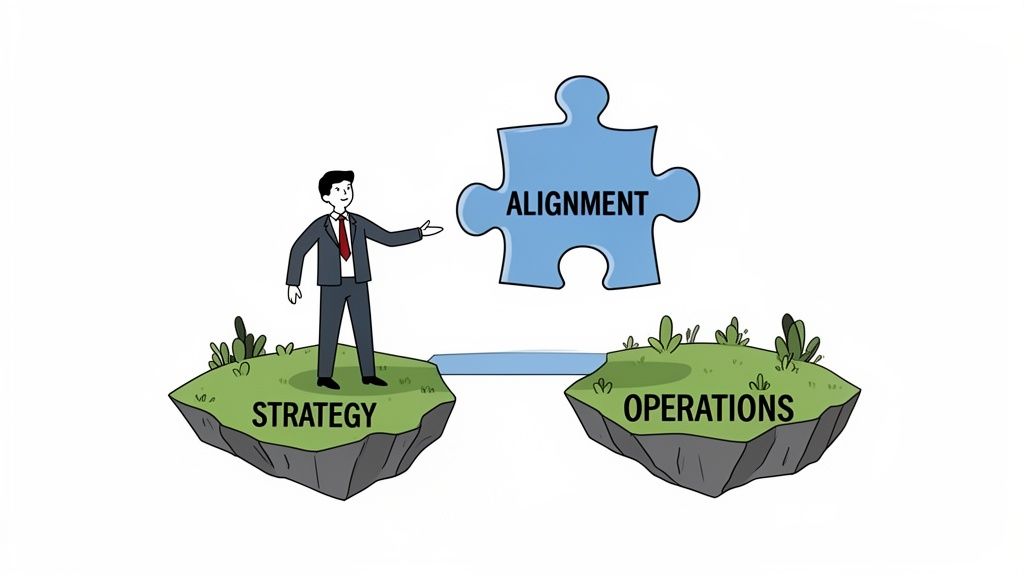
Providing an Objective, Expert Perspective
One of the toughest challenges for a founding team is seeing the company with fresh eyes. A fractional executive walks in without that baggage.
Their outsider perspective is their superpower. They can ask the tough questions and challenge the "that's how we've always done it" thinking that kills growth.
A fractional executive is both a strategist and a practitioner. They don’t just hand you a plan; they roll up their sleeves and help you build the systems, processes, and communication rhythms required to make alignment stick.
Because they’ve guided dozens of companies through similar stages, they bring proven playbooks to the table. This experience collapses the learning curve, helping your company skip common mistakes.
Driving Alignment Across Key Functions
Strategic alignment isn't one person's job; it's a company-wide discipline. Fractional leaders are specialists in creating this harmony. Exploring the advantages of the fractional C-suite shows how this model delivers targeted expertise right where it’s needed most.
Here’s how they create alignment in critical areas:
- A Fractional CMO makes sure every marketing dollar connects to a business outcome, closing the gap between marketing campaigns and sales targets.
- A Fractional CFO brings the financial discipline to make the vision a reality, ensuring budgets directly support the company's biggest goals.
- A Fractional COO is the master of turning strategy into action, designing the processes and systems that link teams and streamline execution.
Building a Sustainable Culture of Alignment
Perhaps the most important role a fractional executive plays is weaving alignment into your company's DNA. They aren't just temporary fixes; they are mentors who level up your team and build lasting capabilities.
They accomplish this by:
- Implementing a Cadence of Accountability: They introduce the rhythms of execution, like quarterly planning and weekly KPI check-ins.
- Championing Transparent Communication: They set up shared dashboards and regular all-hands meetings so everyone sees the score and feels a sense of ownership.
- Mentoring Internal Leaders: A huge part of their job is developing your full-time managers, teaching them to think strategically and lead their teams effectively.
By installing these systems and coaching your team, a fractional leader ensures the principles of strategic alignment stick around long after their contract ends. They don’t just solve a problem; they build a high-performing organization that can power its own growth.
Measuring the ROI of Strategic Alignment
Strategic alignment is a powerful idea, but to earn its keep, you have to see its impact on the bottom line. It’s not enough to just feel more aligned; you need to prove it with data.
How do you know if your efforts are working? The key is tracking a mix of metrics that connect your big-picture strategy to tangible, day-to-day results.
Key Financial Indicators of Alignment
Financial metrics are the most straightforward proof that your alignment efforts are paying off. They are the ultimate evidence that getting everyone rowing in the same direction leads to a healthier company.
Keep a close eye on these KPIs:
- Revenue Growth: An aligned team executes more efficiently, which should translate directly into accelerated top-line growth.
- Profit Margins: When you eliminate wasted effort and focus resources on high-impact work, costs go down, and profitability goes up.
- Customer Acquisition Cost (CAC): A perfectly synced marketing and sales engine is far more efficient, which means the cost to bring in each new customer drops.
Operational and Cultural Metrics
Financials are crucial, but they’re often lagging indicators—they tell you what already happened. Operational and cultural metrics are your early warning system, showing you whether the behaviors that drive financial success are taking root.
Strategic alignment allows organizations to seize opportunities faster and deliver on promises consistently. It isn't just a management theory; it's a competitive advantage that can be measured.
Think of these as the vital signs of your organization's health:
- Employee Engagement Scores: When people see how their work connects to the company's mission, motivation skyrockets.
- Customer Retention Rates: An aligned company delivers a consistent, high-quality experience. Happy customers stick around.
- Speed of Project Execution: Misalignment creates friction that slows everything down. A clear sign you’re getting it right is when cross-functional projects move faster.
To make this data useful, create transparent dashboards that show these key metrics for everyone. This builds accountability and helps every person understand their impact. If you're looking for more ways to connect efforts to results, we have a helpful guide on how to measure business growth.
Ultimately, measuring the ROI of alignment proves one thing: a unified vision, executed well, is the most powerful engine for sustainable success. For a growing company, this is a serious challenge, but it's exactly where a fractional executive can step in to build the systems needed to track—and improve—these critical metrics.
Frequently Asked Questions
Have questions? You're not alone. Let's tackle some of the most common ones.
What Is the Difference Between Strategic Alignment and Strategic Planning?
Think of strategic planning as drawing the treasure map—you’re defining your destination and the path to get there.
Strategic alignment, however, is making sure everyone on the ship is rowing in the same direction, following that map every single day. It’s the constant process that turns a plan into action.
How Often Should We Review Our Strategic Alignment?
For fast-moving companies, a quarterly alignment check-in is the sweet spot. This rhythm is frequent enough to let you pivot based on market feedback without throwing your teams off track.
At a minimum, you need a deep-dive alignment review once a year, usually alongside your annual strategic planning. This ensures your strategy remains a living guide.
Regular reviews are what keep your strategy relevant and effective.
Can a Small Business Really Benefit from This?
Absolutely. In fact, it's more critical for small businesses. When every dollar and every hour of work counts, you can't afford to have your team pulling in different directions.
Alignment gives a small team the focused punch of a much larger organization. It ensures every ounce of effort is spent on the most important levers for growth. For a small crew trying to outmaneuver bigger players, that kind of efficiency isn't just a nice-to-have; it's a survival mechanism.
Achieving—and maintaining—organizational alignment is a C-suite level challenge that demands experienced leadership. If your team is struggling to connect strategy with execution, you're not alone. The right expertise can make all the difference.
Explore our network of vetted fractional executives who specialize in building aligned, high-growth organizations. Schedule a consultation to find the right partner to unite your teams and accelerate your vision.
Find the right executive to build your aligned organization today.