


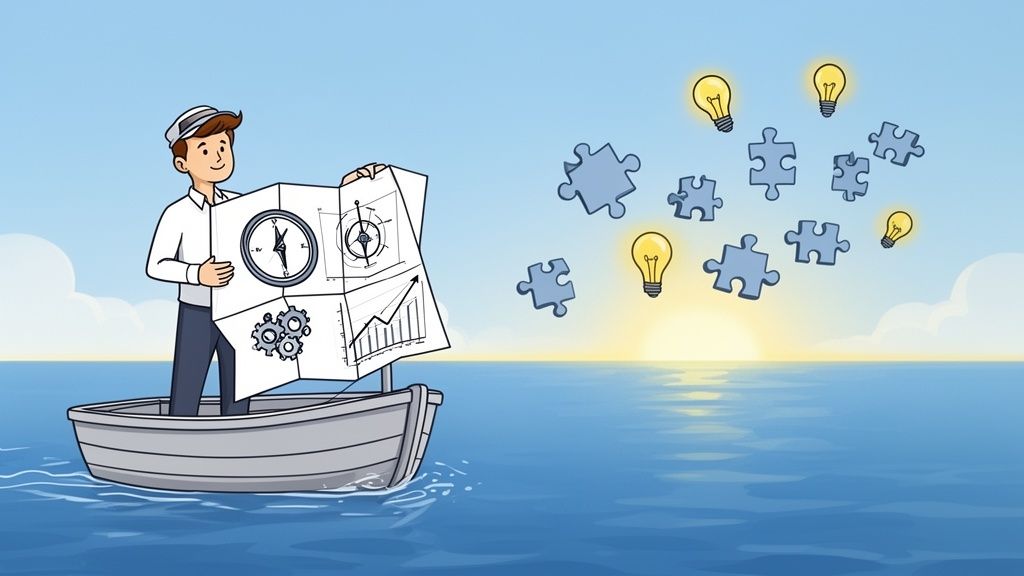
Strategic business planning is the disciplined process of defining your company's direction and making smart decisions on how to allocate resources to pursue that direction. It's not a static document you create once and forget; it's a living framework that guides your decisions every single day, especially when the path forward isn't clear.
For busy founders, it’s the difference between reacting to daily fires and proactively building a resilient, high-growth company.
What Is Strategic Business Planning, Really?
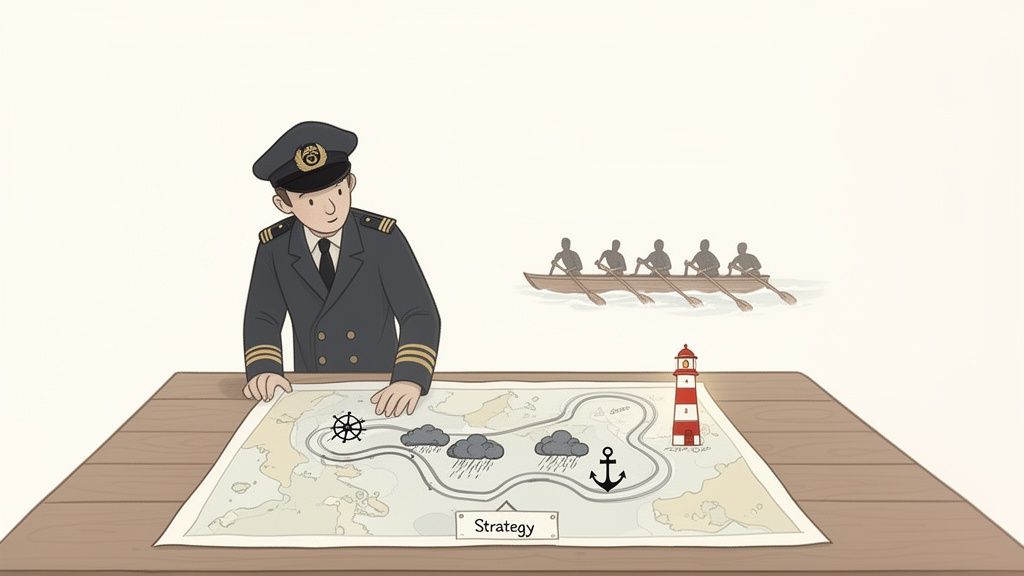

Let's cut through the corporate jargon. When founders hear "strategic business planning," they often imagine a dense, hundred-page binder destined to collect dust on a shelf. This perception completely misses the point.
A great strategic plan is more like a ship captain’s map for navigating unpredictable waters. This map doesn’t just show the final destination; it helps you anticipate storms, manage your crew and resources, and decide when to push full-steam ahead or drop anchor and reassess.
Ultimately, it forces you to answer the three most important questions for any business:
- Where are we now? A brutally honest look at your current position, including your strengths, weaknesses, and the competitive landscape.
- Where do we want to go? A clear, inspiring, and ambitious vision for the future.
- How will we get there? The specific, actionable steps needed to bridge the gap between today and your long-term vision.
A Living Tool For Growth
For a startup, this framework isn't just a nice-to-have—it's essential for survival. It provides the clarity needed to make smart decisions, allocate precious time and capital effectively, and keep the entire team rowing in the same direction.
Without a plan, you’re just reacting to daily fires instead of proactively building toward your goals. You're adrift at sea.
A strategic plan is a disciplined effort that produces fundamental decisions and actions that shape and guide what an organization is, who it serves, what it does, and why it does it.
This process is what turns your big ideas into a concrete blueprint for execution. It ensures that every product launch, marketing campaign, and new hire serves a larger, deliberate purpose.
Strategic Planning At A Glance
| Component | What It Is | Why It Matters For Startups |
|---|---|---|
| Vision & Mission | Your "North Star." The vision is the future you want to create; the mission is how you'll do it. | Aligns the team and provides a powerful "why" that fuels motivation through tough times. |
| SWOT Analysis | An honest assessment of your Strengths, Weaknesses, Opportunities, and Threats. | Forces you to be realistic about your capabilities and the market landscape, preventing costly assumptions. |
| Goals & Objectives | Broad goals (e.g., "Become the market leader") broken into specific, measurable objectives (e.g., "Achieve 25% market share by Q4"). | Turns abstract ambition into tangible targets. This is how you measure progress and hold yourself accountable. |
| Action Plan | The step-by-step roadmap outlining the specific tasks, timelines, and responsibilities to achieve your objectives. | This is where strategy meets reality. It's the "how" that ensures the plan gets implemented, not just discussed. |
Of course, creating and executing this plan can feel overwhelming when you're also managing the day-to-day chaos of running a startup. Navigating this journey is far smoother with an experienced guide at the helm.
Think of it this way: you're the captain, but a seasoned fractional executive is your expert navigator. They bring the perspective and skill to help chart the course, ensuring you not only reach your destination but thrive along the way.
Why a Strategic Plan Is Your Startup's Most Valuable Asset
For any startup, a strategic plan isn't just a document; it's your playbook for a game where the stakes couldn't be higher. Founders are constantly juggling tight budgets, unpredictable markets, and immense pressure to grow—fast. Without a North Star, it's easy to chase 'shiny objects'—tempting features, marketing channels, or partnerships that burn through cash and time without moving the needle.
This is where a solid strategy proves its worth. Think of it as a filter that helps you cut through the noise and zero in on what truly matters.
From Firefighting to Focused Execution
A strategic plan moves you from a reactive firefighting mode into proactive, goal-driven execution. Suddenly, every decision—from who you hire to what you build next—is measured against one simple question: "Does this get us closer to our goal?"
This deliberate focus ensures every dollar and hour is invested, not just spent. Companies that make strategic planning a regular habit consistently report better performance. A clear plan sharpens your decision-making and ensures your limited resources pack the biggest possible punch.
A strategic plan forces you to articulate not only what you will do, but also what you will not do. This discipline of focus is a critical success factor for any resource-constrained startup.
This focused approach also gets everyone on the same page. When the whole team knows where you're going and how you plan to get there, their collective energy becomes a powerful force for growth.
Turning Ambition into Tangible Outcomes
The benefits aren't just theoretical; they tie directly to real-world results. A well-crafted strategy clarifies exactly how you'll hit milestones like faster market entry, better profitability, and sustainable scaling.
By mapping out your path, you can spot potential roadblocks before they become emergencies and allocate resources where they'll have the most impact—a process we cover in detail in our guide on strategic growth planning for business success.
For instance, your plan might highlight a key market segment your competitors are ignoring, allowing you to concentrate your marketing spend for a quicker launch. Or it could uncover operational bottlenecks that, once fixed, give your bottom line an immediate boost.
Ultimately, a strategic plan is the bridge between your grand vision and the daily grind required to make it real. It’s the framework that ensures all your hard work translates into meaningful, lasting progress.
The 5 Core Elements of an Unbeatable Strategic Plan
A real strategic plan isn't a dusty, monolithic document. It’s a living blueprint built on five interconnected pillars. Get these right, and you transform vague ambitions into a clear, actionable roadmap for your team.
Think of it like building a high-performance engine. Each part is critical, and they must work together perfectly to drive your business forward. Once you understand these components, the strategic planning process feels less like a corporate chore and more like the practical growth tool it’s meant to be.
Let’s break them down.
1. Vision and Mission: Your North Star
First, you need to know where you're going. That starts with your Vision Statement. This is your big, hairy, audacious goal—a vivid picture of the future you're creating. It answers the question, "What world are we trying to build?"
Your Mission Statement is more grounded. It’s the "how" that brings your "why" to life. It defines what your company does, who you serve, and your unique approach. Together, your vision and mission become the North Star that guides every decision.
2. Core Values: Your Operating System
If your vision and mission are the destination, your Core Values are the non-negotiable rules of the road. These are the fundamental beliefs that shape your company's culture and every action your team takes. They are your company’s operating system.
For example, a FinTech startup might have a core value of "Radical Transparency," which would dictate that all customer interactions are honest and clear. These values aren't just feel-good words; they influence everything from who you hire to how you build your product.
A well-defined set of core values provides a consistent framework for decision-making, ensuring that even as the company scales, its foundational character remains intact.
This is where an experienced fractional leader can be a game-changer. They help you uncover authentic values that reflect your company's DNA, not just generic buzzwords for a poster. They ensure those values are truly lived, day in and day out.
3. SWOT Analysis: Your Situational Awareness
Next, you need a brutally honest look at where you stand. A SWOT Analysis is a structured assessment of your internal and external landscape. It’s a candid look at your business's:
- Strengths: Internal advantages you have over competitors.
- Weaknesses: Internal limitations that could hold you back.
- Opportunities: External trends or factors you can leverage for growth.
- Threats: External challenges that could sink you if you’re not prepared.
For a SaaS startup, a strength might be a proprietary algorithm, while a threat could be a well-funded competitor entering your space. This analysis gives you the situational awareness needed to make smart, informed strategic bets.
4. Goals and Objectives: Your Measurable Milestones
This is where the rubber meets the road. Goals are the broad outcomes you’re aiming for, like "Become a recognized leader in the enterprise software market."
Objectives are how you actually get there. They are the specific, measurable, achievable, relevant, and time-bound (SMART) steps you’ll take. An objective tied to the goal above might be, "Achieve a 20% market share in our target vertical within three years." These milestones make your progress tangible and keep the team accountable.
5. Action Plan and KPIs: Your Execution Blueprint
Finally, you need a plan to make it all happen. The Action Plan is your step-by-step execution blueprint. It breaks every objective down into specific tasks, assigns ownership, and sets deadlines. It answers the critical question: "Who is doing what by when?"
This plan is tracked using Key Performance Indicators (KPIs)—the specific metrics you'll watch to see if you’re making progress. Without a clear action plan and KPIs, even the most brilliant strategy is just a collection of good ideas. This step turns your strategy into real-world action and measurable results.
Navigating the Strategic Planning Process Step by Step
Knowing the core elements of a strategic plan is one thing; putting them together into a working process is another. Too many founders treat strategic business planning like a project to complete and file away. That’s a mistake.
Think of it as a continuous cycle, an ongoing rhythm that keeps your business sharp and pointed toward its long-term vision. This structured approach turns big, abstract goals into a practical, repeatable system for growth. Each phase builds on the last, ensuring your strategy is both ambitious and grounded in reality.
The flow is simple: start with the big picture and get more granular from there.
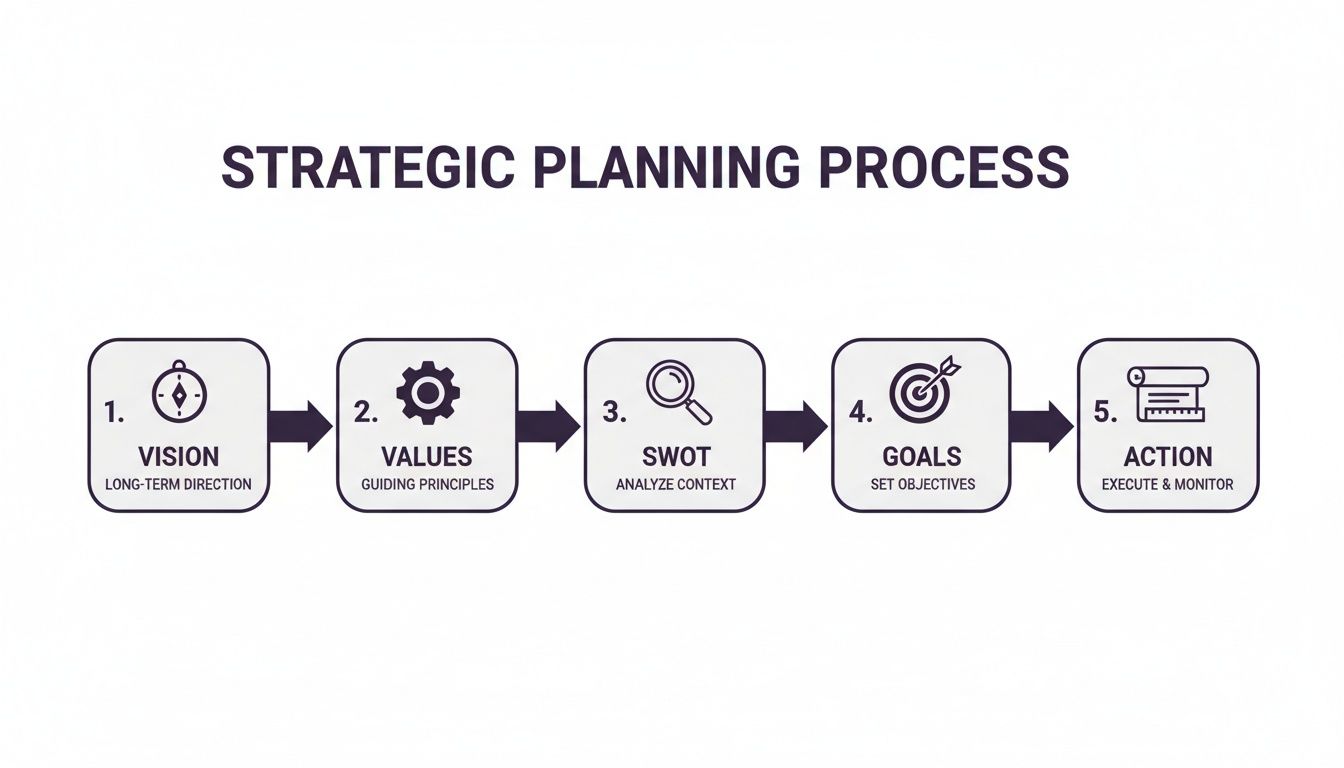

This visual shows how foundational pieces like your vision and values feed directly into the tactical work of analysis, goal-setting, and, most importantly, action.
Phase 1: Preparation and Discovery
Before you can chart a new course, you must know where you're starting from. This phase is about gathering intelligence—deep market research, a no-holds-barred look at your competitors, and an honest internal audit of your capabilities. Who are your real customers? What major market shifts are on the horizon?
This is also when you assemble your planning team. You need a mix of perspectives from across the business to avoid blind spots. For a busy founder, leading this can feel like a second full-time job. A fractional CFO becomes invaluable here; they can build the financial models that give you a crystal-clear picture of your actual financial standing.
Phase 2: Strategy Formulation
With research in hand, it’s time to make decisions. This is where you translate insights from the discovery phase into a concrete strategy with clear goals. You’ll refine your vision and mission, sharpen your value proposition, and define the specific, measurable milestones you plan to hit.
This isn’t about blue-sky brainstorming. It’s about making tough choices based on data. For instance, your SWOT analysis may have revealed an underserved niche. That niche now becomes a primary target in your go-to-market plan. We dig deeper into this in our guide covering the key strategic planning process steps.
Phase 3: Implementation and Execution
A strategy is just a document until you execute it. This phase is where the rubber meets the road. You’ll create an action plan that turns strategic choices into the day-to-day work your team actually does. This means assigning clear owners for every objective, setting realistic timelines, and allocating the necessary budget and people.
Frankly, this is where most plans fail. Without strong leadership, a strategy never leaves the boardroom. A fractional CMO, for example, excels at translating a high-level goal like "increase market share" into a tangible marketing plan with specific campaigns, channels, and KPIs. They ensure the strategy actually happens.
The resilience of strategic planning is evident even in uncertain economic times. While 23% of US middle-market leaders may delay plans, a larger portion—40%—are pressing forward unchanged, demonstrating the power of adaptability. Discover more insights from the 2025 business leaders outlook.
Phase 4: Performance Review and Adaptation
Finally, the process must be a closed loop. This last phase is about consistently tracking performance against your KPIs and being ready to pivot. The market will change, new competitors will emerge, and some of your assumptions will be wrong. That’s okay.
A regular review cadence—whether quarterly or monthly—lets you adapt your plan without losing sight of your North Star vision. This cycle of planning, executing, measuring, and adapting is what builds a resilient business on the path to sustainable growth.
Bringing Your Strategy into the 21st Century with Modern Tools
A modern strategy needs modern tools. The days of drafting a five-year plan, printing it, and letting it gather dust are over. Today's strategic business planning is a living, breathing process, supercharged by trends and technologies that can give your startup a serious edge.
To get ahead, you must build a plan that expects change, not one that just reacts to it. This means moving beyond gut feelings and embracing a data-driven approach—creating a document that can pivot as quickly as the market does.
The Big Shift: Agile and Data-Driven Planning
Not long ago, strategic planning was a slow, top-down affair. The modern approach is far more dynamic, built around agility and real-time information. Think of it less like carving a statue from stone and more like sculpting with clay—you can reshape it as you go.
This evolution is pushed by a few key trends:
- Agile Planning Frameworks: Borrowed from software development, these frameworks use rapid iteration. Instead of rigid annual plans, companies use shorter cycles (like quarterly "sprints") to set goals, execute, review results, and quickly adjust.
- Data Analytics: Powerful tools now allow even small startups to crunch huge amounts of data. This lets you base strategic moves on what your customers are actually doing, not what you think they might do.
- Artificial Intelligence (AI): AI is a practical tool for market forecasting and competitive analysis. It can spot patterns and predict trends with a speed and accuracy beyond human capability.
The way businesses plan is changing fast. The shift from a rigid, annual process to a fluid, data-centric model is a direct response to the need for speed and adaptability.
Traditional vs Modern Strategic Planning
| Aspect | Traditional Approach | Modern Approach |
|---|---|---|
| Frequency | Annual or multi-year cycles. | Continuous or quarterly cycles. |
| Process | Top-down, with leadership setting the plan. | Collaborative, involving cross-functional teams. |
| Flexibility | Rigid and resistant to change. | Agile and adaptive, designed for iteration. |
| Data Usage | Based on historical data and forecasts. | Driven by real-time data and predictive analytics. |
| Focus | Long-term, fixed goals. | Short-term sprints aligned with long-term vision. |
| Tools | Spreadsheets and static documents. | AI, analytics platforms, and collaborative software. |
The modern approach recognizes that strategy isn't a one-time event. It’s an ongoing conversation with the market, informed by data and ready to adapt.
Using Technology to Get a Competitive Edge
When you weave modern tools into your process, your strategic plan transforms from a roadmap into an intelligent navigation system. As we move through 2025, integrating AI into strategic planning is becoming a must-have. A staggering 35% of companies worldwide already use AI in their operations, and the AI market has exploded to $184 billion in 2024. Discover the latest 2025 trends in enterprise planning.
Adopting modern planning tools isn't about replacing human insight; it's about amplifying it. The magic happens when you combine the creative, intuitive power of your leadership with the sharp, analytical precision of technology.
This combination helps you build a forward-looking strategy that keeps you one step ahead. But for a busy founder, adopting these new methods can feel overwhelming.
This is where bringing in the right expertise becomes a game-changer. A seasoned fractional executive, especially one from a tech-heavy background like AI or HealthTech, brings this knowledge straight to your team. They don't just know the theory; they have hands-on experience using these tools to drive actual growth. They help you build a strategic plan that’s not just smart for today, but ready for whatever comes next.
How Fractional Leadership Transforms Strategic Planning

Knowing the steps of strategic planning is one thing. Leading the charge while you're deep in the day-to-day grind is a whole different challenge.
When you're juggling operations, sales, and product development, finding the bandwidth for high-level strategic thinking can feel impossible. You know it’s important, but it’s always the first thing pushed off the list. This is a classic business pain point we see all the time.
This is where bringing in experienced leadership becomes a catalyst for real change. A fractional executive provides the dedicated expertise and objective viewpoint needed to steer the ship. They aren't bogged down by internal politics or daily firefighting; their sole focus is building a rock-solid strategy and ensuring it gets executed.
Bridging the Execution Gap
The magic of an experienced leader is their ability to turn your vision into a concrete, step-by-step plan. They’ve been there, done that, and have the battle-tested experience to see around corners and dodge common pitfalls. For many startups, this is the missing piece of the puzzle.
Imagine these scenarios:
- A fractional COO steps in to refine your internal processes, making sure your operations can actually support the aggressive growth targets you’ve set.
- A fractional CFO builds the sophisticated financial model that validates your vision, giving both you and your investors unshakable confidence in the numbers.
This isn’t about taking on the premature cost of a full-time C-suite. It's about getting top-tier strategic talent on a flexible, cost-effective basis. By learning more about the benefits of fractional leadership, you can see how this model provides targeted expertise precisely when and where your business needs it most.
A fractional executive acts as your strategic co-pilot. They bring the dedicated focus and specialized skill set required to navigate the planning process effectively while you keep running the business.
This approach closes the critical gap between ambition and reality. It provides the leadership capacity to not only build a powerful strategic plan but to see it through to completion, turning goals into measurable results.
Your Strategic Planning Questions, Answered
Even with the best intentions, founders often have lingering questions about strategic planning. Let's clear up some of the most common points of confusion.
Is a Strategic Plan Really Useful for a Fast-Moving Startup?
Absolutely. But you have to think of it differently. For a startup, a strategic plan isn’t a rigid, hundred-page document. It's your compass.
It’s the tool that gives you the clarity to make fast, smart decisions without getting distracted by shiny objects and losing sight of your ultimate goal. Agility is critical, but agility without direction is just chaos. A good plan ensures your rapid movements are actually moving you forward.
What’s the Difference Between a Business Plan and a Strategic Plan?
This is a classic question with an important distinction.
A business plan is typically a snapshot in time, created to launch a company or secure funding. It lays out the business model, target market, and financial projections for investors. Once it serves its purpose, it's often static.
A strategic plan, on the other hand, is a living, internal tool for an existing business. Its sole purpose is to guide growth, focus execution, and help you adapt to market changes. It's dynamic by nature.
How Often Should We Update Our Strategic Plan?
Your plan should never gather dust. While your core vision and mission will likely stay consistent, the tactical elements—your objectives and action plans—need regular attention.
A quarterly review is a great cadence. This gives you a natural rhythm to check progress, celebrate wins, and quickly pivot away from initiatives that aren't hitting the mark. It keeps the plan relevant and useful.
Strategic planning is a powerful tool, but it requires dedicated focus and expertise that founders often can't spare. That's where the right partner makes all the difference. Shiny connects you with seasoned fractional executives who provide the strategic oversight to build and execute a plan that drives real, measurable growth.
Ready to turn your vision into an actionable strategy? Schedule a consultation to find the right leader for your team.