



At its core, unit economics is a simple but powerful way to measure your business's health. It cuts through the noise of big-picture numbers to answer one critical question: for every "unit" you sell, are you actually making money?
That "unit" can be anything—a single product, a monthly subscription, or one new customer. It's the fundamental building block of your revenue. Understanding its profitability tells you if your business model is built on solid ground or sinking sand.
What Is Unit Economics Really Measuring?
Imagine you run a food truck that only sells amazing burritos. Each burrito is your "unit." To know if your business can grow, you can't just look at total daily sales. You have to zoom in on the profitability of a single burrito.
This is what unit economics measures. It forces you to ignore vanity metrics like total revenue or user growth and focus on the fundamental health of your business. It answers the one question that determines long-term success: Is each sale adding to your bottom line?
The Burrito Analogy
Let's break down the economics of one burrito to make this crystal clear:
- Price: You sell each burrito for $12.
- Variable Costs: The ingredients (tortilla, meat, salsa) and the paper wrapping for one burrito cost you $4.
- Marketing Cost: You spent $100 on flyers, which brought in 50 new customers. That means your marketing cost per burrito (or per customer) is $2.
For every $12 burrito you sell, you're spending $6 in direct costs ($4 for ingredients + $2 for marketing). This leaves you with $6 in profit before you account for fixed costs like your truck payment or insurance.
That $6 is your contribution margin—the cash left over to pay for everything else and eventually become profit. If that number were negative, selling more burritos would just mean you lose money faster.
Unit economics provides an honest, unfiltered look at your business's financial engine. It tells you whether you have a sustainable model or if you're just busy losing money with every single transaction.
Before we dive deeper, let's quickly summarize the key components you'll be working with. Think of these as the fundamental building blocks for understanding the health of your business.
Core Components of Unit Economics at a Glance
| Component | What It Represents | Simple Example |
|---|---|---|
| Customer Acquisition Cost (CAC) | The total cost of sales and marketing to acquire one new customer. | If you spend $1,000 on ads and get 10 new customers, your CAC is $100. |
| Customer Lifetime Value (LTV) | The total revenue a single customer is expected to generate over their entire relationship with your company. | A customer pays $50/month for your SaaS product and stays for 36 months, so their LTV is $1,800. |
| Contribution Margin | The revenue left over from a single unit sale after subtracting all variable costs. | A t-shirt sells for $25. The shirt, printing, and shipping cost $10. The contribution margin is $15. |
| Payback Period | The time it takes for a customer to generate enough revenue to cover their acquisition cost. | If your CAC is $300 and the customer pays you $50/month, the payback period is 6 months. |
Each of these metrics tells a different part of the story, but together, they paint a complete picture of your business's sustainability.
Why It Matters for Every Business
This isn't just for food trucks. Whether you're selling software subscriptions, e-commerce products, or professional services, the principle is identical. Unit economics is about analyzing the financial performance of a single "unit" by looking at its associated costs and revenues.
For instance, if a donut shop sells a donut for $5 and the variable cost to make and sell it is $2, its contribution margin is 60%. This means each donut sold contributes 60% of its revenue toward covering the shop's fixed costs and, eventually, generating profit. You can find more great insights about unit economics on breakcold.com.
Ultimately, mastering this metric is non-negotiable because it predicts your company's future. Strong unit economics are a clear signal of a scalable, profitable business. Weak numbers reveal a flawed model that no amount of growth can fix. Before you hit the accelerator, you have to make sure each unit is profitable.
The Four Metrics That Define Your Profitability
To get a grip on unit economics, you have to break profitability down to its core parts. Sure, dozens of acronyms get thrown around, but four truly tell you if your business model has legs. Mastering these isn't just a task for your finance team; it's a must for any leader making strategic calls.
These metrics—Customer Lifetime Value (LTV), Customer Acquisition Cost (CAC), Contribution Margin, and Payback Period—are interconnected. Together, they show you not just if you're making money today, but whether you have a real shot at long-term, sustainable growth. Let's pull back the curtain on each one.
Customer Lifetime Value (LTV)
Customer Lifetime Value (LTV) is the total profit you expect to bank from a single customer over their entire relationship with you. This isn’t about their first purchase; it’s a forecast of their total worth. A high LTV is a huge green flag, signaling a healthy business with loyal customers.
Picture a subscription box company like "SnackCrate." A new customer signs up for a $30 per month box and, on average, sticks around for 18 months before they churn.
- LTV Calculation: $30/month x 18 months = $540
That $540 is a magic number. It tells SnackCrate exactly how much they can afford to spend to get a new customer in the door while still turning a profit. It also shines a light on how valuable it is to keep customers happy and stretch that 18-month average even further.
Customer Acquisition Cost (CAC)
Customer Acquisition Cost (CAC) is what it costs, all-in, to win over a new customer. This includes your total spend on sales and marketing—everything from your ad budget and content team to sales commissions. CAC answers one simple question: How much are we paying for one new customer?
Let's say a SaaS startup fires up a targeted ad campaign on LinkedIn.
- They spend $5,000 on ads for the month.
- That campaign brings in 50 new paying customers.
- CAC Calculation: $5,000 / 50 customers = $100 per customer.
A low CAC means you have an efficient growth engine. If this startup's LTV is $1,000, then spending $100 to land that customer is a brilliant move. But if their LTV is only $80, they're lighting money on fire with every signup. That’s a broken model.
The interplay between LTV and CAC is the single most important health indicator for a growing company.
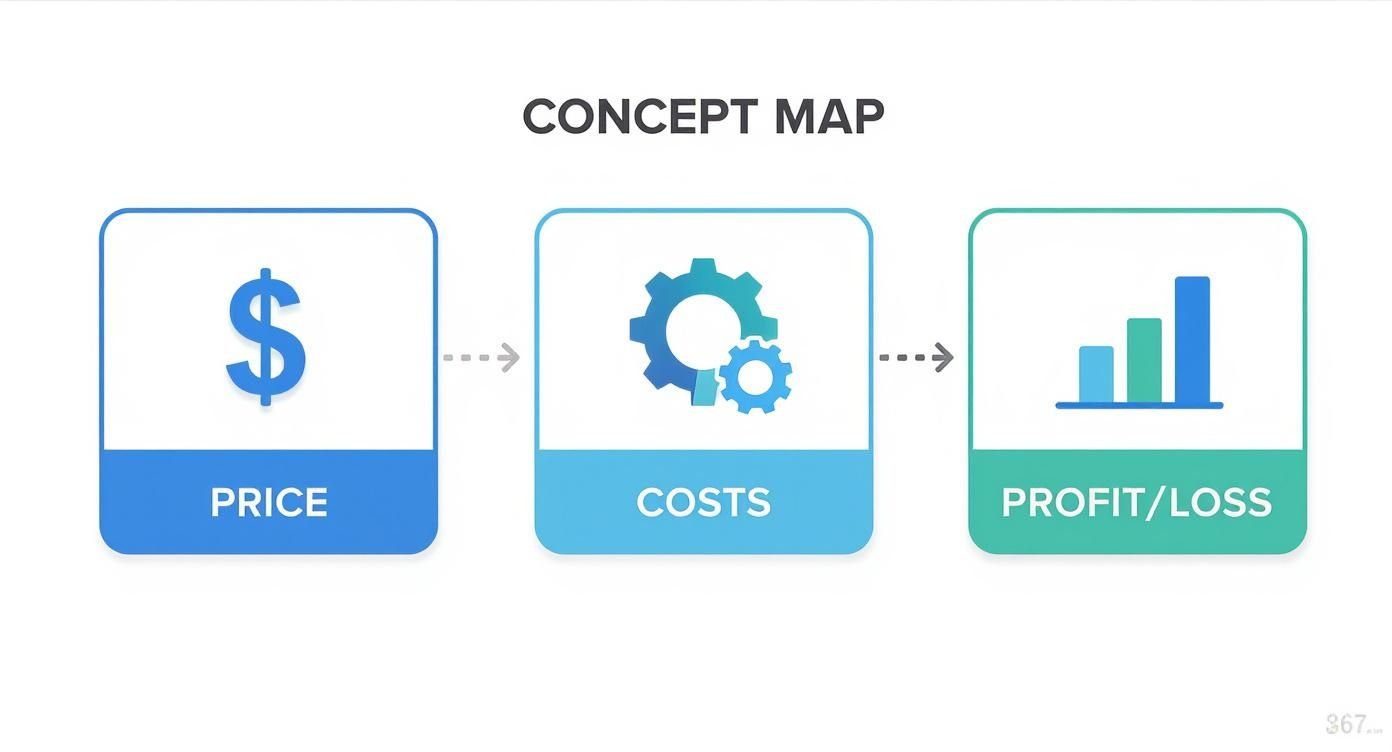

As the infographic shows, once you subtract the costs to acquire and serve a customer, whatever is left over is what determines whether that "unit" is profitable.
A widely accepted benchmark for solid unit economics is the LTV to CAC ratio. You’re generally looking for a ratio of 3:1 or higher for sustainable growth. For example, if a customer is worth $300 over their lifetime (LTV) and it cost you $100 to acquire them (CAC), you’ve got a healthy 3:1 ratio. A ratio below 1:1 means you're actively losing money to grow. You can dive deeper into this crucial ratio and its impact on business health at dealhub.io.
Contribution Margin
While LTV and CAC give you the 30,000-foot view, Contribution Margin gets down to the nitty-gritty of a single sale. It's the revenue left over after you subtract all the variable costs tied directly to producing one unit. That leftover cash is what "contributes" to paying your fixed costs (like rent and salaries) and, eventually, generating profit.
Take an e-commerce brand selling a premium leather wallet:
- Selling Price: $75
- Variable Costs:
- Materials (leather, thread): $15
- Manufacturing Labor: $10
- Packaging & Shipping: $5
- Total Variable Costs: $30
- Contribution Margin Calculation: $75 – $30 = $45
This $45 isn't pure profit yet. But it’s the cash generated from each wallet sale that the company can use to cover its bigger operational bills. A strong contribution margin means that selling more actually leads to making more money overall.
Payback Period
Finally, we have the Payback Period. This metric tells you how long it takes to earn back the money you spent to acquire a customer. For cash-strapped startups, this is everything. A shorter payback period means you get your marketing dollars back faster, which you can then reinvest to acquire the next customer.
Let's go back to our SaaS startup with its $100 CAC. Customers pay a $25 per month subscription.
- Payback Period Calculation: $100 CAC / $25 per month = 4 months.
It takes this company four months to break even on a new customer. After month four, every payment from that user is profit that builds their LTV. For most subscription businesses, a payback period under 12 months is a fantastic benchmark.
These four pillars—LTV, CAC, Contribution Margin, and Payback Period—are not just abstract financial terms. They are the diagnostic tools that reveal the true health of your business, showing you where you’re strong and where you need immediate attention.
Without this clarity, you’re flying blind. When you have experienced leadership guiding these calculations, you can make informed decisions that pave the way for sustainable growth. Connecting with a fractional executive can provide the expert oversight you need without the full-time cost.
How to Calculate Your Unit Economics


Let's move from theory to action. Figuring out your unit economics isn't just for the finance team—it's an essential exercise for any leader who wants a clear, honest picture of the business. You just need the right formulas and a clear idea of where to find the data.
This section will walk you through the core calculations step-by-step. We'll focus on the big three: Customer Lifetime Value (LTV), Customer Acquisition Cost (CAC), and the all-important LTV:CAC ratio.
Breaking Down the Core Formulas
To get started, let’s lay out the key formulas. These are the building blocks that turn abstract concepts into hard numbers.
- Customer Lifetime Value (LTV): This metric forecasts the total revenue a single customer is likely to generate. A simple and effective formula is:
(Average Revenue Per User) x (Customer Lifetime). - Customer Acquisition Cost (CAC): This tells you exactly how much you spend, on average, to win one new customer. The formula is:
(Total Sales & Marketing Spend) / (Number of New Customers Acquired). For a deeper dive, check out our complete guide on customer acquisition cost calculation. - LTV:CAC Ratio: This is the ultimate health check for your business model. The formula is as simple as it gets:
LTV / CAC.
With these formulas in hand, the next step is gathering the right data. You'll typically pull this information from your billing software (like Stripe), your CRM (like HubSpot or Salesforce), and your ad platforms (like Google Ads or LinkedIn).
A Worked Example: "ConnectSphere" SaaS Startup
Let's put these formulas to the test with a hypothetical B2B SaaS company we'll call "ConnectSphere." We're going to analyze their performance over the last quarter (Q3).
Seeing these numbers in action makes the whole process much clearer. Here's a table summarizing how ConnectSphere would calculate its key metrics.
SaaS Startup Unit Economics Calculation Example
| Metric | Formula | Example Data | Calculation | Result |
|---|---|---|---|---|
| Customer Lifetime | 1 / Monthly Churn Rate |
4% Churn Rate | 1 / 0.04 |
25 months |
| LTV | ARPU x Customer Lifetime |
$100 ARPU | $100 x 25 |
$2,500 |
| CAC | Total S&M / New Customers |
$60,000 Spend, 200 Customers | $60,000 / 200 |
$300 |
| LTV:CAC Ratio | LTV / CAC |
$2,500 LTV, $300 CAC | $2,500 / $300 |
8.3:1 |
The table gives you a snapshot, but let's walk through the logic. First, ConnectSphere pulls its key numbers for Q3:
- Total Sales & Marketing Spend: $60,000 (This includes ad spend, content creation, and salaries for the sales and marketing team).
- New Customers Acquired: 200 new subscribers.
- Average Revenue Per User (ARPU): $100 per month.
- Customer Churn Rate: 4% per month.
Next, we plug these numbers into our formulas. To find the LTV, we first need to estimate the average customer lifetime from the churn rate.
- Customer Lifetime:
1 / 0.04= 25 months. - LTV:
$100 (ARPU) x 25 months= $2,500. - CAC:
$60,000 / 200 new customers= $300.
Finally, we calculate the LTV:CAC ratio.
- LTV:CAC Ratio:
$2,500 / $300= 8.3:1.
An 8.3:1 ratio is exceptionally strong. It tells us that for every dollar ConnectSphere spends to acquire a customer, it expects to get back over eight dollars in lifetime revenue. This is a clear indicator of a highly profitable and sustainable business model.
This step-by-step process demystifies unit economics, transforming it from a complex financial concept into a practical tool. By running these calculations regularly, you can monitor your business’s health, spot trends early, and make the data-driven decisions that fuel real, scalable growth.
What Good Unit Economics Looks Like in the Real World
That 3:1 LTV:CAC ratio you hear about? It’s a great rule of thumb, but what counts as “good” unit economics isn't a one-size-fits-all metric.
Context is everything. The numbers that signal a healthy, scalable business can look dramatically different from one industry to another. What works for a high-margin software company would spell disaster for a low-margin e-commerce brand. Understanding these nuances is crucial for setting realistic goals.
Benchmarks Across Different Industries
The ideal balance between what you spend to get a customer and what you earn from them hinges entirely on your business model.
Let's look at how the targets shift across a few common business types:
- SaaS (Software-as-a-Service): With predictable recurring revenue, SaaS businesses can stomach a higher CAC. A healthy SaaS company often aims for an LTV:CAC ratio of 3:1 or higher and a payback period of under 12 months.
- E-commerce: Here, margins are usually thinner and repeat business isn’t a given. Profitability has to happen fast. A successful e-commerce brand might have a lower LTV:CAC ratio but needs a much shorter payback period—often aiming to be profitable on the first or second purchase.
- Marketplaces (e.g., Uber, Airbnb): These businesses have the unique challenge of acquiring two types of "units"—buyers and sellers. This doubles the complexity, often leading to sky-high initial CAC. For them, massive volume and operational efficiency are critical.
A Real-World Example in a Low-Margin World
Companies in the sharing economy show just how tough it can be to get the math right. Take Uber—its early financial model was notoriously complex, with the cost of a ride often being more than the fare collected.
Over time, Uber clawed its way toward better unit economics. They slashed their CAC through brand recognition and dialed back driver incentives. At the same time, they boosted LTV by introducing higher-margin services like Uber Eats. You can find more insights on how companies like Uber manage their financial metrics at finrofca.com.
The Uber story is a powerful lesson: even with a challenging business model, a relentless focus on improving unit economics can pave the way for long-term survival. It shows that these metrics can—and must—evolve as a company grows.
The key takeaway? Your unit economics have to be judged within the context of your specific market and pricing. There's no universal magic number. The real goal is to build a profitable and repeatable system for acquiring and serving customers.
Understanding these benchmarks is the first step. The next is having the right leadership in place to dig into your numbers and build a strategy to move them in the right direction. This is where targeted expertise can make all the difference.
A Practical Playbook for Fixing Your Unit Economics
Figuring out your unit economics is the first step. Actually improving them is where the real work begins.
If your LTV:CAC ratio is sputtering or your payback period is too long, don't panic. The key is to see your numbers not as a final grade, but as a diagnostic tool pointing you exactly where to apply pressure.
This playbook gives you actionable strategies to systematically dial in your company's core profitability, starting with a clear-eyed diagnosis to find the real source of the problem.
Diagnosing the Weak Link
Before you start pulling levers, you need to know which ones are broken. A weak LTV:CAC ratio is a symptom, not the disease. The root cause almost always falls into one of two buckets: either your acquisition costs are too high, or you aren't generating enough value from your customers.
Start by asking a few tough questions:
- Is CAC the problem? Are your ad costs creeping up without a matching bump in conversions? Are you leaning too heavily on expensive paid channels?
- Is LTV the problem? Is your customer churn higher than the industry benchmark? Are customers buying once and then disappearing forever?
An honest assessment will tell you if you've got a customer acquisition problem or a customer retention and monetization problem. Once you know where to focus, you can apply the right tactics.
Strategies for Lowering Customer Acquisition Cost
If your CAC is inflated, the goal is simple: acquire customers more efficiently without sacrificing quality. This isn’t just about slashing your marketing budget; it’s about making every dollar work harder.
Here are some proven ways to lower your CAC:
- Refine Ad Targeting: Go beyond basic demographics. Use lookalike audiences and run retargeting campaigns for warm leads to ensure your ads are shown to people who are likely to convert.
- Invest in Organic Channels: Content marketing and SEO are the long game, but they pay massive dividends. A single, high-ranking blog post can generate leads for years, effectively driving your CAC toward zero over time.
- Optimize Your Conversion Funnel: A leaky funnel is a CAC killer. A/B test your landing pages, simplify your checkout process, and improve your site speed. Removing friction can deliver a huge lift in conversion rates from the traffic you already have.
Lowering your CAC is a critical part of a broader financial health strategy. For more ideas on trimming expenses effectively, check out our detailed guide on practical cost reduction strategies for businesses.
Strategies for Increasing Customer Lifetime Value
On the other side of the coin, increasing LTV is all about getting more value from the customers you've already paid to acquire. It's cheaper to keep a customer than find a new one—boosting LTV is the financial proof of that old saying.
A focus on increasing LTV shifts your company’s mindset from transactional to relational. It’s a commitment to delivering ongoing value that keeps customers loyal, engaged, and profitable.
Put these powerful techniques into action to drive up your LTV:
- Create an Exceptional Customer Experience: This is your best defense against churn. Proactive support, a smooth onboarding process, and consistently listening to feedback build the loyalty that translates into a longer, more profitable customer lifetime.
- Develop Upsell and Cross-Sell Pathways: Don't just hope customers stumble upon your premium features. Build targeted campaigns that introduce them to higher-value offerings at just the right moment in their journey.
- Implement a Loyalty or Retention Program: Reward your best customers and make them feel seen. Whether through discounts, early access, or exclusive content, a formal program gives people an incentive to stick around.
Fixing your unit economics isn't a one-and-done project. It's an ongoing cycle of diagnosis, action, and measurement. By systematically tackling both CAC and LTV, you can build a resilient, profitable engine for real growth.
How Fractional Leadership Can Transform Your Numbers

Mastering unit economics often demands senior expertise that most growing companies can't afford to bring on full-time. The strategies for slashing CAC and boosting LTV are simple in theory but complex to execute well.
This is where the right leadership becomes the most powerful lever you can pull.
Instead of a six-figure salary, you can bring in top-tier talent on a part-time basis to solve these exact high-stakes problems. This approach, known as fractional leadership, gives you the strategic firepower to fix your numbers without the massive commitment of a full-time executive. You can learn more about how fractional leadership models work in our detailed guide.
But does it actually work? Let's walk through a real-world scenario.
Case Study: The InnovateCo Turnaround
InnovateCo, a promising B2B tech company, was stuck. They had a great product but were burning cash, held back by a broken LTV:CAC ratio of just 1.2:1. Their growth was unprofitable, and every new customer pushed them closer to the edge.
Knowing they didn't have the in-house expertise to fix it, they brought in two fractional executives: a seasoned Chief Marketing Officer (CMO) and a strategic Chief Financial Officer (CFO), each working just 15 hours a week.
The impact was immediate.
The fractional team didn't just offer advice; they rolled up their sleeves and executed a turnaround. They provided the specialized, hands-on leadership InnovateCo desperately needed at a fraction of the cost of full-time hires.
The fractional CMO audited the entire marketing engine. She quickly discovered that over 70% of the ad budget was being wasted on channels that weren't converting.
- Action Plan: She restructured their ad campaigns, reallocated the budget to high-performing channels, and kicked off a content strategy to attract organic leads.
- The Result: Within six months, CAC was slashed by 40%.
At the same time, the fractional CFO dug into the company’s pricing and cost structure. He uncovered hidden service costs that were destroying their margins and realized their pricing tiers didn't align with the value customers were getting.
- Action Plan: He rebuilt the pricing model to better capture value from enterprise clients and renegotiated vendor contracts, cutting hidden operational costs.
- The Result: The average LTV shot up by over 30%.
By combining a more efficient acquisition engine with a more profitable customer base, InnovateCo’s LTV:CAC ratio soared to a healthy 3.5:1. Their story is a perfect example of how targeted, expert leadership is the fastest way to fix your profitability engine and unlock sustainable scale.
Common Questions About Unit Economics
You’ve got the basics down, but as leaders start applying these concepts, a few common questions always pop up. Let's tackle them so you can use these metrics with confidence.
How Often Should I Calculate My Unit Economics?
This isn’t a one-and-done calculation. Your unit economics are a living part of your operational rhythm.
- For early-stage startups: You should be looking at your unit economics on a monthly basis. This frequency lets you spot bad trends before they become big problems.
- For more established businesses: A quarterly review is usually enough to keep your finger on the pulse and make smart, strategic calls for the next period.
What Are the Biggest Mistakes Startups Make?
It’s easy to stumble when you’re first digging into these numbers. Knowing the common pitfalls can help you steer clear of them.
The single biggest mistake we see is miscalculating costs, especially CAC. Founders often only count their ad spend, completely forgetting to include the fully-loaded costs of their sales and marketing teams—salaries, commissions, and software. This paints a way-too-rosy picture. Another killer is ignoring customer churn, which artificially inflates your LTV and masks a leaky bucket problem.
A business can have positive unit economics but still be unprofitable overall. This happens when the contribution margin from each unit isn't large enough or sales volume isn't high enough to cover the company's total fixed costs, like rent, utilities, and administrative salaries.
Can Good Unit Economics Still Mean I’m Unprofitable?
Yes, absolutely. And this is a crucial distinction.
Your burrito food truck might make a $6 profit on every single burrito you sell—great unit economics! But if you only sell 100 burritos a month, that $600 in total contribution margin won’t cover your $1,500 monthly truck payment and insurance (your fixed costs). You're still losing money.
Strong unit economics prove your business model works on a micro level. But achieving overall profitability means you have to scale that model to a volume where your total contribution margin blows past all your fixed expenses.
Nailing down your unit economics—and then actually improving them—often calls for seasoned strategic leadership. We connect growing businesses with a marketplace of vetted fractional executives who bring the expert guidance needed to strengthen your financial model and drive sustainable growth. Schedule a consultation to find the right expert for your business.