



Unlocking Top Talent: Crafting Executive Job Descriptions That Shine
Attracting exceptional executive talent requires compelling job descriptions. This listicle provides eight essential components of effective executive job descriptions, helping you secure top leadership. Learn how to define key responsibilities, qualifications, competencies, performance expectations, organizational structure, compensation, and company culture within your executive job descriptions. Whether you need a CFO or CEO, these insights will streamline your executive search, saving you time and resources. This guide covers everything from the executive summary to the compensation package, ensuring your executive job descriptions attract the best candidates.
1. Executive Summary/Job Overview
The Executive Summary, or Job Overview, is the crucial first impression of your executive job description. It acts as a concise and compelling introduction to the role, providing a snapshot of its core responsibilities, position within the organization, and overall purpose. This section is paramount for attracting top-tier executive talent because it allows potential candidates to quickly assess whether the role aligns with their career aspirations and expertise. A well-crafted executive summary acts as a powerful hook, enticing qualified candidates to delve deeper into the full job description. This is especially important in today’s competitive executive job market, where candidates are often inundated with opportunities. This section helps them prioritize roles that genuinely pique their interest and match their skillset. This element is critical for crafting effective executive job descriptions that attract the right leaders for your organization.


This section typically comprises a concise introduction to the role (ideally 3-5 sentences), clearly positions the role within the organizational hierarchy, establishes reporting relationships (e.g., reports to the CEO), and outlines the broad purpose and impact of the position. For example, it should answer questions like, “What is the overarching goal of this role?” and “How does this position contribute to the company’s overall strategy?” By highlighting the strategic importance of the role, you attract candidates who are motivated by impact and possess a strong sense of ownership.
Features of an Effective Executive Summary:
- Concise and Engaging: Captures attention and clearly communicates the essence of the role.
- Strategic Positioning: Clarifies the role’s place within the organization and its contribution to the overall strategy.
- Clear Reporting Lines: Specifies who the executive will report to.
- Impact-Oriented: Emphasizes the role’s influence and potential for making a significant difference.
Pros:
- Efficient Candidate Screening: Facilitates self-selection, saving both the candidate’s and the recruiter’s time.
- Sets Clear Expectations: Provides a realistic preview of the role’s scope and responsibilities.
- Strong First Impression: Creates a positive and engaging introduction to the opportunity.
- Serves as an Elevator Pitch: Concisely conveys the value proposition of the role.
Cons:
- Balancing Brevity and Detail: Can be challenging to provide enough information without becoming too lengthy.
- Risk of Oversimplification: Complex roles may require more nuance than a brief summary can offer.
- Potential for Misalignment: If not carefully crafted, the summary can create discrepancies with the detailed requirements later in the job description.
Examples:
- Chief Financial Officer: A senior leadership position reporting directly to the CEO, responsible for all financial operations, strategic financial planning, and fiscal health of a $500M global organization with 2,000+ employees across 15 countries.
- Executive Director: A visionary leadership role heading our non-profit organization, overseeing all operational, fundraising, and advocacy initiatives while serving as the primary external representative to stakeholders, donors, and the public.
Tips for Writing a Compelling Executive Summary:
- Keep it concise (100-150 words maximum).
- Clearly state the reporting relationship and organizational positioning.
- Highlight the role’s strategic importance and potential impact.
- Consider including brief company information for context.
- Avoid jargon and corporate-speak. Use clear and accessible language.
The Executive Summary/Job Overview is an essential component of any effective executive job description, particularly for startups, SMEs, and companies in fast-paced industries like SaaS, FinTech, and HealthTech. By focusing on clarity, conciseness, and impact, you can attract the high-caliber executive talent your organization needs to thrive.
2. Key Responsibilities and Duties
This section of an executive job description, arguably the most crucial, outlines the core functions, duties, and day-to-day responsibilities the executive will be expected to perform. It provides a clear picture of the executive’s areas of accountability and the expected outcomes. For executive-level roles, these responsibilities are typically strategic, leadership-focused, and centered on driving organizational success rather than simply completing tactical tasks. This clarity is paramount for both the organization and the potential candidate in ensuring a successful hire within the fast-paced world of SaaS, FinTech, HealthTech, and other evolving industries.

A well-crafted “Key Responsibilities and Duties” section acts as a roadmap, outlining the executive’s primary areas of focus. It should detail a comprehensive list of responsibilities, incorporating a blend of strategic and operational duties, with an emphasis on leadership, decision-making, and oversight. This section should clearly delineate the scope of the role and the executive’s authority, including any cross-functional collaborations and external relationship management responsibilities. For a deeper dive into this topic, learn more about Key Responsibilities and Duties.
This section deserves its place in every executive job description because it forms the bedrock of understanding and agreement between the organization and the executive. It sets the stage for effective performance evaluations, establishes clear boundaries and authority levels, and serves as a vital tool for attracting the right talent. For startup founders and entrepreneurs, especially, having a clear understanding of executive roles is vital for cost-effective leadership and scaling the business effectively.
Features and Benefits:
- Comprehensive scope definition: Provides a detailed overview of the role’s purview, enabling candidates to assess fit and the organization to evaluate performance.
- Focus on leadership: Emphasizes strategic decision-making, team management, and organizational leadership—essential for executive success.
- Clarity of authority: Establishes the executive’s decision-making power and reporting structure, crucial for effective leadership.
- Performance benchmark: Serves as a basis for performance reviews and goal setting, ensuring alignment between the executive and the organization.
Pros:
- Sets clear expectations for the role, reducing ambiguity and misunderstandings.
- Helps candidates assess their experience and capabilities against the required skills.
- Provides a framework for performance evaluations and ongoing feedback.
- Establishes boundaries and clarifies authority levels.
Cons:
- Can become excessively long and overwhelming if not properly structured.
- May inadvertently limit executive autonomy if too prescriptive.
- Can become outdated quickly in dynamic and rapidly changing organizations.
Examples:
- Chief Marketing Officer: Lead the development and execution of global marketing strategies to drive brand recognition, customer acquisition, and revenue growth across multiple channels. Oversee market research, competitive analysis, and customer segmentation to identify growth opportunities. Build and manage a high-performing marketing team, fostering a culture of innovation and data-driven decision-making.
- Chief Technology Officer: Direct the organization’s technological vision, overseeing all aspects of technology development and implementation while ensuring alignment with business goals. Manage the IT budget and infrastructure, ensuring security and scalability. Lead the development and execution of the technology roadmap, incorporating emerging technologies and industry best practices.
Tips for Effective Key Responsibilities and Duties Sections:
- Prioritize responsibilities: List the most critical responsibilities first, highlighting the core functions of the role.
- Use subheadings: Group related responsibilities under clear subheadings (e.g., Strategic Leadership, Team Management, Financial Oversight) for better organization.
- Use action verbs: Start each responsibility with strong action verbs (e.g., Lead, Develop, Oversee, Manage, Implement) for clarity and impact.
- Focus on outcomes: Describe the desired results and impact of the executive’s actions rather than simply listing tasks.
- Keep it concise: Limit the section to 8-12 key responsibilities to maintain focus and avoid overwhelming the reader. This is especially valuable for small to medium-sized businesses seeking cost-effective ways to attract executive talent.
By adhering to these tips, organizations can create compelling and informative “Key Responsibilities and Duties” sections that attract top executive talent and contribute to long-term success in today’s competitive landscape.
3. Qualifications and Experience Requirements
This section of an executive job description, focusing on qualifications and experience requirements, is crucial for attracting the right leadership talent and streamlining the hiring process. It defines the essential skills, experience, and educational background needed for success in the executive role. A well-crafted qualifications section acts as a filter, ensuring that applicants possess the baseline criteria for consideration, saving valuable time for both the hiring company and potential candidates. This is particularly important for executive job descriptions, where the stakes are high and the pool of qualified candidates can be competitive.
This section establishes the bar for candidates and sets clear expectations. It helps organizations effectively sift through applications, focusing only on those who meet the predefined criteria. By clearly articulating the necessary qualifications, this section also empowers potential candidates to self-select in or out, leading to a more focused applicant pool. This aspect is highly relevant for time-constrained startup founders and SMBs who need to efficiently manage their hiring process.
Features of a Strong Qualifications and Experience Section:
- Educational Requirements: Specify required degrees, certifications, or professional licenses (e.g., MBA, CPA, PMP).
- Years of Experience: Outline the total years of experience required, as well as specific experience in related roles or functions.
- Industry-Specific Experience: Indicate any specific industry knowledge or experience that is essential for the role (e.g., SaaS, FinTech, HealthTech). This is especially beneficial for industries like HealthTech, where regulatory compliance and specific operational knowledge are essential.
- Leadership and Management Experience Metrics: Define the scope and scale of leadership experience needed (e.g., managing teams of a certain size, P&L responsibility, strategic planning experience). This is critical for assessing a candidate’s ability to lead and execute at the executive level.
- Technical or Specialized Knowledge Requirements: List any specific technical skills or software proficiencies required for the role (e.g., CRM expertise, data analysis skills).
- Clear Distinction between Required and Preferred Qualifications: Clearly differentiate between “must-have” and “nice-to-have” qualifications to provide flexibility and attract a wider range of talent while still prioritizing essential skills.
Pros:
- Objective Candidate Evaluation: Provides a standardized framework for assessing candidates, reducing bias and promoting fair evaluation.
- Efficient Filtering in Applicant Tracking Systems (ATS): Enables automated screening of applications based on keywords and specific requirements, speeding up the initial stages of recruitment.
- Enhanced Role Credibility: A detailed qualifications section communicates the importance and seniority of the role, attracting high-quality candidates.
- Candidate Self-Selection: Helps potential applicants determine if they are a good fit for the role, minimizing unqualified applications.
Cons:
- Potential for Limiting Diversity: Overemphasis on traditional credentials can inadvertently exclude qualified candidates with non-traditional career paths. This is a crucial consideration for companies striving for diverse leadership teams.
- Risk of Over-Specification: Excessively specific requirements can create “unicorn” job descriptions, making it difficult to find suitable candidates.
- Focus on Past Experience over Future Potential: Overreliance on past experience may overshadow a candidate’s potential for growth and adaptability.
Examples of Effective Qualifications Statements within Executive Job Descriptions:
- CEO: “Minimum 15+ years of progressive leadership experience with at least 7 years in C-suite roles, preferably in the technology sector. MBA or equivalent advanced degree required.”
- Hospital COO: “Bachelor’s degree required, Master’s in Healthcare Administration preferred. Minimum 10 years of senior leadership experience in healthcare settings with demonstrated expertise in operational excellence and regulatory compliance.”
Tips for Crafting Effective Qualifications and Experience Requirements:
- Clearly Distinguish “Required” vs. “Preferred”: This provides flexibility and broadens the potential candidate pool.
- Consider Equivalent Experience: Acknowledge that relevant experience can sometimes substitute for formal education.
- Focus on Demonstrable Capabilities: Emphasize the skills and abilities required to perform the job successfully rather than rigid metrics.
- Review for Potential Bias: Scrutinize the requirements to ensure they don’t unintentionally exclude qualified candidates from diverse backgrounds.
- Include Industry-Specific Credentials Only When Truly Necessary: Avoid unnecessary specialization unless absolutely essential for the role.
By following these best practices, organizations can create highly effective executive job descriptions that attract top-tier talent and contribute to a successful hiring process. This is especially valuable for entrepreneurs and businesses in rapidly evolving sectors like SaaS, FinTech, and HealthTech where finding the right executive leadership is critical for growth and innovation. This methodical approach, popularized by executive search firms like Korn Ferry and Russell Reynolds and aligned with SHRM best practices, ensures your executive job descriptions are optimized to find the leadership your organization needs.
4. Competencies and Leadership Attributes
This section of an executive job description, focusing on Competencies and Leadership Attributes, goes beyond simply listing required qualifications and delves into the essential behavioral characteristics, interpersonal skills, and leadership traits needed for success. While a candidate’s resume might demonstrate what they’ve done, the competencies section illuminates how they operate and lead, providing crucial insights into their potential fit within your organization’s culture and their capacity to tackle the unique challenges of the role. This is particularly vital for executive positions where leadership, strategic thinking, and the ability to navigate complex interpersonal dynamics are paramount. For startup founders, SMBs, and companies across various sectors like SaaS, FinTech, and HealthTech, understanding these less tangible aspects is critical for effective executive recruitment.
This approach works by identifying key competencies, which unlike tangible qualifications, focus on the behavioral and interpersonal aspects of leadership. It’s about understanding a candidate’s leadership style, decision-making process, communication skills, adaptability, strategic thinking capabilities, emotional intelligence, and self-awareness. Learn more about Competencies and Leadership Attributes to gain a deeper understanding of their impact. This is especially relevant for entrepreneurs and businesses seeking flexible, part-time executive roles, as finding the right fit in terms of leadership style and cultural alignment becomes even more crucial.
Features of this section typically include expectations regarding:
- Leadership style and approach: Is the role best suited for a transformational leader, a servant leader, or something else entirely?
- Decision-making and problem-solving capabilities: How does the candidate approach complex challenges and make critical decisions under pressure?
- Communication and interpersonal skills: Can they effectively communicate vision, build consensus, and navigate difficult conversations?
- Change management and adaptability traits: How well do they handle organizational change and adapt to evolving circumstances?
- Strategic thinking and vision capabilities: Can they anticipate future trends and develop innovative strategies to achieve organizational goals?
- Emotional intelligence and self-awareness attributes: Do they possess the self-awareness and interpersonal skills to build strong relationships and manage diverse teams effectively?
Pros of including a Competencies section:
- Addresses cultural and team fit: Goes beyond technical skills to evaluate how a candidate aligns with company values and team dynamics.
- Helps assess leadership potential and executive presence: Provides insight into a candidate’s ability to inspire, motivate, and lead effectively.
- Provides guidance for behavioral interview questions: Offers a framework for structuring interviews and evaluating candidate responses based on desired behaviors.
- Supports evaluation of intangible but critical success factors: Allows for a more holistic assessment of a candidate’s potential for success.
Cons of relying on Competencies:
- More subjective and difficult to assess objectively: Evaluating soft skills can be challenging and susceptible to bias.
- Can reflect unconscious biases in leadership expectations: Preconceived notions of ideal leadership styles can limit diversity of thought.
- May prioritize certain leadership styles that limit diversity of thought: Overemphasis on specific competencies can inadvertently discourage candidates with different but equally effective approaches.
- Difficult to verify through traditional screening methods: Requires more sophisticated assessment methods beyond resume review and reference checks.
Examples of Competencies in Action:
- Chief People Officer: “Demonstrates exceptional emotional intelligence, with the ability to build trust across diverse stakeholder groups and navigate complex interpersonal dynamics with diplomacy and authenticity.”
- Chief Strategy Officer: “Exhibits visionary thinking with demonstrated ability to anticipate market trends, identify emerging opportunities, and translate abstract concepts into actionable strategic initiatives.”
Tips for crafting an effective Competencies section:
- Link competencies to specific job challenges and organizational values: Ensure the competencies directly relate to the specific demands of the role and reflect the company’s core values.
- Use competency frameworks (like Lominger or Korn Ferry) for consistency: Established frameworks provide a structured approach and standardized language for defining competencies.
- Include behavioral indicators for each competency: Describe observable behaviors that demonstrate the competency in action.
- Consider using assessment tools to evaluate competencies objectively: Employing standardized assessments can reduce bias and provide more objective data.
- Limit to 5-7 core competencies for clarity and focus: Avoid overwhelming candidates with a long list; prioritize the most critical competencies for the role.
By incorporating a well-defined Competencies and Leadership Attributes section in your executive job descriptions, you can significantly improve your ability to attract and select exceptional leaders who possess not only the right qualifications but also the essential behavioral traits and interpersonal skills to thrive within your organization. This is especially valuable for organizations looking to build strong leadership teams, navigate rapid growth, and achieve long-term success.
5. Strategic Objectives and Performance Expectations
This section of an executive job description, focusing on Strategic Objectives and Performance Expectations, is crucial for attracting top-tier talent and setting the stage for success. It clearly outlines the key strategic objectives, performance expectations, and metrics for the role, providing candidates with a concrete understanding of what they need to achieve and how their performance will be evaluated. This is particularly important for executive job descriptions as these roles carry significant responsibility and impact the overall trajectory of the organization. A well-defined set of objectives ensures alignment between the executive’s work and the company’s strategic goals.
This section details what the executive is expected to deliver, often within specific timeframes such as the first 30/60/90 days or the first year. These timeframes allow for early assessment of performance and provide a roadmap for both the executive and the organization. For startups, SMEs, and rapidly evolving sectors like SaaS, FinTech, and HealthTech, this clarity is paramount, as efficient and impactful leadership is critical for growth and survival.
Features of this section:
- Short and long-term performance objectives: Defines both immediate priorities and the long-term vision for the role.
- Key Performance Indicators (KPIs) and success metrics: Specifies quantifiable measures to track progress and evaluate success.
- First-year priorities and milestones: Sets clear expectations for the initial onboarding period and early contributions.
- Strategic initiatives to lead or implement: Outlines specific projects or programs the executive will oversee.
- Business impact expectations: Articulates the anticipated impact of the executive’s work on the organization’s bottom line, market share, or other relevant metrics.
- Links to organizational goals and strategy: Explicitly connects the executive’s role to the overall company strategy.
Pros:
- Creates clear alignment between role expectations and organizational goals. This is crucial for ensuring everyone is working towards the same vision, a key factor for success in startups and SMEs where resources are often limited.
- Helps candidates understand what success looks like. This attracts candidates who are confident they can deliver on the outlined objectives.
- Provides a foundation for performance evaluation and compensation decisions. Objective metrics enable fair and transparent performance reviews.
- Sets realistic timeframes for achieving key objectives. This facilitates effective planning and resource allocation.
Cons:
- May become quickly outdated in volatile business environments. This is especially relevant in dynamic sectors like SaaS, FinTech, and HealthTech, requiring regular review and adjustments of objectives.
- Can be too prescriptive, limiting executive autonomy and creativity. A balance needs to be struck between providing clear direction and allowing for flexibility.
- Risk of overemphasis on short-term results versus long-term value creation. While short-term wins are important, the focus should also be on sustainable, long-term growth.
- Difficult to establish metrics for some executive functions (e.g., culture building). Qualitative assessments and less quantifiable metrics may be necessary for certain roles.
Examples within Executive Job Descriptions:
- Chief Revenue Officer: “Drive 20% year-over-year revenue growth while maintaining a customer retention rate above 85% and successfully launching the company’s expansion into two new international markets within the first 18 months.”
- Chief Operating Officer: “Lead operational transformation initiative to reduce manufacturing costs by 15% while improving quality metrics by 10% and reducing time-to-market for new products by 30% within the first year.”
Tips for Crafting Effective Objectives:
- Include both quantitative metrics and qualitative objectives for a holistic view of performance.
- Align expectations with available resources and organizational constraints. Ensure the objectives are achievable given the company’s current situation.
- Consider using the SMART framework (Specific, Measurable, Achievable, Relevant, Time-bound) for setting clear and actionable objectives.
- Include 30/60/90 day expectations for onboarding clarity and early performance assessment.
- Review with key stakeholders to ensure alignment before finalizing the job description.
Popularized By:
This approach to management and performance evaluation has been influenced by concepts like Peter Drucker’s Management by Objectives, the OKR (Objectives and Key Results) framework from Intel and Google, and the Balanced Scorecard approach by Kaplan and Norton.
This section deserves its place in any executive job description as it lays the groundwork for a successful tenure. It provides clarity, fosters alignment, and establishes a framework for accountability, ultimately contributing to the achievement of organizational goals. By using these best practices, founders, entrepreneurs, and businesses can create compelling executive job descriptions that attract and secure high-performing leaders.
6. Organizational Relationships and Reporting Structure
This section of an executive job description, crucial for attracting top-tier candidates, clarifies the executive’s place within the organizational hierarchy. It defines reporting lines, areas of authority, and key stakeholder relationships, offering potential hires a clear understanding of their role in the broader organizational context. For startups, SMEs, and even larger corporations navigating complex structures, a well-defined reporting structure minimizes ambiguity and sets the stage for effective leadership. A strong understanding of organizational relationships is essential for executive job descriptions, ensuring both the candidate and the company are aligned on expectations. This is especially critical in fast-paced industries like SaaS, FinTech, and HealthTech where collaboration and clear decision-making paths are paramount.
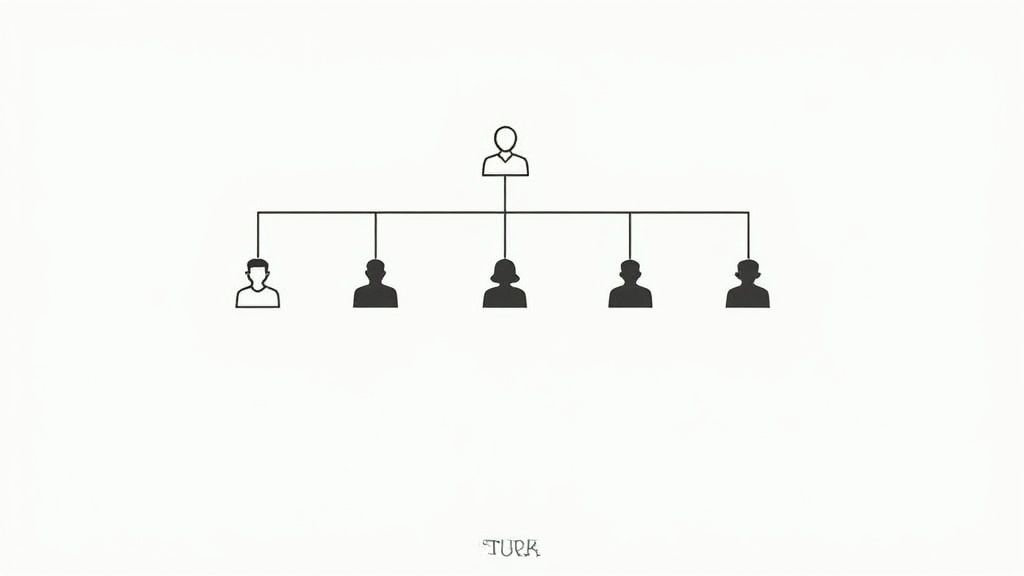
This section should detail the executive’s reporting relationship (to whom they report), their direct reports (their team structure), and any board or committee participation requirements. It should also outline key cross-functional relationships and dependencies, external stakeholder management responsibilities, and, importantly, decision-making authorities and any limitations thereof. This level of detail provides critical context about the executive’s influence, autonomy, and expected collaborative efforts within the organization.
Features of this section:
- Direct reporting relationship: Specifies who the executive reports to.
- Direct reports and team structure oversight: Defines the team the executive will manage.
- Board and committee participation requirements: Outlines any board or committee involvement.
- Cross-functional relationships and dependencies: Clarifies interactions with other departments.
- External stakeholder management responsibilities: Details interactions with external parties.
- Decision-making authorities and limitations: Specifies the scope of the executive’s authority.
Pros:
- Clarifies scope of authority and decision-making boundaries: Reduces ambiguity and potential conflicts.
- Helps candidates understand organizational politics and dynamics: Provides valuable insight into the company culture.
- Prevents misalignment of expectations about influence and autonomy: Ensures both parties are on the same page.
- Provides insight into the broader leadership team structure: Offers a glimpse into the overall leadership landscape.
Cons:
- May reveal organizational challenges or dysfunctions: Could inadvertently expose internal issues.
- Can appear restrictive to executives accustomed to broad authority: Might deter candidates seeking greater autonomy.
- Difficult to capture informal influence networks and relationships: Formal structures may not reflect actual power dynamics.
- May change with organizational restructuring: Requires updates to reflect organizational changes.
Examples:
- Chief Financial Officer: “Reports directly to the CEO with a dotted-line reporting to the Audit Committee Chair. Oversees a team of 35 finance professionals including the Controller, Director of FP&A, Tax Director, and Treasury Manager. Serves as a key member of the Executive Leadership Team and presents quarterly to the Board of Directors.”
- General Counsel: “Reports to the CEO with a functional relationship to the Board’s Governance Committee. Manages the legal department of 12 attorneys and compliance professionals. Serves on the Risk Management Committee and Crisis Response Team.”
Tips for Writing this Section:
- Include an organizational chart snippet: Visually represent the executive’s position.
- Clarify both formal and informal reporting relationships: Provide a comprehensive view of reporting structures.
- Specify governance roles and committee participation expectations: Outline any board or committee responsibilities.
- Outline key relationships with other C-suite executives: Highlight interactions within the leadership team.
- Address any matrix reporting structures clearly: Explain any complex reporting relationships.
This section’s importance in executive job descriptions cannot be overstated. It provides clarity, sets expectations, and ultimately contributes to successful executive recruitment and onboarding. By leveraging best practices from established frameworks like McKinsey’s organizational design frameworks, Ram Charan’s governance structures, and Deloitte’s Executive Reporting Structure best practices, companies can create highly effective executive job descriptions that attract and secure top talent. This is crucial for startups, SMEs, and larger enterprises alike, particularly in competitive sectors such as SaaS, FinTech, and HealthTech, where attracting the right leadership is essential for growth and success.
7. Compensation and Benefits Package
A well-crafted executive job description must include a clear and compelling compensation and benefits package. This section is crucial for attracting top-tier executive talent and ensuring alignment between the organization’s goals and the executive’s performance. It outlines the total value proposition the company offers and plays a pivotal role in the hiring process within executive job descriptions. This is particularly critical for startups, SMEs, and rapidly growing sectors like SaaS, FinTech, and HealthTech, where attracting experienced leadership is essential for success.
This section goes beyond just stating a salary. It details the entire compensation structure, including base salary, variable pay (bonuses), equity components (stock options, RSUs), standard benefits (health, retirement), and executive perquisites (car allowance, club memberships). It also addresses other key aspects like relocation assistance and severance provisions. For companies looking to fill part-time executive roles, clearly outlining the pro-rata compensation structure is essential.
How it Works:
The compensation package should be structured to attract, retain, and motivate high-performing executives. It should be competitive within the industry and geographic location while reflecting the specific responsibilities and expectations of the role. A clear explanation of how performance impacts variable pay components is vital. This transparency helps candidates understand the potential upside and aligns their efforts with company objectives.
Examples of Successful Implementation:
- CEO package: “Competitive base salary in the range of $500,000-$700,000 with annual performance bonus potential of up to 100% of base salary. Long-term incentive plan includes equity grants valued at 200% of base salary vesting over 4 years. Comprehensive executive benefits package including deferred compensation options and executive health program.”
- Division President: “Total target compensation of $450,000-$550,000 including base salary and performance-based annual bonus. Long-term incentive through restricted stock units valued at approximately 75% of base salary. Executive benefits include enhanced retirement contribution matching and executive life insurance policy.”
- Part-time CFO: “Compensation for this part-time role is based on a daily rate of $2,000 – $2,500, commensurate with experience, for an estimated commitment of 2-3 days per week. Benefits include participation in the company’s 401k plan.”
Actionable Tips for Creating Effective Compensation Packages within Executive Job Descriptions:
- Consider providing salary ranges rather than specific numbers: This allows for flexibility during negotiations and caters to a broader range of experience levels.
- Clearly explain performance-based compensation structures: How are bonuses earned? What are the vesting schedules for equity?
- Benchmark against relevant industry and geographic data: Use resources like Mercer, Willis Towers Watson, Equilar, and ISS to ensure competitiveness.
- Include both cash and non-cash elements of total compensation: Highlight the overall value, not just the salary.
- Highlight unique or differentiating benefits for executives: This could be anything from executive coaching to sabbatical programs.
Pros:
- Creates transparency around total compensation expectations.
- Aligns incentives with organizational goals and performance.
- Helps candidates evaluate opportunity cost against other options.
- Streamlines the negotiation process by establishing parameters.
Cons:
- May create internal equity issues if widely shared.
- Can limit negotiation flexibility if too specific.
- May not be competitive if not regularly benchmarked.
- Risks emphasizing compensation over purpose and impact.
Why this Item Deserves its Place in the List:
Compensation and benefits are a primary driver for executive talent. A well-defined package demonstrates the organization’s commitment to attracting and retaining top performers. It sets the stage for a successful recruitment process and contributes significantly to the overall effectiveness of the executive job description. For entrepreneurs and founders, a compelling compensation package is often the key to securing experienced leadership that can drive growth and achieve strategic objectives.
8. Company Culture and Values Statement
Crafting compelling executive job descriptions requires more than just listing responsibilities and requirements. It demands showcasing the heart and soul of your organization – its culture and values. This section, strategically placed within your executive job descriptions, articulates the organization’s culture, values, mission, and working environment, enabling potential executive candidates to assess their fit and alignment with their personal values. It provides crucial context about the organization’s purpose, decision-making approach, and leadership philosophy, painting a picture of the intangible aspects of the work environment they would be joining. This allows candidates to determine not just if they can do the job, but if they want to contribute to your specific organizational ecosystem.

This element deserves a prominent place in your executive job descriptions because it acts as a powerful magnet for attracting the right kind of leader. It goes beyond the transactional aspects of the role and speaks to the intrinsic motivators that drive top-tier executives. Features of a well-crafted Company Culture and Values Statement include:
- Organizational mission and purpose statement: Clearly define why your organization exists and what it aims to achieve.
- Core values and behavioral expectations: Outline the guiding principles and expected behaviors that shape your organizational culture.
- Leadership philosophy and decision-making approach: Describe the leadership style encouraged within the company and how decisions are typically made.
- Company history and heritage highlights: Share key moments and milestones that have shaped the organization’s identity.
- Diversity, equity, and inclusion (DE&I) commitments: Articulate your commitment to creating a diverse and inclusive workplace.
- Work environment and cultural characteristics: Describe the day-to-day atmosphere and the unique cultural traits of your organization.
- Corporate social responsibility (CSR) initiatives: Highlight your organization’s commitment to social and environmental responsibility.
Pros:
- Helps attract candidates who are genuinely aligned with organizational values.
- Reduces cultural mismatches and, consequently, potential turnover.
- Provides context for leadership expectations beyond specific tasks and responsibilities.
- Differentiates the organization from competitors, enhancing your employer brand.
Cons:
- Can appear generic and inauthentic if not carefully crafted and specific to your organization.
- May not reflect the current reality if the statement is aspirational rather than reflective of the actual culture.
- Accurately conveying the nuances of company culture in written form can be challenging.
- Overemphasis on cultural fit can risk creating homogeneity and limiting diversity of thought.
Examples:
- Patagonia: “Join a company committed to environmental activism and sustainable business practices. Our leadership team makes decisions through our core value lens: Build the best product, cause no unnecessary harm, use business to protect nature, and not bound by convention.”
- Microsoft: “Be part of a culture that embraces a growth mindset, values diversity and inclusion, and seeks to empower every person and organization on the planet to achieve more. Our leaders model curiosity, a learn-it-all mentality, and collaborative problem-solving.”
Tips for Implementation:
- Show, Don’t Just Tell: Include specific examples that demonstrate your values in action.
- Be Authentic: Avoid generic platitudes and focus on the truly unique cultural attributes of your organization.
- Address Transformation: If your organization is undergoing a cultural transformation, address these initiatives transparently.
- Incorporate Employee Voices: Consider including employee testimonials or culture survey results to add authenticity. Learn more about Company Culture and Values Statement
- Acknowledge Challenges: Be honest about any cultural challenges and ongoing improvement efforts.
This approach is particularly beneficial for:
- Startup founders seeking executive talent who can shape and embody the company’s emerging culture.
- Small to medium-sized businesses seeking cost-effective leadership solutions through cultural alignment.
- Industries such as SaaS, FinTech, and HealthTech, where cultural fit is crucial for innovation and rapid growth.
- Entrepreneurs facing challenges in executive recruitment by highlighting their unique cultural offering.
- Companies offering flexible, part-time executive roles, where cultural alignment can ensure seamless integration.
By thoughtfully crafting your Company Culture and Values Statement within your executive job descriptions, you can attract and retain top-tier executives who not only possess the necessary skills and experience but also embody the values and beliefs that drive your organization’s success.
Executive Job Comparison Matrix
| Title | 🔄 Complexity | ⚡ Resource Requirements | 📊 Expected Outcomes | 💡 Ideal Use Cases | ⭐ Key Advantages |
|---|---|---|---|---|---|
| Executive Summary/Job Overview | Low – concise and straightforward overview | Minimal – primarily writing effort | Provides a clear snapshot of the role’s purpose and scope | Job postings and initial candidate filtering | Quickly sets tone and clear expectations |
| Key Responsibilities and Duties | Medium-High – requires clear grouping and prioritization | Moderate – collaboration across departments | Clearly defines accountability and role boundaries | Establishing performance criteria and operational clarity | Establishes boundaries and strategic focus |
| Qualifications and Experience Requirements | Medium – balancing required vs. preferred criteria | Moderate – benchmark research and criteria setup | Enables objective candidate evaluation and filtering | Screening based on credentials and experience | Adds credibility and facilitates self-selection by candidates |
| Competencies and Leadership Attributes | High – subjective assessment needs careful framework | Moderate – use of leadership frameworks | Assesses cultural fit, leadership potential, and interpersonal skills | Behavioral interviews and team fit evaluation | Highlights soft skills and executive presence |
| Strategic Objectives and Performance Expectations | Medium-High – requires measurable targets and milestones | High – alignment with strategic goals and resource planning | Establishes clear performance metrics and strategic objectives | Performance management and incentive alignment | Aligns executive output with business strategy |
| Organizational Relationships and Reporting Structure | High – mapping internal and cross-functional links | Moderate – depends on clear organizational design | Clarifies reporting lines and decision-making authority | Clarifying governance and stakeholder relationships | Prevents misalignment and establishes clear authority |
| Compensation and Benefits Package | Medium – requires detailed yet standardized formulation | High – involves market benchmarking and analysis | Sets transparent compensation expectations and incentive alignment | Negotiation processes and talent attraction | Aligns incentives with company goals and attracts top talent |
| Company Culture and Values Statement | Medium – balancing authenticity with aspirational messaging | Low-Moderate – leveraging existing brand attributes | Attracts candidates with aligned values and cultural fit | Employer branding and culture-driven hiring | Differentiates the organization and fosters cultural alignment |
Elevate Your Executive Search with Shiny
Crafting compelling executive job descriptions is paramount to attracting top-tier leadership. From defining key responsibilities and qualifications to outlining performance expectations and company culture, each element of the job description plays a crucial role in targeting the ideal candidate. Remember, a well-defined executive job description not only clarifies the role but also sets the stage for successful onboarding and performance management. Mastering these elements allows you to effectively communicate your needs and attract executives who align with your vision, ultimately driving your company’s growth and success.
For startups, SMEs, and innovative companies across SaaS, FinTech, HealthTech, and beyond, finding the right executive match can be a game-changer. While a strong executive job description lays the foundation, accessing a network of exceptional talent is essential for securing the best fit. This is where Shiny comes in.
Ready to move beyond the executive job description and connect with exceptional leadership talent? Shiny offers a fractional executive marketplace, connecting startups with vetted executives across 40+ industries. Explore Shiny’s platform to find experienced leaders who can dedicate 5-25 hours per week to your company’s success. Shiny