


What exactly is a marketing consultant?
Think of them as a specialist you bring in to solve a specific, complex growth problem. They're an outside advisor with deep expertise, hired to diagnose issues, map out a clear marketing plan, and guide you on how to put it into action.
It’s like calling a specialist for your company's health—you bring them in when you need an expert diagnosis and a clear path forward.
Unpacking the Role of a Marketing Consultant
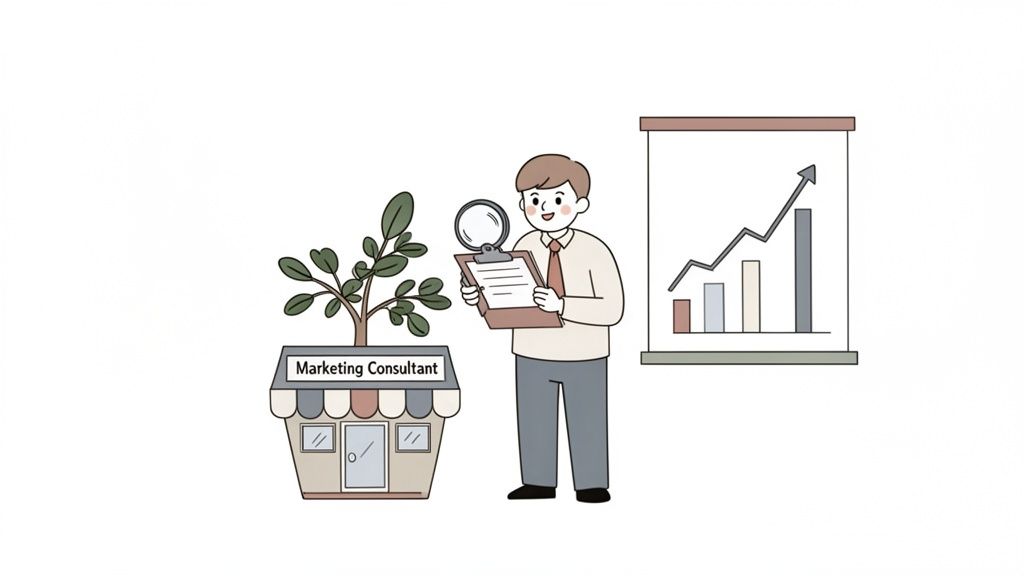

Most businesses eventually hit a wall where growth stalls or the old marketing playbook stops working. This is precisely where a consultant shines. They provide an objective, outside perspective to figure out what’s working, what isn’t, and—most importantly—why.
Unlike an in-house marketing manager who is deep in the weeds with daily tasks, a consultant operates at a higher, strategic altitude. Their main job is to build a solid, data-driven marketing strategy that ties directly to your big-picture business goals, like boosting revenue or cracking into a new market.
What Does a Consultant Actually Focus On?
Their work goes beyond just creating ads or posting on social media. A great marketing consultant digs into the fundamental pain points holding your business back.
Their focus typically falls into a few key areas:
- Market Analysis: Sizing up the competition and finding untapped customer segments to give you a unique edge.
- Strategic Planning: Building a complete marketing roadmap that lays out your goals, channels, budget, and the KPIs you'll use to measure success.
- Brand Positioning: Sharpening your company’s message so it connects powerfully with the right audience.
- Systems and Process Improvement: Looking under the hood of your marketing operations to spot inefficiencies and suggest better tech or workflows.
This strategic guidance has become a massive engine for business growth. In the U.S. alone, the Marketing Consultants industry is worth $88.4 billion, a number that speaks volumes about its importance. The global market is also on a steep upward trajectory, as detailed in analyses from platforms like IBISWorld.
A great marketing consultant provides more than just recommendations; they deliver a clear, actionable blueprint for growth. They connect the dots between market trends, customer behavior, and your business goals to create a strategy that delivers measurable results.
For many growing companies, a consultant is a smart way to access executive-level expertise without the hefty price tag and long-term commitment of a full-time hire. This makes them a powerful ally for scaling your business with precision.
What a Marketing Consultant Actually Does
So, what does a marketing consultant really do day-to-day? Think of them as part business strategist, part growth catalyst. They don't just hand you a report and walk away; they dig in to translate your business goals into a clear, actionable marketing plan.
Their first step is always a deep dive into your business. A good consultant acts like a detective, piecing together clues from your market, competitors, and internal data. They analyze current performance and customer behavior to pinpoint exactly what’s preventing you from hitting that next level of growth.
From Diagnosis to Strategy Development
Once they have the full picture, the real work begins: building a strategy. This isn't a cookie-cutter template. It's a custom roadmap designed to get your business from where it is today to where you want it to be.
This strategic plan often includes:
- Market Research and Competitive Analysis: Sizing up the competition to find gaps in the market where you can win.
- Brand Positioning and Messaging: Sharpening your unique value proposition so it clicks with your ideal customers.
- Go-to-Market Strategy: Building a game plan for a new product launch or market entry, covering channels, budget, and tactics.
- Customer Journey Mapping: Walking in your customer's shoes to map out every interaction they have with your brand and improve the experience.
Executing for Measurable Business Outcomes
At the end of the day, a consultant’s value is measured by the results they deliver. Every recommendation they make is tied to a real business outcome. They provide expert guidance on everything from adapting your SEO for new search engine updates to building AI-driven campaigns and personalized customer journeys.
For example, a consultant can help you navigate shifting trends like the ones detailed by marketing trends at Salesforce.com to boost conversions, which can average 2.55% in paid search.
A consultant's true role is to be a catalyst for growth. They transform insights into actions that directly impact the bottom line, moving a business from a state of ambiguity to one of clarity and forward momentum.
They connect ideas to execution, making sure every marketing dollar is spent with purpose. The goal is always to impact core business metrics, such as:
- Lowering Customer Acquisition Costs (CAC): They optimize your channels and targeting so you can acquire new customers for less.
- Increasing Lead Quality: By refining your messaging and channels, they help attract prospects who are more likely to convert.
- Boosting Revenue: Ultimately, everything they do is about driving sustainable, profitable growth for your company.
Consultant vs. Agency vs. Fractional Executive
Picking the right marketing partner is a critical decision. Do you need a sharp strategist, an entire team for execution, or someone who can do both? Understanding the difference between a consultant, an agency, and a fractional executive is the first step.
Each model solves a different business pain point. A consultant is your go-to for targeted expertise on a specific challenge. An agency brings the muscle for execution. A fractional executive delivers the strategic leadership to tie it all together.
The Strategic Advisor: The Marketing Consultant
Think of a marketing consultant as a specialist you call for a diagnosis. You bring them in to solve a specific problem, map out a strategic plan, and offer expert guidance. They are masters of the "what" and the "why," handing you a high-level roadmap for your team to follow.
However, their role is almost always advisory. They build the brilliant strategy, but they aren't usually the ones in the trenches getting it done. This works great if you have an in-house team ready to implement the plan but need senior-level direction.
The Execution Powerhouse: The Marketing Agency
A marketing agency is essentially an outsourced marketing department. You hire them to do the work—running ad campaigns, managing social media, and handling the nitty-gritty of SEO. They bring a team of specialists, giving you the bandwidth and skills needed to execute on a broad scale.
Agencies are fantastic at carrying out well-defined tasks. The potential catch? They often operate at arm's length, which can sometimes create a disconnect with your company's internal culture or overarching business strategy.
The Integrated Leader: The Fractional Executive
Fractional leadership is a powerful hybrid, blending top-tier strategy with hands-on leadership. A fractional marketing executive, like a Fractional CMO, becomes a part-time member of your leadership team. They don’t just create the strategy—they own it, manage the team, and are accountable for the results.
This deep integration is what sets them apart. They learn the ins and outs of your business, ensure marketing is aligned with sales and product, and drive growth from the inside. This model is a game-changer for companies that need C-suite expertise but aren't ready for a full-time executive salary. You can explore the core responsibilities of a Fractional CMO to see how they operate.
Comparing Marketing Support Models
Here's a simple breakdown to help you decide which partner is right for you.
| Factor | Marketing Consultant | Marketing Agency | Fractional Executive |
|---|---|---|---|
| Primary Role | Strategic Advisor | Execution Team | Integrated Leader |
| Scope | Project-based, focused on strategy | Task-based, focused on execution | Holistic, strategy and oversight |
| Integration | External advisor | External partner | Part-time leadership team member |
| Accountability | Delivers a strategic plan | Completes assigned tasks/campaigns | Owns marketing outcomes and KPIs |
| Best For | Needing a specific strategy or audit | Needing a team to execute a plan | Needing leadership and strategy |
The right choice boils down to your most pressing pain point. If you have a plan but no one to run with it, an agency could be your answer. If you need a brilliant plan for a specific hurdle, a consultant is your go-to. But if you need someone to build the strategy, lead the team, and be accountable for growth, a fractional executive is the most effective path forward.
Five Signs Your Business Needs a Consultant
How do you know if it’s time to call in an expert? It often starts with a nagging feeling that something’s off. Growth has slowed, your campaigns feel stale, or you’re simply overwhelmed by the complexity of modern marketing.
Pinpointing that moment can be the difference between stagnating and hitting a massive growth spurt. While every business is different, some red flags are universal.
Here are five common pain points that signal it’s time to consider hiring a marketing consultant.
1. You've Hit a Growth Plateau
Your company was humming along, but now growth has stalled. The strategies that were your bread and butter no longer deliver, and your team is out of fresh ideas. It feels like you’ve hit an invisible ceiling.
A marketing consultant brings a fresh set of eyes. They can step back, analyze your entire marketing funnel, and diagnose the bottleneck. Their objective viewpoint is crucial for reigniting momentum when internal efforts have gone cold.
2. Your Marketing Efforts Lack a Cohesive Strategy
Are your marketing activities just a bunch of disconnected tactics? Maybe you’re running Google Ads, posting on social media, and sending email newsletters, but there’s no real plan tying it all together. This “random acts of marketing” approach rarely leads to sustainable growth.
A consultant’s core job is to build a comprehensive strategy that aligns every activity with your business goals, creating a cohesive engine for growth instead of a collection of disjointed parts.
When marketing feels chaotic and reactive, it's a sure sign you're missing a strategic foundation. A consultant brings the clarity and structure needed to turn that chaos into a predictable system for attracting and converting customers.
This decision tree can help you determine if you need a partner for strategy or one for hands-on execution.
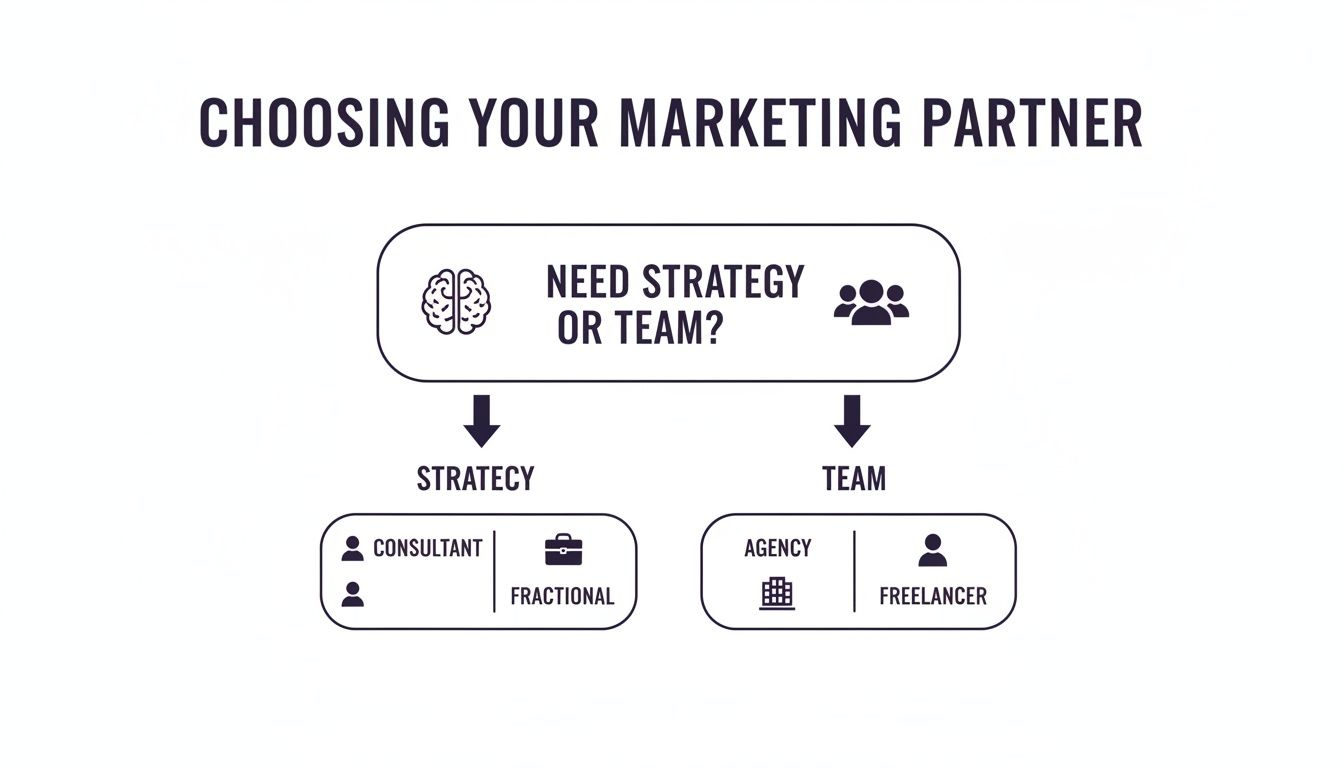

As the flowchart shows, the first question is whether you need high-level strategy or someone in the weeds getting things done.
3. You're Seeing Diminishing Returns on Your Ad Spend
You keep pumping money into paid ads, but your customer acquisition cost (CAC) is creeping up while your return on ad spend (ROAS) is shrinking. The campaigns that used to be profitable are now barely breaking even, and you're not sure why.
A consultant specializing in paid media can perform a deep audit of your campaigns. They’ll dig into your targeting, messaging, and creative to pinpoint inefficiencies and get your budget working smarter.
4. You're Preparing for a Major Launch or Expansion
Launching a new product or entering a new market are high-stakes moments. If you get the go-to-market strategy wrong, it can be disastrous. You're taking a huge risk if your internal team hasn't navigated this kind of launch before.
An experienced marketing consultant de-risks the process by developing a bulletproof launch plan. They bring invaluable experience from previous launches, helping you sidestep common pitfalls and position your new venture for maximum impact.
5. Your Team Lacks Specialized Expertise
Modern marketing demands a wide range of specialized skills: technical SEO, data analytics, conversion rate optimization (CRO), content strategy—the list goes on. It's unrealistic to expect a small in-house team to be experts in everything.
If a specific knowledge gap is holding you back, that’s a clear sign you need outside help. A consultant brings deep, focused expertise to the table, filling the gap and leveling up your team's capabilities in the process.
How to Find and Hire the Right Expert
Finding the right strategic partner is a game-changer, but knowing where to start looking is the first hurdle. The best consultants are often found through trusted networks, not a quick Google search.
Start by asking for referrals from peers, mentors, or investors you respect. A firsthand recommendation from someone who has already seen a consultant in action can save you time and reduce the risk of a bad hire.
Beyond your personal network, marketplaces that vet their talent are an excellent resource. These platforms ensure you're connecting with high-caliber professionals whose skills have already been put under the microscope, dropping you right into a curated pool of experts.
Evaluating a Consultant's Track Record
Once you have a shortlist, it's time to dig into their past work. A strong portfolio is more than just a collage of logos; it should tell a clear story of tangible results.
When reviewing their experience, here's what to look for:
- Relevant Case Studies: Zero in on case studies from businesses that look like yours—similar size, industry, and challenges.
- Quantifiable Results: Vague claims like "increased brand awareness" should be a red flag. Look for hard numbers, like a 25% reduction in Customer Acquisition Cost (CAC) or a 40% increase in marketing-qualified leads.
- Clear Problem-Solving Process: A great case study walks you through the initial problem, the strategy they developed, the actions they took, and the measurable outcomes.
The most reliable predictor of a consultant's future success is their past performance. A history of delivering measurable, bottom-line results for businesses like yours is the clearest indicator they can do the same for you.
Asking the Right Interview Questions
The interview is your chance to understand their strategic thinking and cultural fit. Go beyond surface-level questions to understand how they solve problems.
Here are a few essential questions to ask:
- "Based on what you know about our business, what do you see as our single biggest marketing opportunity and our biggest threat?" This tests their preparation and strategic thinking from the start.
- "Walk me through a time a marketing strategy you developed didn't go as planned. What happened, and how did you pivot?" This reveals their honesty, resilience, and problem-solving skills when things get messy.
- "How do you measure the success of your engagements? What specific KPIs would you focus on for our business?" This ensures their focus is on business outcomes, not vanity metrics.
Hiring an expert is a major decision. To dive deeper, check out our guide on how to hire a Fractional CMO. A methodical approach is the surest way to find a partner who will move the needle for your business.
Measuring Success with a Marketing Consultant
How do you know if your investment in a marketing consultant is paying off? It all comes down to setting clear, measurable goals from day one. You have to agree on what "success" looks like and how you'll track it.
This alignment ensures you and your consultant are rowing in the same direction—towards sustainable growth, not just busywork.
Engagements are often structured as project-based fees for specific initiatives or monthly retainers for ongoing guidance.
Defining Your Key Performance Indicators
This is the most critical step. It’s easy to get distracted by "vanity metrics" like website traffic or social media followers. A great consultant will steer you toward the numbers that actually move the needle.
A consultant's value isn't measured by the volume of their activity but by the impact of their results. Focus on metrics that connect directly to revenue and profitability to ensure you're getting a real return on your investment.
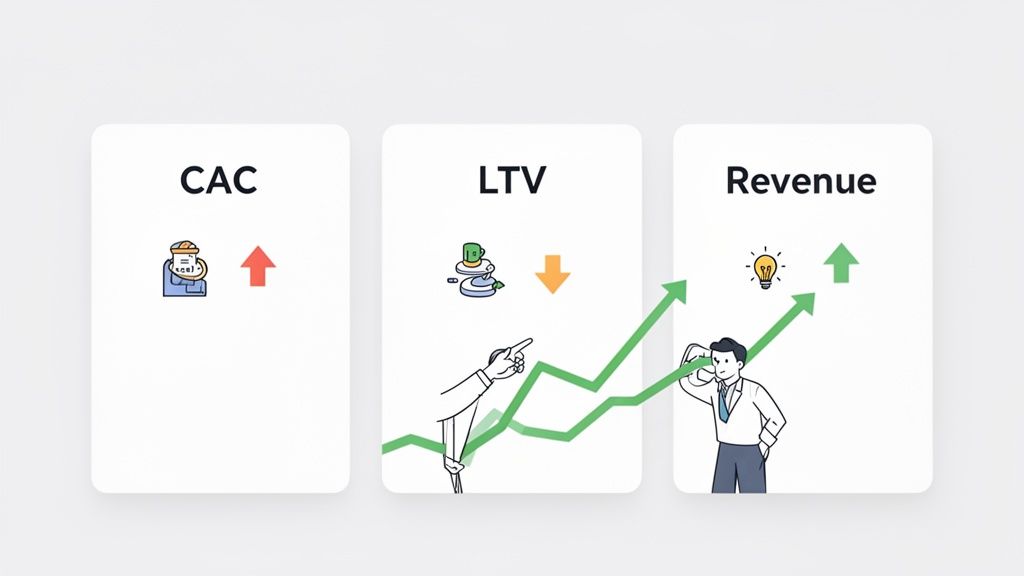
Anchor your measurement in business-critical KPIs. Here are the big ones:
- Customer Acquisition Cost (CAC): How much are you spending to get each new customer? A consultant's job is to drive this number down.
- Lifetime Value (LTV): What’s the total revenue you can expect from a single customer? The goal here is a steady, upward climb.
- Marketing-Attributed Revenue: How much cash in the bank can be directly tied to marketing campaigns? This is the ultimate proof of their financial impact.
A sharp consultant can make your marketing spend far more efficient, directly lowering your CAC. As the industry leans more into specialists, especially with the rise of AI in marketing, tracking these precise KPIs becomes non-negotiable.
To dig deeper into these crucial metrics, check out our guide on how to measure business growth.
Find the Right Strategic Partner for Your Business
Bringing on a marketing expert isn't just about filling a gap; it's a strategic investment in building a sustainable growth engine for your business.
Whether you need a consultant for a specific project or the integrated leadership of a fractional executive, the goal is the same: to transform your marketing from a cost center into a predictable revenue driver.
For many companies, fractional leadership is a game-changer. It blends the big-picture vision of a consultant with the hands-on execution and accountability of a C-suite leader, giving you the best of both worlds without the full-time cost.
Take the Next Step with Confidence
If the business pain points we covered hit close to home, it might be time to find an expert partner. Navigating the world of consultants and fractional leaders can feel overwhelming, but connecting with the right person can completely change your company's trajectory. The key is finding a vetted professional with a proven track record of solving the exact problems you're facing today.
Investing in strategic marketing leadership isn't just another expense—it's a direct path to increasing your company's value. The right expert doesn't just run campaigns; they build the systems and strategies that fuel profitable growth for years to come.
Ready to find the strategic leadership your business deserves? At Shiny, we connect you with a curated network of vetted, on-demand marketing executives. Explore our services and schedule a consultation to see how the right expert can help you achieve your most ambitious growth goals.
Find your fractional executive today.