A Practical Guide to Financial Planning for Small Business
Financial planning is much more than bookkeeping. It’s the strategic process of creating a roadmap for your money, guiding your business toward its most important goals. Think of it as the compass that helps you make confident decisions, drive sustainable growth, and build long-term stability.
This guide isn't just about spreadsheets; it's about transforming your finances from a source of stress into your most powerful asset for growth.
Why a Financial Plan Is Your Most Critical Growth Engine
As a small business owner, you're juggling a dozen different things at once. It's easy for "strategic financial planning" to get pushed to the bottom of the list, filed under "I'll deal with it later."
But putting it off is like captaining a ship without a map. You might stay afloat for a while, but you’re navigating blind—reacting to problems instead of proactively charting a course toward your destination.
A real financial plan changes everything. It’s not about obsessing over past transactions; it’s about using that history to build a clear, actionable roadmap for the future. It gives you the clarity to answer critical questions with confidence. Should you hire that new salesperson? Can you afford to invest in that new equipment? Is now the right time to expand?
Before we dive into the how, let's get a clear picture of the core components we'll be building. Think of these as the essential pillars of your financial strategy.
Core Components of a Small Business Financial Plan
| Component | What It Is | Why It Matters for Growth |
|---|---|---|
| Budgeting | A detailed plan outlining your expected income and expenses over a specific period. | Puts guardrails on your spending, ensures profitability, and helps allocate resources to growth initiatives. |
| Financial Forecasting | The practice of projecting future revenue, expenses, and cash flow based on historical data and market trends. | Allows you to anticipate challenges, spot opportunities, and make proactive decisions instead of reactive ones. |
| Cash-Flow Management | The process of monitoring, analyzing, and optimizing your net cash flow. | Keeps the business running smoothly day-to-day and prevents a cash crunch, which is a leading cause of failure. |
| Financing Strategy | Your plan for securing capital to fund operations, expansion, or investments. | Ensures you have the fuel you need to scale at the right moments, whether through debt, equity, or bootstrapping. |
| Metrics & KPIs | The key numbers you track to measure the financial health and performance of your business. | Gives you a real-time pulse on your business, highlighting what's working and what isn't so you can adjust course. |
This table gives you a bird's-eye view of where we're headed. Each of these components works together to create a comprehensive financial picture that empowers you to lead with confidence.
The Reality for Most Entrepreneurs
Let’s be honest: most founders are not financial experts. This isn't a knock on your skills; it's just the reality for passionate entrepreneurs focused on building a great product or service. But this knowledge gap can create serious risks.
A recent QuickBooks survey reveals that a staggering 84% of new business owners are learning finances on the fly. Even more telling, 42% admitted to having limited or no financial literacy before starting their business.
This becomes a critical vulnerability when the economy gets shaky. The MetLife and U.S. Chamber of Commerce Small Business Index recently showed that revenue concerns spiked to 35%, a 10-point jump and the highest level seen since 2021. You can explore more about these financial literacy gaps among business owners to see the broader picture.
The data is clear: passion is essential, but it isn't enough. Without a solid grasp of your numbers, you're forced to make mission-critical decisions based on gut feelings instead of data.
Gaining a Strategic Advantage Without the Executive Price Tag
Many business owners assume that getting this level of financial control means hiring a full-time, six-figure executive. For a growing business, that’s often an impossible expense.
The good news? You don't need a full-time Chief Financial Officer on your payroll to gain that strategic edge.
Financial planning isn't an administrative chore; it's the engine of strategic growth. It transforms your financial data from a historical record into a forward-looking guide that helps you not just survive, but actively thrive.
The key is shifting your mindset from reactive bookkeeping to proactive financial strategy. When you do that, your numbers become your most powerful tool. This guide will show you how to build that foundation, setting the stage for smarter growth.
Building Your Financial Foundation with Budgets and Forecasts
It's time to roll up your sleeves and move from theory to action. This is where you build the tools that will guide your decisions: your budget and your forecast.
Think of it this way: a budget is your operational playbook, and a forecast is your strategic compass. They aren't just dusty spreadsheets; they're the active, living documents that shape your company's future.
Crafting a Meaningful Operating Budget
A budget isn't a list of restrictions—it's your plan for intentionally allocating resources. For businesses in the $1M-$50M revenue range, this starts with a deep dive into your past financial statements to uncover the real story behind the numbers.
- Pinpoint revenue drivers: Is one product line carrying the team? Is a particular sales channel outperforming others?
- Identify hidden cost centers: Are you burning cash on unused software? Is your customer acquisition cost for one channel secretly spiraling out of control?
Once you have these insights, you can build an operating budget that's both grounded in reality and ambitious. A great budget enforces discipline by setting clear spending limits and enables growth by funneling funds into areas with the biggest returns.
A budget shouldn't feel like a financial straitjacket. It's an empowerment tool. It gives you and your team the clarity to spend confidently on the things that matter.
Financial planning takes your business on a journey from uncertainty to clarity, and finally, to sustainable growth.
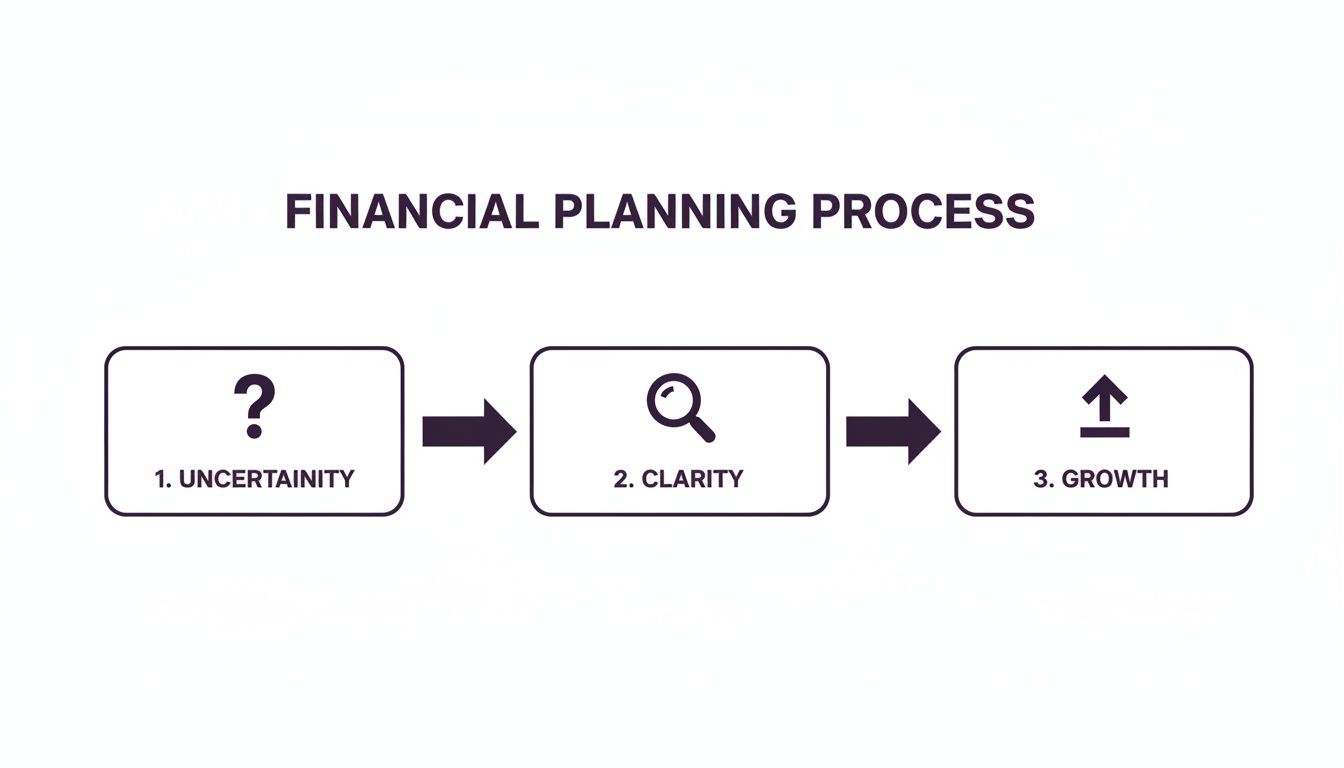
This process turns unknown variables into a clear strategic advantage that fuels expansion.
Demystifying Financial Forecasting
If budgeting sets the plan, forecasting anticipates the future. Instead of creating one rigid projection, the smart move is to build a few different scenarios.
- Conservative Scenario: Your "what if things go south?" model. Think higher customer churn or a market downturn. It’s your defensive plan.
- Realistic Scenario: Your most likely path, based on historical trends. This is your baseline for operational planning.
- Optimistic Scenario: Your "best-case" vision. What happens if a new marketing campaign takes off or a key competitor stumbles?
By building these versions, you prepare for a range of possibilities and are never caught completely flat-footed. We get into the weeds on this in our guide to financial forecasting for startups, which shows you how to build these actionable models.
A Practical Forecasting Example
Imagine a SaaS company looking to grow its Annual Recurring Revenue (ARR). A static forecast is useless, but a dynamic one is a game-changer.
The leadership team can model the impact of different variables to see how they affect year-end ARR. They can ask powerful questions:
- What happens to our ARR if we knock customer churn down by just 1%?
- How does our revenue projection shift if we increase our average contract value by $500?
- If we invest an extra $20,000 in marketing, what conversion rate do we need for a positive ROI?
Suddenly, forecasting isn't a passive report—it's an active decision-making tool. It lets you see the potential ripple effects of your choices before you commit a single dollar. This is how confident growth is built.
Mastering Cash Flow: The Lifeblood of Your Business
Profit is fantastic, but cash is what pays the bills. It makes payroll, keeps the lights on, and funds your next big move.
Think of it this way: profit is like food, and cash is like air. Your business can survive for a while without food, but it can’t last more than a few minutes without air. This is the heart of cash flow management—the day-to-day discipline of watching every dollar that comes in and every dollar that goes out.

Accelerating Your Cash Inflows
One of the fastest ways to improve your cash position is to shorten your cash conversion cycle. Even tiny tweaks to invoicing can have a massive impact.
- Invoice Immediately. Don't wait until the end of the month. Bill clients the moment a project is done or a product ships. Every day you delay is an interest-free loan.
- Offer Early-Payment Discounts. A simple "2/10, net 30" term (a 2% discount if paid in 10 days) nudges clients to prioritize your bill.
- Automate Your Reminders. Use your accounting software to set up automated email reminders. This professional, persistent follow-up does the chasing for you.
Strategically Managing Your Cash Outflows
Just as important as speeding up inflows is being smart about your outflows. This isn't about being cheap; it's about timing your payments to align with your revenue.
For instance, try negotiating better payment terms with vendors. Asking to move from a Net 30 to a Net 60 term with a key supplier could give you an entire extra month of float—a lifeline during a slow sales month.
The Power of the 13-Week Cash Flow Forecast
While annual forecasts are great for big-picture strategy, the 13-week cash flow forecast is the ultimate tactical tool. It gives you a rolling, week-by-week snapshot of every dollar coming in and going out.
This short-term forecast is your early warning system. It provides the granular visibility you need to spot a potential cash crunch weeks in advance, giving you plenty of time to react.
This detailed view allows you to make confident decisions about hiring or expansion, knowing you have the operational stability to support those moves. For a growing company, that foresight is a game-changer.
Most entrepreneurs are optimistic. A recent Bank of America report found that 74% of small and mid-sized business owners expect revenue to increase. But that growth comes with risk. You can read more about the business owner outlook and see how it ties into financial strategy.
How to Secure Smart Financing and Manage Debt
"Debt" can feel like a heavy word, but we need to reframe it. Used the right way, debt isn’t a sign of failure—it’s a powerful tool to accelerate your growth. It lets you jump on opportunities you’d otherwise have to miss.
Think about it this way: if you could borrow a dollar today and confidently turn it into two dollars tomorrow, you’d do it all day long. That’s the heart of strategic debt.
Navigating Your Financing Options
Not all debt is the same. The right financing for a manufacturing company buying machinery is different from what a SaaS startup needs to extend its runway.
Here are a few common paths businesses take when they need capital:
- Traditional Bank Loans & SBA Loans: Often the first stop for established businesses. They offer lower interest rates but come with strict requirements.
- Lines of Credit: A flexible option for managing short-term cash flow gaps. You get access to a revolving line of credit you can tap into as needed. It's a fantastic safety net.
- Venture Debt: Specifically for high-growth, venture-backed startups that might not be profitable yet. It's a way to get capital without giving up as much equity.
Preparing a Loan Application Lenders Will Actually Read
Getting a loan isn't just about a great credit score. Lenders want to see a clear, compelling story that proves you’re a responsible borrower.
They’re really looking for:
- A Detailed Financial Plan: Your budget, cash flow projections, and a crystal-clear explanation of how you'll use their money to generate a return.
- Strength of the Management Team: Lenders want to see an experienced, capable leadership team that knows how to execute.
- A Clear Repayment Strategy: You have to show exactly how growth translates into the cash needed to make loan payments.
Smart debt management is a critical skill. The Federal Reserve's Small Business Credit Survey found that nearly 40% of small businesses carry over $100,000 in debt. You can learn more about the current small business lending environment on Bankrate.com.
The Fractional Expert Advantage in Securing Capital
Trying to untangle the complexities of loan applications and term sheets is overwhelming when you’re also trying to run your business. This is where experienced financial leadership becomes a game-changer. An expert like a fractional CFO brings a massive advantage.
An experienced financial leader doesn't just help you fill out paperwork. They build the financial narrative lenders need to see, negotiate favorable terms, and ensure you secure the right capital without giving up too much control.
That kind of strategic guidance can be the difference between a rejection letter and the funding that unlocks your company's next growth spurt. They know what lenders want and how to present your business in the strongest possible light.
Why Fractional Leadership is the Smartest Financial Move You Can Make
We’ve dug into the "what" of financial planning—the budgets, forecasts, and cash flow systems that fuel growth. Now, let’s talk about the "who." Who is the expert you need to translate all that data into a winning game plan?
For a growing business, hiring a full-time Chief Financial Officer feels like a fantasy. The average CFO salary can rocket past $200,000 a year, plus bonuses and benefits. It’s a huge financial leap, especially when you may only need that high-level strategic guidance for a few hours a week.
This is where fractional leadership completely changes the game.

What Is a Fractional CFO?
A fractional CFO is an experienced, top-tier financial executive who joins your team on a part-time or contract basis. You get access to a world-class strategic mind for a "fraction" of the cost and commitment of a full-time hire.
A fractional CFO operates at the highest strategic level, focused on the future of your business. Their job is to turn your numbers into a clear, actionable roadmap for growth.
A fractional CFO delivers the strategic firepower of a seasoned executive without the crushing weight of a full-time salary. It’s about getting the right expertise at exactly the right time to accelerate your growth.
This model is a smart, flexible solution for ambitious businesses that need senior financial leadership to break through to the next level but aren't ready for a full-time executive payroll.
Full-Time vs. Fractional CFO: A Strategic Comparison
Understanding the difference is crucial. Let's break down how the two roles stack up.
| Aspect | Full-Time CFO | Fractional CFO |
|---|---|---|
| Cost | Six-figure salary plus benefits, equity, and bonuses. A major financial commitment. | A predictable monthly fee based on scope. No benefits, payroll taxes, or equity required. |
| Commitment | Long-term employment contract, making it a high-stakes hiring decision. | Flexible engagement, typically with a short-term contract that can be scaled up or down. |
| Focus | Handles both high-level strategy and day-to-day financial management. | Laser-focused on high-impact strategic initiatives like fundraising, forecasting, and M&A. |
| Experience | Expertise is often specific to one or two industries from their past roles. | Brings a broad perspective from working with multiple companies across various industries. |
| Onboarding | A lengthy process involving integration into company culture and politics. | Rapid deployment. They are hired to make an immediate impact on specific business challenges. |
Laying it out like this makes it obvious why the fractional model is such a powerful tool. You get the high-impact strategic guidance you need without the risk and overhead of a traditional executive hire.
A HealthTech Startup Case Study
Let's ground this in reality. Picture a brilliant HealthTech startup with an industry-changing product. The CEO is a visionary engineer, but the finances are a chaotic mess. They’re burning cash fast with no financial roadmap, and a make-or-break lender meeting is weeks away.
Hiring a full-time CFO is out of the question. Instead, they bring on a fractional CFO for just 10 hours a week.
The impact is immediate:
- Clarity from Chaos: The fractional CFO builds a dynamic financial model, a 13-week cash flow forecast, and a real operating budget. For the first time, the CEO has a clear view of their runway.
- Securing Capital: Armed with a professional, data-backed financial plan, the fractional CFO joins the CEO in the lender meeting. The result? The startup secures a crucial line of credit.
- Strategic Focus: With the financial foundation solid, the CEO is freed from late nights wrestling with Excel. They can now pour 100% of their energy into driving product innovation.
This isn’t just a textbook example; it’s the real-world impact of getting the right expertise at the right time. For this startup, a fractional CFO wasn’t a cost—it was the strategic investment that unlocked their next stage of growth.
Got Questions About Small Business Financial Planning?
Diving deep into your business's finances often sparks a lot of questions. As founders move from just keeping the books to actively planning for the future, certain themes pop up again and again. Let's tackle the most common ones.
How Often Should I Review My Financial Plan?
Your financial plan isn't a "set it and forget it" document. Its power comes from being relevant, which means giving it regular attention.
A solid review rhythm looks like this:
- Monthly Budget vs. Actuals: A non-negotiable check-in. Compare what you thought would happen with what actually happened. This is how you spot problems before they spiral.
- Weekly Cash Flow Check: Cash is king. A quick glance at your cash flow forecast every week is critical, especially if things are tight.
- Quarterly Strategic Review: Every three months, zoom out. Is your financial strategy still aligned with your long-term goals? This is when you make thoughtful adjustments.
Building this review cadence is one of the first things a good fractional CFO will do. It forces accountability and ensures you're always making decisions based on fresh, accurate data.
What Are the Most Common Financial Planning Mistakes?
Knowing where other founders have tripped up is the best way to avoid the same traps.
Here are the biggest pitfalls to watch out for:
- Confusing Profit with Cash: This is the number one killer of healthy businesses. Your income statement can show a profit, but if you don't have cash in the bank to pay bills, you're insolvent.
- Being Too Optimistic with Expenses: Every founder is an optimist, but that can be deadly in budgeting. Underestimating costs is a surefire way to create a cash crunch.
- Forgetting to Build a Cash Cushion: Every business needs a rainy-day fund. Aim for a cash reserve that can cover at least three to six months of essential operating expenses.
- Mixing Personal and Business Finances: It feels easier at the start, but it creates a massive mess. It obscures your company's true financial health and can put your personal assets on the line.
When Is the Right Time to Hire a Fractional CFO?
The answer is almost always "sooner than you think." Too many founders wait until they're in a crisis—a looming cash shortfall, a chaotic fundraising round—to seek expert help. The real value of a fractional CFO is building a strong financial foundation that prevents those crises.
Key triggers that scream "it's time" include:
- You're preparing to raise capital.
- You feel like you're flying blind with no clear visibility into your numbers.
- You're about to make a big move, like a major expansion or an acquisition.
- You realize you’re spending too much time on spreadsheets instead of growing the business.
Bringing on a fractional CFO isn't an expense. It's a strategic investment in your company's future, helping you scale faster and with more confidence.
Feeling like your finances are a black box, or just not sure how to build a plan that actually drives growth? You don’t have to go it alone. We connect you with vetted, experienced fractional executives who bring the strategic firepower you need for a fraction of the cost of a full-time hire. Schedule a consultation to see how the right financial partner can change the game for your business.