
A Founder’s Guide to Risk and Fraud Management
When you hear "risk and fraud management," what comes to mind? For many founders, it sounds like a roadblock—a cost center that slows down growth and adds friction. But what if it's not a brake pedal, but a high-performance handling system?
Think of it as the essential framework that lets you identify, assess, and navigate threats so you can scale safely. It’s not about avoiding speed; it’s about building the secure foundation needed to accelerate with confidence. For startups in fast-moving sectors like FinTech, SaaS, and Ecommerce, getting this right is non-negotiable.
Why Risk and Fraud Management Is Your Growth Superpower

Let’s stick with the race car analogy. Your startup is a finely tuned machine built for speed. Your product is the engine, your team is the fuel, but what about the roll cage and the fire suppression system?
These aren't features designed to slow you down. They’re the critical safety systems that empower a driver to push the car to its absolute limits, knowing they can handle sharp corners and unexpected hazards without a catastrophic crash.
That's risk and fraud management in a nutshell. Too often, founders see it as a compliance checkbox. This view misses the point. A proactive fraud strategy gives you the stability and control to scale aggressively, enter new markets, and launch products without spinning out.
The Real Cost of Driving Without Protection
Trying to scale without a solid risk framework is like entering a Formula 1 race in a streetcar. You might hang on for a lap or two, but a disaster is just around the corner. The consequences go way beyond a few bad transactions. Every ambitious founder needs to grasp these real-world impacts:
- Significant Revenue Leakage: Every dollar lost to fraud actually costs businesses up to four times that amount once you add in chargeback fees, operational overhead, and lost inventory.
- Erosion of Customer Trust: A single security breach can shatter the trust you’ve worked so hard to build, sending customers straight to your competitors.
- Operational Chaos: Without clear protocols, your team is constantly scrambling to put out fires. This pulls precious time and energy away from what really matters—product development and customer acquisition.
A well-designed risk management strategy does more than just stop bad actors; it builds a resilient operational backbone that supports sustainable growth. It transforms risk from a liability into a competitive advantage.
Enabling Speed and Scale Securely
When done right, effective risk and fraud management lets you focus on winning the race. It allows you to onboard legitimate customers smoothly, approve valid transactions in a flash, and expand your business with a safety net firmly in place.
Getting a handle on different risk management strategies is the first step toward building this crucial capability. For today's founders, it's a non-negotiable part of the playbook.
Decoding the Modern Startup Threat Landscape
To build a strong defense, you first have to understand the enemy. For a growing startup, the world of fraud is a lot more than just stolen credit cards. It’s a complex, fast-moving environment where criminals are getting smarter by the day.
Think of your business as a digital vault. In the old days, criminals needed a crowbar. Today, they're masters of disguise, using social engineering and digital impersonation to trick you or your customers into handing over the keys. This demands a proactive approach to risk and fraud management.
The Four Horsemen of Modern Fraud
While threats are endless, a few key types consistently plague growth-stage companies. Getting a handle on these is the first step toward building a real defense.
-
Authorized Push Payment (APP) Fraud: A scammer tricks a customer into sending them money directly. Picture a fraudster posing as your support team, convincing a user to "update" their payment details by sending money to a fraudulent account. The transaction looks legitimate, making it tough to catch.
-
Account Takeover (ATO) Fraud: Criminals use stolen credentials from data breaches or phishing scams to log into a legitimate user's account, lock them out, and go on a spending spree. For your business, this is a trust-killer.
-
Synthetic Identity Fraud: Fraudsters mix real and fake information (like a real Social Security number with a fake name) to create a new, “synthetic” identity. They build a credit history for this phantom person before maxing out credit lines and vanishing.
-
Friendly Fraud (Chargeback Abuse): A real customer buys something, then disputes the charge with their bank, claiming it was fraudulent or the item never arrived. Many are deliberate attempts to get something for free, draining your bottom line.
The Burden is Shifting
The fight against fraud is getting more intense, and new regulations are putting the responsibility squarely on businesses. We’re seeing financial institutions aggressively adopt AI and share intelligence to fight back, especially as "failure to prevent" rules shift the legal burden from the victim to the company.
A recent report found that 60% of organizations saw an increase in fraud attempts. This means if you’re not actively preventing fraud, you're not just losing money—you could be found liable. You can dig into the data behind these emerging fraud prevention trends and global standards.
In this new environment, simply reacting to fraud after it happens is a losing strategy. Proactive risk and fraud management isn’t just a nice-to-have; it's a core requirement for survival and growth.
Understanding this landscape is your first critical task. Each type of fraud pokes at different holes in your process. Once you identify which threats pose the biggest risk to your business model, you can start building a defense that actually works.
Building Your First Line of Defense
Once you've sized up the threats, it’s time to build your fortress. A foundational risk and fraud management framework isn’t about erecting impenetrable walls overnight. Think of it more like installing a smart, layered security system for your business—one that can grow and adapt alongside you.
This involves a few critical stages, from identifying your weak points to actively monitoring for suspicious activity. Creating this blueprint gives your company a solid defense that doesn't demand a massive internal team from day one.
Identifying and Assessing Your Unique Vulnerabilities
Every business has its own risk profile. A SaaS company will face different primary threats than an ecommerce marketplace. The first job is to pinpoint where you’re most exposed.
Start by mapping out every touchpoint where fraud could happen—from new account creation and login portals to payment processing. Once you have your list, assess each risk based on its potential impact and the likelihood of it happening.
This process flow shows how fraudsters often string together their attacks, highlighting key stages where vulnerabilities pop up.
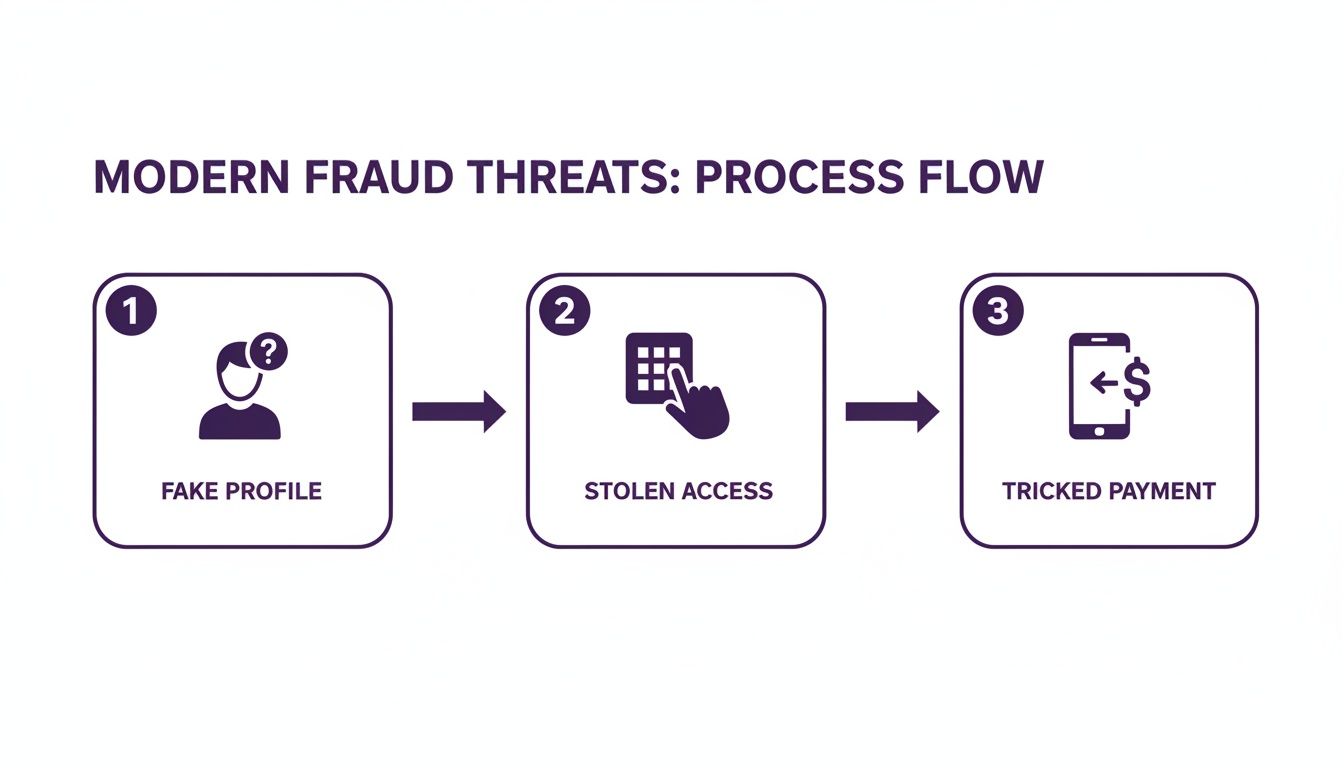
As you can see, seemingly separate events can chain together to result in a fraudulent payment. This underscores the need for defenses at multiple stages of the customer journey. A well-structured framework is your playbook for managing these risks.
Key Components of a Fraud Prevention Framework
| Framework Component | Objective | Key Activities & Tools |
|---|---|---|
| Risk Identification & Assessment | Pinpoint and prioritize potential fraud vulnerabilities specific to the business model. | Conduct risk workshops, map customer journeys, analyze historical data, and use risk assessment matrices (likelihood vs. impact). |
| Prevention & Controls | Proactively block fraudulent activities before they cause damage. | Implement multi-factor authentication (MFA), Address Verification Service (AVS), CVV checks, biometric verification, and device fingerprinting. |
| Detection & Monitoring | Identify suspicious activities that bypass initial prevention measures in real-time. | Use AI/ML models for real-time transaction scoring, set up rule-based alerts for unusual patterns, and conduct velocity checks. |
| Response & Investigation | Quickly contain, investigate, and resolve flagged incidents to minimize losses. | Establish manual review queues, create incident response playbooks, and manage chargeback representment processes. |
| Reporting & Optimization | Measure the effectiveness of the fraud program and continuously improve it based on data. | Track Key Performance Indicators (KPIs) like chargeback rates and false positive ratios; conduct regular performance reviews and model tuning. |
Each of these components works together, creating a comprehensive system that protects your business from multiple angles.
Establishing Robust Prevention Strategies
With a clear picture of your risks, you can start setting up your automated defenses. An effective strategy is always multi-layered, blending smart policies with the right technology.
Here are a few essential prevention tools:
- AI-Driven Fraud Models: These systems analyze hundreds of data points in real-time—like user location and purchase history—to generate a risk score for every transaction, automatically blocking high-risk activities.
- Biometric Verification: Using tools like facial recognition or fingerprint scans adds a powerful, modern layer of security, especially during onboarding or for high-value transactions.
- Address Verification Service (AVS) & CVV Checks: These are the bread and butter of card-not-present transaction security. While not foolproof alone, they are essential for weeding out basic fraud attempts.
Implementing Smart Detection Mechanisms
No prevention system is perfect. Some fraud will slip through. That’s where your detection mechanisms come in—the alarm bells that alert you to suspicious behavior.
Your goal isn't to eliminate risk entirely—that's impossible. It's to manage it intelligently, creating a system where the cost for a fraudster to succeed far outweighs the reward.
Detection is all about continuous monitoring. This might mean setting up rules that flag unusual transaction patterns, like a customer suddenly making large purchases from a new location. It also means having a clear manual review process. For instance, you can learn more about how to automate your startup's receivables management to streamline financial oversight.
Successfully building out this defense is a mix of technology, strategy, and expertise. A fractional executive with deep experience in risk and fraud management can provide the strategic direction needed to select the right tools and build a framework that prepares your business for tomorrow's challenges.
The Escalating Cost of Inaction
What’s the real price of putting a proper risk and fraud management strategy on the back burner? It's an immediate and compounding tax on your growth, silently draining cash from your bottom line.
Ignoring fraud is like leaving your warehouse doors wide open overnight. You might get lucky for a bit, but sooner or later, someone will clean you out. The direct financial losses are just where the pain starts.
The Tangible Financial Drain
When fraud strikes, the initial hit is just the tip of the iceberg. For every dollar lost directly to fraud, businesses can lose up to four times that amount when you factor in all the associated costs.
Think about the domino effect of just one fraudulent transaction:
- Chargeback Fees: Banks slap you with fees for every customer dispute, win or lose.
- Lost Inventory: If you shipped a physical product, it's gone.
- Wasted Shipping Costs: The money you spent sending that product to a scammer is another sunk cost.
- Operational Overhead: Your team's precious time gets hijacked to investigate claims and manage the fallout.
These costs pile up frighteningly fast, putting a chokehold on your cash flow.
Reputational Damage and Lost Trust
Often, the most severe damage is the erosion of customer trust. A single security breach or a wave of account takeovers can permanently tarnish your brand. In today's market, trust is your most valuable currency.
The damage doesn't stop with customers. A company known for weak security will be met with skepticism from investors, partners, and top-tier talent. A major fraud incident can even put a funding round in jeopardy.
"Fraud isn't just a financial problem; it's a strategic one. It tells investors and customers that you haven't built the operational resilience needed to scale responsibly, putting your future valuation at risk."
The Hidden Operational Burnout
For a lean startup team, every hour is gold. Without proactive fraud management, your key people become full-time firefighters. Instead of building the product or driving growth, they're stuck in the weeds—manually reviewing transactions and calming angry users.
This constant reaction leads to employee burnout and grinds your growth engine to a halt. The scale of the problem is massive; recent FTC data shows consumer fraud losses shot past $12.5 billion in 2024, a staggering 25% jump from the year before. You can dig deeper into these 2025 financial fraud statistics and trends.
Ultimately, proactive risk and fraud management isn’t an expense; it’s an investment in efficiency, trust, and your company's long-term valuation. The right fractional leader can help you build this defense, ensuring your team stays focused on growth while an expert secures your foundation.
Leveraging Fractional Leadership for Expert Oversight
You get it. The stakes are high, but hiring a full-time, six-figure Chief Risk Officer (CRO) is often not in the cards for a growth-stage company. It’s a classic startup dilemma: you’re dealing with an enterprise-level problem without an enterprise-level budget.
This is where fractional leadership offers a competitive edge. The answer isn't to wait until you can afford a full-time exec. It’s to get that same top-tier expertise in a way that fits your scale right now.
Accessing a CRO’s Brain Without the Full-Time Cost
Imagine bringing on a seasoned executive for just 10-15 hours a week—someone who has built risk frameworks from the ground up at major companies. This is a genuine C-suite leader who becomes a part-time, integrated member of your team.
A fractional leader provides the strategic oversight that a busy founding team simply can't. Their job isn’t to manage daily tickets; it’s to architect the entire system.
Here's what that looks like in practice:
- Designing the Core Framework: They start by assessing your unique vulnerabilities to create a risk management strategy that’s aligned with your business goals.
- Picking the Right Tech Stack: An expert knows the landscape and can hand-pick the most effective and cost-efficient tools for your specific needs.
- Training and Mentoring Your Team: A fractional executive doesn’t just build systems; they build capability, training your existing team on best practices and emerging threats.
The fractional model is about impact, not hours. It delivers the strategic guidance of a seasoned executive precisely when you need it, ensuring your operational backbone is built to last.
This approach frees up founders to do what they do best: focus on product, customers, and growth, knowing an expert is building the scalable defenses your company needs to thrive.
Why On-Demand Expertise Is the Smartest Play
For a growing business, agility is everything. Your needs can change dramatically from one quarter to the next. The fractional leadership model is built for this reality, offering a flexibility a full-time hire can't match.
Think of it like an electrical dimmer versus an on/off switch. A fractional executive lets you dial their engagement up or down based on your current business needs.
- Early Stage: Your fractional leader might work 5-10 hours a week, focusing on foundational strategy.
- Growth Spurt: Launching a new product? You can scale their involvement to 20+ hours a week to manage the increased risk.
- Stable Operations: Once the framework is mature, you might dial their hours back to a purely advisory capacity.
This adaptability ensures you're never overpaying for expertise you aren't fully using. You get exactly what you need, when you need it, making it the most capital-efficient way to secure top-tier talent.
By bringing on a part-time expert, you aren't just filling a gap—you're making a strategic investment. You can learn more about how this model works by exploring our complete guide to fractional leadership. At Shiny, we connect founders with vetted, experienced executives who can build the robust risk and fraud management programs necessary for secure growth.
Building a Resilient Global Strategy
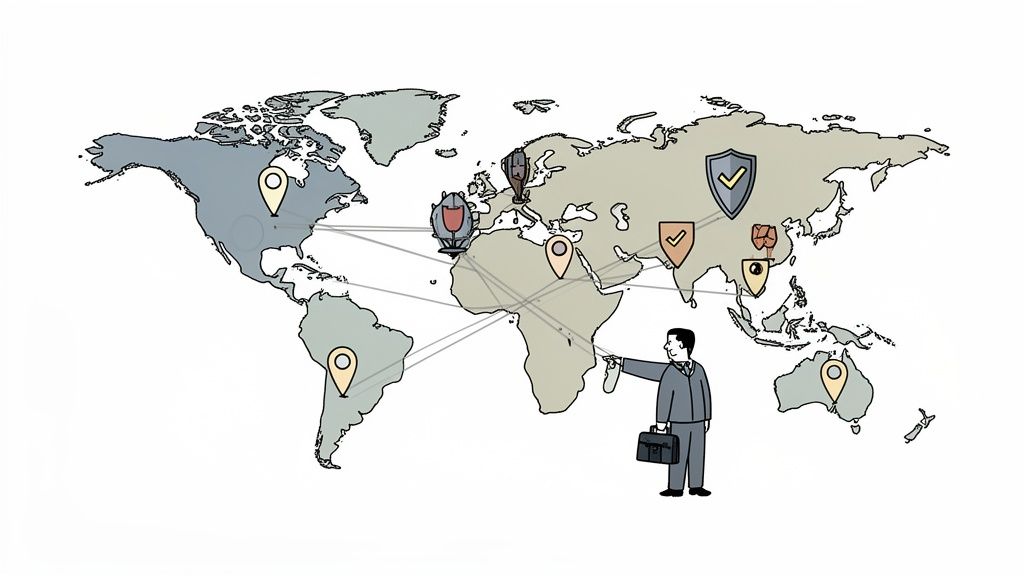
As your business crosses borders, your risk and fraud management strategy must keep pace. A one-size-fits-all approach doesn't work when dealing with different fraud trends, payment habits, and regulations.
This is a make-or-break reality for any company with global ambitions. The fraud patterns in Southeast Asia look nothing like those in North America. Trying to force a single set of rules everywhere is like trying to use one key to unlock a dozen different doors.
Adapting to Diverse Regional Threats
The goal is to build a strategy that's globally consistent but locally intelligent. This means understanding the specific challenges of each market to build a resilient and adaptable risk infrastructure.
An effective global strategy must include:
- Localized Payment Methods: Support the payment options people use in each region, and understand the unique fraud risks that come with them.
- Regional Threat Intelligence: Stay on top of specific fraud tactics trending in each country.
- Regulatory Compliance: Navigate a complex web of international rules, from GDPR in Europe to local data privacy laws everywhere else.
The 2025 Global Fraud Index found huge differences in fraud resilience across 112 countries, signaling that businesses must tailor their strategies to specific regional risks. You can get a deeper look into these global fraud variances and their impact.
Turning Global Complexity into a Competitive Edge
This is where a seasoned fractional executive with international experience becomes invaluable. They’ve seen these regional patterns before and know how to build a defense that respects local nuances while protecting the business.
A strong global risk strategy doesn't just prevent losses; it enables confident expansion. It allows you to enter new markets faster and more securely, turning a major operational headache into a competitive advantage.
With the right expert oversight, these global challenges become opportunities. By mastering international risk and fraud management, you can build an operational backbone that powers your global ambitions.
Common Questions on Startup Fraud Management
Diving into risk and fraud management can feel like a distraction when you're busy scaling. Founders often run into the same roadblocks. Let’s clear up the most common ones.
At What Stage Should My Startup Implement a Formal Fraud Program?
You should be thinking about risk from day one. But a formal program becomes critical the moment you start processing customer payments or handling sensitive user data.
Trying to bolt on a fraud strategy after you’ve hit a growth inflection point is like trying to install a sprinkler system while the building is on fire. It’s messy, expensive, and you’ll wish you had done it sooner. The sweet spot is right before a major growth spurt.
A fractional executive can help you build a program that's right-sized for today but designed to scale for tomorrow. This ensures you are prepared for success instead of just reacting to problems.
What Are the Most Important KPIs to Track?
If you can’t measure your fraud strategy, you can’t manage it. Focusing on a handful of core Key Performance Indicators (KPIs) gives you the clarity to make smart decisions. A good leader will help you set the right benchmarks.
For starters, keep your eyes on these four:
- Fraud Rate: Your north star. The number of fraudulent transactions divided by your total transactions.
- Chargeback Rate: Tracks how many transactions customers dispute. A high rate can get you in hot water with payment processors.
- False Positive Rate: How many legitimate customers are you accidentally blocking? A high rate here means you’re turning away real revenue.
- Manual Review Rate: A direct measure of your team's workload and operational efficiency.
How Does a Fractional Executive Help if We Already Have an Ops Team?
A fractional leader isn't here to replace your existing team; they’re here to make them more powerful. Your operations team is focused on the day-to-day grind, while a fractional executive provides the high-level strategic vision to elevate their work from reactive to resilient.
Think of it this way: your ops team is the skilled crew keeping the ship running. The fractional executive is the expert navigator charting the course through treacherous waters.
They design the overarching strategy, bring in the right tools, set up clear reporting dashboards, and mentor your team on emerging threats, making your entire operation smarter and more efficient.
Ready to build a world-class risk and fraud management strategy without the full-time executive cost? At Shiny, we connect you with a network of over 3,000 vetted fractional executives who can provide the expert oversight your startup needs to scale securely. Schedule a consultation to find your perfect match.