Talent Marketplace Explained: Models, Vetting and Costs
You know the scene. It's 9:40 on a Tuesday night, the cash forecast is open on the kitchen table, and you're rebuilding a spreadsheet nobody else understands because the board wants runway scenarios by Friday.
You run a 40-person company. Revenue crossed $8 million this year. You have a bookkeeper, an accountant who appears once a month, and no CFO. What you need is someone who has built a 13-week cash model at a company twice your size, for fifteen hours a month, for two quarters, and then steps away when the work is done.
That gap between a permanent seat and a defined piece of work is exactly the gap a talent marketplace fills. This guide covers how the model works, what each fee structure really means, how vetting should run, what fractional leadership costs, and how to judge whether the person you engage is producing anything. By the end you'll know whether this route fits your business or whether you should hire full time.
What a Talent Marketplace Is and How It Works
Say you decide not to hire. You go looking for fifteen hours a month of finance leadership and you land on a platform that lists people instead of jobs. What you're buying isn't someone's calendar. You're buying a match, a contract and a payment trail.
A talent marketplace is an online platform that matches an organization needing a specific skill with the people who offer it. It combines three things that used to be separate purchases: a vetted directory of people, a booking and contracting layer, and invoicing and payment.
The three parties in every match
- The buyer. The company with the need. In this case, you.
- The talent. The person offering the skill. A former CFO with two other clients is a typical profile.
- The platform operator. The company running vetting, matching and billing, which is what it charges for.
The closest everyday analogy is a ride-hailing app. You don't buy the car, maintain it or insure it. You pay for a trip with a defined start and end, and the app handles matching, price rules and payment. A talent marketplace works the same way with expertise instead of transport, and the scope of work takes the place of the destination.
Why this market got big enough to matter
This isn't a niche. McKinsey's research on independent work found that 20% to 30% of the working-age population in the United States and the EU-15, up to 162 million people, engaged in independent work. Most of them sold services rather than goods; only 2% to 3% of the working-age population sold goods. Roughly 70% to 75% of independent earners worked that way by preference, which tells you the supply is deliberate rather than forced.
Demand moved in the same direction. Teams that once wrote a job description now scan market supply first, and fresh workforce data for recruiting teams shows how that supply layer gets assembled and measured.

The one-line definition: a talent marketplace sells access to a skill for a defined scope and time, not a permanent seat on the org chart.
That distinction drives every decision that follows, from who pays the fee to how you measure the result.
Business Models Behind Talent Marketplaces
The fee structure tells you whose interests a platform is built to serve. Two platforms listing identical profiles can behave very differently depending on who gets charged and when.
| Model | Who pays | How the platform earns | Best fit |
|---|---|---|---|
| Placement fee | Hiring company | One-off fee when a hire is made | Permanent roles |
| Subscription | Companies or members | Recurring access fee | Teams that hire often |
| Success fee on a fractional engagement | Hiring company | Charged only if a fractional executive is hired | Founders testing fit |
| Freelancer commission | Talent | Share of billed hours or fees | Independent specialists |
| Internal marketplace | Employer's own budget | Internal cost allocation, no external fee | Large firms redeploying staff |
Three questions that settle most of it
- Who is charged? Buyer, talent, or both. A commission taken from the executive's rate reduces what the best people will accept, so the strongest profiles often sit on buyer-paid models.
- When is the fee due? Only when a hire happens, or on access regardless of outcome.
- How is work billed? Through the platform on hours or a retainer, or directly between you and the executive.
Take a 25-person SaaS company that needs one fractional CFO for two quarters. Under a success fee, it pays once when the engagement begins and nothing if the search goes nowhere. Under a monthly subscription, it keeps paying after the CFO leaves, which only makes sense if it expects to hire again soon.
Hybrid models are common, so read the schedule line by line. A platform might run a free buyer tier plus a commission from the executive, which shifts the cost invisibly into the rate you're quoted. If you're weighing this against bringing in contract staff through other channels, flexible staffing solutions covers where each route breaks down.
The takeaway is simple. A success-only structure ties the platform's revenue to your outcome, while a subscription rewards volume. If you'll hire once in two years, don't pay for access.
Benefits and Risks for Companies and Talent
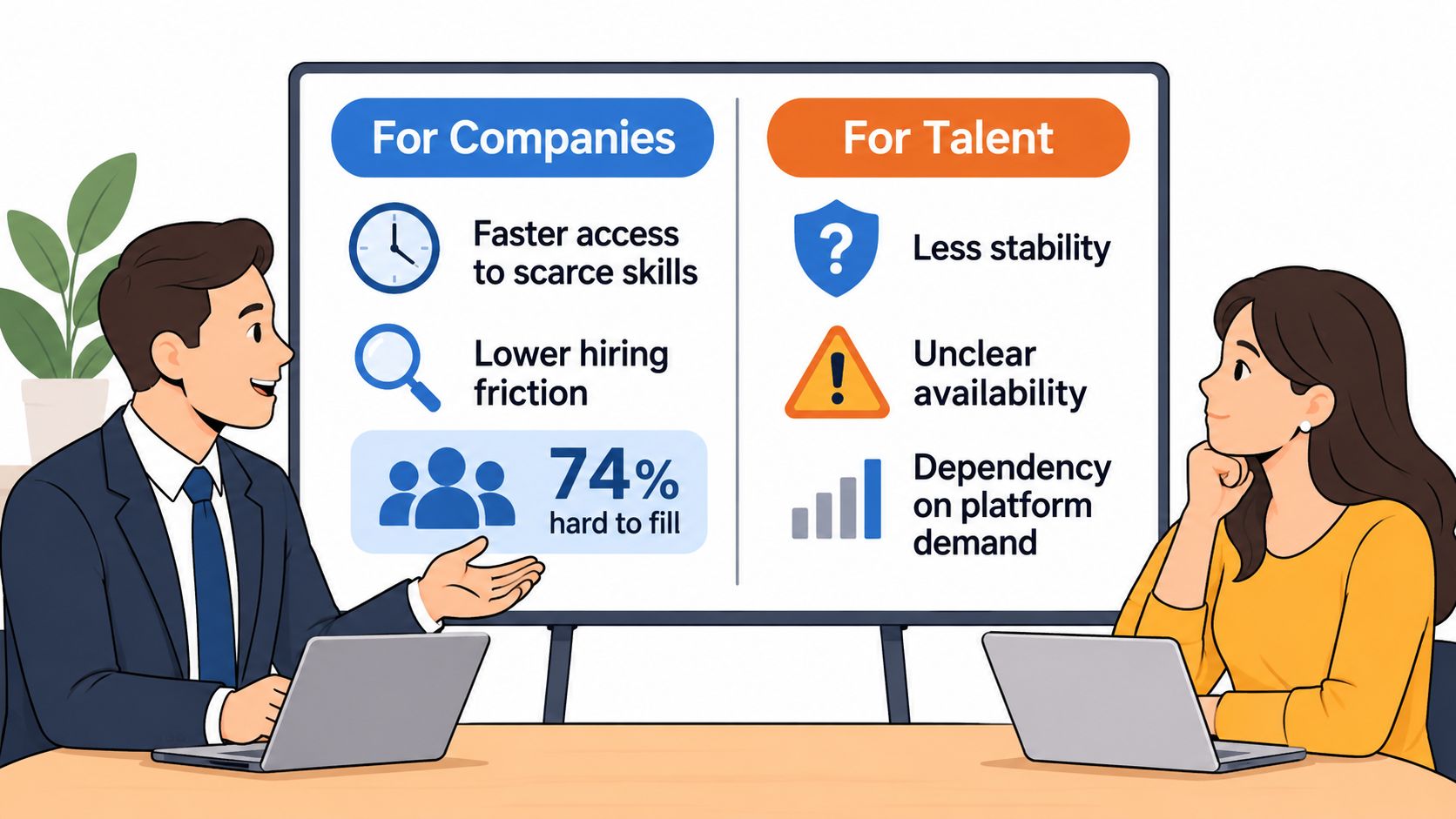
Skill shortages are the biggest barrier to business transformation for 63% of employers, according to the World Economic Forum's Future of Jobs 2025 report, which surveyed more than 1,000 employers across 55 economies. When the person you need doesn't exist on your payroll, you rent the capability instead.
Two owners weighing the same decision rarely write the same list. Here's the honest version of both.
Where the benefits land
- Scarce skills arrive faster. In 2024, 74% of employers across 41 countries reported difficulty filling roles, according to ManpowerGroup's Global Talent Shortage survey of 40,077 employers. A marketplace compresses the search from months to days.
- Geography stops limiting you. The best cash-flow specialist for a manufacturer in Ohio may live two time zones away.
- Commitment scales. Fifteen hours a month can become three days a week, then drop back.
- Payroll exposure shrinks. No benefits, no equipment, no idle salary in a slow quarter.
- Talent gains options. Several clients, variety, and the ability to decline work that doesn't fit.
Where the risks land
- Thin vetting hides a poor fit. A polished profile is not a reference check.
- Coordination overhead creeps in. A leader serving several clients answers email in batches, and your Tuesday question becomes Thursday's reply.
- Decision rights stay blurry. If the fractional CFO can't sign off on pricing changes, you've hired an analyst with a title.
- Platform dependence. You inherit the matching logic, including its blind spots.
- Talent carries its own risks. Uneven pay, vague scopes, and the admin load of juggling four agreements.
The scale analogy: benefits and risks sit on the same pan. What tips it is how clearly the scope and the vetting are defined before anyone signs.
One check decides most of it: a written 90-day outcome agreed before the engagement starts. Vague goals produce vague invoices. A single measurable target, signed by both sides, converts a hopeful arrangement into an accountable one.
How Marketplaces Source and Vet Talent
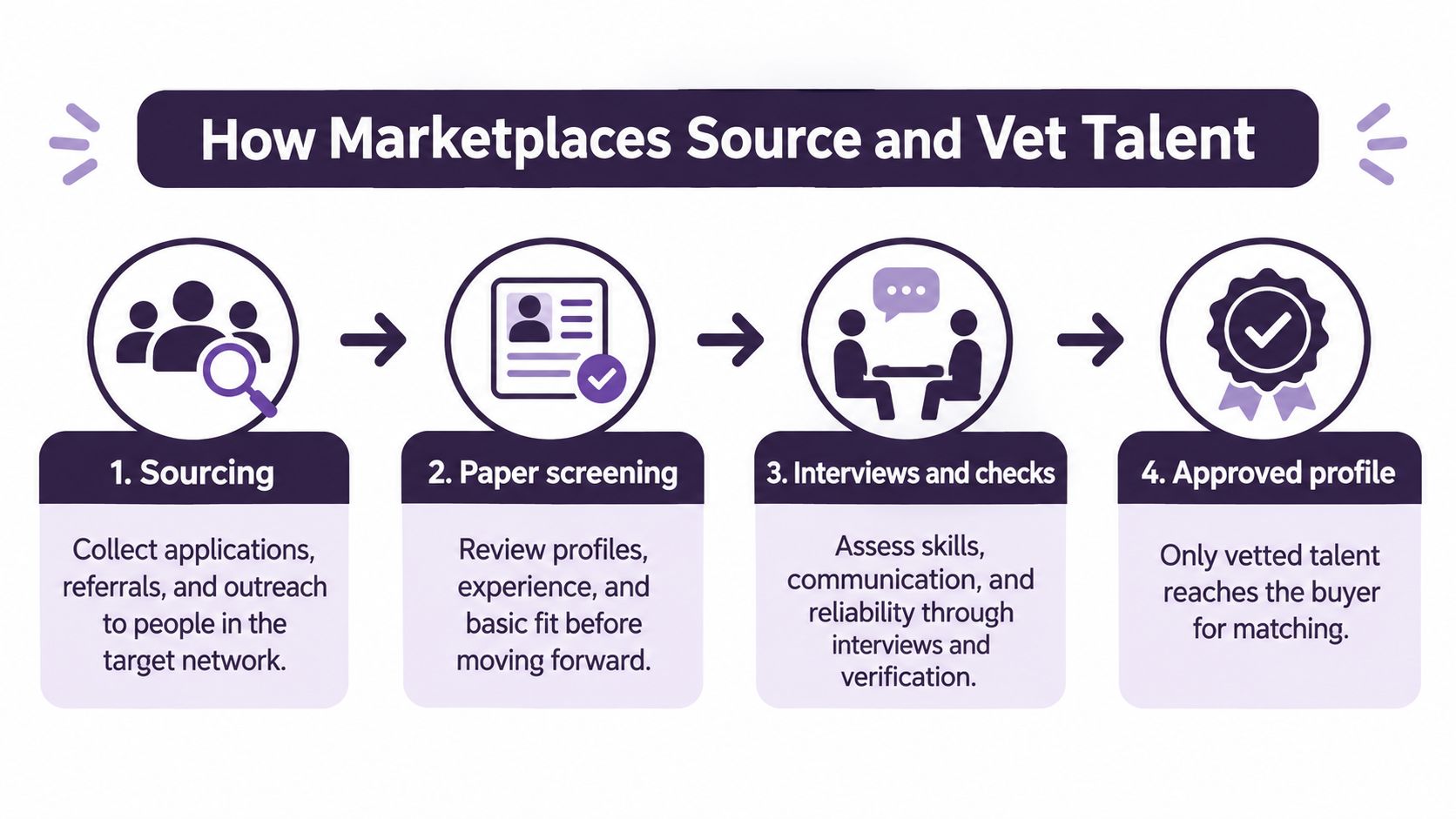
A shortlist is only as good as the filter behind it. For owners of $1M to $50M businesses, the useful question is which steps predict accountable leadership, and which steps only polish a profile.
- Sourcing. Applications, referrals and direct outreach into the target network. Referral-sourced executives behave differently from inbound applicants, because someone staked a reputation on them.
- Paper screening. Role history, company stage and functional scope get compared against the brief. A marketing leader from a 5,000-person enterprise can be wrong for a 40-person company.
- Phone interview. Operating style, availability and current client load. Ask how many engagements the person already carries.
- Skills or case check. A short plan on a real problem from your business. One page is enough to separate people who have done the work from people who have read about it.
- Reference checks. At least two past clients, and the question that matters is what went wrong.
- Matching. You define outcomes and constraints, the system proposes a shortlist, and executives rank the assignments they would accept.
- Trial scope. A defined 30 or 90-day project before any longer retainer. It limits both sides' exposure while producing real evidence.
Why fit and satisfaction pull in opposite directions
A large-organization study of internal talent markets found a measurable trade-off: the study of internal talent markets reports that firm-dictated assignments were 33% more valuable than random assignments within the same job categories, preference-based matching using deferred acceptance was only 5% better than random on the firm's productivity metric, and employees ranked those matches about 38 percentiles higher. Centralized matching exploits existing expertise when the platform holds strong data. Preference matching buys commitment. The practical hybrid is to collect structured data on outcomes, industry experience, availability and functional skills, let executives rank what they would accept, then override only where delivery risk or scarce expertise justifies it. For a fractional marketplace, that override is the difference between a fast placement and a cancelled one.
What to verify yourself
Stage experience matters as much as credentials. The startup executive hiring statistics report that roughly 30% to 35% of pre-Series-B go-to-market and product leaders leave within their first 18 months, with replacement cycles averaging four to six months, driven by cultural misalignment, thin startup experience and disagreements with founders. Vetting should test stage experience, functional scope, operating style and your current growth constraint; past titles alone are weak evidence.
Tie the trial to an outcome frame before interviews start: leading indicators such as weekly decisions cleared and forecast cycle time, lagging indicators such as cash visibility and margin reporting, plus named decision rights so coordination does not become a hidden tax. On Shiny, posting a fractional role is free, a job post can be matched with up to 15 executives, and companies pay only if they hire. Read any provider against the seven steps. If the process is a screening call and nothing more, treat the shortlist as a sourcing list. For a closer look at how senior interim searches are structured, see this guide to interim executive recruiting.
Fractional Executive Platforms in Real Situations
Fractional leadership works like hiring a seasoned chef to design a menu launch. You get the palate and the playbook without paying for a head chef to run the kitchen every night.
A 30-person ecommerce brand has a cash problem and no finance lead. It engages a fractional CFO two days a week for 90 days to rebuild forecasting, fix margin reporting and prepare a facility conversation. The owner names what the CFO owns, reviews progress against the brief, and at day 90 the work shifts to monthly reviews because the model got built. A bounded scope with a defined finish is what separates a productive engagement from an expensive standing meeting.
What fractional leadership costs
The mechanic is simple: you buy a defined number of senior hours instead of a full compensation package, benefits and idle capacity. Rates are quoted per engagement because they move with days per week, scope and how much of the function the executive owns. A lower hourly rate that drifts for a year usually costs more than a tighter scope finished in a quarter, so compare quotes against the deliverable, not the rate.
Platforms also differ in when they charge. Shiny lets companies sign up, submit a job post and request matching for free, and charges only when the company hires a fractional executive.
| Use case | Typical trigger | What the engagement should produce |
|---|---|---|
| Interim CFO, two days per week | Cash forecasting and fundraising preparation | A rebuilt forecast model and facility materials, then monthly reviews |
| Fractional CFO retainer | Ongoing financial oversight and reporting | A monthly close and reporting cadence the owner can read |
| Hourly interim executive | Short project or gap cover | One defined deliverable with an end date |
| Fractional marketing leader | Go-to-market plan and pipeline review | A documented plan plus pipeline reporting |
| Fractional technology leader | Product roadmap and engineering hiring | A prioritized roadmap and an engineering hiring plan |
| Fractional operations leader | Process redesign and vendor management | Documented processes and revised vendor terms |
Where the model doesn't fit
Skip fractional when the work is daily and continuous, when someone must permanently own a function and its team, or when decision rights stay undefined. A part-time executive adds coordination overhead by design: access has to be scheduled, and every decision routed to a named owner. Forcing a two-day-a-week arrangement onto a full-time problem produces friction and accountability gaps rather than progress.
The roles bought fractionally cluster in five areas: finance, marketing, technology, operations and human resources. Technology is the newest of the five, and strategic IT leadership for mid-market businesses sets out what a fractional CIO typically owns across roadmap, vendor contracts and security.
Waiting has a cost too. An open executive seat stalls the decisions that seat exists to make: pricing, hiring, spending. Searches run long, and the queue of postponed choices grows while they do.
The principle: match engagement length to the job, and define what the executive must produce before agreeing to the rate.
Measuring Whether Fractional Leadership Works
Most marketplace advice stops at matching, rates and speed to hire. Those are inputs. The question you ask is different: did the part-time executive change anything, and did the change consume more management time than it produced?
Two layers of evidence
Leading indicators appear inside the first 90 days and sit within the leader's control. Lagging indicators arrive later and respond to the market as much as to the person, so they can't be the only test.
| Indicator type | Examples | When to check |
|---|---|---|
| Leading | Completed 90-day operating plan | Day 30 and Day 90 |
| Leading | Forecast accuracy within 5% of actuals | Monthly |
| Leading | Qualified pipeline coverage, faster hiring, reduced cash burn | Monthly |
| Lagging | Revenue growth, profit | End of quarter, then at six and twelve months |
Say a 45-person software company engages a fractional marketing leader two days a week. The agreement sets one target: a documented go-to-market plan approved by day 45, with pipeline coverage visible by day 90. The owner reviews the plan at day 30, checks coverage monthly, and only then looks at revenue, which depends on sales execution and seasonality as much as on marketing.
Accountability check: name one owner for every decision in the engagement and agree on a weekly written update. If the leading indicators stall by day 60, change the scope or end the engagement.
That single rule prevents the most common failure, which isn't a weak executive. It's an engagement nobody defined, reviewed or ended.
Compare Providers and Decide the Engagement
Choosing a provider is really a choice about coordination cost. A cheap platform with a weak match can consume more management hours than a pricier one that reads the brief correctly the first time. Score each provider from one to three on vetting depth, matching method, pricing transparency, specialization, contract terms and speed to shortlist. Treat any red flag on pricing or vetting as disqualifying until the provider explains it in writing.
| Criterion | What good looks like | Red flag |
|---|---|---|
| Vetting depth | Several stages, including skills checks and references | Profiles only, with no defined vetting process |
| Matching method | Buyer-defined outcomes plus candidate input | Keyword search with no outcome brief |
| Pricing transparency | Fees shown before matching starts | Fees revealed only after a hire |
| Specialization | Clear coverage of functions and industries | Claims to cover every role equally well |
| Contract and exit terms | Defined notice period and scope-change process | Long minimum terms with no exit route |
| Speed to shortlist | Shortlist within days of the brief | No stated timeline |
Five questions to put to any provider
- What happens if the hire fails in the first 90 days?
- Which stages of your vetting process does every candidate complete, and where do most applicants drop out?
- What is the fee at each stage, and who pays it?
- How many clients does this executive serve at once?
- What reporting will I receive, and how often?
Capacity matters as much as skill. An executive carrying four concurrent clients will reply more slowly than one carrying two, so set response-time expectations up front rather than discovering the lag in week three. If you're assessing the supply side too, either as a buyer or as an executive joining a network, compare platforms for finding freelance work lays out how the major marketplaces differ on fees and contracts. Owners who want to model the full-time alternative can review fractional executive compensation before comparing it with a salary plus benefits.
From guide to decision
- Write one 90-day outcome in a sentence, such as a monthly close that lands by the tenth working day with variance notes.
- List the decisions the leader will own and those that stay with you, so accountability never sits between two people.
- Estimate the hours per week that outcome requires. Most defined projects land between five and twenty-five.
- Choose permanent, project-based or fractional based on whether the need is continuous, time-limited or uncertain.
- Shortlist with the criteria and the questions above, then ask for fees in writing.
Shiny is one option to run through that sheet. It operates a marketplace of vetted fractional executives, matches a job posting with up to 15 of them, and lets companies sign up and request matching for free, with payment due only if you hire. Put the same five questions to the platform and ask for every answer in writing.
The concrete next step: post your 90-day outcome and role requirements on Shiny. Posting is free and matching can start right away, so you can see a shortlist before committing to anything. Request the fee schedule in writing before matching begins, then hold whichever executive you choose to the outcome you wrote down in step one.
The right engagement has the clearest deliverables and the lowest management burden. The checklist above is how you find out before you sign.