Executive Equity Compensation: A Founder’s Guide
You're in the meeting when the offer starts to get real. The candidate has the title, the cash number is mostly settled, and then the conversation turns to equity. Everyone nods like they understand what the package means, but it's usually messier, because the grant looks generous on paper and still might be the wrong shape for your cap table, your hiring plan, or your eventual exit.
That's the part founders learn the hard way. Executive equity compensation is not a decorative add-on to salary, it's the mechanism that ties senior leaders to company value, keeps them through the hard middle, and can reshape ownership long before anyone talks about a liquidity event. If you get it right, the package helps recruit the right operator without creating a future clean-up project. If you get it wrong, you can over-dilute the company, under-incentivize the hire, or end up renegotiating from a weaker position later.
The First Equity Conversation Every Founder Has
The first serious equity conversation usually happens right at the edge of relief and panic. You've found someone who can finally fix the thing that has been slowing the company down, maybe sales, finance, marketing, or product, and now you're trying to translate role, risk, and upside into a package that feels credible on both sides.
A founder usually thinks in terms of total cost. The candidate thinks in terms of what the grant could be worth if the company works. Those are different lenses, and the gap between them is where most confusion starts. Equity is a promise about future ownership, future behavior, and future dilution.
Why the conversation gets tense so fast
The tension shows up quickly because founders usually know the cap table, but the candidate only sees the offer letter. One side is thinking about every share already spoken for, and the other is trying to judge whether the package justifies a move, a pay cut, or both.
That asymmetry matters because equity carries strategic weight. In major U.S. executive-pay datasets, the Economic Policy Institute reported that in 2023 the average realized CEO compensation of the largest U.S. firms was $22.2 million, and stock-related pay alone averaged $16.7 million, or 77.6% of total realized compensation. In the same study, the CEO-to-worker compensation ratio was 290-to-1 in 2023, up from 21-to-1 in 1965. Economic Policy Institute CEO pay in 2023
That does not mean a startup should copy public-company pay. It means founders should stop treating equity as a side topic. At the startup stage, the grant is often what makes the hire possible, especially for people who are betting on the company's trajectory more than today's cash.
Practical rule: if you can't explain the grant in one minute, you probably haven't settled what you're promising.
The best founder conversations are calm and specific. They cover what is being granted, when it vests, what happens if the person leaves, and how much dilution the company can tolerate. If you want a broader baseline on how these packages are framed, this overview of executive compensation is a useful reference point.
Understanding Executive Equity Compensation
At the simplest level, executive equity compensation means ownership-based pay granted to a senior leader. Instead of relying only on cash, the company gives the executive a stake whose value rises or falls with the business.
That ownership can take a few forms. The main thing is to understand the economics before memorizing the jargon. Equity works like a deferred promise, one whose value depends on what the company becomes, not just what it looks like today.
The four instruments founders see most
Stock options give the executive the right to buy shares later at a preset price, often called the strike price or exercise price. If the company value rises, the spread can become valuable. ISO and NSO are tax labels for different kinds of options, and the tax consequences differ.
Restricted stock units, or RSUs, are promises to deliver shares later, usually after vesting. They are simpler to explain, but they are also less common in very early companies because they work better when the company already has a more visible market value.
Stock appreciation rights, or SARs, let the executive benefit from value growth without directly buying the shares. They show up less often in founder-led startup hiring, but they are useful when a company wants economic upside without the same ownership mechanics as stock.
Founder shares are the stock issued to the people who started the company. They matter here because every new executive grant is measured against what founders already own, even when nobody says that out loud.
The core mechanics are easy to hold in your head once you name them. Grant size is how much is promised. Fair market value is the company's current value per share for tax and pricing purposes. Strike price is the amount the executive must pay to buy option shares. Vesting start date is when the clock begins.
For a broader primer on how these packages are framed in practice, what executive compensation covers in practice is a useful reference point.
A founder reading a grant should ask a simple question. What is being promised, what has to happen before it becomes real, and what does that promise do to the cap table if the hire stays and performs? Those are the questions that separate a clean offer from a vague one.
Equity is the part of the offer that forces the founder and the executive to answer the same question, what has to happen for this slice to become worth something?
How Vesting and Acceleration Work
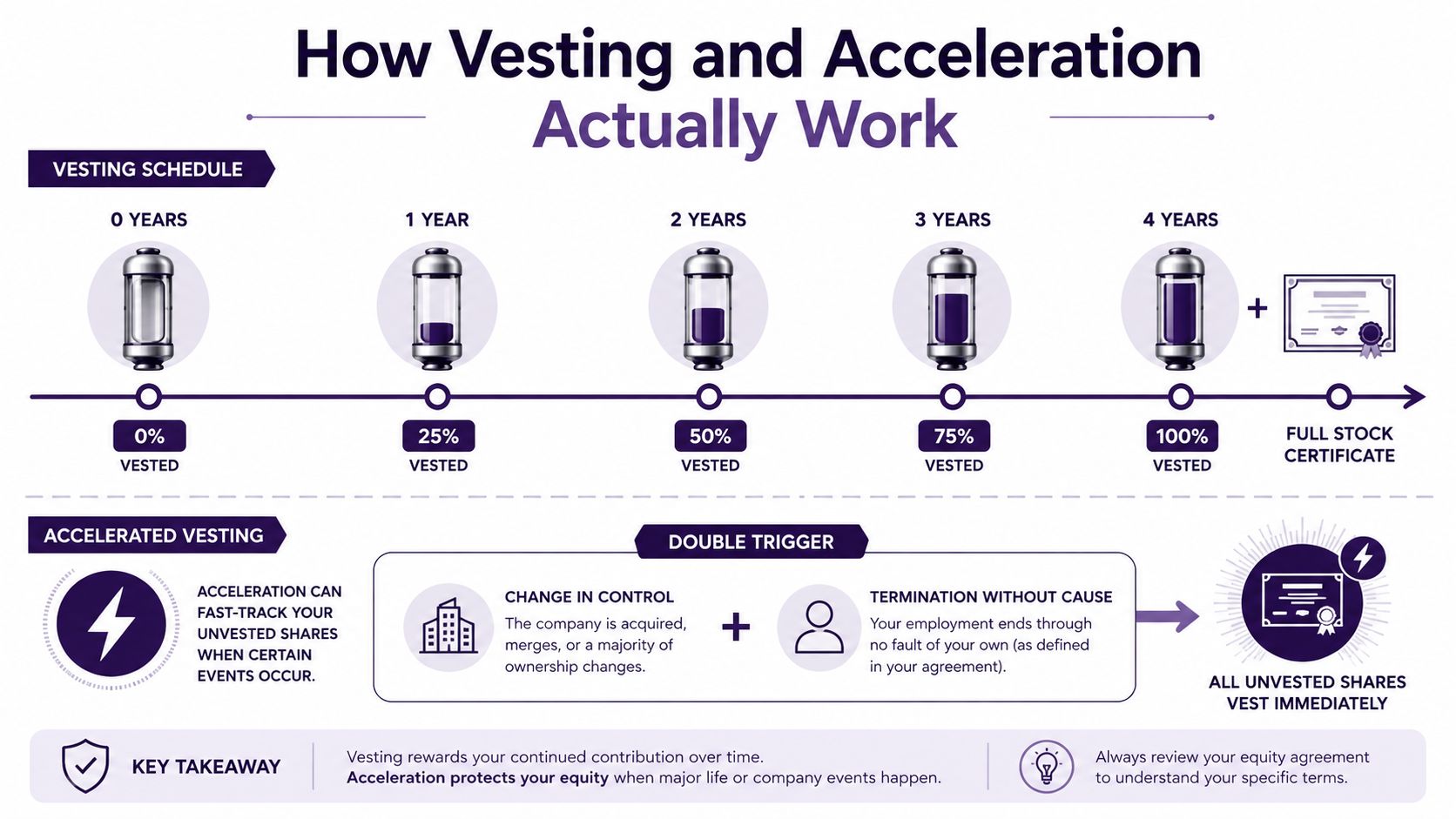
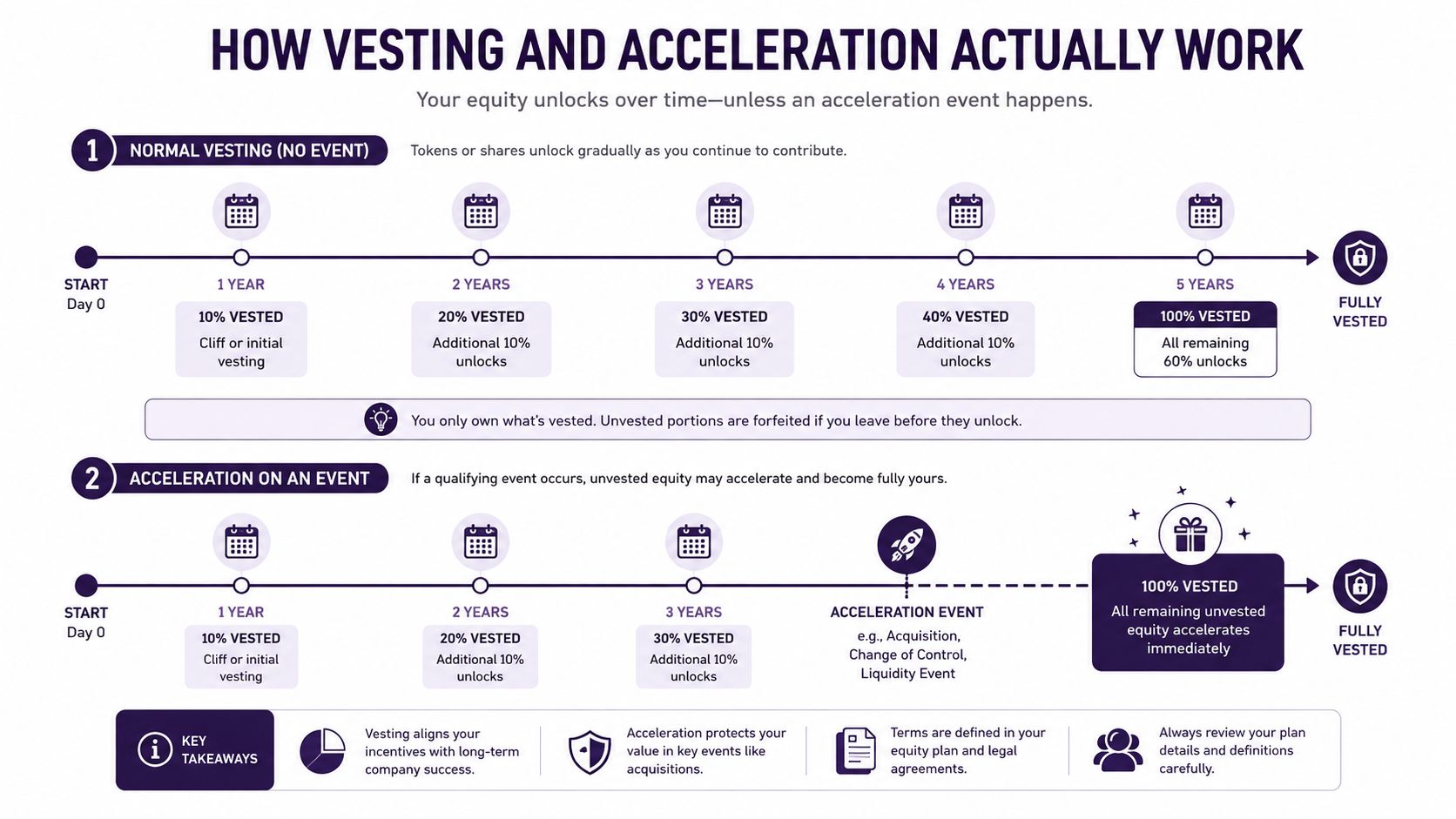
Vesting is where many good packages become meaningful and many weak packages stay weak. The executive does not fully own the award on day one. They earn it over time, which is why vesting exists at all.
A simple way to think about it is a time-release capsule. The value is there, but it does not all hit at once. That delay protects the company from handing over the full economics before the leader has stayed long enough to create them.
The mechanics founders need to read closely
A cliff means nothing vests until a set point, often the first year. That gives the company a first filter against short-tenure hires.
Monthly vesting spreads ownership out in smaller increments. Annual vesting does the same thing in larger chunks. The difference sounds minor, but it changes the retention math because one cadence gives the executive more frequent earned value than the other.
Milestone vesting ties ownership to a business event, not just time. That can make sense for a fractional leader or a project-based hire, especially when the role is tied to a launch, a financing event, or a defined transformation.
Acceleration changes what happens if the company is sold or the executive is terminated after a change in control. A single-trigger feature accelerates on one event. A double-trigger feature usually requires two events, such as a sale plus a qualifying termination. That second trigger gives the acquirer more room to plan integration.
JPMorgan Workplace Solutions explains that vesting can be time-based, milestone-based, or a combination of both, and notes that a typical package may allocate roughly 30% to salary, 20% to bonuses, 10% to benefits, and 40% to long-term incentives such as equity. JPMorgan Workplace Solutions on executive equity compensation
That mix is not a startup template, but it does underline something founders miss. Vesting is the behavioral contract that gives the package its shape.
The behavioral gap matters after grant acceptance too. A 2026 Fortune piece noted that even senior executives can lack a structured personal financial plan, which can leave them unsure when to exercise, sell, or diversify their holdings. Fortune on the executive equity planning gap
For founders, the checklist around vesting has to match the grant itself. The schedule needs to be written clearly, the acceleration trigger has to fit the deal, and the company should confirm that the grant terms align with its hiring plan and with startup valuation methods before anyone signs. A well-structured vesting schedule aligns the executive's incentives with the company's long-term success.
Dilution, the Cap Table, and the Founder's Pizza
Every equity grant changes the size of everyone else's slice. That's dilution, the reduction in an owner's percentage when new shares are issued. Founders usually understand this intellectually, then get surprised by how much a single hire plus a refreshed pool can change the ownership picture.
The cleanest way to see it is with a tiny company. Two founders own the business. A new executive joins. The company needs an option pool refresh to make room for the grant. On paper, the executive gets a modest percentage. On the cap table, the founders absorb more than that once the pool is expanded.
A simple ownership lens
If you grant 1.5% to a new executive and also expand the option pool, the actual founder dilution is larger than the headline grant alone suggests. That's because the pool expansion sits upstream of the grant, and investors usually expect that future hiring reserve to be in place before the round closes.
That's why the printed pool size on a term sheet is not the same thing as the dilution founders feel. The term sheet says what needs to exist. The cap table shows who pays for it.
A useful external reality check comes from private-company markets. Heidrick's 2023 survey of private-equity-backed CEOs found that 39% of U.S. CEOs received no equity in 2023, while among those who did, the average value was 1.5 points; in Europe, 46% received no equity and the average was 0.7 points. The same survey reported U.S. CEOs had average base pay of $510,000 and average cash bonuses of $390,000 in 2022, and in technology and services, average long-term equity compensation reached $12.433 million. Heidrick private-equity-backed CEO compensation survey
The lesson for founders is not to copy those figures. It's to understand that executive equity is highly concentrated at the top, and the size varies dramatically by company type and region.
Cap-table rule: never approve an executive grant without seeing the post-grant ownership math, not just the grant percentage.
For a founder, this is also where valuation thinking matters. A grant that looks small at one valuation can feel large after a down round or a slower growth path. A practical framing for that analysis is here, how startup valuation methods affect ownership decisions.
The pizza analogy helps because it forces the right question. Are you cutting another slice from the existing pie, or are you baking a bigger pie and reserving part of it for future hires? In real life, it's usually both.
Tax and Timing Considerations Founders Trip On
The tax story starts at grant, but it doesn't end there. Founders need to think through grant, vest, exercise, and sale as separate events, because each one can trigger a different tax result.
That's especially important with options. An ISO can have different tax treatment from an NSO, and the choice matters long before the executive ever sells shares. Restricted stock has a different rhythm again, because the tax question can turn on when the stock becomes vested and whether an 83(b) election is filed on time.
The dates that belong on the calendar
The first date is the grant date, because that's when the paperwork should match the board approval and the pricing mechanics.
The second date is the vest date, because that's when value becomes earned and, depending on the instrument, taxable.
The third date is the exercise or sale date, because that's where the cash and tax consequences often appear.
Vanderbilt Law Review reports that at the turn of the millennium, stock options represented over half of the aggregate ex ante value of senior executive pay at large public companies, while restricted stock and similar compensation accounted for only about 10%. By 2006, stock grants had displaced options as the single largest component of senior executive compensation at those firms. Vanderbilt Law Review on the shift from options to stock grants
That shift matters because an RSU and an option can have similar headline values but very different tax paths. A founder who treats them as interchangeable is asking for trouble.
The biggest founder-specific trap is timing. Early ISO exercises can create a tax bill before cash has been realized, and that's where careful planning matters. An 83(b) election can also be powerful for restricted stock, but only if it fits the company's facts and the executive's personal situation.
Don't sign the grant and forget the calendar. In practice, the missing dates cause more pain than the missing fine print.
A useful way to simplify this for a candidate is to tell them to keep three things visible, the vesting schedule, the tax filing deadline if relevant, and the expected liquidity path. If those three items aren't clear, the package isn't clear.
Sizing Equity for Full-Time and Fractional Executives
Founders often ask the wrong sizing question. They ask, “How much equity does a CFO get?” The better question is, “How much ownership should this specific role earn given the hours, scope, and risk?”
That's where full-time and fractional executives diverge. A full-time hire is joining the company as a core operator. A fractional executive might work 5 to 25 hours a week, but still carry real accountability across a function. The package should reflect that difference without pretending the roles are the same.
Percent ownership versus target value
For full-time executives, founders often think in percentage terms because the person is joining the company's long-term story. For fractional leaders, a dollar-value framing can be easier because the engagement is narrower, shorter, and more explicitly tied to outcomes.
That doesn't mean fractional leaders should be paid only in cash. It means the equity piece should usually be smaller, more deliberate, and attached to a clear scope. In those cases, vesting speed can also be adjusted to match the shorter commitment.
The table below is illustrative, not a market promise. It's a way to pressure-test internal thinking before you send an offer.
| Role | Series Seed (% equity) | Series A (% equity) | Typical Vesting |
|---|---|---|---|
| Fractional CMO | 0.25% to 0.75% | 0.10% to 0.40% | 12 to 24 months, often monthly |
| Fractional CFO | 0.20% to 0.60% | 0.10% to 0.30% | 12 to 24 months, often milestone-linked |
| Fractional CTO | 0.30% to 0.90% | 0.15% to 0.50% | 12 to 24 months, often monthly or milestone-linked |
The right number depends on company stage, urgency, and how embedded the role is in execution. A fractional CFO who owns fundraising prep and board reporting is a different case from a part-time operator who drops in occasionally for advice. The same is true for marketing and engineering leadership.
Harvard Law School's corporate governance review points out that perquisites, retirement, and severance are often overlooked in annual committee work, but they can change the value of a package. Harvard Law School corporate governance review on overlooked elements of executive pay
For fractional roles, those items are usually simplified into cash retainers or kept minimal. For full-time hires, they can add meaningful value, which is why founders should compare total package economics, not just the equity headline.
Shiny's fractional executive marketplace is one example of how startups can structure this differently, since it connects companies with executives for 5 to 25 hours a week and uses a hiring process built around part-time leadership. Shiny's fractional executive compensation guide
The Pre-Grant Checklist Founders Should Hand to Counsel
A grant fails in boring ways. The board approval is missing, the pricing date is stale, the plan document doesn't match the offer, or the cap table software never gets updated. Those mistakes are avoidable if the founder runs the same checklist every time.
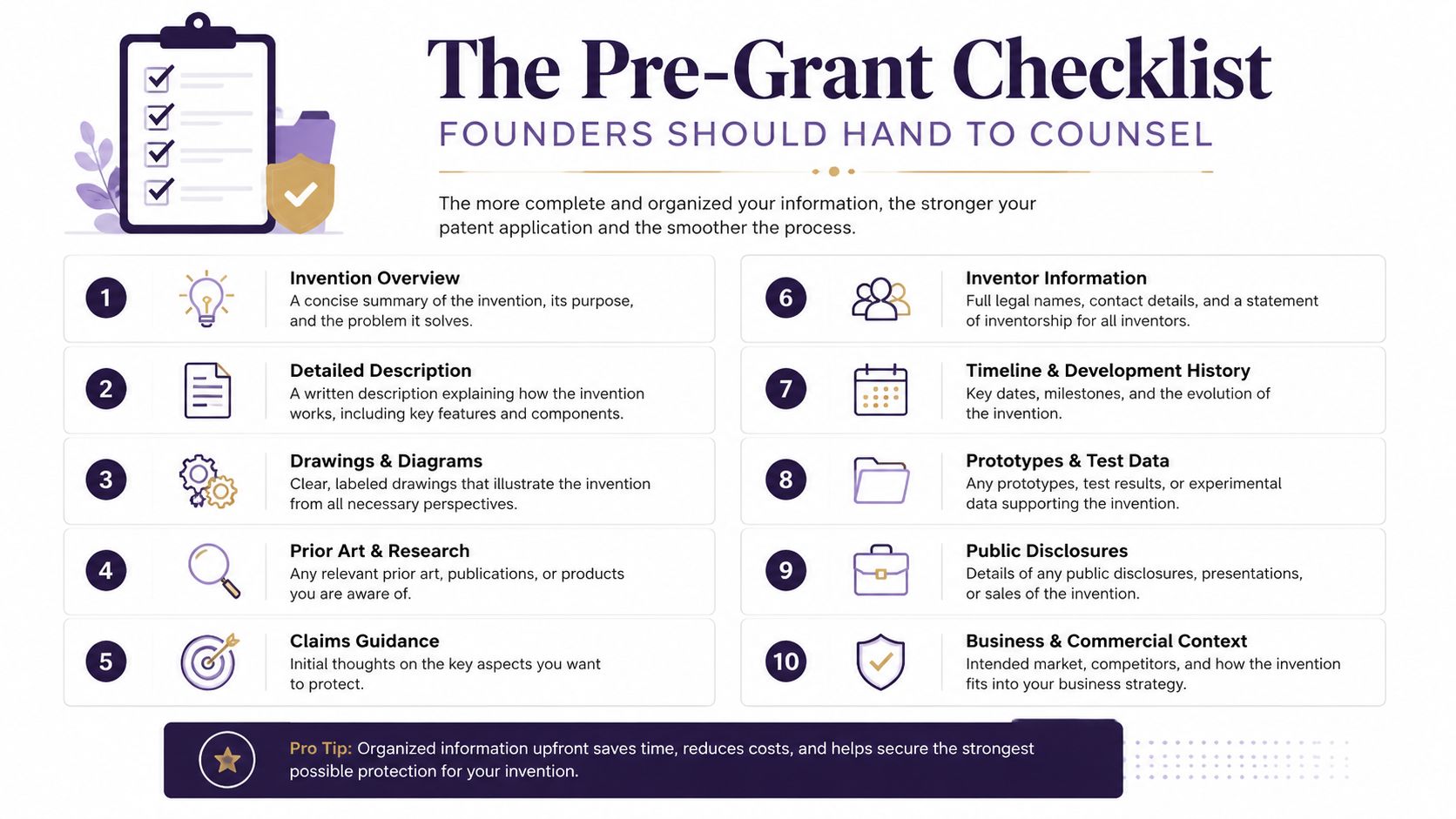
The five things that have to be true
- The pool exists on the cap table. If there isn't enough reserved equity, the offer may be dead on arrival.
- The 409A valuation is current. Pricing the grant off stale data can create avoidable tax and compliance risk.
- The plan and grant docs match. If the offer letter says one thing and the equity plan says another, counsel has a cleanup project.
- The board or compensation committee has approved it. No approval, no clean grant.
- The executive gets added to the cap table system immediately. Paper grants that never hit the ledger cause payroll, accounting, and downstream transaction problems.
The order matters because each step depends on the one before it. If the cap table is wrong, the board may approve the wrong thing. If the grant agreement is sloppy, the executive may not understand what was promised. If the ledger isn't updated, later financing work becomes a reconciliation exercise.
That's why founders should hand this list to counsel and finance on the same day they make the offer. Clean process here saves real time later, especially when the company is moving fast and the executive is expected to start quickly.
If a grant can't survive a diligence review, it wasn't really a grant yet.
This is the part many skip because it feels administrative. It isn't. It's what turns a promise into something enforceable.
Putting It All Together and What to Do Next
The founder's job is to answer four questions before the offer goes out. Which instrument fits the role, how much equity makes sense, how fast it vests, and what protections need to sit around it. If one of those answers is vague, the package will probably be vague in practice too.
The biggest mistakes are easy to spot. First, treating equity as free. It isn't, because every grant changes the ownership math. Second, skipping the cap-table simulation. That's how founders discover too late that a “small” grant interacts with a pool refresh and a funding round in ways they didn't expect. Third, ignoring the fractional-executive nuance. A part-time operator should not always receive a full-time package just because the title sounds senior.
That last point matters most for early-stage and growth-stage companies. If the role is part-time, a fractional CMO, CFO, or CTO can often solve the problem faster and with less dilution than a full-time executive search. The right structure is the one that matches the scope, the stage, and the company's appetite for ownership change.
If you want help thinking through that tradeoff, Shiny connects startups with vetted fractional executives and can help you pressure-test whether a part-time leader, a different grant structure, or a full-time hire makes more sense for the role you're trying to fill.
If you're trying to size an executive package for a role that's still fuzzy, bring the cap table, the draft offer, and the business problem you're trying to solve. Shiny can help you evaluate whether a fractional executive is the better fit, and if it is, you can schedule a consultation to build a package that's clearer, cleaner, and easier to defend.