
How to Hire a Fractional CFO: A Practical Guide for Founders
You hired a fractional CFO because cash is tightening, investors are asking harder questions, or your finance function has outgrown spreadsheets. The candidate looked impressive, quoted a reasonable rate, and promised strategic leadership. Three months later, you have more polished reports, but no better decisions about hiring, pricing, runway, or fundraising.
That outcome is avoidable. The hard part of learning how to hire a fractional CFO isn't finding people with finance credentials. It's defining the operating problem, verifying that a candidate has solved that problem at your stage, and putting decision rights and deliverables in writing before the first invoice.
Why Most Founders Get Fractional CFO Hiring Wrong
A startup can hire a fractional CFO with an impressive résumé and still remain unable to answer basic questions about runway, hiring capacity, or the affordability of its next growth push. The warning sign is a forecast that gets updated on schedule but never changes the decisions the team makes as the business shifts.
Founders say they need “a CFO,” then leave the candidate to interpret whether that means fundraising support, cash management, board reporting, controllership oversight, or strategic planning. That ambiguity creates the hidden screening gap: candidates are evaluated on credentials and availability before anyone tests whether they can solve the company's immediate operating problem.
That explains why 31% of first fractional CFO engagements reportedly end in dissatisfaction, with misaligned expectations, weak industry knowledge, and poor communication among the cited causes in the fractional CFO hiring playbook from Umbrex. The failure often begins before the first interview, when neither side has defined the decisions, deliverables, and working rhythm the engagement requires.

The title isn't the operating experience
A finance advisor can build a model. A CFO owns the decisions that model informs. Treating those capabilities as interchangeable is how founders hire someone who produces polished analysis without changing the company's financial behavior.
Before sourcing, identify the business event that makes the hire necessary:
- Runway pressure: You need a cash view that supports spending and hiring decisions.
- Fundraising: You need a credible model, diligence materials, and someone who can handle investor questions.
- Rapid growth: You need forecasting, reporting, controls, and financial infrastructure that can keep pace.
- Transaction work: You need a leader who has managed diligence, valuation questions, or a closing process.
- Finance team development: You need executive judgment and a clear operating cadence for the people already handling the books.
A fractional CFO may handle strategic planning, forecasting, reporting, cash flow management, risk management, fundraising, and process improvement. Scope still requires discipline. Ask, “What must change because this person is here?” Then screen for evidence that the candidate has produced that change in a company facing a similar constraint.
Practical rule: Hire for the next consequential decision, not for an impressive biography.
Use this guide to what a fractional CFO does to separate executive finance work from accounting administration. If the main need is reconciliations, invoicing, payroll, or closing the books, hire a bookkeeper or controller instead. A CFO assigned to that work is expensive underutilization. A bookkeeper assigned to fundraising strategy leaves the company with a serious capability gap.
Defining Scope and Hours Before You Start Sourcing
Don't post a role until you can answer three questions: Which decisions will this person own, what will they deliver, and how often will they work with the team? Hours should follow those answers. They shouldn't become the scope.
A useful starting point is to match engagement depth to revenue and complexity. One published framework estimates the following ranges for smaller companies:
| Revenue Stage | Hours per Month | Monthly Price Range |
|---|---|---|
| Pre-revenue to $1M | 4–8 | $1,500–$3,000 |
| $1M–$5M | 8–15 | $3,000–$6,000 |
| $5M–$15M | 15–25 | $6,000–$12,000 |
| $15M–$50M | 25–40 | $12,000–$20,000 |
These benchmarks come from Acuity's fractional CFO pricing framework. Treat them as planning anchors, not automatic quotes. A company with modest revenue but an imminent transaction may need more concentrated support than a larger, stable business with a capable controller.
Write the operating brief first
Your scope should identify the work in concrete terms:
- Cash management: Define the cash reporting cadence, runway assumptions, and actions required when actual results diverge from plan.
- Forecasting: Specify whether the CFO owns a rolling forecast, scenario model, hiring plan, or board-level planning package.
- Fundraising: List model preparation, data-room organization, investor diligence, and founder preparation as separate deliverables.
- Reporting: Name the metrics, audience, reporting date, and level of interpretation expected.
- Team leadership: Clarify whether the CFO manages employees, directs an outsourced accounting provider, or advises the founder.
Then state what isn't included. A fractional CFO shouldn't become the bookkeeper, controller, tax preparer, and finance systems administrator unless you intentionally buy that broader mandate.
For an early-stage company, start with a scoped project when the problem is still unclear. A cash diagnostic, forecast rebuild, or fundraising-readiness review gives both sides evidence about working style and capability before a continuing retainer begins. The fractional CFO job description resource can help turn that brief into a candidate-facing role.
Choose cadence deliberately
Set the meeting rhythm around decisions, not habit. A weekly founder check-in may suit a cash-constrained company, while a monthly executive review may be enough once reporting is stable. Include response expectations, required meetings, system access, and the person who can approve changes.
A vague promise to provide “strategic finance support” invites scope creep. A clear statement such as “deliver a cash forecast, review hiring scenarios, and prepare an investor-ready model” gives the CFO a lane and gives you a way to judge progress.
Where to Find Qualified Fractional CFOs
The market has expanded far beyond a handful of visible independent advisors. One independent 2026 market report says the global fractional executive market reached $5.7 billion in 2025, grew at 14% annually, and saw its active professional base double from 60,000 in 2022 to 120,000 in 2024. The same report says demand for fractional CMOs, CFOs, and CTOs rose 68% year over year, while LinkedIn fractional profiles increased from 2,000 in 2022 to 110,000 in 2024. Those figures appear in the 2026 State of Fractional Work report.
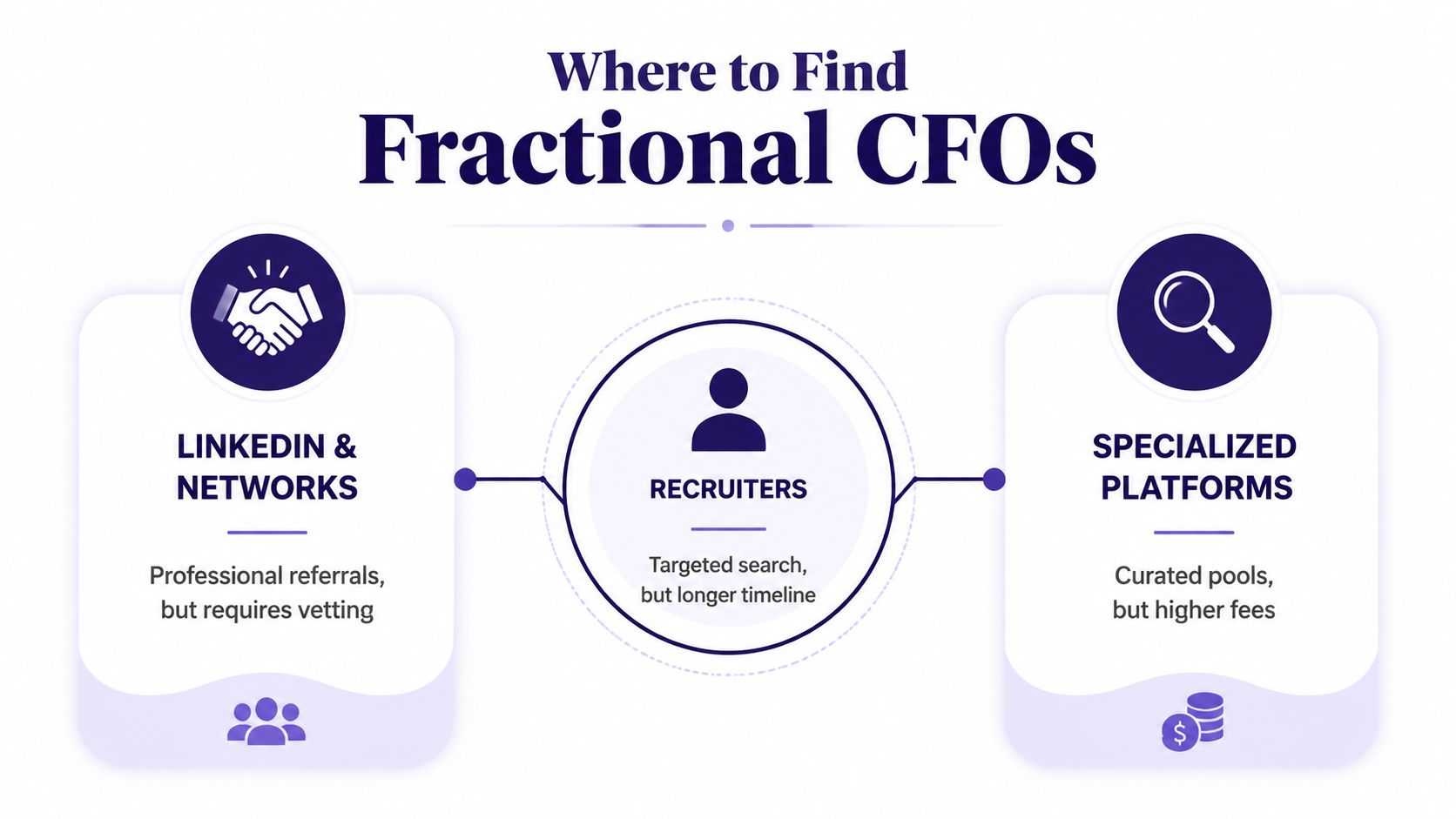
More supply is good for buyers, but it creates a filtering problem. Your network may surface trustworthy people, yet it can also recycle the same candidates other founders already know. LinkedIn offers reach, but a profile rarely proves that someone has owned outcomes at your stage. Traditional executive search can produce a targeted slate, though it may take longer and cost more than a direct or platform-based search.
Match the channel to the hiring problem
Use referrals when industry trust and confidentiality matter most, especially if a founder, investor, or board member can recommend someone who has worked through a comparable situation. Still run the same evidence-based screen. A warm introduction isn't proof of stage fit.
Use LinkedIn when you already know the background you want and can search for specific operating history, such as venture fundraising, multi-entity reporting, or transaction support. Ask for references and work examples rather than treating profile language as verification.
Use an executive recruiter when the search is highly specialized or politically sensitive, and you need targeted outreach beyond your immediate network. Recruiters are useful when the cost of a wrong hire is high and the profile requires careful calibration.
Use a specialized platform when speed, matching, and a broad curated pool matter. Shiny, for example, connects companies with a pool of over 3,000 vetted executives and supports candidate matching, interviews, and onboarding. Review how any platform defines “vetted,” who checks references, and whether you can speak with candidates before committing.
One industry analysis reports that fractional executive positions grew from 5 to 18 per 1,000 new executive hires between 2018 and 2024, as summarized in Crown CFO's hiring guidance. That growth makes precise filters essential. Search for evidence of operating responsibility, not just the phrase “fractional CFO.”
Screening Candidates for Real Operating Experience
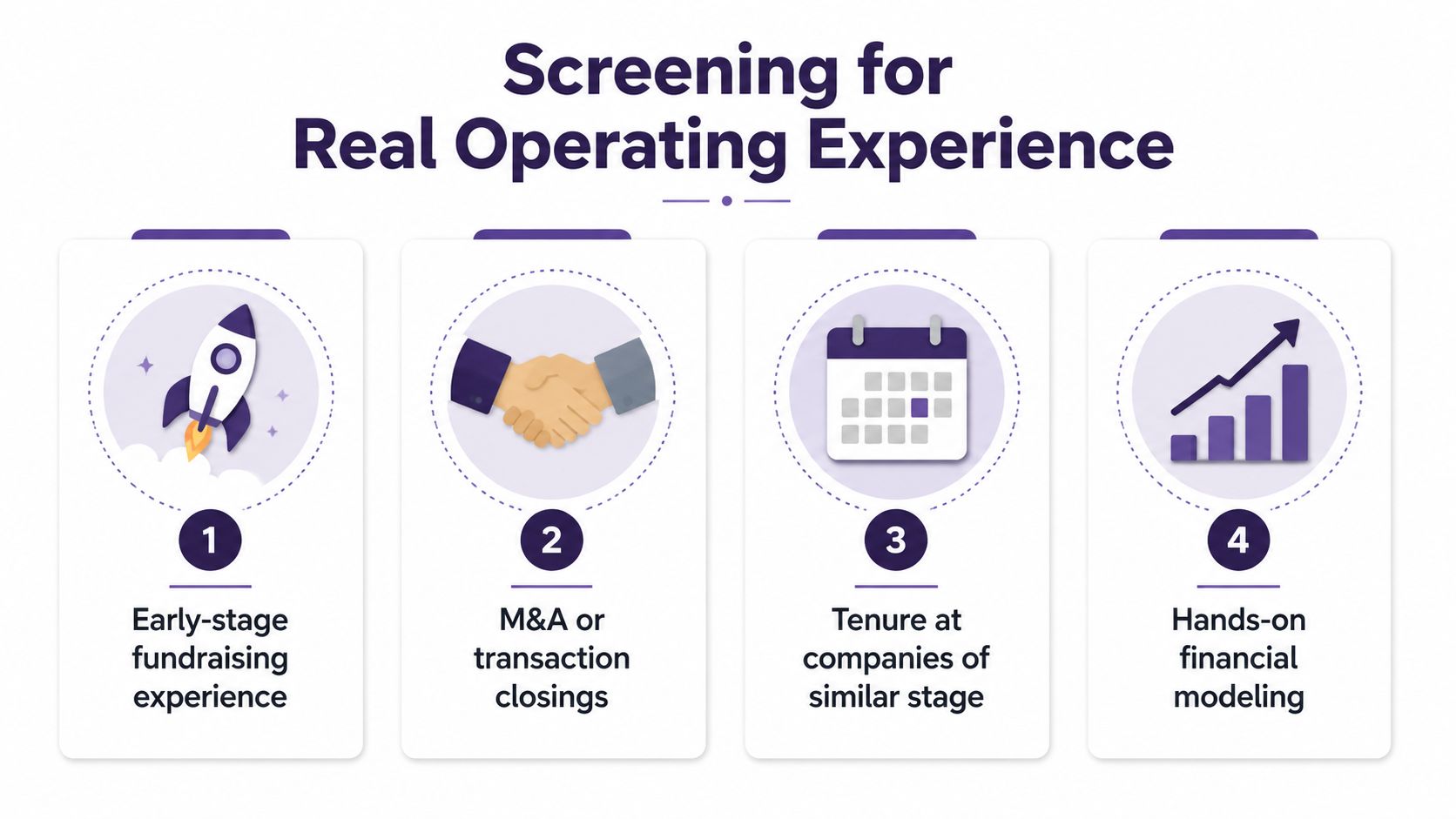
A CFO title can conceal a serious stage mismatch. A candidate may have managed a large finance team, yet never owned the cash decisions, reporting cadence, or fundraising pressure your company faces. Ask what role they held, which decisions they controlled, how long they operated in comparable businesses, and whether they are still seeking full-time employment. Someone treating fractional work as a stopgap may not offer the availability or commitment your engagement needs.
The strongest screen tests outcome ownership under constraints. Ask questions that require the candidate to separate personal decisions from team activity, explain tradeoffs, and show measurable changes:
- Tell me about a fundraising process you led when the company had limited cash.
- Describe a turnaround where you changed spending or working-capital decisions quickly.
- What did you personally own during a multi-entity reporting setup?
- Show me how you would build a forecast when operating data is incomplete.
- Which decision did the model change, and who had authority to make it?
Score evidence, not confidence
Use a 1–5 score across seven dimensions before interview chemistry affects the decision. Mercury's fractional CFO hiring rubric provides a practical structure:
| Dimension | What strong evidence looks like |
|---|---|
| Startup experience | Direct responsibility in a company with comparable pace and constraints |
| Finance skills | Hands-on forecasting, reporting, controls, and modeling |
| Strategic thinking | Clear tradeoffs connecting finance to operating decisions |
| Communication | Plain explanations for founders, boards, and non-finance teams |
| Cultural alignment | A working style compatible with your decision cadence |
| Fundraising experience | Direct participation in preparation, diligence, and investor communication |
| References | Specific feedback from people who saw the candidate operate |
Score each dimension independently. A technically strong CFO who cannot explain decisions plainly can slow the company. A personable candidate without relevant fundraising experience can create confidence without evidence. Require an explanation whenever a score depends mainly on resume language.
Verify the story
References should test operating responsibility, not personality. Ask what the candidate owned, how they responded when the forecast missed, whether they challenged the founder appropriately, and what work remained after the engagement ended.
Then run a paid working session with the finalist. Provide a sanitized cash-flow problem, a rough forecast, or an investor question resembling your situation. Watch how the candidate states assumptions, identifies missing information, communicates uncertainty, and recommends action. The exercise should expose judgment, not reward spreadsheet theater. A polished answer matters less than a clear decision process and an honest account of what the candidate still needs to learn.
Understanding Pricing Models and Market Rates
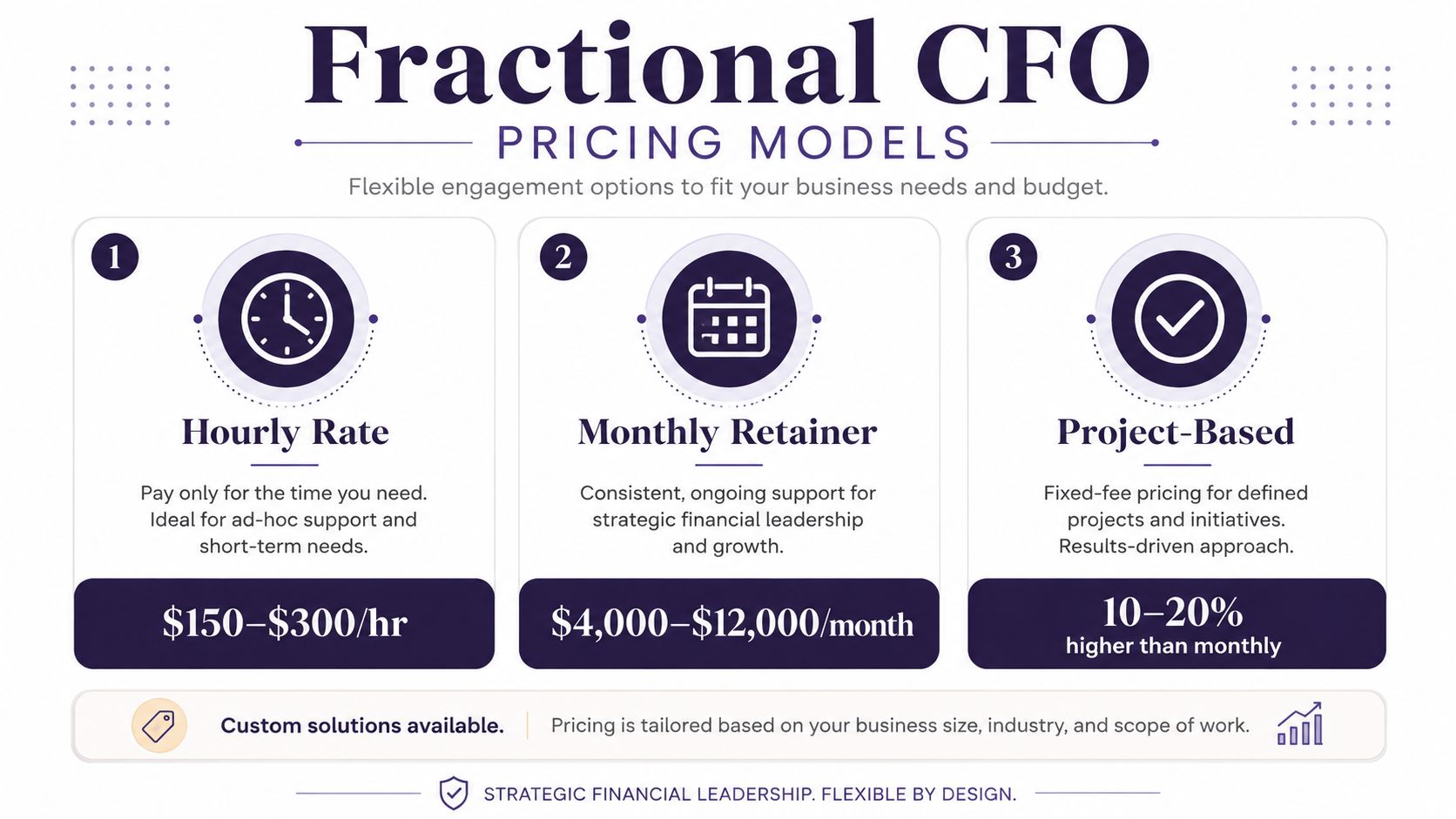
Pricing follows the work. Use an hourly arrangement for a defined advisory need, a monthly retainer for an ongoing operating cadence, and a project fee for fundraising preparation, M&A diligence, or audit preparation. The mistake is choosing a model before defining the decisions, deliverables, and access the engagement requires.
Independent market guidance cites hourly rates of $175–$450, with premium or urgent work reaching $700 per hour. Project work may be billed at $200–$400 per hour or as a fixed fee, according to Aardvark's fractional CFO cost guide. Treat those figures as a comparison point, not a quote for your company. A different benchmark reports an average hourly rate of $161 per hour, based on Think Fractional's compensation research.
Compare proposals on the same basis
At Series B, one benchmark puts a fractional CFO engagement at about $102,000 per year, compared with a median fully loaded full-time CFO year-one cost of $829,000, according to Think Fractional's report. The fractional engagement represents roughly 12.3% of the full-time cost, an 87.7% reduction in year-one spend at that stage. Use this comparison to test the business case, not to select the lowest bid.
Require each proposal to state:
- Hourly: Expected hours, response time, meeting attendance, and whether unused hours expire.
- Retainer: Included hours, deliverables, overage rates, and the process for adding support during a raise or transaction.
- Project fee: Milestones, assumptions, revision limits, dependencies, and acceptance criteria.
Published guides report monthly ranges from roughly $9,000–$18,000 for one to two days per week. Other guidance cites retainers around $8,000–$15,000 for Series A SaaS and hourly rates of $175–$450, depending on scope and expertise. Broader guidance reports $200–$700 per hour or approximately $5,000–$20,000 per month, depending on scope and geography, in Upflow's fractional CFO guide.
Do not negotiate only on rate. Ask what seniority, judgment, access, and deliverables the quote includes. A low hourly rate becomes expensive when the CFO needs constant supervision or produces work your team cannot use. For budgeting context, compare proposals with this part-time CFO cost guide, then require every candidate to explain the assumptions behind the quote.
Interviewing and Structuring the Engagement
A candidate can sound impressive and still fail because the engagement was poorly defined. Run the final interview as an operating review, not a biography exercise. Share the actual financial problem, team, systems, next decision, and constraints. Strong candidates ask precise questions before proposing work.
Start with three verification questions:
- Have you held a CFO role, and what did you own?
- What does a normal engagement look like for you, including cadence, deliverables, and client load?
- Are you currently pursuing full-time employment?
The third answer shows whether you must plan around competing priorities and whether the candidate treats fractional work as a serious operating model.
Use a paid working session
Make the session resemble the first month of the engagement. Provide enough information to test judgment, then pay for the candidate's time. Ask them to explain:
- What they would investigate first.
- Which assumptions they would challenge.
- Which report or model they would build.
- What decision the founder should make next.
- What they can deliver within the initial engagement.
Judge the reasoning, not the presentation. A capable CFO identifies missing data, separates facts from assumptions, and states what the available evidence cannot support yet. That distinction exposes candidates who rely on polished language instead of operating judgment.
Put the first 90 days in writing
Create a practical 90-day milestone plan before signing. Set an early diagnostic phase, core deliverables, and decision milestones. The plan might include a finance-system review, a cash and forecast baseline, a reporting cadence, and preparation for a specific funding or transaction event. Tie each milestone to an owner, deadline, required access, and acceptance standard.
The contract should cover confidentiality, intellectual property ownership, system access, termination notice, payment terms, conflicts of interest, and approval for work outside scope. Name the executive sponsor and define how disagreements get resolved.
Onboarding is part of the hire. Provide access to financial systems, prior forecasts, bank information, contracts, cap-table materials, and key stakeholders before the first working session. Set recurring meetings, document where decisions live, and define success in terms the leadership team can observe.
A fractional CFO should strengthen internal capability rather than create permanent dependence. Reassess the engagement after the initial milestones. Increase support when a raise, sale, or rapid scale requires it. Move toward a full-time CFO when the company needs continuous executive ownership that no longer fits a part-time model.
Shiny helps startups define finance leadership needs, match with fractional CFO candidates, and manage interviews and onboarding through one marketplace. Visit Shiny to review available executive talent and schedule a consultation about the right CFO scope for your company.