Chief Commercial Officer Interview Questions for 2025
Level Up Your CCO Hiring Process
Hiring the right Chief Commercial Officer (CCO) is crucial for growth. This role requires strategic thinking, leadership, and commercial expertise. This list provides 8 essential interview questions to help you uncover a candidate’s true potential and ensure they align with your company vision. These questions explore critical areas like strategy execution, revenue and profitability balance, team collaboration, pricing strategies, market development, team building, performance measurement, and addressing missed targets. Shiny can connect you with a fractional CCO to support your growth. Learn more at useshiny.com.
1. How would you develop and execute our commercial strategy?
This question is a cornerstone of any Chief Commercial Officer (CCO) interview. It probes far beyond superficial understanding, delving into the candidate’s strategic thinking process, market awareness, and ability to translate vision into tangible, revenue-generating action. Interviewers use this question to gauge whether the candidate can effectively identify market opportunities, craft winning sales strategies, and ultimately drive revenue growth, all while aligning with the company’s overarching business objectives. It’s crucial for understanding if a candidate can not only plan but also execute a successful commercial strategy.

This question deserves its place on the list because a strong CCO is the architect and driver of a company’s commercial success. Their strategic approach lays the foundation for sustainable growth and market leadership. This question directly assesses core competencies crucial for the role. Specifically, it assesses strategic thinking capabilities, tests their understanding of market dynamics and business development, and evaluates their ability to translate a vision into actionable plans. Furthermore, it reveals the candidate’s methodical approach to commercial growth, a critical factor for long-term success. For a more in-depth look at strategic growth planning, learn more about How would you develop and execute our commercial strategy?.
Features and Benefits:
- Insight into strategic thinking: Uncovers how the candidate approaches problem-solving and opportunity identification in a commercial context.
- Alignment with business goals: Reveals the candidate’s ability to connect commercial activities with the overall strategic direction of the company.
- Leadership potential: Demonstrates how the candidate would lead and influence cross-functional teams (marketing, sales, product) to achieve commercial objectives.
Pros:
- Provides insight into the candidate’s strategic thinking process. You gain a deeper understanding of their analytical abilities and how they approach complex commercial challenges.
- Reveals the ability to connect commercial activities to overall business goals. This ensures the CCO’s strategies contribute to the company’s broader success.
- Shows leadership capabilities in driving commercial initiatives. This is crucial for a role that requires influencing and motivating teams.
Cons:
- Responses may be theoretical without company-specific context. Candidates might provide generic answers without a deep understanding of your specific business needs.
- Difficult to assess implementation skills based solely on verbal response. Practical experience and execution abilities can be challenging to evaluate in an interview setting.
- Candidates might give idealized answers rather than realistic approaches. It’s important to probe deeper to understand the feasibility and practicality of their proposed strategies.
Examples of successful implementation:
- Amazon’s expansion: Their strategic move into new product categories (e.g., groceries, cloud computing) and international markets demonstrates a well-executed commercial strategy.
- Spotify’s diversification: Their transition from a pure music streaming platform to incorporating podcasts and supporting content creators showcases successful strategic adaptation to changing market demands.
Actionable Tips for Answering This Question:
- Outline a clear methodology for strategy development: Describe your process, including market analysis, opportunity identification, competitive analysis, target segmentation, resource allocation, and go-to-market strategy.
- Include concrete examples from past experiences: Showcase specific instances where you successfully developed and executed commercial strategies, quantifying results whenever possible.
- Discuss how you would measure success and adjust strategies: Explain your approach to tracking key performance indicators (KPIs) and making data-driven adjustments to optimize performance.
- Address how you would align different teams (marketing, sales, product) around commercial goals: Demonstrate your understanding of cross-functional collaboration and leadership.
- Demonstrate how you balance short-term results with long-term strategic objectives: Show your ability to deliver immediate impact while building a foundation for sustainable growth. This is especially important for startup founders, SMBs, and those in fast-paced industries like SaaS, FinTech, and HealthTech, where balancing rapid growth with long-term vision is crucial. For companies seeking flexible or part-time CCOs, this question helps identify candidates who can effectively prioritize and manage resources within a defined scope.
2. How do you balance driving revenue growth with maintaining profitability?
This question is a critical probe into a CCO candidate’s understanding of the fundamental tension at the heart of every business: the need to expand while also remaining financially sound. It explores how they strategically navigate the trade-offs between aggressive revenue generation and preserving healthy profit margins. A strong candidate will demonstrate not just financial literacy but also a nuanced understanding of business economics and the ability to make sound judgments under pressure. They should be able to articulate a clear philosophy about balancing these often competing priorities and illustrate it with concrete examples from their experience.

This question deserves a prominent place in your CCO interview arsenal because it speaks directly to the core responsibilities of the role. The CCO is ultimately responsible for driving the commercial success of the business, and that requires a sophisticated understanding of both growth and profitability.
Features and Benefits of Asking This Question:
- Assesses Financial Literacy and Business Economics Understanding: It goes beyond superficial knowledge and probes the candidate’s grasp of how financial levers impact overall business performance.
- Tests Decision-Making Abilities When Facing Competing Priorities: The ability to make sound trade-off decisions is crucial for a CCO, and this question directly assesses this skill.
- Evaluates Long-Term Business Thinking Versus Short-Term Results: Does the candidate prioritize short-term gains at the expense of long-term sustainability, or do they possess a more strategic outlook?
- Reveals Approach to Resource Allocation and Investment Decisions: Understanding how a CCO candidate approaches resource allocation provides valuable insights into their strategic thinking.
Pros:
- Demonstrates the candidate’s understanding of financial fundamentals.
- Shows their ability to make tough trade-off decisions.
- Reveals their strategic thinking about sustainable business growth.
Cons:
- May be difficult for candidates to answer without specific industry or company context.
- Risk of receiving generic responses without demonstrable expertise.
- Challenging to verify past results without concrete metrics.
Examples of Balancing Growth and Profitability:
- Apple: Maintains high margins through premium pricing while simultaneously investing heavily in R&D and innovation.
- Amazon: Historically willing to sacrifice short-term profits to capture market share and build long-term dominance.
- Microsoft: Transitioned to subscription-based models for predictable revenue streams while investing in cloud infrastructure.
Actionable Tips for Interviewers:
- Encourage candidates to discuss specific metrics they track (e.g., CAC, LTV, ROAS).
- Ask for examples of difficult growth vs. profit decisions they’ve made and the outcomes.
- Probe their approach to incremental investment decisions and how they evaluate ROI.
- Explore their understanding of unit economics and how they drive overall business performance.
- Inquire about their strategies for identifying high-margin growth opportunities versus volume-driven approaches.
When and Why to Use This Approach:
This question is relevant for any CCO role, but particularly crucial for startups and SMEs where resources are limited and strategic decision-making is paramount. It’s also highly relevant for fast-growing companies in sectors like SaaS, FinTech, and HealthTech, where balancing rapid expansion with sustainable profitability is a constant challenge. Asking this question helps you identify CCO candidates who can effectively navigate this complex dynamic and drive long-term value for your organization. The insights gleaned from this question can significantly impact your hiring decision and ultimately contribute to the success of your business. It is inspired by the works of business thought leaders like Jim Collins (“Good to Great”), Clayton Christensen (“The Innovator’s Dilemma”), and Peter Drucker (management principles), highlighting the importance of strategic balance in achieving lasting success.
3. How would you improve collaboration between sales, marketing, and product teams?
This question is crucial for evaluating a prospective CCO’s ability to lead and influence across different departments. A successful CCO must be able to break down silos and foster a unified commercial vision. This question probes how a candidate plans to align teams with often disparate priorities, metrics, and working styles, ultimately driving revenue growth through synergistic collaboration. It gets to the heart of whether they can create a cohesive and high-performing commercial engine.
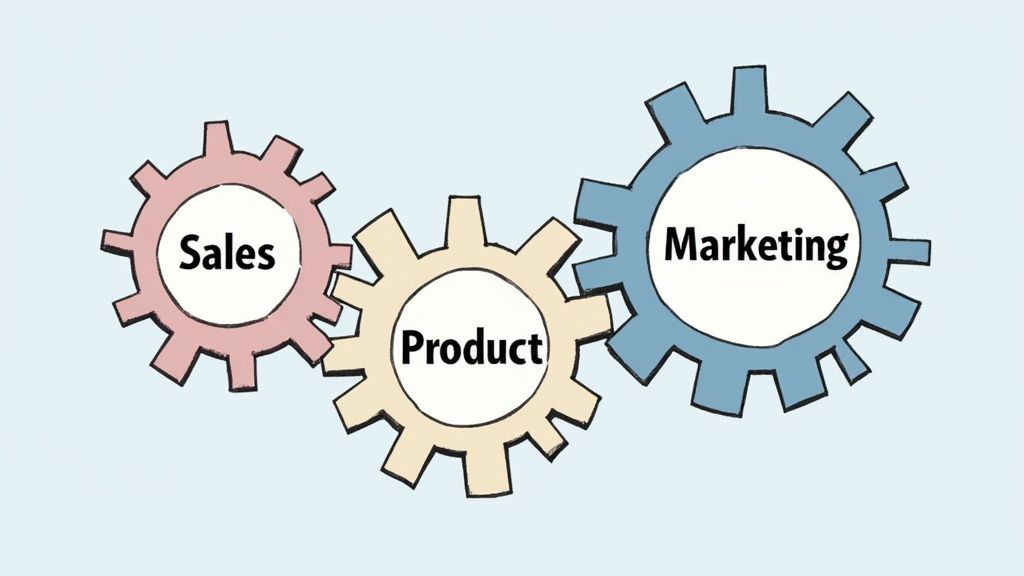
This question deserves its place on the list because cross-functional collaboration is paramount to commercial success. Features of this question include testing organizational leadership, influence capabilities, and understanding of common friction points between sales, marketing, and product. It also evaluates the candidate’s ability to create a shared vision and reveals their preferred communication and collaboration approaches. The benefits of asking this question are clear: it shows the candidate’s ability to lead without direct authority, demonstrates their understanding of different departmental perspectives, and reveals their skills in creating common goals and incentive structures.
Examples of successful cross-functional collaboration:
- HubSpot’s “smarketing” approach: This methodology aligns sales and marketing through shared metrics and regular communication, creating a closed-loop system where marketing generates leads and sales closes them.
- Salesforce’s V2MOM (Vision, Values, Methods, Obstacles, and Measures): This framework helps create alignment across departments by defining a shared vision and outlining the steps needed to achieve it.
- Slack’s use of channels for transparent communication: Slack’s own platform exemplifies how transparent communication can foster collaboration, breaking down barriers and allowing for real-time information sharing across functions.
Actionable tips for candidates:
- Discuss specific structures: Mention implementing joint planning sessions, shared Objectives and Key Results (OKRs), and regular cross-functional reviews to ensure alignment and accountability.
- Propose specific metrics that foster alignment: Focus on metrics that encourage teamwork rather than inter-departmental competition. For example, instead of solely focusing on marketing qualified leads (MQLs), consider shared metrics like revenue generated from marketing-sourced leads.
- Share past experiences: Provide concrete examples of how you’ve successfully resolved cross-departmental conflicts and facilitated collaboration in previous roles.
- Establish clear decision-making frameworks: Describe how you would establish clear decision-making processes to avoid ambiguity and ensure efficient execution.
- Align incentive structures: Explain how you would adjust incentive structures to promote collaborative behaviors and reward collective success. Learn more about How would you improve collaboration between sales, marketing, and product teams? This can be invaluable for gaining additional insights.
Pros and Cons of using this question:
- Pros: Reveals leadership potential, demonstrates understanding of departmental perspectives, and highlights skills in creating shared goals.
- Cons: Can be abstract without specific organizational context, making it difficult to assess practical implementation skills. It also risks eliciting generic responses without demonstrable experience.
This question is particularly relevant for startups, SMEs, and companies in fast-paced industries like SaaS, FinTech, and HealthTech where agile cross-functional collaboration is critical. It helps identify CCO candidates who can effectively navigate the complexities of a growing business and build a high-performing commercial organization.
4. Describe how you’ve successfully led a major pricing strategy change.
This question is a crucial one for any prospective Chief Commercial Officer (CCO) because pricing is a fundamental lever for revenue growth and profitability. It probes beyond theoretical knowledge and delves into the candidate’s practical experience in navigating the complexities of a significant pricing overhaul. By asking this question, you’re assessing not only their understanding of pricing models but also their leadership, communication, and strategic thinking abilities.
What it is and how it works: A pricing strategy change involves a significant alteration to how a company prices its products or services. This can include shifts in pricing models (e.g., from perpetual licenses to subscriptions), adjustments to price points, the introduction of tiered pricing, or changes to discounting practices. A successful change requires a deep understanding of customer value, competitive dynamics, market positioning, and the internal organizational impact.
Examples of successful implementation:
- Adobe’s transition to a subscription model (Creative Cloud): This bold move, while initially met with resistance, ultimately unlocked significant recurring revenue and strengthened customer relationships through ongoing value delivery.
- Netflix’s gradual price increases: By consistently adding high-quality content and demonstrating increasing value, Netflix has successfully implemented price increases over time while maintaining high customer retention.
- Salesforce’s tiered pricing: This strategy allows Salesforce to cater to a wide range of customer needs and budgets, maximizing market penetration while enabling upselling as customers grow. It’s a classic example of value-based pricing where the price aligns with the features and benefits received.
Actionable tips for interviewers:
- Ask for specifics: Don’t settle for vague answers. Probe for details about the specific pricing change, the market context, the candidate’s role, the challenges faced, and the results achieved.
- Quantify the impact: Push candidates to quantify the impact of the pricing change on key metrics like revenue, customer churn, market share, and profitability.
- Explore the process: Encourage the candidate to describe the entire process, from initial analysis and market research to implementation, communication, and ongoing monitoring.
- Uncover stakeholder management: Understanding how the candidate navigated internal resistance and communicated the change to various stakeholders (sales, marketing, customer support) is critical.
- Look for testing and iteration: Did the candidate employ a test-and-learn approach, piloting the pricing change before full rollout? This demonstrates a data-driven mindset.
When and why to use this approach:
This question is essential for any CCO role, particularly in industries where pricing is highly dynamic (e.g., SaaS, FinTech). It’s especially relevant for companies:
- Considering a significant pricing change: If your company is contemplating a pricing overhaul, this question helps identify candidates with the relevant experience to lead the initiative.
- Facing pricing challenges: If your current pricing strategy isn’t delivering the desired results, a CCO with a proven track record of successful pricing transformations can be invaluable.
- Operating in a competitive market: In highly competitive landscapes, smart pricing strategies are crucial for differentiation and market share gains.
Pros:
- Focuses on practical experience, not just theory.
- Demonstrates the candidate’s ability to handle resistance to change.
- Shows strategic thinking about value creation and capture.
Cons:
- May disadvantage candidates from industries with less dynamic pricing.
- Risk of candidates overstating their role.
- Difficult to verify the actual business impact without access to confidential data.
This question deserves its place on the list because it provides a direct window into a candidate’s commercial acumen, strategic thinking, and leadership abilities in a critical area of business performance. It goes beyond textbook knowledge and reveals how the candidate has tackled a complex, high-stakes challenge in the real world. It helps you identify a CCO who can not only develop a winning pricing strategy but also execute it effectively, navigate internal complexities, and communicate its value to the market and customers.
5. How do you identify and develop new market opportunities?
This question is crucial for evaluating a prospective Chief Commercial Officer’s (CCO) ability to drive business expansion and spearhead innovation. It delves into their approach to market research, opportunity assessment, and the development of new business ventures – all key responsibilities for a CCO tasked with finding growth avenues beyond the existing product portfolio and market presence. This question goes beyond simply managing existing revenue streams; it explores the candidate’s vision and strategic thinking for future growth.
What it assesses and why it’s important:
This question assesses several critical skills and traits:
- Market analysis and opportunity identification: Can the candidate systematically analyze market trends, identify whitespace opportunities, and understand competitive dynamics?
- Creative thinking and commercial innovation: Does the candidate possess the vision and creativity to conceive new offerings and explore unconventional approaches to market expansion?
- Balancing risk and reward in new ventures: Can they realistically assess the potential risks and rewards associated with new opportunities and make informed decisions?
- Creating business cases and securing resources: Can they translate market insights into compelling business cases and effectively advocate for the resources needed to pursue new ventures?
Examples of Successful Implementation:
Understanding how established companies have successfully identified and capitalized on new market opportunities provides valuable context. Consider these examples:
- Amazon: Amazon’s journey from an online bookstore to a global e-commerce giant and cloud services leader (AWS) exemplifies successful market expansion. They identified unmet customer needs and leveraged their existing infrastructure to expand into new product categories and service offerings.
- Microsoft: Under Satya Nadella, Microsoft’s strategic pivot to cloud services with Azure revitalized the company’s growth trajectory. This demonstrates a successful adaptation to changing market dynamics and a willingness to embrace new technologies.
- Disney: Disney’s expansion into the streaming market with Disney+ showcased their ability to leverage their extensive content library and brand recognition to compete in a rapidly evolving entertainment landscape.
Actionable Tips for Candidates:
- Outline a systematic approach: Describe your structured process for market assessment, including how you gather data, analyze trends, and identify potential opportunities. Mentioning frameworks like Porter’s Five Forces or PESTLE analysis can be beneficial.
- Discuss evaluation frameworks: Explain how you evaluate the potential market size, profitability, and strategic fit of new opportunities with the company’s existing capabilities and long-term goals.
- Share specific examples: Provide concrete examples of successful market expansions you’ve led or significantly contributed to. Quantify your achievements whenever possible.
- Explain your validation process: Detail how you validate assumptions, test new concepts through pilot programs or MVPs (Minimum Viable Products), and mitigate risks before committing significant resources.
- Describe how you build internal support: Explain how you communicate your vision, build consensus among stakeholders, and secure buy-in for exploring new opportunities.
Pros of using this question:
- Demonstrates growth mindset and entrepreneurial thinking: It reveals whether the candidate proactively seeks growth opportunities and possesses the drive to innovate.
- Shows ability to look beyond current business operations: It highlights the candidate’s strategic thinking and ability to anticipate future market trends.
- Reveals skills in translating market insights into business opportunities: It assesses the candidate’s ability to connect market analysis with actionable business strategies.
Cons of using this question:
- Potential bias: It may unintentionally favor candidates from growth-stage companies who have had more exposure to new market development.
- Focus on ideation over implementation: Responses might lean heavily on theoretical concepts without demonstrating practical experience in executing market expansion strategies.
- Difficulty assessing risk management: It can be challenging to gauge a candidate’s risk management abilities based solely on their responses to hypothetical scenarios.
Popularized By: The concepts behind identifying and developing new market opportunities are rooted in influential frameworks like Clayton Christensen’s “Jobs to be Done,” Steve Blank’s “Customer Development” methodology, and W. Chan Kim and Renée Mauborgne’s “Blue Ocean Strategy.”
Why this question deserves its place on the list:
In today’s dynamic business environment, the ability to identify and capitalize on new market opportunities is paramount for sustained growth. This question is essential for assessing whether a CCO candidate possesses the strategic foresight, analytical skills, and entrepreneurial spirit to lead the company into the future. It provides valuable insights into their ability to not only manage existing revenue streams but also to create new ones, making it a critical component of any CCO interview process.
6. How do you approach building and developing commercial teams?
This question is a cornerstone of any CCO interview. It probes far beyond surface-level management tactics and delves into the candidate’s fundamental leadership philosophy and their ability to cultivate high-performing commercial teams. As a CCO, success hinges on effectively recruiting, organizing, motivating, and developing talent across all commercial functions, including sales, marketing, partnerships, and more. This directly impacts the execution of the company’s commercial strategy and ultimately, its bottom line.
This question is crucial because it assesses several key areas:
- Leadership Philosophy and People Management Approach: How does the candidate view their role as a leader? Do they prioritize mentorship, empowerment, or a more directive approach? Understanding their core beliefs about leadership provides insights into their potential effectiveness.
- Ability to Identify and Develop Commercial Talent: Can the candidate spot potential in individuals and nurture their growth within the organization? Building a strong commercial team requires an eye for talent and a commitment to ongoing development.
- Organizational Design Thinking: Does the candidate possess a strategic approach to structuring teams for optimal performance and collaboration? This includes understanding roles, responsibilities, and reporting lines.
- Approach to Performance Management and Team Culture: How does the candidate set expectations, measure performance, and foster a positive and productive work environment? A healthy team culture is essential for long-term success.
Why This Question Matters:
A strong CCO needs to build a sustainable and scalable commercial engine. This question helps determine if the candidate can create a team capable of achieving consistent growth and adapting to market changes. It reveals whether they can build internal capabilities that drive long-term success, rather than relying on short-term fixes.
Pros of Asking This Question:
- Demonstrates the candidate’s people leadership abilities, a critical aspect of the CCO role.
- Shows their understanding of different commercial roles, responsibilities, and talent needs within a cohesive team.
- Reveals their ability to build sustainable organizational capabilities for continued growth.
Cons of Asking This Question:
- Responses may reflect the candidate’s ideal management style rather than their actual practices under pressure.
- Different industries have varying team structures and requirements, making it difficult to compare candidates across diverse backgrounds.
- It’s challenging to assess actual leadership effectiveness solely through interview responses. Real-world experience and references are crucial for validation.
Examples of Successful Implementations:
- HubSpot: Known for its robust training and development programs, HubSpot invests heavily in equipping its sales teams with the skills and knowledge to succeed.
- Salesforce: Their V2MOM (Vision, Values, Methods, Obstacles, and Measures) approach aligns teams around a shared vision and provides a clear framework for achieving goals.
- LinkedIn: Prioritizes internal talent development and promotion, fostering a culture of growth and opportunity within the organization.
Tips for Answering This Question:
- Describe your approach to organizational design and team structure. How do you determine roles and responsibilities?
- Share specific examples of how you’ve developed future leaders. What strategies did you use, and what were the outcomes?
- Discuss how you establish clear performance expectations and accountability. What metrics do you track, and how do you provide feedback?
- Explain your philosophy on hiring. Do you prioritize skills or potential? Specialists or generalists?
- Detail how you create a high-performance commercial culture. What values do you emphasize, and how do you foster collaboration and motivation?
- When building and developing your commercial team, having solid employment contracts is crucial for protecting your business and setting clear expectations from the outset. This includes outlining roles, responsibilities, compensation, and other key terms.
Popularized By: The concepts of team building and leadership development have been significantly influenced by thought leaders like Kim Scott (Radical Candor), Marcus Buckingham (First, Break All the Rules), and Patty McCord (Netflix culture deck). Their work provides valuable frameworks for understanding and implementing effective leadership practices.
7. How do you measure the success of commercial operations?
This question is crucial for evaluating a potential CCO’s analytical abilities and their understanding of how to quantify the effectiveness of commercial strategies. It delves into how they define success, select key performance indicators (KPIs), and utilize data to inform decisions, drive continuous improvement, and foster accountability across the commercial teams. A strong candidate will demonstrate a clear understanding of how their activities translate into tangible business outcomes.

This question deserves its place on the list because it goes beyond simply asking about revenue targets. It probes the candidate’s strategic thinking about performance measurement. Features of a good answer include a focus on data-driven decision-making, a deep understanding of relevant commercial metrics, and the ability to connect daily activities to overall business goals. Benefits for the interviewer include gaining insights into the candidate’s results orientation, their ability to differentiate leading from lagging indicators, and their level of sophistication in performance measurement. For example, a candidate who discusses measuring customer lifetime value (CLTV) demonstrates a more strategic approach than one focused solely on monthly sales.
Examples of Successful Implementation:
- SaaS companies: Tracking customer acquisition cost (CAC), CLTV, churn rate, and expansion revenue. A successful CCO might explain how they’ve used cohort analysis to understand churn patterns and implemented strategies to improve customer retention.
- E-commerce businesses: Monitoring conversion rates, average order value (AOV), and customer retention. A strong candidate could share examples of A/B testing different website layouts to optimize conversion rates.
- Subscription businesses: Measuring engagement metrics, net promoter score (NPS), and customer lifetime value alongside standard financial measures. A successful implementation might involve analyzing user behavior data to identify areas for improving product engagement.
Actionable Tips for Interviewers:
- Probe for both financial and operational metrics that provide a holistic view of commercial health.
- Encourage candidates to discuss how they establish balanced scorecards that incentivize the right behaviors and align with overall business objectives.
- Ask for specific examples of how they have used data to identify and address performance issues in previous roles.
- Explore how they make metrics visible and actionable for their teams, fostering a data-driven culture.
- Understand how they balance quantitative and qualitative performance assessments to get a complete picture of team effectiveness. Learn more about How do you measure business growth? can offer additional context.
Pros of asking this question:
- Demonstrates candidate’s results orientation.
- Shows ability to distinguish leading from lagging indicators.
- Reveals sophistication in performance measurement beyond basic revenue metrics.
Cons of asking this question:
- Risk of focusing on metrics without proper business context.
- Different businesses require different measurement approaches, making direct comparisons difficult.
- May not reveal the qualitative judgment that complements strong quantitative analysis.
This question is particularly relevant for startups, SMEs, and companies in fast-paced industries like SaaS, FinTech, and HealthTech, where data-driven decision-making and a strong understanding of performance metrics are critical for success. It allows interviewers to identify CCO candidates who possess the analytical skills and strategic mindset needed to drive commercial growth and build sustainable businesses. Understanding the nuances of measuring commercial success is a cornerstone of effective leadership in these dynamic environments.
8. How would you handle a situation where sales targets are consistently being missed?
This question is a crucial one for any prospective Chief Commercial Officer (CCO). It goes beyond simply identifying a problem and delves into a candidate’s ability to navigate the complexities of a struggling sales organization. By posing this scenario, interviewers are trying to gauge the candidate’s problem-solving skills, leadership style under pressure, and their ability to balance immediate needs with long-term strategic adjustments. It reveals how they diagnose root causes, implement corrective actions, manage underperformance, and ultimately drive accountability while maintaining team morale and avoiding widespread demotivation.
Why This Question Matters:
Missing sales targets is a significant challenge for any business. This question deserves its place on the list because it helps assess a candidate’s practical experience and their ability to tackle this critical issue. It provides insight into their thought processes and how they would approach a real-world problem that many CCOs inevitably face. It reveals if they lean towards quick fixes or adopt a more structured, sustainable approach to improvement.
Features and Benefits of Asking This Question:
- Assesses diagnostic and problem-solving approach: Understanding how a candidate breaks down a complex problem into smaller, manageable components is vital. This question unveils their analytical skills and their ability to identify the root causes of underperformance.
- Tests crisis management and leadership under pressure: Missing targets creates stress. This question reveals how a candidate leads during challenging times, makes decisions under pressure, and rallies the team to overcome obstacles.
- Evaluates ability to balance short-term fixes with long-term solutions: Sustainable growth requires a balanced approach. This question helps identify if a candidate can implement immediate corrective actions while also addressing underlying structural issues that could hinder future success.
- Reveals approach to performance management and accountability: This aspect highlights how a candidate addresses underperformance while maintaining a positive and motivating team environment. It helps determine whether they favor a collaborative approach or a more direct, results-oriented style.
Pros of Using This Question:
- Demonstrates candidate’s practical approach to real-world problems: The question elicits practical, hands-on experience rather than theoretical knowledge.
- Shows ability to make difficult decisions while maintaining relationships: Managing underperforming teams requires tough decisions. This question reveals a candidate’s ability to balance accountability with empathy.
- Reveals leadership style during challenging situations: Pressure reveals true leadership qualities. This question provides insights into how a candidate motivates and directs their team during difficult times.
Cons of Using This Question:
- Hypothetical scenario may not fully reflect real-world complexity: While the question aims for realism, the specific nuances of a company’s situation can be hard to replicate in an interview setting.
- Different industries have varying sales cycles and challenges: The ideal response can vary based on industry specifics, making it important to consider the candidate’s experience within the relevant sector.
- Risk of candidates giving idealized rather than realistic responses: Candidates might be tempted to present an idealized version of their problem-solving approach rather than a truly realistic one.
Examples of Successful Implementation:
- Analyzing sales pipeline metrics: Identifying specific breakdown points (lead generation, qualification, closing ratios) helps pinpoint areas needing immediate attention.
- Implementing additional training and coaching: Addressing skill gaps and providing targeted support to underperforming team members can improve overall sales performance.
- Revisiting go-to-market strategy: Changing market conditions might necessitate a reassessment of the overall sales strategy, including target audience, messaging, and channels.
Actionable Tips for Interviewers:
- Probe for specific examples: Encourage candidates to share concrete examples of how they’ve successfully addressed similar challenges in the past.
- Focus on the “how”: Pay close attention to the candidate’s process and methodology rather than just the outcome.
- Assess their communication strategy: Inquire about how they would communicate the situation and proposed solutions to various stakeholders (board, CEO, other departments).
When and Why to Use This Approach:
This question is essential for any CCO role, especially in startups and SMEs where the CCO’s impact on revenue generation is paramount. It is particularly relevant in fast-paced industries like SaaS, FinTech, and HealthTech where market dynamics can shift rapidly. By asking this question, you gain valuable insights into a candidate’s ability to lead a sales organization through challenges and drive sustainable growth. Inspired by performance management approaches championed by leaders like Jack Welch, Larry Bossidy (author of Execution: The Discipline of Getting Things Done), and Mark Roberge (author of The Sales Acceleration Formula), this question assesses a candidate’s ability to execute effectively under pressure.
8-Point CCO Interview Comparison
| Interview Question | Implementation Complexity (🔄) | Resource Requirements (⚡) | Expected Outcomes (📊) | Ideal Use Cases (💡) | Key Advantages (⭐) |
|---|---|---|---|---|---|
| How would you develop and execute our commercial strategy? | High – requires multi-layer planning and cross-functional coordination | High – extensive market research and resource alignment | A comprehensive, actionable plan driving revenue growth | Organizations seeking strategic, multi-channel expansion | Demonstrates strategic vision and leadership |
| How do you balance driving revenue growth with maintaining profitability? | Medium – balancing competing priorities and trade-offs | Moderate – needs robust financial analytics and oversight | Sustainable growth with preserved margins | Companies needing equilibrium between expansion and profit | Highlights financial acumen and decision-making |
| How would you improve collaboration between sales, marketing, and product teams? | Medium – aligning diverse functions and overcoming silos | Low to Moderate – focus on communication and shared metrics | Enhanced teamwork and unified commercial goals | Organizations with departmental silos aiming for cohesion | Strengthens cross-functional alignment and culture |
| Describe how you’ve successfully led a major pricing strategy change. | High – involves complex change management and stakeholder alignment | High – requires deep market analytics and execution planning | Optimized pricing models driving competitive advantage | Businesses undergoing pricing transitions or repositioning | Proves hands-on expertise and strategic execution |
| How do you identify and develop new market opportunities? | Medium – systematic market analysis with proactive innovation | Moderate – leverages market research and creative strategies | Identification of viable, growth-oriented opportunities | Companies focused on expansion and exploring untapped markets | Showcases entrepreneurial insight and market foresight |
| How do you approach building and developing commercial teams? | Medium – integrating leadership with organizational design | Moderate – involves recruiting, training and talent investment | High-performing teams with clear roles and growth potential | Organizations emphasizing strategic team development and culture | Demonstrates effective leadership and people management skills |
| How do you measure the success of commercial operations? | Medium to High – integrating complex analytics and performance metrics | High – requires dedicated data systems and tracking mechanisms | Transparent, actionable insights that drive continuous improvement | Data-driven companies focused on performance and accountability | Combines quantitative rigor with strategic insight |
| How would you handle a situation where sales targets are consistently being missed? | High – addressing underlying issues with diagnostic rigor | Moderate – relies on analytics and corrective leadership actions | Improved performance through targeted problem solving | Organizations facing continual sales challenges needing turnaround strategies | Illustrates crisis management and effective problem-solving skills |
Find the Perfect Fractional CCO with Shiny
This article has provided key interview questions to help you assess candidates for a Chief Commercial Officer role, covering crucial areas like strategy development, revenue growth, team collaboration, pricing strategies, market opportunity identification, team building, performance measurement, and handling underperformance. Mastering these concepts and incorporating them into your interview process is essential for selecting a CCO who can effectively drive your company’s commercial success. The right CCO can significantly impact your bottom line, leading to increased revenue, stronger market positioning, and sustainable growth. By asking targeted and insightful questions, you can identify the ideal candidate to lead your commercial efforts.
Finding the perfect CCO can be a challenging and time-consuming endeavor. But, it doesn’t have to be. Shiny offers a solution by providing access to a network of highly experienced fractional CCOs. Ready to accelerate your growth with a top-tier fractional CCO? Explore Shiny’s network of experienced executives and discover the perfect fit for your needs at Shiny. Leverage these interview questions and Shiny’s platform to find the fractional CCO who can transform your commercial strategy and drive impactful results.