
7 Essential Questions to Ask Executive Management in 2025
Level Up Your Leadership Understanding
Want to gain strategic perspective and align your work with company goals? This listicle provides 7 powerful questions to ask executive management. These questions will help you understand the company’s vision, strategic approach to challenges, and top-level decision-making. Whether you’re a startup founder, part of a small business, or in a SaaS, FinTech, or HealthTech company, knowing what questions to ask executive management is crucial in 2025. From understanding long-term vision to identifying competitive threats, these questions unlock key insights from leadership.
1. What is our company’s long-term strategic vision?
This question is arguably the most crucial one to ask executive management. It aims to understand the organization’s overarching direction, goals, and future positioning. By asking this question, you’re seeking to explore how executives envision the company evolving over the next 3-10 years, what markets they’re targeting, and how they plan to maintain a competitive edge and remain relevant in a constantly changing business landscape. Understanding this long-term vision provides a critical foundation for evaluating the leadership’s decision-making process and the organization’s overall potential.

This question deserves its place at the top of the list for several reasons. It focuses on long-term thinking, exploring the organizational purpose and direction, and revealing the leadership’s strategic decision-making framework. By understanding the long-term vision, you uncover the strategic priorities that will guide the company’s actions and resource allocation. This provides invaluable context for current initiatives and day-to-day decisions. Furthermore, understanding the long-term strategy allows individuals to align their contributions with the company’s overall direction, fostering a sense of shared purpose and maximizing individual impact. It also helps identify potential future opportunities and career paths within the organization. Finally, asking this question demonstrates your own strategic thinking and engagement, which is highly valued in any organizational setting.
Features and Benefits:
- Focuses on Long-Term Thinking: Moves beyond short-term gains and emphasizes sustainable growth.
- Explores Organizational Purpose and Direction: Clarifies the “why” behind the company’s existence and its intended trajectory.
- Reveals Leadership’s Decision-Making Framework: Provides insights into how executives prioritize and allocate resources.
- Uncovers Strategic Priorities: Highlights the key areas of focus for the company’s future success.
- Helps Align Individual Contributions with Company Direction: Enables employees to understand how their work contributes to the bigger picture.
- Identifies Potential Future Opportunities and Career Paths: Provides a roadmap for professional growth within the organization.
Pros:
- Provides context for current initiatives and decisions.
- Helps align individual contributions with company direction.
- Identifies potential future opportunities and career paths.
- Demonstrates strategic thinking and engagement.
Cons:
- May receive guarded or overly generalized responses.
- Vision statements might be aspirational rather than actionable.
- Could reveal sensitive competitive information executives are reluctant to share.
Examples of Successful Implementation:
- Jeff Bezos maintained Amazon’s long-term vision of being “Earth’s most customer-centric company,” which guided decades of decisions.
- Satya Nadella transformed Microsoft by articulating a clear “cloud-first, mobile-first” vision that employees could rally behind.
Actionable Tips for Readers:
- Follow up with questions about how current initiatives connect to the vision.
- Ask about specific milestones or indicators of progress toward the vision.
- Frame the question in terms of how it helps you align your work to company goals.
- Request concrete examples of how the vision influences day-to-day decisions.
When and Why to Use This Approach: This question is essential for anyone interacting with executive management, from prospective employees during interviews to existing team members seeking clarity and alignment. It is particularly valuable for startup founders, small to medium-sized businesses, and those in rapidly evolving industries like SaaS, FinTech, and HealthTech. Understanding the long-term vision is crucial for navigating uncertainty and making informed decisions in dynamic environments.
You can learn more about What is our company’s long-term strategic vision? and strategic growth planning. This understanding is crucial for effective leadership and overall business success. The insights gained from this question can significantly impact decision-making and resource allocation across the organization, ultimately contributing to a more cohesive and successful future. This question, popularized by thought leaders like Jim Collins (Good to Great), Peter Drucker, and Simon Sinek (Start With Why), emphasizes the importance of a clear and compelling vision in driving organizational success.
2. What are our biggest competitive threats and how are we addressing them?
This question is crucial for understanding executive management’s grasp of the market landscape and their strategic thinking. It probes their awareness of existing and emerging challenges, disruptive forces, and competitive pressures that could significantly impact the business. By asking this question, you gain insight into how leadership evaluates these threats, formulates risk mitigation strategies, and develops both defensive and offensive tactics to maintain a competitive edge. This provides a window into the executive’s understanding of not just the current market, but also their vision for the future and how they plan to navigate it.

This question deserves a prominent place on your list of questions to ask executive management because it speaks directly to the long-term viability and success of the company. For startups, understanding how potential executives perceive and address competitive threats is essential for navigating the challenging early stages of business. For established SMEs, this insight can highlight opportunities for growth and innovation. Across industries like SaaS, FinTech, and HealthTech, where disruption is constant, this question helps assess an executive’s adaptability and strategic foresight.
Features and Benefits:
- External Focus on Market Dynamics: This question forces a look outward, ensuring the executive team isn’t solely focused on internal operations but also on the broader market context.
- Assesses Leadership’s Competitive Awareness: It directly evaluates how well the executive team understands the competitive landscape, including both established rivals and potential disruptors.
- Explores Risk Management Strategies: It reveals how the company identifies and mitigates potential risks stemming from competitive pressures.
- Reveals Defensive and Offensive Business Tactics: It sheds light on the strategies employed to protect market share and pursue new opportunities.
Pros:
- Shows Engagement with Business Realities: Asking this question demonstrates your own engagement with the challenges and opportunities the company faces.
- Provides Insight into Executive Thinking about Industry Trends: You gain valuable insight into how the leadership team interprets industry trends and their potential impact.
- Helps Identify Potential Business Vulnerabilities: The responses can uncover blind spots or areas where the company may be vulnerable to competitive pressures.
- May Reveal Upcoming Strategic Shifts or Initiatives: This question can offer a glimpse into future strategic directions the company may be considering.
Cons:
- Could Touch on Sensitive Competitive Intelligence: Executives might be hesitant to divulge highly sensitive information about their competitive strategies.
- Executives Might Downplay Actual Threats to Maintain Confidence: There’s a risk that responses might be overly optimistic or downplay real threats to project an image of strength and control.
- May Receive Politically Cautious Responses: Answers might be carefully crafted to avoid revealing any internal weaknesses or uncertainties.
Examples of Successful Implementation:
- Netflix: Recognizing the disruptive potential of streaming, Netflix transformed its business model from DVD rentals to become a dominant player in the online streaming market. This demonstrates a successful response to a simultaneous threat and opportunity.
- IBM: Facing the commoditization of hardware, IBM strategically pivoted towards services and AI (Watson), reinventing itself for a changing technological landscape.
- Microsoft: In response to the growing threat from Google and Amazon in the cloud computing space, Microsoft successfully transitioned its business model to become a major cloud provider with Azure.
Actionable Tips:
- Research competitors before asking this question: Having background knowledge will allow you to ask more informed follow-up questions.
- Frame it as seeking to understand how you can help address these challenges: This approach encourages more open and collaborative responses.
- Ask about both traditional competitors and non-traditional disruptors: This ensures a comprehensive understanding of the competitive landscape.
- Request specific examples of how the company has successfully responded to past threats: This provides concrete evidence of the executive team’s ability to navigate competitive challenges.
Popularized By:
The importance of understanding competitive threats has been emphasized by influential thinkers like Clayton Christensen (disruption theory), Michael Porter (competitive strategy frameworks), and Andy Grove (“Only the Paranoid Survive”). This question reflects these important business principles and helps assess how well executive management incorporates them into their strategic thinking.
3. What metrics or KPIs do you personally track most closely?
This question is crucial when interacting with executive management. It unveils what truly drives their decision-making process and offers a glimpse into their core values. By understanding which performance indicators (KPIs) an executive prioritizes, you gain valuable insight into their management philosophy, their areas of focus, and where they believe the organization should concentrate its resources. This question deserves its place on the list of questions to ask executive management because it gets to the heart of how an executive defines success and provides a powerful lens through which to understand their operational priorities.

Asking about personally tracked metrics reveals not just the what but also the why behind an executive’s actions. It uncovers informal performance expectations, identifies critical business health indicators, and shows the alignment (or misalignment) between stated goals and actual measurement. This is particularly valuable for startup founders, SMBs, and entrepreneurs in fast-paced industries like SaaS, FinTech, and HealthTech, where aligning with executive priorities is essential for efficient resource allocation and growth.
Features and Benefits:
- Reveals true executive priorities: Understanding what metrics an executive monitors daily provides a clear picture of their true priorities, often more so than stated company objectives.
- Uncovers informal performance expectations: The metrics often reveal unspoken performance expectations, offering valuable guidance for aligning individual work with executive goals.
- Identifies critical business health indicators: This insight offers a window into the executive’s assessment of the organization’s health and areas needing attention.
- Shows alignment between stated goals and actual measurement: Comparing stated priorities with tracked metrics reveals the degree to which the organization “walks the talk.”
Pros:
- Provides insight into how success is actually defined within the organization.
- Helps align individual work with what executives value, increasing the impact of contributions.
- Reveals the organization’s operational focus and where resources are likely to be directed.
- Can uncover unstated but important objectives that drive executive decisions.
Cons:
- Metrics may change frequently based on evolving business conditions, requiring ongoing communication.
- Some executives may be reluctant to share their actual decision-making criteria.
- Different executives may track seemingly contradictory metrics, reflecting differing departmental priorities.
Examples of Successful Implementation:
- Amazon’s Jeff Bezos: Famously prioritized customer-centric metrics above all else, driving a relentless focus on customer satisfaction.
- Former GE CEO Jack Welch: Focused on market share dominance, aiming for GE to be #1 or #2 in every market they competed in.
- Netflix: Tracks hours viewed and retention as key indicators of engagement, rather than solely focusing on subscriber numbers.
Actionable Tips:
- Ask follow-up questions: “Why do these specific metrics matter most to you?” and “How do they influence your decisions?” provide deeper context.
- Inquire about evolution: Asking how these metrics have evolved over time reveals how the executive adapts to changing business conditions.
- Connect your role: Demonstrate how your role contributes to the executive’s prioritized metrics, highlighting your value to the organization.
- Compare measured vs. communicated: Analyze the difference between what’s measured and what’s publicly communicated as priorities to understand potential disconnects.
Popularized By:
- Management by Objectives (Peter Drucker): Emphasizes setting specific, measurable, achievable, relevant, and time-bound (SMART) objectives.
- Balanced Scorecard approach (Kaplan and Norton): Provides a framework for measuring organizational performance across multiple perspectives, including financial, customer, internal processes, and learning & growth.
- OKR framework (popularized by Intel and Google): Focuses on setting ambitious Objectives and Key Results to track progress and drive alignment.
By asking this insightful question, candidates interviewing for executive roles, or individuals working with executive teams, can gain a deeper understanding of the organization’s true priorities and effectively align their efforts for maximum impact. This is especially crucial for those involved in executive recruitment, as it provides valuable data points to assess leadership fit and potential for success.
4. What do you see as our biggest internal obstacle to success?
This question, a powerful tool for any leader looking to gain a deeper understanding of their organization, probes the executive team’s perspective on internal challenges hindering performance. It’s a crucial question to ask executive management because it goes beyond surface-level observations and delves into the underlying issues that might be holding the company back. This focus on organizational self-awareness is essential for sustainable growth and success, making it a worthy inclusion in this list of crucial questions. By understanding where the roadblocks lie, you can begin to formulate strategies to overcome them and unlock the organization’s full potential. This question is particularly relevant for startup founders, SMBs, and those in fast-paced industries like SaaS, FinTech, and HealthTech where agility and efficient execution are paramount.
How it Works:
Asking this question encourages executives to critically assess internal limitations – be they process bottlenecks, communication breakdowns, cultural issues, or skill gaps. It’s a way to understand the executive perspective on what’s preventing the organization from achieving its strategic goals. The responses you receive can offer valuable insight into potential areas for improvement and can even foreshadow future organizational changes or reorganizations.
Examples of Successful Implementation:
History is replete with examples of leaders who identified and tackled internal obstacles to achieve remarkable turnarounds. Microsoft, under Steve Ballmer, eventually recognized that its siloed organizational structure stifled innovation. Addressing this cultural issue became a key focus for subsequent leadership. Similarly, Lou Gerstner’s transformation of IBM involved overcoming deep-seated cultural resistance to customer-centricity. And at Ford, Alan Mulally spearheaded a turnaround by breaking down functional silos and fostering collaboration. These examples highlight the importance of identifying and addressing internal obstacles to achieve significant organizational improvements.
Actionable Tips:
- Frame as Seeking Understanding, Not Criticism: Phrase the question in a way that encourages open and honest dialogue, rather than putting executives on the defensive. For instance, instead of “Why are we failing in X?”, try “What internal factors do you see as contributing to the challenges in X?”
- Follow Up with How You Might Help Address Identified Challenges: Show initiative by asking how you can contribute to solutions. This demonstrates your commitment to improvement and your willingness to collaborate.
- Ask for Historical Examples: Encourage executives to share past instances where the company successfully overcame internal obstacles. This can provide valuable lessons and insights into effective strategies.
- Connect to Performance Improvement: Explicitly link the removal of these obstacles to improved organizational performance. This reinforces the importance of addressing the identified challenges.
Pros:
- Shows your interest in organizational improvement and growth.
- May reveal unstated organizational challenges that need attention.
- Provides insight into potential future changes or reorganizations.
- Demonstrates your willingness to tackle difficult issues.
Cons:
- Executives may be hesitant to acknowledge significant internal problems.
- You might receive politically safe answers rather than candid insights.
- The discussion may touch on sensitive leadership or performance issues.
When and Why to Use This Approach:
This question is particularly valuable during strategic planning sessions, performance reviews, or when onboarding new executives. It’s also helpful during times of organizational change or when seeking to diagnose the root causes of underperformance. For entrepreneurs and leaders in dynamic industries like SaaS, FinTech, and HealthTech, understanding and addressing these internal obstacles is critical for maintaining a competitive edge and achieving sustainable growth. By using this question strategically, you can gain valuable insights, foster open communication, and drive meaningful organizational improvement. This understanding positions your company, whether a fledgling startup or an established SMB, for greater success.
5. How do you evaluate and make high-risk decisions?
This question is crucial when interviewing executive management as it probes their decision-making process, particularly for strategic choices with significant uncertainty or potential downside. Understanding how potential executives navigate high-stakes decisions is critical for any organization, especially startups and SMEs. It provides valuable insights into their risk tolerance, strategic thinking, and ability to balance data-driven analysis with intuition. This question seeks to understand the frameworks, principles, and approaches leadership uses when facing complex decisions with incomplete information. This is a key question to ask executive management because it reveals how they will likely approach critical junctures in the future.
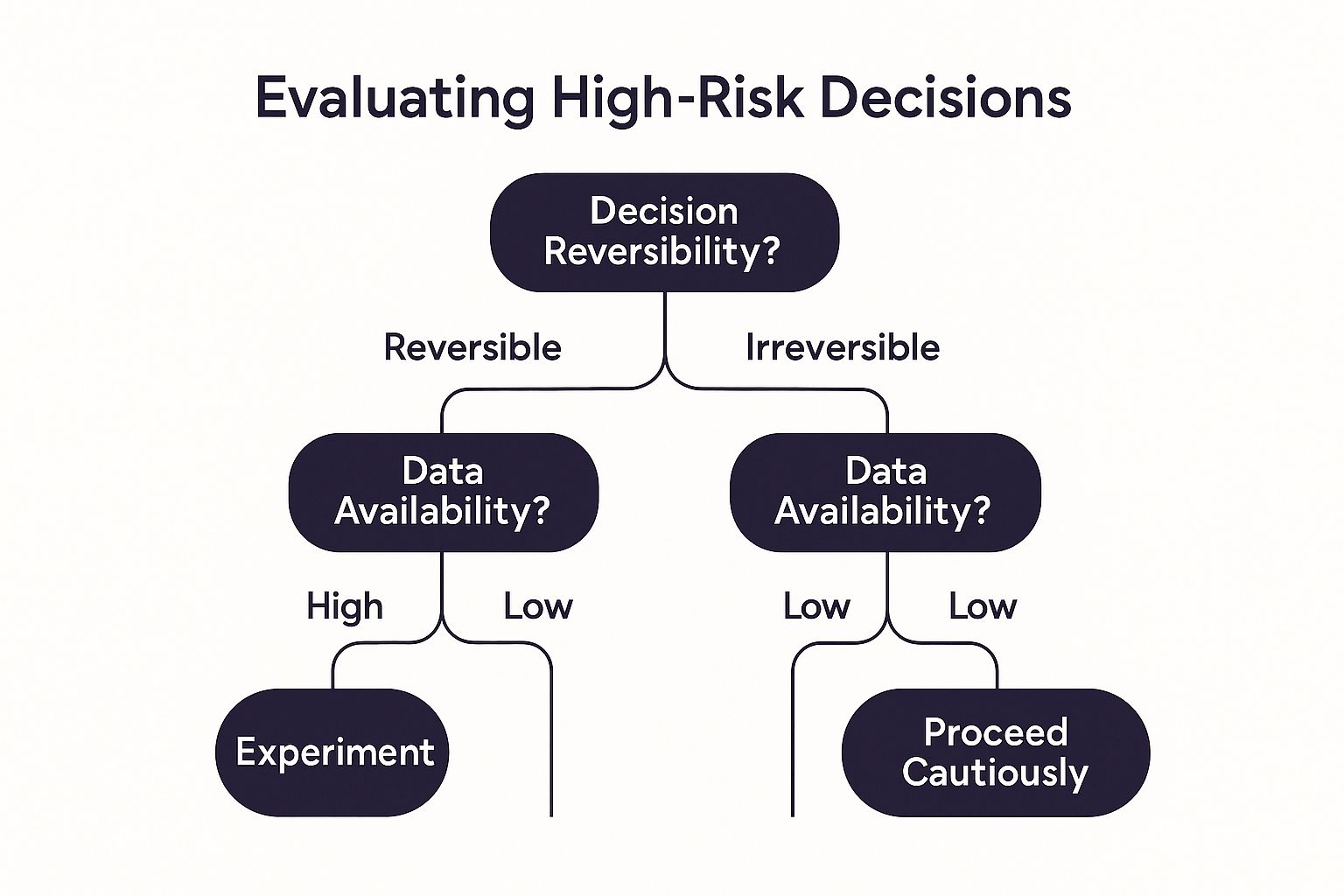
The infographic visualizes a simplified decision-making process for high-risk scenarios. It starts with identifying the problem and assessing the risk level.
This decision tree provides a visual representation of a typical high-risk decision-making process. It demonstrates how to assess the reversibility of a decision, a key concept popularized by Amazon’s Jeff Bezos. For reversible decisions, the focus is on speed and experimentation. For irreversible decisions, a more cautious approach involving data analysis, stakeholder consultation, and contingency planning is recommended. The infographic emphasizes the iterative nature of decision making, highlighting the importance of review and adjustment regardless of the initial outcome.
Asking this question offers several benefits: it reveals the executive’s decision-making philosophy and framework, explores their risk tolerance and management strategies, uncovers how they balance data with intuition, and shows their prioritization methodologies. This insight can help you, as a founder or hiring manager, understand how to present ideas effectively to this individual and align your communication with their preferred style. It also reveals the organizational values that guide their decisions, demonstrating your interest in their leadership challenges.
However, be aware of potential drawbacks. Some executives may offer theoretical processes rather than their actual practices, and some may be hesitant to fully disclose their decision criteria. Decision frameworks can also vary significantly depending on the specific situation.
Successful examples of robust decision-making frameworks include Jeff Bezos’ distinction between reversible and irreversible decisions at Amazon, which encourages calculated risk-taking. Warren Buffett’s value-investing approach at Berkshire Hathaway provides another example, emphasizing fundamental analysis and long-term vision. Indra Nooyi’s transformation of PepsiCo through purpose-driven decision-making demonstrates the power of values-based leadership. Learn more about How do you evaluate and make high-risk decisions?
To get the most out of this question, ask for a specific example of a recent difficult decision they faced, inquiring about both successful and unsuccessful past decisions. Frame your question as a desire to understand how to better support their decision-making processes, and ask how the process varies for different types of decisions. This demonstrates your genuine interest and provides a more practical understanding of their approach. This approach is particularly relevant in today’s fast-paced industries, including SaaS, FinTech, and HealthTech, where executives constantly face complex and high-stakes decisions. Understanding their decision-making process becomes even more critical in these dynamic environments.
6. What skills or capabilities does our organization need to develop or strengthen?
This question is crucial for any business leader, especially startup founders, entrepreneurs, and executives in fast-paced industries like SaaS, FinTech, and HealthTech, who need to ask executive management about their vision for future capabilities. It directly addresses the potential gaps in your organization’s skillset and resources that could hinder future success. By asking this question to ask executive management, you gain insights into how executives perceive the evolving demands of the market and what talent, technical proficiencies, or organizational competencies they believe are essential to execute the company’s strategy and maintain a competitive edge. This is a powerful question to ask executive management because it gets to the heart of how the company plans to adapt and thrive in the future.
This method works by prompting executives to think strategically about the future and articulate their vision for the organization’s development. It goes beyond simply identifying current strengths and weaknesses; it delves into the anticipated needs of the business and how it plans to equip its workforce for future challenges and opportunities. This proactive approach to talent assessment helps organizations stay ahead of the curve and maintain a competitive advantage in rapidly evolving markets.
Features and Benefits:
- Future-focused talent assessment: Instead of just focusing on current needs, this question helps identify skills and capabilities needed for future success.
- Identifies strategic capability gaps: It highlights areas where the organization needs to invest in training, development, or recruitment to achieve its strategic objectives.
- Reveals prioritization of organizational development: The response shows what capabilities are deemed most important by leadership, indicating where resources are likely to be allocated.
- Connects to business strategy and competitive advantage: Understanding the desired future capabilities reveals how leadership envisions the organization competing and winning in the marketplace.
Examples of Successful Implementation:
Several leading companies have demonstrated the importance of proactively developing organizational capabilities:
- Microsoft’s massive AI upskilling initiative: Recognizing the transformative potential of AI, Microsoft invested heavily in upskilling its workforce in artificial intelligence and machine learning across various departments, positioning itself as a leader in the field.
- Google’s leadership development program focusing on coaching capabilities: Google emphasized developing coaching skills within its leadership ranks to foster a culture of continuous learning and development, enhancing employee engagement and performance.
- IBM’s investments in quantum computing expertise: IBM has made significant investments in building expertise in quantum computing, a nascent but potentially disruptive technology, preparing itself for a future where quantum computing plays a major role.
Actionable Tips for Asking This Question to Ask Executive Management:
- Ask about both technical and adaptive capabilities: Explore both hard skills (e.g., coding, data analysis) and soft skills (e.g., collaboration, problem-solving).
- Inquire about planned investments in developing these capabilities: Understand how the organization plans to acquire or cultivate these skills (e.g., training programs, recruitment strategies).
- Connect to how these capabilities support strategic goals: Ask how the development of these capabilities directly contributes to the achievement of the organization’s overall strategic objectives.
- Follow up about how individuals can develop these needed skills: This demonstrates your personal commitment to growth and aligns your development with the organization’s future needs.
Pros:
- Provides insight into future organizational direction.
- Helps identify potential career development priorities.
- Shows leadership thinking about organizational evolution.
- Demonstrates strategic thinking about capabilities.
Cons:
- May receive generic answers about common business trends.
- Could create concern about skills becoming obsolete.
- Might not address immediate operational needs.
Learn more about What skills or capabilities does our organization need to develop or strengthen?
This question deserves its place on the list of questions to ask executive management because it is essential for understanding the long-term vision of the organization and how it plans to achieve its strategic goals. By understanding the prioritization of future capabilities, individuals and teams can better align their own development and contribute to the overall success of the organization. The insights gained from this question can be invaluable for both individuals seeking career advancement and organizations looking to stay competitive in a dynamic environment. This is particularly crucial for startups and businesses seeking cost-effective leadership, as it allows them to understand how potential executives envision building and developing a strong team. For those in SaaS, FinTech, HealthTech, and other rapidly evolving industries, understanding the executive team’s vision for future capabilities is paramount to navigating the challenges and opportunities that lie ahead. The theories popularizing this approach, including The Resource-Based View of strategy, Core competency theory (Prahalad and Hamel), and the Learning organization concept (Peter Senge), further underscore its importance in achieving sustainable competitive advantage.
7. How do you see our industry evolving in the next 3-5 years?
This question is crucial to ask executive management as it provides a window into their strategic foresight and understanding of the industry landscape. It’s a powerful tool for anyone looking to gain insights into a company’s potential trajectory and how leadership plans to navigate the future. This is a key question to ask executive management because it helps assess their strategic thinking and preparedness for future challenges and opportunities. It’s especially relevant for startup founders, SMBs, and companies in dynamic sectors like SaaS, FinTech, and HealthTech, where the landscape can shift dramatically in a short period.
This question explores executives’ perspectives on pivotal industry trends, potential disruptions, and the overall transformative forces at play. It reveals how leadership views market evolution, emerging opportunities, and, importantly, how the organization is positioning itself within this future landscape. Understanding this forward-looking perspective is critical when evaluating a company’s potential for success. For entrepreneurs and those involved in executive recruitment, this question helps gauge whether leadership is proactively anticipating change or reacting passively.
Features and Benefits:
- Forward-looking industry assessment: This question elicits insights beyond the current state of affairs, offering a glimpse into the executive’s vision for the future.
- Reveals executive perspective on market trends: It uncovers how leadership interprets current market signals and anticipates future developments.
- Explores potential disruptions and opportunities: This is where you can discern whether the executive is truly aware of potential threats and how they plan to capitalize on emerging opportunities.
- Connects to strategic positioning decisions: The answer to this question should ideally link back to the company’s strategic initiatives and overall direction.
Pros:
- Provides insight into future business direction: Understanding the executive’s vision for the industry helps you align your own goals with the company’s trajectory.
- Helps understand strategic rationale for current initiatives: This question can illuminate the reasoning behind current strategies and investments.
- Reveals leadership thinking about competitive positioning: Gain insights into how the executive views the competitive landscape and the company’s place within it.
- Demonstrates your strategic interest in industry dynamics: Asking this question signals your own forward-thinking approach and interest in the bigger picture.
Cons:
- Predictions may be speculative or self-serving: Be aware that future predictions are inherently uncertain, and responses may be influenced by the executive’s own biases or agendas.
- Could receive general trends rather than specific insights: Some executives may offer generic industry trends without providing concrete details about the company’s specific plans.
- Executives may withhold truly disruptive views for confidentiality: Sensitive information regarding disruptive innovations or strategic pivots might be kept confidential for competitive reasons.
Examples of Successful Implementation:
- Microsoft’s early recognition of cloud computing’s transformative potential: Their early investment in cloud technology allowed them to become a dominant player in the market.
- Netflix’s anticipation of streaming over physical media: Their foresight in recognizing the shift towards online streaming disrupted the traditional movie rental industry.
- Amazon’s foresight in the transformation of retail: Their early adoption of e-commerce and innovative logistics revolutionized the retail landscape.
Actionable Tips:
- Do industry research before asking this question: This allows you to have a baseline understanding of the industry and ask more informed follow-up questions.
- Ask about both obvious trends and potential unexpected shifts: Don’t just focus on the predictable; explore potential “black swan” events and how the company might respond.
- Inquire about how the organization is preparing for these changes: This demonstrates your interest in practical implementation and strategic planning.
- Follow up about specific initiatives connected to these trends: This helps connect the executive’s vision to concrete actions and plans.
Popularized By:
- Clayton Christensen’s disruption theory
- PESTEL analysis frameworks
- Industry futurists and analysts
By asking this question to executive management, you are not simply gathering information about industry trends; you are gaining valuable insights into the leadership’s strategic thinking, foresight, and ability to adapt to change. This information is invaluable for anyone evaluating a company’s potential for long-term success, especially in the fast-paced world of today’s dynamic industries. This question provides a crucial data point for informed decision-making, whether you’re a startup founder seeking executive talent, an investor evaluating a company, or an employee assessing career opportunities.
7 Key Executive Questions Comparison
| Question Title | Implementation Complexity 🔄 | Resource Requirements ⚡ | Expected Outcomes 📊 | Ideal Use Cases 💡 | Key Advantages ⭐ |
|---|---|---|---|---|---|
| What is our company’s long-term strategic vision? | Medium – requires strategic insight and foresight | Moderate – involves executive input and alignment | High – provides direction and prioritization | Strategic planning, alignment, vision setting | Aligns goals, reveals priorities, guides decisions |
| What are our biggest competitive threats and how are we addressing them? | Medium-High – involves market intelligence and analysis | Moderate-High – needs research and risk assessment | High – uncovers risks and tactical responses | Risk management, competitive strategy, market analysis | Reveals vulnerabilities, informs defensive/offensive actions |
| What metrics or KPIs do you personally track most closely? | Low – focused on information gathering | Low – mainly interviews and data access | Medium-High – clarifies performance focus | Performance management, alignment, operational insight | Reveals true priorities, aligns work with exec focus |
| What do you see as our biggest internal obstacle to success? | Medium – requires candid organizational assessment | Moderate – involves trust and openness | Medium – identifies internal bottlenecks | Organizational improvement, change management | Highlights challenges, fosters improvement mindset |
| How do you evaluate and make high-risk decisions? | High – explores complex cognitive and procedural aspects | Moderate – requires detailed executive examples | High – clarifies decision frameworks and risk tolerance | Decision-making training, risk evaluation | Reveals leadership style, guides communication |
| What skills or capabilities does our organization need to develop or strengthen? | Medium – strategic talent and capability assessment | Moderate – involves forecasting and development planning | Medium-High – identifies gaps and development areas | Talent management, capability building, future readiness | Focuses on growth, guides upskilling and investment |
| How do you see our industry evolving in the next 3-5 years? | Medium – requires research and trend analysis | Low-Moderate – based on executive insight | Medium-High – informs strategic positioning | Market forecasting, strategic adaptation | Reveals trends, anticipates disruption |
Drive Success with Strategic Dialogue
Asking the right questions to ask executive management is paramount for any organization striving for success. From understanding the long-term vision and competitive landscape to identifying internal obstacles and key performance indicators, the insights gleaned from these conversations are invaluable. This article has provided seven key questions to ask executive management, covering critical areas such as strategic planning, risk assessment, and industry foresight. Mastering these concepts and incorporating them into your communication strategy will not only enhance your understanding of the organization’s trajectory but also position you as a proactive and insightful contributor. By fostering open communication and seeking clarity from leadership, you can contribute meaningfully to the company’s overall success, whether you’re a startup founder, a small business owner, or part of a larger organization in SaaS, FinTech, HealthTech, or beyond. These questions to ask executive management can help bridge the gap between strategy and execution, empowering you to align your efforts with the overarching goals of the company and navigate the evolving business landscape.
Ready to augment your leadership team with experienced executives who can provide strategic guidance and mentorship? Shiny offers access to a network of seasoned professionals ready to help your organization thrive. Visit Shiny to learn more and explore how fractional executives can help you answer these critical questions and drive your company forward.