Mastering Process Improvement Steps for Your Business
If you’ve ever felt like your team is constantly putting out fires instead of making real progress, you’re not alone. The secret to breaking that cycle isn’t just working harder—it’s working smarter. This is where process improvement comes in, but not the stuffy, corporate version you might be thinking of.
It’s about taking a hard, honest look at how work actually gets done, finding the snags and bottlenecks, and then methodically smoothing them out.
What Process Improvement Really Means Today

Let’s cut through the jargon. Real process improvement isn’t about some massive, one-and-done project that turns the whole company upside down. For a startup, that’s a recipe for disaster.
Instead, think of it as a commitment to making small, deliberate tweaks that add up to big wins. The goal is simple: create more value for your customers with less wasted effort, time, and money. It’s about building a system for getting better, bit by bit, every single day.
The Modern Approach to Improvement
The most successful companies I’ve worked with treat process management as a core part of their business, not some side project for when they have “free time.” They know that every single workflow—from how you onboard a new customer to how you ship a new feature—is a chance to get a little bit better.
And this isn’t just a hunch; the data backs it up. A 2025 study found that 67.5% of organizations now have a solid handle on managing their business processes from start to finish. This shows that most companies are no longer just winging it; they’re being intentional about how they operate and are seeing the benefits.
To really nail this, you have to think about the core pillars holding up any good process improvement plan. I’ve broken them down into a simple table to give you a quick reference.
Core Pillars of Modern Process Improvement
| Pillar | Focus Area | Primary Goal |
|---|---|---|
| Culture | Team Mindset & Empowerment | Create an environment where everyone feels responsible for finding and fixing inefficiencies. |
| Technology | Tools & Automation | Use the right software to automate repetitive tasks and gain better visibility into workflows. |
| Data | Metrics & Measurement | Make decisions based on real numbers, not just gut feelings. Track progress and prove impact. |
| Methodology | Frameworks & Systems | Apply a structured approach (like Lean, Six Sigma, or a custom hybrid) to guide your efforts. |
Each of these pillars is crucial. A great culture with bad tools won’t get you far, and the best tech in the world is useless without the right data and a clear method for using it.
The real magic of process improvement happens when it becomes part of your culture. When every person on your team is empowered to call out a broken process and suggest a better way, your company becomes unstoppable.
This isn’t just about theory. We’re about to get into the practical, actionable steps to make this a reality in your startup. For an even deeper look at the strategies behind this, our comprehensive guide to business process improvement is a great next step.
This is a journey of small, consistent changes that build on each other, leading to massive, long-term success.
Identifying and Mapping Your Current Processes
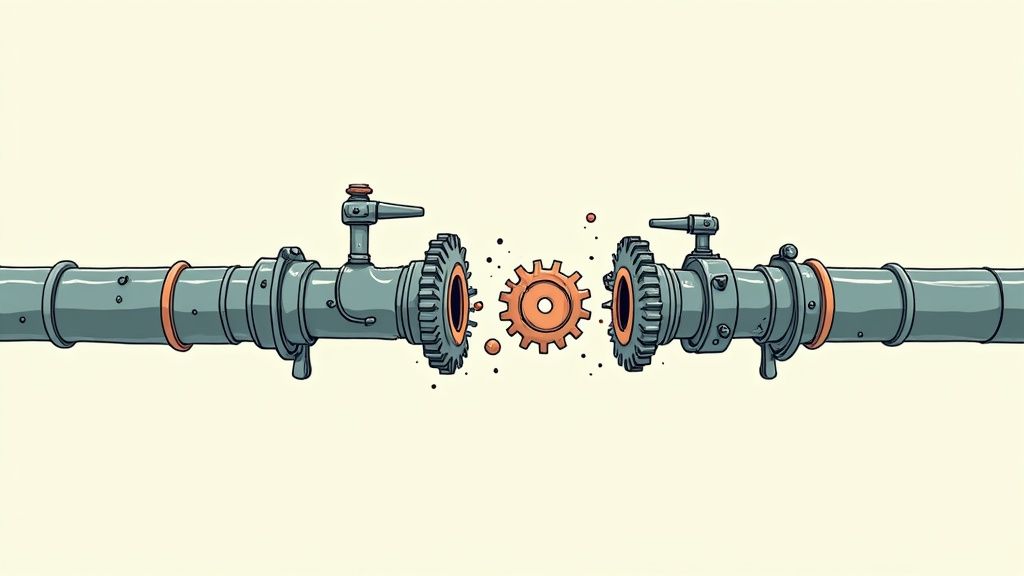
You can’t fix what you can’t see. It’s a simple truth, but it’s the absolute foundation of any real process improvement. Before you can dream up a better way of doing things, you first need a brutally honest picture of how work gets done right now. Not how the procedure manual says it should be done, but how it actually happens in the trenches.
This means you’ve got to roll up your sleeves. The goal here is to create a visual process map—think of it as a flowchart that tracks every single action, decision, and handoff in a specific workflow. This map becomes your anchor, your single source of truth for everything that follows.
First, pick your battle. Don’t try to boil the ocean by mapping every single process in your company. Start with one that’s a known headache, is critical for keeping customers happy, or directly ties to revenue. For most startups, the customer onboarding process is a perfect, and often painful, place to begin.
Conducting a Workflow Walkthrough
The only way to build an accurate map is by talking to the people who live and breathe the process every day. Your team on the ground knows about all the undocumented workarounds, frustrating delays, and communication black holes that leadership never hears about.
Set aside time to interview them. But don’t just ask them to describe their job. Ask them to show you, to walk you through a real example, step by painful step. As they explain, start documenting each action. Use a digital whiteboard tool like Miro or even just physical sticky notes on a wall.
To get the real story, guide the conversation with pointed questions:
- What kicks this whole thing off? (e.g., “A customer signs the contract and it lands in my inbox.”)
- Okay, what’s the very next thing you do? (e.g., “I have to manually create their account in our system.”)
- Who do you need to get info or an approval from? (e.g., “I have to wait for the sales rep to send me their setup form.”)
- What happens when things go sideways at this step? (e.g., “If the form is missing info, I have to email them and wait… and wait.”)
This is the detective work where you strike gold. You might find out, for instance, that your customer success team is burning 30% of their time just chasing down incomplete information from the sales team—a huge bottleneck that was completely invisible before.
The most enlightening moments in process mapping come from the “unofficial” steps. These are the workarounds and quick fixes your team has invented to overcome a broken system. They are bright, flashing signs pointing directly to your biggest opportunities for improvement.
By the time you’re done, you won’t have some theoretical diagram from a textbook. You’ll have a real-world snapshot of your operations, warts and all. This clear, visual evidence makes it impossible to ignore the problems and gives you the hard data you need to justify making a change. With this map in hand, you’re ready to dig in and start analyzing the workflow for its weaknesses.
Analyzing Workflows to Pinpoint Inefficiencies
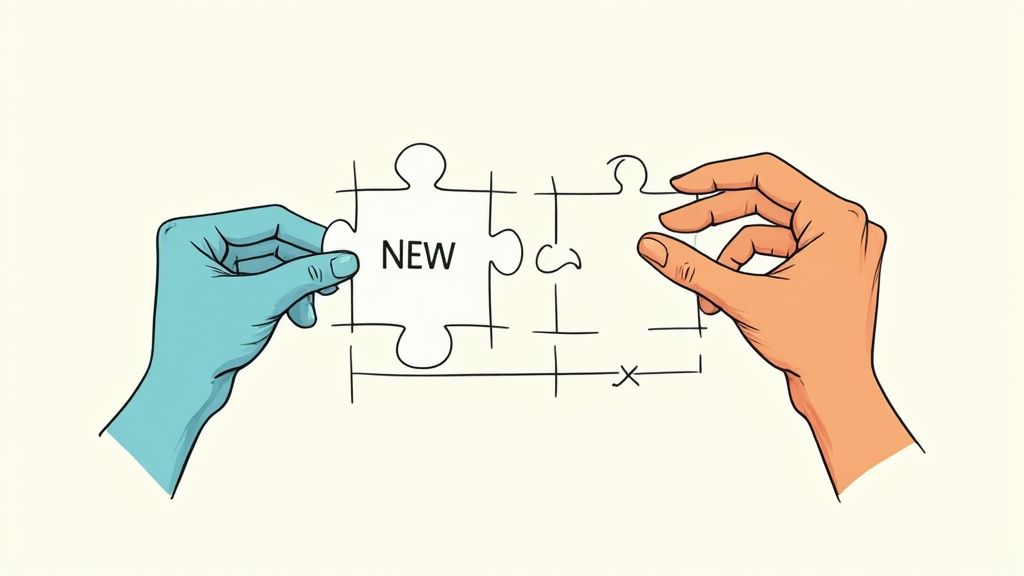
You’ve laid out your process map. That alone is a huge step—you’ve moved past assumptions and now have a clear picture of what’s really happening on the ground. But now, the real detective work begins. This is where you transform that visual map into a goldmine of actionable insights by finding its weakest links.
Think of your map not as a static drawing, but as a live feed of your operations. The goal is to spot the silent productivity killers: the bottlenecks where work piles up, the redundant tasks that burn precious hours, and the resource drains that slowly bleed your budget.
A great way to start is by looking at every step through your customer’s eyes. Would they be willing to pay for this specific activity? If the answer is no, you should immediately question why it exists. This simple filter is shockingly effective at exposing internal “busy work” that adds no real value.
Digging Deeper with Root Cause Analysis
Often, the problems you see on the surface are just symptoms of a much deeper issue. To create any kind of lasting change, you have to get to the root of the problem.
One of the simplest yet most powerful tools for this is the “Five Whys.” It’s a technique that Toyota pioneered, and it’s brilliant in its simplicity. You just keep asking “Why?” until you uncover the core of the issue.
Let’s say your analysis shows that customer reports are consistently delivered late.
- Why are the reports late? Because the data team is behind.
- Why is the data team behind? They’re waiting on corrected inputs from the sales team.
- Why are the sales inputs wrong so often? The CRM entry form is confusing to use.
- Why is the form confusing? It was designed without any input from the data team who actually uses the output.
- Why wasn’t the data team consulted? There was no formal process for cross-departmental tool development.
And there it is. What looked like a “data team problem” is actually a systemic breakdown in how you develop internal tools. Sure, you could patch the form, but fixing the development process prevents dozens of similar problems from ever popping up again.
The most impactful improvements come from fixing the cause, not the symptom. The Five Whys method pushes you beyond quick fixes to uncover the foundational breakdowns in your workflow.
Using Data to Expose Hidden Weaknesses
While a qualitative gut-check like the Five Whys is essential, hard data provides undeniable proof of where your biggest headaches are. Start by overlaying key metrics onto your process map:
- Cycle Time: How long does the entire process take, from start to finish? Where are the longest delays?
- Error Rate: How often do mistakes happen at a specific step? What’s the downstream cost of fixing those errors?
- Resource Utilization: Are certain people or tools completely overloaded while others are sitting idle? This is a classic sign of a bottleneck.
These numbers help you prioritize. An issue backed by data showing a 48-hour delay in your customer onboarding process will—and should—get far more attention than a vague, anecdotal complaint. This data-first approach is absolutely critical for making smart, defensible decisions with limited resources.
Today’s businesses also have to contend with a sprawling tech stack. In fact, large firms have dramatically increased their software reliance, with the number of apps used soaring by over 68% in just four years. Companies now juggle an average of 129 applications. Analyzing the friction and manual data transfers between these tools is a massive, often overlooked, opportunity for improvement.
Redesigning and Implementing Smarter Workflows

Analysis without action is just an academic exercise. Armed with insights from your process map and analysis, it’s time to roll up your sleeves and do the creative, rewarding work. This is where you architect a better way to operate, moving from simply finding problems to actively designing solutions. The goal isn’t perfection on the first try, but tangible, meaningful progress.
This redesign phase is one of the most critical process improvement steps. It’s where you collaboratively build a new, smarter workflow. A huge mistake I see founders make is trying to redesign a process in a closed-off meeting room. Instead, make it a team sport. Get the people who actually do the work into the brainstorming session. They live the day-to-day realities and will be the first to tell you why a “perfect” process on a whiteboard won’t work in the real world.
Getting them involved does more than just produce a better design; it creates ownership. When your team helps build the solution, they become its biggest champions, not its biggest critics.
From Small Tweaks to Big Changes
Your new design might be a simple adjustment or a major overhaul. Don’t underestimate the impact of small changes. Sometimes, the biggest wins come from just reordering a few tasks or finally clarifying who’s responsible for what during a handoff.
Most improvements will fall into a few key buckets:
- Simplification: Can you get rid of steps that add zero value from the customer’s perspective? This is classic Lean thinking—be ruthless about cutting out waste.
- Reordering: Does changing the sequence of tasks eliminate a common delay? For instance, can a parallel task kick off earlier instead of waiting for a previous step to be 100% finished?
- Automation: Is there a repetitive, manual task that software could handle? Think about automatically creating a new project in your project management tool the moment a deal is marked “won” in your CRM.
- Empowerment: Can you give your team more authority to make decisions on their own, removing approval bottlenecks? This not only makes things faster but also does wonders for morale.
Your best ideas won’t come from a consultant’s report. They’ll come from a collaborative session where you ask your team, “If we could start from scratch, how would we build this to make our lives easier and our customers happier?”
Running a Pilot Program
Once you have a redesigned workflow on paper, fight the urge to roll it out to the entire company at once. A full-scale launch is asking for trouble. This is where you execute one of the most crucial process improvement steps: run a pilot program.
Pick a small, controlled group—maybe one sales pod or a single customer success manager—to test the new process for a set period, like two weeks. This creates a safe space to fail and learn fast. You’ll quickly uncover unexpected issues and get real-world feedback without blowing up your entire operation.
This small-scale test gives you the data and the confidence you need for a successful, company-wide rollout.
Monitoring Performance and Building a Culture of Improvement
Launching a new workflow is a huge win, but it’s definitely not the finish line. The most important part of any process improvement effort is what happens after the launch. This is where you shift from a one-off project to creating a self-sustaining cycle of growth, measuring what works, and embedding improvement into your company’s DNA.
The changes you’ve worked so hard to implement need a scoreboard. This means picking just a handful of meaningful Key Performance Indicators (KPIs) that show you whether the new process is actually working. Don’t overdo it. If you just redesigned your customer onboarding, your KPIs might be as straightforward as Time to Onboard and Customer Satisfaction Score for the first 30 days.
These numbers aren’t just for the leadership team; they need to be front and center for everyone. A simple, shared dashboard is a great way to keep the team aligned and show them the direct result of their efforts. When people see the metrics moving in the right direction, it creates incredible momentum.
Creating a Powerful Feedback Loop
Data is pretty useless if you don’t do anything with it. To make monitoring an active part of your operations, you have to build a regular rhythm for review. This doesn’t mean you need to schedule another stuffy, hour-long meeting. A quick, 15-minute huddle every Friday to go over the week’s KPIs can be surprisingly effective.
This consistent check-in is what builds a real feedback loop. When the team sees a KPI dip, it’s not a moment for finger-pointing. Instead, it’s a trigger for a constructive conversation: “What was different this week? What can we try next week to get back on track?” This simple routine changes the team’s perspective from just doing tasks to actively owning the outcome.
A process is never truly “done.” The goal is to create a culture where your team isn’t just following the map you gave them—they’re actively looking for ways to draw a better one. This is the heart of sustainable improvement.
Fostering an Improvement Culture
Ultimately, you want to get away from thinking of improvement as a top-down project. It needs to become a shared habit—a cultural standard where every single person on the team feels empowered to speak up, point out problems, and try new things. Real progress happens when the person actually doing the work feels safe enough to say, “Hey, I think there’s a better way to do this.”
Here are a few practical ways to build this kind of environment:
- Celebrate Small Wins: When a team member’s suggestion leads to a positive change, acknowledge it publicly. It doesn’t matter how small the win is; you’re reinforcing the exact behavior you want to see more of.
- Decouple Ideas from Outcomes: Create a space where people can toss out ideas without the pressure of them being perfect. Not every experiment is going to be a home run, and that’s perfectly fine. The learning itself is the real win.
- Lead with Questions: As a leader, your job isn’t always to have the answers. Instead, ask probing questions like, “What’s the most frustrating part of your week?” or “If you had a magic wand, what’s the one thing you’d fix in our workflow?”
This cultural shift is what makes progress stick. Building this kind of environment is a fundamental part of how you can improve operational efficiency across your entire startup. It turns process improvement from an occasional project into the way your company works, day in and day out.
You’ve mapped the workflows, analyzed the bottlenecks, and designed a brilliant new process. You’ve done the hard part, right?
Not quite.
Even the most perfectly engineered plan can completely fall apart during implementation. And it’s almost never because the idea was bad or the process map was wrong. It’s because of people.
Let’s be honest: change is disruptive, even when it’s for the better. If you don’t have a strategy to manage the human side of the equation, your shiny new process is on shaky ground from day one. You have to get ahead of this, or your hard work will be for nothing.
Why Most Change Initiatives Fizzle Out
The data on this is pretty sobering. Research from McKinsey and Company found that a staggering 70% of complex, large-scale change programs fail to hit their targets. The cause isn’t faulty analysis or a bad strategy. It’s almost always a breakdown in execution—momentum fades, the team disengages, and the old habits creep back in. Y
So, how do you make sure your plan is in the successful 30%? It starts at the top.
It All Starts with Leadership and Clear Communication
One of the fastest ways to kill a new process is for leadership to lose interest. Team members are always watching for cues. If a founder or a part-time exec is all-in on day one but seems to forget about it by day seven, it sends a crystal clear message: this isn’t a real priority.
This is especially true in a startup, where every person’s contribution feels magnified. Your team needs to understand the why behind the change, not just the how.
The moment a process improvement feels like a top-down mandate instead of a shared mission, you’ve already started to lose the battle for buy-in. Real success is built on transparency and collective ownership.
Leaders need to be the chief evangelists for the new way of doing things. You have to constantly communicate the benefits—not just for the company’s metrics, but for the team members themselves. Frame it around their experience. Explain how this change will reduce their frustration, eliminate mind-numbing tasks, and free them up to do more impactful work.
Get Ahead of Resistance and Keep the Momentum Going
Expecting your team to resist a new process isn’t cynical; it’s realistic. It’s a natural human reaction, not a sign of a bad team. So instead of being caught off guard by it, plan for it.
- Anticipate the Friction: Pinpoint exactly where the new process will cause the biggest disruption to someone’s daily routine. That’s where you need to provide extra training, support, and patience.
- Engineer an Early Win: Don’t try to boil the ocean. Structure your rollout to deliver a small, tangible victory as quickly as possible. This builds immediate confidence and quiets the early skeptics.
- Find Your Champions: Identify the people on your team who are genuinely excited about the new process. Empower them to be peer coaches and advocates. Their enthusiasm will be far more contagious than any memo from management.
Keeping the momentum alive is just as crucial. In a startup, it’s easy for big projects to get shoved aside by the daily fire drills. This is where part-time executive talent can be a game-changer. For example, a fractional CFO can ensure new financial reporting processes are actually adopted and used correctly, providing that steady hand of oversight without the full-time cost. A fractional CFO for startups is uniquely positioned to drive these kinds of initiatives, keeping strategic projects on track.
By understanding where improvement plans typically go wrong, you can build a more resilient, human-centric approach from the very beginning.
Your Top Process Improvement Questions, Answered
When you start digging into process improvement, a lot of practical questions bubble up. It’s one thing to read about theories, but another to actually apply them. Let’s tackle a couple of the most common questions I hear from founders and team leads.
What’s the Easiest Way to Get Started?
If your team is brand new to this, my go-to recommendation is always Kaizen. It’s a Japanese philosophy centered on making small, continuous improvements rather than one giant, disruptive overhaul. Forget massive projects for a minute.
The whole idea is to get everyone, at every level, thinking about tiny ways to make their own work better. It builds momentum and creates a culture where improvement is a daily habit, not a once-a-year event. Instead of complex charts and Six Sigma belts, it starts with a simple question: “How can we make this just 1% better today?”
How Do You Know If It’s Actually Working?
You have to measure it. Success in process improvement can’t be a gut feeling; it needs to be tangible. That means tracking specific Key Performance Indicators (KPIs) that are directly linked to the process you just tweaked.
Let’s say you just overhauled your customer support ticket workflow. You wouldn’t just say, “It feels faster.” You’d look at the hard data.
- Average First Response Time: How long does a customer wait for that first reply?
- Ticket Resolution Time: What’s the total time from when a ticket is opened until it’s fully resolved?
- Customer Satisfaction Score (CSAT): Are customers actually happier with the support they’re getting?
The best process improvements are always tied to measurable results. If you can’t measure the impact, you can’t prove its value, and you won’t know whether to double down or try something else.
By tracking these numbers before and after you make a change, you get undeniable proof of what’s working. This data-driven approach is your best friend when it comes to getting buy-in for future improvements.
Are you a startup founder ready to implement these kinds of process improvements but don’t have the executive leadership to drive it? Shiny connects you with a marketplace of over 650 vetted, part-time executives who can supercharge your growth for 5 to 25 hours a week. Find the perfect fractional leader to scale your operations at https://useshiny.com.