
What is Executive Leadership? Key Traits & Strategies
When people hear the term “executive leadership,” they often picture a corner office and a fancy C-suite title. But that’s missing the forest for the trees. True executive leadership is a function, not just a position. It’s the art and science of steering an entire organization toward a future that doesn’t exist yet.
This role is about crafting a long-term vision, building a resilient company culture, and making the high-stakes strategic calls that ultimately determine a company’s path to success or failure.
What Is Executive Leadership Really About?

It’s easy to mistake executive leadership for simply being “the boss.” But the reality is far more complex and demanding. Think of an executive leader as the chief architect of a massive skyscraper. They don’t lay every brick or hammer every nail—that’s what their specialized teams are for.
Instead, the architect creates the master blueprint (the company’s vision), ensures the foundation is rock-solid (the organizational culture), and expertly coordinates every team to build something that is both magnificent and built to last. Their focus isn’t on the day-to-day grind; it’s on the final structure and its permanent place on the city skyline.
More Than Just a Title
This distinction is absolutely critical. While a C-suite title often comes with the job, executive leadership is defined by its function—the accountability for the organization’s overall direction and health. This function is so vital that companies invest staggering amounts to get it right.
The global leadership development market is valued at a whopping $366 billion, with a huge chunk of that spent right here in the U.S. But here’s the kicker: despite that massive investment, 77% of organizations still say they have a critical lack of leadership depth.
This isn’t just a soft problem; it has hard consequences. Companies that get it right and invest in developing their leaders see 25% better business performance than their peers. If you’re curious, you can dig into more eye-opening leadership statistics that underscore just how much strong leaders matter.
The core of executive leadership isn’t about managing people or processes. It’s about inspiring belief in a shared future and making the tough, strategic bets required to get there.
To truly understand executive leadership, it helps to break it down into its core components. These four pillars provide a clear framework for grasping the immense scope and responsibility of the role.
The Four Pillars of Executive Leadership
This table breaks down the core components that define the role and responsibilities of an executive leader.
| Pillar | Description | Key Outcome |
|---|---|---|
| Strategic Vision | The ability to define a clear, compelling, and ambitious long-term direction for the entire organization. | A unified company direction that guides all decisions and actions. |
| Organizational Alignment | The skill of uniting all departments, teams, and stakeholders around the strategic vision and core objectives. | A cohesive workforce moving in the same direction, minimizing internal friction. |
| Cultural Stewardship | The responsibility for intentionally shaping the values, behaviors, and norms that define the workplace environment. | A resilient and high-performing culture that attracts and retains top talent. |
| Decisive Execution | The capacity to make high-stakes decisions with conviction and drive the execution of key strategic initiatives. | Tangible progress toward long-term goals and market leadership. |
Ultimately, these pillars work together to create the engine of sustainable growth and innovation. Executive leadership is the force that turns a simple idea into a thriving enterprise, navigates the choppy waters of uncertainty, and builds a legacy that outlasts any single person.
The Unspoken Qualities of Great Executive Leaders

Sure, strategy and vision are the table stakes for executive leadership. But what separates the good from the truly legendary? It comes down to a set of qualities you’ll never find on a resume—subtle, practiced behaviors that are more about character than credentials.
These aren’t buzzwords; they’re the real engine of impact. It’s about moving past the job description and into the messy, human world of courage, connection, and gut instinct. Getting these right is how an executive inspires unwavering loyalty, sparks genuine innovation, and builds a company that can weather any storm.
The Power of Radical Accountability
One of the most powerful—and rarest—qualities is radical accountability. This goes way beyond just admitting your own mistakes. It means publicly taking ownership of the entire organization’s failures.
Picture this: a major product launch bombs, costing the company millions. An average leader might point to market conditions or throw a department under the bus. An executive practicing radical accountability steps up and says, “This happened on my watch. The buck stops with me. Here’s what I got wrong, and here’s our plan to learn from it together.”
This single act changes everything. It doesn’t create a culture of fear; it builds psychological safety. It sends a clear signal that failure is a stepping stone to innovation, not a career-killer. This approach fosters far more resilience than a perfect, risk-free track record ever could.
Decisiveness in Ambiguity
Executives almost never get to make decisions with all the facts. They live in a fog of ambiguity, with shifting markets, surprise competitors, and new technology making a clear path hard to see. A critical, unspoken quality is the ability to make high-stakes decisions with conviction, even when the data is incomplete.
Think of a CEO deciding to pivot the company into a totally new market. The data might be murky, and the experts on the team might be split.
A great executive leader synthesizes the available information, listens to their intuition honed by experience, and makes a clear, decisive call. They understand that indecision is often more damaging than a wrong decision that can be corrected later.
This isn’t about being a reckless gambler. It’s a calculated leap of faith, grounded in foresight and a healthy acceptance of risk. This decisiveness provides clarity and momentum, freeing up the entire organization to move forward with purpose instead of being stuck in limbo.
Deep-Seated Curiosity
The most effective leaders I’ve ever worked with are endlessly curious. They don’t walk into a room assuming they have all the answers. Instead, they’re constantly asking questions, challenging the “way we’ve always done it,” and trying to see the world through someone else’s eyes.
This isn’t a passive trait; it’s an active pursuit. You’ll see a truly curious leader:
- Spending time with frontline employees, not just their direct reports, to get an unfiltered view of the customer experience.
- Reading voraciously on topics completely outside their own industry to find unexpected connections and spot trends early.
- Fostering a “questioning culture” where people are encouraged and even rewarded for challenging the status quo.
This insatiable appetite for learning is what keeps an organization from going stale. It’s how a company spots opportunities its competitors miss and pivots before a disruption becomes a crisis. These unspoken qualities—accountability, decisiveness, and curiosity—are anything but soft skills. They are the active, powerful behaviors that form the very foundation of exceptional executive leadership.
Leadership vs. Management: The Critical Distinction
In the business world, “leader” and “manager” get tossed around like they’re the same thing. They’re not. And while you absolutely need both for a healthy company, confusing the two can kill innovation and stop you from understanding what executive leadership is really about.
The difference is simple, but it’s profound.
Think of it like this: Management is about making sure the train runs perfectly—on time, on the right tracks, with maximum efficiency. Leadership is about deciding if those tracks are even heading to the right destination in the first place.
A manager’s job is to perfect the current system. A leader’s job is to build a better one.
Different Focus, Different Goals
The core difference between leadership and management really boils down to what they focus on. Management is all about handling complexity and creating stability. Leadership is about navigating change and creating opportunity.
A manager’s world revolves around execution. They live and breathe tasks, processes, timelines, and budgets. They ask how and when. Their goal is to get things done right, reliably and predictably. They work within the system to make it better.
A leader’s world revolves around vision. They’re focused on direction, inspiration, and purpose. They ask what and why. Their goal is to do the right things. They challenge the system and ask, “What if we could build something entirely new here?”
A Tale of Two Scenarios
Let’s say a software company is seeing a drop in customer renewals.
The manager’s approach is to diagnose and fix the current process. They’d probably:
- Analyze support tickets to spot common complaints.
- Retrain the customer success team on retention scripts.
- Roll out a new ticketing system to speed up response times.
- Set new KPIs for the team to track progress.
These are all good, necessary actions. The manager is focused on operational excellence—keeping the train on the tracks.
The leader’s approach, on the other hand, is to question the underlying assumptions. They ask bigger, more uncomfortable questions:
- Have our customers’ core problems changed?
- Is a competitor solving that problem in a fundamentally better way?
- Should we be in a different market altogether?
- Does our product’s core value still hold up?
The leader is looking at the horizon, not just the tracks directly ahead. They are focused on strategic direction. You need both, but only one is true executive leadership.
“Management is efficiency in climbing the ladder of success; leadership determines whether the ladder is leaning against the right wall.” – Stephen Covey
This quote just nails it. A company full of brilliant managers but zero leadership will climb the wrong ladder with incredible efficiency, executing a flawed strategy with perfect precision.
Executive Leadership vs. Management at a Glance
To really hammer home the difference, let’s look at their core functions side-by-side. While a single person can definitely have skills in both camps, their primary role dictates where they put their energy.
| Attribute | Executive Leadership | Management |
|---|---|---|
| Primary Goal | To inspire change and create a new future. | To maintain order and deliver predictable results. |
| Core Focus | On people, vision, and long-term direction. | On systems, processes, and short-term objectives. |
| Method | Empowers and influences through inspiration. | Controls and directs through authority. |
| Approach to Risk | Embraces calculated risks for greater rewards. | Mitigates and avoids risk to ensure stability. |
| Orientation | Future-focused; asks “where are we going?” | Present-focused; asks “how do we get today’s job done?” |
| Outcome | Growth, innovation, and transformation. | Efficiency, stability, and scalability. |
Getting this distinction right is the first real step toward developing your own executive leadership potential. It clarifies that the goal isn’t just about getting better at managing tasks, but about getting much, much better at defining the future.
How Executive Leadership Shapes Company Culture

Let’s get one thing straight: company culture isn’t a mission statement hanging on a wall or a list of values in a handbook. It’s the real-time, living environment that people experience every single day. And it flows directly from the top.
Think of it like this: culture is the shadow cast by leadership. The way an executive reacts to bad news, celebrates a big win, or handles an honest mistake sets the tone for the entire organization. If a leader punishes failure, you get a culture of fear. If they reward shortcuts, you get a culture of mediocrity.
There’s a simple, powerful principle at play here: what leaders permit, they promote. Every action—and every inaction—sends a clear signal about what truly matters.
Building Culture Through Action
Great leaders know that culture isn’t an accident; it’s an asset you build with intention. It’s about deliberately creating an environment where people feel safe, respected, and driven to contribute their best work. True cultural architects don’t just talk about values—they build them into the company’s operating system.
They focus on a few key pillars:
- Psychological Safety: Creating a space where your team feels safe enough to speak up, ask tough questions, and even admit mistakes without getting thrown under the bus. This is the absolute bedrock of innovation.
- Radical Transparency: Being open and honest about the company’s challenges, not just the wins. This builds incredible trust and gives everyone a sense of shared ownership in the journey.
- Consistent Accountability: Holding everyone to the same high standard, especially senior leaders. When accountability is consistent, it kills hypocrisy and reinforces a sense of fairness.
When leaders model these behaviors day in and day out, they’re providing a clear blueprint for everyone else to follow. This is one of the most critical parts of understanding what is executive leadership—it’s being the chief architect of the human side of the business. For a deeper look, check out our guide on how to build a strong company culture from the ground up.
Culture is the most powerful tool an executive has. It’s the invisible force that governs how people behave when no one is watching, shaping everything from employee retention to a company’s ability to innovate.
The Trust and Engagement Connection
The link between a leader’s behavior and their team’s engagement is crystal clear. The modern workplace demands more than just traditional management; it requires empathy and inclusion. The data tells a compelling story: while only 15% of employees report feeling engaged at work, those who trust their leaders are a staggering 14 times more likely to be highly engaged.
Despite this, trust in managers has been on a downward slide, pointing to a major leadership gap across industries. You can find more eye-opening leadership stats and what they mean over at elearningindustry.com.
This proves that culture isn’t just some “soft” metric. It has a direct, measurable impact on performance, morale, and ultimately, the bottom line. Executives who neglect their role as the primary shapers of culture aren’t just letting down their teams—they’re failing the business itself.
Navigating Today’s Executive Challenges
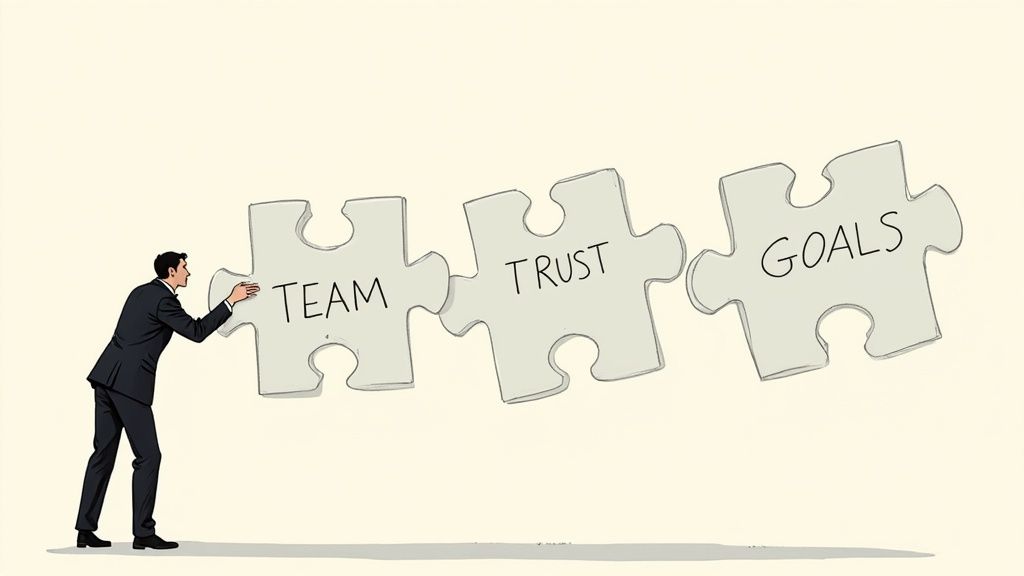
The job of an executive has been completely turned on its head. Gone are the days of predictable quarterly targets and stable markets. Today’s business environment is a whirlwind of constant change.
Leaders aren’t just steering a steady ship anymore; they’re navigating a perfect storm of technological, economic, and social upheaval. This new reality demands a different breed of leadership—one that’s far more agile, resilient, and forward-thinking. These challenges aren’t just hurdles; they are the defining tests of modern executive leadership.
The New Battlefield of Business
The pressures facing today’s executives are coming from every direction, hitting every part of the organization. A recent global survey paints a clear picture of this complexity, pointing to critical challenges like geopolitical instability, rising inflation, and the relentless pace of digital transformation.
On top of all that, leaders are also fighting a global talent war while trying to champion sustainability and push DEI initiatives forward.
These aren’t separate problems you can tackle one by one. They’re all tangled together, creating a high-stakes game where the old rules just don’t work. A decision to adopt a new AI platform, for instance, is a financial, operational, and cultural decision all at once.
The true test of executive leadership today isn’t just about putting out fires. It’s about building an organization that can thrive in the middle of constant chaos and turn disruption into a real competitive edge.
Leading Through Digital and Economic Turbulence
Two of the biggest waves crashing down on executives are rapid digital evolution and economic volatility. Digital transformation isn’t a one-and-done project anymore; it’s a constant state of being. Leaders have to figure out how to integrate everything from cloud infrastructure to artificial intelligence, not just to be more efficient, but to completely reinvent how they do business.
This means making huge financial bets with no guarantee of a payoff. A leader has to decide whether to pour millions into an unproven technology or risk getting steamrolled by nimbler competitors. Meanwhile, economic headwinds like inflation, shaky supply chains, and unpredictable consumer spending add another layer of chaos to the mix.
An executive has to balance the long-term vision of a digital future with the immediate need to protect profit margins and keep the lights on. This is where real strategic foresight becomes absolutely critical.
The Human-Centered Challenges
Beyond the tech and the financials, the toughest challenges are often deeply human. The global fight for top talent is more intense than ever. Executives aren’t just competing on salary anymore; they’re competing on culture, purpose, and flexibility. Building an organization that can attract and—more importantly—keep the best people is a massive priority.
At the same time, there’s a huge push for leaders to build a more equitable and sustainable future. This means a few key things:
- Embedding DEI: Diversity, Equity, and Inclusion can’t just be an HR initiative tucked away in a corner. It needs to be a core part of the business strategy, creating an environment where every single voice is heard and valued.
- Championing Sustainability: Leaders need to weave Environmental, Social, and Governance (ESG) principles into every decision they make. This isn’t just about checking a box for compliance; it’s about building a brand that customers and employees are genuinely proud to stand behind.
These human-centered challenges require a ton of emotional intelligence and a strong moral compass. They demand that leaders build companies that are not only profitable but also responsible and inclusive. Successfully navigating these issues is what separates good leaders from truly exceptional executive leadership in today’s world.
Developing Your Executive Leadership Potential
One of the biggest myths in business is that leaders are simply born. We all know someone who seems to have that natural charisma, but the truth is, exceptional executive leadership is almost always the product of intentional, focused development. It’s a skill that’s built, not a trait you’re just born with.
The data backs this up. Research shows that while only about 10% of people might be “natural” leaders, another 20% have the core traits to become great leaders if they’re given the right training and opportunities. The real question isn’t whether you have a born leader on your team, but whether you’re willing to invest in creating one.
Building a Strong Leadership Pipeline
For any company, growing talent from within is more than just a feel-good strategy—it’s a massive competitive advantage. When you promote from your own ranks, you build a leadership team that is more stable, deeply knowledgeable about the business, and far more committed to its success.
Trying to hire from the outside is often a gamble. In fact, external leaders are 61% more likely to fail within their first 18 months compared to those promoted internally. That’s a staggering number, and it points to a clear business reality: betting on your own people is almost always the smarter move.
Developing leaders isn’t just an HR function; it’s a core strategic priority. A company that fails to build its next generation of leaders is actively planning for its own obsolescence.
So, how do you actually unlock this potential? The most successful companies don’t leave it to chance. They use a combination of proven methods to mold high-potential individuals into the strategic thinkers and inspiring executives they need to be.
Proven Methods for Cultivating Leaders
There’s no single magic bullet for creating a great leader. The best approach is always multifaceted, giving people a mix of hands-on experience, trusted guidance, and targeted coaching. Here are three of the most effective methods:
- Strategic Job Rotations: Moving a promising team member through different departments does more than teach them new tasks. It forces them to see the entire organization from multiple viewpoints, which breaks down silos and builds a truly holistic understanding of how the business actually works.
- Structured Mentorship Programs: There’s no substitute for experience. Pairing an aspiring leader with a seasoned executive provides invaluable, real-world guidance. A great mentor can offer candid feedback, help navigate tricky political landscapes, and share wisdom that can only come from years in the trenches.
- Executive Coaching: A professional coach gives a leader a confidential, objective space to work through their toughest challenges. This could mean anything from honing their communication style and improving strategic decision-making to building greater emotional intelligence.
These strategies create well-rounded leaders who are genuinely prepared for the complexities of an executive role. For growing businesses that need this level of guidance but can’t yet swing the budget for a full-time executive, exploring a fractional model can be a game-changer. Our guide on the meaning of a fractional CFO breaks down how this flexible approach can bring top-tier strategic thinking into your organization when you need it most.
Common Questions About Executive Leadership
Even after getting the big picture, a few practical questions always pop up when you start thinking about executive leadership in the real world. Let’s tackle some of the most common ones to bridge the gap between theory and what actually happens day-to-day.
Answering these helps drive home the point that executive leadership isn’t just a static title. It’s a dynamic role, defined by strategic influence and the ultimate accountability for where a business is headed.
Can You Be an Executive Leader Without a C-Suite Title?
Absolutely. Executive leadership is all about the scope of your responsibility, not the title printed on your business card. Anyone setting long-term strategy, rallying a team toward that vision, and owning the results for a major part of the business is acting as an executive leader.
Think about a General Manager for a key division or a Director overseeing a large, critical department. They often fit this description perfectly. The real test is the strategic nature of your influence and decisions.
The most common mistake new executive leaders make is failing to shift from “doing” to “leading.” They get trapped in the operational weeds instead of focusing on the big picture: setting vision, aligning stakeholders, and developing their teams.
True executive leadership means letting go of the need to control daily tasks. Instead, you gain influence over the company’s long-term trajectory and strategic wins.
How Has AI Changed the Executive Role?
Artificial intelligence has completely flipped the script for executives. The job is no longer about being the source of all the answers; it’s about being the source of the right questions. With AI handling complex data analysis and automating routine work, leaders are finally free to focus on the skills that are uniquely human.
And those skills are more critical now than ever:
- Strategic Foresight: Using AI-powered insights to get ahead of market shifts and spot brand-new opportunities.
- Ethical Oversight: Making sure AI is used responsibly and in a way that reflects the company’s core values.
- Fostering Innovation: Building a culture where people feel safe to experiment and play with new technologies.
- Building Culture: Strengthening the human connections and relationships that AI simply can’t replicate.
Today’s executive needs to be data-literate enough to guide an AI strategy, but also emotionally intelligent enough to lead the people who will actually bring it to life. This mix of technical and human insight is crucial for hiring top talent—you can see how these skills are assessed in these interview questions for a Chief Operating Officer.
Finding the right executive talent is one of the biggest challenges for growing companies. Shiny connects you with a marketplace of over 650 vetted, experienced executives ready to provide part-time strategic leadership for 5 to 25 hours a week. Get the guidance you need without the full-time cost at https://useshiny.com.